
Key takeaways
- Operation NightShift connects enterprise middleware intrusion (Oracle E-Business Suite, Zimbra, and Windows/IIS) with staged off-hours Monero mining and search-bot SEO cloaking.
- Across four primary ports on 38.60.227[.]210 (plus a fifth mirror port), Odin by Brandefense observed 1,580 entries and 895 unique SHA-256 digests through 20 November 2026.
- Withheld output stores confirm activity in at least three environments: 505 Windows/IIS command outputs, 22 Oracle EBS DB-link job outputs, and 4 education DB outputs.
- An active receiver on TCP 8093 logged 382 entries between 6 and 20 November 2026, capturing seven-part ~1 MB dumps plus key, status, and agent callbacks.
- Audit Oracle database links, enforce Defender Tamper Protection, hunt Linux memfd loaders with inhibit.lock, and block 38.60.227[.]210, 38.60.252[.]110, and 38.54.14[.]162.
Operation NightShift links Oracle E-Business Suite (EBS), Zimbra, and Windows IIS intrusions with off-hours Monero mining and search-bot SEO spam scripts. Odin by Brandefense analyzed the multi-port workbench on 38.60.227[.]210 during a two-week observation window ending 20 November 2026. Most teams expect ERP database or IIS intrusions to end in noisy ransomware.
Returned outputs and receiver logs show database activity and transferred data. Separate staged scripts describe memory-only persistence, off-hours mining, and search-spam cloaking.
How does Operation NightShift expand Monograph 03 and public reporting?
Monograph 03 examined an initial four-day snapshot of 38.60.227[.]210 from 13 to 16 November 2026. That snapshot held 1,824 raw rows across five HTTP ports, including 645 mirrored entries on TCP 9002. Removing the mirror and eight cross-port overlaps left 1,171 unique paths.
Tracking the four primary non-mirrored ports (8000, 8082, 8083, and 8093) through 20 November 2026 revealed 1,580 entries and 1,561 unique paths. Those entries map to 895 unique SHA-256 digests. Within that total, 1,090 sized files measure 602.61 MB (602,605,284 bytes), while 490 entries omit byte size.
Etugen Research linked 38.60.227[.]210 to post-exploitation behind Ivanti flaw CVE-2026-104935 on 3 November 2026. The flaw has a CVSS score of 8.6; the cited patch guidance is a branch-compatible release addressing the related chain: 25.1.1.3, 25.1.3.0+, or 22.8R2.6+. Etugen separated this operator from UTA0576.
None of our 1,580 directory entries holds Ivanti exploit code. Instead, the server delivers second-stage persistence and lateral-movement tools after initial access. Pairing external attack surface management with cyber threat intelligence helps teams connect perimeter flaws to internal middleware risk.
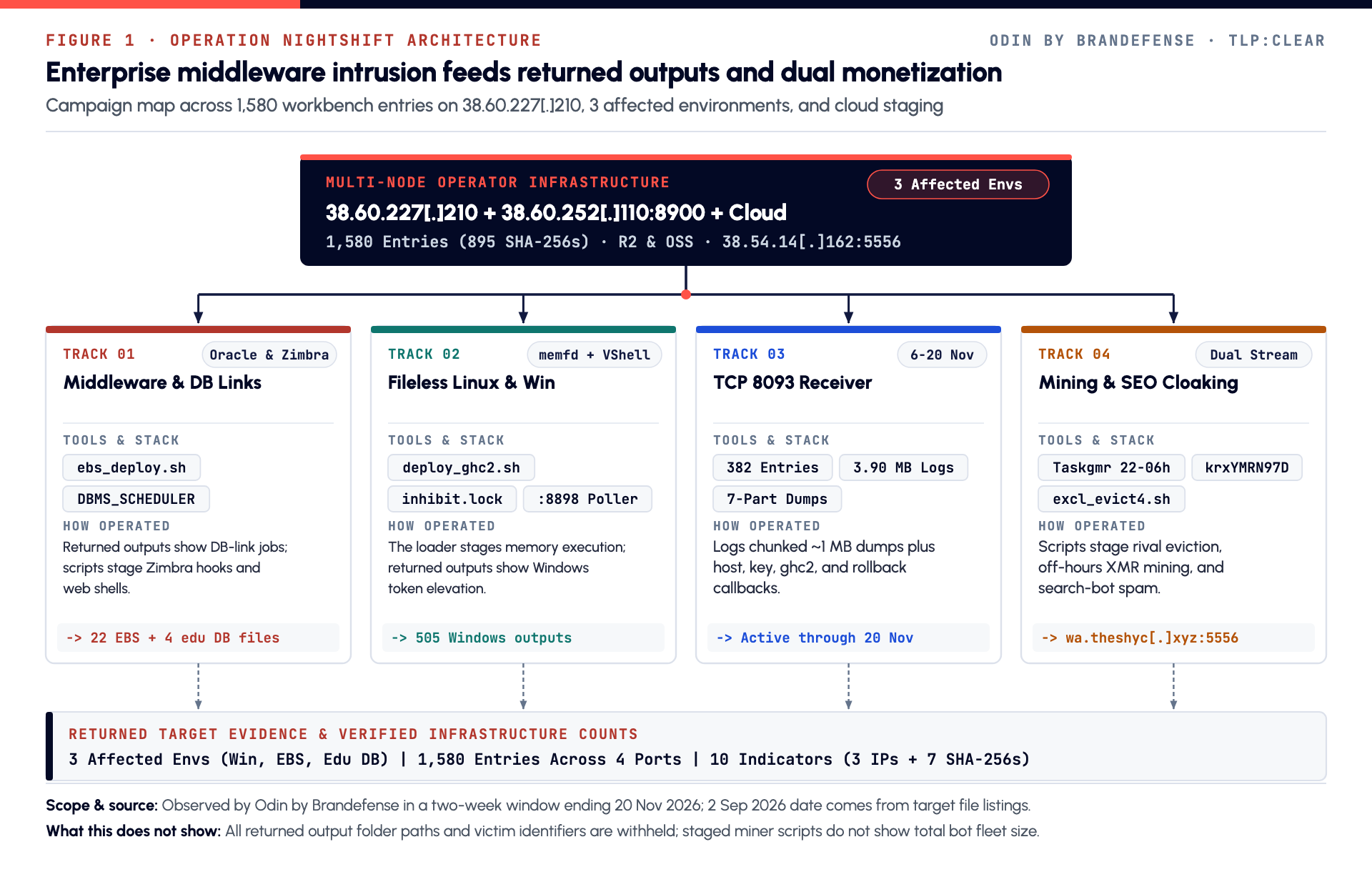
What do the returned target outputs and November receiver logs confirm?
Withheld directories on 38.60.227[.]210 hold returned outputs from at least three distinct target environments. Because 38.60.227[.]210 is a public indicator, all output folder paths and log filenames are withheld. Disk serials, database schema names, and institution names are also withheld.
| Anonymized environment / stream | Port | Entries | Verified operational evidence |
|---|---|---|---|
| Windows and IIS Server Environment | 8000 | 466 | 505 command outputs (target file dates back to 2 Sep 2026): Defender Real-Time Monitoring tamper attempts, CreateProcessAsUser() elevation, IIS module staging, and Alibaba OSS pulls. |
| Oracle E-Business Suite Environment | 8083 | 22 | 22 DBMS_SCHEDULER job outputs (2,349 B) returned across Oracle database links via ebs_deploy.sh (4,199 B). |
| Higher-Education Database Environment | 8083 | 4 | 4 returned database output files (137 B) from a separate academic database environment (26 DB files total). |
| Active Upload Receiver Store | 8093 | 382 | 380 chunk/recon items plus two transfer logs (3.90 MB) active 6 Nov to 20 Nov 2026, logging 7-part ~1 MB dumps, keys, and ghc2 status. |
The 505 Windows outputs on TCP 8000 record four steps. PowerShell commands try to turn off Defender real-time checks, and CreateProcessAsUser() raises IIS worker tokens to SYSTEM. The host then pulls payloads from Alibaba Cloud OSS (imagefiles-backup.oss-ap-southeast-7.aliyuncs[.]com) and stages IIS modules.
On TCP 8083, ebs_deploy.sh (4,199 B) moves across Oracle database links without SSH brute force. It queries link tables and calls DBMS_UTILITY.EXEC_DDL_STATEMENT@ and DBMS_SCHEDULER.CREATE_JOB@ on linked database hosts. Those remote jobs fetch loaders from 38.60.227[.]210 and send their output back to TCP 8083.
For Linux database and mail hosts, the workbench stages deploy_ghc2.sh (5,796 B). The script is built to lock /var/tmp/.systemd/inhibit.lock and check the SHA-256 of github-c2-agent-dual. It then loads the binary into anonymous memory via memfd_create.
Companion scripts target Zimbra flaw CVE-2026-73570 (CVSS 8.9, fixed in 10.1.20). That command injection flaw applies when optional zimbra-snmp is installed and SNMP notifications are enabled. The staged scripts edit .swatchrc to poll 38.60.227[.]210:8898 every 45 seconds.
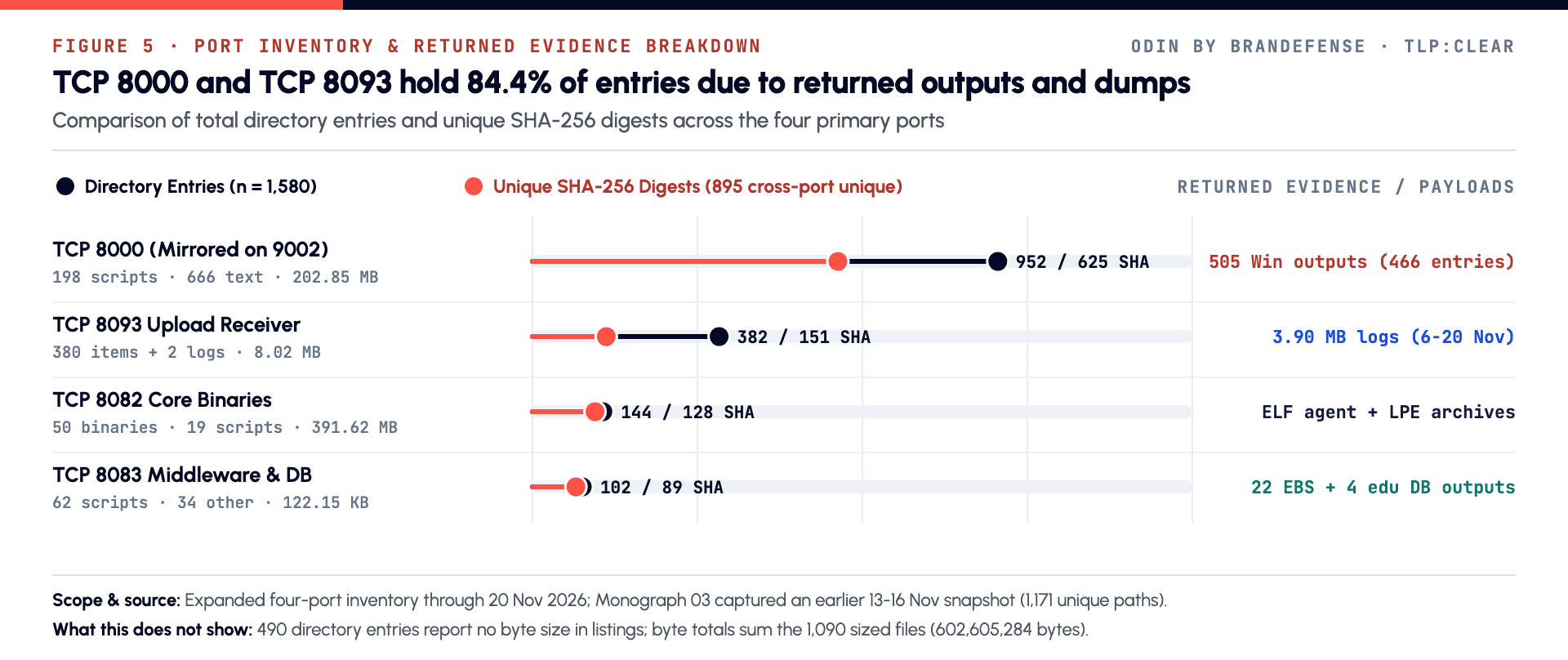
How does the dual-monetization engine stay quiet during business hours?
Once inside multi-core middleware and web servers, the operator stages two parallel revenue modules. The staged mining wrapper limits daytime CPU use, while the cloaker is designed to leave normal pages visible to human visitors.
- Rival eviction sweep. The staged script
excl_evict4.sh(7,153 B) is built to scan/proc,/tmp, and crontabs every 120 seconds. It kills rival miners while keeping operator markers (.sysjvd,z_73570, and :8899). - Off-hours Monero mining. Companion installer
install_user.sh(16,351 B) beacons to38.60.252[.]110:8900/GEO_TOP_and fetches miner bundles from Cloudflare R2 (pub-307c565a487b43c5bee73d21edc4d83b.r2[.]dev). It stagesTaskgmrunder pool prefixkrxYMRN97D. Wrapper rules curb daytime CPU load and ramp threads between 22:00 and 06:00 local time via TLS proxywa.theshyc[.]xyz:5556(38.54.14[.]162:5556). Staged scripts do not show the total active miner count. - Search-bot SEO spam cloaking. Staged scripts
z_prepend.php(3,148 B) andwbi_v10.php(3,655 B) use PHPauto_prepend_filehooks. If deployed, the script is designed to leave ordinary visitors on the normal site. ForGooglebot,bingbot, orYahoorequests, it could serve doorway spam from*.jssnjc[.]comandt1.sysflowus[.]com; this evidence does not show that search engines indexed it.
Why do enterprise database and IIS servers attract this hybrid model?
Enterprise ERP databases and IIS web tiers create two blind spots that these scripts target together. First, database admins often exclude Oracle data paths and IIS worker processes from antivirus scans to protect query speed. File-scan exclusions may hide staged files, while memfd_create loaders and Defender tamper attempts require process and behavior monitoring.
Second, middleware servers combine high CPU core counts with trusted public web domains. Database teams, SOC analysts, and web teams rarely compare night CPU spikes (22:00-06:00 local time) with Google Search Console spam alerts. One host can therefore support database pivoting, off-hours mining, and search-bot spam at the same time.
What should defenders do first?
- Block and hunt the confirmed infrastructure. Block
38.60.227[.]210,38.60.252[.]110:8900, and38.54.14[.]162:5556at the perimeter. Hunt DNS and TLS SNI logs forwa.theshyc[.]xyz,*.jssnjc[.]com, andt1.sysflowus[.]com. Also check traffic topub-307c565a487b43c5bee73d21edc4d83b.r2[.]devandimagefiles-backup.oss-ap-southeast-7.aliyuncs[.]com. - Audit Oracle database links and patch Zimbra and Ivanti. Upgrade Ivanti Connect Secure (a branch-compatible release addressing the related chain:
25.1.1.3,25.1.3.0+, or22.8R2.6+) and Zimbra (10.1.20+). Inspect.swatchrcand/proc/*/exememfdlinks after patching. RevokeCREATE JOBrights across OracleDB_LINKaccounts. - Enforce Defender Tamper Protection and check web hooks. Turn on Microsoft Defender Tamper Protection on Windows Server hosts. Review IIS modules and PHP
auto_prepend_filesettings. Test public URLs internally using aGooglebotUser-Agentheader.
What is…?
Short explanations of the tools and families named in this study.
What is Zimbra?
Zimbra Collaboration is an email and collaboration suite. Its internet-facing servers are frequent targets of exploitation.
More about ZimbraRemote access implantWhat is VShell?
VShell is a remote access implant and C2 panel that talks over WebSocket and other transports. It is popular with Chinese-speaking operators.
More about VShellFrequently asked questions
How does Operation NightShift expand Monograph 03 and public reporting?
Monograph 03 examined an initial four-day snapshot of 38.60.227[.]210 from 13 to 16 November 2026. That snapshot held 1,824 raw rows across five HTTP ports, including 645 mirrored entries on TCP 9002. Removing the mirror and eight cross-port overlaps left 1,171 unique paths.
What do the returned target outputs and November receiver logs confirm?
Withheld directories on 38.60.227[.]210 hold returned outputs from at least three distinct target environments. Because 38.60.227[.]210 is a public indicator, all output folder paths and log filenames are withheld. Disk serials, database schema names, and institution names are also withheld.
How does the dual-monetization engine stay quiet during business hours?
Once inside multi-core middleware and web servers, the operator stages two parallel revenue modules. The staged mining wrapper limits daytime CPU use, while the cloaker is designed to leave normal pages visible to human visitors.
Why do enterprise database and IIS servers attract this hybrid model?
Enterprise ERP databases and IIS web tiers create two blind spots that these scripts target together. First, database admins often exclude Oracle data paths and IIS worker processes from antivirus scans to protect query speed. File-scan exclusions may hide staged files, while memfd_create loaders and Defender tamper attempts require process and behavior monitoring.