
Key takeaways
- Operation SapperSync ran on an East Asian cloud VPS on TCP 9099 recorded on 13–20 November 2026, reporting 399 active files and 23 directories on 20 November.
- Deduplication across 13–20 November captures yields 400 entries (199 sized files totaling 435,295,482 bytes and 201 unsized entries) across 190 withheld SHA-256 digests.
- The root workspace stages a 54-entry AI skill slice (251,977 B), two local-upload skill ZIPs (290 B unpacked), 11 ImageMagick MSL scripts, and 15 PNG files.
- Eight Alpine tarballs in /la (3,733,376 B) stage runtime-entrypoint, hidden .agent_sync, and a 15-minute cron task beside one ownCloud 10.13.0.4 report.
- Update ownCloud graphapi to 0.2.1 or 0.3.1 and remove GetPhpInfo.php, block MSL coders in ImageMagick policy.xml, disable unsigned local-upload skills, and run read-only containers.
An East Asian cloud server on TCP 9099 staged AI agent skill packages, ImageMagick .msl scripts, and Alpine Linux persistence tarballs beside a captured ownCloud 10.13.0.4 diagnostic report. Odin by Brandefense recorded the open directory between 13 and 20 November 2026.
The server holds a 349,235-byte appliance diagnostic file dated 6 November 2026 and logs third-party scanner hits. All server addresses, scanner IPs, 190 workbench SHA-256 digests, victim filenames, and container hostnames are therefore withheld.
How was the 400-entry TCP 9099 workbench organized?
On 20 November 2026, the open HTTP directory on TCP 9099 reported 399 active files and 23 directories. Across captures recorded from 13 to 20 November 2026, deduplication yields 400 unique entries (1 transient entry rotated out before 20 November).
Security teams can use cyber threat intelligence to evaluate how upload tests and container layers fit together on one host. They can also pair vulnerability intelligence with asset reviews to check ImageMagick and ownCloud patch levels.
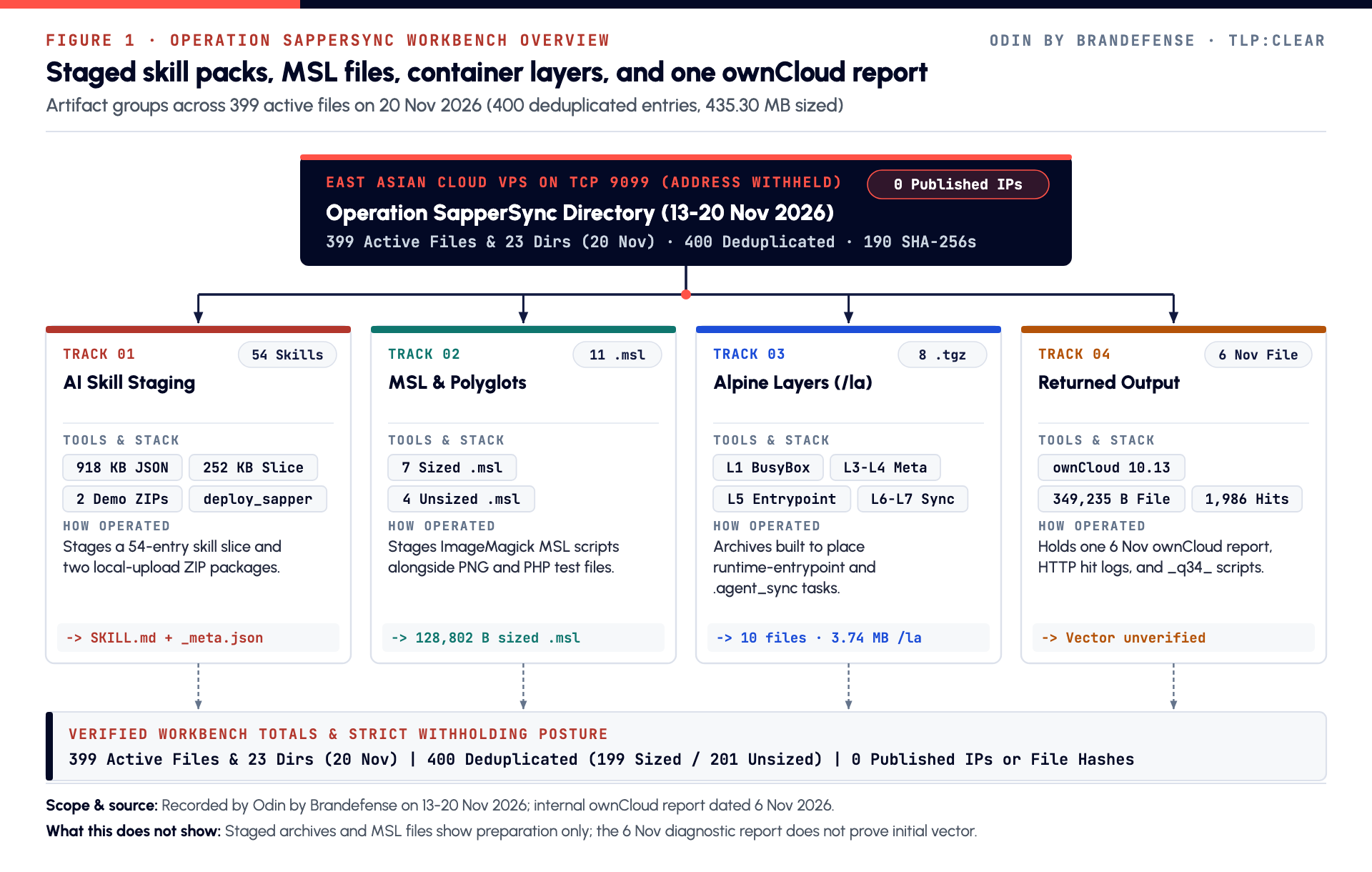
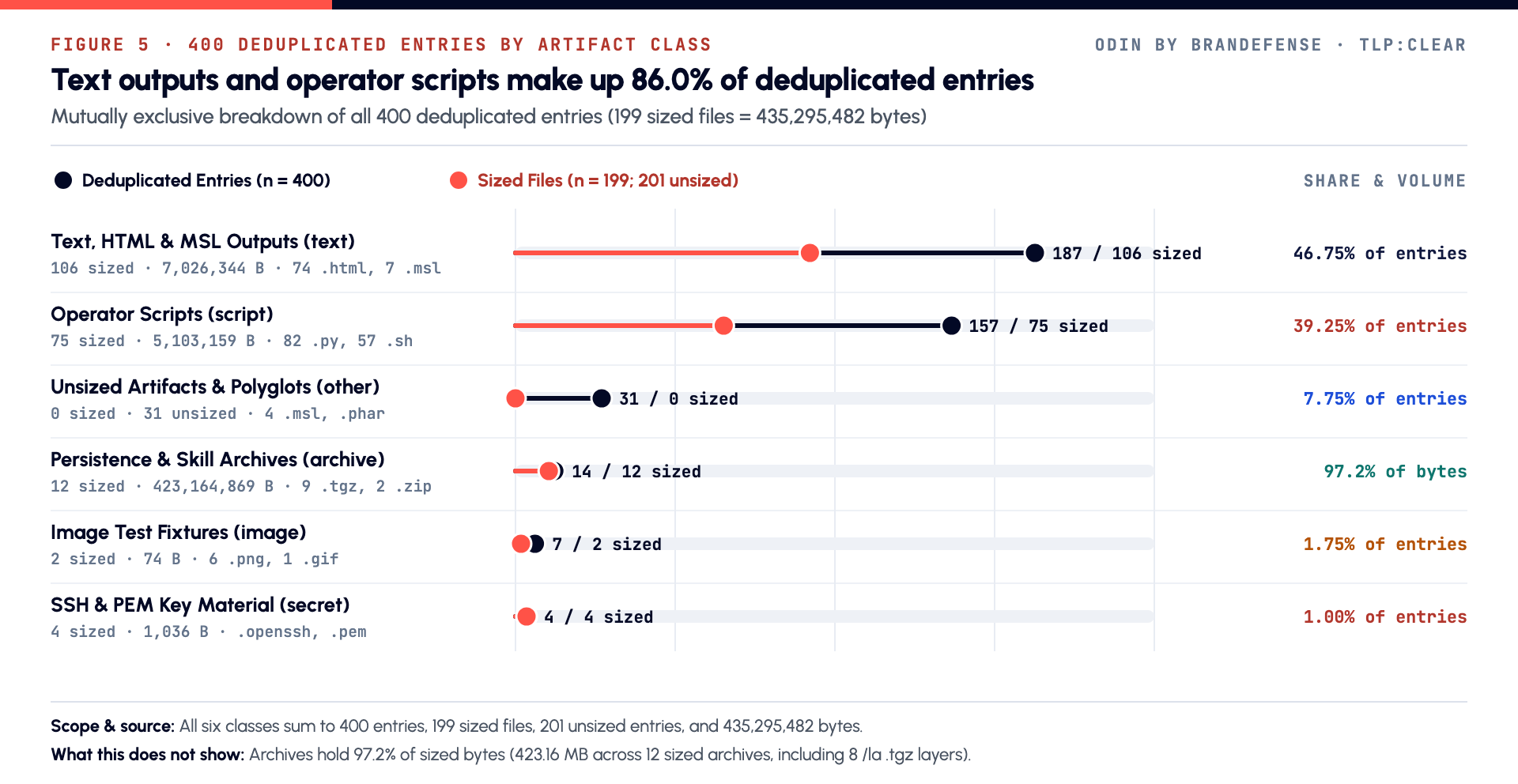
Within the 400 deduplicated entries, 199 sized files total 435,295,482 bytes (435.30 MB) and 201 entries omit byte size. Those 199 sized files span 190 unique SHA-256 digests, reflecting nine exact duplicates such as demo-skill.zip and demo.zip.
Across folders, 387 entries (96.75%, 431,559,751 bytes) sit in root and 10 sized files (2.50%, 3,735,731 bytes) sit in /la. Three unsized entries (0.75%) sit across /q33 (/q33/patch33.py), /q33o, and /tmux-0.
| Artifact class on TCP 9099 | Entries | Sized files | Sized bytes | Key workbench contents |
|---|---|---|---|---|
Text, HTML & MSL (text) | 187 | 106 | 7,026,344 | 74 .html, 19 .txt, 11 .json (skill catalogues), 8 .png, and 7 sized .msl files (128,802 B). |
Operator Scripts (script) | 157 | 75 | 5,103,159 | 82 .py, 57 .sh (/deploy_sapper_v2.sh, _q34_*), 10 .php, 6 .js, 1 .png, and 1 .phtml. |
Unsized & Polyglots (other) | 31 | 0 | 0 | 15 extensionless entries, 4 unsized .msl files, 3 .b64, 3 .out, 1 .php5, and 1 .phar. |
Archives (archive) | 14 | 12 | 423,164,869 | 9 .tgz (including /la/L1.tgz–L8.tgz), 3 .gz, and 2 .zip (demo-skill.zip, demo.zip). |
Image Fixtures (image) | 7 | 2 | 74 | 6 .png and 1 .gif minimal image test files. |
Keys & Secrets (secret) | 4 | 4 | 1,036 | 2 extensionless key files, 1 .openssh key, and 1 .pem key (all withheld). |
How do the staged AI skill packs, MSL files, and Alpine layers work?
Four artifact groups sit across the root folder and /la subdirectory. Staged scripts and archives show preparation, while the 6 November 2026 ownCloud file confirms external output:
- AI agent skill slices and
local-uploadZIPs. Root holds a 918,252-byte full skills JSON catalogue and a 251,977-byte slice containing 54 skill entries. Two identical archives (demo-skill.zipanddemo.zip, 290 bytes unpacked) pairSKILL.mdwith_meta.json(source=local-upload) beside/deploy_sapper_v2.sh(5,304 bytes). No logs confirm external ingestion of those test ZIPs. - ImageMagick
.msland polyglot upload files. Seven sized.mslscripts total 128,802 bytes, led by/e_z4.msl(64,064 B) and/e_z6.msl(64,062 B). Four unsized.mslentries sit beside 15.pngfiles and 13 PHP-family files. Open ImageMagickpolicy.xmlrules (CVE-2016-3714) leaveMSL<read>and<write>tags active. Separately, ImageMagick7.1.0-49(CVE-2022-44268, fixed in7.1.0-52and6.9.12-67) leaked local files through PNGprofilechunks. - Layered Alpine persistence (
/la/L1.tgz–L8.tgz). Inside the 3,735,731-byte/lafolder, eight.tgzarchives total 3,733,376 compressed bytes. LayerL1.tgzadds an Alpine BusyBox rootfs, andL3.tgz–L4.tgzwriterelease=2.4.2andchannel=hotfixmarkers. LayersL5.tgzandL7.tgzplaceruntime-entrypointand a 15-minute.runtime-synccron job. LayerL6.tgzadds hidden.agent_syncreferencingAPP_ENV,DB_HOST,DB_PORT, and/var/www/html/cache. - Returned
ownCloud 10.13.0.4diagnostic file and HTTP hit log. Root holds a 349,235-byte diagnostic report dated6 November 2026from containerizedownCloud 10.13.0.4 Community, plus 1,986 HTTP hit-log lines. The ownCloud 10.13.0 complete bundle included affectedgraphapi0.3.0; 10.13.1 included fixed 0.3.1. The diagnostic file does not establish initial access.
What should platform and container defenders do first?
Security and engineering teams can close these upload, appliance, and container gaps with four direct steps:
- Patch ownCloud and rotate container secrets. Update
graphapito0.2.1or0.3.1or later (bundled fromownCloud 10.13.1; check separately installed app versions) and delete vendorGetPhpInfo.phptest files. Rotate database passwords, ownCloud admin credentials, S3 keys, and secret tokens stored in container environment variables. - Harden ImageMagick
policy.xmland update binaries. Upgrade ImageMagick to7.1.0-52/6.9.12-67or later. Setrights="none"inpolicy.xmlforMSL,MVG,TEXT,EPHEMERAL,HTTPS,HTTP, and@*paths, and disable script handlers on upload folders. - Require signed AI agent skills. Disable unsigned
source=local-uploadskill ZIP uploads on production agent gateways. Allow only CI-signedSKILL.mdpackages from internal repositories and isolate skill runners fromDB_HOSTsecrets. - Enforce read-only container root filesystems and deploy detections. Run containers with
--read-onlyso web workers cannot write/usr/local/bin/.agent_syncor/etc/periodic/15min/.runtime-sync. Deploy Suricatasid:9557001-9557007, Sentinel KQL, Sigma, and YARA rules to alert on MSL uploads and hidden sync paths.
Frequently asked questions
How was the 400-entry TCP 9099 workbench organized?
On 20 November 2026, the open HTTP directory on TCP 9099 reported 399 active files and 23 directories. Across captures recorded from 13 to 20 November 2026, deduplication yields 400 unique entries (1 transient entry rotated out before 20 November).
How do the staged AI skill packs, MSL files, and Alpine layers work?
Four artifact groups sit across the root folder and /la subdirectory. Staged scripts and archives show preparation, while the 6 November 2026 ownCloud file confirms external output:
What should platform and container defenders do first?
Security and engineering teams can close these upload, appliance, and container gaps with four direct steps: