
Key takeaways
- Operation FalsePort pairs MySQL, PostgreSQL, and SQL Server JDBC source audits with live TCP 3306 rogue MySQL listeners on a China-hosted server.
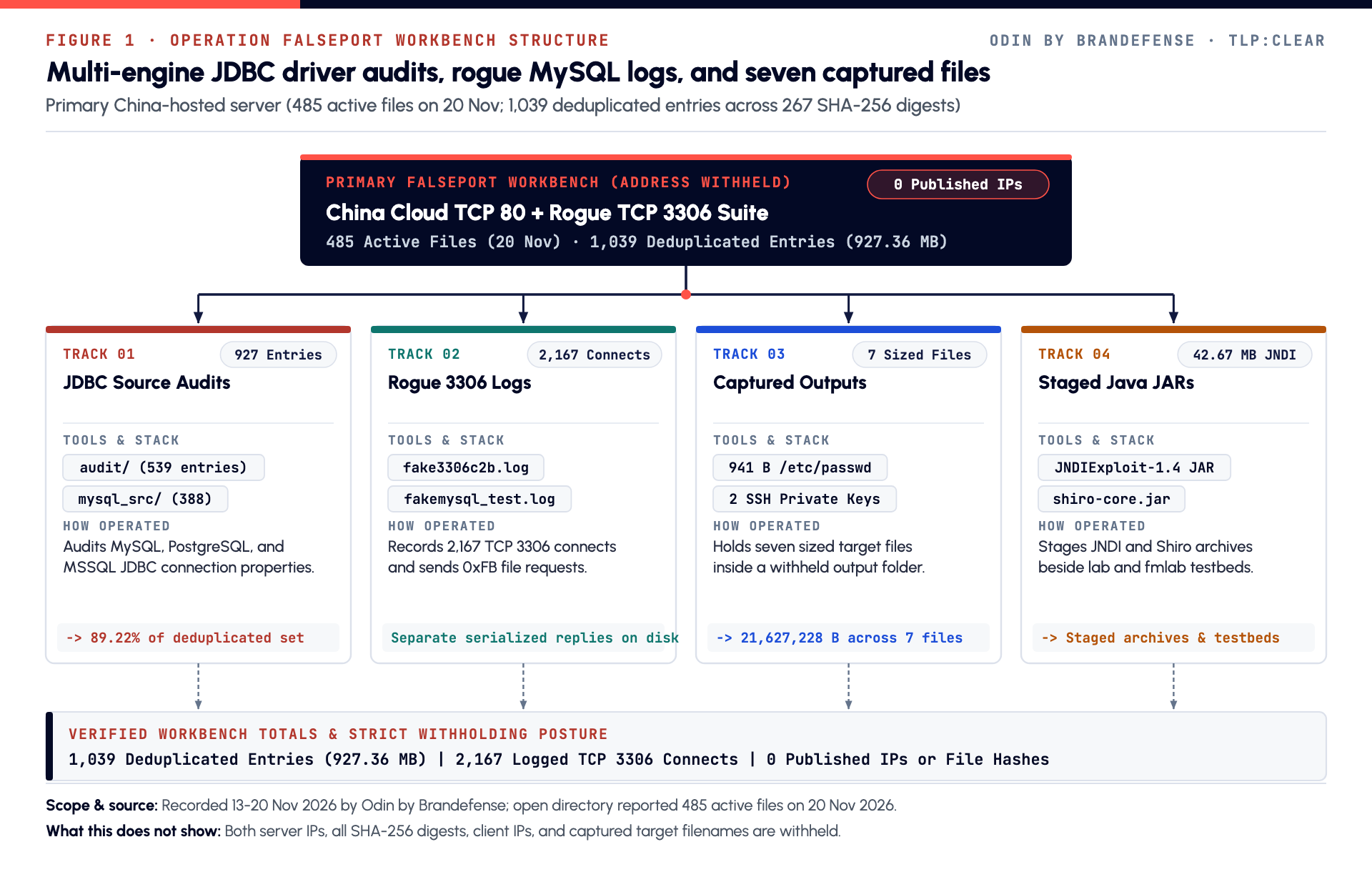
- Across 1,039 unique entries (263 sized files totaling 927.36 MB; 485 active files on 20 November), 927 entries (89.22%) sit in audit/ and mysql_src/.
- Two TCP 3306 logs record 2,167 inbound connects, including one Connector/J 8.0.28 query session answered with 0xFB LOCAL INFILE and serialized payloads.
- A withheld output folder holds seven sized captures (21.63 MB): a 941-byte /etc/passwd file, two SSH keys, Git credentials, configs, and a 21.59 MB log.
- Upgrade MySQL Connector/J to 8.2.0+, patch pgjdbc to 42.2.25 or 42.3.2+, set allowLoadLocalInfile=false, and block outbound TCP 3306 from Java hosts.
An operator behind Operation FalsePort paired code audits of three SQL JDBC drivers with live TCP 3306 rogue MySQL listeners on a China-hosted server (TCP 80). Odin by Brandefense analyzed 1,039 deduplicated entries recorded on 13–20 November 2026.
When a Java web portal lets users edit or test a database URL, the JDBC client itself turns into an attack surface. Pointing a permissive driver at an external fake MySQL port lets that rogue server pull local files from the Java host. Because the workbench stores captured SSH keys, Git credentials, and Spring Boot logs, all server IPs, file hashes, client IPs, and target filenames are withheld.
How was the 1,039-entry FalsePort workbench organized, and how does the India VPS compare?
On 20 November 2026, the open directory on the China-hosted server reported 485 active files across 32 folders. Across the 13–20 November 2026 snapshots, the deduplicated dataset holds 1,039 entries. Those entries span 263 sized files (927,357,421 bytes, or 927.36 MB) and 776 unsized entries across 267 unique SHA-256 digests.
Platform teams can use external attack surface management to find exposed Java admin panels before attackers edit their database settings. SOC teams can pair that visibility with cyber threat intelligence to hunt rogue database callbacks from server subnets.
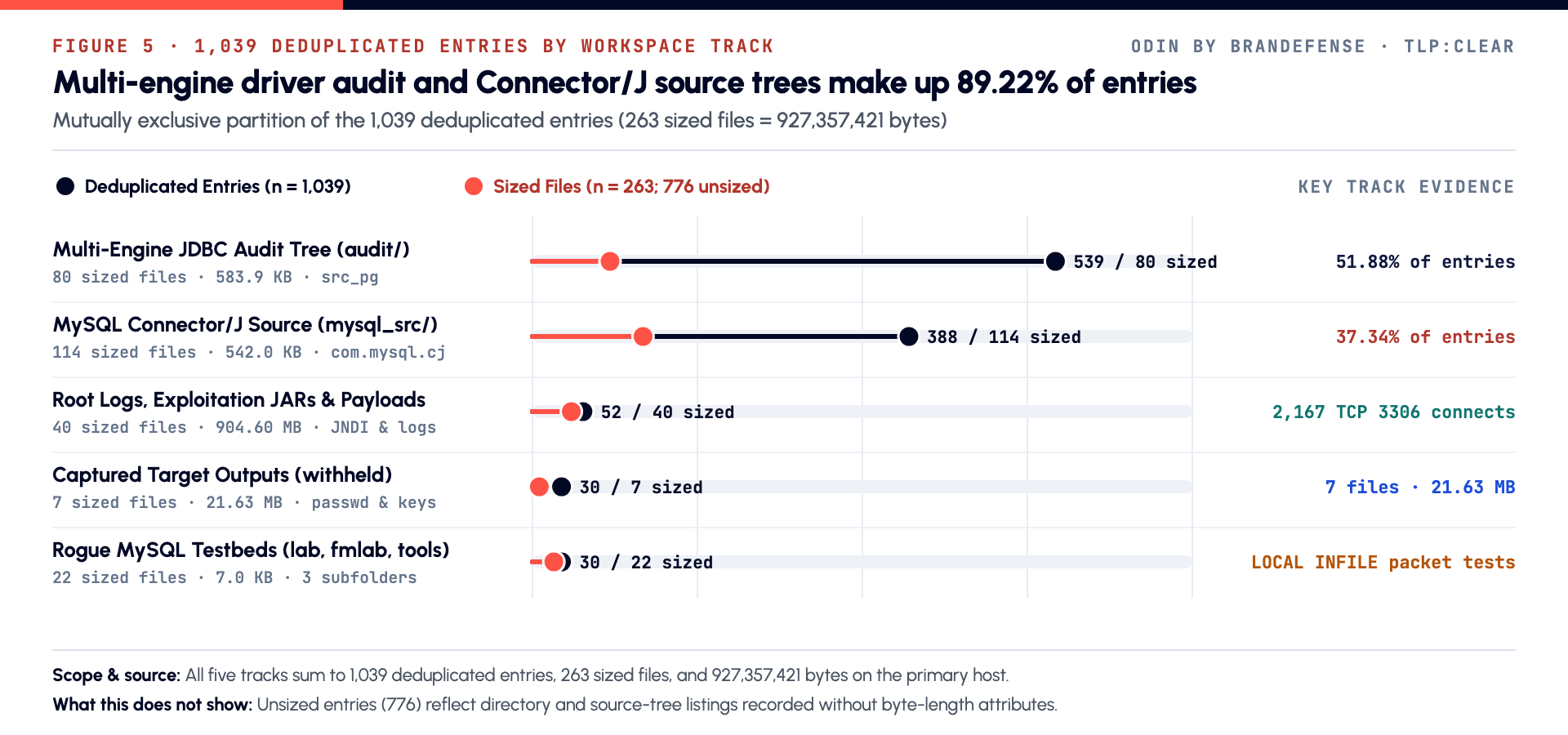
Driver source trees dominate the file count on the primary host. Two folders hold 927 of the 1,039 entries (89.22%). Folder audit/ holds 539 entries (including audit/src_pg/ for PostgreSQL pgjdbc), and mysql_src/ holds 388 com.mysql.cj.* files.
Root holds 52 entries (904.60 MB). A seven-file captured-output folder (name withheld) holds 30 entries (7 sized files = 21,627,228 bytes), and lab/, fmlab/, and tools/ hold 30 testbed entries.
On 20 November 2026, Odin by Brandefense also examined an independent India-hosted VPS on TCP 8001. That host reported 713 active files and 114 folders (874 deduplicated entries totaling 1.58 GB across 506 SHA-256 digests).
The India VPS runs java-chains 2.0.0/2.0.1 (712 entries, 1,311 log lines) beside MySQL_Fake_Server (23 entries) and payloads/ (24 entries). Comparing the 267 primary SHA-256 digests with the 506 India VPS digests shows zero shared non-public hashes, and nothing links the two operators.
Primary workbench track (n = 1,039) | Entries | Sized files | Sized bytes | Observed workbench contents |
|---|---|---|---|---|
Multi-Engine Audit Tree (audit/) | 539 | 80 | 583,901 | PostgreSQL audit/src_pg/ tree auditing socketFactory class loading (CVE-2022-21724). |
MySQL Driver Source (mysql_src/) | 388 | 114 | 541,993 | com.mysql.cj.* files auditing allowLoadLocalInfile, autoDeserialize, and queryInterceptors. |
| Root Logs, JARs & Payloads | 52 | 40 | 904,597,314 | fake3306c2b.log (1,145 connects), fakemysql_test.log (1,022), JNDIExploit-1.4-SNAPSHOT.jar, pg.jar, sqljdbc4.jar, Shiro JARs, and 3,432 B / 1,686 B payloads. |
| Captured Target Outputs (withheld) | 30 | 7 | 21,627,228 | 941 B /etc/passwd, 2 SSH keys (incl. 1,675 B), Git creds, configs, and 21.59 MB Spring Boot log. |
Rogue MySQL Testbeds (lab, fmlab, tools) | 30 | 22 | 6,985 | Local JDBC URL, property, and rogue MySQL 0xFB LOCAL INFILE packet test files. |
How do multi-engine JDBC audits, TCP 3306 logs, and seven captured files fit together?
Three artifact groups on the primary server show how driver code review pairs with live rogue MySQL listeners. Staged JARs and stored TCP 3306 logs play distinct roles on disk:
- Source and bytecode audits across three SQL engines. Beyond
mysql_src/(388 entries) andaudit/src_pg/, root holdspg.jar(1,006,732 B),sqljdbc4.jar(584,207 B), andSQLServerConnection.class(57,341 B). Root also stagesshiro-core.jar,shiro-web.jar, andJNDIExploit-1.4-SNAPSHOT.jar(42,671,630 B). No PostgreSQL, MSSQL, Shiro, or LDAP callback logs appear on disk, so those JARs stay staged. - Live TCP 3306 rogue MySQL logs. Two logs record 2,167 inbound
== connect fromevents. Logfake3306c2b.log(151,645 B, 3,171 lines) records 1,145 connects, andfakemysql_test.log(95,593 B, 2,083 lines) records 1,022 connects. Public 3306 ports draw constant scan noise, yetfake3306c2b.logalso records onemysql-connector-java-8.0.28client (<= 8.1.0,CVE-2023-22102). That client ranSELECT @@session.auto_increment_increment...andSHOW SESSION STATUSand received0xFBLOCAL INFILEor serialized payloads (3,432 B and 1,686 B). - Seven captured target files (21,627,228 B). A seven-file captured-output folder (folder name withheld; 7 sized files plus 23 unsized entries) holds returned host data. Those seven files include a 941-byte Linux
/etc/passwdfile, harvested Git credentials, and two SSH private keys (including 1,675 B). They also include config outputs and a 21,586,294-byte Spring Boot log. Folder listings alone do not link each file to a single log line.
What should Java platform and security teams do first?
Java architects and SOC teams can close this JDBC client attack surface with three direct actions. Each step cuts a link in the rogue-listener workflow:
- Lock down DataSource URLs and disable
LOCAL INFILE. Buildjdbc:strings from checked host, port, and database fields rather than raw user text. StripallowLoadLocalInfile,autoDeserialize,queryInterceptors, andsocketFactory, and setallowLoadLocalInfile=falseandautoDeserialize=falsein code. - Patch MySQL Connector/J and PostgreSQL
pgjdbc. Upgrade MySQL Connector/J to8.2.0or later. That update fixesCVE-2023-22102(8.1.0and prior) andCVE-2021-2471(8.0.26and prior, fixed in8.0.27). Upgradepgjdbcto42.2.25or42.3.2or later (CVE-2022-21724), and replace legacysqljdbc4.jarfiles. - Block outbound SQL ports and deploy wire rules. Block Java web and BI hosts from opening outbound TCP 3306, 5432, 1433, or 1389 sessions to public IPs. Run JVM apps under
nologinLinux accounts without.ssh/keys or.git-credentials, and deploy Suricatasid:9558001–9558007 plus our KQL, Sigma, and YARA rules.
What is…?
Short explanations of the tools and families named in this study.
Frequently asked questions
How was the 1,039-entry FalsePort workbench organized, and how does the India VPS compare?
On 20 November 2026, the open directory on the China-hosted server reported 485 active files across 32 folders. Across the 13–20 November 2026 snapshots, the deduplicated dataset holds 1,039 entries. Those entries span 263 sized files (927,357,421 bytes, or 927.36 MB) and 776 unsized entries across 267 unique SHA-256 digests.
How do multi-engine JDBC audits, TCP 3306 logs, and seven captured files fit together?
Three artifact groups on the primary server show how driver code review pairs with live rogue MySQL listeners. Staged JARs and stored TCP 3306 logs play distinct roles on disk:
What should Java platform and security teams do first?
Java architects and SOC teams can close this JDBC client attack surface with three direct actions. Each step cuts a link in the rogue-listener workflow: