
1. Executive Summary
In short
Odin by Brandefense analyzed a 325-file browser exploitation workbench on TCP port 9000 of a China-hosted cloud server, recorded on 13–25 November 2026. The open Python HTTP directory pairs packaged CVE-2022-4262 V8 reproducers with 94 in-cage reconnaissance scripts and archives. Modern V8 Sandbox tables block direct pointer overwrites. Keep Chromium browsers on current supported security releases, apply JIT-less browser policies, and restrict high-port web egress.
Modern Chromium browsers isolate untrusted JavaScript and WebAssembly inside strict memory boundaries. V8 pointer compression uses a 4 GB heap region. The separate V8 Sandbox reserves a larger address space and aims to prevent in-cage corruption from writing outside it. Separate out-of-cage tables guard native code pointers and C++ backing stores.
Between 13 and 25 November 2026, Odin by Brandefense studied an open HTTP directory on TCP port 9000 of a China-hosted cloud server. That listener ran SimpleHTTP/0.6 Python/3.12.3. On 25 November 2026, the directory listing reported 325 active files and 10 directories.
Deduplicating all paths yields 325 sized files totaling 1,928,392 bytes (1.93 MB) and zero unsized entries. Those 325 files map to 291 unique SHA-256 digests and 34 duplicate file copies across subdirectories.
We assess this host consistently as an adversary browser-exploitation staging and cage-testing workbench. Odin by Brandefense publishes zero IPv4 addresses and zero SHA-256 digests in this report. We withhold the server IP, all 291 file digests, and all folder and file names inside a 197-entry backup test subdirectory.
Standard-renderer CVE-2022-4262 files sit beside seven parallel staging folders.
Six entries totaling 27,104 bytes hold a reproducer suite for CVE-2022-4262, a V8 type-confusion bug fixed in Chrome 108.0.5359.94 in December 2022. Archive cveweb.tar.gz (4,722 bytes) packs HTML and JavaScript files that run without V8 debug flags. Meanwhile, seven short subdirectories each hold an 86-byte HTML loader, an exp.js script, and a 9,996-byte exploit-q.js copy.
Ninety-four recon scripts and archives test V8 cage and WebAssembly layouts.
Eighty-seven root HTML and JavaScript files (261,904 bytes) and seven .tar.gz bundles (12,269 bytes) probe inside the V8 heap cage. Numbered archives step from typed-array external pointers and WebAssembly tables to JavaScript function code links and float64 constant pools.
V8 Sandbox tables and non-writable code pages stop direct pointer swaps.
External Pointer Tables replace raw C++ backing-store addresses with type-tagged handles. The out-of-cage Code Pointer Table removes direct instruction pointers from JavaScript function objects. Write-xor-execute rules and hardware memory protection keys also block direct writes to WebAssembly jump tables and JIT pages.
Local Linux procfs pause code is consistent with a test rig.
Two archives (recon5.tar.gz and r5.tar.gz) are written to print candidate addresses to page output and pause for a local /proc/mem check. A remote page cannot itself read a visitor's /proc/mem. Those staged pauses are consistent with a test rig, and no live drive-by attack is established.
Three Decisions for Security Leaders
- Keep Chromium browsers on current security releases with prompt relaunches. Keep Chrome, Edge, kiosk browsers, and Electron apps on current supported security releases (
108.0.5359.94is the historical fix forCVE-2022-4262) to patch known exploited vulnerabilities. Set enterprise relaunch policies so security updates restart browsers within 48 to 72 hours. - Turn on V8 JIT-less mode for high-risk users and lock Site Isolation. Block JavaScript JIT compilation by default for executive, admin, and finance profiles while allowlisting vetted web apps. Enforce
SitePerProcessand alert on--no-sandboxor--allow-natives-syntaxflags. - Block direct browser traffic to high TCP ports and run structural hunts. Stop workstation browsers from opening direct HTTP sessions to public hosts on ports like TCP 9000. Route web traffic through a proxy watched by Suricata, Sentinel KQL, Sigma, and YARA rules.
The Study in Numbers
| Number | What it is |
|---|---|
| 325 | Active sized files (1,928,392 bytes; 0 unsized) across 10 reported directories on TCP 9000 on 25 November 2026 |
| 291 | Unique file SHA-256 digests across the 325 sized files (all withheld; 34 duplicate copies across subdirectories) |
| 197 | Backup browser PoC files (1,473,170 bytes; 60.6% of files) inside a withheld test subdirectory |
| 94 | In-cage V8 and WebAssembly recon files: 87 root recon* files (261,904 B) plus 7 .tar.gz bundles (12,269 B) |
| 8 | Compressed .tar.gz bundles totaling 16,991 bytes (40,582 unpacked bytes across 15 members and 1,096 lines) |
| 6 | CVE-2022-4262 V8 type-confusion reproducer entries (27,104 bytes), fixed in Chrome 108.0.5359.94 |
| 0 | Published IPv4 addresses, file SHA-256 digests, exploit snippets, or backup subdirectory names |
2. Workbench Layout, 325-File Inventory, and Cluster Partition
The workbench ran an unauthenticated SimpleHTTP/0.6 Python/3.12.3 server on TCP 9000 of a China-hosted cloud VPS ([REF-09]). Odin by Brandefense recorded the directory on 13–25 November 2026, with 325 active files and 10 directories reported on 25 November 2026.
Enterprise defenders can apply vulnerability intelligence to verify browser patch floors across managed endpoints and virtual desktops. Security operations teams can also use cyber threat intelligence to correlate staged archive names and high-port web banners across proxy logs.
We reviewed directory listings, byte counts, and archive structures statically without running any script or printing offensive code. All 325 deduplicated entries carry exact sizes (0 unsized) totaling 1,928,392 bytes (1.93 MB), with 291 unique SHA-256 digests (all withheld) and 34 duplicate copies. Figure 1 maps the four workbench tracks.
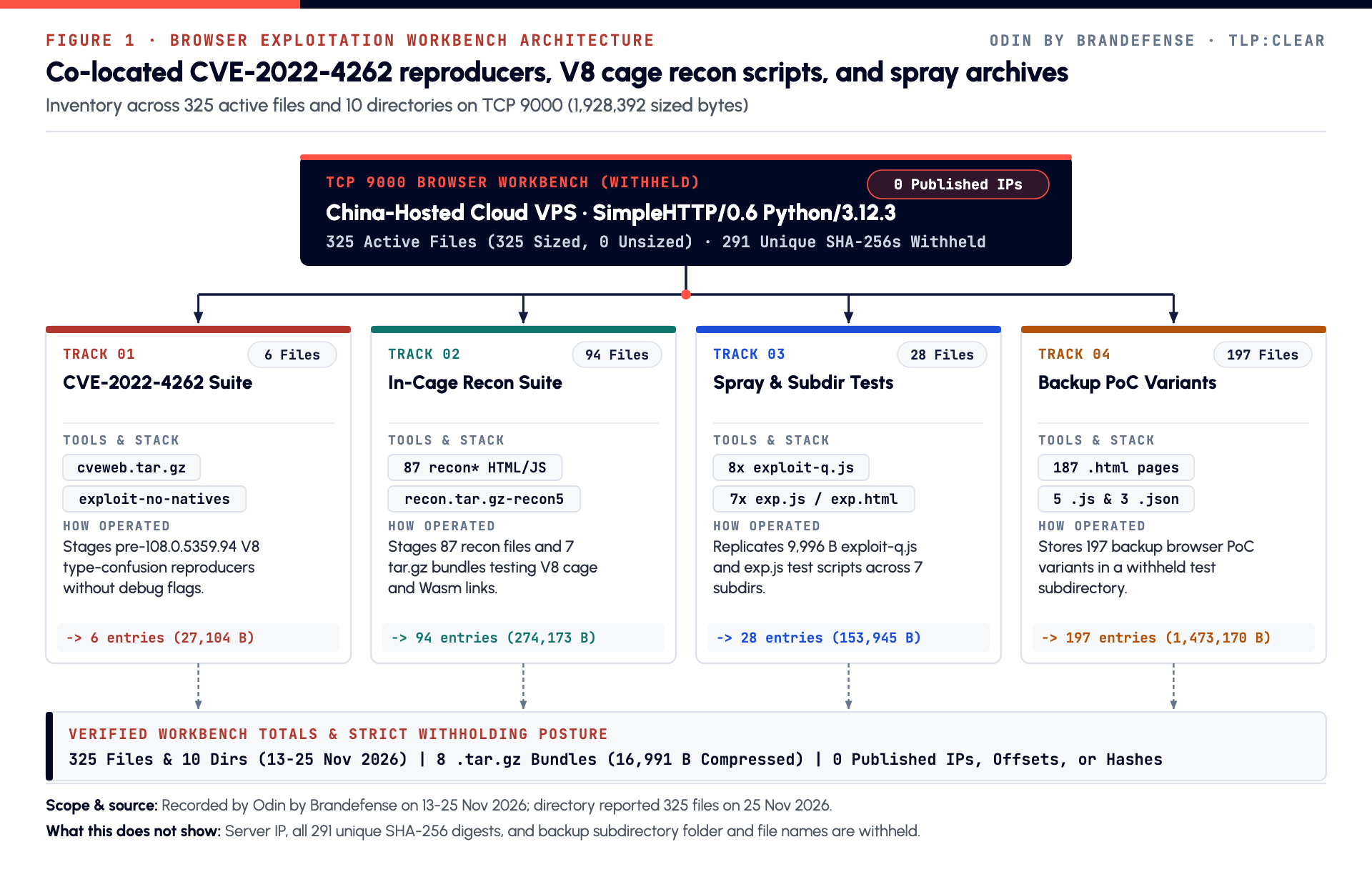
Six Functional Workbench Clusters (n = 325)
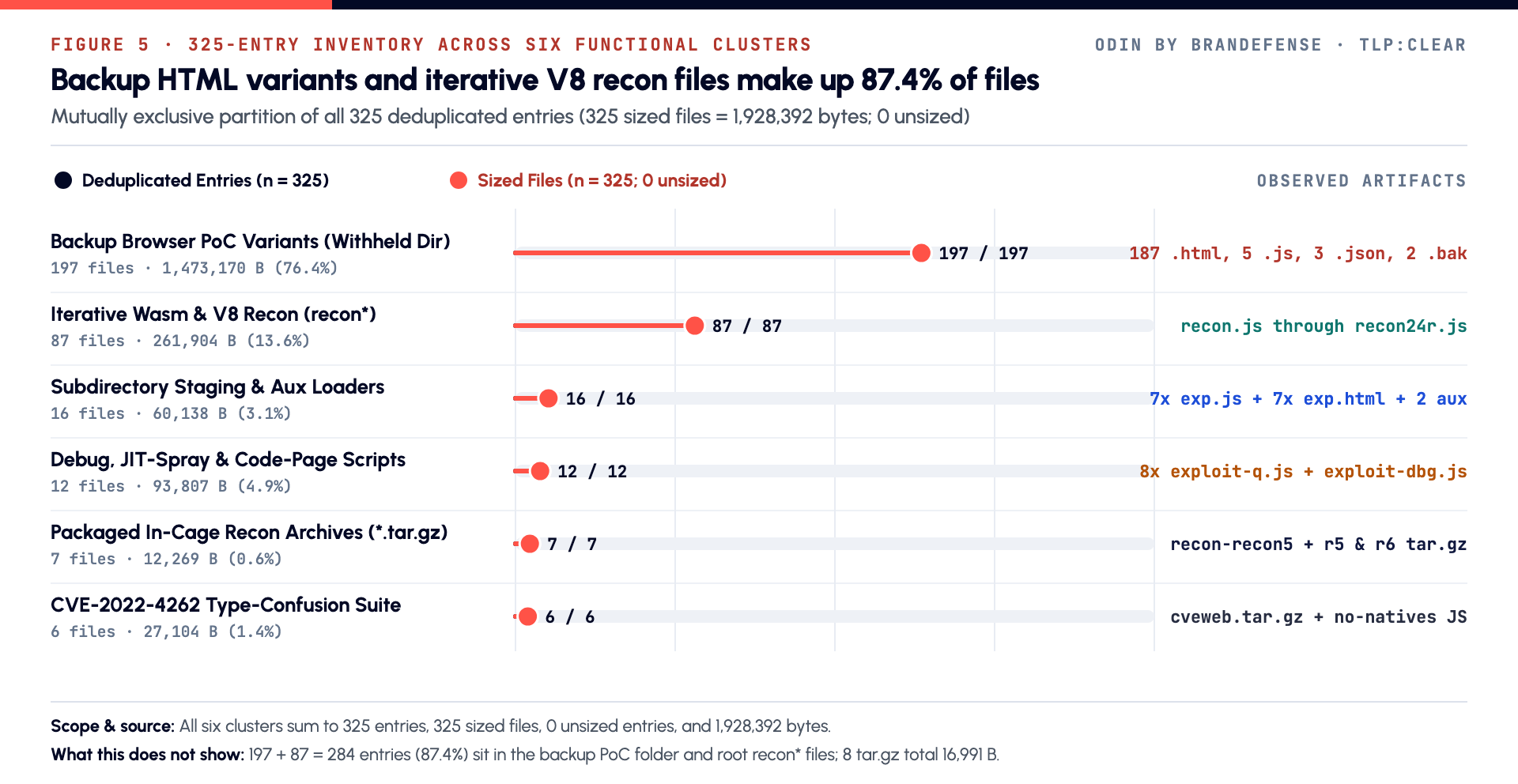
Sorting all 325 files into six mutually exclusive clusters separates bulk backup test pages from active V8 cage reconnaissance (197 + 87 + 16 + 12 + 7 + 6 = 325). Table 1 reconciles file counts and byte totals across all six groups.
| Functional cluster | Entries | Share (%) | Sized bytes | Byte share (%) | Observed contents |
|---|---|---|---|---|---|
| Backup Browser PoC Variants (withheld dir) | 197 | 60.6% | 1,473,170 | 76.4% | 187 .html, 5 .js, 3 .json, and 2 .bak files in a withheld folder. |
Iterative Wasm & V8 Recon (recon*) | 87 | 26.8% | 261,904 | 13.6% | Root HTML/JS files up to recon24r.html/recon24r.js (peaking at 13,028 B in recon24p.js). |
| Subdirectory Staging & Aux Loaders | 16 | 4.9% | 60,138 | 3.1% | 7 exp.js (7,618–9,076 B), 7 86-byte exp.html, diag-ladder.html (2,366 B), test.txt (10 B). |
| Debug, JIT-Spray & Code-Page Scripts | 12 | 3.7% | 93,807 | 4.9% | exploit-dbg.js (10,321 B), 8x exploit-q.js (9,996 B each), and 3 dbg103*.html pages. |
Packaged In-Cage Recon Archives (*.tar.gz) | 7 | 2.2% | 12,269 | 0.6% | r6, recon4, recon5, recon3, recon2, r5, and recon .tar.gz bundles. |
CVE-2022-4262 Type-Confusion Suite | 6 | 1.8% | 27,104 | 1.4% | exploit-no-natives.js, exploit-loadable.js, cveweb.tar.gz, HTML loader, and 2 ._* stubs. |
| Total workbench (325 sized, 0 unsized) | 325 | 100.0% | 1,928,392 | 100.0% | 10 reported directories; 291 unique SHA-256 digests withheld. |
Two clear patterns stand out in Table 1 and Figure 5. First, the withheld backup folder (197 files) and root recon* files (87 files) hold 284 of the 325 entries (87.4%) and 1,735,074 bytes (90.0%). Folder and file names inside that 197-entry backup folder reflect copied third-party PoC labels that do not prove who runs the server, so we withhold them all.
Second, the remaining 41 entries (12.6%; 193,318 bytes) hold the packaged archives, CVE-2022-4262 suite, debug scripts, and subdirectory harnesses. Adding the 87 root recon* files to the 7 recon .tar.gz bundles gives 94 in-cage recon files (274,173 bytes). Figure 5 shows the six-cluster breakdown.
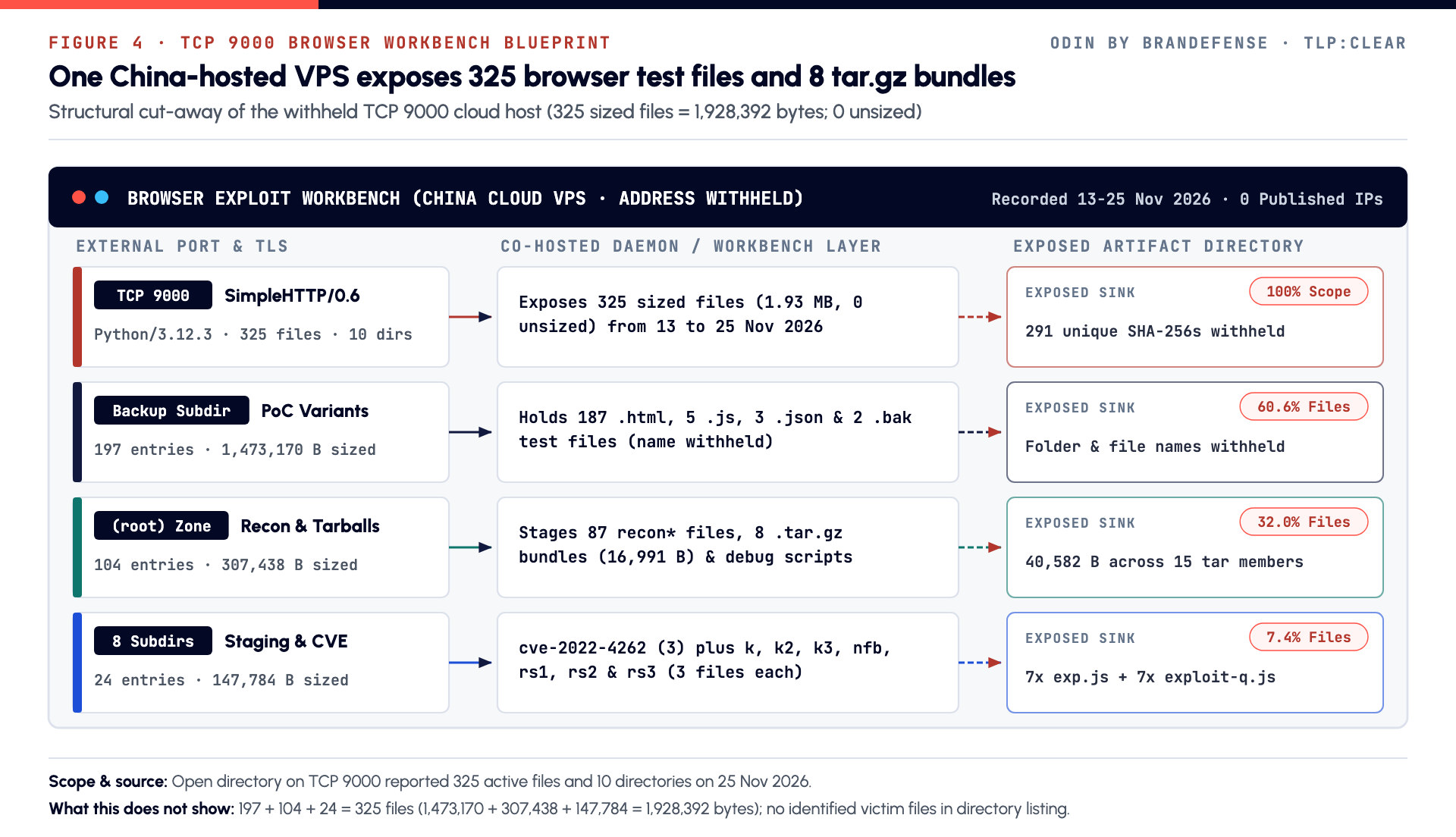
Four Artifact Classes and Five Directory Zones (1,928,392 Bytes)
Grouping the 325 entries by file type shows that the reviewed directory lists only web pages, JavaScript files, tarballs, and two .bak backups. The reviewed directory inventory lists no server binaries, private keys, or identified victim files. Table 2 reconciles all four file classes (248 + 67 + 8 + 2 = 325).
| Artifact class | Entries | Share (%) | Sized bytes | Byte share (%) | Extension breakdown |
|---|---|---|---|---|---|
text | 248 | 76.3% | 1,437,381 | 74.5% | 244 .html pages, 3 .json files, and 1 .txt file (test.txt, 10 B). |
script | 67 | 20.6% | 452,898 | 23.5% | 67 .js V8/Wasm recon, spray, and reproducer scripts. |
archive | 8 | 2.5% | 16,991 | 0.9% | 8 .tar.gz bundles (15 members = 40,582 B unpacked). |
data | 2 | 0.6% | 21,122 | 1.1% | 2 .bak backup files inside the withheld 197-entry folder. |
| Total | 325 | 100.0% | 1,928,392 | 100.0% | 325 sized files (0 unsized). |
Across the folder tree, 197 files (1,473,170 B, 60.6%) sit in the withheld backup subdirectory and 104 files (307,438 B, 32.0%) sit in (root). Eight named subdirectories hold the remaining 24 files (147,784 B, 7.4%). Folders /nfb and /rs1–/rs3 hold 12 files (70,800 B; 17,700 B per folder). Folders /k–/k3 hold 9 files (56,934 B), and /cve-2022-4262 holds 3 files (20,050 B).
Seven copies of exploit-q.js (9,996 B each) mirror /exploit-q.js across /k–/k3, /nfb, and /rs1–/rs3 (8 copies = 79,968 B). Matching 86-byte exp.html loaders and 7,618-byte exp.js scripts also repeat across /nfb and /rs1–/rs3, explaining the 34 duplicate copies.
3. CVE-2022-4262 Standard-Renderer Archives and Subdirectory Staging
This workbench stages a patched V8 reproducer beside later cage-recon archives. On TCP 9000, six entries (27,104 bytes) center on CVE-2022-4262, while seven .tar.gz bundles (12,269 bytes) store follow-on cage checks. Figure 4 shows the TCP 9000 server blueprint.
CVE-2022-4262 Patch Scope and Why no-natives Matters
Per NIST NVD ([REF-01]) and Google Chrome Releases ([REF-02]), CVE-2022-4262 is a high-severity type confusion in Google Chrome V8 before 108.0.5359.94. Google fixed the flaw in Desktop Stable update 108.0.5359.94/.95 on 2 December 2022 ([REF-02]). On unpatched builds below 108.0.5359.94, a crafted HTML page could trigger V8 heap corruption ([REF-01]).
Public bug-tracker test cases for V8 bugs often rely on % runtime intrinsics gated behind --allow-natives-syntax. Normal Chrome browsers reject those debug intrinsics. Two staged files adapt the reproducer for standard pre-108.0.5359.94 renderers:
- Standard-renderer
cveweb.tar.gz(4,722 bytes). Unpacking/cveweb.tar.gzyields 4 members totaling 12,467 bytes (336 lines). It packscve-2022-4262-no-natives.html(1,958 B),cve-2022-4262/exploit-no-natives.js(9,917 B), and two macOS AppleDouble._*stubs (374 B and 218 B = 592 B). Dropping--allow-natives-syntaxlets the page run in an unpatched browser build without debug flags. - Modular
exploit-loadable.js(9,915 bytes). Stored besideexploit-no-natives.jsinside/cve-2022-4262/, this 9,915-byte file lets separate HTML wrappers import the baseline script. The two AppleDouble._*stubs show that the archive was packed on macOS before upload to the Linux VPS.
Eight Packaged .tar.gz Bundles (16,991 Compressed Bytes)
Across the root directory, eight .tar.gz archives total 16,991 compressed bytes and unpack to 40,582 bytes (1,096 lines) across 15 members. Table 3 summarizes each bundle without printing exploit code or memory offsets.
| Archive path | Compressed bytes | Members | Unpacked bytes | Unpacked lines | Structural role |
|---|---|---|---|---|---|
/cveweb.tar.gz | 4,722 | 4 | 12,467 | 336 | cve-2022-4262-no-natives.html (1,958 B), exploit-no-natives.js (9,917 B), and 2 ._* stubs (592 B). |
/r6.tar.gz | 2,472 | 1 | 6,277 | 158 | Single-file bundle (recon6.js) testing constant spacing and indirect code-entry behavior. |
/recon4.tar.gz | 1,991 | 2 | 4,473 | 126 | recon4.js + recon4.html testing JIT-spray markers in TurboFan float64 constant pools. |
/recon5.tar.gz | 1,893 | 2 | 4,344 | 117 | recon5.js + recon5.html written to print candidate addresses and pause for /proc/mem checks. |
/recon3.tar.gz | 1,780 | 2 | 3,923 | 108 | recon3.js + recon3.html walking in-cage JSFunction-to-Code links before a write check. |
/recon2.tar.gz | 1,647 | 2 | 3,708 | 109 | recon2.js + recon2.html checking WebAssembly instance structures and jump tables. |
/r5.tar.gz | 1,345 | 1 | 3,037 | 79 | Single-file snapshot (recon5.js, 3,037 B) written to pause for local /proc/mem checks. |
/recon.tar.gz | 1,141 | 1 | 2,353 | 63 | Baseline script (recon.js, 2,353 B) checking JSTypedArray external_pointer and Wasm fields. |
| Total (8 bundles) | 16,991 | 15 | 40,582 | 1,096 | 4,722 B (cveweb.tar.gz) + 12,269 B (7 recon bundles = 28,115 B unpacked). |
Alongside those eight tarballs, (root) holds 87 unpacked recon* files (261,904 bytes). Those files run from recon.html/recon.js through recon24r.html/recon24r.js and peak at 13,028 bytes in recon24p.js. Root also holds diag-ladder.html (2,366 B), exploit-dbg.js (10,321 B), and three dbg103 pages (469 B, 1,358 B, and 1,691 B).
4. In-Cage Reconnaissance Versus Modern V8 Sandbox Boundaries
Checking recon.tar.gz through r6.tar.gz against V8 Sandbox design docs ([REF-03], [REF-04]) shows why older V8 chains stall on current Chrome. Figure 3 presents an analytical model of those staged checks against modern Chromium boundaries.
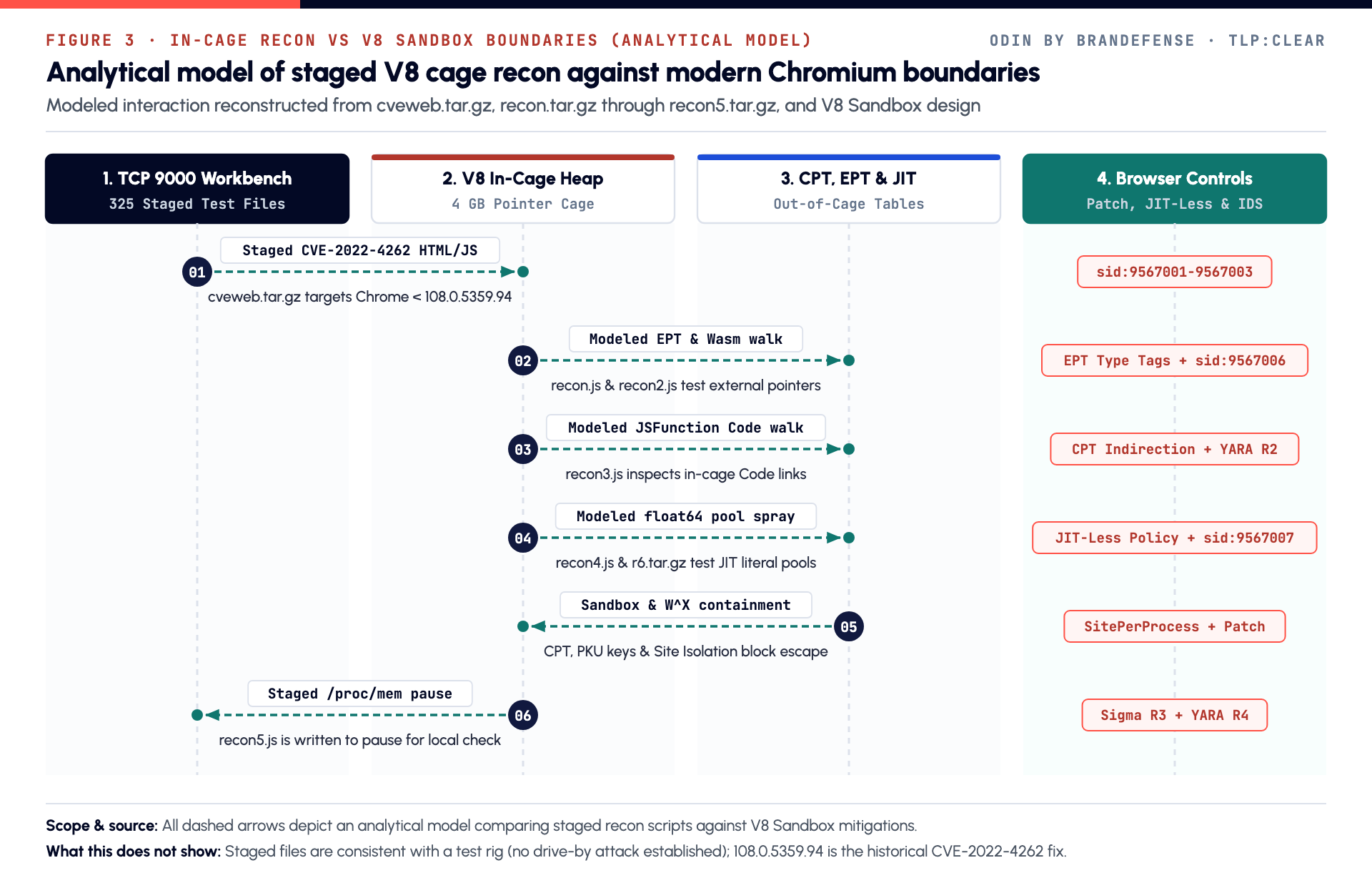
Four V8 Sandbox Barriers Tested by the recon* Scripts
On 64-bit systems, V8 Pointer Compression keeps JavaScript objects inside a 4 GB virtual cage using 32-bit offsets ([REF-03]). Older V8 exploits turned heap bugs into code execution by overwriting raw 64-bit pointers stored inside heap objects. Current Chromium releases enforce four barriers that block those paths:
- External Pointer Table (
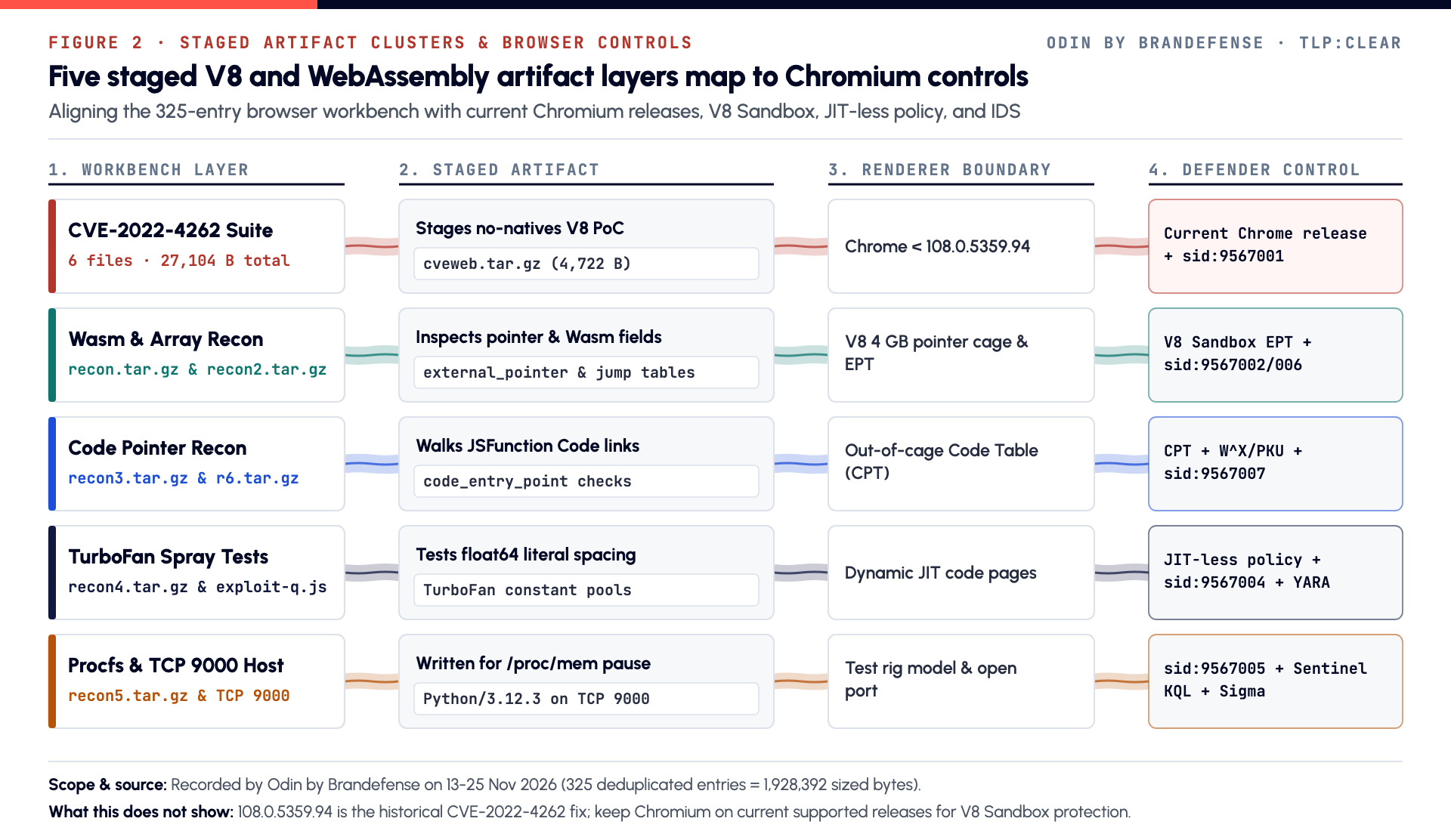
EPT) handles (recon.tar.gz, 2,353 B unpacked). Corrupting aJSTypedArraybacking-store pointer once gave arbitrary 64-bit memory read/write. The V8 Sandbox ([REF-03],[REF-04]) replaces raw C++ pointers with bounds-checked, type-tagged indices into an out-of-cageEPT. Whenrecon.jschecksexternal_pointerfields on modern Chrome, it meets table handles instead of raw addresses. - WebAssembly trusted data and
W^X/PKUpages (recon2.tar.gz, 3,708 B unpacked). WebAssemblyRWXjump tables were once a primary code-execution target. Modern V8 moves trusted Wasm state outside the cage and guards JIT pages withW^Xor hardwarePKUkeys ([REF-03],[REF-04]). That blocks direct jump-table writes tested inrecon2.js. - Code Pointer Table (
CPT) indirection (recon3.tar.gz3,923 B &r6.tar.gz6,277 B unpacked). Corrupting aJSFunctiononce let an attacker pointcode_entry_pointat shellcode. Chromium's Code Pointer Table (CPT) ([REF-04]) movesCodemetadata and native entry pointers outside the cage behind validated table handles. TurboFanfloat64pools and local/proc/mempauses (recon4.tar.gz4,473 B &recon5.tar.gz4,344 B unpacked). BecauseEPT,CPT, andW^Xblock raw pointer swaps,recon4.js,r6.tar.gz, andexploit-q.jstest constant spacing insideTurboFanfloat64pools. Scriptrecon5.js(inrecon5.tar.gzandr5.tar.gz) is written to printaddr_of,v8_read64, andv8_write64values to the page. It is written to pause for a local Linux/proc/<pid>/memcheck, consistent with a test rig rather than establishing a live drive-by attack.
Figure 2 links all five workbench artifact groups to browser policy and detection controls.
5. Enterprise Browser Exposure and Control Verification
Desktop and security teams should verify five concrete controls across corporate endpoints, developer hosts, and VDI pools rather than assuming unverified root causes:
| Exposure layer | Observed workbench evidence | Control to verify | Operational risk |
|---|---|---|---|
Legacy Chromium < 108.0.5359.94 | cveweb.tar.gz (4,722 B), cve-2022-4262-no-natives.html, and exploit-no-natives.js. | Verify that browsers, kiosks, PDF containers, and Electron apps run current supported Chromium releases (108.0.5359.94 is the historical fix for CVE-2022-4262; [REF-01], [REF-05], [REF-10]). | Pre-108.0.5359.94 V8 builds remain exposed to CVE-2022-4262, and outdated releases lack current V8 Sandbox hardening ([REF-03], [REF-07]). |
Unrestricted TurboFan & Wasm JIT | recon4.tar.gz (float64 pools), r6.tar.gz, 8x exploit-q.js, and recon2.tar.gz. | Verify whether high-risk profiles enforce DefaultJavaScriptJitSetting (Block JavaScript JIT) with allowlists ([REF-06]). | Active TurboFan and Wasm JIT compilers expose dynamic code-generation surfaces ([REF-03], [REF-06]). |
| Disabled sandbox or Site Isolation | no-natives vs --allow-natives-syntax tests and dbg103*.html debug pages. | Verify whether endpoint controls enforce SitePerProcess and block --no-sandbox, --allow-natives-syntax, and --disable-site-isolation-trials ([REF-08], [REF-12]). | Weakened flags strip OS sandbox and SitePerProcess barriers around renderer bugs ([REF-12]). |
| Direct high-port browser egress | Open SimpleHTTP/0.6 Python/3.12.3 directory on TCP 9000 serving 325 files ([REF-09]). | Verify whether firewalls and web gateways block direct browser calls to public hosts on TCP 9000 and peer high ports. | Unfiltered high-port egress lets browsers pull staged test pages and tarballs from ad-hoc VPS servers. |
Linux /proc/mem & http.server | recon5.tar.gz & r5.tar.gz (/proc/mem pauses) and Python/3.12.3 on TCP 9000. | Verify kernel.yama.ptrace_scope >= 1 on Linux hosts and alert on unapproved python3 -m http.server processes. | Same-UID processes can inspect browser memory or expose local security test folders online. |
6. Alternative Hypotheses
| Hypothesis | Evidence for | Evidence against | Assessment |
|---|---|---|---|
| Adversary browser-exploitation workbench | Pairs cveweb.tar.gz (CVE-2022-4262 no-natives), exploit-dbg.js, 8x exploit-q.js, and 94 V8 recon files on a VPS. | None; no-natives archives and /k*, /nfb, /rs* paths fit offensive preparation. | Supported. Treated consistently as an adversary workbench; IP, 291 hashes, and backup names stay withheld. |
| Benign web developer or QA server | Runs SimpleHTTP/0.6 Python/3.12.3 and holds test.txt (10 B) plus HTML pages. | Normal QA hosts never stage CVE-2022-4262 no-natives archives and float64 JIT-spray scripts. | Contradicted. Python's http.server here serves V8 exploitation test suites. |
| Confirmed active drive-by watering hole | Serves 244 .html and 67 .js files on TCP 9000, plus 7 exp.html loaders. | recon5.js is written to pause for a local /proc/mem check, CVE-2022-4262 dates to Dec 2022, and the reviewed directory lists no identified visitor logs or victim artifacts. | Not established by staged files. Staged files are consistent with a test rig; no live drive-by attack is established. |
| Backup folder names prove operator identity | The 197-entry backup folder (1,473,170 B) carries third-party research labels. | Operators routinely copy public PoC repos and conference writeups onto cloud servers. | Unsupported for attribution. Folder labels do not prove authorship; all 197 backup names stay withheld. |
7. Validated Detection Rules
The TCP 9000 server IP, all 291 file SHA-256 digests, and all 197 backup folder names are withheld. Each rule file therefore targets HTTP patterns, browser or Python CLI flags, or structural script strings.
Check scope (Publication Rules §6): all seven Suricata rules passed the Odin Suricata linter (0 problems). YAML checks verified all three Sigma rules, and structural checks verified the Sentinel KQL and YARA files. Live engine binaries (suricata -T, Kusto.Language, pySigma, and yara) were not installed on the build host. Rules were not replayed on live traffic, so test and tune them in staging before rollout.
7.1 Suricata 7.x Network Signatures (sid:9567001–9567007)
Rules sid:9567001 and sid:9567002 match outbound GET requests for /cveweb.tar.gz and /recon*.tar.gz (recon.tar.gz through recon5.tar.gz). Rules sid:9567003 and sid:9567004 match GET URIs pairing cve-2022-4262 with no-natives or ending in /exploit-q.js. Rules sid:9567005–9567007 match inbound HTTP 200 SimpleHTTP/ listings and V8 recon response bodies (external_pointer or code_entry_point with TurboFan).
All seven http rules require cleartext HTTP traffic (such as direct TCP 9000 sessions) or an IDS tap behind a TLS-terminating forward proxy. Because alert rules record events without blocking packets inline, enforce blocks in your web proxy or firewall.
# Odin by Brandefense - Monograph 67 Suricata 7.x Ruleset
# Syntax-checked with Odin Suricata linter (0 problems); test with suricata -T prior to deployment.

alert http $HOME_NET any -> $EXTERNAL_NET any (msg:"ODIN-R67 Outbound CVE-2022-4262 cveweb Archive Fetch"; flow:established,to_server; http.method; content:"GET"; bsize:3; http.uri; content:"/cveweb.tar.gz"; endswith; fast_pattern; classtype:attempted-user; sid:9567001; rev:1;)
alert http $HOME_NET any -> $EXTERNAL_NET any (msg:"ODIN-R67 Outbound V8 Cage Recon Tarball Fetch"; flow:established,to_server; http.method; content:"GET"; bsize:3; http.uri; content:"/recon"; fast_pattern; content:".tar.gz"; endswith; classtype:attempted-user; sid:9567002; rev:1;)
alert http $HOME_NET any -> $EXTERNAL_NET any (msg:"ODIN-R67 Outbound CVE-2022-4262 No-Natives Script Fetch"; flow:established,to_server; http.method; content:"GET"; bsize:3; http.uri; content:"cve-2022-4262"; nocase; fast_pattern; content:"no-natives"; nocase; classtype:attempted-user; sid:9567003; rev:1;)
alert http $HOME_NET any -> $EXTERNAL_NET any (msg:"ODIN-R67 Outbound Staged V8 exploit-q Script Fetch"; flow:established,to_server; http.method; content:"GET"; bsize:3; http.uri; content:"/exploit-q.js"; endswith; fast_pattern; classtype:attempted-user; sid:9567004; rev:1;)
alert http $EXTERNAL_NET any -> $HOME_NET any (msg:"ODIN-R67 Inbound SimpleHTTP Browser Workbench Listing"; flow:established,to_client; http.stat_code; content:"200"; bsize:3; http.header; content:"Server: SimpleHTTP/"; fast_pattern; http.response_body; content:"<title>Directory listing for /"; content:"cve-2022-4262"; nocase; classtype:web-application-activity; sid:9567005; rev:1;)
alert http $EXTERNAL_NET any -> $HOME_NET any (msg:"ODIN-R67 Inbound V8 External Pointer Recon Script"; flow:established,to_client; http.stat_code; content:"200"; bsize:3; http.response_body; content:"external_pointer"; fast_pattern; classtype:attempted-user; sid:9567006; rev:1;)
alert http $EXTERNAL_NET any -> $HOME_NET any (msg:"ODIN-R67 Inbound V8 Code Entry and TurboFan Recon Script"; flow:established,to_client; http.stat_code; content:"200"; bsize:3; http.response_body; content:"code_entry_point"; fast_pattern; content:"TurboFan"; classtype:attempted-user; sid:9567007; rev:1;)
7.2 Microsoft Sentinel KQL Hunt
This 7-day Sentinel query checks DeviceProcessEvents for Chrome, Edge, or d8 flags weakening renderer isolation (--no-sandbox, --allow-natives-syntax, --disable-site-isolation-trials) and Python http.server listeners on port 9000. It also checks DeviceNetworkEvents for browsers connecting to Public IPs on RemotePort in (WorkbenchHttpPorts) (9000). Replace the two placeholder hostnames in ApprovedBrowserTestHosts with your own QA runners before scheduling.
// Odin by Brandefense - Monograph 67
// Hunts Chromium/d8 sandbox-weakening flags, unapproved Python SimpleHTTP staging on TCP 9000, and browser egress to public TCP 9000 hosts.
let Lookback = 7d;
let ApprovedBrowserTestHosts = dynamic(["qa-runner-01.corp.example", "browser-ci-01.corp.example"]);
let WorkbenchHttpPorts = dynamic([9000]);
let UnsafeChromiumOrV8Cli =
    DeviceProcessEvents
    | where Timestamp >= ago(Lookback)
    | where not(DeviceName in~ (ApprovedBrowserTestHosts))
    | where FileName in~ ("chrome.exe", "chrome", "chromium", "msedge.exe", "msedge", "d8", "d8.exe")
    | where ProcessCommandLine contains "--no-sandbox" or ProcessCommandLine contains "--allow-natives-syntax" or ProcessCommandLine contains "--disable-site-isolation-trials"
    | project Timestamp, DeviceName, AccountName, SignalType = "UnsafeBrowserSandboxOrV8Flag", Detail = ProcessCommandLine;
let PythonSimpleHttpPort9000 =
    DeviceProcessEvents
    | where Timestamp >= ago(Lookback)
    | where not(DeviceName in~ (ApprovedBrowserTestHosts))
    | where FileName in~ ("python", "python3", "python.exe")
    | where ProcessCommandLine contains "http.server" and ProcessCommandLine contains "9000"
    | project Timestamp, DeviceName, AccountName, SignalType = "PythonSimpleHttpPort9000", Detail = ProcessCommandLine;
let BrowserHighPortPublicEgress =
    DeviceNetworkEvents
    | where Timestamp >= ago(Lookback)
    | where not(DeviceName in~ (ApprovedBrowserTestHosts))
    | where InitiatingProcessFileName in~ ("chrome.exe", "chrome", "chromium", "msedge.exe", "msedge")
    | where RemoteIPType == "Public" and RemotePort in (WorkbenchHttpPorts)
    | project Timestamp, DeviceName, AccountName = InitiatingProcessAccountName, SignalType = "BrowserPublicTcp9000Egress", Detail = strcat(InitiatingProcessFileName, " -> ", RemoteIP, ":", tostring(RemotePort));
union UnsafeChromiumOrV8Cli, PythonSimpleHttpPort9000, BrowserHighPortPublicEgress
| summarize FirstSeen = min(Timestamp), LastSeen = max(Timestamp), EventCount = count(), Signals = make_set(SignalType, 6), SampleDetails = make_set(Detail, 5) by DeviceName, AccountName
| order by LastSeen desc
7.3 Portable Sigma Process-Creation Rules (3 Rules)
Rule 1 (T1203) flags /chrome, /chromium, /msedge, or /d8 launched with --no-sandbox, --allow-natives-syntax, or --disable-site-isolation-trials. Rule 2 (T1608) catches Python http.server bound to port 9000 ([REF-09]). Rule 3 (T1203) detects python, python3, dd, or gdb command lines containing /proc/ and /mem, using exact ComputerName allowlists.
title: Chromium or V8 Shell Launched With Disabled Sandbox or Natives Syntax
id: 67b2d4f1-9c12-4a83-8e25-67a19c83d201
status: experimental
description: Detects Chromium, Edge, or V8 d8 processes launched with flags that disable OS renderer sandboxing, Site Isolation, or V8 native-syntax restrictions.
author: Odin by Brandefense
date: 2026-11-25
logsource:
  category: process_creation
  product: linux
detection:
  selection_bin:
    Image|endswith:
      - '/chrome'
      - '/chromium'
      - '/msedge'
      - '/d8'
  selection_flags:
    CommandLine|contains:
      - '--no-sandbox'
      - '--allow-natives-syntax'
      - '--disable-site-isolation-trials'
  filter_qa_hosts:
    ComputerName:
      - 'qa-runner-01.corp.example'
      - 'browser-ci-01.corp.example'
  condition: selection_bin and selection_flags and not filter_qa_hosts
falsepositives:
  - Dedicated browser QA automation runners explicitly listed in the host allowlist
level: high
tags:
  - attack.execution
  - attack.t1203
---
title: Unauthenticated Python SimpleHTTP Directory Staging on TCP 9000
id: 67b2d4f1-9c12-4a83-8e25-67a19c83d202
status: experimental
description: Detects Python http.server directory listeners bound to port 9000 matching the exposed browser-exploitation workbench profile.
author: Odin by Brandefense
date: 2026-11-25
logsource:
  category: process_creation
  product: linux
detection:
  selection_py:
    Image|endswith:
      - '/python'
      - '/python3'
  selection_mod:
    CommandLine|contains: 'http.server'
  selection_port:
    CommandLine|contains:
      - 'http.server 9000'
      - '0.0.0.0 9000'
  filter_dev_hosts:
    ComputerName:
      - 'browser-ci-01.corp.example'
  condition: selection_py and selection_mod and selection_port and not filter_dev_hosts
falsepositives:
  - Approved local development servers running on isolated build hosts
level: medium
tags:
  - attack.resource-development
  - attack.t1608
---
title: Linux Process Inspecting Target Virtual Memory via Procfs Mem
id: 67b2d4f1-9c12-4a83-8e25-67a19c83d203
status: experimental
description: Detects command-line tools reading /proc/<pid>/mem directly to inspect live renderer cage addresses as referenced in staged V8 recon5 test scripts.
author: Odin by Brandefense
date: 2026-11-25
logsource:
  category: process_creation
  product: linux
detection:
  selection_tool:
    Image|endswith:
      - '/python'
      - '/python3'
      - '/dd'
      - '/gdb'
  selection_proc:
    CommandLine|contains: '/proc/'
  selection_mem:
    CommandLine|contains: '/mem'
  filter_sec_lab:
    ComputerName:
      - 'sec-lab-01.corp.example'
  condition: selection_tool and selection_proc and selection_mem and not filter_sec_lab
falsepositives:
  - Authorized crash-triage or debugging workflows on designated lab hosts
level: high
tags:
  - attack.execution
  - attack.t1203
7.4 Structural YARA Rules (4 filesize-Bounded Rules)
Rules 1 and 2 (filesize < 512KB) match unpacked CVE-2022-4262 no-natives scripts and in-cage JSFunction pointer scripts. Rules 3 and 4 match TurboFan float64 constant-pool spray tests and V8 address-inspection harnesses (addr_of, v8_read64, and v8_write64).
/*
   Odin by Brandefense - Monograph 67 YARA Suite
   4 filesize-bounded structural rules covering CVE-2022-4262 no-natives reproducers,
   V8 in-cage JSFunction/Code pointer recon scripts, TurboFan float64 constant-pool spray tests,
   and V8 renderer address-inspection harnesses on disk.
*/

rule ODIN_V8_CVE_2022_4262_NoNatives_Reproducer
{
    meta:
        author = "Odin by Brandefense"
        monograph = "67"
        description = "Detects unpacked CVE-2022-4262 standard-renderer V8 type-confusion test files"
        date = "2026-11-25"
    strings:
        $c1 = "CVE-2022-4262" ascii nocase
        $n1 = "exploit-no-natives" ascii nocase
        $n2 = "allow-natives-syntax" ascii nocase
    condition:
        filesize < 512KB and $c1 and ($n1 or $n2)
}

rule ODIN_V8_InCage_CodePointer_Recon_Script
{
    meta:
        author = "Odin by Brandefense"
        monograph = "67"
        description = "Detects V8 pointer-compression cage reconnaissance scripts walking JSFunction and Code object fields"
        date = "2026-11-25"
    strings:
        $s1 = "JSFunction" ascii
        $s2 = "code_entry_point" ascii
        $a1 = "external_pointer" ascii
        $a2 = "in-cage" ascii nocase
    condition:
        filesize < 512KB and $s1 and ($s2 or $a1) and $a2
}

rule ODIN_V8_TurboFan_Float64_JITSpray_Test
{
    meta:
        author = "Odin by Brandefense"
        monograph = "67"
        description = "Detects V8 JIT-spray diagnostic scripts testing TurboFan float64 constant-pool spacing"
        date = "2026-11-25"
    strings:
        $t1 = "TurboFan" ascii
        $t2 = "float64" ascii
        $p1 = "constant pool" ascii nocase
        $p2 = "JIT-spray" ascii nocase
    condition:
        filesize < 512KB and $t1 and $t2 and ($p1 or $p2)
}

rule ODIN_V8_ProcMem_Renderer_Inspection_Script
{
    meta:
        author = "Odin by Brandefense"
        monograph = "67"
        description = "Detects V8 address-inspection harnesses containing addr_of, v8_read64 and v8_write64."
        date = "2026-11-25"
    strings:
        $v1 = "addr_of" ascii
        $v2 = "v8_read64" ascii
        $v3 = "v8_write64" ascii
    condition:
        filesize < 512KB and all of ($v*)
}
8. Behavioral and Protocol Hunt Markers (0 Published IPs or File SHA-256s)
The Indicators tab holds 0 published IPv4 addresses and 0 file SHA-256 digests. The TCP 9000 server IP, all 291 unique SHA-256 digests, and all 197 backup folder filenames are withheld. Defenders can hunt with the 10 protocol, CLI, and host markers below.
| Marker category | Pattern / protocol artifact | Layer | Defensive hunt & control |
|---|---|---|---|
cveweb archive URI | /cveweb.tar.gz (4,722 B) | Outbound HTTP GET | Alert at web proxies with sid:9567001 and keep Chromium on current supported releases (108.0.5359.94 fixed CVE-2022-4262). |
| Recon tarball URIs | /recon*.tar.gz (recon.tar.gz–recon5.tar.gz, 8,452 B) | Outbound HTTP GET | Alert with sid:9567002 (r5.tar.gz and r6.tar.gz add 3,817 B on disk). |
no-natives reproducer URI | cve-2022-4262 paired with no-natives (11,875 B) | Outbound HTTP GET | Alert on visible HTTP with sid:9567003 and YARA Rule 1. |
| Staged spray script URI | /exploit-q.js (8 copies × 9,996 B = 79,968 B) | Outbound HTTP GET | Alert with sid:9567004 across root and /k*, /nfb, /rs* paths. |
| Workbench directory banner | Server: SimpleHTTP/0.6 Python/3.12.3 + cve-2022-4262 | Inbound HTTP 200 | Alert with sid:9567005 and block direct browser TCP 9000 egress. |
| External pointer script body | external_pointer in the recon.js baseline (2,353 B) | Inbound HTTP 200 | Alert on decrypted proxy traffic with sid:9567006 and YARA Rule 2. |
| Code-entry & JIT script body | code_entry_point + TurboFan | Inbound HTTP 200 | Alert with sid:9567007, YARA Rules 2–3, and JIT-less policy. |
| Sandbox-weakening CLI flags | --no-sandbox / --allow-natives-syntax / --disable-site-isolation-trials | Browser / d8 CLI | Hunt with Sentinel UnsafeChromiumOrV8Cli and Sigma Rule 1. |
| Ad-hoc Python HTTP staging | python3 -m http.server 9000 | Endpoint process CLI | Hunt unapproved port-9000 staging servers with Sentinel KQL and Sigma Rule 2. |
Renderer /proc/mem pause | /proc/<pid>/mem read + recon5.js (addr_of, v8_read64, v8_write64) | Linux host / disk | Enforce yama.ptrace_scope >= 1, hunt procfs reads with Sigma Rule 3, and scan scripts with YARA Rule 4. |
9. Hardening Priorities for Enterprise Browser Fleets
Desktop engineering and security operations teams can apply five practical steps in order:
- Keep Chrome and other Chromium-based browsers on current supported security releases, with prompt relaunches (
0–48 Hours). Keep Chrome, Edge, kiosk images, headless browser containers, and Electron apps on current supported security releases;108.0.5359.94is the historical fix forCVE-2022-4262([REF-01],[REF-02],[REF-03]). SetRelaunchNotificationto Required andRelaunchNotificationPeriodto 48–72 hours; useRelaunchWindowonly to schedule the restart time ([REF-05],[REF-10],[REF-11]). - Apply V8 JIT-less policies (
DefaultJavaScriptJitSetting) to high-risk users (0–72 Hours). Block JavaScript JIT by default (DefaultJavaScriptJitSetting = 2) for executives, admins, finance staff, and SOC analysts. UseJavaScriptJitAllowedForSitesto allowlist vetted internal apps that need WebAssembly orTurboFanspeed ([REF-03],[REF-06]). - Lock
SitePerProcessand alert on unsafe browser flags (Days 1–7). EnforceSitePerProcess = truein browser policy so cross-site pages stay isolated behind V8 Sandbox (EPTandCPT) boundaries ([REF-03],[REF-04],[REF-12]). Schedule Sentinel KQL and Sigma Rule 1 to catch--no-sandboxor--allow-natives-syntaxoutside QA hosts ([REF-08]). - Block direct workstation browser egress to
TCP 9000and peer high ports (Days 7–14). Stop user browsers from opening direct HTTP connections to uncategorized public servers on non-standard ports ([REF-07],[REF-09]). Route web traffic through a TLS-inspecting forward proxy watched by Suricatasid:9567001–9567007. - Lock Linux
yama.ptrace_scopeand audithttp.serverlisteners (Days 14–21). Verifysysctl kernel.yama.ptrace_scope = 1(or 2 on non-dev systems) so peer processes cannot read/proc/<pid>/mem(recon5.tar.gz). Use Sigma Rules 2 and 3 to catch unapprovedpython3 -m http.server 9000staging and/proc/*/memreads.
10. Scope, Limits, and Sources
Odin by Brandefense studied open-directory listings and archive metadata on TCP 9000 (SimpleHTTP/0.6 Python/3.12.3) of a China-hosted cloud server from 13 to 25 November 2026. On 25 November 2026, the open directory reported 325 active files and 10 directories (325 sized files = 1,928,392 bytes, 0 unsized entries, and 291 unique SHA-256 digests).
All findings come from static file and archive metadata review; zero scripts were run against targets and zero exploit snippets or hex offsets are published. Staged CVE-2022-4262 files (cveweb.tar.gz) and recon* scripts (recon5.js is written to pause for a local /proc/mem check) are consistent with a test rig. No live drive-by attack is established, and the reviewed directory contained no identified visitor logs or victim artifacts. The server IP, all 291 file SHA-256 digests, and all folder and file names inside the 197-entry backup subdirectory (1,473,170 bytes) are withheld.
[REF-01]NIST NVD, *CVE-2022-4262 Detail (V8 < 108.0.5359.94)* (verified on 25 November 2026).[REF-02]Chrome Releases, *Desktop Update 108.0.5359.94/.95* (verified on 25 November 2026).[REF-03]V8 Blog, *The V8 Sandbox: High-Level Design* (verified on 25 November 2026).[REF-04]Chromium V8 Docs, *V8 Sandbox README and CPT Design* (verified on 25 November 2026).[REF-05]Google Security, *An Update on Chrome Security Updates* (verified on 25 November 2026).[REF-06]Chrome Enterprise, *DefaultJavaScriptJitSetting Policy* (verified on 25 November 2026).[REF-07]MITRE ATT&CK, *Drive-by Compromise (T1189)* (verified on 25 November 2026).[REF-08]MITRE ATT&CK, *Exploitation for Client Execution (T1203)* (verified on 25 November 2026).[REF-09]MITRE ATT&CK, *Stage Capabilities (T1608)* (verified on 25 November 2026).[REF-10]Chrome Enterprise, *RelaunchNotificationPeriod Policy* (verified on 25 November 2026).[REF-11]Chrome Enterprise, *RelaunchWindow Policy* (verified on 25 November 2026).[REF-12]Chrome Enterprise, *SitePerProcess Policy* (verified on 25 November 2026).
Frequently asked questions
How was the 325-file browser workbench organized on TCP 9000?
Sorting all 325 files into six mutually exclusive clusters separates bulk backup pages from active V8 Sandbox tests. Desktop security teams can use vulnerability intelligence to audit Chromium version floors against legacy renderer flaws. Analysts can pair those patch checks with cyber threat intelligence when hunting staged archive paths in web gateway telemetry.
Why did the operator pair CVE-2022-4262 with 94 V8 cage recon files?
CVE-2022-4262 is a V8 type-confusion flaw in Google Chrome before 108.0.5359.94, fixed in December 2022. Public V8 bug reports usually rely on --allow-natives-syntax debug intrinsics that normal Chrome builds reject.
Does this workbench show live drive-by attacks on external visitors?
No live drive-by attack is established. A remote page cannot itself read a visitor’s /proc/<pid>/mem; recon5.js is written to pause for a local check, consistent with a test rig. The reviewed directory contained no identified visitor logs or victim artifacts.
What should enterprise browser and SOC teams do first?
Defenders can harden Chromium fleets and catch workbench staging with four practical controls: The Indicators tab lists 0 IPv4 or SHA-256 rows because all host addresses and file digests are withheld. Section 8 of the full report lists 10 HTTP, CLI, and host hunt markers, and the Detection rules tab provides Suricata, Sentinel KQL, Sigma, and YARA rules.