
Key takeaways
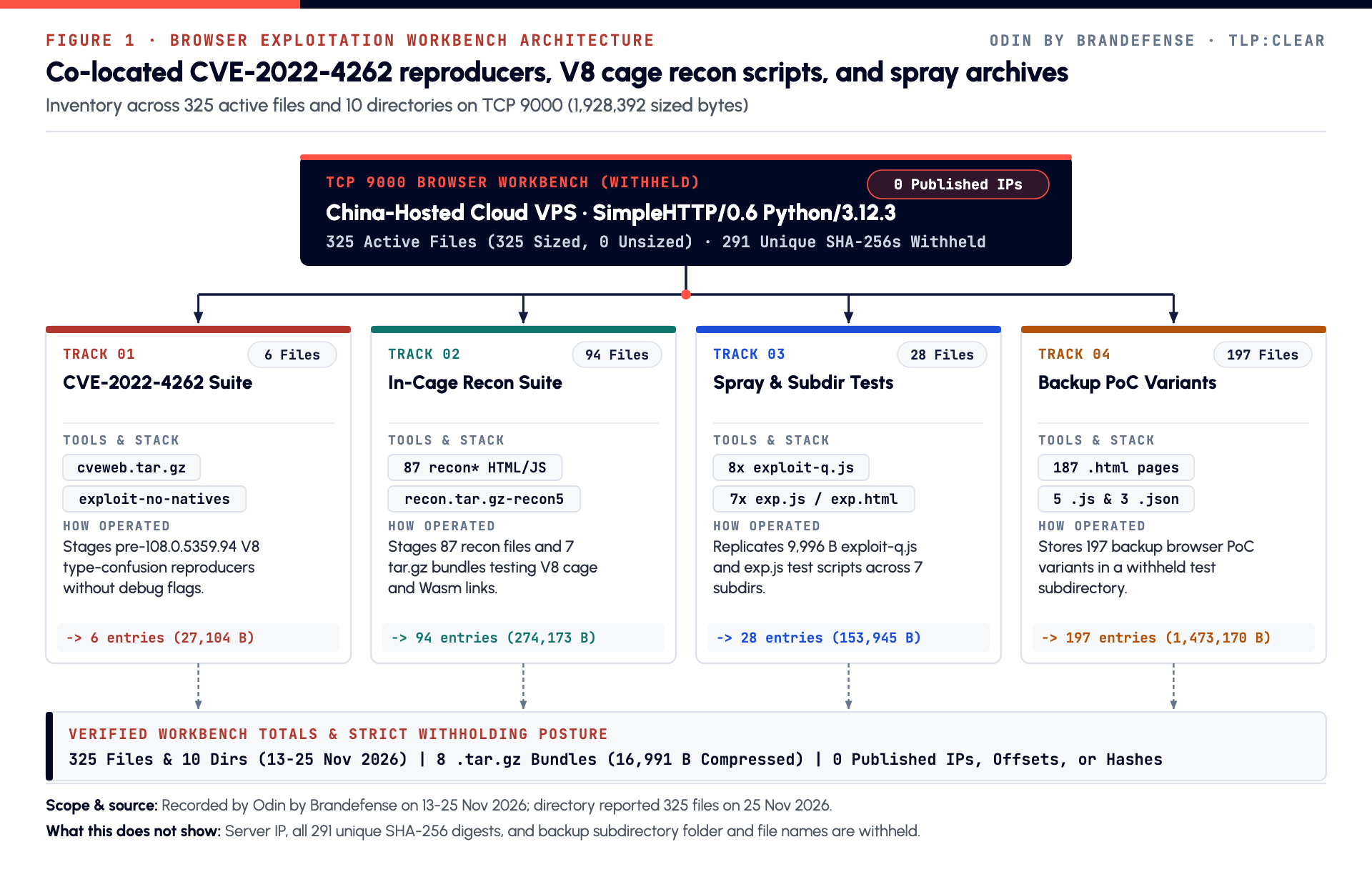
- An open Python HTTP directory on TCP 9000 recorded on 13–25 November 2026 held 325 sized browser test files (1,928,392 bytes) across 10 directories.
- Six CVE-2022-4262 entries (27,104 bytes), led by cveweb.tar.gz (4,722 bytes), package V8 type-confusion reproducers that run without --allow-natives-syntax.
- Ninety-four in-cage recon files (87 root recon* HTML/JS files and 7 tar.gz bundles) test external pointers, Wasm jump tables, Code entry links, and float64 pools.
- Packaged recon5.tar.gz and r5.tar.gz scripts are written to pause for local Linux /proc/mem checks, consistent with a test rig; no live drive-by attack is established.
- Keep Chrome and Chromium browsers on current supported security releases (108.0.5359.94 is the historical fix for CVE-2022-4262), enable JIT-less policies, lock SitePerProcess, and block TCP 9000 egress.
An open Python HTTP server on TCP 9000 staged 325 browser exploit and V8 memory-cage test files on a China-hosted cloud server. Odin by Brandefense recorded the SimpleHTTP/0.6 Python/3.12.3 directory on 13–25 November 2026, with 325 active files and 10 directories listed on 25 November 2026.
Deduplicating all paths yields 325 sized files totaling 1,928,392 bytes (1.93 MB), 0 unsized entries, and 291 unique SHA-256 digests (34 duplicate copies). We assess this host consistently as an adversary browser-exploitation workbench. The server IP, all 291 file hashes, and all names inside a 197-entry backup folder are withheld.
How was the 325-file browser workbench organized on TCP 9000?
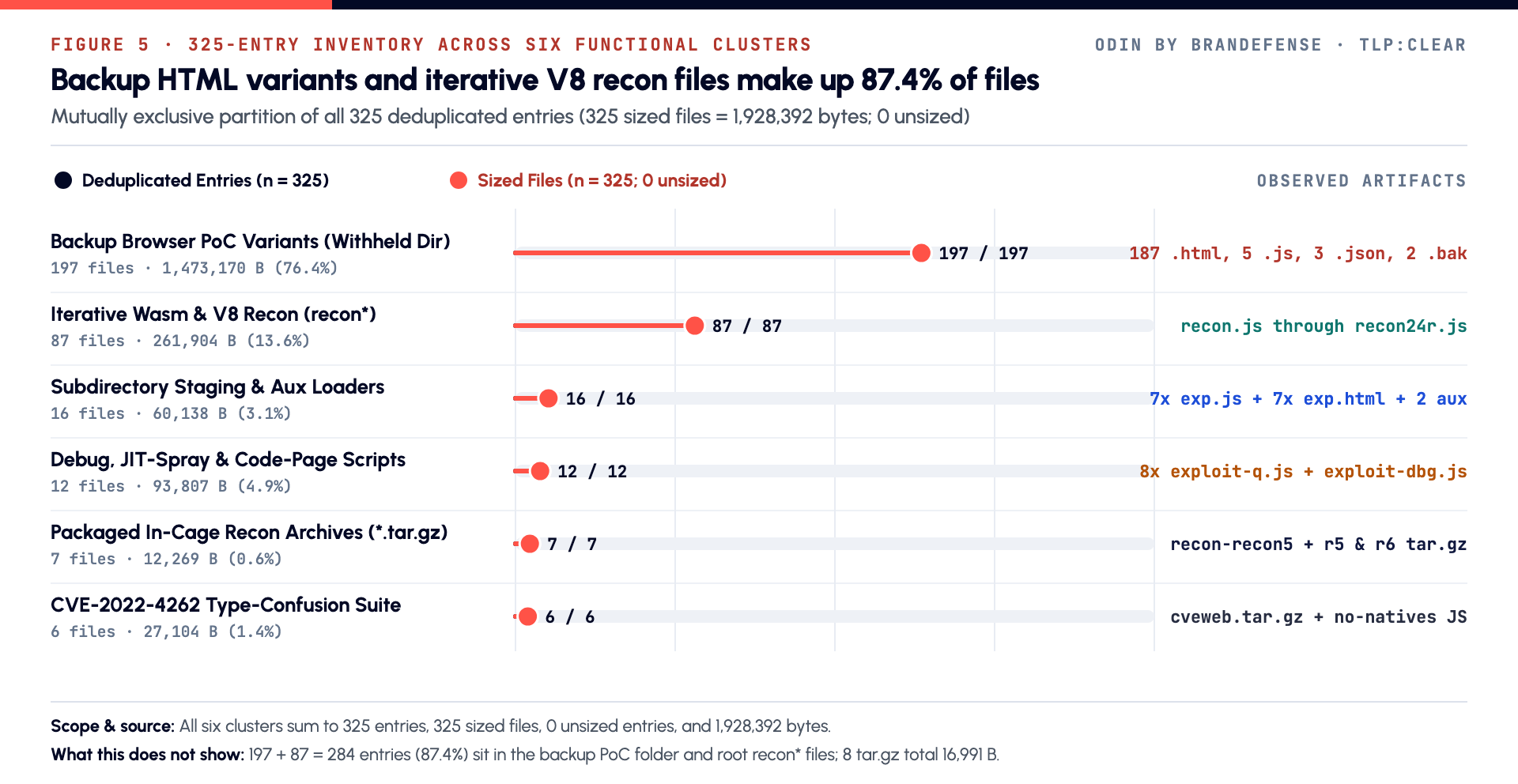
Sorting all 325 files into six mutually exclusive clusters separates bulk backup pages from active V8 Sandbox tests. Desktop security teams can use vulnerability intelligence to audit Chromium version floors against legacy renderer flaws. Analysts can pair those patch checks with cyber threat intelligence when hunting staged archive paths in web gateway telemetry.
Two groups account for 87.4% of all files (284 of 325) and 90.0% of byte volume (1,735,074 bytes). A withheld backup test subdirectory holds 197 browser PoC variants (1,473,170 bytes: 187 .html, 5 .js, 3 .json, and 2 .bak). Root recon* files add 87 iterative V8 and WebAssembly scripts and pages (261,904 bytes), peaking at 13,028 bytes in recon24p.js.
Folder and file labels inside the 197-entry backup folder reflect copied public PoC names that do not prove operator identity, so we withhold them. The other 41 files (193,318 bytes) hold eight .tar.gz bundles, CVE-2022-4262 scripts, and debug pages. Seven short subdirectories (/k–/k3, /nfb, and /rs1–/rs3) hold three staged files each.
| Functional cluster | Entries | Share (%) | Sized bytes | Core observed artifacts |
|---|---|---|---|---|
| Backup Browser PoC Variants | 197 | 60.6% | 1,473,170 | 187 .html, 5 .js, 3 .json, 2 .bak in a withheld folder. |
Iterative Wasm & V8 Recon (recon*) | 87 | 26.8% | 261,904 | Root files from recon.html/recon.js to recon24r.html/recon24r.js. |
| Subdirectory Staging & Aux Loaders | 16 | 4.9% | 60,138 | 7 exp.js scripts, 7 86-byte exp.html loaders, diag-ladder.html, test.txt. |
| Debug, JIT-Spray & Code-Page Scripts | 12 | 3.7% | 93,807 | exploit-dbg.js (10,321 B), 8x exploit-q.js (9,996 B each), dbg103*.html. |
Packaged Recon Archives (*.tar.gz) | 7 | 2.2% | 12,269 | r6, recon4, recon5, recon3, recon2, r5, and recon tarballs. |
CVE-2022-4262 Reproducer Suite | 6 | 1.8% | 27,104 | exploit-no-natives.js, exploit-loadable.js, cveweb.tar.gz, HTML loader, 2 ._* stubs. |
Why did the operator pair CVE-2022-4262 with 94 V8 cage recon files?
CVE-2022-4262 is a V8 type-confusion flaw in Google Chrome before 108.0.5359.94, fixed in December 2022. Public V8 bug reports usually rely on --allow-natives-syntax debug intrinsics that normal Chrome builds reject.
Archive /cveweb.tar.gz (4,722 bytes) unpacks to 12,467 bytes across 4 members. Inside it, cve-2022-4262-no-natives.html (1,958 B) and exploit-no-natives.js (9,917 B) drop those debug flags so the test runs in a standard pre-108.0.5359.94 renderer. Two ._* AppleDouble stubs (592 B) show macOS packaging.
With the V8 Sandbox enabled, in-cage corruption alone does not establish out-of-sandbox writes or code execution; out-of-sandbox reads may remain possible. Across recon.tar.gz through r6.tar.gz (12,269 bytes compressed; 28,115 bytes unpacked across 11 members), staged scripts probe four V8 Sandbox barriers:
- External Pointer Table (
EPT). Archiverecon.tar.gz(recon.js, 2,353 B) checksJSTypedArrayexternal_pointerfields. Modern V8 swaps raw C++ backing pointers for bounds-checked, type-taggedEPThandles outside the 4 GB cage. - WebAssembly jump tables and
W^X/PKU. Archiverecon2.tar.gz(3,708 B unpacked) checks WebAssembly instance structures and page flags. Current V8 moves trusted Wasm state out of the cage and guards JIT pages withW^Xor hardwarePKUkeys. - Code Pointer Table (
CPT). Archivesrecon3.tar.gz(3,923 B unpacked) andr6.tar.gz(6,277 B unpacked) walkJSFunctioncode_entry_pointlinks.CPTindirection movesCodeentry pointers out of the untrusted heap. TurboFanfloat64pools and/proc/mempauses. Archiverecon4.tar.gz(4,473 B unpacked) and 8 copies ofexploit-q.js(9,996 B each) testTurboFanfloat64constant-pool spacing. Archivesrecon5.tar.gz(4,344 B unpacked) andr5.tar.gz(3,037 B unpacked) are written to pause execution for a local Linux/proc/<pid>/memcheck.
Does this workbench show live drive-by attacks on external visitors?
No live drive-by attack is established. A remote page cannot itself read a visitor’s /proc/<pid>/mem; recon5.js is written to pause for a local check, consistent with a test rig. The reviewed directory contained no identified visitor logs or victim artifacts.
What should enterprise browser and SOC teams do first?
Defenders can harden Chromium fleets and catch workbench staging with four practical controls:
- Keep Chrome and other Chromium-based browsers on current supported security releases, with prompt relaunches;
108.0.5359.94is the historical fix for CVE-2022-4262. Audit Chrome, Edge, kiosk systems, headless containers, and Electron apps against known exploited vulnerabilities and setRelaunchNotificationto Required withRelaunchNotificationPeriodat 48–72 hours. - Enable V8 JIT-less policies for high-risk profiles. Set
DefaultJavaScriptJitSetting(Block JavaScript JIT) for executives, admins, and finance teams while allowlisting vetted internal web apps that need WebAssembly orTurboFan. - Lock
SitePerProcessand alert on unsafe CLI flags. Enforce mandatory Site Isolation and run Sentinel KQL and Sigma Rule 1 to catch--no-sandbox,--allow-natives-syntax, or--disable-site-isolation-trialsoutside QA hosts. - Block
TCP 9000browser egress and run proxy/YARA rules. Block direct workstation browser calls to public high ports, and run Suricatasid:9567001–9567007 behind TLS proxies. Set Linuxkernel.yama.ptrace_scope >= 1and scan test files with our four YARA rules.
The full report's Indicators tab lists 0 IPv4 or SHA-256 rows because all host addresses and file digests are withheld. Section 8 of the full report lists 10 HTTP, CLI, and host hunt markers, and the full report's Detection rules tab provides Suricata, Sentinel KQL, Sigma, and YARA rules.
Frequently asked questions
How was the 325-file browser workbench organized on TCP 9000?
Sorting all 325 files into six mutually exclusive clusters separates bulk backup pages from active V8 Sandbox tests. Desktop security teams can use vulnerability intelligence to audit Chromium version floors against legacy renderer flaws. Analysts can pair those patch checks with cyber threat intelligence when hunting staged archive paths in web gateway telemetry.
Why did the operator pair CVE-2022-4262 with 94 V8 cage recon files?
CVE-2022-4262 is a V8 type-confusion flaw in Google Chrome before 108.0.5359.94, fixed in December 2022. Public V8 bug reports usually rely on --allow-natives-syntax debug intrinsics that normal Chrome builds reject.
Does this workbench show live drive-by attacks on external visitors?
No live drive-by attack is established. A remote page cannot itself read a visitor’s /proc/<pid>/mem; recon5.js is written to pause for a local check, consistent with a test rig. The reviewed directory contained no identified visitor logs or victim artifacts.
What should enterprise browser and SOC teams do first?
Defenders can harden Chromium fleets and catch workbench staging with four practical controls: The Indicators tab lists 0 IPv4 or SHA-256 rows because all host addresses and file digests are withheld. Section 8 of the full report lists 10 HTTP, CLI, and host hunt markers, and the Detection rules tab provides Suricata, Sentinel KQL, Sigma, and YARA rules.