
Key takeaways
- An exposed staging workbench on a China-hosted cloud server exposed 186 active files and 21 directories (57.08 MB) on TCP 8090 across 13-25 November 2026.
- Thirty-six entries from 13 November (56.97 MB, 99.8% of bytes) stage VShell configs, web UI bundles, Python helpers, and GOST and fscan binaries.
- One hundred fifty entries from 25 November (117.15 KB) add 142 blind-SQL, IIS, and xp_cmdshell JSON files alongside five JNDI callback files.
- Compiled Exploit.class bytecode references /RCE_PROOF and /RCE_ERR on TCP 8091; JSON and log bodies were not retrieved and target execution is unverified.
- Keep xp_cmdshell disabled, strip sysadmin from web SQL logins, enforce read-only IIS webroots, patch Log4j2, and block direct database and JVM internet egress.
An open TCP 8090 directory on a China-hosted cloud server paired staged VShell and GOST tunnel plugins with 142 blind-SQL, IIS, and xp_cmdshell JSON files. Odin by Brandefense analyzed all 186 deduplicated entries from this exposed staging workbench recorded on 13–25 November 2026.
The directory exposes an RSA private-key file (1,679 B; location withheld), an operator token file (217 B; location withheld), and 142 Wave 2 JSON probe files. Zero server IPv4 addresses and zero file SHA-256 digests are therefore published (166 unique digests withheld). Candidate VShell ports 8888 and 7878, target-output filenames, cloud socket names, and target identifiers are also withheld.
How Were the 186 Files Organized Across the 13 and 25 November Waves?
On 25 November 2026, the open Python directory (SimpleHTTP/0.6 Python/3.14.4) reported 186 active files and 21 directories. Every item seen on 13 November stayed on disk on 25 November. That live count matches all 186 deduplicated entries, spanning 176 sized files (57,082,695 bytes) and 10 unsized items.
Two dated waves split the workbench cleanly. Wave 1 (13 November 2026) recorded 36 entries (26 sized files = 56,965,544 bytes, 99.8% of byte volume, plus 10 unsized entries). Wave 2 (25 November 2026) added 150 sized files totaling 117,151 bytes (117.15 KB).
Platform security teams rely on external attack surface management to spot exposed web endpoints before SQL probing begins. SOC analysts also apply cyber threat intelligence to connect staged tunnel kits with database and Java probing patterns.
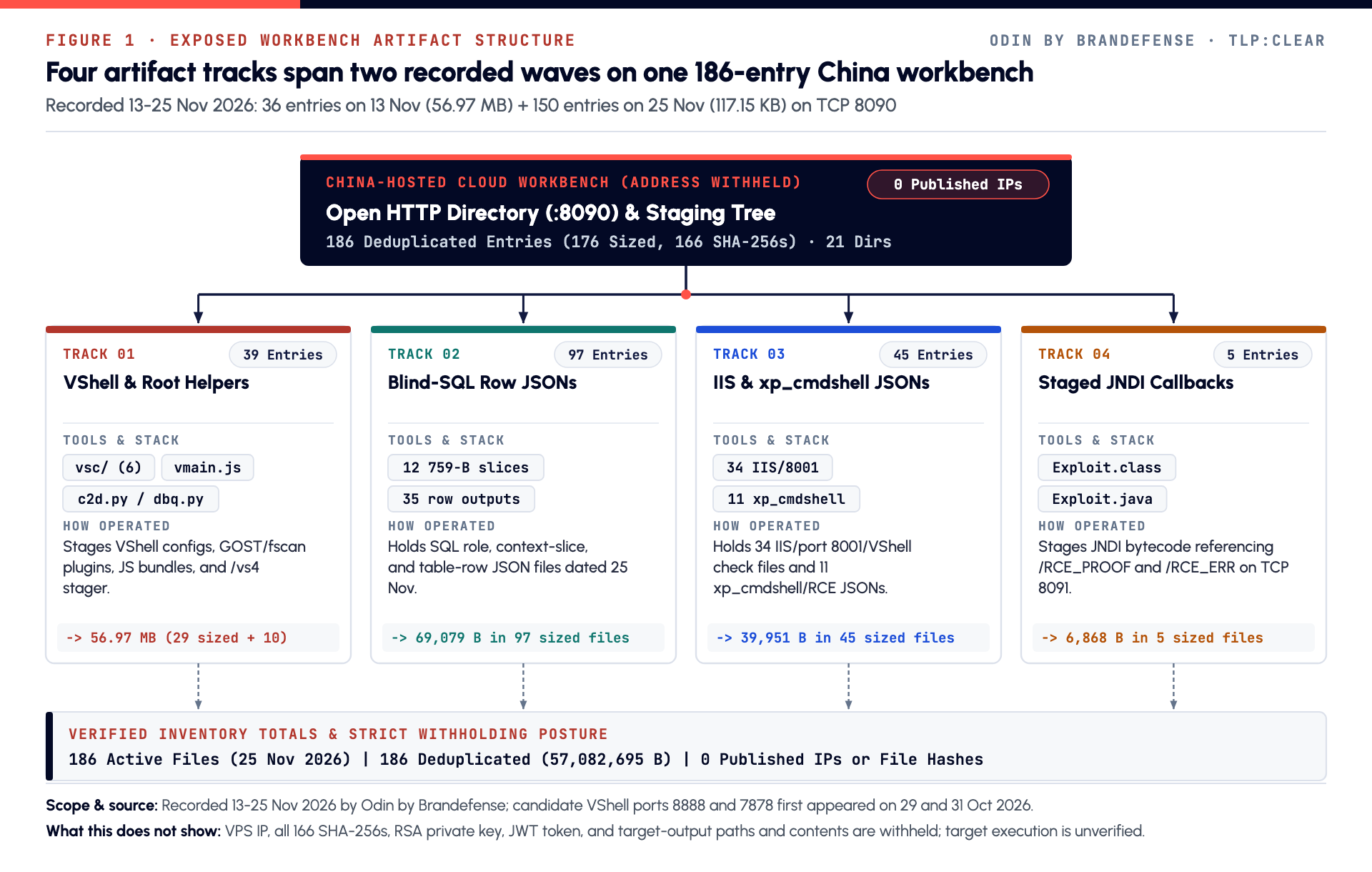
Across folders, 178 entries (95.7%) sit in (root), 6 (3.2%, 54.13 MB) sit in vsc/, and 2 (1.1%, 2,734 B) sit in jndi/. Text, JSON, and log files account for 163 entries (87.6%), while five binaries make up 97.5% of total bytes.
Content inspection covered 6 stored binaries and bundles (Exploit.class, vmain.js, v2.js, bash, gost.x64.so, and fscan.x64.elf). Five indexed key and callback URL records were also reviewed. The 144 .json files and 7 .log files were not retrieved in body form and are analyzed from paths, sizes, hashes, and dates.
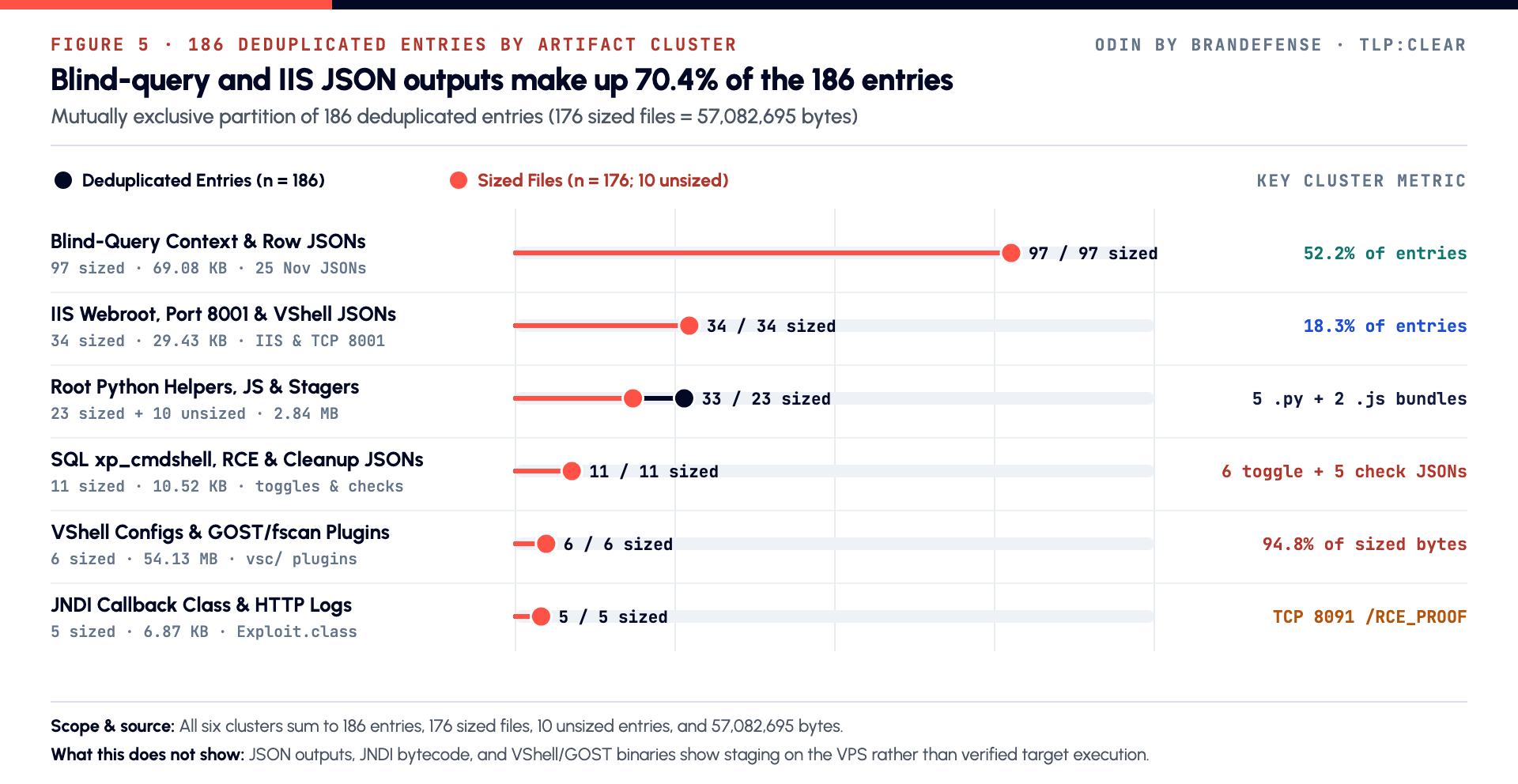
| Artifact cluster in 186-entry inventory | Entries | Sized bytes | Verified workbench artifacts |
|---|---|---|---|
| Blind-Query Context & Row JSONs | 97 | 69,079 | 2 SQLi request templates, 4 calibration files, 3 role checks, 12 759-B context slices, and 35 row-output files (paths withheld). |
| IIS Webroot, Port 8001 & VShell JSONs | 34 | 29,430 | 11 IIS path, site, and folder check files, 15 host-recon files, 2 TCP 8001 checks, and 6 VShell check files (paths withheld). |
| Root Python Helpers, JS & Stagers | 33 | 2,836,558 | bash, vmain.js, v2.js, vh.html, 5 .py scripts, http8000.log, clients.json, an operator token file (location withheld), and 10 unsized items. |
| SQL xp_cmdshell, RCE & Cleanup JSONs | 11 | 10,521 | 6 xp_cmdshell status and toggle capture files alongside 4 command-output check files and 1 cleanup file (1,353 B; paths withheld). |
| VShell Configs & GOST/fscan Plugins | 6 | 54,130,239 | an RSA private-key file (1,679 B; location withheld), server.pem, setting.conf, and vsc/plugins/ (gost.x64.exe, gost.x64.so, fscan.x64.elf). |
| JNDI Callback Class & HTTP Logs | 5 | 6,868 | jndi/Exploit.class (1,739 B referencing /RCE_PROOF and /RCE_ERR on TCP 8091), Exploit.java, and 3 JNDI logs. |
How Do the SQL Captures, JNDI Bytecode, and VShell Plugins Relate?
Four technical artifact groups sit on the China-hosted server. Together they link persistent tunnel infrastructure from 13 November with database, webroot, and Java callback files from 25 November:
- Blind SQL context and row-output captures (97 entries). Wave 2 pairs baseline (62 B) and injected (129 B) request templates with four calibration files and three SQL Server role checks (paths withheld). Repeated file sizes are consistent with scripted captures, but the uninspected bodies do not confirm extraction. Twelve context-slice files measure 759 bytes each, and 35 row-output files comprise nine 717-byte and 26 723-byte entries (paths and contents withheld).
- SQL
xp_cmdshelland IIS webroot checks (45 entries). Eleven JSON filenames suggest sixxp_cmdshellstatus and toggle checks, four command-output checks, and one cleanup step (1,353 B; paths withheld). Their bodies were not retrieved, so table writes, restoration, and target execution remain unverified. Thirty-four more files are named for IIS webroot,TCP 8001, host-recon, and VShell client checks (paths withheld). - Staged JNDI callback bytecode (5 entries). Stored inspection of
jndi/Exploit.class(1,739 B) shows hardcoded callback routes/RCE_PROOFand/RCE_ERRonTCP 8091. Root holdsjndi_http.log(3,024 B) and two identical 555-byte LDAP logs besideExploit.java. In Apache Log4j22.0-beta9through2.15.0(excluding2.12.2,2.12.3, and2.3.1),CVE-2021-44228enabled JNDI code execution (fixed in2.16.0and2.17.0+). HereCVE-2021-44228is architectural context only, and staged files do not confirm target execution. - VShell configs, GOST tunnels, and co-hosted ports (39 entries). Six
vsc/files holdgost.x64.exe(26.37 MB),gost.x64.so(21.54 MB),fscan.x64.elf(6.22 MB), an RSA private-key file (1,679 B; location withheld),server.pem, andsetting.conf. Root addsvmain.js(1.17 MB),v2.js, andhttp8000.log. Five Python scripts (c2d.py,c2d2.py,lst.py,dbq.py,dbg_client.py) sit in root. Stager URI/vs4onTCP 8000aligns with candidate ports 8888 and 7878.
What Should SQL Server, IIS, and Java Teams Do First?
Database, Windows, and Java teams can close these exposure paths across their production tiers. Apply the three controls below in priority order:
- Keep
xp_cmdshelldisabled and removesysadminfrom web logins. Confirmxp_cmdshellstays set to 0 across all SQL Server hosts and alert onsp_configurechanges. Parameterize JSON API queries, run web database pools with minimum schema rights, and alert whensqlservr.exespawnscmd.exeorpowershell.exe. - Enforce read-only IIS webroots and segment internal ports. Grant
IIS AppPoolaccounts read-only permissions oninetpubwwwrootand virtual application folders so file-write bugs cannot drop web shells. Restrict internal service ports likeTCP 8001to authenticated backend VLANs and monitorw3wp.exechild processes. - Lock down JNDI lookups and block direct tier internet egress. Keep Log4j2 on
2.17.1or later and run current LTS JDKs wheretrustURLCodebasedefaults tofalse. Block direct internet egress from SQL Server, IIS, and JVM subnets, and deploy Suricatasid:9563001–9563007 behind TLS-terminating proxies.
What is…?
Short explanations of the tools and families named in this study.
What is VShell?
VShell is a remote access implant and C2 panel that talks over WebSocket and other transports. It is popular with Chinese-speaking operators.
More about VShellTechniqueWhat is JNDI injection?
JNDI injection makes a Java application look up a remote object, usually over LDAP or RMI, and load attacker code. Log4Shell is the best-known example.
More about JNDI injectionTechniqueWhat is xp_cmdshell?
xp_cmdshell is a SQL Server extended stored procedure that runs operating system commands. Attackers enable it to move from database access to the host.
More about xp_cmdshellFrequently asked questions
How Were the 186 Files Organized Across the 13 and 25 November Waves?
On 25 November 2026, the open Python directory (SimpleHTTP/0.6 Python/3.14.4) reported 186 active files and 21 directories. Every item seen on 13 November stayed on disk on 25 November. That live count matches all 186 deduplicated entries, spanning 176 sized files (57,082,695 bytes) and 10 unsized items.
How Do the SQL Captures, JNDI Bytecode, and VShell Plugins Relate?
Four technical artifact groups sit on the China-hosted server. Together they link persistent tunnel infrastructure from 13 November with database, webroot, and Java callback files from 25 November:
What Should SQL Server, IIS, and Java Teams Do First?
Database, Windows, and Java teams can close these exposure paths across their production tiers. Apply the three controls below in priority order: