
1. Executive Summary
In short
An open TCP 8090 staging workbench on a China-hosted cloud VPS recorded on 13–25 November 2026 holds 186 entries (57.08 MB). Wave 1 (13 November, 36 entries) stages VShell configs and GOST and fscan binaries. Wave 2 (25 November, 150 entries) adds 142 blind-SQL, IIS, and xp_cmdshell JSON files plus five JNDI files. Disable xp_cmdshell, lock down IIS webroots, and block SQL and JVM internet egress.
Enterprise Windows and Java web stacks often place IIS reverse proxies and JSON APIs ahead of Microsoft SQL Server databases and JVM backend services. Over-privileged SQL logins or unrestricted outbound connections let SQL injection bugs escalate into command shells and encrypted proxy tunnels. This exposed workbench brings four distinct intrusion and tunnel-staging tracks together on one server.
Between 13 and 25 November 2026, Odin by Brandefense analyzed an open Python directory (SimpleHTTP/0.6) on TCP port 8090 of a China-hosted cloud VPS. On 25 November 2026, that Python 3.14.4 listener reported 186 active files and 21 directories.
Every file recorded on 13 November remained on disk on 25 November. The deduplicated inventory therefore matches all 186 entries across 176 sized files totaling 57,082,695 bytes (57.08 megabytes) and 10 unsized entries, spanning 166 unique SHA-256 digests.
The workbench exposes an RSA private-key file (location withheld), an operator token file (location withheld), and 142 Wave 2 JSON probe files. Odin by Brandefense therefore publishes zero server IPv4 addresses and zero file SHA-256 digests. Candidate VShell ports 8888 and 7878, target-output filenames, cloud socket names, and target identifiers are also withheld.
Two dated waves separate persistent tunnel staging from SQL and JNDI probing.
Thirty-six entries recorded on 13 November total 56.97 megabytes (99.8% of byte volume) and stage VShell server configs, web bundles, Python helpers, and tunnel plugins. One hundred fifty entries recorded on 25 November add 117.15 kilobytes across 142 JSON probe files, five JNDI files, and three helper files.
Wave 2 adds 142 JSON files named for blind-SQL, IIS, and xp_cmdshell checks.
Ninety-seven JSON files have names for database-context, server-role, context-slice, and row checks (paths withheld). Thirty-four JSON files are named for IIS webroot, TCP 8001, and VShell client checks, while 11 JSON filenames suggest xp_cmdshell checks and cleanup (target execution unverified).
One staged JNDI class references HTTP proof and error callbacks on TCP 8091.
Two files in jndi/ pair Java source and compiled Exploit.class bytecode beside one HTTP log and two LDAP logs. Stored bytecode inspection reveals /RCE_PROOF and /RCE_ERR callback URLs on TCP 8091, while CVE-2021-44228 serves strictly as architectural context.
Co-hosted VShell ports and 54.13 megabytes of plugins prepare encrypted pivoting.
Six files in vsc/ pair TLS files and settings with Windows and Linux GOST tunnel plugins (47.91 megabytes) and the fscan intranet scanner (6.22 megabytes). Candidate VShell ports 8888 and 7878 ran on the same server beside Python HTTP ports 8090, 8899, and 8000.
Three Decisions for Enterprise Security Leaders
- Keep SQL Server
xp_cmdshelldisabled and stripsysadminfrom web logins. Enforcexp_cmdshell = 0, run web database pools under least-privilege schema logins, and block direct internet traffic from SQL Server subnets. - Enforce read-only IIS webroots and monitor worker shell creation. Remove write permissions for IIS application pools inside
inetpubwwwrootand isolate internal ports likeTCP 8001. Alert immediately wheneverw3wp.exeorsqlservr.exespawns a shell. - Patch Java naming libraries, disable remote JNDI class loading, and hunt GOST tunnels. Keep Log4j2 on
2.17.1or later, block outbound LDAP, RMI, and unapproved WebSocket streams, and deploy protocol and endpoint detections across backend tiers.
2. Workbench Architecture, Two-Wave Reconciliation, and Co-Hosted Ports
The exposed staging workbench sat on a China-hosted cloud virtual private server (address withheld). That server exposed an unauthenticated Python directory (SimpleHTTP/0.6 Python/3.14.4) on TCP 8090. Engineering teams use external attack surface management to find exposed web interfaces and database gateways before operators enumerate backend paths.
Odin by Brandefense recorded the workbench between 13 and 25 November 2026. Defenders also apply cyber threat intelligence to link C2 plugin staging with SQL and Java exploitation workflows. Figure 1 maps the four operational tracks present on the server.
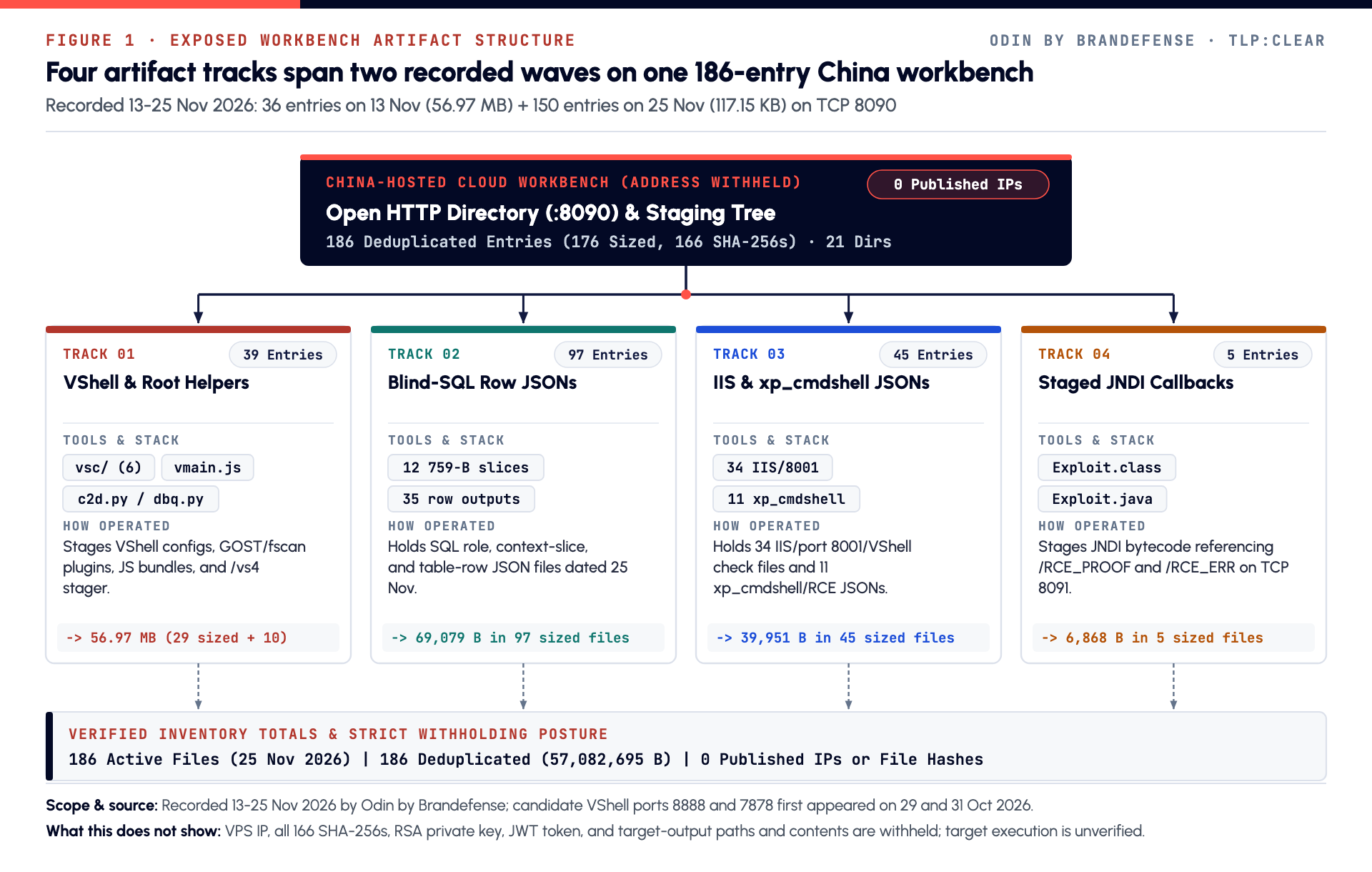
Reconciling the 186 Deduplicated Entries Across Waves and Folders
On 25 November 2026, the live TCP 8090 directory reported 186 active files and 21 directories (2 populated top-level folders, vsc/ and jndi/, plus (root)). All 36 entries recorded on 13 November remained present when 150 additional entries were recorded on 25 November, yielding 186 deduplicated entries (36 + 150 = 186).
Those 186 entries span 176 sized files totaling 57,082,695 bytes (57.08 MB) and 10 unsized entries (9 extensionless or socket items plus 1 unsized vs4.log). Content inspection covered 6 stored binaries and bundles (Exploit.class, vmain.js, v2.js, bash, gost.x64.so, fscan.x64.elf). Five indexed key and callback URL records were also reviewed, while the 144 .json files and 7 .log files were not retrieved in body form.
The 176 sized files span 166 unique SHA-256 digests (all withheld). Eight exact-hash duplicate groups account for 9 duplicate copies across vs1–vs3, vc.jar/vc2.jar, the two LDAP logs, and five .json pairs. One 26.37 MB binary (gost.x64.exe) had no recorded digest, completing the 10-file difference (176 - 10 = 166).
| Workspace zone | Top-level dirs | Deduplicated entries | Share (%) | Sized files | Unsized entries | Sized bytes | Operational role |
|---|---|---|---|---|---|---|---|
Root Wave 2 Captures ((root), 25 Nov) | 0 (root) | 148 | 79.6% | 148 | 0 | 114,417 | Holds 142 Wave 2 .json files (109,030 B; paths withheld), 3 JNDI logs (4,134 B), 2 .txt markers, and dbg_client.py. |
Root Wave 1 Helpers & Bundles ((root), 13 Nov) | 0 (root) | 30 | 16.1% | 20 | 10 | 2,835,305 | Holds bash, vmain.js, v2.js, vh.html, 4 .py helpers, http8000.log, clients.json, an operator token file (location withheld), and 10 unsized items. |
VShell Configs & Plugins (vsc/, 13 Nov) | 1 | 6 | 3.2% | 6 | 0 | 54,130,239 | Holds an RSA private-key file (1,679 B; location withheld), server.pem, setting.conf, and 3 vsc/plugins/ GOST and fscan binaries. |
JNDI Callback Directory (jndi/, 25 Nov) | 1 | 2 | 1.1% | 2 | 0 | 2,734 | Holds staged jndi/Exploit.class (1,739 B, referencing /RCE_PROOF and /RCE_ERR on TCP 8091) and jndi/Exploit.java (995 B). |
| Combined deduplicated inventory | 2 populated + root | 186 | 100.0% | 176 | 10 | 57,082,695 | Combined (root) = 178 (2,949,722 B); Wave 1 = 36 (56,965,544 B) & Wave 2 = 150 (117,151 B). |
A second breakdown reconciles the same 186 entries (176 sized, 10 unsized, 57,082,695 bytes) across five file types. Text, JSON, and log files represent 87.6% of entries (163), while five binaries represent 97.5% of total byte volume (55.67 MB).
Artifact class (kind) | Deduplicated entries | Share (%) | Sized files | Unsized entries | Sized bytes | Verified extensions & contents |
|---|---|---|---|---|---|---|
JSON outputs, logs & source (text) | 163 | 87.6% | 162 | 1 | 123,656 | 144 .json (2 Wave 1 + 142 Wave 2), 7 .log (1 unsized), 5 extensionless, 2 .txt, 2 .jar stubs, and .html/.conf/.java. |
Unsized stagers & socket (other) | 9 | 4.8% | 0 | 9 | 0 | 8 extensionless Wave 1 stagers (vc1, vc1b, vc2, vc3, vclient, vn1–vn3) and 1 unsized .sock entry (vendor socket name withheld). |
Python helpers & JS bundles (script) | 7 | 3.8% | 7 | 0 | 1,287,543 | 5 .py scripts (7,111 B across c2d2.py, c2d.py, lst.py, dbq.py, dbg_client.py) and 2 .js bundles (1,280,432 B). |
Tunnel, scan & bytecode binaries (exe) | 5 | 2.7% | 5 | 0 | 55,668,471 | gost.x64.exe (26,366,976 B), gost.x64.so (21,542,180 B), fscan.x64.elf (6,217,056 B), bash (1,540,520 B), and jndi/Exploit.class (1,739 B). |
TLS key & certificate (secret) | 2 | 1.1% | 2 | 0 | 3,025 | an RSA private-key file (1,679 B; location withheld) and server.pem (1,346 B certificate). |
| Total | 186 | 100.0% | 176 | 10 | 57,082,695 | Exact byte-level parity (57.08 MB; 166 withheld SHA-256 digests). |
Figure 5 partitions all 186 entries into six mutually exclusive clusters (97 + 34 + 33 + 11 + 6 + 5 = 186). Blind-SQL context/row JSONs (97) and IIS/port 8001/VShell JSONs (34) make up 70.4% of all indexed items.
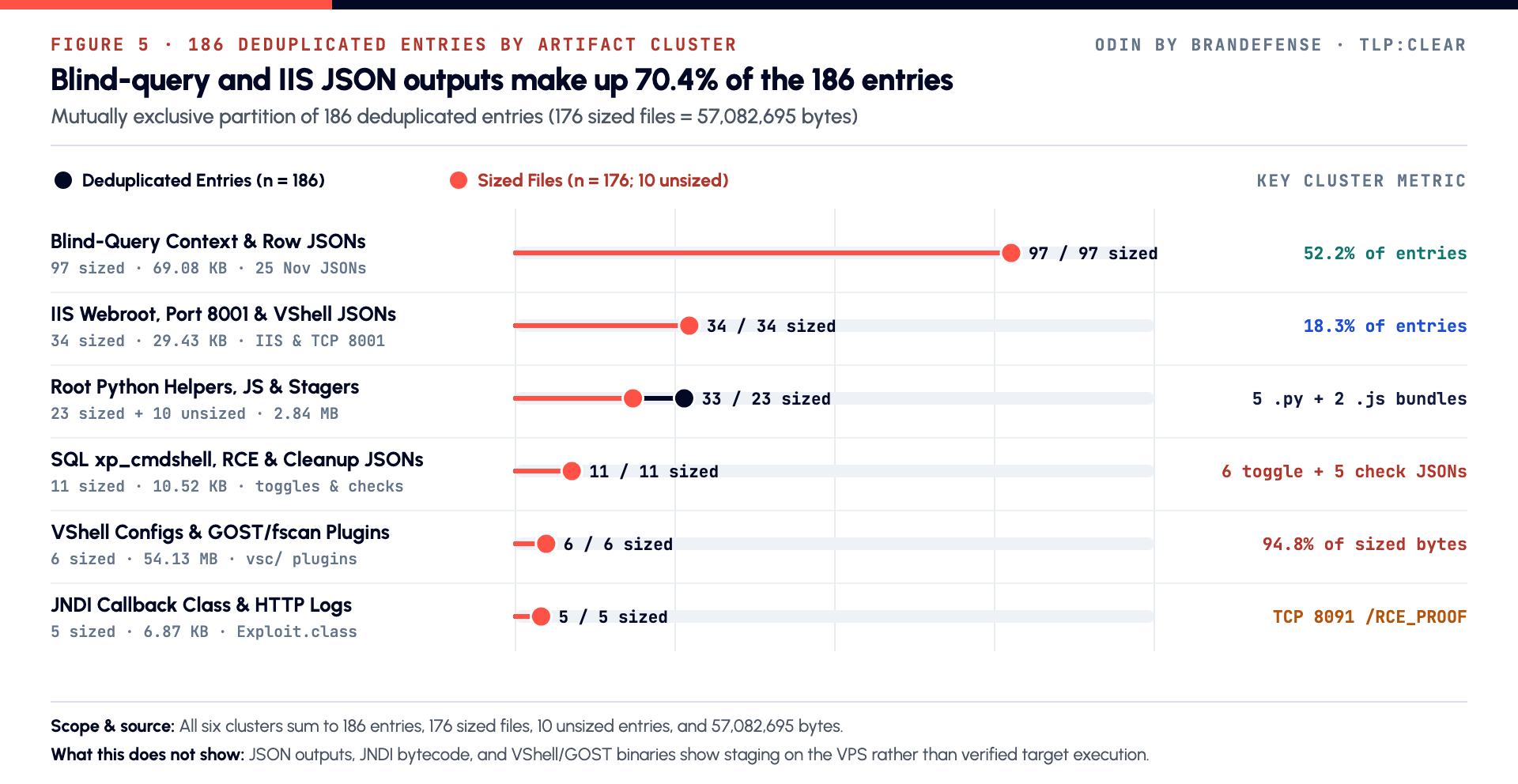
Co-Hosted Listener Ports on the China Cloud VPS
Service banners and staged callback URLs connect several TCP ports on the same withheld VPS. Each listener aligns with a specific stage of the workbench:
- Candidate VShell listeners (
TCP 8888andTCP 7878).TCP 8888was first observed on29 October 2026and stayed active on25 November 2026, serving anHTTP 200Welcome to nginxdecoy title.TCP 7878was first observed on31 October 2026and stayed active through23 November 2026. Both remain candidate C2 listeners rather than blocklist indicators without raw implant handshakes. - Python
3.14.4HTTP listeners (TCP 8090,TCP 8899, andTCP 8000). Ports 8090 and 8899 servedSimpleHTTP/0.6directory listings. Meanwhile,TCP 8000ranBaseHTTP/0.6(HTTP 404on/), matchinghttp8000.log(2,060 B) and the indexed stager URI/vs4onTCP 8000. - JNDI callback and auxiliary ports (
TCP 8091andTCP 8082).TCP 8091is referenced insidejndi/Exploit.class(/RCE_PROOFand/RCE_ERR), whileTCP 8082returnedHTTP 401besideTCP 80, 443, and 22.
3. Blind SQL Enumeration, xp_cmdshell Activation, and IIS Webroot Probing
Wave 2 (25 November 2026) added 142 .json files (109,030 bytes) to (root). Those files sit beside dbq.py (623 B, 13 Nov) and dbg_client.py (196 B, 25 Nov). Figure 3 presents an analytical model separating verified 13 November workbench staging (solid) from unverified target-side steps inferred from filenames (dashed).
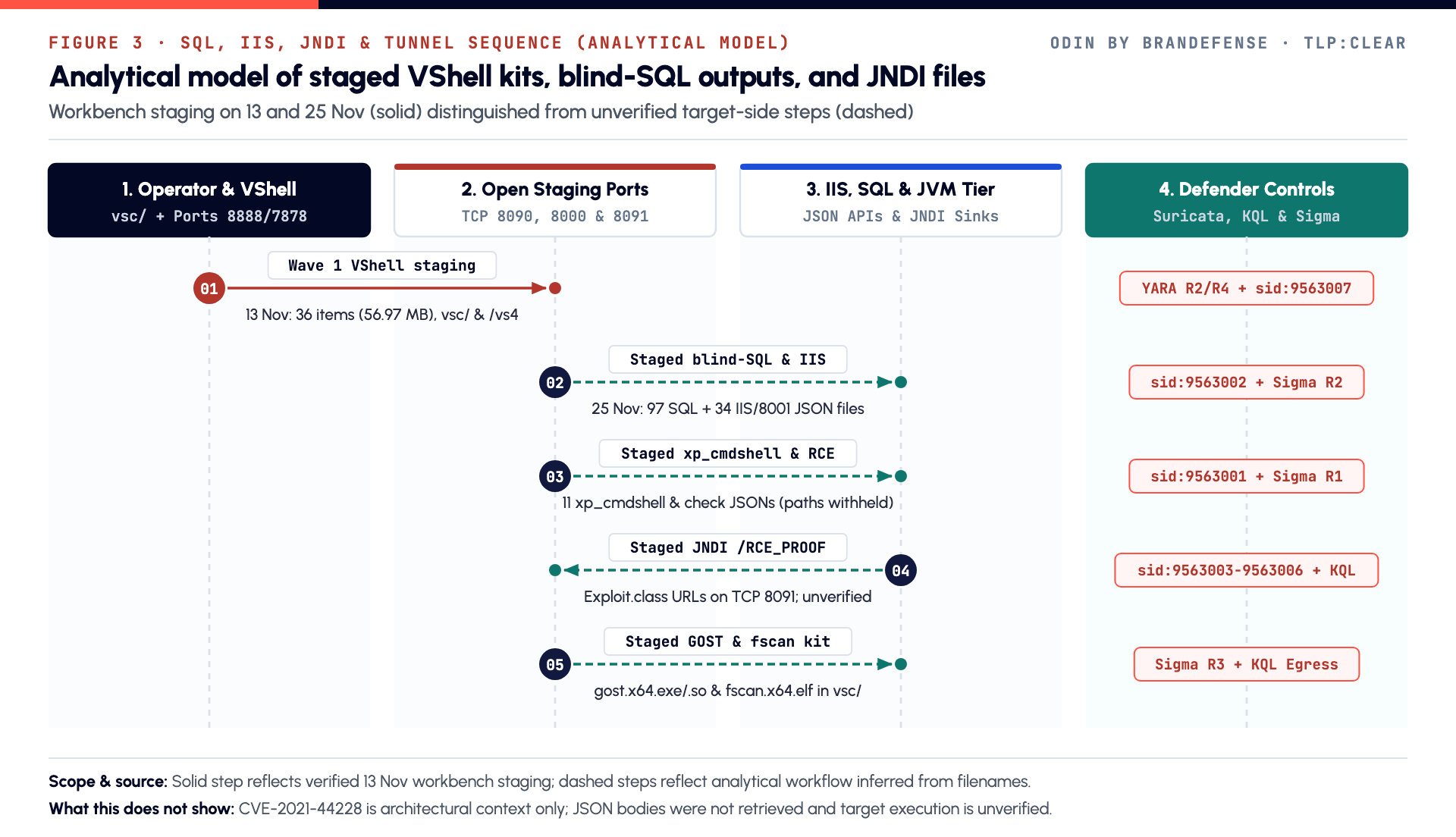
Blind SQL Context Slices and Table-Row Enumeration (97 Entries)
Ninety-seven Wave 2 .json files (69,079 bytes, 52.2% of entries; paths withheld) have names consistent with a blind-SQL workflow. Their bodies do not verify target requests or returned data. Root pairs baseline (62 B) and injected (129 B) request templates with four calibration captures (345 B to 759 B). Those four files are named for boolean, newline, response-length, and stacked-query checks.
Three database-context files (513 B, 645 B, and 627 B; paths withheld) are named for SQL Server database-identity and role checks. Their naming aligns with SQL Server DB_NAME() and IS_SRVROLEMEMBER('sysadmin') checks used to test administrative privileges ([REF-02]).
Repeated file sizes are consistent with scripted captures, but the uninspected bodies do not confirm extraction. Twelve context-slice files measure 759 bytes each. Thirty-five row-output files comprise nine 717-byte and 26 723-byte entries; their paths and contents are withheld.
Remaining captures include two aggregate output files (1,221 B and 1,839 B), six secondary row slices (717 B each), and three table- and view-count files. Thirty-three column-slot and row-check entries plus one 213-byte summary file complete the cluster (paths withheld).
SQL Server xp_cmdshell and Companion Check Files (11 Entries)
Eleven Wave 2 .json files (10,521 bytes; paths withheld) follow the SQL stored-procedure escalation pattern in MITRE ATT&CK T1505.001 ([REF-02], [REF-07]). Six filenames suggest xp_cmdshell existence, status, and activation checks (591 B to 1,149 B across six captures).
Microsoft SQL Server disables xp_cmdshell by default ([REF-02]). However, a sysadmin login can re-enable it via sp_configure, causing sqlservr.exe to spawn Windows cmd.exe processes ([REF-02], [REF-07]).
Four companion filenames suggest command-output checks, and a fifth suggests cleanup. Their bodies were not retrieved, so table writes, restoration, and target execution remain unverified.
IIS Webroot Discovery, Port 8001 Checks, and VShell Verification (34 Entries)
Thirty-four Wave 2 .json files (29,430 bytes; paths withheld) are named for IIS webroot, internal-port, and VShell client checks. Eight files are named for IIS paths and sites (including 1,635-byte and 1,149-byte entries alongside count and row-output files). Three 849-byte files are named for standard web folders.
Twenty-three additional files are named for host-recon, TCP 8001, and VShell checks (paths withheld). Recon files include 2,043-byte and 1,545-byte entries, two 699-byte count files, and 11 row-output slices (741 to 747 B). Port and implant checks span two 861-byte TCP 8001 files and six VShell check files (675 B to 1,161 B). Exact-hash matches on two 675-byte entries fit repeated empty responses.
4. Staged JNDI Callback Bytecode and the VShell / GOST Tunnel Suite
Alongside the 142 JSON files, the server pairs five Wave 2 JNDI callback files with 39 VShell, GOST, fscan, and Python helper files. Figure 4 shows the directory layout and co-hosted ports on the China VPS.
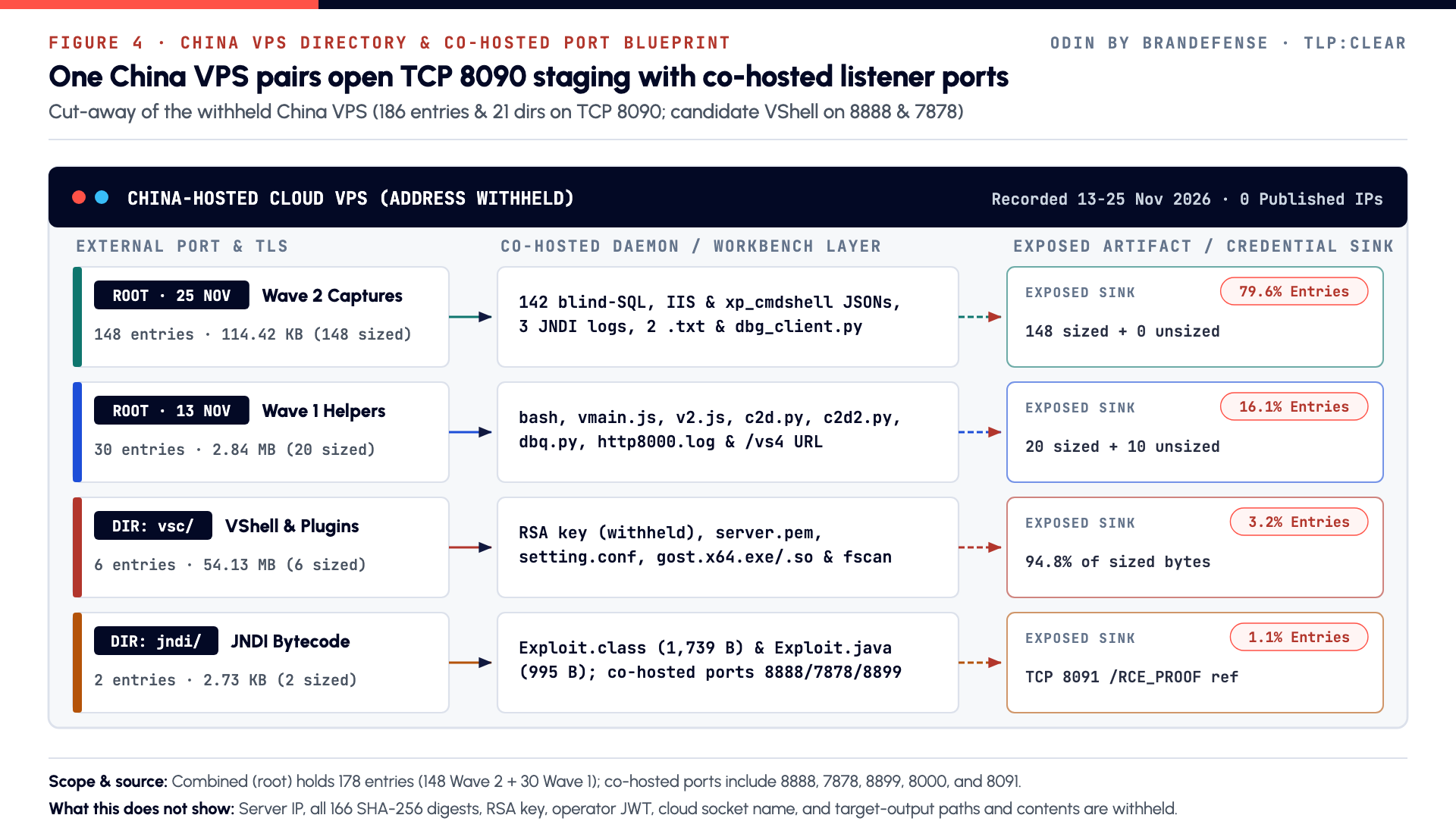
Staged JNDI Bytecode and /RCE_PROOF Callback URLs (5 Entries)
Five Wave 2 files (6,868 bytes) stage a Java JNDI callback harness ([REF-01], [REF-03]). Inside jndi/, Exploit.java (995 B) compiles to Exploit.class (1,739 B). Stored inspection of Exploit.class reveals hardcoded HTTP callback paths /RCE_PROOF and /RCE_ERR directed to TCP 8091 on the same VPS.
Root also holds jndi_http.log (3,024 B) and two identical 555-byte LDAP logs (jndi_ldap.log and jndi_ldap_stdout.log). In Apache Log4j2 2.0-beta9 through 2.15.0 (excluding 2.12.2, 2.12.3, and 2.3.1), CVE-2021-44228 allowed JNDI remote code execution ([REF-01]).
Apache fixed that flaw in 2.16.0 and 2.17.0+ ([REF-01]), while Oracle JDK 8u191+, 11.0.1+, and 17+ set trustURLCodebase=false by default ([REF-03]). We cite CVE-2021-44228 strictly as architectural context, and staged JNDI files do not confirm target JVM execution.
VShell C2 Configs, GOST Tunnel Plugins, and Root Helpers (39 Entries)
Six Wave 1 files in vsc/ (54,130,239 bytes, 94.8% of sized bytes) pair TLS and configuration files with three compiled plugins. Specifically, that set includes an RSA private-key file (1,679 B; location withheld), server.pem (1,346 B), and setting.conf (1,002 B). Meanwhile, vsc/plugins/ stages gost.x64.exe (26.37 MB) and gost.x64.so (21.54 MB) for GOST proxy tunneling ([REF-04], [REF-08]). It also holds fscan.x64.elf (6.22 MB; [REF-05]).
Thirty-three root entries (2,836,558 B across 23 sized + 10 unsized) complete the inventory. Wave 1 (30 entries) holds bash (1.54 MB) and VShell web bundles (vmain.js 1.17 MB, v2.js 114.80 KB, vh.html). It also holds an operator token file (217 B; location withheld), clients.json, and tun.json.
Root Wave 1 also holds four Python helpers (c2d2.py, c2d.py, lst.py, dbq.py; [REF-09]) with logs and http8000.log (2,060 B). It stages URI /vs4 on TCP 8000, two .jar stubs, vs1–vs3, .del, and 10 unsized items. Wave 2 added dbg_client.py (196 B) and two .txt markers (1,057 B; one name withheld), and Figure 2 maps all 186 entries to detections.
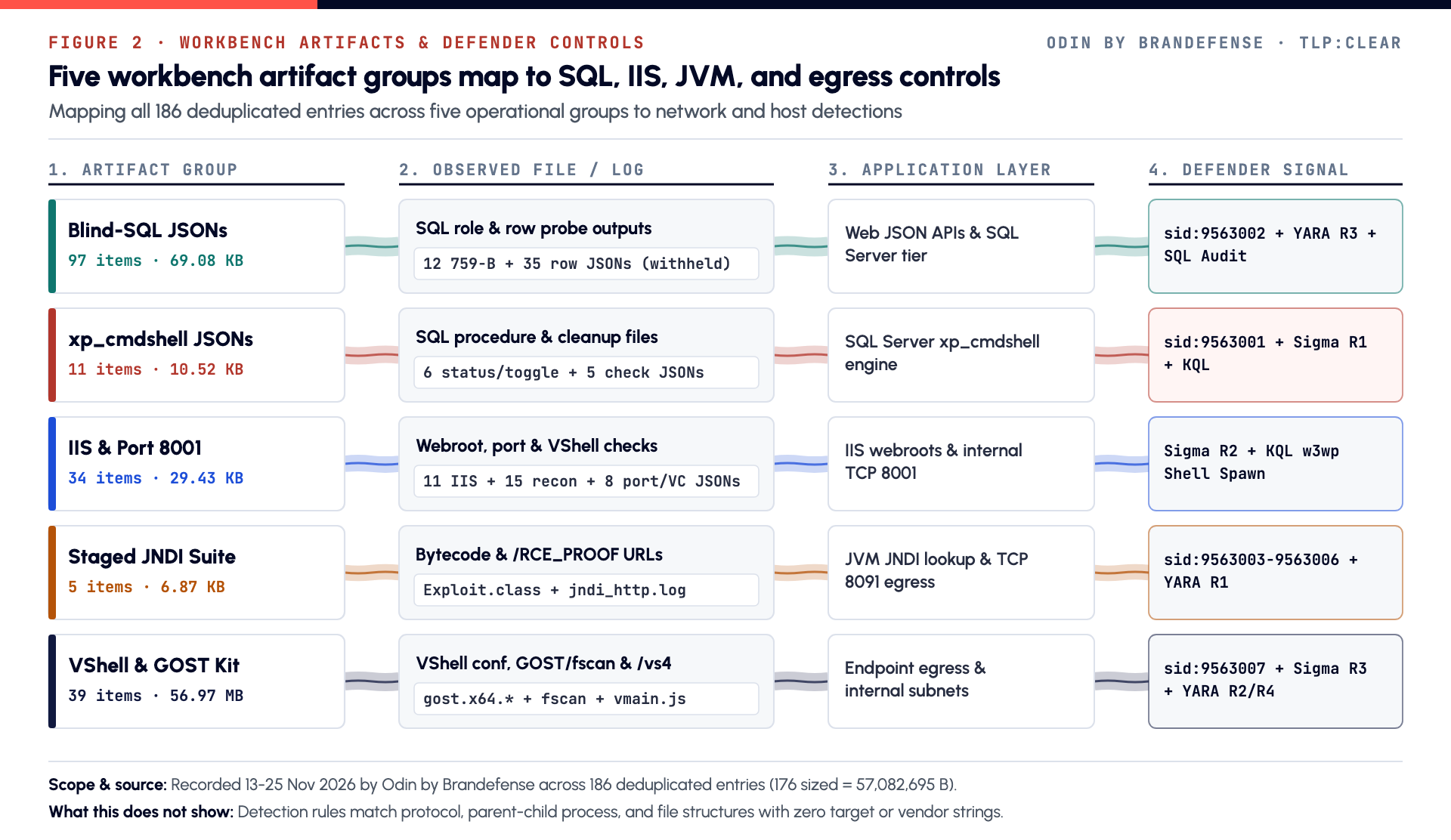
5. Enterprise SQL Server, IIS, JVM, and Egress Exposure Analysis
Platform and security teams should verify four controls mapped to the exposed workbench. Reviewing each layer directly avoids treating unverified staging files as an established breach root cause:
| Exposure layer | Observed workbench evidence | Control to verify | Operational risk |
|---|---|---|---|
| JSON APIs & SQL Server roles | 97 blind-SQL .json files (2 request templates, 3 role checks, 12 759-B context slices, 35 row-output files; paths withheld) + dbq.py. | Verify whether JSON endpoints use parameterized SQL queries and whether web DB logins lack sysadmin rights ([REF-02], [REF-10]). | Blind SQL injection under sysadmin exposes database catalogs and server configuration toggles. |
SQL xp_cmdshell procedure | 11 .json files (6 xp_cmdshell status/toggle captures, 4 command-output check files, 1 cleanup file; paths withheld and execution unverified). | Verify whether xp_cmdshell stays 0, SQL audit logs sp_configure, and sqlservr.exe uses a restricted service account ([REF-02], [REF-07]). | Enabling xp_cmdshell lets SQL injection spawn OS shells (cmd.exe / powershell.exe) on database hosts. |
| IIS webroots & internal ports | 34 .json files (11 IIS path/site/folder files, 15 host-recon files, 2 TCP 8001 checks, 6 VShell check files; paths withheld). | Verify whether IIS AppPool accounts have read-only access on inetpubwwwroot and whether TCP 8001 is segmented ([REF-06], [REF-10]). | Writable webroots allow persistent web shells (w3wp.exe child shells) and internal port probing. |
| JVM JNDI & C2 tunnel egress | jndi/Exploit.class (/RCE_PROOF on :8091), 3 JNDI logs, vsc/ (gost.x64.*, fscan.x64.elf), and /vs4 on :8000. | Verify Log4j2 (>= 2.17.1) and JDK defaults (trustURLCodebase=false), plus strict firewall blocks on tier internet egress ([REF-01], [REF-03], [REF-08]). | Open outbound HTTP, LDAP, or WebSocket egress allows .class fetches, /vs4 staging, and GOST tunnels. |
6. Alternative Hypotheses
| Hypothesis | Evidence for | Evidence against | Assessment |
|---|---|---|---|
Wave 2 xp_cmdshell, VShell, and JNDI files confirm target RCE | Directory holds 11 xp_cmdshell and check .json files, 6 VShell check .json files (paths withheld), Exploit.class (/RCE_PROOF), and jndi_http.log. | Raw bodies of the 144 .json files and 7 .log files were not retrieved, and duplicate 675-byte hashes fit empty or negative check responses. | Unverified for target execution. Treat JSON and JNDI files as unverified check files and staged tooling. |
Wave 2 JNDI files confirm CVE-2021-44228 on the SQL/IIS target | Exploit.class and 3 JNDI logs were recorded on 25 November alongside the 142 SQL and IIS JSON files. | Current JDKs block remote LDAP .class loading ([REF-03]), and operators often test JNDI against separate Java gateways or TCP 8001 services. | Unverified. Cite CVE-2021-44228 strictly as architectural context without merging unlinked target tiers. |
| Attacker staging workbench classification | Co-locates 54.13 MB of VShell, GOST, and fscan binaries, VShell console assets, an nginx-decoy :8888 port, 142 SQL and IIS probe JSON files, and compiled JNDI callback bytecode. | Passive directory listings and unretrieved JSON and log bodies do not identify the operator or verify target outcomes. | Assessed attacker staging. Co-located VShell server files, tunnel plugins, console assets, and probe files support this workbench classification. The operator’s identity and target outcomes remain unknown. |
Single exposed workbench reused across 13 and 25 November | Six Wave 2 VShell-check filenames align with the VShell client components (vc.jar, vc1–vc3, vclient) staged on 13 November. | Separate targets or operators may have used the directory across the two dates, and JSON bodies were not retrieved. | Partially supported for directory reuse. Shared vc* stager naming ties the 25 November checks to the 13 November kit on the same host without establishing one operator across targeting and output. |
7. Validated Detection Rules
The China VPS IPv4 address and all 166 file SHA-256 digests are withheld. Defenders should deploy protocol, process, and file-structure rules that catch this tradecraft on any network. Static checks passed in the Odin Suricata linter (0 problems) and offline structural checks across KQL, 3 Sigma rules, and 4 YARA rules. Because live suricata -T, Kusto.Language, pySigma, and YARA binaries were not run locally, test each rule in staging first.
7.1 Suricata 7.x Network Signatures (sid:9563001–9563007)
Rules sid:9563001–9563003 inspect inbound HTTP request bodies for xp_cmdshell, IS_SRVROLEMEMBER + sysadmin, and ${jndi: expressions. Rules sid:9563004–9563005 detect outbound GET /RCE_ callbacks (/RCE_PROOF, /RCE_ERR) and GET /jndi/Exploit.class fetches. Rule sid:9563006 alerts on inbound Java .class magic bytes (0xCAFEBABE), while sid:9563007 matches exact 4-byte GET /vs4 stager requests.
All seven HTTP alert rules generate alerts without blocking inline. They require cleartext HTTP visibility or deployment behind a TLS-terminating proxy, and sid:9563001–9563002 and sid:9563006 should be tuned around internal database admin tools or build servers.
# Odin by Brandefense - Monograph 63 (Blind SQL and Tunnel Staging) Suricata 7.x Ruleset
# Static syntax checked with Odin Suricata linter (0 problems); test with suricata -T before deployment.

alert http $EXTERNAL_NET any -> $HOME_NET any (msg:"ODIN-R63 Inbound SQL Server xp_cmdshell Body Attempt"; flow:established,to_server; http.request_body; content:"xp_cmdshell"; nocase; fast_pattern; classtype:web-application-attack; sid:9563001; rev:1;)
alert http $EXTERNAL_NET any -> $HOME_NET any (msg:"ODIN-R63 Inbound SQL IS_SRVROLEMEMBER sysadmin Probe"; flow:established,to_server; http.request_body; content:"IS_SRVROLEMEMBER"; nocase; fast_pattern; content:"sysadmin"; nocase; classtype:attempted-recon; sid:9563002; rev:1;)
alert http $EXTERNAL_NET any -> $HOME_NET any (msg:"ODIN-R63 Inbound JNDI Lookup Expression in HTTP Body"; flow:established,to_server; http.request_body; content:"${jndi:"; nocase; fast_pattern; classtype:web-application-attack; sid:9563003; rev:1;)
alert http $HOME_NET any -> $EXTERNAL_NET any (msg:"ODIN-R63 Outbound JNDI RCE_PROOF or RCE_ERR HTTP Callback"; flow:established,to_server; http.method; content:"GET"; bsize:3; http.uri; content:"/RCE_"; startswith; fast_pattern; classtype:trojan-activity; sid:9563004; rev:1;)
alert http $HOME_NET any -> $EXTERNAL_NET any (msg:"ODIN-R63 Outbound JVM Exploit.class HTTP Fetch"; flow:established,to_server; http.method; content:"GET"; bsize:3; http.uri; content:"/jndi/Exploit.class"; fast_pattern; classtype:trojan-activity; sid:9563005; rev:1;)
alert http $EXTERNAL_NET any -> $HOME_NET any (msg:"ODIN-R63 Inbound Compiled Java Class Bytecode Stream"; flow:established,to_client; http.response_body; content:"|CA FE BA BE|"; startswith; fast_pattern; classtype:trojan-activity; sid:9563006; rev:1;)
alert http $HOME_NET any -> $EXTERNAL_NET any (msg:"ODIN-R63 Outbound VShell /vs4 HTTP Stager Request"; flow:established,to_server; http.method; content:"GET"; bsize:3; http.uri; content:"/vs4"; bsize:4; fast_pattern; classtype:trojan-activity; sid:9563007; rev:1;)
7.2 Microsoft Sentinel KQL Hunt
This 7-day Sentinel KQL query correlates SQL and IIS child shells, GOST and fscan switches, and unexpected public egress from backend tiers. Replace the two placeholder FQDNs (dba-jump-01.corp[.]example and ci-java-01.corp[.]example) in ApprovedAdminAndBuildHosts before scheduling.
// Odin by Brandefense - Monograph 63 (Blind SQL and Tunnel Staging)
// Hunts SQL Server xp_cmdshell and IIS worker shell spawns, GOST/fscan CLI activity, and unexpected SQL/IIS/Java public egress.
let Lookback = 7d;
let ApprovedAdminAndBuildHosts = dynamic(["dba-jump-01.corp.example", "ci-java-01.corp.example"]);
let SqlOrIisShellSpawns =
    DeviceProcessEvents
    | where Timestamp >= ago(Lookback)
    | where not(DeviceName in~ (ApprovedAdminAndBuildHosts))
    | where (
        (InitiatingProcessFileName in~ ("sqlservr.exe", "w3wp.exe") and FileName in~ ("cmd.exe", "powershell.exe", "pwsh.exe", "whoami.exe", "curl.exe", "certutil.exe"))
        or FileName in~ ("gost", "gost.exe", "gost.x64.exe", "fscan", "fscan.exe", "fscan.x64.elf")
        or (ProcessCommandLine has "-L=" and ProcessCommandLine has "-F=")
        or ProcessCommandLine has_any ("mwss://", "gost.x64.so", "-nopoc")
    )
    | project Timestamp, DeviceName, AccountName, SignalType = "HostSqlIisShellOrTunnelCli", Detail = strcat(InitiatingProcessFileName, " -> ", FileName, ": ", ProcessCommandLine);
let UnexpectedTierPublicEgress =
    DeviceNetworkEvents
    | where Timestamp >= ago(Lookback)
    | where not(DeviceName in~ (ApprovedAdminAndBuildHosts))
    | where RemoteIPType == "Public"
    | where (
        InitiatingProcessFileName in~ ("sqlservr.exe", "w3wp.exe")
        or (InitiatingProcessFileName in~ ("java", "java.exe") and RemotePort in (389, 636, 1099, 1389, 8091))
    )
    | project Timestamp, DeviceName, AccountName = InitiatingProcessAccountName, SignalType = "UnexpectedDatabaseWebOrJndiEgress", Detail = strcat(InitiatingProcessFileName, " -> ", RemoteIP, ":", tostring(RemotePort), " (", RemoteUrl, ")");
union SqlOrIisShellSpawns, UnexpectedTierPublicEgress
| summarize FirstSeen = min(Timestamp), LastSeen = max(Timestamp), EventCount = count(), Signals = make_set(SignalType, 6), SampleDetails = make_set(Detail, 5) by DeviceName, AccountName
| order by LastSeen desc
7.3 Portable Sigma and YARA Rules
- Sigma process-creation rules. Rule 1 catches Windows
sqlservr.exespawning shells or transfer tools outsidesql-maint-01.corp[.]example. Rule 2 catches Windowsw3wp.exespawning shells orwhoami.exe/netstat.exeoutsideiis-deploy-01.corp[.]example. Rule 3 catches Linux/gostor/fscanbinaries ormwss://,gost.x64.so, and-nopocflags outsidenet-relay-01.corp[.]example. - YARA file-structure rules. Four
filesize-bounded rules detect/RCE_PROOFJava callback classes and VShell server configuration files. They also match Pythonxp_cmdshellharnesses and exposed VShell frontend JS bundles.
8. Behavioral and Protocol Hunt Markers (0 Published IPs or Workbench SHA-256s)
Zero server IPv4 addresses or workbench-file SHA-256 digests appear in the indicator feeds. The workbench holds an exposed RSA key, an operator JWT, and 142 probe JSON files, while ports 8888 and 7878 remain candidate VShell listeners. Defenders can hunt using the 10 behavioral markers below.
| Marker category | Pattern / protocol artifact | Layer | Defensive hunt & control |
|---|---|---|---|
SQL xp_cmdshell body | xp_cmdshell in HTTP request body | HTTP / WAF ingress | Keep xp_cmdshell = 0 ([REF-02]), parameterize queries, and alert via sid:9563001. |
| SQL role enumeration | IS_SRVROLEMEMBER + sysadmin in HTTP body | HTTP / SQL Audit | Remove sysadmin from web DB pools ([REF-02]) and alert via sid:9563002. |
| Inbound JNDI lookup | ${jndi: in HTTP request body | HTTP / WAF ingress | Patch Log4j2 (>= 2.17.1, [REF-01]) and alert via sid:9563003. |
| JNDI HTTP proof callback | GET /RCE_PROOF or GET /RCE_ERR (GET /RCE_) | HTTP egress (:8091) | Block unapproved app-tier HTTP egress and alert via sid:9563004 and YARA Rule 1. |
Remote .class fetch | GET /jndi/Exploit.class & 0xCAFEBABE stream | HTTP egress (:8090) | Keep JDK trustURLCodebase=false ([REF-03]) and alert via sid:9563005–9563006. |
| VShell stager URI | GET /vs4 (exact 4-byte URI) | HTTP egress (:8000) | Block direct server HTTP downloads and alert via sid:9563007. |
| SQL child shell spawn | sqlservr.exe -> cmd.exe / powershell.exe | Windows EDR | Alert immediately on sqlservr.exe child shells (Sigma Rule 1; KQL; [REF-07]). |
| IIS worker shell spawn | w3wp.exe -> cmd.exe / powershell.exe / whoami.exe | Windows EDR | Enforce read-only IIS webroots and alert via Sigma Rule 2 and KQL ([REF-06]). |
GOST & fscan CLI | gost (-L=/-F=, mwss://) & fscan (-nopoc) | Windows / Linux EDR | Hunt GOST proxy plugins and fscan switches (Sigma Rule 3; KQL; [REF-04], [REF-05]). |
| Tier public egress | sqlservr.exe, w3wp.exe, or java (389/636/1099/1389/8091) | Firewall / EDR | Block direct public internet egress from SQL, IIS, and JVM subnets (Sentinel KQL). |
9. Hardening Priorities for SQL Server, IIS, and JVM Tiers
Database, Windows, Java, and network defenders can close each exposure path systematically. Apply the five engineering controls below in priority order:
- Keep
xp_cmdshelldisabled and enforce least-privilege SQL logins (0–48 Hours). Confirmxp_cmdshellstays 0 insys.configurations([REF-02]) and alert onsp_configure(15457 event ID). Migrate web connection strings offsaorsysadminaccounts to schema-scoped logins ([REF-02],[REF-10]), and runsqlservr.exeunder an isolated virtual service account ([REF-07]). - Parameterize JSON API database queries (
0–72 Hours). Audit JSON POST endpoints to enforce prepared statements on every filter and offset ([REF-06],[REF-10]). Suppress verbose SQL error traces to disrupt blind length-based probing. - Lock down IIS webroot ACLs and internal ports (
Days 1–7). GrantIIS AppPoolidentities read-only access oninetpubwwwrootand virtual folders so file-write bugs cannot plant web shells ([REF-10]). Isolate internal ports likeTCP 8001inside authenticated backend VLANs. - Patch Log4j2 and harden JVM JNDI defaults (
Days 7–14). Keep Apache Log4j2 on2.17.1or later (CVE-2021-44228,[REF-01]) and run current LTS JDKs wherecom.sun.jndi.ldap.object.trustURLCodebasedefaults tofalse([REF-03]). Ensure untrusted strings never reachInitialContext.lookup(). - Block direct internet egress from SQL, IIS, and JVM subnets (
Days 14–30). Block outboundHTTP,HTTPS,LDAP 389/636,RMI 1099/1389, and high ports (7878, 8000, 8090, 8091, 8888) from backend tiers ([REF-04],[REF-08]). Force approved outbound calls through an authenticated TLS-inspecting proxy to block/vs4,/RCE_PROOF, and GOST WebSocket tunnels.
10. Scope, Limits, and External References
Odin by Brandefense analyzed an exposed staging workbench on a China-hosted cloud VPS (TCP 8090, SimpleHTTP/0.6) recorded between 13 and 25 November 2026. On 25 November 2026, the Python 3.14.4 directory reported 186 active files and 21 directories.
That count matches all 186 deduplicated entries across 176 sized files (57,082,695 bytes) and 10 unsized items (166 SHA-256 digests). Wave 1 (13 November) contributed 36 entries (56,965,544 B), and Wave 2 (25 November) added 150 entries (117,151 B).
Content inspection covered 6 stored binaries and bundles (Exploit.class, vmain.js, v2.js, bash, gost.x64.so, fscan.x64.elf). Five indexed key and URL records were also reviewed. The 144 .json files and 7 .log files were not retrieved in body form. CVE-2021-44228 is architectural context only.
Candidate VShell ports 8888 and 7878, the VPS IPv4, all 166 SHA-256 digests, the RSA private-key file, the operator JWT file, target-output filenames, socket names, and target identifiers are withheld.
[REF-01]NIST National Vulnerability Database, *CVE-2021-44228 Detail: Apache Log4j2 JNDI Lookup Remote Code Execution* (verified on 25 November 2026).[REF-02]Microsoft Learn, *xp_cmdshell Server Configuration Option (SQL Server Security Hardening)* (verified on 25 November 2026).[REF-03]Oracle Java SE Documentation, *Java Naming and Directory Interface (JNDI) Architecture and Remote Class Loading Controls* (verified on 25 November 2026).[REF-04]GOST (GO Simple Tunnel), *Official Source Repository and TLS/WebSocket Tunneling Documentation* (verified on 25 November 2026).[REF-05]fscan, *Intranet Scanning Tool Source Repository* (verified on 25 November 2026).[REF-06]MITRE ATT&CK, *Exploit Public-Facing Application (T1190)* (verified on 25 November 2026).[REF-07]MITRE ATT&CK, *Server Software Component: SQL Stored Procedures (T1505.001)* (verified on 25 November 2026).[REF-08]MITRE ATT&CK, *Protocol Tunneling (T1572)* (verified on 25 November 2026).[REF-09]MITRE ATT&CK, *Command and Scripting Interpreter: Python (T1059.006)* (verified on 25 November 2026).[REF-10]CISA, *Advisory AA23-347A: Stopping Adversaries Before They Exploit Internet-Facing Applications and Services* (verified on 25 November 2026).
What is…?
Short explanations of the tools and families named in this study.
What is VShell?
VShell is a remote access implant and C2 panel that talks over WebSocket and other transports. It is popular with Chinese-speaking operators.
More about VShellTechniqueWhat is JNDI injection?
JNDI injection makes a Java application look up a remote object, usually over LDAP or RMI, and load attacker code. Log4Shell is the best-known example.
More about JNDI injectionTechniqueWhat is xp_cmdshell?
xp_cmdshell is a SQL Server extended stored procedure that runs operating system commands. Attackers enable it to move from database access to the host.
More about xp_cmdshellFrequently asked questions
How Were the 186 Files Organized Across the 13 and 25 November Waves?
On 25 November 2026, the open Python directory (SimpleHTTP/0.6 Python/3.14.4) reported 186 active files and 21 directories. Every item seen on 13 November stayed on disk on 25 November. That live count matches all 186 deduplicated entries, spanning 176 sized files (57,082,695 bytes) and 10 unsized items.
How Do the SQL Captures, JNDI Bytecode, and VShell Plugins Relate?
Four technical artifact groups sit on the China-hosted server. Together they link persistent tunnel infrastructure from 13 November with database, webroot, and Java callback files from 25 November:
What Should SQL Server, IIS, and Java Teams Do First?
Database, Windows, and Java teams can close these exposure paths across their production tiers. Apply the three controls below in priority order: