
1. Executive Summary
In short
Odin by Brandefense analyzed 95 staged directory entries across three unrelated Linux virtual private servers recorded on 13–20 November 2026. Zero shared SHA-256 digests link the three servers. They hold a Linux Name Service Switch loader script, a custom Root CA injector suite, and application-layer proxy and SSH flood kits. Audit nsswitch.conf and CA trust stores, restrict PROXY headers to edge CIDRs, and rate-limit OpenSSH handshakes.
Linux name-resolution libraries, system certificate stores, and proxied network origins guard core trust across enterprise networks. Modifying Linux Name Service Switch modules lets unauthorized shared libraries load inside local daemons during routine lookups. If an attacker controls a trusted root’s private key and intercepts traffic, clients may accept forged certificates without warnings. Direct origin access and unthrottled SSH queues likewise expose perimeter services to connection floods.
Between 13 and 20 November 2026, Odin by Brandefense analyzed exposed directories on three commercial virtual private servers in Hong Kong, Indonesia, and Israel. Together, the three hosts hold 95 deduplicated entries across 90 sized files (275,250,121 bytes, or 275.25 megabytes) and 5 unsized entries. Those files resolve to 78 unique SHA-256 digests.
Zero shared SHA-256 digests or infrastructure indicators link Workbenches A, B, and C. Each server is therefore evaluated strictly as an independent staging workspace. Odin by Brandefense withholds all server IPv4 addresses, unconfirmed command-and-control addresses inside scripts, file SHA-256 digests, and one harvested browser-cookie filename.
Workbench A stages a Python loader referencing libnscd.so alongside an evasive binary.
Discovered on 20 November 2026 on TCP port 8000 of a Hong Kong server, Workbench A holds two sized root files totaling 1,000,208 bytes. An 82,987-byte Python script references download and callback routes for libnscd.so and kreport beside a 917,221-byte Linux executable named bot-evasive.
On Linux systems, the Name Service Switch configuration file and Name Service Cache Daemon govern account and hostname lookups. Standard Linux distributions install nscd as an executable daemon rather than a shared library named libnscd.so. Referencing libnscd.so aligns with dynamic-linker or NSS library masquerading, though static listings do not confirm downstream target execution.
Workbench B pairs a custom Root CA file with 34 companion files.
Recorded on 13–20 November 2026 across mirrored ports 80, 443, and 8080 on an Indonesia server, Workbench B holds 35 sized files totaling 349,757 bytes. A 1,318-byte PEM certificate sits beside 34 companion files: Python scripts, Python 3.10 bytecode caches, account JSON data, JavaScript interceptors, and named backups. Backup names trace edits across browser-only, user-ID, device, and multi-user revisions.
Workbench C stages edge-bypass scripts, SSH floods, multi-architecture bots, and one cookie file.
Recorded on 13–20 November 2026 on TCP port 80 of an Israel cloud server, Workbench C holds 58 entries totaling 273,900,156 sized bytes. Staged tools include HAProxy PROXY header spoofing, HTTP proxy SSH floods, native SSH floods, Cloudflare Worker lists, and 12 cross-compiled bot binaries. The host also holds 210.87 megabytes of local logs and a harvested browser-cookie file (30,642 bytes; filename withheld).
Unlinked staging servers call for host and protocol controls rather than static IP blocks.
Because zero file digests or network indicators connect Workbenches A, B, and C, address blocklists offer little value. Defenders need file-integrity rules on Linux library and CA paths, origin firewall CIDR restrictions, and OpenSSH pre-authentication limits.
Three Decisions for Infrastructure and Security Leaders
- Monitor Linux Name Service Switch and shared-library paths. Alert whenever any process outside signed OS package managers edits nsswitch.conf, writes libnscd.so or libnss modules, or alters ld.so.preload.
- Lock down OS and application Root CA trust stores. Restrict update-ca-certificates, update-ca-trust, trust anchor commands, and NODE_EXTRA_CA_CERTS overrides to approved PKI hosts. Audit installed PEM digests regularly.
- Restrict origin ingress and tune OpenSSH handshake limits. Accept origin TCP packets and PROXY headers strictly from verified CDN or DDoS-shield CIDRs. Set tight PerSourceMaxStartups and LoginGraceTime limits in sshd_config.
The Study in Numbers
| Number | What it is |
|---|---|
| 95 | Deduplicated directory entries recorded across three unrelated Linux virtual private servers on 13–20 November 2026 |
| 90 | Sized files totaling 275,250,121 bytes (275.25 MB), alongside 5 unsized directory entries on Workbench C |
| 78 | Unique SHA-256 file digests across Workbenches A (2), B (25), and C (51), all withheld |
| 0 | Shared SHA-256 digests or infrastructure indicators linking Workbenches A, B, and C |
| 2 | Sized root files on Workbench A (1,000,208 B): kp_admin.py (82,987 B) and bot-evasive (917,221 B ELF) |
| 35 | Sized files on Workbench B (349,757 B): kyng-ca.pem (1,318 B) and 34 companion Python, JS, .pyc, JSON, and backup files |
| 58 | Entries on Workbench C (273,900,156 sized bytes): 57 edge-bypass, SSH flood, bot, C2, and log entries plus 1 withheld cookie file (30,642 B) |
2. Multi-Workbench Inventory, Independence Check, and File Breakdown
Odin by Brandefense recorded the three exposed directories between 13 and 20 November 2026. Rather than grouping separate hosts into one unproven campaign, we test cross-host overlap first. Zero shared SHA-256 digests or infrastructure indicators link Workbenches A, B, and C.
Comparing 2 unique digests on Workbench A, 25 on Workbench B, and 51 on Workbench C yields 78 distinct digests with 0 matches. Hosting regions, port layouts, and programming habits also differ across all three servers. Figure 1 maps the three independent workbenches and their withholding rules.
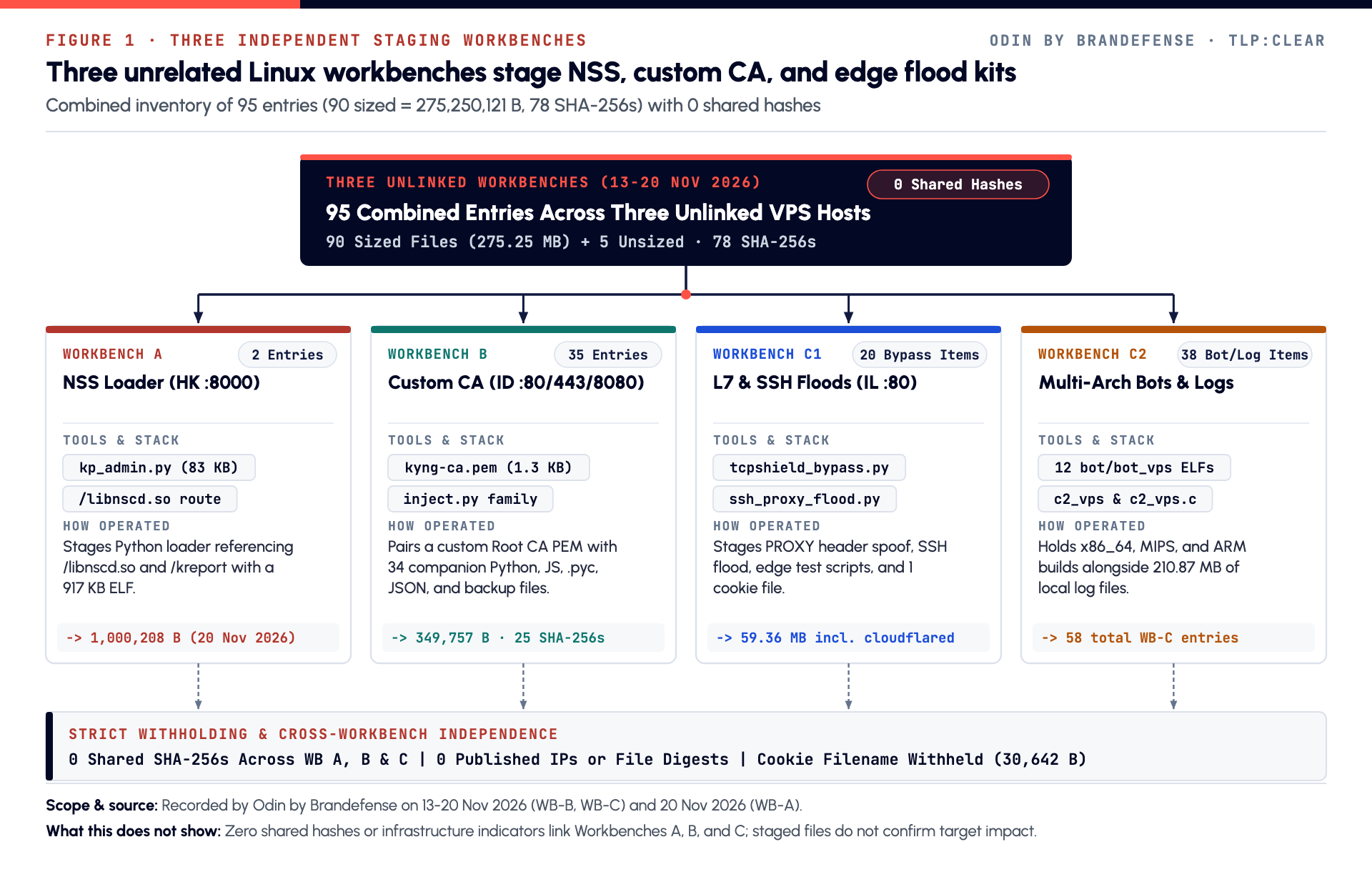
Three-Workbench Partition (n = 95)
Across all three virtual private servers, the deduplicated inventory totals 95 directory entries. Ninety entries report byte sizes summing to 275,250,121 bytes (275.25 MB). Five entries on Workbench C omit byte sizes in listings.
Security teams can use external attack surface management to spot exposed staging ports on cloud instances. Pairing those checks with cyber threat intelligence helps engineers translate staged tools into host and network detections. Table 1 reconciles all 95 entries across Workbenches A, B, and C.
| Workbench & hosting profile | Directory buckets | Total entries | Share (%) | Sized files | Unsized entries | Sized bytes | Unique SHA-256 (withheld) | Observed staging focus |
|---|---|---|---|---|---|---|---|---|
Workbench A (Hong Kong VPS · TCP 8000) | 1 (root) | 2 | 2.11% | 2 | 0 | 1,000,208 | 2 | Discovered 20 Nov 2026; stages kp_admin.py (82,987 B) referencing /libnscd.so and /kreport plus bot-evasive (917,221 B ELF). |
Workbench B (Indonesia VPS · TCP 80/443/8080) | 2 (root, __pycache__) | 35 | 36.84% | 35 | 0 | 349,757 | 25 | Recorded 13–20 Nov 2026; mirrors three ports staging kyng-ca.pem (1,318 B) with 34 companion Python, JS, .pyc, backup, and account JSON files. |
Workbench C (Israel Cloud VPS · TCP 80) | 6 (root + 5 dirs) | 58 | 61.05% | 53 | 5 | 273,900,156 | 51 | Recorded 13–20 Nov 2026; stages 57 L7/SSH flood, bot, C2, and log entries plus 1 harvested cookie file (30,642 B; name withheld). |
| Combined study inventory | 9 buckets | 95 | 100.00% | 90 | 5 | 275,250,121 | 78 (0 shared) | Three unlinked VPS workbenches (275.25 MB sized volume). |
Directory depth differs cleanly across the three servers.
- Workbench A (1 bucket). Both files sit in the root directory on
TCP 8000(1,000,208 bytes). - Workbench B (2 buckets). Thirty-two sized files (345,437 bytes) sit in the root directory mirrored across
TCP 80, 443, and 8080. Three CPython 3.10.pycfiles (4,320 bytes) sit inside__pycache__/. Ten identical-content backup copies explain why 35 files yield 25 unique digests. - Workbench C (6 buckets). Fifty-two entries (48 sized = 264,119,732 bytes and 4 unsized) sit in root on
TCP 80. Five subdirectories (serve/,debug/,scratch/,.ssh/, and.cache/) hold the remaining six entries (5 sized = 9,780,424 B and 1 unsized).
Combined File-Class and Functional Cluster Breakdown
Table 2 reconciles the same 95 entries (90 sized files, 5 unsized entries, 275,250,121 bytes) by file class. Text, log, backup, and C source files lead by count (41 entries, 43.16%) and volume (211,080,131 bytes). Compiled Linux ELF binaries (23 entries, 24.21%) and scripts (22 entries, 23.16%) make up another 47.37%.
| Artifact class | Total entries | Share (%) | Sized files | Unsized entries | Sized bytes | Cross-workbench composition |
|---|---|---|---|---|---|---|
Text, logs & C source (text) | 41 | 43.16% | 38 | 3 | 211,080,131 | 18 WB-B backups, users.json, and save files (146,229 B) plus 23 WB-C logs, worker lists, .c sources, dotfiles, and 1 withheld 30,642 B cookie file (210,933,902 B). |
Compiled binaries (exe) | 23 | 24.21% | 23 | 0 | 63,810,159 | 1 WB-A bot-evasive ELF (917,221 B) plus 22 WB-C x86_64, MIPS, ARM, cloudflared, and c2_vps binaries (62,892,938 B). |
Scripts (script) | 22 | 23.16% | 22 | 0 | 320,772 | 1 WB-A .py (82,987 B), 10 WB-B (5 .py, 5 .js; 164,469 B), and 11 WB-C (5 .py, 3 .js, 3 .sh; 73,316 B). |
Bytecode & state (other) | 5 | 5.26% | 3 | 2 | 4,320 | 3 WB-B CPython 3.10 .pyc files (4,320 B) and 2 WB-C unsized host markers (0 B). |
Backup snapshots (data) | 3 | 3.16% | 3 | 0 | 33,421 | 3 WB-B .bak files (kyng_c.js.bak 30,331 B, auth.py.bak 1,631 B, inject.py.bak 1,459 B). |
Certificates (secret) | 1 | 1.05% | 1 | 0 | 1,318 | 1 WB-B staged custom Root CA PEM certificate (kyng-ca.pem, 1,318 B). |
| Total | 95 | 100.00% | 90 | 5 | 275,250,121 | Exact parity with Table 1 (95 entries = 275.25 MB). |
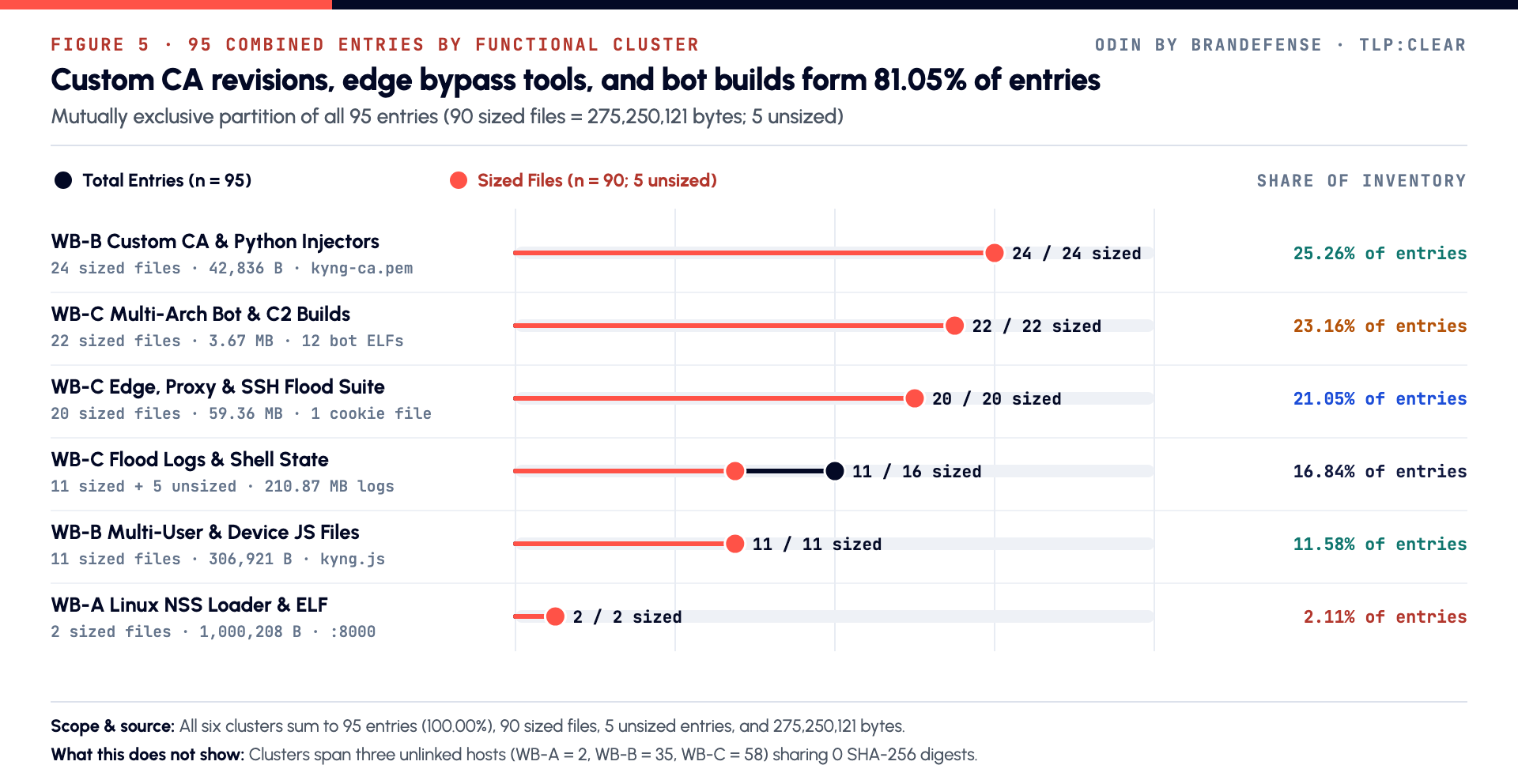
Figure 5 divides all 95 entries into six mutually exclusive functional clusters (24 + 22 + 20 + 16 + 11 + 2 = 95). Four active tooling clusters on Workbenches B and C account for 77 entries (81.05%). Local logs and dotfiles on Workbench C (16 entries, 16.84%) and Workbench A (2 entries, 2.11%) form the rest.
3. Linux Name Service Switch Loaders and Custom Root CA Suites
Workbenches A and B focus on host-level trust mechanisms: Linux name-resolution libraries (Workbench A) and Root CA trust anchors (Workbench B). Neither server shares files with the other. Figure 3 presents a dashed analytical model showing how defenders can spot these staged mechanisms alongside Workbench C's network floods.
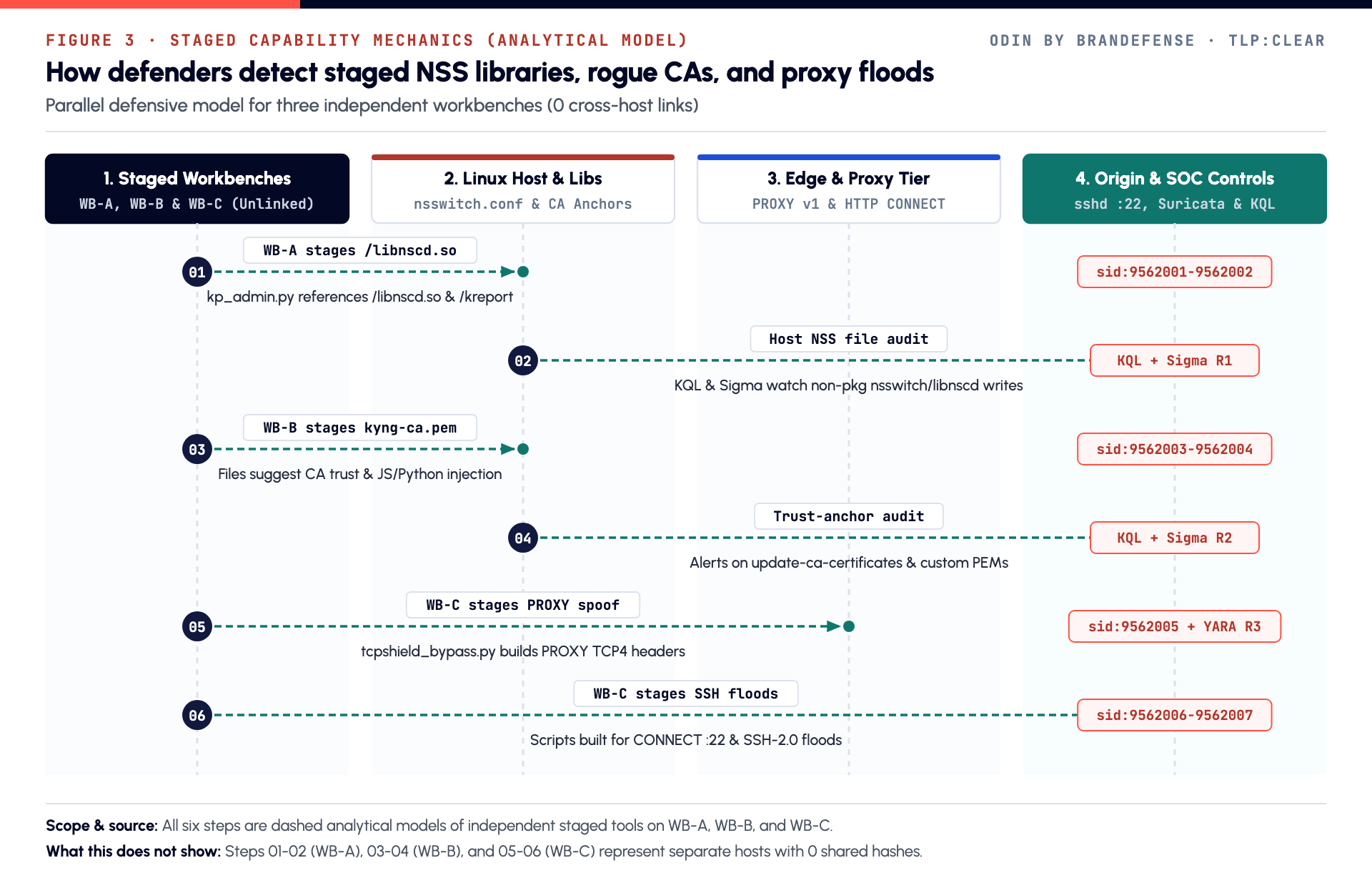
Workbench A: Linux nsswitch.conf, nscd, and Staged /libnscd.so Loading (2 Entries)
Discovered on 20 November 2026 on a Hong Kong VPS exposing TCP 8000 (address withheld), Workbench A holds 2 sized files totaling 1,000,208 bytes.
/kp_admin.py(82,987 bytes,script). This Python administration script references two HTTP endpoints:/libnscd.soand/kreport./bot-evasive(917,221 bytes,exe). This compiled Linux ELF executable sits in the same root directory.
Defenders can assess /libnscd.so by reviewing how GNU glibc resolves names and accounts on Linux ([REF-01], [REF-02]).
- Name Service Switch (
nsswitch.conf) loading ([REF-01]). When a dynamically linked Linux process callsgetpwnam()orgetaddrinfo(),glibcparses/etc/nsswitch.conf. For each listed module name,glibcloadslibnss_<module>.so.2into the calling process withdlopen(). Becausesshd,sudo,cron, and web servers run these lookups, an added NSS library loads inside privileged processes (T1556,[REF-04]). - Daemon naming vs shared-object masquerading (
[REF-02],[REF-03]). Linux distributions install the Name Service Cache Daemon as/usr/sbin/nscd, not as/libnscd.so([REF-02]). Naming a rogue.sofilelibnscd.sohelps it blend into/lib/or/usr/lib/during manual checks. Attackers can stage such libraries for/etc/ld.so.preload,LD_PRELOAD, linker path hijacking (T1574.006,[REF-03]), or/etc/nsswitch.confedits. - Staged reference boundary (
/kreport). Referencing/libnscd.soand/kreportseparates binary fetches from status callbacks. Becauselibnscd.soitself did not sit in the root listing on20 November 2026, both paths represent staged script references only.
Workbench B: Staged kyng-ca.pem Root CA and Multi-User Injectors (35 Entries)
From 13–20 November 2026, an Indonesia VPS mirrored identical directories on TCP 80, 443, and 8080 (address withheld). Workbench B holds 35 sized files totaling 349,757 bytes (25 unique SHA-256s). Table 3 summarizes all 35 files across its five component groups.
| Workbench B component group | Entries | Sized bytes | Representative filenames & sizes | Staged architectural role |
|---|---|---|---|---|
Custom Root CA (secret) | 1 | 1,318 | kyng-ca.pem (1,318 B) | PEM X.509 certificate staged to anchor local or proxied TLS interception (T1553.004). |
Python Injectors (inject*) | 15 | 24,522 | inject.py (1,632 B), inject_b.py (1,461 B), inject_c.py (1,461 B), inject.py.bak-debug (3,050 B) | Active Python scripts and 11 backups spanning browser-only, login, user-ID, device, and multi-user edits. |
CPython 3.10 Bytecode (__pycache__) | 3 | 4,320 | inject.cpython-310.pyc (1,610 B), inject_b.cpython-310.pyc (1,355 B), inject_c.cpython-310.pyc (1,355 B) | Bytecode caches created when Python 3.10 imported inject, inject_b, and inject_c locally. |
Auth & Accounts (auth* + users.json) | 5 | 12,797 | auth.py (3,695 B), auth.py.backup-sekarang (3,695 B), auth.py.bak (1,631 B), users.json (81 B) | Session auth scripts (1,631 B to 3,695 B) paired with an 81-byte JSON account file. |
JS Interceptors (kyng*.js*) | 11 | 306,921 | kyng.js (31,733 B), kyng-before-total-fix.js (31,446 B), kyng_b.js (30,331 B), kyng_c.js (30,331 B), kyng.js.save (1 B) | Client or proxy JavaScript revisions (30.3 KB to 31.7 KB) plus a 1-byte save stub. |
| Workbench B Total | 35 | 349,757 | 32 root files (345,437 B) + 3 __pycache__ files (4,320 B) | 25 unique SHA-256 digests (0 unsized entries). |
Three practical lessons stand out on Workbench B.
- Root CA trust subversion (
T1553.004,[REF-05],[REF-06]). Under RFC 5280 ([REF-06]), a client may trust a server certificate signed by an installed root certificate authority when its validation checks pass. Registeringkyng-ca.pemwithupdate-ca-certificates,update-ca-trust,trust anchor, orNODE_EXTRA_CA_CERTSlets an intercepting proxy with the matching private key inspect or modify HTTPS traffic ([REF-05]). - Clear feature evolution in backups. Early Python snapshots (
inject.py.bak-browser-onlyandinject.py.backup-before-multiuser, 1,459 B each) grow intoinject.py(1,632 B). Likewise,kyng.js.backup-before-device(30,392 B) grows intokyng.js(31,733 B). One backup (inject_c.py.bak-20261111-072238) carries an11 November 2026filename timestamp created two days before collection began. - Language clues vs attribution. Two backups (
auth.py.backup-sekarangandinject.py.backup-sebelum-userid) use Indonesian words ("now" and "before") on an Indonesia-hosted VPS. Hosting geography and filename words describe the workspace only and do not establish operator nationality.
4. Application-Layer Proxy, SSH, and Shield Bypass Kits (Workbench C)
Recorded on 13–20 November 2026 on an Israel cloud VPS exposing TCP 80 (address withheld), Workbench C holds 58 deduplicated entries. Fifty-three sized files total 273,900,156 bytes, five entries are unsized, and 51 unique SHA-256 digests appear (0 shared with A or B). Figure 4 compares port layouts and directory slices across all three hosts.
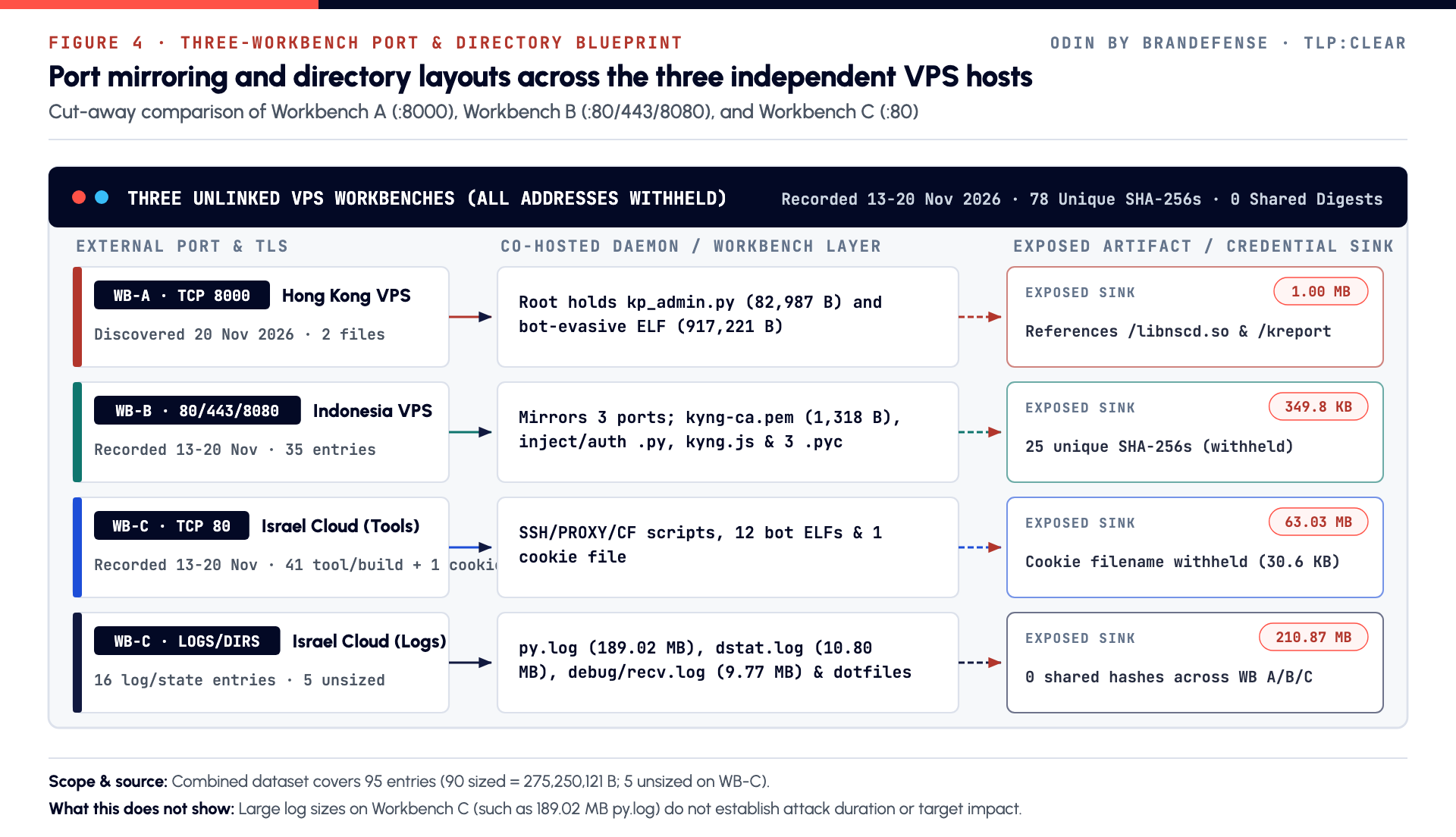
Edge-Shield Bypass, SSH Floods, Multi-Arch Bots, and Logs (58 Entries)
Table 4 reconciles all 58 entries (53 sized = 273,900,156 bytes and 5 unsized) across Workbench C's three functional clusters (20 + 22 + 16 = 58).
| Workbench C component group | Entries | Sized bytes | Representative files & sizes | Staged mechanism |
|---|---|---|---|---|
| Origin & Shield Bypass | 5 | 15,418,214 | tcpshield_bypass.py (3,541 B), cf_bypass.x86_64 (10,829,986 B), mc_bypass.x86_64 (2,314,402 B), ovh_specter.x86_64 (2,269,449 B), ovhkill.sh (836 B) | Direct-to-origin HAProxy PROXY TCP4 header spoofing and edge flood binaries. |
| Tunnel, Worker & L7 Scripts | 10 | 39,862,087 | cloudflared (39,798,028 B), tornado.js (35,814 B), 4 CF Worker .txt lists (310 B), c2_roblox.py, roblox_join.js, snipe, snipe.c | Serverless Worker lists, tunnel utility, and HTTP flood scripts. |
| SSH Floods, Bandwidth & Cookie | 5 | 4,077,784 | ssh_native.py (3,872 B), ssh_proxy_flood.py (6,278 B), ssh_killer.x86_64 (4,026,633 B), dstat.py (10,359 B), 1 withheld cookie file (30,642 B) | Native and HTTP CONNECT :22 SSH floods, bandwidth monitor, and withheld cookie file. |
| Multi-Arch Bots & C2 | 22 | 3,668,226 | c2_vps & c2_vps_new (936,280 B each), c2_vps.c (25,276 B), 12 bot/bot_vps ELFs (x86_64, MIPS, ARM), 7 build/test files | Cross-compiled bot client binaries, C2 server builds, and C parser helpers. |
| Local Logs & Dotfiles | 16 | 210,873,845 | py.log (189,024,142 B), dstat.log (10,795,269 B), debug/recv.log (9,774,454 B), http.log (1,271,776 B), 5 unsized entries | Local console logs (11 sized, 5 unsized) and shell dotfiles (5,395 B). |
| Workbench C Total | 58 | 273,900,156 | 53 sized files + 5 unsized entries (51 unique SHA-256s) | 0 shared digests with Workbenches A or B. |
Four operational takeaways guide edge and SSH defenders (T1499, [REF-07]).
- Direct-to-origin
PROXYheader spoofing. Game servers behind TCPShield and proxied web backends parse HAProxyPROXY TCP4headers ([REF-10]) to read client IPs. When origin firewalls fail to drop non-shield packets,tcpshield_bypass.py(3,541 B) can hit the origin directly and spoof client addresses ([REF-10]). - Native and HTTP-proxied SSH handshake floods. Every TCP connection to
sshdtriggers anSSH-2.0-banner and key exchange before login ([REF-09]). OpenSSH limits unauthenticated queues throughMaxStartups([REF-08]). Staged toolsssh_native.py,ssh_killer.x86_64, andssh_proxy_flood.py(via HTTPCONNECTto :22) aim to fill those queues. - Withheld cookie file (30,642 bytes). Workbench C holds a harvested browser-cookie file (30,642 bytes; filename withheld). Operators often load session or clearance cookies into HTTP flooders. Odin by Brandefense withholds its filename, digest, and contents to protect affected users.
- Local log sizes vs external impact. Six sized logs (
py.logat 189.02 MB,dstat.logat 10.80 MB, anddebug/recv.logat 9.77 MB) hold nearly all bytes in the log group. Verbose socket errors grow rapidly on disk and never establish run duration or remote service impact.
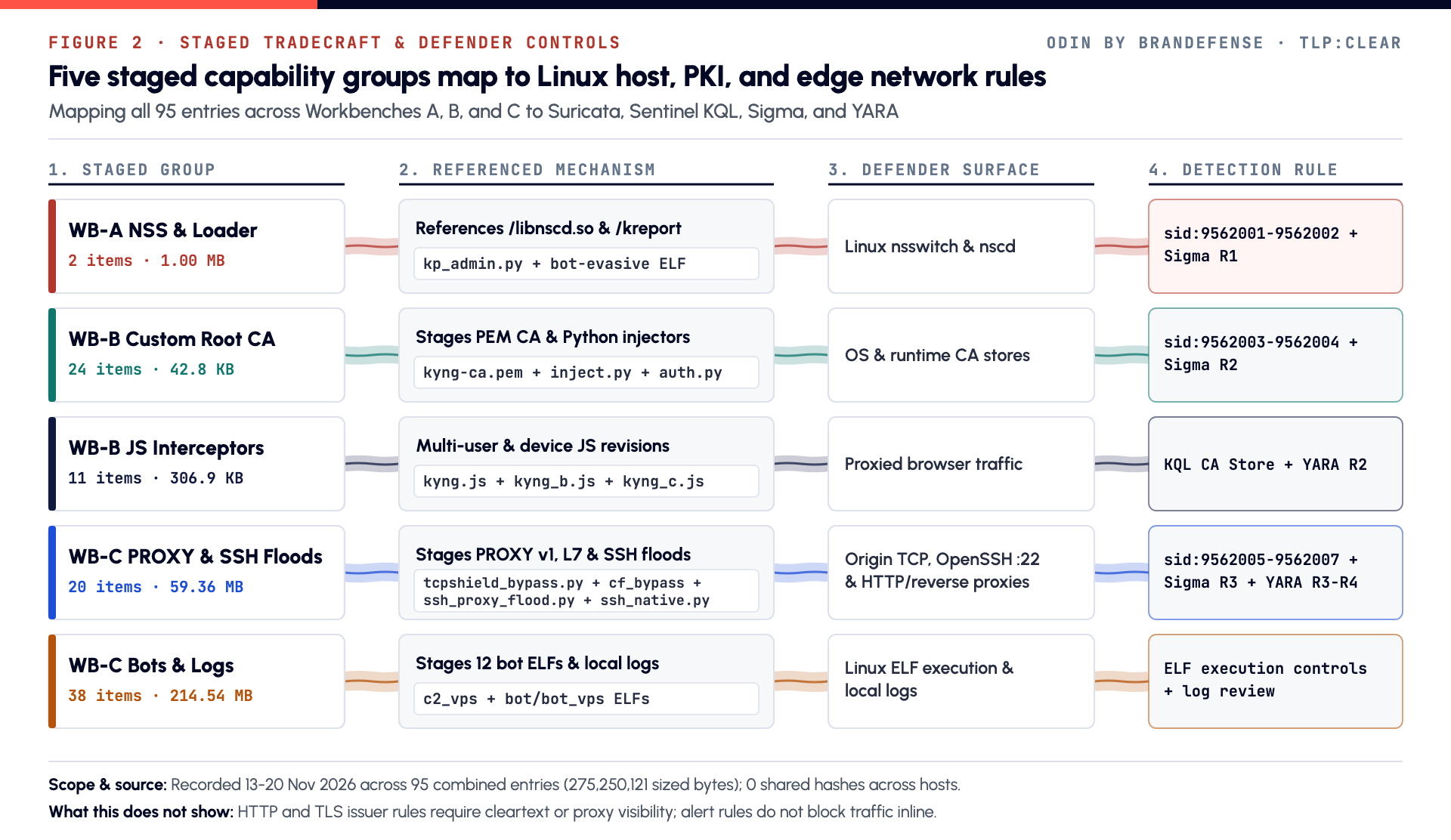
Figure 2 maps all five staged capability groups across Workbenches A, B, and C to the detections in Chapter 8.
5. Linux Identity, TLS Trust, and Edge Exposure Analysis
Defenders should verify four concrete controls across Linux servers, PKI trust stores, and proxied network perimeters before treating any configuration gap as an established root cause.
| Exposure surface | Observed workbench evidence | Control to verify | Operational risk |
|---|---|---|---|
| Linux NSS & library paths | WB-A kp_admin.py (82,987 B) referencing /libnscd.so and /kreport plus bot-evasive (917,221 B). | Verify whether /etc/nsswitch.conf, /etc/ld.so.preload, /lib*, and /usr/lib* alert on non-package writes ([REF-01], [REF-03]). | Rogue NSS or preloaded .so files load into sshd and sudo during lookups ([REF-04]). |
| OS & runtime Root CA stores | WB-B kyng-ca.pem (1,318 B) plus 34 companion Python, JS, .pyc, backup, and account JSON files (348,439 B). | Verify whether update-ca-certificates, update-ca-trust, trust anchor, and NODE_EXTRA_CA_CERTS are restricted ([REF-05], [REF-06]). | With a matching private key and traffic path, a rogue Root CA lets an intercepting proxy forge certificates without client warnings. |
Origin firewall & PROXY ACLs | WB-C tcpshield_bypass.py (3,541 B), cf_bypass.x86_64, mc_bypass.x86_64, ovh_specter.x86_64, 4 CF lists. | Verify whether origin firewalls drop non-shield packets and restrict PROXY TCP4 parsing to upstream CIDRs ([REF-10]). | Direct origin connections bypass DDoS scrubbing edges and spoof source IPs. |
| OpenSSH queues & HTTP proxies | WB-C ssh_native.py (3,872 B), ssh_proxy_flood.py (6,278 B), ssh_killer.x86_64, 12 bot ELFs. | Verify whether sshd sets PerSourceMaxStartups and LoginGraceTime ([REF-08]) and proxies block CONNECT :22. | Unauthenticated SSH-2.0- floods fill pre-auth slots and block admin SSH access ([REF-07], [REF-09]). |
6. Alternative Hypotheses
| Hypothesis | Evidence for | Evidence against | Assessment |
|---|---|---|---|
| Single operator across Workbenches A, B, and C | All three Linux VPS hosts were recorded during 13–20 November 2026. | Comparing 2 + 25 + 51 = 78 unique SHA-256s shows 0 shared hashes; regions (HK, ID, IL), ports, and code differ. | Refuted. Treat A, B, and C strictly as three independent hosts. |
| Authorized security or load testing | dstat.py, test_parse.c, and dated backups resemble developer test habits. | WB-C holds 12 bot ELFs, ssh_killer.x86_64, and a withheld 30,642 B cookie file on an open port; A and B expose offensive kits openly. | Authorized use is unsupported by the recorded files. The staged loader, CA injector suite, and flood kit support an attacker-workbench assessment. Withhold all VPS IPs. |
Large WB-C logs (189.02 MB py.log) show prolonged target outages | py.log (189.02 MB), dstat.log (10.80 MB), and recv.log (9.77 MB) hold large console outputs. | Per-socket Python error loops can write hundreds of megabytes in minutes without affecting any remote target. | Unsupported. File size alone never establishes run duration or target impact. |
| Indonesian backup suffixes establish operator nationality | auth.py.backup-sekarang and inject.py.backup-sebelum-userid sit on an Indonesia VPS. | Reused kits and outsourced scripts often keep earlier filename words regardless of operator location. | Insufficient for attribution. Treat backup names as revision labels only. |
7. What Defenders Should Do
Infrastructure and security teams can close these host, PKI, and perimeter gaps in five steps.
- Protect
/etc/nsswitch.confand system library paths (0–48 Hours). Addauditdwrite watches on/etc/nsswitch.confand/etc/ld.so.preload([REF-01],[REF-03]). Rundpkg -Vorrpm -Vato verify shared libraries against package digests. Disablenscd([REF-02]) where local caching is unnecessary. - Baseline OS and runtime Root CA stores (
0–72 Hours). Hash all PEM and CRT anchors under/etc/ssl/certs/,/usr/local/share/ca-certificates/, and/etc/pki/ca-trust/source/anchors/against an approved baseline ([REF-05],[REF-06]). Audit service files and shell profiles for unauthorizedNODE_EXTRA_CA_CERTSorSSL_CERT_FILEvariables. - Close direct-to-origin leaks and scope
PROXYheaders (Days 1–7). Configure security groups ornftablesso origin TCP ports accept packets strictly from verified CDN or TCPShield CIDRs ([REF-10]). Scope Nginxset_real_ip_fromand HAProxyaccept-proxyACLs to those same CIDRs. Rotate origin public IPs if historical DNS records exposed them. - Throttle OpenSSH pre-auth queues and forward proxies (
Days 7–14). SetLoginGraceTime 20,MaxStartups 30:30:100, andPerSourceMaxStartups 5in/etc/ssh/sshd_config([REF-08],[REF-09]). Deny HTTPCONNECTrequests to :22 on forward proxies (sid:9562007). - Enforce outbound egress rules on Linux workloads (
Days 14–30). Route server egress through proxies or strict VPC allowlists so workloads cannot fetch staged.sobinaries (sid:9562001) or join outbound flood traffic.
8. Detection Rules
All VPS IPv4 addresses and all 78 workbench SHA-256 digests are withheld. Defenders should deploy protocol, file-integrity, process, and file-structure rules that work across any infrastructure.
Each rule was checked statically before release. Suricata 7.x sticky-buffer, flow, and semicolon syntax passed the static Suricata linter with 0 problems (sid:9562001-9562007). Sentinel KQL table schemas, in~ allowlists, Sigma YAML fields, and filesize-bounded YARA conditions were verified structurally. Live Suricata, Sentinel, Sigma, and YARA engines were not installed in this build environment, so validate in staging before rollout.
8.1 Suricata 7.x Network Signatures (sid:9562001-9562007)
These seven alert signatures detect staged /libnscd.so and /kreport HTTP routes (sid:9562001-9562002) and /kyng-ca.pem fetches (sid:9562003). Rule sid:9562004 matches TLS server certificates whose tls.cert_issuer contains kyng. Rules sid:9562005-9562007 match inbound PROXY TCP4 spoofing, high-rate SSH-2.0- floods (>=40 in 10s), and HTTP CONNECT requests to :22.
HTTP rules (sid:9562001-9562003, 9562007) need cleartext HTTP or a TLS-inspecting proxy. Rule sid:9562004 sees tls.cert_issuer in cleartext on TLS 1.2, whereas TLS 1.3 encrypts server certificates and requires TLS inspection. For sid:9562005, exclude verified upstream CDN or TCPShield proxy CIDRs from $EXTERNAL_NET. All seven rules use alert mode and do not drop packets inline.
# Odin by Brandefense - Monograph 62 Suricata 7.x Ruleset
# Covers staged libnscd.so / kreport routes, custom kyng Root CA fetches/issuers, PROXY v1 spoofing, and SSH floods.

alert http $HOME_NET any -> $EXTERNAL_NET any (msg:"ODIN-R62 WB-A Outbound HTTP Request for Staged libnscd.so Shared Object"; flow:established,to_server; http.uri; content:"/libnscd.so"; endswith; fast_pattern; classtype:trojan-activity; sid:9562001; rev:1;)
alert http $HOME_NET any -> $EXTERNAL_NET any (msg:"ODIN-R62 WB-A Outbound HTTP POST Callback to Staged kreport Endpoint"; flow:established,to_server; http.method; content:"POST"; bsize:4; http.uri; content:"/kreport"; startswith; fast_pattern; classtype:command-and-control; sid:9562002; rev:1;)
alert http $HOME_NET any -> $EXTERNAL_NET any (msg:"ODIN-R62 WB-B Outbound HTTP Fetch of Custom kyng-ca.pem Root Certificate"; flow:established,to_server; http.uri; content:"/kyng-ca.pem"; endswith; fast_pattern; classtype:policy-violation; sid:9562003; rev:1;)
alert tls $EXTERNAL_NET any -> $HOME_NET any (msg:"ODIN-R62 WB-B Inbound TLS Server Certificate Issued by Custom kyng CA"; flow:established,to_client; tls.cert_issuer; content:"kyng"; nocase; fast_pattern; classtype:bad-unknown; sid:9562004; rev:1;)
alert tcp $EXTERNAL_NET any -> $HOME_NET any (msg:"ODIN-R62 WB-C Inbound Direct-to-Origin HAProxy PROXY v1 Header Spoof Attempt"; flow:established,to_server; content:"PROXY TCP4 "; startswith; fast_pattern; classtype:attempted-recon; sid:9562005; rev:1;)
alert tcp $EXTERNAL_NET any -> $HOME_NET 22 (msg:"ODIN-R62 WB-C Inbound High-Rate SSH-2.0 Handshake Flood Against TCP 22"; flow:established,to_server; content:"SSH-2.0-"; startswith; fast_pattern; threshold:type both, track by_src, count 40, seconds 10; classtype:attempted-dos; sid:9562006; rev:1;)
alert http $HOME_NET any -> $EXTERNAL_NET any (msg:"ODIN-R62 WB-C Outbound HTTP CONNECT Proxy Tunnel Targeting SSH Port 22"; flow:established,to_server; http.method; content:"CONNECT"; bsize:7; http.uri.raw; content:":22"; endswith; fast_pattern; classtype:policy-violation; sid:9562007; rev:1;)
8.2 Microsoft Sentinel KQL Hunt
This query joins DeviceFileEvents (non-package NSS and CA store writes), DeviceProcessEvents (trust-anchor and flood commands), and DeviceNetworkEvents (staged /libnscd.so, /kreport, and /kyng-ca.pem fetches). Replace the placeholder FQDNs in ApprovedAdminHosts with your configuration and PKI management hosts before scheduling.
// Odin by Brandefense - Monograph 62
// Hunts Linux /etc/nsswitch.conf edits, non-package libnscd.so writes, Root CA trust additions, and scripted SSH/proxy floods.
let Lookback = 7d;
let ApprovedAdminHosts = dynamic(["cfg-mgmt-01.corp.example", "pki-admin-01.corp.example"]);
let ApprovedPackageManagers = dynamic(["dpkg", "apt", "apt-get", "rpm", "yum", "dnf", "apk", "pacman", "zypper"]);
let NssAndCaFileWrites =
    DeviceFileEvents
    | where Timestamp >= ago(Lookback)
    | where not(DeviceName in~ (ApprovedAdminHosts))
    | where ActionType in ("FileCreated", "FileModified", "FileRenamed")
    | where not(InitiatingProcessFileName in~ (ApprovedPackageManagers))
    | where (
        FolderPath == "/etc" and FileName == "nsswitch.conf"
        or FileName == "libnscd.so"
        or (FileName startswith "libnss_" and FileName has ".so")
        or FolderPath startswith "/usr/local/share/ca-certificates"
        or FolderPath startswith "/etc/pki/ca-trust/source/anchors"
    )
    | project Timestamp, DeviceName, AccountName = InitiatingProcessAccountName, SignalType = "LinuxNssOrCaStoreWrite", Detail = strcat(InitiatingProcessFileName, " -> ", FolderPath, "/", FileName);
let TrustAndFloodProcesses =
    DeviceProcessEvents
    | where Timestamp >= ago(Lookback)
    | where not(DeviceName in~ (ApprovedAdminHosts))
    | where (
        ProcessCommandLine has_any ("update-ca-certificates", "update-ca-trust", "trust anchor")
        or (ProcessCommandLine has "/etc/nsswitch.conf" and not(FileName in~ (ApprovedPackageManagers)))
        or ProcessCommandLine has_any ("libnscd.so", "tcpshield_bypass", "ssh_proxy_flood", "ssh_native", "cf_bypass")
    )
    | project Timestamp, DeviceName, AccountName, SignalType = "TrustStoreOrBypassProcess", Detail = ProcessCommandLine;
let StagedLoaderEgress =
    DeviceNetworkEvents
    | where Timestamp >= ago(Lookback)
    | where not(DeviceName in~ (ApprovedAdminHosts))
    | where InitiatingProcessFileName in~ ("python", "python3", "curl", "wget")
    | where RemoteUrl has_any ("/libnscd.so", "/kreport", "/kyng-ca.pem")
    | project Timestamp, DeviceName, AccountName = InitiatingProcessAccountName, SignalType = "StagedLoaderOrCaFetch", Detail = strcat(InitiatingProcessFileName, " -> ", RemoteUrl, " (", RemoteIP, ":", tostring(RemotePort), ")");
union NssAndCaFileWrites, TrustAndFloodProcesses, StagedLoaderEgress
| summarize FirstSeen = min(Timestamp), LastSeen = max(Timestamp), EventCount = count(), Signals = make_set(SignalType, 6), SampleDetails = make_set(Detail, 5) by DeviceName, AccountName
| order by LastSeen desc
8.3 Portable Sigma and YARA Rules
- Sigma (
sigma_linux_nss_hijack_root_ca_and_ssh_flood.yml). Rule 1 detects Linux commands referencing/etc/nsswitch.conf,/libnscd.so,kp_admin.py, or/kreportoutsidecfg-mgmt-01.corp.example. Rule 2 catchesupdate-ca-certificates,update-ca-trust,trust anchor, orNODE_EXTRA_CA_CERTS=paired with.pem,.crt,ca-certificates, orkyng-caoutsidepki-admin-01.corp.example. Rule 3 detectstcpshield_bypass,ssh_proxy_flood,ssh_native.py,ssh_killer,cf_bypass, orovh_specteroutsidenet-test-01.corp.example. - YARA (
odin_nss_loader_custom_ca_and_l7_bypass.yar). Fourfilesize-bounded rules match/libnscd.so+/kreportloader scripts (< 256KB) and custom CA trust-injection scripts (< 128KB). Two further rules match rawPROXY TCP4spoofing scripts (< 64KB) and HTTPCONNECT:22 SSH flood scripts (< 64KB).
9. Indicators
No VPS IPv4 addresses, referenced C2 addresses, file SHA-256 digests, or victim cookie filenames appear in the indicator feeds (0 published indicators in the Indicators tab). Defenders should hunt using the 10 protocol, CLI, and file-integrity markers below.
| Marker category | Pattern / artifact marker | Layer | Defensive hunt & control |
|---|---|---|---|
| Staged library URI | GET /libnscd.so | HTTP egress | Alert on visible HTTP requests with sid:9562001 and KQL StagedLoaderEgress. Block unauthorized binary fetches at egress proxies. |
| Loader callback URI | POST /kreport | HTTP egress | Alert via sid:9562002 behind egress proxies and inspect the initiating Linux process in EDR. |
Linux NSS & .so FIM | /etc/nsswitch.conf & libnscd.so | Linux FIM | Alert on writes outside dpkg, apt, rpm, or dnf via Sentinel NssAndCaFileWrites and Sigma Rule 1. |
| Custom Root CA URI | GET /kyng-ca.pem (1,318 B) | HTTP egress | Alert via sid:9562003 and inspect endpoints fetching .pem files from untrusted servers. |
| Custom TLS CA issuer | tls.cert_issuer containing kyng | TLS / proxy | Alert via sid:9562004 on TLS 1.2 or TLS-inspected traffic; verify against approved enterprise CAs. |
| CA trust registration | update-ca-certificates / trust anchor | Linux CLI | Alert via Sentinel TrustAndFloodProcesses and Sigma Rule 2 outside approved PKI hosts. |
| Spoofed PROXY header | PROXY TCP4 from untrusted WAN IPs | TCP ingress | Alert via sid:9562005 and drop direct non-shield packets at the origin firewall ([REF-10]). |
| SSH banner flood | SSH-2.0- (>=40 / 10s per source) | TCP 22 | Alert via sid:9562006 and enforce PerSourceMaxStartups in sshd_config ([REF-08]). |
| Proxied SSH flood | CONNECT <host>:22 | HTTP proxy | Alert via sid:9562007 and restrict forward proxies to CONNECT port 443 only. |
| Flood script CLI | tcpshield_bypass / ssh_proxy_flood | Linux EDR | Alert via Sigma Rule 3 and stop unauthorized flood processes on Linux hosts. |
10. Scope and Limits
Odin by Brandefense analyzed exposed directories on three commercial virtual private servers recorded on 13–20 November 2026. Workbench A was recorded on 20 November 2026; Workbenches B and C on 13–20 November 2026. Counts cover all 95 deduplicated entries (90 sized files = 275,250,121 bytes and 5 unsized entries; 78 unique SHA-256 digests).
Directory listings and local log files (189,024,142-byte py.log) document staged files and local console output, not confirmed compromises or outages. All VPS IPv4 addresses, referenced C2 addresses, all 78 file digests, and the 30,642-byte cookie filename on Workbench C are withheld. Zero shared SHA-256 digests or infrastructure indicators link Workbenches A, B, and C.
11. Sources
[REF-01]Linux Manual Pages (man7.org), *nsswitch.conf(5) - Name Service Switch Configuration File* (verified on 24 November 2026).[REF-02]Linux Manual Pages (man7.org), *nscd(8) - Name Service Cache Daemon* (verified on 24 November 2026).[REF-03]MITRE ATT&CK, *Hijack Execution Flow: Dynamic Linker Hijacking (T1574.006)* (verified on 24 November 2026).[REF-04]MITRE ATT&CK, *Modify Authentication Process (T1556)* (verified on 24 November 2026).[REF-05]MITRE ATT&CK, *Subvert Trust Controls: Install Root Certificate (T1553.004)* (verified on 24 November 2026).[REF-06]IETF, *Internet X.509 Public Key Infrastructure Certificate and Certificate Revocation List (CRL) Profile (RFC 5280)* (verified on 24 November 2026).[REF-07]MITRE ATT&CK, *Endpoint Denial of Service (T1499)* (verified on 24 November 2026).[REF-08]OpenBSD Manual Pages, *sshd_config(5) - OpenSSH Daemon Configuration File* (verified on 24 November 2026).[REF-09]IETF, *The Secure Shell (SSH) Transport Layer Protocol (RFC 4253)* (verified on 24 November 2026).[REF-10]HAProxy Technologies, *The PROXY Protocol Versions 1 & 2 Specification* (verified on 24 November 2026).
Frequently asked questions
How were the 95 staged entries split across the three independent servers?
Comparing all 2 unique digests on Workbench A, 25 on Workbench B, and 51 on Workbench C confirms 0 shared hashes. Hosting regions, open TCP ports, and code stacks also differ completely across the three servers. Security teams can apply external attack surface management to spot exposed cloud directories and cyber threat intelligence to turn staged tooling into portable detections.
How do staged Linux NSS loaders and custom Root CAs alter host trust?
Workbenches A and B target two quiet trust mechanisms on Linux endpoints and application runtimes. Both servers hold staged files only, so neither directory listing confirms downstream deployment against external victims.
Why do PROXY header spoofing and SSH proxy floods test perimeter controls?
Recorded on 13–20 November 2026 on an Israel cloud VPS (TCP 80), Workbench C holds 58 entries (53 sized files = 273,900,156 bytes and 5 unsized entries). Alongside 12 cross-compiled bot and bot_vps ELF builds (x86_64, MIPS, and ARM) and two c2_vps binaries, its scripts target two common edge gaps (T1499).
What should Linux, identity, and edge defenders do first?
Because zero indicators link the three servers, defenders should enforce behavioral controls across Linux hosts, PKI stores, and network perimeters. The Detection rules tab includes Suricata (sid:9562001-9562007), Microsoft Sentinel KQL, Sigma, and YARA rules. The full report covers each workbench, protocol mechanism, and rule limitation in detail.