
Key takeaways
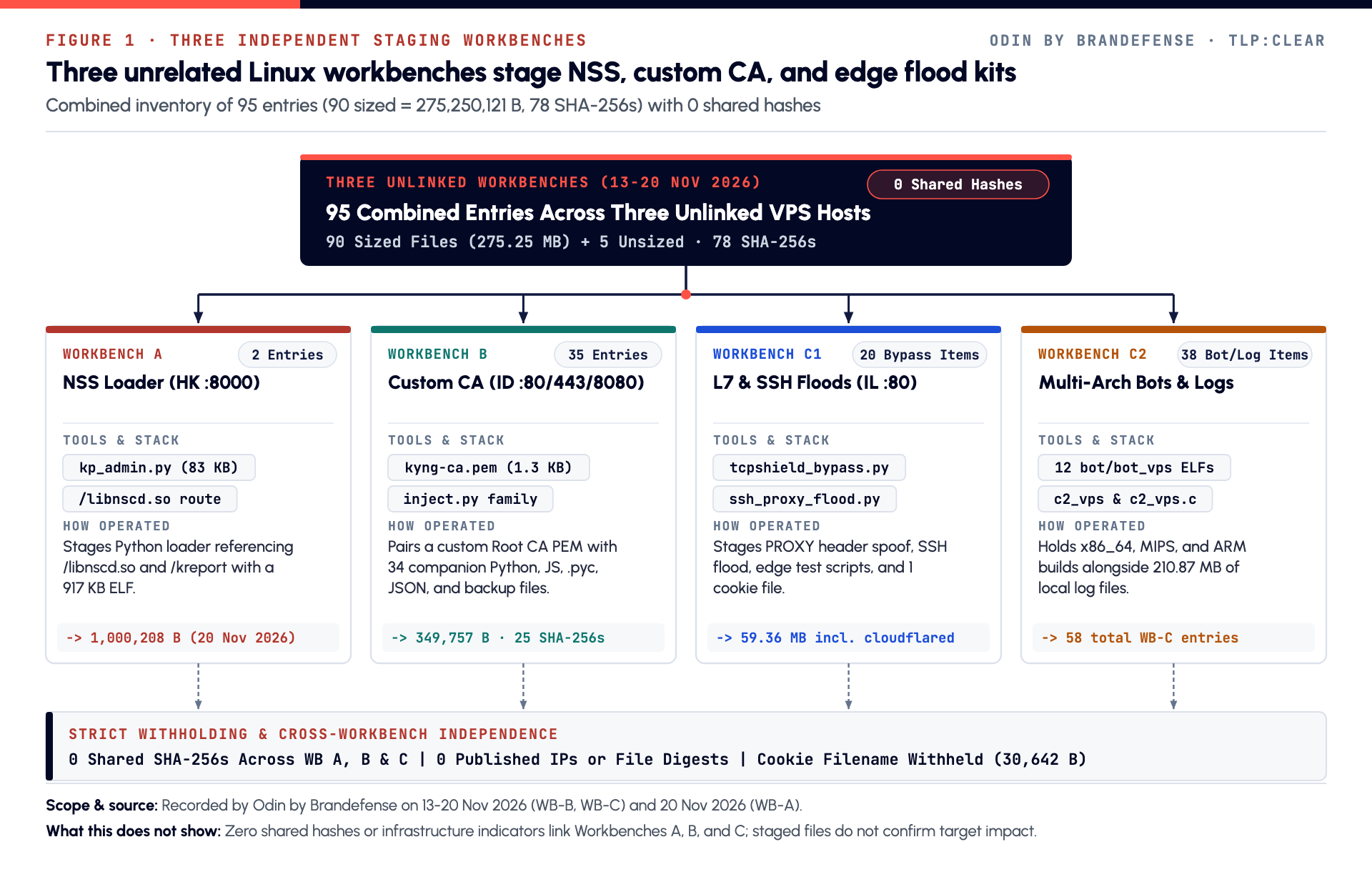
- Three unlinked Linux VPS hosts recorded on 13–20 November 2026 held 95 entries (90 sized files = 275.25 MB, 5 unsized, and 78 unique SHA-256s).
- Zero shared SHA-256 digests or infrastructure indicators link Workbenches A, B, and C, so each server represents an independent staging workspace.
- Workbench A (:8000) staged kp_admin.py (82,987 B) referencing /libnscd.so and /kreport routes alongside a 917,221-byte bot-evasive ELF binary.
- Workbench B (:80, :443, :8080) paired a 1,318-byte kyng-ca.pem custom Root CA with 34 companion Python, JavaScript, bytecode, backup, and account files.
- Audit /etc/nsswitch.conf and OS CA stores, restrict PROXY TCP4 headers to verified edge CIDRs, and tune OpenSSH PerSourceMaxStartups limits.
Three unrelated Linux virtual private servers staged a shared-library loader script, a custom Root CA injector suite, and application-layer proxy and SSH flood kits. Odin by Brandefense analyzed all 95 deduplicated directory entries across those three hosts recorded on 13–20 November 2026.
Zero shared SHA-256 digests or infrastructure indicators link Workbenches A, B, and C.
Ninety sized files total 275,250,121 bytes (275.25 MB), five entries omit byte size, and 78 unique SHA-256 digests appear across the set. All server IPv4 addresses, referenced unconfirmed C2 addresses, file SHA-256 digests, and one harvested browser-cookie filename are withheld.
How were the 95 staged entries split across the three independent servers?
Comparing all 2 unique digests on Workbench A, 25 on Workbench B, and 51 on Workbench C confirms 0 shared hashes. Hosting regions, open TCP ports, and code stacks also differ completely across the three servers. Security teams can apply external attack surface management to spot exposed cloud directories and cyber threat intelligence to turn staged tooling into portable detections.
Across all 95 entries, text, log, C source, and backup files form the largest group (41 entries, 43.16%, 211,080,131 bytes). Compiled Linux ELF binaries (23 entries, 24.21%, 63,810,159 bytes) and Python, JavaScript, and shell scripts (22 entries, 23.16%, 320,772 bytes) follow closely. Five bytecode and host-state entries (4,320 bytes), three .bak files (33,421 bytes), and one .pem certificate (1,318 bytes) complete the dataset.
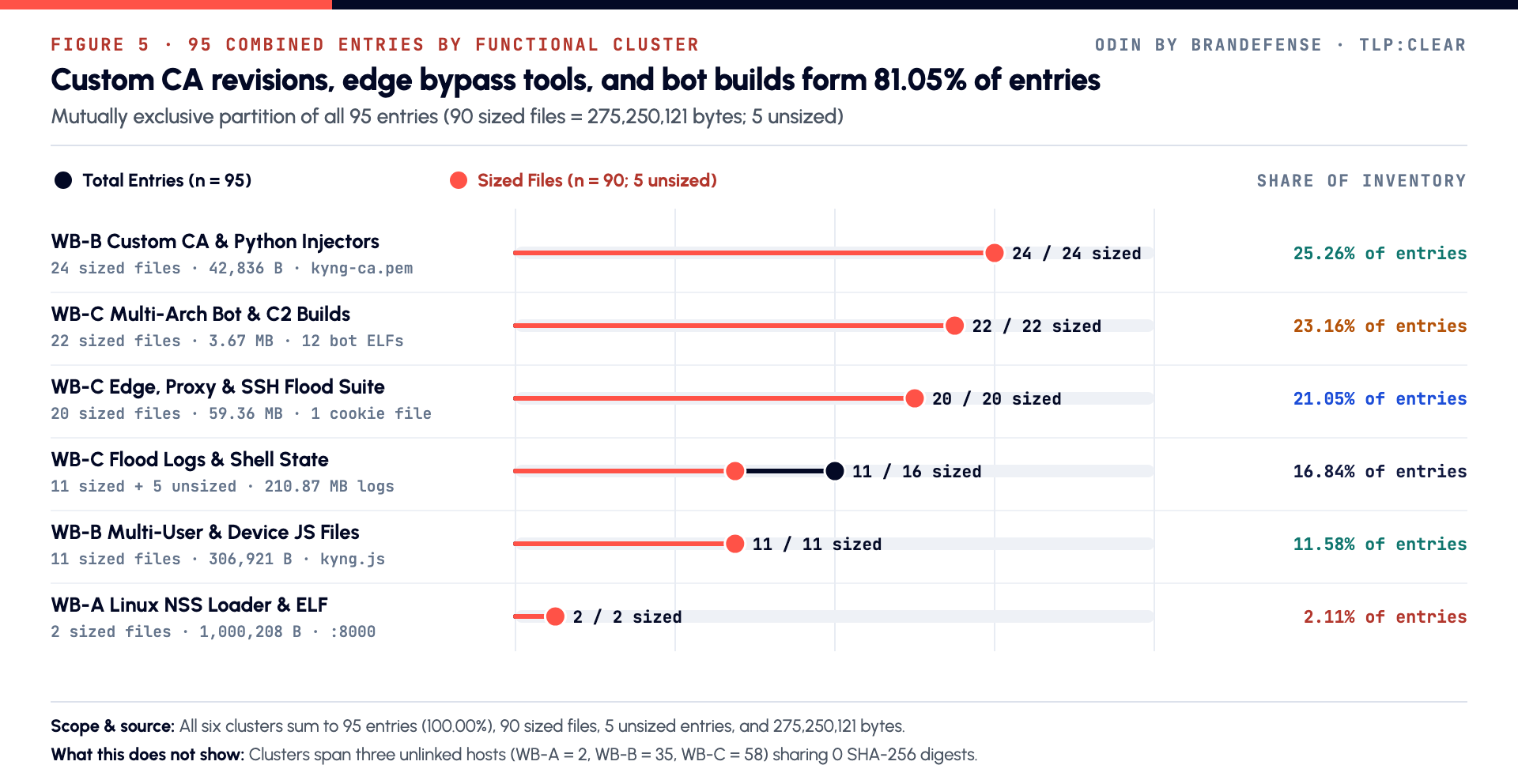
| Functional cluster across the 3 hosts | Entries | Sized bytes | Key staged files |
|---|---|---|---|
| WB-A NSS Loader & ELF (:8000) | 2 | 1,000,208 | kp_admin.py (82,987 B) + bot-evasive (917,221 B ELF). |
| WB-B Custom CA & Python (:80/443/8080) | 24 | 42,836 | kyng-ca.pem (1,318 B), 18 inject/.pyc files, 4 auth files, users.json. |
| WB-B Multi-User JS (:80/443/8080) | 11 | 306,921 | kyng.js (31,733 B), kyng_b.js, kyng_c.js, and 8 backup files. |
| WB-C Edge, Proxy & SSH Flood (:80) | 20 | 59,358,085 | tcpshield_bypass.py, ssh_proxy_flood.py, ssh_native.py, dstat.py, 1 cookie file. |
| WB-C Multi-Arch Bots & C2 (:80) | 22 | 3,668,226 | c2_vps, c2_vps_new, c2_vps.c, 12 bot/bot_vps ELFs, 7 test/build files. |
| WB-C Local Logs & Dotfiles (:80) | 16 | 210,873,845 | py.log (189.02 MB), dstat.log (10.80 MB), recv.log (9.77 MB), 5 unsized items. |
How do staged Linux NSS loaders and custom Root CAs alter host trust?
Workbenches A and B target two quiet trust mechanisms on Linux endpoints and application runtimes. Both servers hold staged files only, so neither directory listing confirms downstream deployment against external victims.
- Linux Name Service Switch masquerading (
Workbench A). On20 November 2026, a Hong Kong VPS (TCP 8000) stagedkp_admin.py(82,987 B) andbot-evasive(917,221 B). That Python script references/libnscd.soand/kreport. On Linux, GNUglibcreads/etc/nsswitch.confto load NSS modules intosshd,sudo, and web processes (T1556). Linux distributions ship/usr/sbin/nscdas a daemon rather than/libnscd.so, matching shared-library masquerading (T1574.006). - Custom Root CA trust-anchor injection (
Workbench B). From13–20 November 2026, an Indonesia VPS mirrored 35 files (349,757 B) onTCP 80, 443, and 8080. It pairedkyng-ca.pem(1,318 B) with 34 companion Python, JavaScript, bytecode, backup, and account files (348,439 B). An installed root certificate authority can make a forged certificate appear trusted to affected clients if an intercepting proxy holds its private key (T1553.004). Backup names trace edits frominject.py(1,632 B) to multi-userkyng.js(31,733 B) andauth.py(3,695 B) builds.
Why do PROXY header spoofing and SSH proxy floods test perimeter controls?
Recorded on 13–20 November 2026 on an Israel cloud VPS (TCP 80), Workbench C holds 58 entries (53 sized files = 273,900,156 bytes and 5 unsized entries). Alongside 12 cross-compiled bot and bot_vps ELF builds (x86_64, MIPS, and ARM) and two c2_vps binaries, its scripts target two common edge gaps (T1499).
- Direct-to-origin
PROXY TCP4spoofing. TCP shields and reverse proxies prepend HAProxyPROXYheaders so backend servers see client IPs. When origin firewalls accept non-shield packets,tcpshield_bypass.py(3,541 B) can connect directly and spoof source IPs. The host also stagesmc_bypass.x86_64(2.31 MB),cf_bypass.x86_64(10.83 MB), and four Cloudflare Worker route lists. - Native and HTTP-proxied SSH handshake floods. OpenSSH caps concurrent unauthenticated handshakes using
MaxStartups. Staged scriptsssh_native.py(3,872 B),ssh_killer.x86_64(4.03 MB), andssh_proxy_flood.py(6,278 B) target TCP 22 directly or via HTTPCONNECT. Meanwhile,dstat.py(10,359 B) tracks bandwidth. Workbench C also holds a harvested browser-cookie file (30,642 bytes; filename withheld) and 210.87 MB of local logs (py.log= 189.02 MB), which do not show target impact.
What should Linux, identity, and edge defenders do first?
Because zero indicators link the three servers, defenders should enforce behavioral controls across Linux hosts, PKI stores, and network perimeters.
- Monitor
/etc/nsswitch.confand shared-library writes. Alert on writes to/etc/nsswitch.conf,/etc/ld.so.preload, orlibnscd.sooutsidedpkg,apt,rpm, ordnf. Deploy Suricatasid:9562001andsid:9562002behind egress proxies. - Audit OS and runtime Root CA anchors. Restrict
update-ca-certificates,update-ca-trust,trust anchor, andNODE_EXTRA_CA_CERTSto approved PKI management hosts. Compare installed PEM digests against a known baseline and deploysid:9562003andsid:9562004. - Lock origin firewalls and throttle OpenSSH handshakes. Drop inbound origin packets from outside verified CDN or TCPShield CIDRs and scope
PROXY TCP4parsing (sid:9562005). Block forward-proxyCONNECTrequests to :22 (sid:9562007) and setPerSourceMaxStartups 5andLoginGraceTime 20insshd_config(sid:9562006).
The full report's Detection rules tab includes Suricata (sid:9562001-9562007), Microsoft Sentinel KQL, Sigma, and YARA rules. The full report covers each workbench, protocol mechanism, and rule limitation in detail.
Frequently asked questions
How were the 95 staged entries split across the three independent servers?
Comparing all 2 unique digests on Workbench A, 25 on Workbench B, and 51 on Workbench C confirms 0 shared hashes. Hosting regions, open TCP ports, and code stacks also differ completely across the three servers. Security teams can apply external attack surface management to spot exposed cloud directories and cyber threat intelligence to turn staged tooling into portable detections.
How do staged Linux NSS loaders and custom Root CAs alter host trust?
Workbenches A and B target two quiet trust mechanisms on Linux endpoints and application runtimes. Both servers hold staged files only, so neither directory listing confirms downstream deployment against external victims.
Why do PROXY header spoofing and SSH proxy floods test perimeter controls?
Recorded on 13–20 November 2026 on an Israel cloud VPS (TCP 80), Workbench C holds 58 entries (53 sized files = 273,900,156 bytes and 5 unsized entries). Alongside 12 cross-compiled bot and bot_vps ELF builds (x86_64, MIPS, and ARM) and two c2_vps binaries, its scripts target two common edge gaps (T1499).
What should Linux, identity, and edge defenders do first?
Because zero indicators link the three servers, defenders should enforce behavioral controls across Linux hosts, PKI stores, and network perimeters. The Detection rules tab includes Suricata (sid:9562001-9562007), Microsoft Sentinel KQL, Sigma, and YARA rules. The full report covers each workbench, protocol mechanism, and rule limitation in detail.