
1. Executive Summary
In short
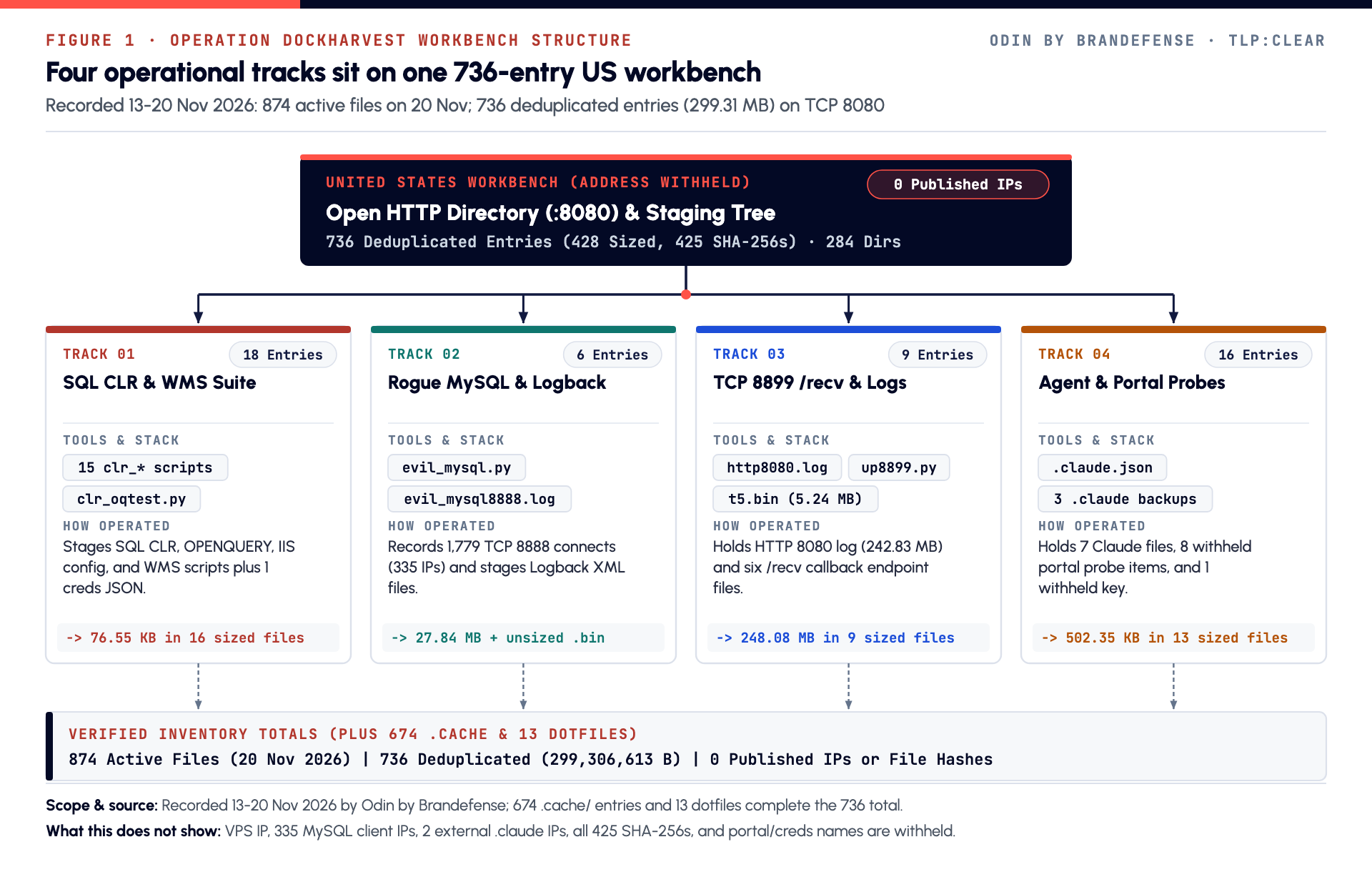
Operation DockHarvest sits on an open TCP 8080 adversary staging workbench on a United States server recorded on 13–20 November 2026. The directory reported 874 active files on 20 November and 736 deduplicated entries totaling 299.31 megabytes. It holds 15 staged SQL Server CLR and OPENQUERY scripts, a rogue MySQL listener on port 8888, Logback XML stagers, and six /recv callback files. Enforce SQL CLR strict security, disable MySQL client local file reads, and patch Logback libraries.
Enterprise supply-chain and backend apps often pair SQL Server and IIS web tiers with Java services, MySQL drivers, and CLI coding agents. Permissive database assemblies, unsafe JDBC flags, or credentials in files can expose secrets across tiers. Operation DockHarvest brings four backend and credential tracks onto one adversary staging server.
Between 13 and 20 November 2026, Odin by Brandefense studied an open HTTP directory on TCP port 8080 of a United States server. That host is assessed consistently as an adversary staging workbench. On 20 November 2026, the live directory header reported 874 active files and 284 directories.
Across the 13 to 20 November window, our deduplicated index captured 736 entries. Those entries span 428 sized files totaling 299,306,613 bytes (299.31 megabytes) and 308 unsized entries across 425 unique digests.
The workbench holds a credential output file, an SSH private key, target-portal login scripts, and MySQL logs with 335 client addresses. Odin by Brandefense therefore publishes zero IPv4 addresses and zero file SHA-256 digests. All target organization names, portal filenames, client addresses, and external open-directory addresses are withheld.
First, eighteen root entries stage SQL Server CLR, OPENQUERY, and logistics table scripts.
Fifteen sized clr_* scripts (75,548 bytes) sit beside one 997-byte credential JSON file (name withheld) and two unsized items. They target SQL CLR settings, OPENQUERY links, IIS configs, and an inventory management system (WMS), though target execution is unverified.
Second, rogue MySQL logs on port 8888 record 1,779 connections from 335 withheld addresses.
Three files (27.84 megabytes) run and log a rogue MySQL server targeting 11 client files into /tmp/stolen. Across 5,461 captured lines of evil_mysql8888.log, 1,393 of 1,779 connections dropped during authentication and 28 lines mention /tmp/stolen or saves.
Third, three Logback XML and binary files stage Java naming and socket tests.
Root holds logback-evil.xml (919 bytes), logback-socket.xml (681 bytes), and unsized socket_recv.bin. Legacy flaws CVE-2021-42550 and CVE-2017-5929 provide architectural context, while staged XML files do not confirm target JVM execution.
Fourth, six /recv endpoint files and seven Claude agent files expose connector and CLI risks.
A TCP 8899 listener pairs with http8080.log (242.83 megabytes) and six /recv/ files (t5.bin, sdk, mcp, sse, acp, unnamed). Sixteen more entries hold seven .claude files, eight withheld portal-probe items, and one withheld SSH private key.
Three Decisions for Enterprise Security Leaders
- Enforce SQL Server CLR strict security and audit linked servers. Keep CLR execution off unless signed assemblies are required, verify CLR strict security stays enabled, audit OPENQUERY logins, and protect IIS connection strings.
- Disable MySQL client local file transfers and upgrade Logback. Force local infile settings off in MySQL Connector/J and CLI clients, upgrade Logback past legacy vulnerable releases, and block outbound Java logging ports.
- Lock down AI coding-agent credentials and outbound callback paths. Restrict file permissions on developer
.claudecredentials, rotate tokens in backup snapshots, and monitor unexpected HTTP posts to/recv/routes.
2. Workbench Architecture, 736-Entry Reconciliation, and Timeline Scope
Operation DockHarvest operated from a United States commercial virtual private server (address withheld) assessed as an adversary staging workbench. That host exposed an unauthenticated HTTP directory on TCP 8080 beside a 242,826,779-byte access log (http8080.log). Enterprise defenders use dark web monitoring to spot exposed developer agent credentials and database connection secrets before reuse.
Odin by Brandefense recorded the directory between 13 and 20 November 2026. Detection engineers also apply cyber threat intelligence to correlate SQL CLR tooling, rogue MySQL listeners, and Logback stagers. Figure 1 shows the four operational tracks on the workbench.
Reconciling the 20 November Listing (874 Files) and 736 Deduplicated Entries
Two counts describe the workbench across 13–20 November 2026. On 20 November 2026, the live open-directory header reported 874 active files and 284 directories (7 top-level folders plus 277 nested subdirectories). Almost all nested subdirectories are two-character hexadecimal shard folders inside /.cache/go-build/.
Across 13–20 November 2026, deduplicated indexing captured 736 total entries. Those 736 entries span 428 sized files totaling 299,306,613 bytes (299.31 MB) and 308 unsized entries. Bounded shard traversal inside .cache/go-build/ explains why 674 .cache/ entries were indexed rather than every leaf shard in the 874-file header.
All 62 non-cache operational, log, config, and /recv/ entries across (root) and the other six folders are captured in full. The 736 entries span 425 unique SHA-256 digests, all withheld. The table below reconciles all 736 entries across four workspace zones.
| Workspace zone | Top-level dirs | Deduplicated entries | Share (%) | Sized files | Unsized entries | Sized bytes | Operational role |
|---|---|---|---|---|---|---|---|
Go Build & Tooling Cache (.cache/) | 1 | 674 | 91.6% | 374 | 300 | 22,770,504 | Go compiler cache shards (/.cache/go-build/, 374 sized + 300 unsized) built for Go recon utilities. |
Root Operator Workspace ((root)) | 0 (root) | 40 | 5.4% | 37 | 3 | 270,785,443 | Holds http8080.log, 15 clr_* scripts + 1 withheld creds JSON + 2 unsized items, evil_mysql files, logback-*.xml, unsized socket_recv.bin, up8899.py/.log, 3 withheld portal scripts, 1 withheld SSH key, .claude.json, and 8 dotfiles. |
| Agent, Probe & Host Subfolders (5 dirs) | 5 | 16 | 2.2% | 11 | 5 | 506,793 | Spans .claude/ (6 sized = 445,245 B), 1 withheld probe folder (5 items: 2 sized = 47,428 B + 3 unsized), .config/ (3), .ssh/ (1), and .local/ (1). |
TCP 8899 Receiver Directory (recv/) | 1 | 6 | 0.8% | 6 | 0 | 5,243,873 | Holds 6 sized callback files under /recv/: t5.bin (5,242,880 B), sdk (441 B), mcp (164 B), sse (164 B), acp (159 B), and unnamed (65 B). |
| Combined deduplicated inventory | 7 top dirs + root | 736 | 100.0% | 428 | 308 | 299,306,613 | Spans 425 withheld SHA-256 digests (874 active files & 284 dirs on 20 Nov 2026). |
A second breakdown reconciles the same 736 entries (428 sized, 308 unsized, 299,306,613 bytes) by file type. Cache and metadata entries (400), text and logs (251), and archived cache shards (62) make up 96.9% of entries. By byte size, root log files inside text (271.24 MB) make up 90.6% of the server.
Artifact class (kind) | Deduplicated entries | Share (%) | Sized files | Unsized entries | Sized bytes | Verified extensions & contents |
|---|---|---|---|---|---|---|
Cache & metadata (other) | 400 | 54.3% | 95 | 305 | 249,069 | 395 extensionless cache/probe items, 3 .hdr, 1 .legal-displayed, and 1 .token. |
Logs, configs & text (text) | 251 | 34.1% | 249 | 2 | 271,239,519 | 229 extensionless items, 5 .log, 5 .json (1 withheld 997 B creds file), 3 .txt, 2 .xml, 1 .md, 1 .body (47,102 B), 1 .yaml, and 2 .claude.json.backup.* files. |
Archived cache (archive) | 62 | 8.4% | 62 | 0 | 22,483,582 | 62 extensionless Go build cache objects under /.cache/go-build/. |
Executable scripts (script) | 20 | 2.7% | 20 | 0 | 89,884 | 18 .py (14 clr_*.py, evil_mysql.py, up8899.py, 2 withheld portal scripts) and 2 .sh (clr_guess_tables.sh, 1 withheld portal script). |
Binary payloads (exe) | 2 | 0.3% | 1 | 1 | 5,242,880 | 2 .bin entries: /recv/t5.bin (5,242,880 B) and unsized /socket_recv.bin. |
Private keys (secret) | 1 | 0.1% | 1 | 0 | 1,679 | 1 SSH RSA private key file in root (1,679 B; filename withheld). |
| Total | 736 | 100.0% | 428 | 308 | 299,306,613 | Exact byte parity (299.31 MB; shares rounded to 0.1%). |
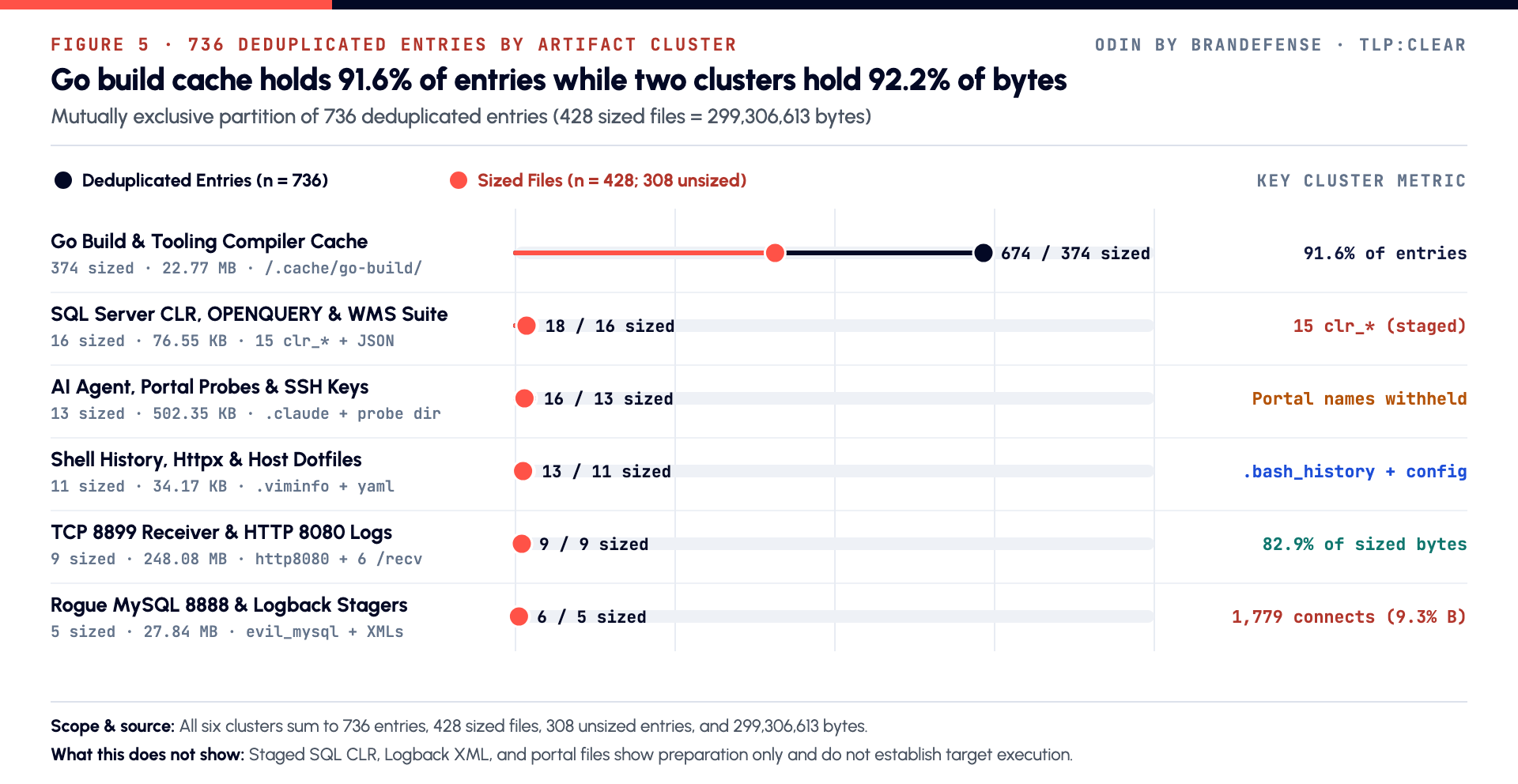
Figure 5 groups all 736 deduplicated entries into six mutually exclusive clusters (674 + 18 + 16 + 13 + 9 + 6 = 736). Go build cache shards represent 91.6% of entries (674), while HTTP/receiver logs (82.9%) and rogue MySQL/Logback files (9.3%) hold 92.2% of sized bytes.
Observation Dates Versus Host Provisioning Files
Every date in the dataset carries a distinct boundary. Odin by Brandefense observed the open TCP 8080 directory between 13 and 20 November 2026, with 874 active files and 284 directories reported on 20 November 2026.
Root holds virt-sysprep-firstboot.log (547 B) from virtual machine image setup. Inside .config/go/, one 2,516-byte local Go configuration JSON file carries a 2026-06-30 filename date beside .config/httpx/config.yaml (11,028 B).
That June filename marks when the base Go configuration file was initialized, not how long the workbench operated. Likewise, http8080.log (242.83 MB) and evil_mysql.log (26.66 MB) reflect internet scan volume rather than continuous targeted testing.
3. SQL Server CLR Integration, OPENQUERY, and Rogue MySQL 8888 Mechanics
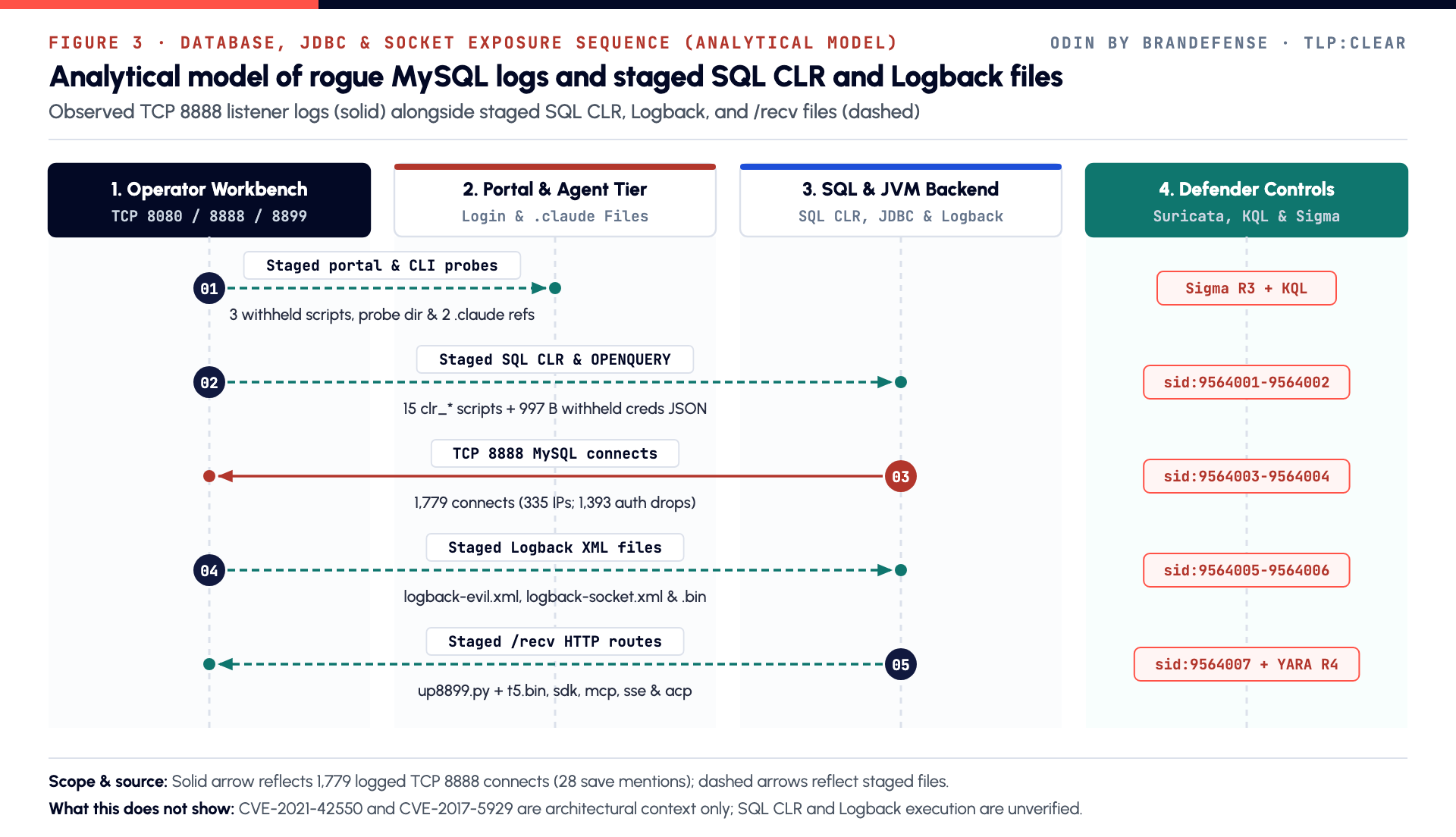
Supply-chain and inventory platforms frequently run IIS web apps backed by Microsoft SQL Server beside Java services using MySQL drivers. Figure 3 shows an analytical model separating logged TCP 8888 MySQL connections (solid) from staged SQL CLR, Logback, portal, and /recv/ files (dashed).
Hardening SQL Server CLR Assemblies, OPENQUERY, and IIS Connection Strings (18 Entries)
The SQL Server and supply-chain logistics system (WMS) cluster holds 18 entries (16 sized files totaling 76,545 bytes plus 2 unsized root items). Fifteen sized clr_* scripts (75,548 bytes) sit beside one 997-byte credential output JSON file (name withheld). While numbered revisions show structured preparation, directory files alone do not confirm external SQL execution.
Script role in CL-02 | Count | Sized bytes | Staged workbench artifacts |
|---|---|---|---|
Instance & OPENQUERY checks | 4 | 20,927 | clr_fingerprint.py (8,291 B), clr_jump_probe.py (4,901 B), clr_multi.py (4,875 B), clr_oqtest.py (2,860 B). |
| IIS config & credential queries | 5 | 27,250 | clr_iis_find.py (9,545 B), clr_get_creds3.py (5,251 B), clr_get_creds.py (4,784 B), clr_get_creds2.py (4,482 B), clr_get_connstr.py (3,186 B). |
| Schema & WMS table extraction | 6 | 27,373 | clr_dump_wms.py (9,197 B), clr_fast_dump.py (6,274 B), clr_dump_final.py (4,327 B), clr_tablescan.py (3,312 B), clr_scan_tables.py (2,322 B), clr_guess_tables.sh (1,941 B). |
| Credential JSON & unsized items | 3 | 997 | 1 withheld credential output JSON (997 B) plus 2 unsized root entries (0 B). |
Cluster CL-02 total | 18 | 76,545 | 16 sized files + 2 unsized entries in (root). |
SQL Server leaves clr enabled off (0) by default ([REF-01]). Since SQL Server 2017, clr strict security also defaults to 1, requiring cryptographic signatures even on SAFE and EXTERNAL_ACCESS .NET assemblies ([REF-01]).
If admins disable clr strict security, set TRUSTWORTHY ON, or run apps as sysadmin, operators can load UNSAFE CLR procedures (T1505.001; [REF-08]). Those procedures can read IIS web.config files and probe internal hosts, while OPENQUERY ([REF-02]) relays queries across linked servers (sys.servers).
Blocking Rogue MySQL LOCAL INFILE Client File Reads (3 of 6 Cluster Entries)
Three sized files (27,837,567 bytes) run and log a rogue MySQL server on the host. Root holds evil_mysql.py (6,382 B), evil_mysql.log (26,658,404 B), and evil_mysql8888.log (1,172,781 B on disk). Under the MySQL wire protocol, a server can answer an initial query with byte 0xfb and a file path ([REF-06]).
The server chooses which file to request regardless of the client's SQL query ([REF-06]). Clients using allowLoadLocalInfile=true or Connector/J builds before 8.0.15 ([REF-07]) upload that local file back to the server.
A 196,357-character (5,461-line) captured excerpt of evil_mysql8888.log provides exact listener metrics. Chinese startup headers log Evil MySQL on 0.0.0.0:8888, output folder /tmp/stolen, and 11 configured target files.
Across those 5,461 lines, 1,779 client connections arrived from 335 withheld IPv4 addresses, and 1,393 (78.3%) dropped during authentication. Twenty-eight lines mention /tmp/stolen or save events, though scanner noise and missing /tmp/stolen files prevent confirming third-party file reads.
4. Staged Logback Socket XMLs, /recv/ Agent Endpoints, and Credential Hygiene
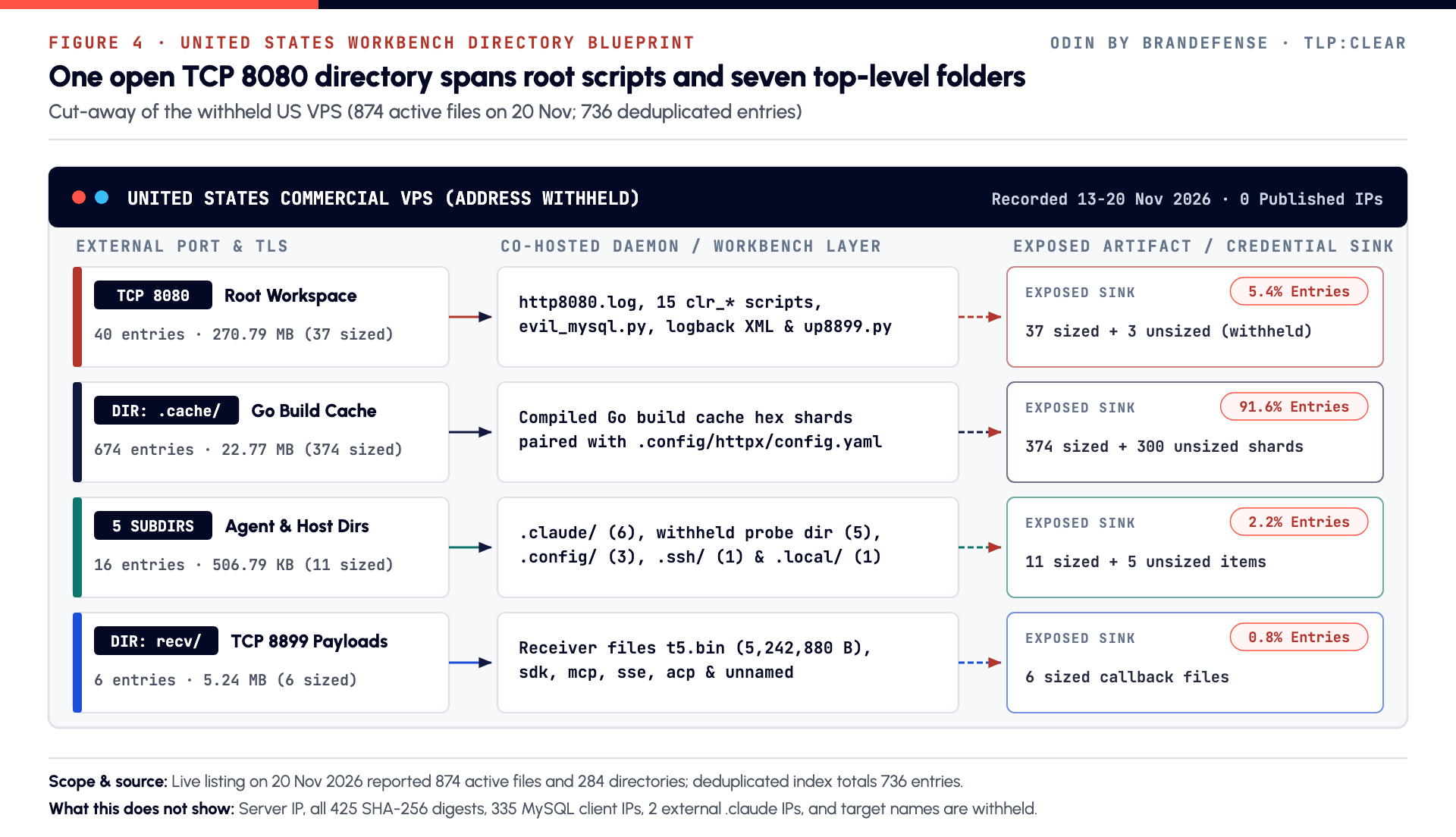
Beside the SQL CLR suite and rogue MySQL listener, the server holds staged Logback XML files, a TCP 8899 upload receiver, .claude configs, and withheld portal probes. Figure 4 shows the directory layout across (root) and the seven top-level folders.
Staged Logback XML Configurations and Socket Deserialization Context (3 Entries)
Three remaining items in the MySQL and Logback cluster target QOS[.]ch Logback: logback-evil.xml (919 B), logback-socket.xml (681 B), and unsized socket_recv.bin. Two NVD records explain why operators stage these files ([REF-03], [REF-04], [REF-05]).
In Logback 1.2.x before 1.2.9 (plus 1.3.0-alpha0 to 1.3.0-alpha10), CVE-2021-42550 allowed LDAP code loading from modified, reloaded XML configurations ([REF-03]). QOS[.]ch fixed that flaw in Logback 1.2.9 and 1.3.0-alpha11 ([REF-03]).
Earlier, CVE-2017-5929 affected Logback prior to 1.2.0 (fixed in 1.2.0), where SocketServer and ServerSocketReceiver deserialized untrusted Java ObjectInputStream streams ([REF-04]). Logback's release notes also explain that SocketReceiver opens outbound TCP sockets to read serialized events ([REF-05]). Both CVEs are cited strictly as architectural context, and staged files do not confirm target JVM execution.
Monitoring TCP 8899 /recv/ Callback Endpoints and TCP 8080 Logs (9 Entries)
Nine sized files (248,083,871 bytes, 82.9% of sized bytes) cover HTTP directory logs and a callback receiver. In (root), http8080.log (242,826,779 B) sits beside up8899.py (1,015 B) and up8899.log (12,204 B).
Six sized files under /recv/ total 5,243,873 bytes, led by t5.bin (5,242,880 B) and sdk (441 B). Four smaller files cover mcp (164 B), sse (164 B), acp (159 B), and unnamed (65 B). Names matching Model Context Protocol (mcp), Server-Sent Events (sse), and Agent Communication Protocol (acp) highlight outbound connector paths (T1071.001; [REF-10]).
Protecting AI-Agent Credentials, Portal Probes, and Go Recon Configs (703 Entries)
Sixteen entries (502,353 sized bytes across 13 sized files plus 3 unsized) cover AI-agent configs, portal probes, and SSH keys. Seven Claude CLI files (446,307 B) include .claude/cache/changelog.md (443,393 B), .claude.json (1,062 B), and 3 .claude.json.backup.* snapshots. Two cross-directory references point to credential files on two external open directories; their paths and addresses are withheld ([REF-09]).
Eight withheld target-portal entries total 54,367 bytes across 3 root login scripts (6,939 B) and 5 probe-folder items (47,428 B, including a 47,102-byte .body file). One withheld 1,679-byte SSH RSA private key completes that 16-entry cluster.
Finally, 674 .cache/ shards (22.77 MB) pair with 13 host dotfiles (34,173 B across 11 sized and 2 unsized items). Sized dotfiles include .viminfo (11,054 B), .config/httpx/config.yaml (11,028 B), .bash_history (4,524 B), and .bashrc (3,359 B). Smaller items hold a 2,516-byte .config/go/ JSON file, .ssh/authorized_keys (576 B), virt-sysprep-firstboot.log (547 B), and .profile (377 B).
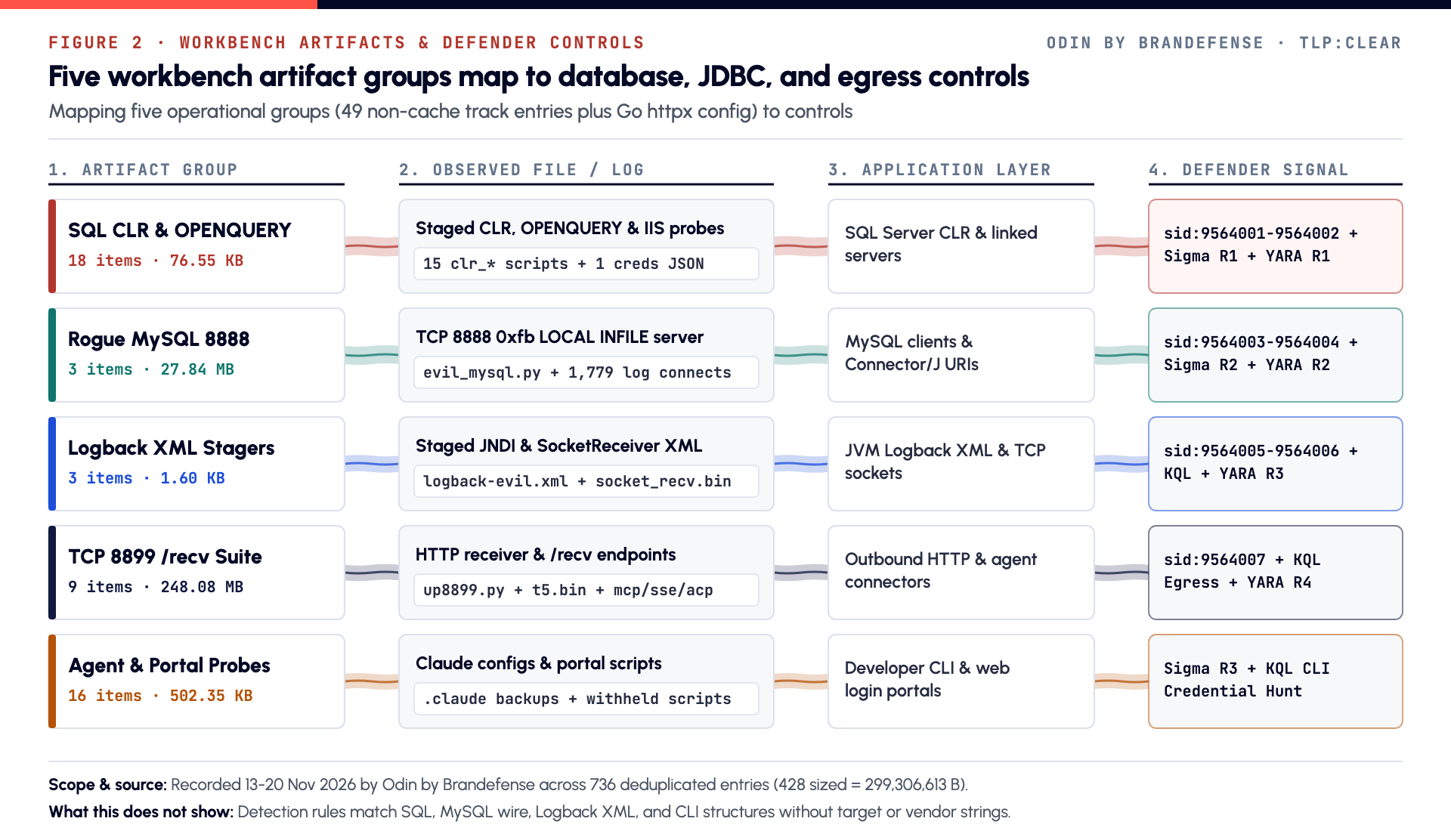
Figure 2 maps the five operational artifact groups to network, host, and file detections.
5. Enterprise Database, JDBC, and Logging Exposure Analysis
Database, Java, and platform teams should verify five defensive controls mapped to the observed DockHarvest artifacts before assuming any single flaw occurred on an external target:
| Exposure layer | Observed DockHarvest evidence | Control to verify | Operational risk |
|---|---|---|---|
SQL Server CLR & OPENQUERY | 15 clr_* scripts (75,548 B), 1 withheld 997 B creds JSON, 2 unsized items; execution unverified. | Verify whether clr enabled = 0, clr strict security = 1, TRUSTWORTHY = OFF, and OPENQUERY logins enforce least privilege ([REF-01], [REF-02]). | UNSAFE CLR procedures run OS commands and read IIS web.config secrets (T1505.001; [REF-08]). |
MySQL / JDBC LOCAL INFILE | evil_mysql.py, evil_mysql.log (26.66 MB), evil_mysql8888.log (1,779 connects across 335 withheld IPs; 11 target files). | Verify whether JDBC datasources block user URLs, set allowLoadLocalInfile=false, and block outbound TCP 8888 ([REF-06], [REF-07]). | Connecting to a rogue MySQL server lets 0xfb packets read /etc/passwd, keys, and app configs. |
| JVM Logback XML & sockets | logback-evil.xml (919 B), logback-socket.xml (681 B), unsized socket_recv.bin; execution unverified. | Verify whether Logback is >= 1.2.9, XML config paths are read-only, and SocketReceiver is absent ([REF-03], [REF-04], [REF-05]). | Writable, reloaded XML can enable CVE-2021-42550. Separately, CVE-2017-5929 concerns untrusted streams reaching SocketServer or ServerSocketReceiver before Logback 1.2.0. |
Outbound /recv/ connectors | up8899.py (1,015 B), up8899.log (12,204 B), and 6 /recv/ files (t5.bin 5.24 MB, sdk, mcp, sse, acp, unnamed). | Verify whether backend services and MCP/SSE agent workers enforce outbound proxy allowlists ([REF-10]). | Open egress allows SSRF callbacks or payload uploads to external ports like TCP 8899. |
Developer .claude credentials | 7 .claude files (446,307 B, 3 backups) and 2 external credential-file references (paths withheld). | Verify whether developer-agent credential files and .claude.json.backup.* enforce 0600 permissions outside web roots ([REF-09]). | Exposed CLI agent tokens leak API access and developer session histories (T1552.001). |
6. Alternative Hypotheses
| Hypothesis | Evidence for | Evidence against | Assessment |
|---|---|---|---|
All 1,779 evil_mysql8888.log connects (335 IPs) are breached clients | evil_mysql8888.log logs 1,779 connects across 335 IPs and 28 /tmp/stolen or save mentions. | 1,393 connects (78.3%) dropped at the auth stage like internet port scanners, and /tmp/stolen is not exposed to separate self-tests. | Refuted for total counts. Withhold all 335 connecting client IPs as unconfirmed traffic. |
Staged clr_* scripts and Logback XMLs achieved target RCE | Scripts span clr_get_creds v1–v3 and clr_dump_final.py beside a 997 B withheld creds JSON and logback-*.xml files. | Target SQL Server and Logback versions are unknown, and directory files alone do not confirm remote code execution. | Unverified. Cite CVE-2021-42550 and CVE-2017-5929 as context only and treat both suites as staged. |
| Benign developer host or authorized test server | Holds 674 Go build cache items, .claude/ files, and standard shell dotfiles. | Runs evil_mysql.py targeting 11 files into /tmp/stolen, stages clr_dump_wms.py and logback-evil.xml, and exposes credentials on TCP 8080. | Contradicted. Rogue MySQL file theft, WMS scripts, and open credential exposure confirm an adversary staging workbench. |
| Multi-track adversary workbench across separate targets | Co-hosts SQL CLR/WMS scripts, evil_mysql.py, Logback XMLs, /recv/ routes, Go httpx config, and portal scripts on one US VPS. | Separate tracks may target distinct systems rather than one single organization. | Supported. Assess as one adversary workbench hosting four distinct tracks without claiming a single chained victim. |
7. Validated Detection Rules
All IPv4 addresses and all 425 file SHA-256 digests are withheld. Defenders should deploy protocol, process, and file-structure detections across SQL, JDBC, JVM, and CLI tiers. Static syntax checks passed in the Odin Suricata linter (0 problems) and offline structural checks across KQL, 3 Sigma rules, and 4 filesize-bounded YARA rules. Because live suricata -T, Kusto.Language, pySigma, and YARA binaries were not run locally, teams should test each rule in staging first.
7.1 Suricata 7.x Network Signatures (sid:9564001–9564007)
Rules sid:9564001–9564003 inspect inbound SQL CLR CREATE ASSEMBLY, sp_configure, and jdbc:mysql:// allowLoadLocalInfile requests. Rule sid:9564004 matches rogue MySQL 0xfb LOCAL INFILE responses asking for /etc/passwd. When an internal client initiates outbound TCP to a rogue MySQL server, the server reply flows $EXTERNAL_NET -> $HOME_NET (to_client).
Rules sid:9564005–9564006 detect inbound Logback XML configs with <insertFromJNDI or SocketReceiver (matching ServerSocketReceiver too). Rule sid:9564007 alerts on outbound HTTP POST calls to /recv/, which teams should tune if approved webhooks use /recv/. None of these alert rules block traffic inline; HTTP rules need cleartext or proxy decryption, and sid:9564004 needs cleartext MySQL traffic.
# Odin by Brandefense - Monograph 64 (Operation DockHarvest) Suricata 7.x Ruleset
# Static syntax checked with Odin Suricata linter (0 problems); test with suricata -T before deployment.

alert http $EXTERNAL_NET any -> $HOME_NET any (msg:"ODIN-R64 DockHarvest Inbound SQL CLR CREATE ASSEMBLY Payload"; flow:established,to_server; http.request_body; content:"CREATE ASSEMBLY"; nocase; fast_pattern; content:"PERMISSION_SET"; nocase; classtype:web-application-attack; sid:9564001; rev:1;)
alert http $EXTERNAL_NET any -> $HOME_NET any (msg:"ODIN-R64 DockHarvest Inbound SQL sp_configure CLR Toggle Attempt"; flow:established,to_server; http.request_body; content:"sp_configure"; nocase; fast_pattern; content:"clr "; nocase; classtype:web-application-attack; sid:9564002; rev:1;)
alert http $EXTERNAL_NET any -> $HOME_NET any (msg:"ODIN-R64 DockHarvest Inbound JDBC MySQL allowLoadLocalInfile URI"; flow:established,to_server; http.request_body; content:"jdbc:mysql://"; nocase; fast_pattern; content:"allowLoadLocalInfile"; nocase; classtype:web-application-attack; sid:9564003; rev:1;)
alert tcp $EXTERNAL_NET any -> $HOME_NET any (msg:"ODIN-R64 DockHarvest Rogue MySQL Server LOCAL INFILE /etc/passwd Request"; flow:established,to_client; content:"|0c 00 00 01 fb|/etc/passwd"; depth:16; fast_pattern; classtype:credential-theft; sid:9564004; rev:1;)
alert http $EXTERNAL_NET any -> $HOME_NET any (msg:"ODIN-R64 DockHarvest Inbound Logback insertFromJNDI XML Config"; flow:established,to_server; http.request_body; content:"<insertFromJNDI"; nocase; fast_pattern; content:"env-entry-name"; nocase; classtype:web-application-attack; sid:9564005; rev:1;)
alert http $EXTERNAL_NET any -> $HOME_NET any (msg:"ODIN-R64 DockHarvest Inbound Logback SocketReceiver XML Config"; flow:established,to_server; http.request_body; content:"ch.qos.logback."; fast_pattern; content:"SocketReceiver"; nocase; classtype:web-application-attack; sid:9564006; rev:1;)
alert http $HOME_NET any -> $EXTERNAL_NET any (msg:"ODIN-R64 DockHarvest Outbound Callback POST to /recv/ Agent Route"; flow:established,to_server; http.method; content:"POST"; bsize:4; http.uri; content:"/recv/"; startswith; fast_pattern; classtype:trojan-activity; sid:9564007; rev:1;)
7.2 Microsoft Sentinel KQL Hunt
Replace the two placeholder hostnames in ApprovedAdminAndBuildHosts with your approved SQL administration and CI build FQDNs before scheduling.
// Odin by Brandefense - Monograph 64 (Operation DockHarvest)
// Hunts SQL Server CLR child-process spawning, rogue MySQL LOCAL INFILE / Logback stagers, and unexpected SQL/Java public egress.
let Lookback = 7d;
let ApprovedAdminAndBuildHosts = dynamic(["sql-admin-01.corp.example", "ci-go-01.corp.example"]);
let HostSqlClrAndStagingAnomalies =
    DeviceProcessEvents
    | where Timestamp >= ago(Lookback)
    | where not(DeviceName in~ (ApprovedAdminAndBuildHosts))
    | where (
        (InitiatingProcessFileName =~ "sqlservr.exe" and FileName in~ ("cmd.exe", "powershell.exe", "pwsh.exe", "whoami.exe", "ipconfig.exe", "net.exe"))
        or (ProcessCommandLine has_any ("CREATE ASSEMBLY", "clr strict security", "allowLoadLocalInfile", "evil_mysql", "logback-evil", "logback-socket"))
    )
    | project Timestamp, DeviceName, AccountName, SignalType = "HostSqlClrOrStagingTool", Detail = ProcessCommandLine;
let UnexpectedSqlAndJavaPublicEgress =
    DeviceNetworkEvents
    | where Timestamp >= ago(Lookback)
    | where not(DeviceName in~ (ApprovedAdminAndBuildHosts))
    | where RemoteIPType == "Public"
    | where (
        InitiatingProcessFileName =~ "sqlservr.exe"
        or (InitiatingProcessFileName in~ ("java", "java.exe", "mysql", "mysql.exe") and RemotePort in (8888, 8899, 1389, 4560))
    )
    | project Timestamp, DeviceName, AccountName = InitiatingProcessAccountName, SignalType = "UnexpectedSqlOrJavaPublicEgress", Detail = strcat(InitiatingProcessFileName, " -> ", RemoteIP, ":", tostring(RemotePort), " (", RemoteUrl, ")");
union HostSqlClrAndStagingAnomalies, UnexpectedSqlAndJavaPublicEgress
| summarize FirstSeen = min(Timestamp), LastSeen = max(Timestamp), EventCount = count(), Signals = make_set(SignalType, 6), SampleDetails = make_set(Detail, 5) by DeviceName, AccountName
| order by LastSeen desc
7.3 Portable Sigma and YARA Rules
- Sigma (
sigma_dockharvest_sql_clr_mysql_and_claude_creds.yml). Rule 1 catches Windowssqlservr.exespawningcmd.exe,powershell.exe,pwsh.exe,whoami.exe,ipconfig.exe, ornet.exeoutsidesql-admin-01[.]corp[.]example. Rule 2 detects Linux/python,/python3,/mysql, or/javapassingevil_mysql,allowLoadLocalInfile,--local-infile=1,logback-evil, orlogback-socketoutsidedb-audit-01[.]corp[.]example. Rule 3 detects/curl,/wget,/python3, or/httpxreading.claude.json.backupoutsidedev-ws-01[.]corp[.]example. - YARA (
odin_dockharvest_clr_mysql_and_logback_artifacts.yar). Fourfilesize-bounded rules detect SQL CLR andOPENQUERYscripts, Python0xfbrogue MySQL servers, LogbackinsertFromJNDIorSocketReceiverXML stagers, and Python/recvHTTP upload listeners.
8. Behavioral and Protocol Hunt Markers (0 Published IPs or Workbench SHA-256s)
Zero IPv4 addresses or file SHA-256 digests appear in the indicator feeds. The server holds withheld credential, private-key, and portal files alongside 335 unconfirmed connecting IPs. Defenders can hunt using the 10 behavioral markers below.
| Marker category | Pattern / protocol artifact | Layer | Defensive hunt & control |
|---|---|---|---|
| SQL CLR registration | CREATE ASSEMBLY ... WITH PERMISSION_SET = UNSAFE | TCP 1433 / HTTP | Audit sys.assemblies, keep clr strict security = 1, and alert via sid:9564001. |
| SQL config toggle | sp_configure 'clr enabled' / 'clr strict security' | TCP 1433 / HTTP | Alert on RECONFIGURE changes in SQL Server Audit and sid:9564002. |
| Linked-server query | OPENQUERY() pass-through (clr_oqtest.py) | TCP 1433 | Audit sys.servers linked logins ([REF-02]) and scan scripts with YARA Rule 1. |
| JDBC MySQL file read | jdbc:mysql://...allowLoadLocalInfile=true | HTTP / JDBC | Force allowLoadLocalInfile=false ([REF-07]) and alert via sid:9564003 and Sigma Rule 2. |
Rogue MySQL 0xfb packet | 0x0c000001fb + /etc/passwd (evil_mysql.py) | TCP 8888 response | Block untrusted MySQL egress and alert on cleartext 0xfb packets (sid:9564004). |
| Logback JNDI XML | <insertFromJNDI env-entry-name=...> | HTTP / TCP 1389 | Upgrade Logback >= 1.2.9 (CVE-2021-42550; [REF-03]) and alert via sid:9564005. |
| Logback SocketReceiver | ch.qos.logback...SocketReceiver / ServerSocketReceiver | HTTP / TCP 4560 | Upgrade Logback >= 1.2.0 (CVE-2017-5929; [REF-04]), drop receivers, and alert via sid:9564006. |
/recv/ HTTP callback | POST /recv/ (mcp, sse, acp, sdk, t5.bin) | TCP 8899 egress | Restrict app and agent connector egress ([REF-10]) and alert via sid:9564007. |
| SQL child OS shell | sqlservr.exe spawning cmd.exe / powershell.exe | Windows EDR | Alert immediately on sqlservr.exe child shells or public egress (Sigma Rule 1; KQL). |
| AI-agent credential file | .claude.json.backup | Linux / macOS EDR | Enforce 0600 permissions ([REF-09]) and hunt backup-file CLI access via Sigma Rule 3. |
9. Hardening Priorities for SQL Server, MySQL/JDBC, and JVM Logging Tiers
Database, Java, and platform defenders should execute five controls in priority order:
- Lock down SQL Server CLR and
OPENQUERYlinked servers (0–48 Hours). Keepclr enabled = 0unless signed.NETroutines are required, and verifyclr strict security = 1andTRUSTWORTHY = OFF([REF-01]). Auditsys.assemblies([REF-08]) andsys.serverslinked logins ([REF-02]), and isolate IISweb.configsecrets from SQL accounts. - Disable MySQL and JDBC
LOCAL INFILEtransfers (0–72 Hours). SetallowLoadLocalInfile=false,allowUrlInLocalInfile=false, andallowLoadLocalInfileInPath=""on MySQL Connector/J datasources ([REF-07]). Pass--local-infile=0on MySQL/MariaDB clients ([REF-06]), block user-supplied JDBC hostnames, and block outboundTCP 8888. - Upgrade Logback and make XML configs read-only (
Days 1–7). Upgrade QOS[.]ch Logback to a supported 1.6.x release where compatible, past 1.2.x before1.2.9(CVE-2021-42550, fixed in1.2.9and1.3.0-alpha11;[REF-03]) and pre-1.2.0branches (CVE-2017-5929, fixed in1.2.0;[REF-04]). Mountlogback.xmlread-only, removeSocketReceivercomponents ([REF-05]), and block outboundTCP 1389and 4560. - Restrict outbound HTTP and agent connector callbacks (
Days 7–14). Route application and MCP/SSE/SDK worker traffic through strict allowlist proxies so arbitraryPOSTcallbacks to external ports (TCP 8899,/recv/*;[REF-10]) fail closed. - Protect developer
.claudecredentials and workstation directories (Days 14–30). Enforce 0600 permissions on developer-agent credential files,.claude.json,.claude/backups/*, and.ssh/keys ([REF-09]). Prohibit unauthenticated HTTP file servers inside home folders and rotate keys on shared VMs.
10. Scope, Limits, and External References
Odin by Brandefense analyzed workbench artifacts recorded between 13 and 20 November 2026 on a United States VPS (TCP 8080) assessed as an adversary staging workbench. On 20 November 2026, the open directory reported 874 active files and 284 directories. Across 13–20 November 2026, deduplicated indexing captured 736 entries (428 sized files totaling 299,306,613 bytes and 308 unsized entries; 425 unique SHA-256 digests).
In evil_mysql8888.log (1,172,781 B on disk), the 196,357-character (5,461-line) excerpt logged 1,779 connects across 335 IPs. Of those connects, 1,393 dropped at auth and 28 lines mention saves or /tmp/stolen.
Staged clr_* scripts (15), Logback XMLs (3 items), portal probes (8 items), and /recv/ routes do not establish external execution. Both CVE-2021-42550 and CVE-2017-5929 serve as design context only, and all IPs, SHA-256s, portal names, and credential or key filenames are withheld.
[REF-01]Microsoft Learn, *CLR Integration Security in SQL Server* (verified on 25 November 2026).[REF-02]Microsoft Learn, *OPENQUERY (Transact-SQL) Ad Hoc Distributed Query Controls* (verified on 25 November 2026).[REF-03]NIST National Vulnerability Database, *CVE-2021-42550 Detail: QOS.ch Logback before 1.2.9 JNDI Configuration Code Execution* (verified on 25 November 2026).[REF-04]NIST National Vulnerability Database, *CVE-2017-5929 Detail: QOS.ch Logback < 1.2.0 SocketServer Deserialization* (verified on 25 November 2026).[REF-05]QOS.ch Logback Documentation, Logback release notes on network receivers (verified on 25 November 2026).[REF-06]MariaDB Knowledge Base, *LOAD DATA INFILE and LOCAL INFILE Client Security* (verified on 25 November 2026).[REF-07]MySQL Connector/J Official Source Repository, *allowLoadLocalInfile Driver Controls* (verified on 25 November 2026).[REF-08]MITRE ATT&CK, *Server Software Component: SQL Stored Procedures (T1505.001)* (verified on 25 November 2026).[REF-09]MITRE ATT&CK, *Unsecured Credentials: Credentials In Files (T1552.001)* (verified on 25 November 2026).[REF-10]MITRE ATT&CK, *Application Layer Protocol: Web Protocols (T1071.001)* (verified on 25 November 2026).
What is…?
Short explanations of the tools and families named in this study.
Frequently asked questions
How was the 736-entry United States workbench organized, and how do the counts align?
On 20 November 2026, the live directory header reported 874 active files and 284 directories (7 top-level folders plus 277 nested subdirectories). Across 13–20 November 2026, deduplicated indexing captured 736 entries totaling 299,306,613 bytes (299.31 MB) across 428 sized files and 308 unsized entries (425 withheld SHA-256s).
How do the SQL CLR scripts, rogue MySQL 8888 logs, Logback XMLs, and /recv files relate?
Four offensive artifact tracks sit beside the Go compiler cache and shell dotfiles on the United States server:
What should SQL Server, Java, and developer platform teams do first?
Database, application, and SOC teams can close these exposures with three immediate steps: