
Key takeaways
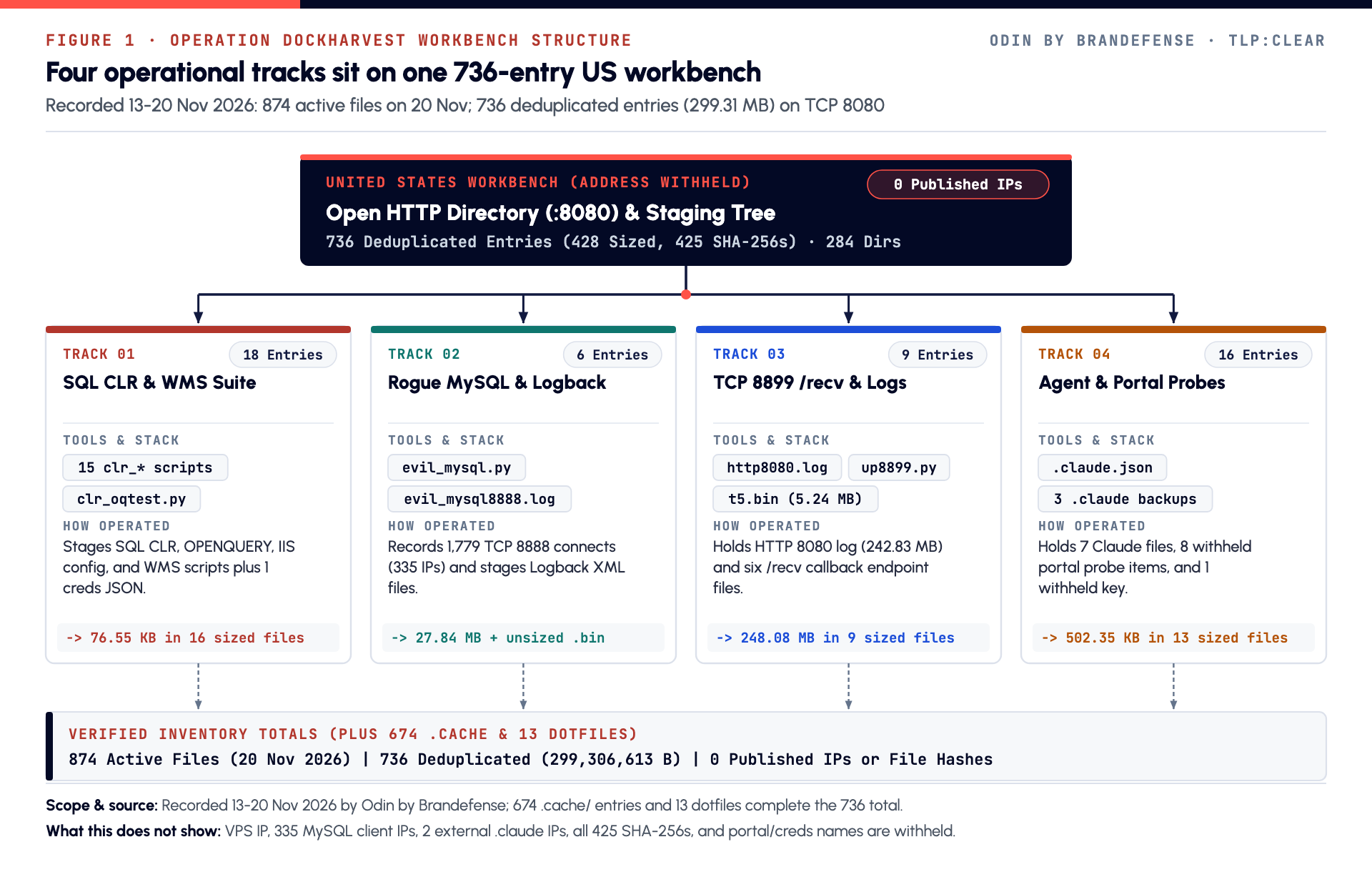
- Operation DockHarvest ran on an open TCP 8080 United States server recorded on 13-20 November 2026 (874 active files on 20 Nov; 736 deduplicated entries).
- Eighteen root items stage SQL Server CLR, OPENQUERY, IIS config, and WMS scripts across 15 clr_* scripts (75,548 B), 1 withheld creds JSON (997 B), and 2 unsized entries.
- Rogue MySQL logs on TCP 8888 (evil_mysql8888.log, 5,461 captured lines) record 1,779 connects from 335 withheld IPs, 1,393 auth drops, and 11 target files.
- Staged Logback XMLs (logback-evil.xml, logback-socket.xml, socket_recv.bin) sit beside six /recv callback files (t5.bin, sdk, mcp, sse, acp, unnamed) and 7 .claude files.
- Enforce SQL Server clr strict security, set JDBC allowLoadLocalInfile=false, upgrade Logback >= 1.2.9, and lock down developer-agent credential files.
An open TCP 8080 directory on a United States server combined staged SQL CLR scripts, a rogue MySQL 8888 listener, Logback XML files, and /recv/ routes. Odin by Brandefense analyzed 736 deduplicated entries from that Operation DockHarvest adversary staging workbench recorded on 13–20 November 2026.
The directory holds a credential output JSON file, an SSH private key, target-portal login scripts, and listener logs containing 335 client addresses. Zero IPv4 addresses and zero file SHA-256 digests are therefore published to protect credentials in files. All target organization names, portal filenames, client addresses, and external .claude open-directory addresses are withheld.
How was the 736-entry United States workbench organized, and how do the counts align?
On 20 November 2026, the live directory header reported 874 active files and 284 directories (7 top-level folders plus 277 nested subdirectories). Across 13–20 November 2026, deduplicated indexing captured 736 entries totaling 299,306,613 bytes (299.31 MB) across 428 sized files and 308 unsized entries (425 withheld SHA-256s).
Bounded recursion inside /.cache/go-build/ explains why 674 .cache/ entries were indexed rather than every nested cache shard in the 874-file header. Security teams pair dark web monitoring with rotation rules to catch leaked AI-agent tokens and database credentials early. Analysts also apply cyber threat intelligence to connect SQL CLR, rogue MySQL, and Java socket staging patterns.
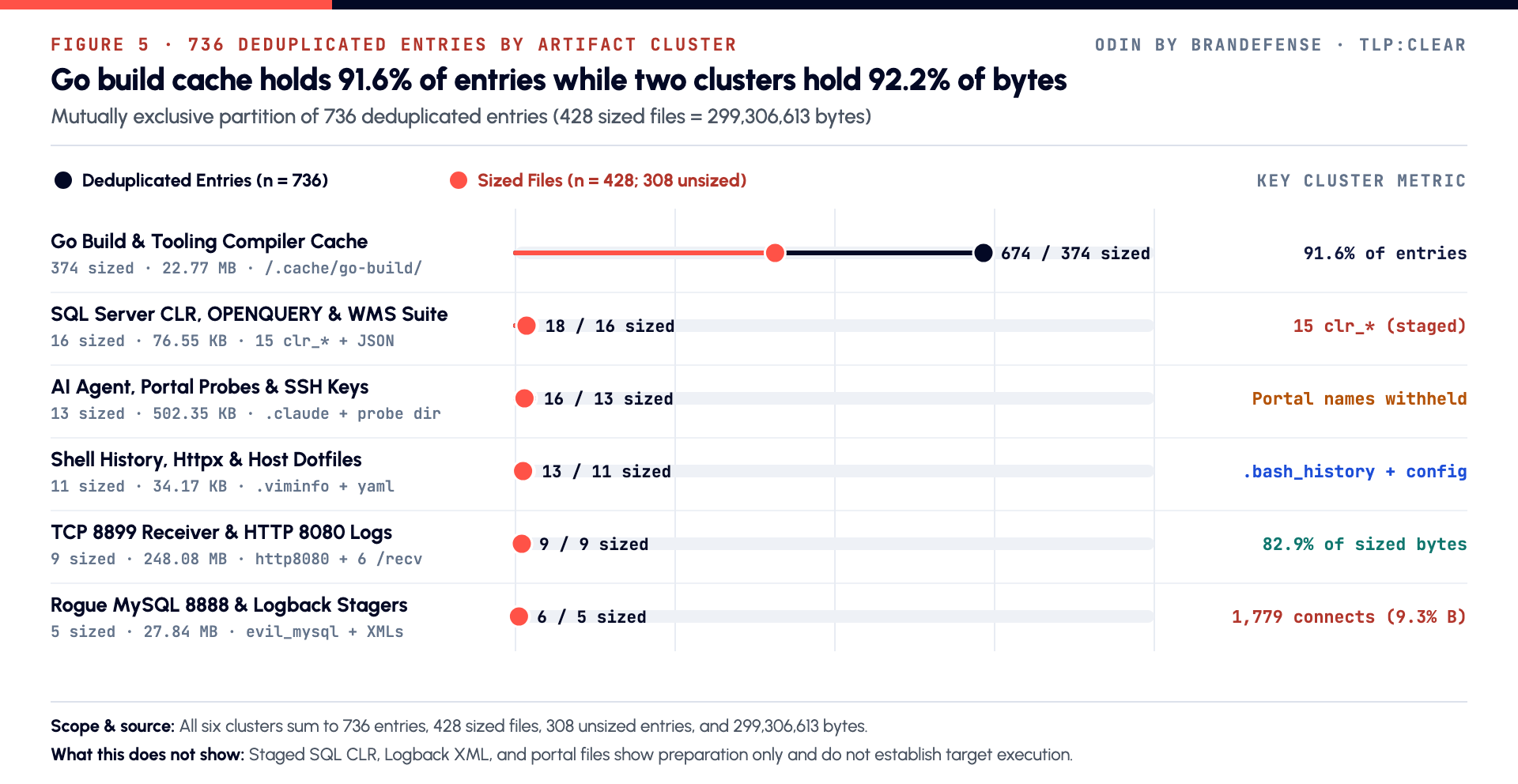
Across folders, 674 entries (91.6%) sit in .cache/ (22.77 MB) and 40 (5.4%) sit in (root) (270.79 MB). Sixteen entries (2.2%) span .claude/ (6), a withheld portal-probe folder (5), .config/ (3), .ssh/ (1), and .local/ (1), while 6 (0.8%) sit in recv/ (5.24 MB). By byte size, http8080.log (242.83 MB) and evil_mysql.log (26.66 MB) make up 90.0% of the server.
Inside .config/go/, one 2,516-byte local Go configuration JSON file carries a 2026-06-30 filename date beside .config/httpx/config.yaml (11,028 B). That June date marks base Go tool initialization rather than continuous listener runtime across months.
| Artifact cluster in 736-entry inventory | Entries | Sized bytes | Verified workbench artifacts |
|---|---|---|---|
| Go Build & Tooling Compiler Cache | 674 | 22,770,504 | 374 sized Go build shards and 300 unsized items under /.cache/go-build/. |
| SQL Server CLR, OPENQUERY & WMS Suite | 18 | 76,545 | 15 sized clr_* scripts (75,548 B), 1 withheld creds JSON (997 B), and 2 unsized items. |
| AI Agent, Portal Probes & SSH Keys | 16 | 502,353 | 7 .claude files (3 backups; 2 external refs withheld), 8 withheld portal items, and 1 SSH key. |
| Shell History, Httpx & Host Dotfiles | 13 | 34,173 | .viminfo (11,054 B), httpx/config.yaml (11,028 B), .bash_history, .bashrc, and host dotfiles. |
| TCP 8899 Receiver & HTTP 8080 Logs | 9 | 248,083,871 | http8080.log (242.83 MB), up8899.py/.log, and 6 /recv/ files (t5.bin, sdk, mcp, sse, acp, unnamed). |
| Rogue MySQL 8888 & Logback Stagers | 6 | 27,839,167 | evil_mysql.py, evil_mysql.log, evil_mysql8888.log (1,779 connects), 2 logback-*.xml files, and socket_recv.bin. |
How do the SQL CLR scripts, rogue MySQL 8888 logs, Logback XMLs, and /recv files relate?
Four offensive artifact tracks sit beside the Go compiler cache and shell dotfiles on the United States server:
- Staged SQL Server CLR,
OPENQUERY, and WMS scripts (18 entries). Fifteen sizedclr_*scripts (75,548 B) sit beside one 997-byte withheld credential JSON file and 2 unsized entries. Named tools includeclr_iis_find.py,clr_dump_wms.py,clr_fingerprint.py,clr_fast_dump.py, andclr_oqtest.py. They target SQL CLR settings,OPENQUERYlinked servers, IIS connection strings, and an inventory management system (WMS), though target execution is unverified. - Rogue MySQL 8888
LOCAL INFILElistener (3 of 6 cluster entries). Root holdsevil_mysql.py(6,382 B),evil_mysql.log(26.66 MB), andevil_mysql8888.log(1.17 MB). A 196,357-character (5,461-line) captured excerpt ofevil_mysql8888.logshows0.0.0.0:8888targeting 11 client files for/tmp/stolen. It records 1,779 connections across 335 withheld client IPs, with 1,393 auth-stage scanner drops (78.3%) and 28 save or path mentions. - Staged Logback XML and socket files (3 of 6 cluster entries). Root holds
logback-evil.xml(919 B),logback-socket.xml(681 B), and unsizedsocket_recv.bin. In Logback 1.2.x before1.2.9, and1.3.0-alpha0throughalpha10,CVE-2021-42550allowed LDAP code loading from a modified configuration; fixes arrived in1.2.9and1.3.0-alpha11. Meanwhile,CVE-2017-5929affectedSocketServerandServerSocketReceiverdeserialization before1.2.0(fixed in1.2.0); both CVEs are architectural context only. TCP 8899/recv/endpoints and.claudefiles (9 and 16 entries). Root holdsup8899.py(1,015 B) beside/recv/t5.bin(5,242,880 B) andsdk(441 B). Four more/recv/files covermcp(164 B),sse(164 B),acp(159 B), andunnamed(65 B). Meanwhile, 7.claudefiles (3 backups plus 2 external credential-file references (paths and addresses withheld)) sit beside 8 withheld portal-probe items and 1 withheld SSH key.
What should SQL Server, Java, and developer platform teams do first?
Database, application, and SOC teams can close these exposures with three immediate steps:
- Enforce SQL Server CLR strict security and audit linked servers. Keep
clr enabled = 0where signed.NETassemblies are unneeded, confirmclr strict security = 1andTRUSTWORTHY = OFF, and auditsys.assemblies. Reviewsys.serverslogins used byOPENQUERYand isolate IISweb.configsecrets from SQL service accounts. - Disable MySQL
LOCAL INFILEand harden Logback configurations. ForceallowLoadLocalInfile=falseandallowUrlInLocalInfile=falseon MySQL Connector/J datasources and--local-infile=0on CLI clients. Upgrade Logback to a supported 1.6.x release where compatible, mountlogback.xmlread-only, removeSocketReceiverclasses, and block outboundTCP 8888, 1389, and 4560. - Restrict
/recv/callback egress and lock down.claudecredentials. Enforce outbound proxy allowlists on web and MCP/SSE/SDK workers so unexpectedPOSTcalls to/recv/fail. Set 0600 permissions on developer-agent credential files and.claude/backups/*, ban open HTTP listeners in home folders, and deploy Suricatasid:9564001–9564007.
What is…?
Short explanations of the tools and families named in this study.
Frequently asked questions
How was the 736-entry United States workbench organized, and how do the counts align?
On 20 November 2026, the live directory header reported 874 active files and 284 directories (7 top-level folders plus 277 nested subdirectories). Across 13–20 November 2026, deduplicated indexing captured 736 entries totaling 299,306,613 bytes (299.31 MB) across 428 sized files and 308 unsized entries (425 withheld SHA-256s).
How do the SQL CLR scripts, rogue MySQL 8888 logs, Logback XMLs, and /recv files relate?
Four offensive artifact tracks sit beside the Go compiler cache and shell dotfiles on the United States server:
What should SQL Server, Java, and developer platform teams do first?
Database, application, and SOC teams can close these exposures with three immediate steps: