
Key takeaways
- Across 4,042 examined RAT endpoints from 19,519 feed records, only nine dedicated cloud and VPS candidates carried upstream confirmed labels, and none had independent C2 corroboration.
- Four hundred twenty-one RAT-labelled endpoints sit on residential and mobile broadband networks across 250 hosts.
- Built-in .NET builder certificates such as Quasar Server CA, DcRat, AsyncRAT Server, and VenomRAT appear on 414 endpoints, including 89 on broadband ISPs.
- Sixty-three endpoints collide with shared certificates (49), standard service ports (10), or open HTTP directories (4), while 33 DcRAT endpoints use Remote Desktop port 3389.
- Do not block feed addresses from certificate, JARM, or hosting records alone; retain the nine cloud and VPS candidates for analyst review and hunt default RAT certificates on the wire.
None of 4,042 examined commodity RAT endpoints met our standard for an automatic firewall block without independent C2 corroboration. Pushing raw RAT feeds into an outbound firewall looks like an easy win against Windows remote administration trojans. In practice, doing so cuts off home broadband customers, cloud reverse proxies, and database servers.
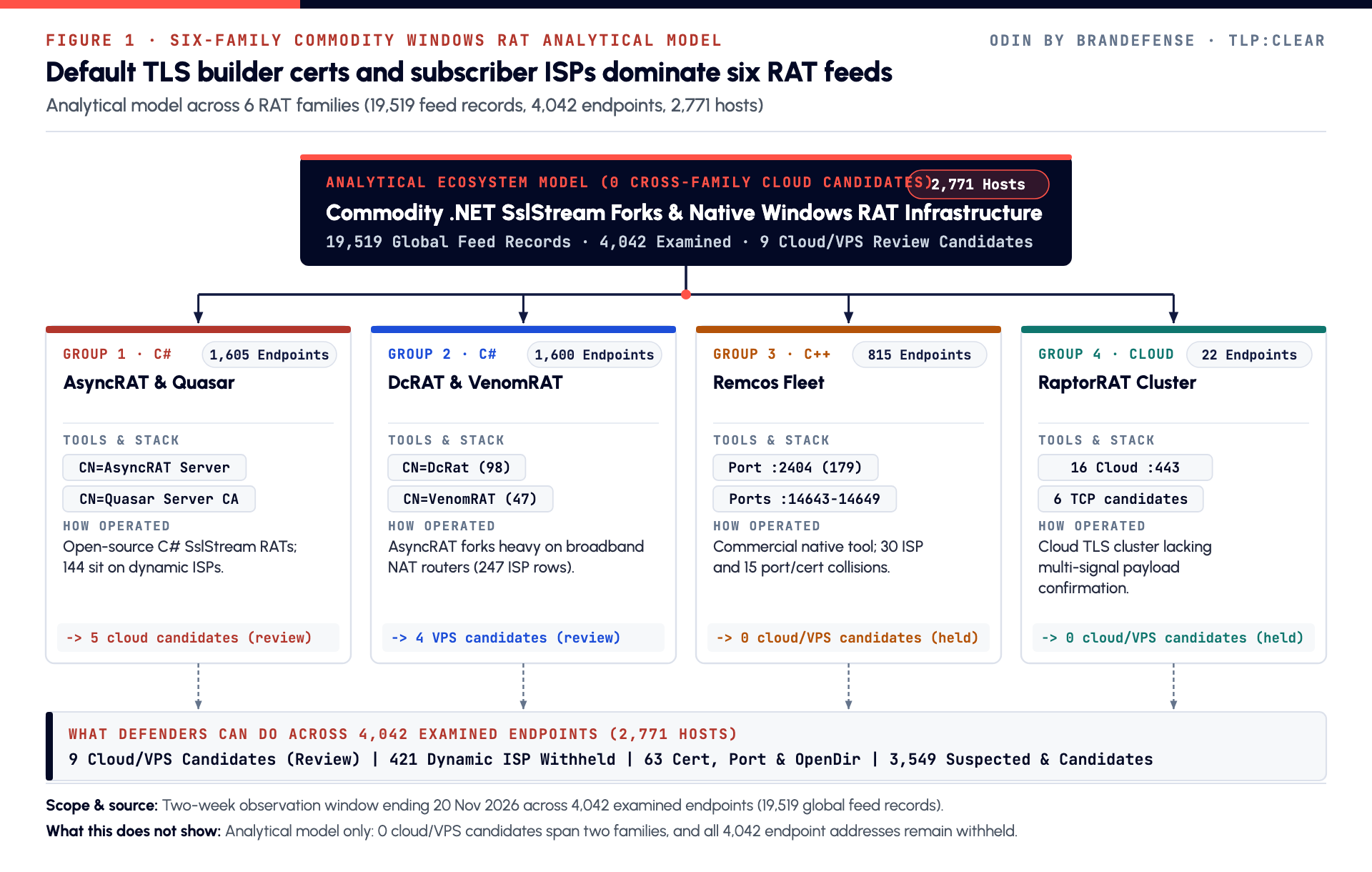
Odin by Brandefense examined 4,042 endpoints across 2,771 hosts during a two-week window ending 20 November 2026. The sample came from 19,519 global feed records across six Windows RAT families.
Only nine dedicated cloud and virtual private server endpoints carried upstream confirmed labels; defenders can use external attack surface management to check their own exposed services. Because the inventory records certificates, JARM fingerprints, ports, and hosting without live C2 traffic, all 4,042 addresses are withheld. Outside those nine cloud and VPS candidates, the sample holds 85 suspected C2 endpoints, 421 broadband endpoints, 63 collision cases, and 3,464 single-signal candidates.
This short read explains why commodity RAT feeds produce so much collateral noise and how defenders can use cyber threat intelligence to assess them. The full report on commodity RAT infrastructure carries the hosting breakdown, the 10 published JARM indicators in the full report's Indicators tab, and the detection rules in the full report's Detection rules tab.
Why do .NET RAT builders create broadband block-list collisions?
Four of the six families in our study share a C# .NET codebase built around Microsoft's SslStream TLS library. Those four families are AsyncRAT (804 examined endpoints), QuasarRAT (801), DcRAT (800), and VenomRAT (800). When an operator compiles a client stub without replacing the default keystore, the server presents a hardcoded self-signed certificate name on every TLS 1.2 handshake:
| Default certificate subject | Examined endpoints | Broadband ISP endpoints | Feed-labelled cloud candidates |
|---|---|---|---|
CN=Quasar Server CA | 184 | 38 | 2 |
CN=DcRat | 98 | 18 | 0 |
CN=AsyncRAT Server | 80 | 20 | 0 |
CN=VenomRAT | 47 | 13 | 0 |
CN=AsyncRAT Server CA | 5 | 0 | 0 |
Low-cost operators frequently start those listeners on home computers behind consumer fiber or cable routers. They forward ports 4449, 4782, 5000, 6606, or 8848 and point a dynamic DNS hostname at their home router. Across our 4,042 examined endpoints, 421 sit on residential and mobile telecom networks across 250 hosts, led by VenomRAT (148), DcRAT (99), QuasarRAT (89), AsyncRAT (55), and Remcos (30).
One feed-labelled QuasarRAT endpoint was on a residential cable network; its connection details are withheld. When a broadband provider rotates DHCP leases, yesterday's home RAT listener becomes today's innocent household or small office. Blocking subscriber IPv4 leases permanently creates silent outages while the operator's dynamic DNS name moves to a fresh address.
Why do the nine cloud and VPS relay candidates stay on analyst review?
Nine dedicated cloud and VPS endpoints across four families carried a "confirmed" label in the upstream feed. Our inventory records their hosting, ports, TLS certificates, and JARM fingerprints without a live protocol response, beacon, or workbench link. Their IPv4 addresses and host-specific connection details are therefore withheld for analyst review:
| Family | Feed-labelled review candidates | Hosting category | Analyst review window |
|---|---|---|---|
| AsyncRAT | 1 | Commercial cloud (connection details withheld) | 7-day cloud review |
| QuasarRAT | 4 | Commercial cloud (connection details withheld) | 7-day cloud review |
| DcRAT | 2 | Dedicated VPS (connection details withheld) | 30-day VPS review |
| VenomRAT | 2 | Dedicated VPS (connection details withheld) | 30-day VPS review |
Two operational details stand out. First, commodity .NET RAT configurations in the sample also use TCP port 3389 (including 33 DcRAT endpoints) so encrypted traffic blends into outbound Remote Desktop sessions. Alerting whenever PowerShell, MSBuild, RegAsm, or InstallUtil opens an external TCP 3389 connection catches this camouflage without relying on a static IP block.
Second, five of the nine candidates sit on commercial cloud platforms, including three entries last listed on 1 August 2026, while four sit on virtual private servers. Because virtual machine addresses return to shared cloud pools when deleted, retain these candidates for analyst review with a 7-day cloud and 30-day VPS re-verification window.
Why did Remcos and RaptorRAT produce zero dedicated relay candidates?
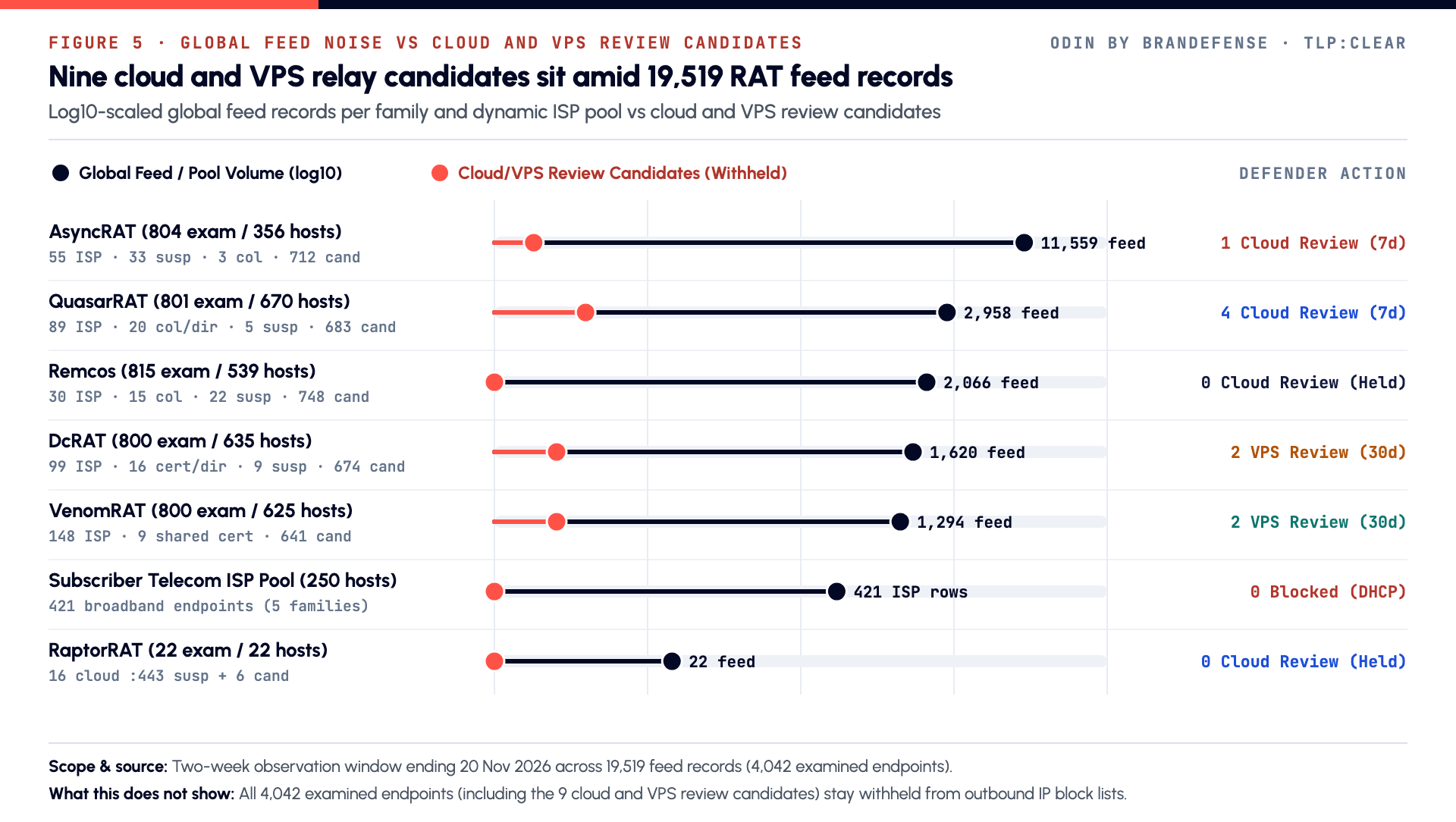
Out of 2,066 global Remcos feed records (815 examined endpoints on 539 hosts), none carried an upstream confirmed label or multi-signal C2 corroboration. None of the 22 RaptorRAT records (22 examined endpoints on 22 hosts) met that threshold either.
Unlike C# .NET forks, Remcos is a commercial native Windows program that uses custom binary framing over raw TCP. Its default port 2404 accounts for 179 examined endpoints and is also assigned by IANA to IEC 60870-5-104 power-grid telecontrol. Raw TCP sockets on port 2404 rarely complete a TLS handshake, so 179 Remcos rows produce a mostly zero JARM (000000000000 prefix). Another 15 Remcos rows collide with shared certificates or SSH (22), DNS (53), and SMTPS (465).
In RaptorRAT, 16 suspected cloud endpoints listen on TCP 443 and share JARM prefix 1dd40d40d000. That same JARM also shows up on eight unconfirmed Remcos and VenomRAT candidates without verified payload activity. Across the wider study, 49 endpoints collided with shared certificates (CN=CloudFlare Origin Certificate on 15). Ten more hit standard ports (22, 53, 143, 465, 1433, 3306, 6379), and four shared a VPS with an open HTTP directory.
Are these six RAT families run by one group?
No evidence links them to one operator. None of the nine feed-labelled cloud and VPS relay candidates shares an IPv4 address or custom certificate across two RAT families. Where 77 other hosts carry labels from two or three families, the overlap comes from shared .NET builder certificates or home routers forwarding several ports. We present the six families as an analytical model of shared Windows RAT builder tradecraft so defenders can design cleaner controls.
What to do now
- Do not block the nine cloud and VPS addresses from this evidence alone; retain them for analyst review with a 7-day cloud and 30-day VPS window until each has current, independent C2 corroboration.
- Hunt default
.NETbuilder certificates on the wire (CN=AsyncRAT Server,CN=Quasar Server CA,CN=DcRat, andCN=VenomRAT) using the Suricata 7 rules in the full report's Detection rules tab. - Restrict external TCP 3389 egress to approved Remote Desktop jump hosts and exact
C:WindowsSystem32mstsc.exebinaries, and alert on any scripting or.NETprocess opening port 3389. - Monitor
.NETand script utilities hitting default RAT ports (2404, 4449, 4782, 4783, 6606, 7707, 8808, and 8848) using the Sentinel KQL and Sigma rules. - Keep telecom ISP networks, shared CDN certificates, standalone JARMs, and standard service ports out of automatic block lists.
What is…?
Short explanations of the tools and families named in this study.
What is Quasar?
Quasar is an open-source .NET remote access tool for Windows that criminals and some state actors use as a RAT.
More about QuasarRemote access trojanWhat is AsyncRAT?
AsyncRAT is an open-source .NET remote access trojan widely used in commodity malware campaigns.
More about AsyncRATRemote access trojanWhat is VenomRAT?
VenomRAT is a commodity remote access trojan descended from the Quasar and AsyncRAT code bases.
More about VenomRATTechniqueWhat is JARM?
JARM is an open TLS server fingerprinting method from Salesforce. It hashes how a server answers a set of crafted TLS handshakes.
More about JARMFrequently asked questions
Why do .NET RAT builders create broadband block-list collisions?
Four of the six families in our study share a C# .NET codebase built around Microsoft's SslStream TLS library. Those four families are AsyncRAT (804 examined endpoints), QuasarRAT (801), DcRAT (800), and VenomRAT (800). When an operator compiles a client stub without replacing the default keystore, the server presents a hardcoded self-signed certificate name on every TLS 1.2 handshake:
Why do the nine cloud and VPS relay candidates stay on analyst review?
Nine dedicated cloud and VPS endpoints across four families carried a "confirmed" label in the upstream feed. Our inventory records their hosting, ports, TLS certificates, and JARM fingerprints without a live protocol response, beacon, or workbench link. Their IPv4 addresses and host-specific connection details are therefore withheld for analyst review:
Why did Remcos and RaptorRAT produce zero dedicated relay candidates?
Out of 2,066 global Remcos feed records (815 examined endpoints on 539 hosts), none carried an upstream confirmed label or multi-signal C2 corroboration. None of the 22 RaptorRAT records (22 examined endpoints on 22 hosts) met that threshold either.
Are these six RAT families run by one group?
No evidence links them to one operator. None of the nine feed-labelled cloud and VPS relay candidates shares an IPv4 address or custom certificate across two RAT families. Where 77 other hosts carry labels from two or three families, the overlap comes from shared .NET builder certificates or home routers forwarding several ports. We present the six families as an analytical model of shared Windows RAT builder tradecraft so defenders can design cleaner controls.