
1. Executive Summary
In short
Odin by Brandefense examined 4,042 endpoints across 2,771 hosts during a two-week window ending 20 November 2026. The sample came from 19,519 feed records labelled as AsyncRAT, QuasarRAT, Remcos, DcRAT, VenomRAT, and RaptorRAT. Nine dedicated cloud and VPS endpoints carried upstream confirmed labels without independent C2 behaviour, while 421 endpoints sat on residential and mobile telecom networks. Retain the nine cloud and VPS candidates for analyst review, hunt default RAT certificates on the wire, and keep subscriber ISP leases out of static firewall feeds.
Public C# .NET builders and commercial Windows remote administration kits ship with built-in self-signed TLS certificates and fixed listener ports. Threat feeds flag thousands of addresses whenever external scans match those default certificates, Windows TLS fingerprints, or common ports.
Blocking every feed match cuts off home broadband customers after DHCP lease rotation and breaks servers behind shared cloud certificates. Because none of the nine cloud and VPS relay candidates shares an IPv4 address or custom certificate across two RAT families, we present the six families as an analytical model.
Nine dedicated cloud and VPS candidates require analyst review across 4,042 examined endpoints.
Out of 19,519 global feed records across six Windows RAT families, nine dedicated endpoints carried upstream confirmed labels: one AsyncRAT, four QuasarRAT, two DcRAT, and two VenomRAT candidates. Because the evidence records certificates, JARMs, ports, and hosting without independent C2 behaviour, all 4,042 endpoint addresses are withheld.
Subscriber telecom networks host 421 RAT-labelled endpoints on 250 dynamic hosts.
Operators running home or dynamic-DNS listeners behind consumer routers account for 148 VenomRAT, 99 DcRAT, 89 QuasarRAT, 55 AsyncRAT, and 30 Remcos endpoints. Eighty-nine of those telecom endpoints present default builder certificates such as CN=Quasar Server CA or CN=AsyncRAT Server, including one feed-labelled residential cable lease whose connection details are withheld.
Shared TLS certificates, service ports, and open directories create 63 collision cases.
Forty-nine endpoints sit behind shared Cloudflare origin, proxy, or appliance certificates, ten use standard SSH, DNS, mail, or database ports, and four expose open HTTP folders. Meanwhile, commodity .NET RAT configurations in the sample also use TCP port 3389 (including 33 DcRAT endpoints) to blend into Remote Desktop traffic.
Three Decisions for Leaders
- Do not block commodity RAT feed addresses without independent C2 corroboration. Retain the nine dedicated cloud and VPS candidates for analyst review with a 7-day cloud and 30-day VPS window. Keep all 4,042 uncorroborated endpoints out of static firewall block lists.
- Replace static ISP blocks with TLS certificate and port-3389 hunting. Alert on default builder certificate names (
CN=AsyncRAT Server,CN=Quasar Server CA,CN=DcRat, andCN=VenomRAT) and non-RDP Windows processes opening external TCP 3389. - Never block on a Windows TLS fingerprint or default RAT port alone. Use cyber threat intelligence to assess JARM fingerprints and default builder ports (2404, 4449, 4782, 6606, 8848) as hunting leads paired with endpoint process logs.
The Study in Numbers
| Number | What it is |
|---|---|
| 19,519 | Global feed records labelled as AsyncRAT, QuasarRAT, Remcos, DcRAT, VenomRAT, or RaptorRAT |
| 4,042 / 2,771 | Endpoints examined across 2,771 distinct hosts (all 4,042 endpoint addresses withheld) |
| 9 | Feed-labelled dedicated cloud and VPS relay candidates retained for analyst review (1 AsyncRAT, 4 QuasarRAT, 2 DcRAT, 2 VenomRAT) |
| 421 / 250 | Residential and mobile telecom ISP endpoints withheld across 250 dynamic subscriber hosts |
| 414 | Examined endpoints presenting default Quasar, DcRat, AsyncRAT, or VenomRAT certificate names |
| 63 | Collision cases withheld across 49 shared certificates, 10 standard service ports, and 4 open directories |
| 10 | Indicators published in the Indicators tab (10 TLS JARM fingerprints for hunting; 0 IPv4 addresses) |
How to use this report.
Security leaders can start with the Short Read on commodity RAT infrastructure, then Chapters 1, 6, and 7. Network and Windows platform engineers should read Chapters 3, 4, 5, and 7. SOC analysts and detection engineers should go directly to Chapters 8 and 9. Threat intelligence analysts will find the hosting breakdown and scope limits in Chapters 2, 5, 6, and 10.
2. Six RAT Families, One Analytical Model
In short
None of the nine feed-labelled cloud and VPS relay candidates shares an IPv4 address or custom certificate across two RAT families. Retain those candidates for analyst review, and use our six-family analytical model to focus controls on shared Windows RAT builder habits.
Open-source C# .NET remote administration trojans (AsyncRAT, QuasarRAT, and the AsyncRAT forks DcRAT and VenomRAT) sit alongside native Windows remote control tools (Remcos) and smaller clusters (RaptorRAT). Their builder programs circulate widely on public repositories and criminal forums. Hundreds of unrelated operators start listeners without changing the built-in TLS certificates or default TCP ports.
We compared addresses and X.509 certificates across all nine dedicated cloud and VPS relay candidates. Zero candidate IPv4 addresses and zero custom TLS certificates span two different RAT families.
Within DcRAT alone, the two VPS review candidates (connection details withheld) share one server certificate and one JARM fingerprint. Across the wider sample, 77 hosts carry labels from two (73 hosts) or three (4 hosts) families because operators reuse .NET certificates or forward several ports on one router. Figure 1 shows the four functional groups in our analytical model and what defenders can do with each.
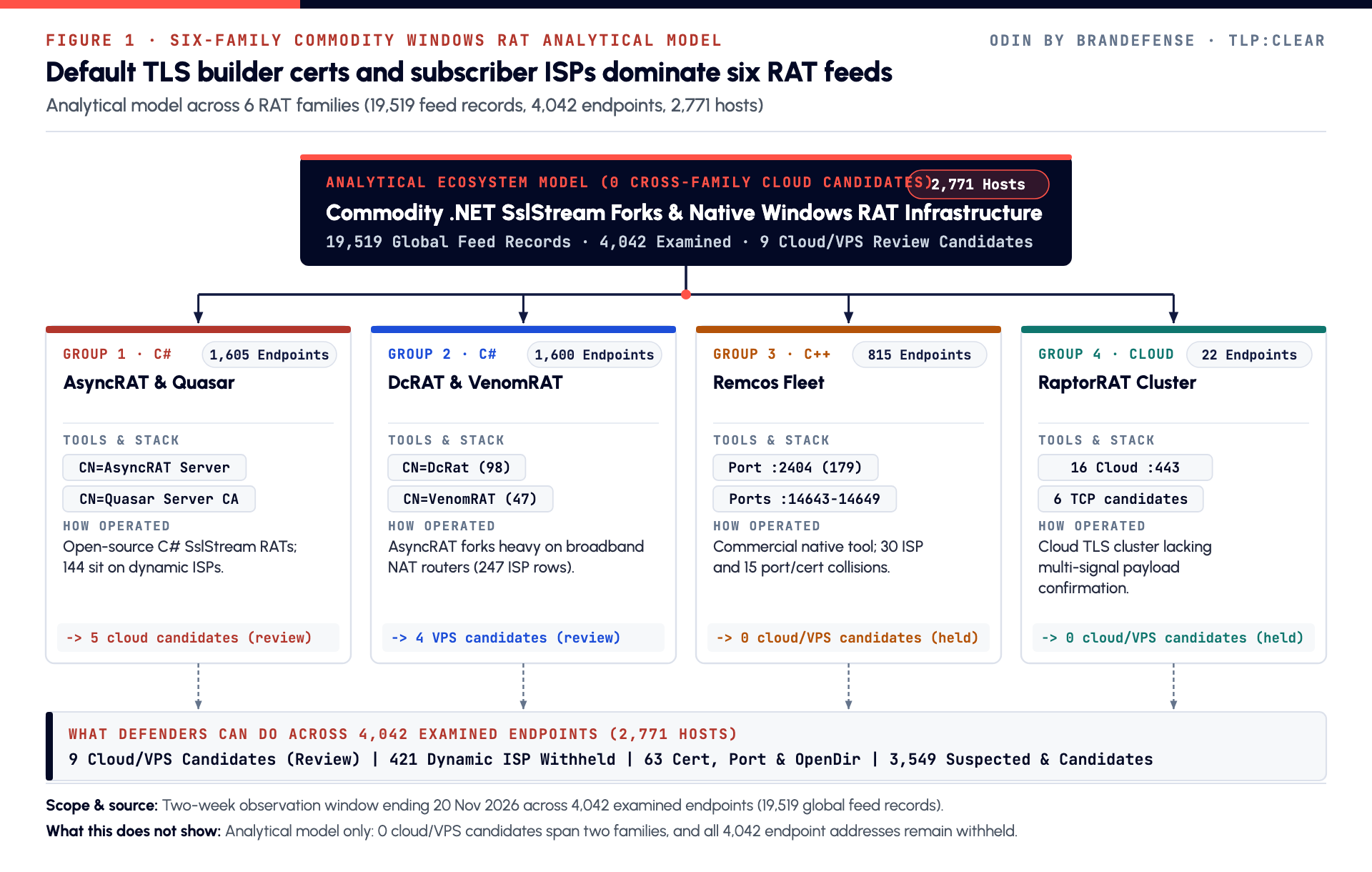
Six families from 19,519 feed records to 4,042 examined endpoints
Feed records across the six labels total 19,519 entries. They span 81 countries for AsyncRAT, 77 for QuasarRAT, 54 for DcRAT, 53 for Remcos, 50 for VenomRAT, and 6 for RaptorRAT. Older dates attached to some feed records are the upstream listing dates recorded on those entries, not continuous observation by Odin by Brandefense.
Our examined set covers 4,042 endpoints across 2,771 distinct hosts. Nine dedicated cloud and VPS endpoints (0.22%) carried upstream confirmed labels without independent C2 behaviour. Their addresses and connection details are withheld for analyst review alongside all 4,033 other endpoints (99.78%) on 2,762 hosts.
| RAT family | Feed records | Examined | Hosts | Cloud/VPS review candidates | Broadband ISP | Collisions | Suspected and candidates |
|---|---|---|---|---|---|---|---|
| AsyncRAT | 11,559 | 804 | 356 | 1 (cloud, withheld) | 55 | 3 (2 cert, 1 port) | 745 (33 suspected, 712 candidates) |
| QuasarRAT | 2,958 | 801 | 670 | 4 (cloud, withheld) | 89 | 20 (12 cert, 6 port, 2 open-dir) | 688 (5 suspected, 683 candidates) |
| Remcos | 2,066 | 815 | 539 | 0 (all withheld) | 30 | 15 (12 cert, 3 port) | 770 (22 suspected, 748 candidates) |
| DcRAT | 1,620 | 800 | 635 | 2 (VPS, withheld) | 99 | 16 (14 cert, 2 open-dir) | 683 (9 suspected, 674 candidates) |
| VenomRAT | 1,294 | 800 | 625 | 2 (VPS, withheld) | 148 | 9 (9 shared cert) | 641 (0 suspected, 641 candidates) |
| RaptorRAT | 22 | 22 | 22 | 0 (all withheld) | 0 | 0 | 22 (16 suspected, 6 candidates) |
Where the infrastructure sits
Ten countries account for 71.9% (2,906 endpoints) of the 4,042 examined ports. The United States leads with 878 endpoints (21.7%), followed by Germany (401, 9.9%), the Netherlands (394, 9.7%), Vietnam (231, 5.7%), and Hong Kong (221, 5.5%). China (203, 5.0%), France (199, 4.9%), Colombia (130, 3.2%), the United Kingdom (126, 3.1%), and Türkiye (123, 3.0%) complete the top ten.
| Commercial cloud or VPS provider | Examined endpoints | Primary RAT labels seen |
|---|---|---|
| Contabo GmbH and Contabo Inc. | 144 | AsyncRAT (97 combined), DcRAT |
| Alibaba Cloud (US and Hangzhou) | 132 | AsyncRAT, QuasarRAT, DcRAT |
| Fiba Cloud Operation Company, LLC | 113 | Remcos, DcRAT |
| HostPapa | 112 | Remcos, QuasarRAT |
| Amazon.com, Inc. | 92 | QuasarRAT, VenomRAT, RaptorRAT |
| M247 Europe SRL | 90 | Remcos, DcRAT |
| Shenzhen Tencent Computer Systems | 77 | DcRAT, QuasarRAT |
| OVH SAS | 72 | DcRAT, QuasarRAT, VenomRAT |
| VPS Dedicated LLC | 65 | AsyncRAT |
| Microsoft Corporation | 64 | QuasarRAT, AsyncRAT, RaptorRAT |
Hosting splits into two distinct groups. Feed-labelled cloud and VPS candidates and suspected cloud clusters sit on the commercial cloud and VPS providers listed above. By contrast, the 421 dynamic ISP endpoints cluster on broadband and mobile networks in Vietnam (155), Colombia (94), China (38), France (18), Morocco (18), Canada (11), and Russia (11).
3. Core Open-Source .NET Fleets: AsyncRAT and QuasarRAT
In short
AsyncRAT and QuasarRAT account for 14,517 of the 19,519 global feed records (74.4%). Five dedicated cloud endpoints (one AsyncRAT and four QuasarRAT) carried upstream confirmed labels without independent C2 corroboration. Retain those cloud candidates for analyst review and hunt default RAT TLS certificates on the wire.
Both AsyncRAT (MITRE ATT&CK S1087) and QuasarRAT (S0262) encrypt traffic with Microsoft's .NET System.Net.Security.SslStream library over Windows SChannel sockets (T1573.002). If the builder's bundled X.509 keystore remains unchanged, the server presents a fixed self-signed certificate subject during TLS 1.2 handshakes (T1587.003). The bundled keystore is ServerCertificate.p12 or quasar.p12. Figure 2 maps all six RAT cohorts and co-exposed staging directories to their network surfaces and detections, where external attack surface management helps defenders spot exposed services.
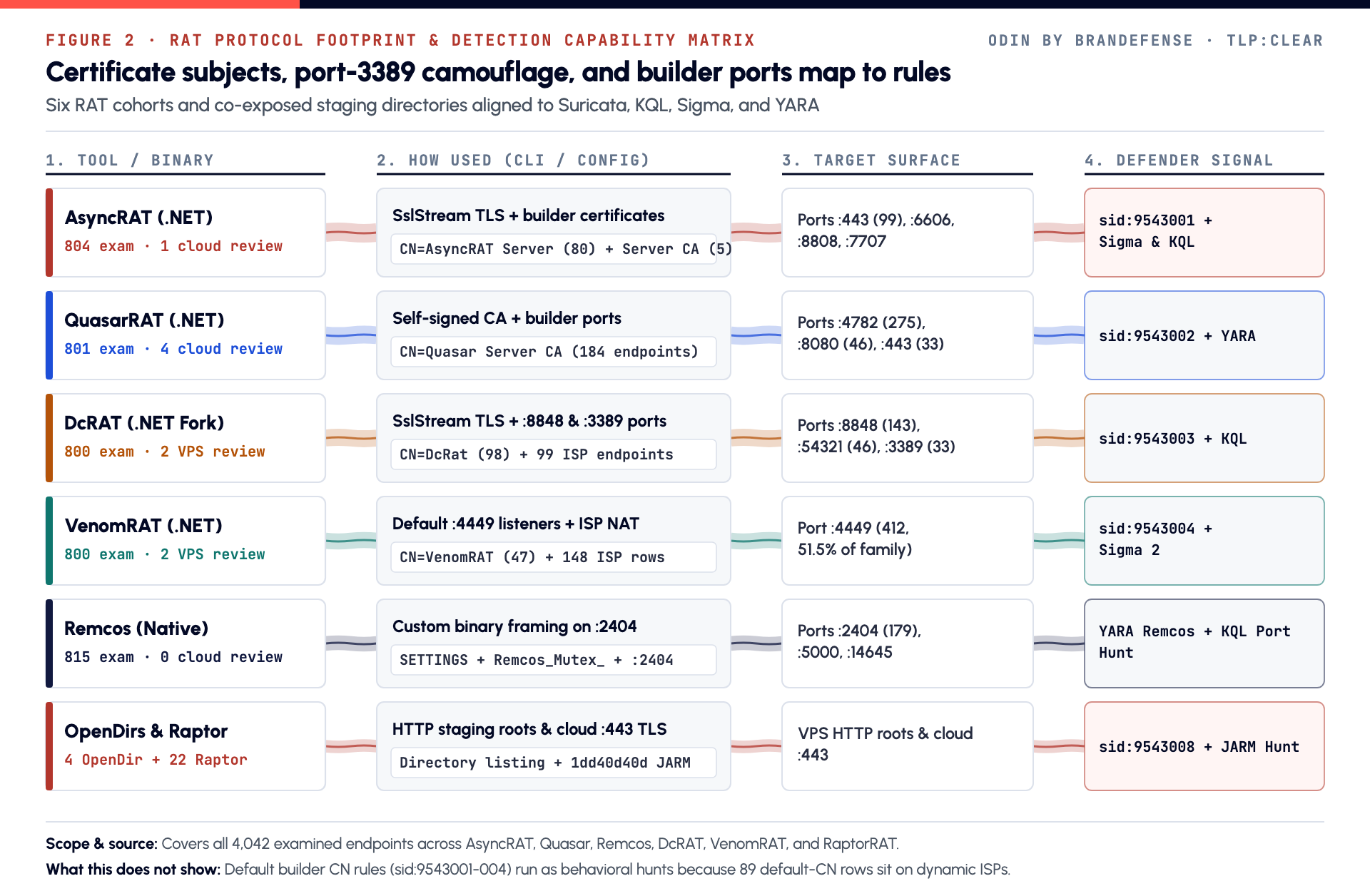
AsyncRAT: port 3389 TLS camouflage and cloud port 443 clusters
AsyncRAT accounts for 11,559 feed records across 81 countries, from which we examined 804 endpoints on 356 hosts (2.26 ports per host). Default AsyncRAT ports remain common across the sample: TCP 6606 (76 endpoints), 8808 (56), 7707 (42), and 8282 (42), alongside TCP 443 (99) and 8080 (15).
Only one AsyncRAT endpoint carried an upstream confirmed label on dedicated cloud hosting. Its address, provider, port, and certificate details are withheld for a seven-day analyst review window because the inventory records no live beacon or workbench link. Across the wider .NET RAT sample, operators also bind TLS listeners to non-standard or camouflaged ports such as TCP 3389 so outbound traffic blends into Remote Desktop sessions (T1571). Alerting on non-RDP Windows processes that open external TCP 3389 catches that camouflage without relying on static IP blocks.
Thirty-three AsyncRAT endpoints sit in our suspected group (all withheld). Twenty-six of them form a TCP 443 cluster on cloud servers in China, Singapore, Vietnam, Thailand, Germany, South Korea, and Indonesia sharing JARM prefix 29d29d00029d. The other 770 AsyncRAT endpoints split into 712 single-signal candidates, 55 dynamic telecom ISP addresses, 2 shared-certificate collisions, and 1 MySQL port 3306 collision.
QuasarRAT: four cloud relay candidates and a broadband feed false positive
QuasarRAT accounts for 2,958 feed records across 77 countries, with 801 endpoints examined on 670 hosts. Its default builder port TCP 4782 dominates the sample with 275 endpoints (34.3%), followed by 8080 (46), 443 (33), 4783 (13), and 80 (12). Default CN=Quasar Server CA certificates appear on 184 endpoints across the full study (176 labelled QuasarRAT, 5 Remcos, 2 AsyncRAT, and 1 DcRAT).
Five QuasarRAT endpoints carried a "confirmed" label in the upstream feed, yet none had independent C2 behaviour in our evidence. One of the five sat on a residential cable broadband network. Its connection details and address are withheld because blocking a home cable lease punishes the next subscriber who receives it.
The other four feed-labelled QuasarRAT review candidates sit on commercial cloud providers. Their addresses, ports, providers, and host-specific fingerprints are withheld pending independent C2 corroboration. Two of the four present the default CN=Quasar Server CA certificate, and two present custom or instance-specific certificate subjects (withheld).
Three of the four QuasarRAT cloud records carry upstream listing dates of 1 August 2026. Because cloud virtual machine addresses return to shared pools when deleted, do not block these four endpoints from feed records alone. Retain them for analyst review with a seven-day cloud re-verification window.
4. AsyncRAT Forks, Native Remcos Listeners, and RaptorRAT
In short
AsyncRAT forks DcRAT and VenomRAT included four feed-labelled VPS review candidates alongside 247 broadband ISP endpoints. Native Windows tool Remcos and cloud cluster RaptorRAT included zero upstream-confirmed endpoints. Withhold all 2,437 endpoints across these four families from static IP block lists, and hunt by certificate and process behavior instead.
Criminal developers regularly fork AsyncRAT's C# project to package credential stealers, hidden VNC desktop modules, or reverse SOCKS proxies. DcRAT and VenomRAT keep AsyncRAT's .NET SslStream handshake, whereas Remcos is a native C++ and Delphi remote control program with its own binary wire framing.
DcRAT and VenomRAT: four VPS review candidates vs broadband router sprawl
Within DcRAT (1,620 feed records; 800 examined endpoints on 635 hosts), default port 8848 leads with 143 endpoints, followed by 54321 (46), 3389 (33), 8080 (33), and 443 (30). Two dedicated VPS endpoints carried upstream confirmed labels for DcRAT. Their addresses, provider, ports, shared certificate, and JARM details are withheld for a 30-day analyst review window pending independent C2 behaviour.
Across the remaining 798 DcRAT rows, 99 sit on dynamic telecom ISPs and 14 hit shared-certificate collisions. Two more sit on VPS hosts that also serve an open HTTP directory (connection details withheld). Nine DcRAT endpoints are suspected and 674 remain single-signal candidates.
Within VenomRAT (1,294 feed records; 800 examined endpoints on 625 hosts), default port 4449 accounts for 412 endpoints (51.5%). VenomRAT also shows the heaviest residential telecom footprint in the study, with 148 broadband and mobile ISP endpoints (18.5%), led by 110 endpoints on a national carrier in Vietnam.
Only two dedicated VPS endpoints carried upstream confirmed labels for VenomRAT. Their addresses, providers, ports, certificates, and JARM fingerprints are withheld for a 30-day analyst review window pending independent C2 corroboration.
Why all 815 Remcos and 22 RaptorRAT endpoints are withheld
Remcos (MITRE ATT&CK S0332; 2,066 feed records; 815 examined endpoints on 539 hosts) uses custom binary framing over raw TCP rather than .NET SslStream (T1095). Its default port 2404 accounts for 179 examined endpoints, alongside port 5000 (21) and sequential ports 14643 through 14649 (48). Port 2404 rarely completes a standard TLS handshake and is also the IANA port for IEC 60870-5-104 power-grid telecontrol, producing 179 zero-cipher JARM prefixes (000000000000).
Zero Remcos endpoints met multi-signal confirmation. Instead, the 815 rows split into 22 suspected endpoints, 30 dynamic ISP rows, 12 shared certificates, 3 SSH/DNS/SMTPS port collisions (ports 22, 53, and 465), and 748 candidates.
RaptorRAT (22 feed records; 22 examined endpoints on 22 hosts) likewise produced zero confirmed addresses. Sixteen suspected cloud endpoints listen on TCP 443 and share JARM prefix 1dd40d40d000.
Six more single-signal candidates listen on TCP 2222 (4), 8080 (1), and 80 (1) without multi-signal confirmation. Because that port 443 JARM also appears on eight unconfirmed Remcos and VenomRAT candidates without payload confirmation, all 22 RaptorRAT addresses stay withheld.
| Family | Feed-labelled review candidates | Hosting category | Withheld details | Review window |
|---|---|---|---|---|
| AsyncRAT | 1 | Commercial cloud | Address, provider, port, certificate, and JARM withheld | 7-day analyst review |
| QuasarRAT | 4 | Commercial cloud | Addresses, providers, ports, certificates, and JARMs withheld (3 listed 1 Aug 2026) | 7-day analyst review |
| DcRAT | 2 | Dedicated VPS | Addresses, provider, ports, shared certificate, and JARM withheld | 30-day analyst review |
| VenomRAT | 2 | Dedicated VPS | Addresses, providers, ports, certificates, and JARMs withheld | 30-day analyst review |
5. Default Builder Certificates, Broadband ISP Churn, and Collisions
In short
Default .NET RAT certificates appear on 414 examined endpoints, including 89 on residential and mobile broadband networks. Hunt those certificate names in network TLS logs, and never turn broadband router addresses into permanent firewall blocks.
Treating a malware builder's default X.509 certificate name as proof of a static adversary server breaks consumer networks. Small-scale RAT operators often run listeners on home computers behind fiber or cable routers, forwarding ports 4449, 4782, 5000, 6606, or 8848 with dynamic DNS.
When an ISP reassigns a broadband lease, a former listener's IPv4 address may move to another subscriber. Figure 3 shows how broadband DHCP churn turns naive IP block lists into outages, and how wire-level TLS hunting avoids that trap.
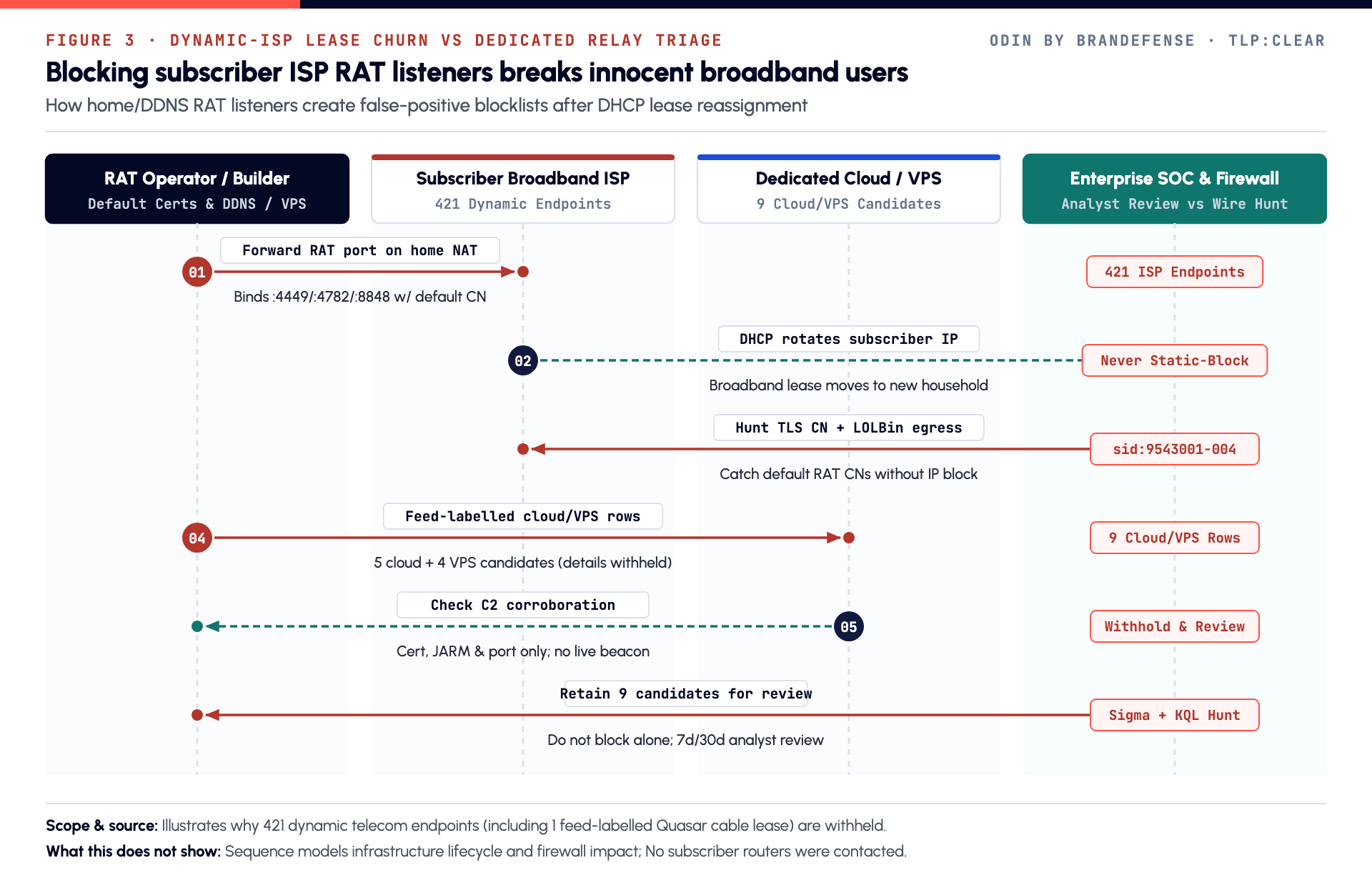
Five default .NET builder certificates on 414 endpoints
Across all 4,042 examined endpoints, 2,129 (52.7%) returned no TLS certificate on raw TCP or reset sockets, while 1,913 presented an X.509 certificate. Five built-in .NET RAT builder subject strings account for 414 endpoints (21.6% of all TLS-bearing endpoints):
CN=Quasar Server CA: 184 endpoints across 164 hosts (2 feed-labelled cloud relay candidates, 38 broadband ISP endpoints, 5 port collisions, and 139 single-signal candidates).CN=DcRat: 98 endpoints across 69 hosts (0 cloud review candidates, 18 broadband ISP endpoints, and 80 single-signal candidates).CN=AsyncRAT Server: 80 endpoints across 52 hosts (0 cloud review candidates, 20 broadband ISP endpoints, and 60 single-signal candidates).CN=VenomRAT: 47 endpoints across 35 hosts (0 cloud review candidates, 13 broadband ISP endpoints, and 34 single-signal candidates).CN=AsyncRAT Server CA: 5 candidate endpoints across 5 hosts.
More than one in five default-certificate endpoints (89 of 414, or 21.5%) sits on a residential or mobile telecom network. Feeds also cross-label families sharing .NET builder code: CN=DcRat appears on 73 DcRAT, 9 VenomRAT, 8 Remcos, 6 AsyncRAT, and 2 QuasarRAT records.
On individual broadband routers in the sample, multiple forwarded AsyncRAT and DcRAT listener ports (ports withheld) appear alongside consumer router certificates. Figure 4 compares the nine feed-labelled cloud and VPS relay candidate stacks with the 421 dynamic ISP and 63 collision endpoints.
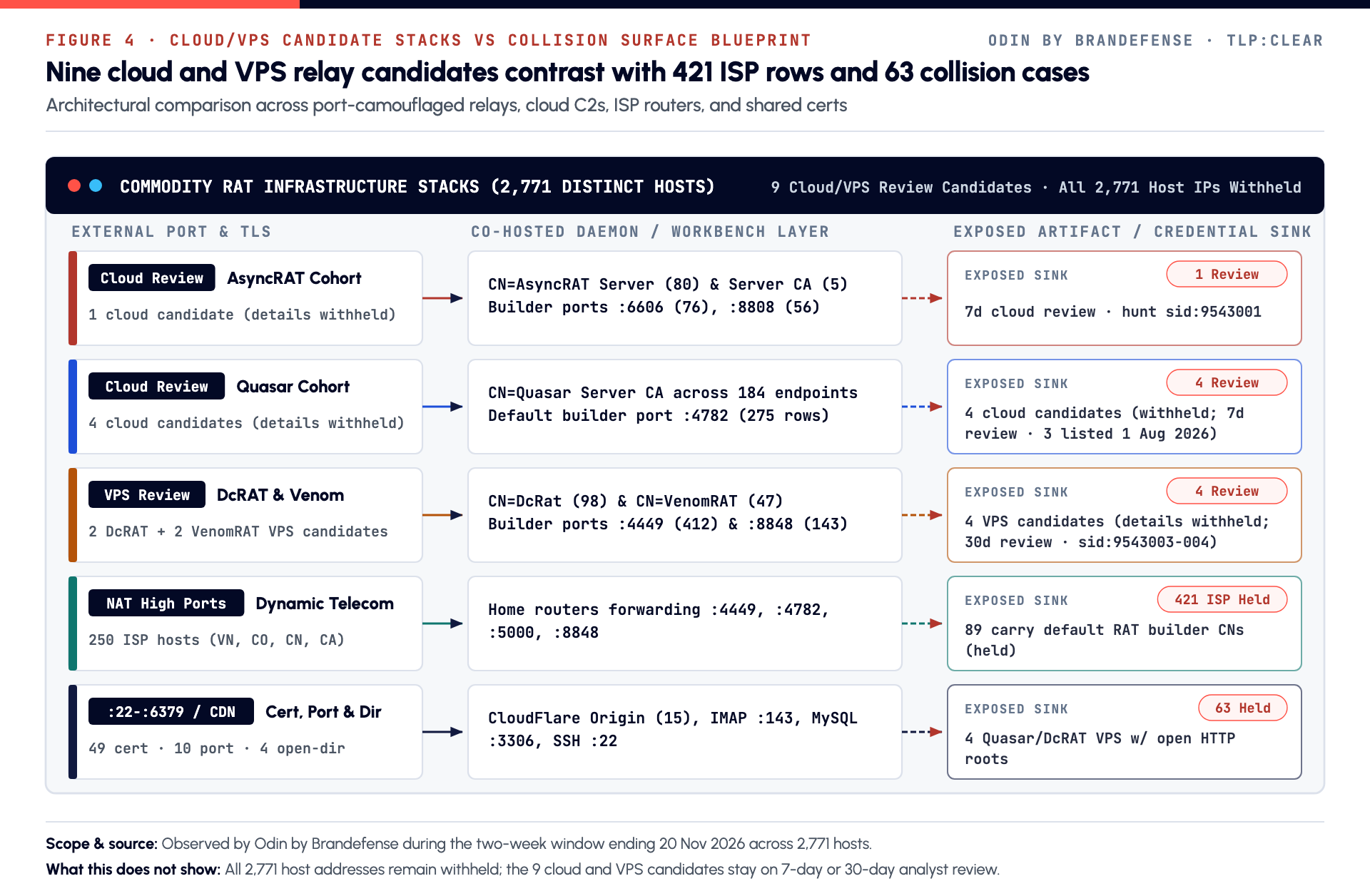
Windows SChannel JARMs, CDN certificates, and standard service ports
Three collision patterns explain why single-signal TLS and port feeds generate false positives:
- Windows SChannel JARM overlap (1,973 JARM-bearing endpoints across 315 unique JARMs). C#
SslStreaminherits the underlying Windows Server TLS cipher list. As a result, the most common JARM in our study (22b22b00022bprefix, 231 endpoints) spans five RAT feed labels (80 AsyncRAT, 73 DcRAT, 53 VenomRAT, 14 Remcos, and 11 QuasarRAT) plus ordinary Windows servers. - CDN, proxy, WinRM, and router certificates (49 shared-certificate collisions plus generic defaults). Fifteen shared-certificate rows sit behind
CN=CloudFlare Origin Certificate. Across the wider candidate set, feeds also swept upCN=localhost(85),CN=Server(41),CN=TRAEFIK DEFAULT CERT(25),CN=Cloudbase-Init WinRM(24),CN=AnyDesk Client(20),CN=ASUS(11), andCN=Vigor Router(9). - Standard service ports (10) and co-exposed open directories (4). Ten endpoints collided with everyday service ports: three IMAP port 143 listeners at a US cloud provider, two MySQL port 3306 servers, Redis (6379), and MS-SQL (1433). Three Remcos rows collided with SSH (22), DNS (53), and SMTPS (465). Four more VPS hosts (two QuasarRAT and two DcRAT; connection details withheld) also served open HTTP directories.
| Certificate or collision group | Endpoints | Hosts | Cloud/VPS review | Withheld IPs | Defender guidance |
|---|---|---|---|---|---|
CN=Quasar Server CA (default) | 184 | 164 | 2 | 184 | Hunt with SID 9543002; require independent C2 evidence before blocking |
CN=DcRat (default) | 98 | 69 | 0 | 98 | Hunt with SID 9543003; seen across five feed labels |
CN=AsyncRAT Server and Server CA | 85 | 57 | 0 | 85 | Hunt with SID 9543001; 80 Server plus 5 Server CA |
CN=VenomRAT (default) | 47 | 35 | 0 | 47 | Hunt with SID 9543004; 27.7% sit on broadband ISPs |
| Custom or cloud candidate certs | 7 | 7 | 7 | 7 | All 7 candidate-specific certificate subjects withheld pending C2 corroboration |
| Generic proxy, WinRM, and router certs | 238 | 190 | 0 | 238 | localhost (85), Traefik (25), WinRM (24), CloudFlare (17) |
| Dynamic subscriber telecom pool | 421 | 250 | 0 | 421 | Never block by IP; DHCP rotation hits innocent users |
| Standard ports (10) and open dirs (4) | 14 | 14 | 0 | 14 | Ports 22, 53, 143, 465, 1433, 3306, 6379 and 4 HTTP dirs |
6. Feed Labels Against Corroborated C2 Evidence
In short
Feeding raw commodity RAT lists into a firewall could block 250 subscriber IPs, 42 shared-certificate hosts, and 10 mail, DNS, SSH, or database endpoints. Only nine dedicated cloud and VPS endpoints (0.22% of examined endpoints, 0.046% of global feed records) carried upstream confirmed labels. Even those nine require analyst review rather than automatic blocking until live C2 behaviour corroborates them.
Good infrastructure defense is defined by what it refuses to block. Figure 5 compares the global feed volume for each RAT family and the 421-endpoint broadband ISP pool against the nine feed-labelled cloud and VPS relay candidates.
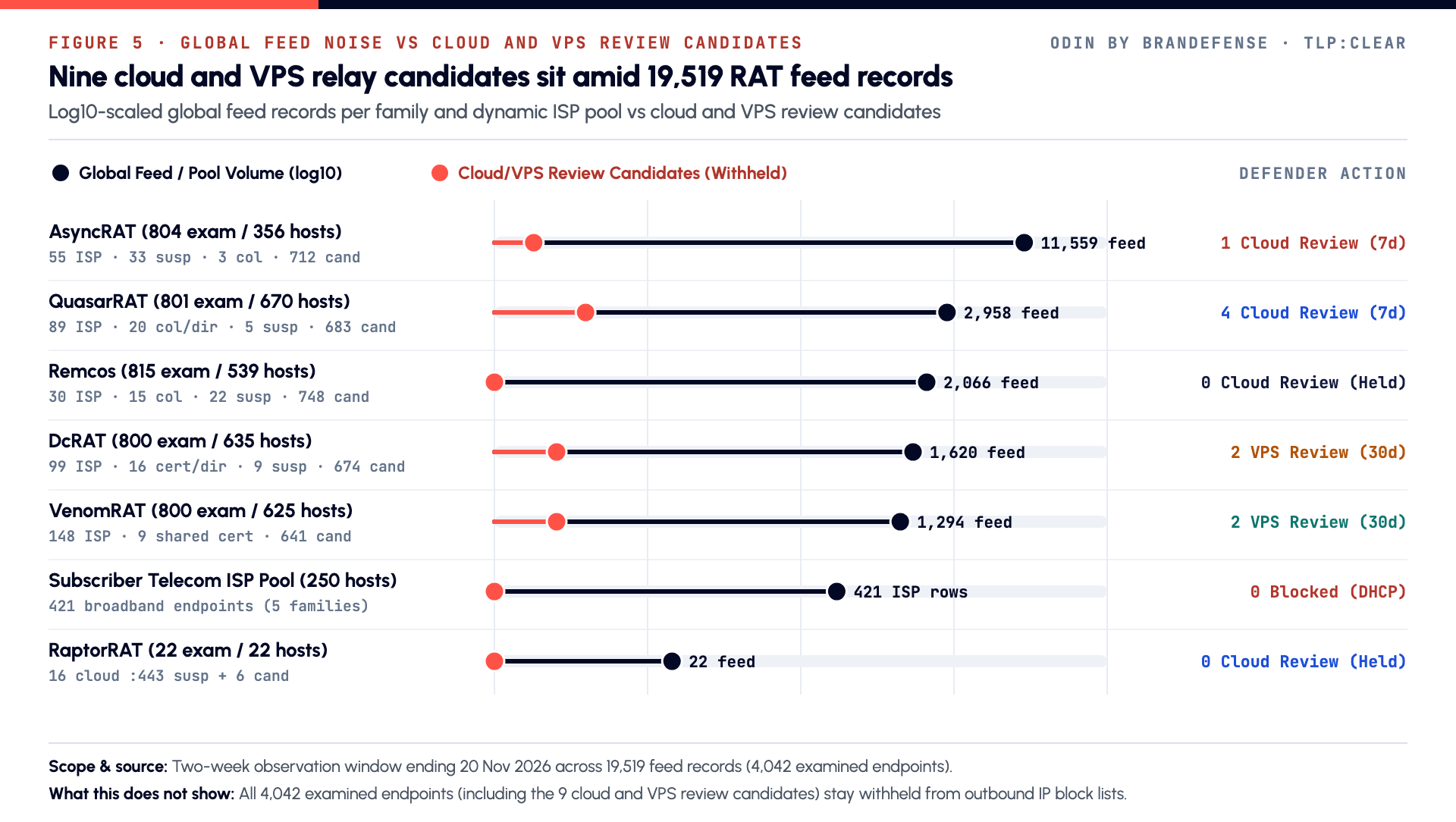
| Group in our analysis | Feed "confirmed" | Feed "suspected" | Feed "candidate" | Total | Share | Action |
|---|---|---|---|---|---|---|
| Dedicated cloud and VPS relay candidates | 9 | 0 | 0 | 9 | 0.22% | Withhold; analyst review (7-day cloud / 30-day VPS) |
| Suspected C2 clusters | 0 | 85 | 0 | 85 | 2.10% | Withhold; hunt with TLS and endpoint logs |
| Dynamic broadband and mobile ISPs | 1 | 2 | 418 | 421 | 10.42% | Withhold; hunt by TLS cert instead |
| Shared-certificate collisions | 0 | 0 | 49 | 49 | 1.21% | Withhold; do not block shared origins |
| Standard service-port collisions | 0 | 3 | 7 | 10 | 0.25% | Withhold; protect SSH, DNS, mail, DBs |
| Co-exposed open HTTP directories | 0 | 0 | 4 | 4 | 0.10% | Withhold; hunt staging pages with SID 9543008 |
| Single-signal candidates | 0 | 0 | 3,464 | 3,464 | 85.70% | Withhold; insufficient evidence to block |
Four other ways to read the 4,042 examined endpoints
- Home routers and expired dynamic DNS domains (421 endpoints on 250 hosts). Operators may forward ports on consumer routers (
CN=ASUS,CN=Vigor Router,CN=OpenWrt) via dynamic DNS. Even when a feed recordsCN=Quasar Server CAon cable broadband, DHCP rotation passes that address to ordinary subscribers. - Normal Windows Server SChannel, WinRM, and RDP services (3,464 candidates). Legitimate
.NETservices, Remote Desktop, andCloudbase-Init WinRM(24 endpoints) use the same Windows SChannel cipher suites (22b22band14d14dJARM prefixes) as.NETRATs. - CDN origins, reverse proxies, and core ports (59 collision endpoints). Reverse proxies (
CloudFlare Origin Certificateon 15,TRAEFIK DEFAULT CERTon 25) and services on ports 22, 53, 143, 465, 1433, 3306, and 6379 trip loose heuristics. - Lab servers and reassigned cloud addresses (4 open-directory hosts and 5 cloud candidates). Open-source AsyncRAT and QuasarRAT builds are used in test labs, and the five cloud candidates (three last listed on 1 August 2026) require seven-day lease review.
7. What Defenders Should Do
Perimeter firewall and network security
- Do not block these addresses from this evidence alone; retain them for analyst review until each has current, independent C2 corroboration. Apply a seven-day re-verification window for the five cloud candidates and a 30-day window for the four VPS candidates.
- Allow outbound public TCP 3389 only from approved Remote Desktop jump hosts (
CORP-RDP-GW-01,CORP-PAM-BASTION-01) and native Windows Remote Desktop binaries (C:WindowsSystem32mstsc.exe).
SOC and endpoint detection
- Deploy the Suricata 7 signatures in Chapter 8 on perimeter and TLS-inspection links so
CN=AsyncRAT Server,CN=Quasar Server CA,CN=DcRat, andCN=VenomRAThandshakes trigger hunts even when dynamic DNS or cloud addresses rotate. - Run the Sentinel KQL query and Sigma rules across Windows endpoint logs. Alert whenever PowerShell, MSBuild, RegAsm, InstallUtil, WScript, or MSHTA connects to external port 3389 or default RAT ports (2404, 4449, 4782, 4783, 6606, 7707, 8808, 8848).
- Scan unpacked
.NETassemblies, quarantine files, and memory dumps with the three YARA rules forSslStreamcertificate-pinning strings,Quasar Server CAclient stubs, and RemcosSETTINGSresources.
Threat intelligence management
- Keep residential broadband and mobile telecom ASNs, shared Cloudflare or Traefik certificates, standalone JARM matches, and standard ports (22, 53, 143, 465, 1433, 3306, 6379) out of automatic firewall block lists.
8. Detection Rules
The full rules are in the Detection rules tab. The Suricata file passes a static syntax lint with zero problems. The rules were not loaded on live Suricata, Sentinel Kusto, Sigma, or YARA engines for this edition, so test and tune them in your environment before turning on automated containment.
| Rule file | What it catches |
|---|---|
odin_commodity_dotnet_rats_asyncrat_quasar_dcrat_venomrat.rules | Suricata 7 (5 rules): default AsyncRAT, Quasar, DcRat, and VenomRAT TLS certificates and co-exposed RAT open directories |
sentinel_commodity_dotnet_rat_c2_and_tls_hunt.kql | Microsoft Sentinel and Defender XDR: traffic to analyst-listed review addresses, non-RDP processes using external TCP 3389, and .NET or script binaries hitting default RAT ports |
sigma_commodity_dotnet_rat_tls_and_port_anomalies.yml | Sigma (2 Windows network rules): non-RDP processes opening external port 3389, and scripting or .NET binaries reaching default RAT ports |
odin_commodity_dotnet_rat_config_and_cert_artifacts.yar | YARA (3 rules): AsyncRAT/DcRAT/VenomRAT SslStream configs, Quasar Quasar Server CA client stubs, and Remcos SETTINGS binaries |
How the Suricata signatures work
| SID | Looks for | Why |
|---|---|---|
| 9543001 | CN=AsyncRAT Server | Default AsyncRAT certificate (hunt) |
| 9543002 | CN=Quasar Server CA | Default QuasarRAT CA subject (hunt) |
| 9543003 | CN=DcRat | Default DcRAT certificate (hunt) |
| 9543004 | CN=VenomRAT | Default VenomRAT certificate (hunt) |
| 9543008 | HTTP 200 directory listing with RAT or .p12 names | Co-exposed RAT staging directory (hunt) |
TLS 1.3 encrypts server certificates on the wire, whereas .NET SslStream on older Windows Server builds often negotiates TLS 1.2 where Suricata reads tls.cert_subject directly. Keep SIDs 9543001 through 9543004 and 9543008 in behavioral-hunt mode where sandboxes run.
How the KQL, Sigma, and YARA rules work
The Sentinel KQL query looks back seven days across DeviceNetworkEvents and DeviceProcessEvents. Connections to the listed IPv4 addresses bypass host exclusions and return an AlertAction label for analyst review; this query does not isolate devices. Unconfirmed traffic alerts when non-RDP binaries open public TCP 3389 outside exact mstsc.exe or msrdcw.exe paths and jump hosts. A companion join flags PowerShell, MSBuild, RegAsm, InstallUtil, WScript, or MSHTA hitting default RAT ports (2404, 4449, 4782, 4783, 6606, 7707, 8808, 8848, 54321).
| Rule | Level / Action | Fires when |
|---|---|---|
Sigma Rule 1 (...0002) | High | Non-RDP Windows binary connects to public TCP 3389 |
Sigma Rule 2 (...0003) | High | Scripting or .NET binary connects to ports 2404, 4449, 4782, 4783, 6606, 7707, 8808, or 8848 |
ODIN_AsyncRAT_DcRAT_VenomRAT_DotNet_Config_Strings | Hunt / Contain | File (<2 MB) holds AsyncRAT/DcRat/VenomRAT, SslStream/ServerCertificate, and Pastebin/Aes256 |
ODIN_QuasarRAT_Client_Certificate_And_Config_Artifact | Hunt / Contain | File (<2 MB) holds Quasar Server CA with two Quasar client or SslStream markers |
ODIN_Remcos_Native_Settings_And_Mutex_Artifact | Hunt / Contain | File (<2 MB) holds BreakingSecurity/Remcos_Mutex_ with SETTINGS, Watchdog, or :2404 |
MITRE ATT&CK mapping
| Tactic | Technique | Study observation | Detection |
|---|---|---|---|
| Resource Development | T1587.003 Digital Certificates | Default self-signed certs on 414 endpoints | SIDs 9543001 to 9543004; YARA |
| Command and Control | T1573.002 Asymmetric Cryptography | .NET SslStream TLS handshakes | SIDs 9543001 to 9543004; KQL |
| Command and Control | T1571 Non-Standard Port | Builder ports (4449, 4782, 6606, 8848) and TCP 3389 camouflage | Sigma (...0002, ...0003); KQL |
| Command and Control | T1095 Non-Application Layer Protocol | Native TCP framing on Remcos 2404 | Sigma (...0003); KQL; YARA |
9. Indicators
The Indicators tab holds 10 published indicators: 10 TLS JARM fingerprints for hunting. There are no published IPv4 addresses or file hashes in this report; the nine feed-labelled cloud and VPS relay addresses from the v1.0 register are withheld pending independent, address-specific C2 corroboration. Five more text-only indicators appear below: the five default .NET builder certificate names seen across 414 examined endpoints.
| Type | Count | Where to use it |
|---|---|---|
| TLS JARM fingerprints | 10 | TLS hunting paired with endpoint process logs; never block on a JARM alone |
| Default builder certificate subjects (text-only) | 5 | Suricata (tls.cert_subject) and Zeek TLS hunting across 414 endpoints |
| Feed-labelled cloud and VPS relay addresses | 9 (withheld) | Withheld from public block lists; retain for analyst review (7-day cloud / 30-day VPS) |
JARM fingerprints to hunt
| JARM fingerprint | Family | Context |
|---|---|---|
22b22b00022b22b22b22b22b22b22bd3b67dd3674d9af9dd91c1955a35d0e9 | AsyncRAT | Windows SChannel TLS fingerprint shared across 231 examined endpoints across five RAT families |
2ad2ad16d2ad2ad0002ad2ad2ad2add3b67dd3674d9af9dd91c1955a35d0e9 | QuasarRAT | Windows SChannel TLS fingerprint shared across 121 examined endpoints |
40d40d40d00040d00042d42d000000e1ea2a807a629b496b664cf07ad7c08d | QuasarRAT | QuasarRAT TLS fingerprint for wire-level hunting paired with endpoint process logs |
14d14d16d14d14d08c14d14d14d14dfd9c9d14e4f4f67f94f0359f8b28f532 | QuasarRAT | Windows SChannel TLS fingerprint shared across 160 examined endpoints across the sample |
29d29d00029d29d00042d42d000000301510f56407964db9434a9bb0d4ee4a | QuasarRAT | QuasarRAT TLS fingerprint shared across two cloud endpoints (hunt with process logs) |
2ad2ad16d2ad2ad00042d42d00000061256d32ed7779c14686ad100544dc8d | DcRAT | TLS fingerprint shared across 75 examined endpoints across the sample |
27d40d40d00040d00042d43d000000d2e61cae37a985f75ecafb81b33ca523 | VenomRAT | TLS fingerprint shared across 29 examined endpoints across the sample |
3fd3fd0003fd3fd21c42d42d000000bdfc58c9a46434368cf60aa440385763 | VenomRAT | TLS fingerprint shared across 50 examined endpoints across the sample |
29d29d00029d29d21c41d41d000000bb69d90480e646db0082ba62fb24e3c8 | AsyncRAT | Shared across 26 suspected port 443 cloud endpoints |
1dd40d40d00040d00042d43d000000831b6af40378e2dd35eeac4e9311926e | RaptorRAT | Shared across all 16 suspected port 443 cloud endpoints |
Certificate subject names (text-only hunt indicators)
| Certificate subject | Family | Observed scope and use |
|---|---|---|
CN=Quasar Server CA | QuasarRAT | Default builder CA across 184 endpoints (2 cloud review candidates, 38 ISP); SID 9543002 |
CN=DcRat | DcRAT | Default builder CN across 98 endpoints (18 ISP); SID 9543003 |
CN=AsyncRAT Server | AsyncRAT | Default builder CN across 80 endpoints (20 ISP); SID 9543001 |
CN=AsyncRAT Server CA | AsyncRAT | Builder root CA variant across 5 candidate endpoints; TLS hunting |
CN=VenomRAT | VenomRAT | Default builder CN across 47 endpoints (13 ISP); SID 9543004 |
We withhold all 4,042 examined endpoint addresses across 2,771 hosts. That total covers 9 cloud and VPS review candidates, 85 suspected C2 endpoints, 421 broadband ISP rows, 63 collision rows, and 3,464 single-signal candidates. Every unverified Windows machine hostname and all seven custom or host-specific certificate subjects on the cloud and VPS review candidates are also withheld.
10. Scope and Limits
- Observation window. Findings cover a two-week observation window ending 20 November 2026. Earlier dates on three QuasarRAT cloud entries (1 August 2026) are upstream feed listing dates, which is one reason those addresses remain on analyst review rather than automatic block lists.
- Feed labels are not attribution. Family labels and upstream "confirmed" tags come from threat feeds. Because our inventory records hosting, port, certificate, and JARM without a live protocol response, beacon, or workbench link, all nine upstream-confirmed cloud and VPS addresses are withheld pending independent C2 corroboration.
- Analytical model. Zero dedicated cloud or VPS relay candidates and zero custom certificates link two different RAT families. Figures 1 and 3 present an analytical model of shared builder patterns and broadband ISP churn rather than a single actor.
- No subscriber routers contacted. Odin by Brandefense did not interact with victim endpoints or consumer routers, and all 250 dynamic telecom hosts remain unpublished.
- Rule validation. Detection rules were checked statically and were not loaded on live engines for this edition.
11. Sources
- MITRE ATT&CK. S1087 AsyncRAT. https://attack.mitre.org/software/S1087/ (verified 20 November 2026)
- MITRE ATT&CK. S0262 QuasarRAT. https://attack.mitre.org/software/S0262/ (verified 20 November 2026)
- MITRE ATT&CK. S0332 Remcos. https://attack.mitre.org/software/S0332/ (verified 20 November 2026)
- MITRE ATT&CK. T1573.002 Encrypted Channel: Asymmetric Cryptography. https://attack.mitre.org/techniques/T1573/002/ (verified 20 November 2026)
- MITRE ATT&CK. T1587.003 Develop Capabilities: Digital Certificates. https://attack.mitre.org/techniques/T1587/003/ (verified 20 November 2026)
- MITRE ATT&CK. T1571 Non-Standard Port. https://attack.mitre.org/techniques/T1571/ (verified 20 November 2026)
- Microsoft Learn. System.Net.Security.SslStream Class. https://learn.microsoft.com/en-us/dotnet/api/system.net.security.sslstream (verified 20 November 2026)
- Salesforce Engineering. JARM: active TLS server fingerprinting. https://github.com/salesforce/jarm (verified 20 November 2026)
- MITRE ATT&CK. T1095 Non-Application Layer Protocol. https://attack.mitre.org/techniques/T1095/ (verified 20 November 2026)
What is…?
Short explanations of the tools and families named in this study.
What is Quasar?
Quasar is an open-source .NET remote access tool for Windows that criminals and some state actors use as a RAT.
More about QuasarRemote access trojanWhat is AsyncRAT?
AsyncRAT is an open-source .NET remote access trojan widely used in commodity malware campaigns.
More about AsyncRATRemote access trojanWhat is VenomRAT?
VenomRAT is a commodity remote access trojan descended from the Quasar and AsyncRAT code bases.
More about VenomRATTechniqueWhat is JARM?
JARM is an open TLS server fingerprinting method from Salesforce. It hashes how a server answers a set of crafted TLS handshakes.
More about JARMFrequently asked questions
Why do .NET RAT builders create broadband block-list collisions?
Four of the six families in our study share a C# .NET codebase built around Microsoft's SslStream TLS library. Those four families are AsyncRAT (804 examined endpoints), QuasarRAT (801), DcRAT (800), and VenomRAT (800). When an operator compiles a client stub without replacing the default keystore, the server presents a hardcoded self-signed certificate name on every TLS 1.2 handshake:
Why do the nine cloud and VPS relay candidates stay on analyst review?
Nine dedicated cloud and VPS endpoints across four families carried a "confirmed" label in the upstream feed. Our inventory records their hosting, ports, TLS certificates, and JARM fingerprints without a live protocol response, beacon, or workbench link. Their IPv4 addresses and host-specific connection details are therefore withheld for analyst review:
Why did Remcos and RaptorRAT produce zero dedicated relay candidates?
Out of 2,066 global Remcos feed records (815 examined endpoints on 539 hosts), none carried an upstream confirmed label or multi-signal C2 corroboration. None of the 22 RaptorRAT records (22 examined endpoints on 22 hosts) met that threshold either.
Are these six RAT families run by one group?
No evidence links them to one operator. None of the nine feed-labelled cloud and VPS relay candidates shares an IPv4 address or custom certificate across two RAT families. Where 77 other hosts carry labels from two or three families, the overlap comes from shared .NET builder certificates or home routers forwarding several ports. We present the six families as an analytical model of shared Windows RAT builder tradecraft so defenders can design cleaner controls.