
1. Executive Summary
In short
Across a historical feed sample through 20 November 2026, Odin by Brandefense reviewed 3,744 endpoints on 2,944 hosts across eight web offense and recon families. We also reviewed one open directory in China reporting 3,001 files. Zero endpoints qualified for IP blocking after setting aside 2,481 dual-use endpoints, 154 PHP 8.5 header collisions, 800 port-3000 BeEF candidates, and two feed-confirmed German ezXSS rows lacking independent HTTP corroboration. Hunt outbound /callback and OAST traffic, and enforce strict admin Content Security Policies.
Out-of-band application security testing (OAST) listeners, blind cross-site scripting (XSS) panels, browser-hooking servers, and web reconnaissance suites create a hard problem for defenders using external attack surface management. Internal security teams and hired penetration testers use PortSwigger Burp Collaborator, DNSLog, reNgine, Burp Suite, ARL-Next, and reconFTW during authorized assessments every day. Attackers use those exact same tools to confirm blind server-side vulnerabilities and map public assets.
Feeding raw threat lists for these eight tool families straight into a firewall blocks authorized scanners, disrupts cloud mail ports, and cuts off ordinary PHP 8.5 websites. We reviewed all 3,744 endpoints and 538 sampled directory entries without running any captured script or contacting any external host.
Dual-use OAST and recon tools call for egress hunting, not IP blocks.
Six commercial and open-source testing tools account for 2,481 of the 3,744 examined endpoints on 1,841 hosts, drawn from 10,131 feed-labelled records. Every dual-use address is withheld from blocklists, including 939 Burp Collaborator listeners and 800 reNgine consoles. With cyber threat intelligence, defenders can prioritize outbound DNS or HTTP calls from production application servers to OAST domains instead of blocking dual-use cloud addresses.
Benign PHP 8.5 response headers triggered 154 false ezXSS alerts.
Among 463 examined ezXSS blind-XSS records on 304 hosts, 154 suspected endpoints across 123 hosts were ordinary PHP 8.5 websites on AWS, Hetzner, and Contabo. Their standard X-Powered-By: PHP/8.5 headers matched an overly broad upstream feed signature. Two feed-confirmed German HTTP servers on M247 Europe SRL and DigitalOcean, LLC also stay withheld until independent HTTP or /callback responses corroborate them.
One open directory in China held ARL-plus and PentAGI files.
Separate from the endpoint feeds, an open HTTP directory in China reports 3,001 exposed files, with 538 entries sampled. The directory held an ARL-plus Docker asset-mapping repository, two PentAGI autonomous penetration-testing trees, Langfuse tracing clients, Fast Reverse Proxy configurations, and JavaScript command-injection proofs of concept. Because the server's owner is not established, its address, port, paths, and file hashes are withheld.
Three Decisions for Leaders
- Hunt blind-XSS
/callbackposts and lock down admin browsers. Inspect egress proxy logs for HTTPPOSTrequests to/callback, and enforce strictContent-Security-Policyscript-srcrules on internal support, ticketing, and administration panels. - Hunt outbound OAST callbacks from production servers instead of blocking dual-use tools. Keep Burp Collaborator, DNSLog, reNgine, Burp Suite, ARL-Next, and reconFTW feeds out of firewall blocklists. Alert whenever Java, PHP, Node.js, Python, or .NET application servers resolve OAST domains.
- Reject banner-only and port-only threat feeds while auditing internal test labs. Remove rules that flag PHP 8.5 version headers or TCP port 3000 without payload proof, and ban unauthenticated HTTP file servers on red-team virtual machines.
The Study in Numbers
| Number | What it is |
|---|---|
| 11,365 | Global feed-labelled records across the eight OAST, blind-XSS, hook, and recon families |
| 3,744 | Endpoints examined by Odin by Brandefense across 2,944 distinct hosts |
| 0 | Confirmed blocklist IPv4 addresses published in the Indicators tab (two feed-confirmed German ezXSS rows withheld) |
| 2,481 | Dual-use OAST and web reconnaissance endpoints across six tool families (all withheld) |
| 154 | Benign PHP 8.5 web endpoints on 123 hosts falsely flagged as suspected ezXSS servers |
| 800 | Single-signal TCP port 3000 BeEF candidates across 800 hosts (0 confirmed) |
| 3,001 / 538 | Reported exposed files and sampled entries on the China open-directory server |
How to use this report.
Security leaders can start with Chapters 1, 6, and 7. Application security, WebOps, and platform engineers should read Chapters 3, 4, and 7. SOC analysts and detection engineers should go directly to Chapters 8 and 9. Threat intelligence analysts will find the full cohort breakdown, the China open-directory analysis, and scope limits in Chapters 2, 5, 6, and 10.
2. Four Functional Groups, One Analytical Model
In short
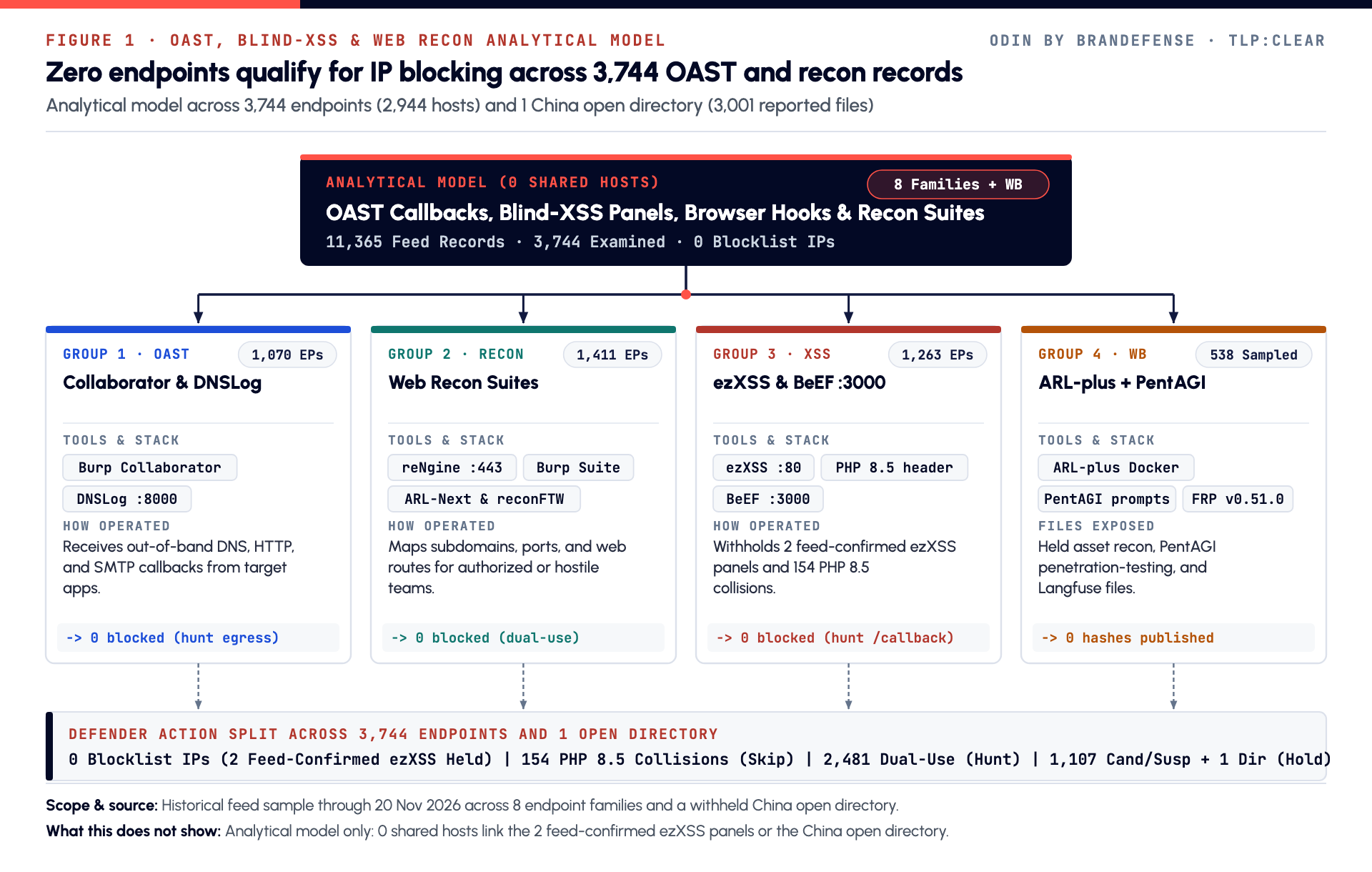
Zero shared IP addresses or certificates connect the two feed-confirmed ezXSS servers or the China open directory to the dual-use cohorts. We present the four groups together as an analytical model of web reconnaissance and callback operations. Hunt outbound callbacks, and do not infer a shared actor.
Web intrusions often combine four building blocks. Reconnaissance suites map the attack surface: subdomains, open ports, and web routes. Out-of-band callback listeners confirm blind server bugs that return no error in the HTTP response.
Blind-XSS and browser-hook panels capture administrator sessions when stored payloads render inside internal tools. Autonomous offense stacks then chain reconnaissance output into automated exploitation attempts.
In raw threat feeds, all four layers arrive mixed together under broad confirmed or suspected tags. Treating every feed entry as hostile breaks authorized penetration tests, blocks cloud mail ports, and blacklists legitimate web servers.
We compared host addresses and TLS certificates across all 2,944 hosts in the 3,744-endpoint set and the China open directory. Zero shared hosts connect the two feed-confirmed ezXSS servers or the China open directory to any other family. Within the dual-use and candidate cohorts, six hosts expose two tools at once.
Four of those six hosts pair ARL-Next with DNSLog, one pairs reconFTW with reNgine, and one pairs Burp Collaborator with an unconfirmed ezXSS candidate. Because no technical indicator links these populations to a single threat actor, we treat them as an analytical model. Figure 1 shows the four groups and how defenders should handle each one.
How the eight families and the open directory compare
Across all eight endpoint families, upstream feeds listed 11,365 global records, including 127 records marked verified by upstream providers. Our review examined 3,744 endpoints on 2,944 distinct hosts (2,950 summed per-family hosts before accounting for six hosts present in two families).
| Family or workspace | Functional role | Global feed records | Feed verified | Countries | Examined records | Hosts | Confirmed (block) | Filtered PHP 8.5 | Withheld (hunt or skip) |
|---|---|---|---|---|---|---|---|---|---|
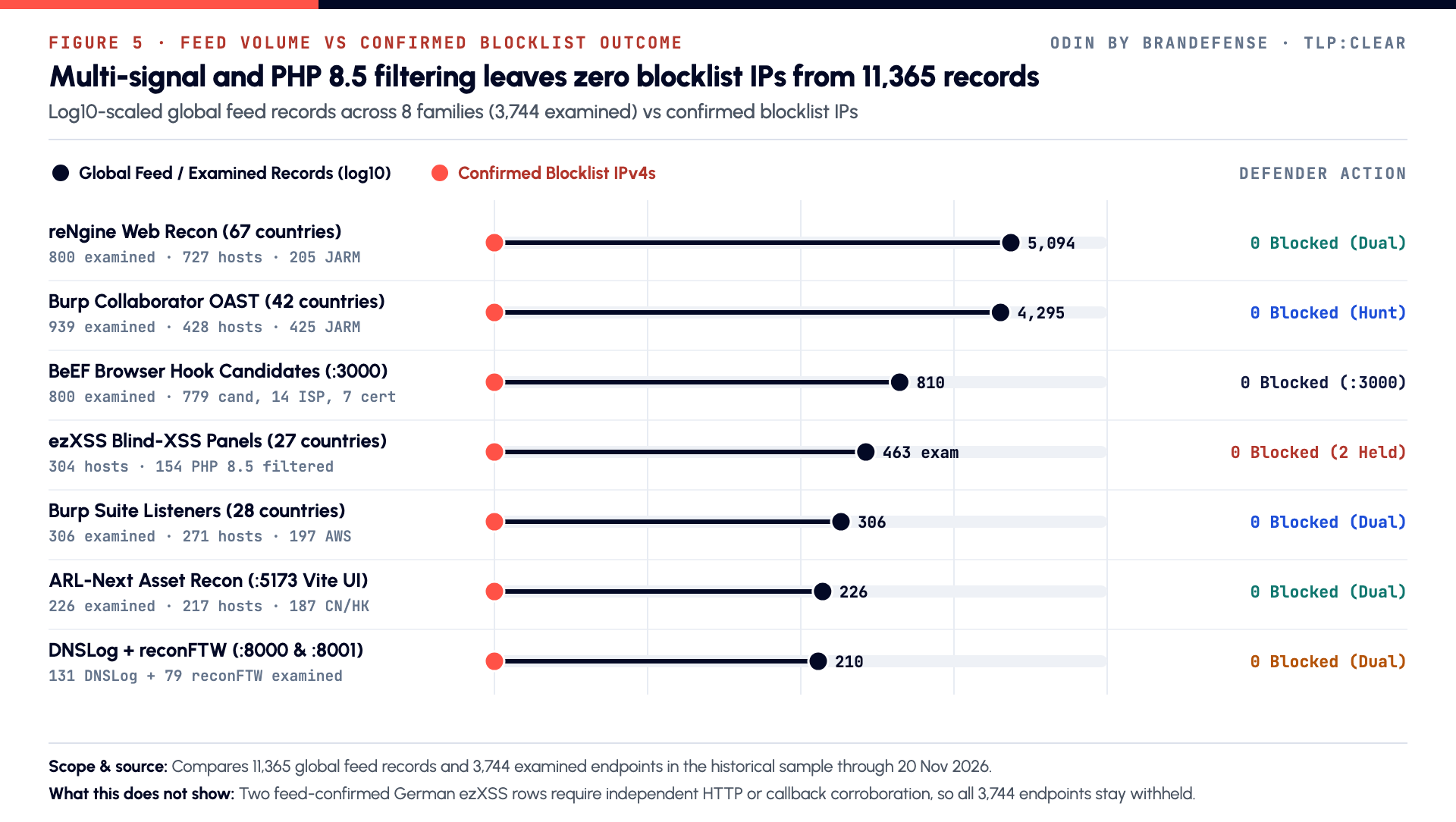
| Burp Collaborator | Commercial OAST listener | 4,295 | 73 | 42 | 939 | 428 | 0 | 0 | 939 |
| reNgine | Open-source web recon | 5,094 | 23 | 67 | 800 | 727 | 0 | 0 | 800 |
| BeEF | Browser hook framework | 810 | 0 | 30 | 800 | 800 | 0 | 0 | 800 |
| ezXSS | Blind-XSS callback panel | 424 | 2 | 27 | 463 | 304 | 0 | 154 | 309 |
| Burp Suite | Commercial web testing suite | 306 | 6 | 28 | 306 | 271 | 0 | 0 | 306 |
| ARL-Next | Asset recon lighthouse | 226 | 20 | 13 | 226 | 217 | 0 | 0 | 226 |
| DNSLog | OAST DNS and HTTP callback | 131 | 3 | 10 | 131 | 124 | 0 | 0 | 131 |
| reconFTW | Automated recon wrapper | 79 | 0 | 10 | 79 | 79 | 0 | 0 | 79 |
| 8-Family Subtotal | Endpoint cohorts | 11,365 | 127 | -- | 3,744 | 2,944 | 0 | 154 | 3,590 |
| ARL-plus and PentAGI | Open directory (China, port withheld) | 3,001 files | 25 listings | 1 | 538 (220 detailed) | 1 | 0 | 0 | 538 |
The 463 examined ezXSS endpoints exceed the 424-record feed snapshot by 39; the supplied evidence does not establish when those rows went offline.
Why upstream status labels cannot drive firewall blocks
Upstream feed statuses across the 3,744 examined endpoints label 137 endpoints confirmed, 274 suspected, and 3,333 candidate. Automating blocks from those upstream labels would misfire immediately for two reasons.
First, 135 of the 137 upstream confirmed endpoints belong to dual-use assessment tools, while the remaining two ezXSS rows lack independent HTTP callback proof. Those 135 dual-use rows comprise 83 Burp Collaborator listeners, 23 reNgine consoles, 20 ARL-Next servers, 6 Burp Suite instances, and 3 DNSLog servers.
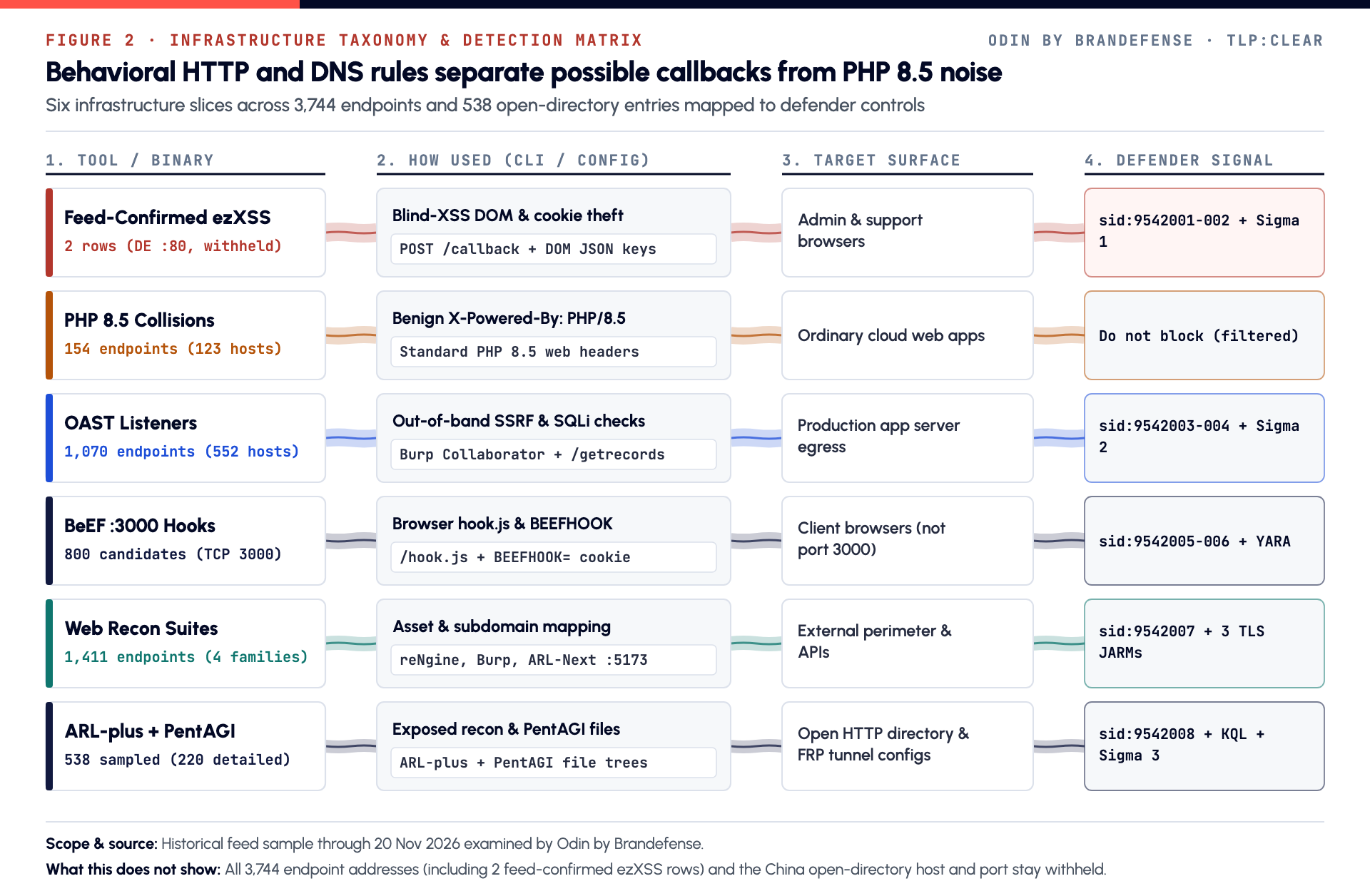
Second, 154 of the 274 upstream suspected endpoints (56.2% overall, and 76.2% of the 202 suspected ezXSS rows) are harmless PHP 8.5 websites. Figure 2 maps each slice of the dataset to the specific network, DNS, and host detections that replace blind IP blocking.
3. Dual-Use OAST Listeners and Web Reconnaissance Suites
In short
Six dual-use testing families account for 2,481 examined endpoints across 1,841 hosts, led by Burp Collaborator (939 endpoints) and reNgine (800 endpoints). Because authorized testers share this infrastructure, defenders should hunt outbound callbacks from production servers instead of blocking dual-use addresses.
Whether an OAST or web reconnaissance server represents a threat depends on which side of your perimeter starts the connection. Inbound requests from reNgine or Burp Suite look like everyday internet scanning.
An outbound DNS query or HTTP request from an internal Java, PHP, Python, or Node.js application server to Burp Collaborator or DNSLog is completely different. Production servers have no business reason to contact OAST listeners. An outbound hit points to active blind server-side request forgery (SSRF), blind SQL injection, XML external entity (XXE), or remote code execution testing (T1071.001).
Self-hosted Burp Collaborator (939 endpoints) and DNSLog (131 endpoints)
PortSwigger's Burp Collaborator lets testers run private callback servers that capture DNS lookups, HTTP/HTTPS requests, and SMTP mail interactions on one host. Across 4,295 global feed records in 42 countries, we examined 939 Burp Collaborator endpoints on 428 hosts, an average of 2.19 open ports per host.
The port breakdown reflects Collaborator's multi-protocol listener design:
- Web callback ports (811 endpoints). HTTPS port 443 (394 endpoints, 42.0%) and HTTP port 80 (387 endpoints, 41.2%) dominate. Docker high-port mappings on 33443 (15 endpoints) and 3380 (15 endpoints) follow, alongside 8080 (11) and 8443 (10).
- Mail submission ports (61 endpoints). Thirty-four endpoints listen on SMTPS port 465 and 27 listen on SMTP submission port 587. Blocking port-based Collaborator feeds without protocol checks risks interfering with mail-submission workflows.
- Western cloud concentration. Hosting centers on commercial cloud networks used by enterprise AppSec teams: Amazon.com, Inc. (275 endpoints, 29.3%), DigitalOcean, LLC (181, 19.3%), and OVH SAS (86, 9.2%). Microsoft Corporation (52, 5.5%), Hetzner Online GmbH (39), and Akenes SA (32) follow. The United States (338), Germany (153), the United Kingdom (67), and France (66) lead geographically.
- Java JSSE TLS fingerprint. Across TLS-enabled ports, 425 Burp Collaborator endpoints (45.3%) share one JARM fingerprint (
28d28d28d00028d00042d42d00042de0d120da90d5910c5de2af43b74a6bd8). That JARM comes from Collaborator's embedded Java JSSE TLS stack and appears on zero other families in our 3,744-endpoint set. Another 217 Collaborator endpoints behind Nginx or OpenSSL reverse proxies share a second JARM (2ad2ad16d2ad2ad00042d42d00042ddb04deffa1705e2edc44cae1ed24a4da). Direct HTTP responses also carry theServer: Burp Collaboratorheader.
Open-source DNSLog servers (131 endpoints on 124 hosts across 10 countries) show a different regional and port profile. Nearly seven in ten sit in China (60) and Hong Kong (29), followed by the United States (22) and Singapore (8). Tencent (38 combined) and Alibaba (30 combined) host the largest shares.
Over three-fifths (79 of 131, 60.3%) expose the default Python/Django DNSLog-Platform web interface on TCP port 8000, where users poll /getrecords to view captured DNS queries. Four hosts in China and the United States run DNSLog alongside ARL-Next on the same server.
Four web reconnaissance suites (1,411 endpoints)
The four web reconnaissance and vulnerability-scanning families span 1,411 examined endpoints (5,705 global feed records) and split cleanly by default management port and cloud footprint:
| Recon tool | Global feed | Examined / hosts | Main TCP ports | Leading countries & providers | Notable TLS or cert trait |
|---|---|---|---|---|---|
| reNgine | 5,094 | 800 / 727 | 443 (690), 8000 (47), 8082 (18), 8443 (18) | US (246), DE (128), FR (70) · Contabo (157), DigitalOcean (133), AWS (46) | 205 share exclusive Caddy/Nginx JARM; 35 use TRAEFIK DEFAULT CERT |
| Burp Suite | 306 | 306 / 271 | 80 (106), 443 (94), 8080 (53), 8081 (13) | IE (135), US (77), KR (14) · AWS (197, 64.4%), Korea Telecom (6), SK Broadband (6) | 37 share one exclusive Burp TLS JARM |
| ARL-Next | 226 | 226 / 217 | 5173 (175, 77.4%), 443 (15), 80 (8), 5003 (5) | CN (149), HK (38), US (18) · Tencent (105), Alibaba (33), LUCIDACLOUD (16) | Vite UI on 5173; 24 present CN=localhost |
| reconFTW | 79 | 79 / 79 | 8001 (78, 98.7%), 8080 (1) | US (27), DE (17), IN (9) · DigitalOcean (45, 57.0%), Contabo (7), Akamai (6) | One German host also runs reNgine on 443 and 8000 |
All 2,481 endpoints across these six dual-use families remain withheld. Blocking AWS Ireland scanner nodes, DigitalOcean recon droplets, or Korean telecom addresses would create constant operational friction without stopping an attacker from spinning up a new VPS in minutes.
4. Feed-Confirmed ezXSS Rows, 154 PHP 8.5 Collisions, and BeEF on Port 3000
In short
Across 463 ezXSS records and 800 BeEF candidates, two feed-confirmed German ezXSS HTTP servers stay withheld pending independent HTTP or callback corroboration. Over three-quarters of suspected ezXSS feed records (154 of 202) were false positives on ordinary PHP 8.5 websites. Hunt outbound POST /callback requests and BEEFHOOK cookies, and enforce strict admin Content Security Policies.
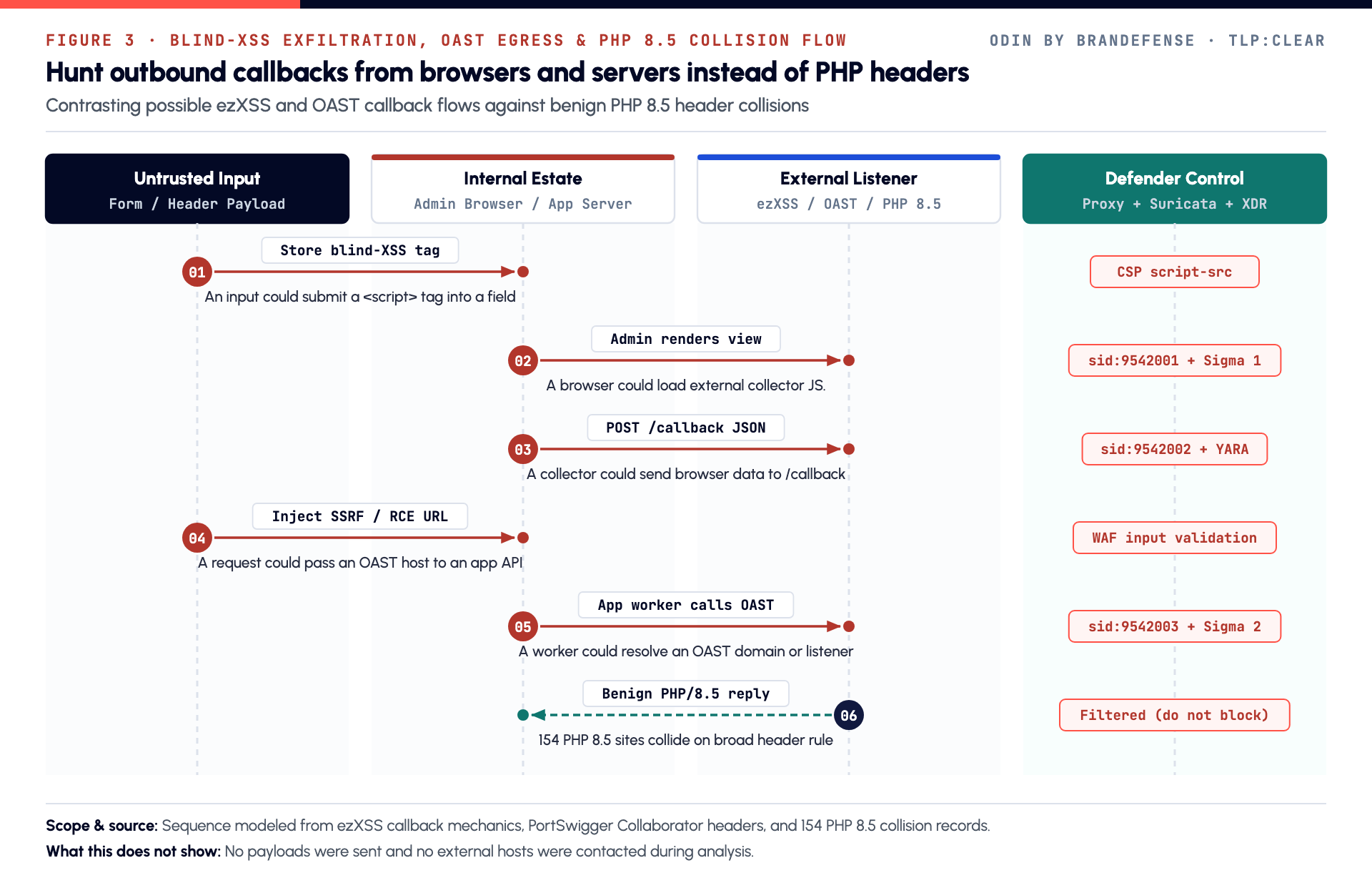
Unlike server-side OAST tools, blind-XSS (ezXSS) and browser-hooking (BeEF) frameworks target human staff inside back-office web applications (T1059.007). An attacker plants an HTML <script> tag inside a support ticket, contact form, User-Agent string, or order comment.
An internal administrator or support analyst later views that record inside an unhardened dashboard. The browser then loads the external script and posts session data back to the attacker's listener. Figure 3 contrasts possible blind-XSS and server OAST callbacks against the PHP 8.5 response-header collision.
Two feed-confirmed ezXSS rows in Germany withheld pending corroboration
Across 463 examined ezXSS endpoints on 304 hosts in 27 countries, two feed-confirmed rows require independent HTTP or callback corroboration before either address can be published or blocked.
| Feed-confirmed row | Location and provider | Protocol | Disposition |
|---|---|---|---|
| German ezXSS row 1 (address withheld) | Germany, M247 Europe SRL | Plain HTTP (:80) | Withhold IP; hunt outbound POST /callback |
| German ezXSS row 2 (address withheld) | Germany, DigitalOcean, LLC | Plain HTTP (:80) | Withhold IP; hunt outbound POST /callback |
Both servers were observed on 13 November 2026 on TCP port 80. Because the record carries no independent HTTP body or callback capture, both IPv4 addresses and their certificate domains stay withheld.
When an ezXSS collector script runs in a browser, it posts JSON to /callback. The payload can contain uri, cookies, referer, user-agent, origin, localstorage, sessionstorage, dom, and optional html2canvas screenshots. Inspecting egress proxy traffic for that JSON callback structure catches blind-XSS exfiltration even when an operator rotates to a new IP address.
How PHP 8.5 response headers caused 154 false ezXSS alerts
Examining the 202 ezXSS endpoints marked suspected by upstream feeds uncovered a major false-positive trap. Exactly 154 endpoints across 123 hosts were benign PHP 8.5 websites rather than blind-XSS panels. They made up 76.2% of suspected ezXSS rows and 33.3% of all 463 examined ezXSS rows.
The ezXSS application is written in PHP. When PHP's expose_php configuration directive is left enabled (expose_php = On), web responses include an X-Powered-By: PHP/... header alongside standard PHPSESSID cookies and web security headers. As cloud administrators deployed PHP 8.5 (X-Powered-By: PHP/8.5.x), an overly broad upstream feed signature matched that response-header combination. It labelled ordinary websites as suspected ezXSS servers without checking for /callback or /manage routes.
The hosting profile of those 154 collision endpoints confirms they are mainstream cloud web applications:
- Cloud and port distribution. Ninety-eight of the 154 collision endpoints (63.6%) sit on Amazon.com, Inc., followed by Hetzner Online GmbH (17), Contabo GmbH (13), Alibaba (7), and Contabo Inc. (4). Ninety listen on HTTP port 80, 46 on HTTPS port 443, and 8 on port 8080. Leading countries are the United States (57), Germany (33), South Korea (14), India (11), Australia (9), and China (8).
- Generic web TLS stacks. Their top TLS JARM fingerprints (
29d29d00029d29d00041d41d00041dcb3f8752a2d70d1dbf446fc46ab5df96on 11 endpoints and27d40d40d00040d00042d43d000000d2e61cae37a985f75ecafb81b33ca523on 10 endpoints) are standard cloud reverse-proxy fingerprints shared across unrelated web services.
Pushing upstream suspected ezXSS records into a web proxy blocklist would have cut off 123 legitimate PHP 8.5 websites. All 154 PHP 8.5 collision endpoints are suppressed. The remaining 309 ezXSS records also stay withheld. They include 2 feed-confirmed German HTTP rows, 48 suspected rows on 37 hosts, 251 candidates on 147 hosts, 4 Magyar Telekom ISP rows, and 4 shared-certificate collisions.
Why all 800 BeEF port-3000 candidates are withheld
We examined 800 BeEF (Browser Exploitation Framework) endpoints across 800 hosts in 30 countries, drawn from 810 global feed records with 0 feed-verified rows. Every examined BeEF endpoint sits on TCP port 3000 with candidate status:
| Slice | Endpoints | Hosts | Ports | Key hosting context | Action |
|---|---|---|---|---|---|
| ezXSS feed-confirmed HTTP rows | 2 | 2 | 80 (2) | Germany: M247 Europe SRL (1), DigitalOcean (1) | Withhold IP; hunt /callback |
| ezXSS PHP 8.5 header collision | 154 | 123 | 80 (90), 443 (46), 8080 (8) | AWS (98), Hetzner (17), Contabo (13) | Do not block |
| ezXSS suspected and candidates | 307 | 184 | 443 (155), 80 (111), 8443 (8) | 48 suspected, 251 candidate, 4 Magyar Telekom ISP, 4 shared cert | Withhold IP; hunt /callback |
| BeEF port-3000 candidates | 779 | 779 | 3000 (779) | CN (352), US (154), DE (69) · Tencent (168), Alibaba (141), AWS (114) | Withhold IP; hunt BEEFHOOK |
| BeEF telecom ISP and shared cert | 21 | 21 | 3000 (21) | 14 telecom ISP (China Telecom, China Unicom, Free SAS) + 7 shared cert | Withhold IP |
BeEF listens on TCP port 3000 by default (/hook.js and /ui/authentication). However, TCP 3000 is also the default port for Grafana dashboards, Metabase, Gitea, Node.js, Next.js, and Ruby on Rails servers. Certificate subjects on the 800 port-3000 hosts include TRAEFIK DEFAULT CERT (8), localhost (5), and CloudFlare Origin Certificate (4). Instead of blocking port-3000 addresses, defenders should detect BeEF by its BEEFHOOK and beef.init strings in HTTP responses and the BEEFHOOK= session cookie in outbound requests.
5. Asset Recon and PentAGI Files on a China Open Directory
In short
An open HTTP directory in China reports 3,001 exposed files, with 538 sampled and 220 exported in detail. It held an ARL-plus Docker repository, two PentAGI autonomous penetration-testing directory trees, Langfuse tracing code, and Fast Reverse Proxy tunnel configurations. Audit red-team test servers for unauthenticated HTTP directories and unmanaged reverse-proxy tunnels.
Endpoint feeds show individual ARL-Next or reNgine login pages from the outside. Separately, an open HTTP directory observed in China held files from several security tools. That server held files associated with asset reconnaissance and autonomous penetration testing; the evidence does not establish an operator or show that the tools ran.
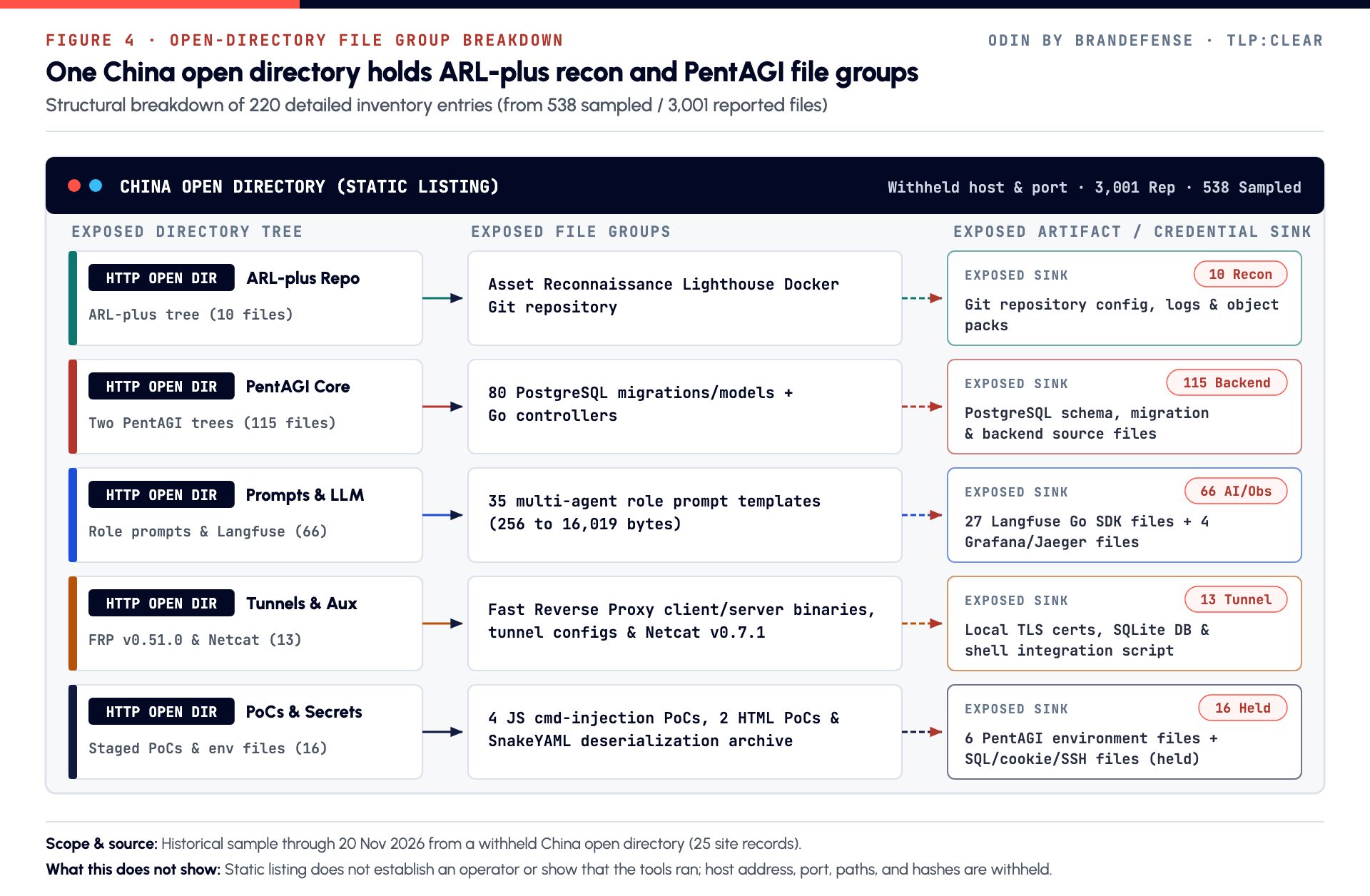
Across 25 directory listings, the server reported 3,001 exposed files, with 538 entries sampled through 20 November 2026 and 220 entries exported in detail. Eighteen detailed repository entries carry last-seen dates of 16 August 2026, while the remaining detailed entries carry last-seen dates from 18 to 20 November 2026. Figure 4 breaks down the 220 detailed entries across five file groups.
Seven file groups inside the 220 detailed entries
Across the 220 detailed entries, there are 81 SQL files, 42 Go source files, 35 prompt templates, and 21 extensionless files. Another 25 entries include 7 HTML pages, 4 JavaScript files, 4 Markdown documents, 4 configuration files, and 6 Git pack files. The remaining 16 entries comprise 12 archive, certificate, or database files and 4 other text files:
| File group in open directory | Detailed entries | Share | Published hashes | What the directory exposes |
|---|---|---|---|---|
| PentAGI backend, SQL, and Git source | 115 | 52.3% | 0 | 80 PostgreSQL migrations and models across two PentAGI directory trees, Go controllers, a 285 KB Go documentation file, and 5 search HTML fixtures |
| PentAGI agent prompt templates | 35 | 15.9% | 0 | Multi-agent role prompt templates ranging from 256 to 16,019 bytes |
| Langfuse, Grafana, and Jaeger tracing | 31 | 14.1% | 0 | 27 Langfuse Go SDK client files plus 4 Grafana and Jaeger observability files |
| Tunneling, proxy, and shell tools | 13 | 5.9% | 0 | Fast Reverse Proxy v0.51.0 client and server binaries and configuration files, Netcat v0.7.1, a shell integration script, and local TLS and SQLite files |
| ARL-plus Docker recon repository | 10 | 4.5% | 0 | ARL-plus Docker Git repository configuration, branch logs, and object packs |
| Environment, database, cookie, and SSH files | 9 | 4.1% | 0 | Six PentAGI environment configuration files, one SQL dump, one cookie text file, and an SSH host-key backup |
| Exploit PoCs and deserialization archive | 7 | 3.2% | 0 | Four JavaScript command-injection PoC scripts, two HTML PoC pages, and a SnakeYAML Java deserialization archive |
What the ARL-plus, PentAGI, Langfuse, and FRP file groups contain
The directory held files from three categories of security and tunneling software, without showing whether they were run together:
- External discovery (
ARL-plus). CommunityARL-plusDocker stacks automate subdomain enumeration, port scanning, service fingerprinting, and vulnerability template checks. - Autonomous penetration testing (
PentAGIandLangfuse). Two PentAGI directory trees (59 and 128 entries) hold Go backend and PostgreSQL schema files. They also expose 35 agent role prompt templates, with the five largest measuring 16,019, 12,544, 11,676, 11,133, and 10,486 bytes. Twenty-seven Langfuse client files provide LLM observability support. - Tunnels and manual PoCs (
FRPandSnakeYAML). Fast Reverse Proxy v0.51.0 binaries and configuration files sit beside the repository trees. The directory also holds a SnakeYAML archive for Java deserialization testing and four JavaScript command-injection PoCs.
Starting an unauthenticated HTTP server over that workspace exposed six environment configuration files, local TLS private keys, a SQLite database, and cookie files at once. An authorized red team or security researcher can make that exact configuration mistake on a cloud test machine. We therefore withhold the server's address, port, directory paths, file names, and file hashes.
6. Feed Volume Against Confirmed Infrastructure
In short
Zero of the 3,744 examined endpoints qualify for an IP blocklist once single-signal feed rows are withheld. Keeping dual-use OAST and recon tools, 154 PHP 8.5 header collisions, and 800 port-3000 candidates off blocklists prevents self-inflicted outages. Replace static IP feeds with outbound /callback, BEEFHOOK, and OAST domain hunting.
A threat feed is only as useful as the false positives it removes. Figure 5 compares the global feed and examined volume of each family against the zero confirmed blocklist IPv4 addresses that remained after multi-signal filtering.
Four plain analytical boundaries govern how defenders should read these findings:
- Separate populations, not one actor. Zero shared IP addresses, certificates, or domains connect the two feed-confirmed German ezXSS servers, the China open directory, and the dual-use cohorts. Grouping them is an analytical model for defenders, not an attribution claim.
- PHP 8.5 headers are not blind-XSS proof. Over three-quarters of upstream
suspectedezXSS hits (154 of 202) were ordinary PHP 8.5 websites on AWS, Hetzner, and Contabo. Never block anezXSSfeed entry unless payload or/callbackbehavior confirms it. - Dual-use scanners and shared JARMs must stay hunt-only. All 2,481 endpoints across Burp Collaborator, reNgine, Burp Suite, ARL-Next, DNSLog, and reconFTW are dual-use security tools. Generic reverse-proxy JARMs also cross families: one Go/proxy JARM (
27d40d40d00040d00042d43d000000d2e61cae37a985f75ecafb81b33ca523) appears on 62 endpoints across six families, including 10 PHP 8.5 collision sites. Traefik's default JARM (3fd3fd00000000000043d3fd3fd43d79451d8c63b099acafdbabb24551d0e6) appears on 56 endpoints across seven families. Even the three single-family JARMs for Burp Collaborator, reNgine, and Burp Suite identify software stacks rather than malicious intent, so they are strictly for hunting. - Staged workbench files do not confirm target breaches. Nothing in the China open-directory listing shows whether
ARL-plus,PentAGI, the SnakeYAML deserialization archive, or the JavaScript PoC scripts were used against external victims or inside an authorized lab.
7. What Defenders Should Do
Network and web proxy
- Withhold single-signal ezXSS feed addresses from firewall blocklists until independent HTTP response or callback evidence corroborates them.
- Search the last 30 days of web proxy logs for any internal workstation that sent HTTP
POSTrequests to/callbackcontaininglocalstorage,sessionstorage, andcookies.
Internal admin panels and web applications
- Deploy a strict
Content-Security-Policy(script-src 'self'or cryptographic nonces, plus tightconnect-srcrules) andHttpOnlysession cookies across internal dashboards and support portals. That prevents stored blind-XSS payloads from loading external scripts or reading session cookies. - Set
expose_php = Offin productionphp.inifiles to stop emittingX-Powered-By: PHP/8.5.xheaders, and strip header-onlyezXSSor port-only :3000BeEFfeeds from automated firewall blocklists.
Production server egress
- Restrict default outbound internet DNS and HTTP access from production application server tiers (
Java,PHP-FPM,Node.js,Python,.NET), and alert whenever a server worker resolves.oastify[.]com,.burpcollaborator[.]net,.dnslog[.]cn, or.ceye[.]io.
Red-team and security testing infrastructure
- Audit internal security-testing virtual machines for
Directory listing for /pages and unmanagedfrpcreverse-proxy tunnels. Banpython3 -m http.serverbound to0.0.0.0in folders holding environment configuration or Langfuse keys, and store agent API keys in short-lived vaults.
8. Detection Rules
The full rules are in the Detection rules tab. All four published rule files pass static syntax checks; they were not loaded on live Suricata, Sentinel, Sigma, or YARA engines on our build host. Test and tune them in your own environment before enabling inline blocking or automated isolation.
| Rule file | What it catches |
|---|---|
odin_burp_collaborator_ezxss_beef_and_arl_recon.rules | Suricata 7: eight signatures covering ezXSS collector script delivery, /callback JSON exfiltration, Server: Burp Collaborator headers, DNSLog /getrecords polling, BeEF hook.js and BEEFHOOK= traffic, ARL /api/task requests, and Python SimpleHTTP open-directory listings |
sentinel_oast_ezxss_beef_and_recon_hunt.kql | Microsoft Sentinel and Defender XDR: URL-only hunt for outbound /callback connections on port 80, application-server processes contacting OAST domains or ports 3380/33443, and unapproved http.server or frpc process launches |
sigma_oast_callback_ezxss_and_recon_workbench.yml | Sigma (3 rules): web proxy outbound HTTP POST requests to ezXSS /callback endpoints, Linux application workers resolving OAST callback domains, and Linux http.server or frpc execution outside approved lab hosts |
odin_ezxss_beef_and_pentagi_arl_artifacts.yar | YARA (4 rules): ezXSS DOM collector payloads, BeEF hook.js client scripts, PentAGI and Langfuse configuration files, and captured Python SimpleHTTP open-directory listings or FRP tunnel configuration files |
How the Suricata signatures work
| SID | Looks for | Why |
|---|---|---|
| 9542001 | Inbound HTTP 200 response body containing /callback, localstorage, and sessionstorage | Catches ezXSS blind-XSS collector script delivery to internal browsers |
| 9542002 | Outbound POST to /callback carrying localstorage, sessionstorage, and cookies | Catches ezXSS blind-XSS DOM and cookie exfiltration to any external host |
| 9542003 | Inbound HTTP response containing Server: Burp Collaborator | Hunt signal for internal hosts interacting with a self-hosted Burp Collaborator server |
| 9542004 | Outbound GET to /getrecords with a Cookie: header | Hunt signal for DNSLog callback polling from internal hosts |
| 9542005 | Inbound HTTP 200 response body containing BEEFHOOK and beef.init | Catches BeEF browser-hook JavaScript delivery regardless of server port |
| 9542006 | Outbound HTTP request carrying Cookie: BEEFHOOK= | Catches command polling from a browser already hooked by BeEF |
| 9542007 | Inbound POST to /api/task with a Token: header and target field | Hunt signal for unplanned ARL or ARL-Next scan task submissions |
| 9542008 | HTTP 200 response carrying Server: SimpleHTTP/ and Directory listing for / | Flags exposed Python http.server open-directory listings during perimeter or lab scans |
Keep SIDs 9542003, 9542004, and 9542007 in alert-only mode where internal AppSec or red-team scanners operate.
How the endpoint, DNS, and file rules work
The Sentinel KQL query looks back seven days across DeviceNetworkEvents and DeviceProcessEvents. Because DeviceNetworkEvents.RemoteUrl records only a URL or domain, the first branch runs a URL-only hunt (HUNT_POSSIBLE_CALLBACK_URL). It matches outbound TCP port 80 connections whose RemoteUrl contains /callback, with no host exclusions. Confirming HTTP POST methods and JSON body keys (localstorage, sessionstorage, and cookies) requires web proxy telemetry, covered by Suricata SID 9542002 and Sigma Rule 1.
Second, it hunts java, php-fpm, node, python3, dotnet, w3wp.exe, nginx, httpd, or apache2 processes reaching OAST domains (oastify[.]com, burpcollaborator[.]net, dnslog[.]cn, ceye[.]io). That same query branch also matches /getrecords, BEEFHOOK, or Collaborator container ports 3380 and 33443. Third, it flags python3 -m http.server or frpc/frps runs (server_addr, remote_port, vhost_http_port) outside exact hostnames in ApprovedAppSecHosts and ApprovedLabHosts.
In Sigma, Rule 1 (high) alerts on web proxy outbound HTTP POST requests to /callback carrying localstorage, sessionstorage, and cookies with no exclusions. Rule 2 (high) watches Linux DNS logs for java, php-fpm, node, python3, dotnet, or ruby resolving .oastify[.]com, .burpcollaborator[.]net, .dnslog[.]cn, or .ceye[.]io outside named AppSec scanner hosts. Rule 3 (high) flags Linux http.server (http.server, SimpleHTTPServer) or frpc/frps (server_addr, remote_port) processes outside a named lab host.
| YARA rule | Fires when |
|---|---|
ODIN_ezXSS_Blind_XSS_Collector_Payload | A file under 256 KB combines /callback, localstorage, and sessionstorage with document.cookie, html2canvas, or ezXSS |
ODIN_BeEF_Browser_Hook_Script | A script under 512 KB combines BEEFHOOK and beef.init with beef[.]net or beef.browser |
ODIN_PentAGI_Autonomous_Offense_Prompt_Bundle | A file under 128 KB combines PENTAGI with Langfuse observability configuration keys (LANGFUSE_SECRET_KEY, LANGFUSE_PUBLIC_KEY, or LANGFUSE_BASE_URL) |
ODIN_Exposed_ARL_PentAGI_OpenDir_Listing | A file under 512 KB matches Python http.server Directory listing for / HTML tags or an FRP tunnel configuration block ([common], server_addr, and remote_port) |
MITRE ATT&CK mapping
| Tactic | Technique | How it appears in this study | Detection coverage |
|---|---|---|---|
| Execution | T1059.007 Command and Scripting Interpreter: JavaScript | ezXSS blind-XSS collectors and BeEF hook.js running in browsers | SIDs 9542001, 9542002, 9542005, 9542006; YARA rules 1 and 2 |
| Command and Control | T1071.001 Application Layer Protocol: Web Protocols | Blind-XSS /callback posts and application-server OAST callbacks | SIDs 9542002, 9542003, 9542004; KQL; Sigma rules 1 and 2 |
| Reconnaissance | T1595.002 Active Scanning: Vulnerability Scanning | reNgine, Burp Suite, ARL-Next (:5173//api/task), and reconFTW (:8001) | SID 9542007; 3 hunt-only TLS JARM fingerprints |
| Resource Development | T1583.003 Acquire Infrastructure: Virtual Private Server | China open directory holding ARL-plus, PentAGI, and Fast Reverse Proxy v0.51.0 files | SID 9542008; KQL; Sigma rule 3; YARA rules 3 and 4 |
| Credential Access | T1552.001 Unsecured Credentials: Credentials In Files | Six PentAGI environment configuration files, Langfuse keys, local TLS keys, and cookies exposed over HTTP | SID 9542008; Sigma rule 3; YARA rules 3 and 4 |
9. Indicators
The Indicators tab holds 0 published indicators: 0 IPv4 addresses and 0 file hashes. The two feed-confirmed German ezXSS rows from the register stay withheld until independent HTTP response or callback evidence corroborates them. Eleven hunting patterns appear in this report only: three dual-use TLS JARM fingerprints, six HTTP and cookie patterns, and two lab-exposure patterns. All 3,744 endpoint addresses, the China open-directory server address and port, and all workbench file digests are withheld.
| Type | Count | Where to use it |
|---|---|---|
| Confirmed blocklist IPv4 addresses | 0 | Zero endpoint IPv4 addresses are published in the Indicators tab; two feed-confirmed German ezXSS rows stay withheld pending independent HTTP or callback corroboration |
| File hashes (SHA-256) | 0 | Zero workbench file hashes are published because host ownership is not established |
| Dual-use TLS JARM fingerprints | 3 | Listed below for TLS hunting only; never block an address on JARM alone |
| HTTP, cookie, and lab-exposure patterns | 8 | Listed below for proxy, IDS, and internal lab-hygiene hunting |
Dual-use TLS JARM fingerprints to hunt (report only)
| JARM fingerprint | Tool stack | Observed count and hunting note |
|---|---|---|
28d28d28d00028d00042d42d00042de0d120da90d5910c5de2af43b74a6bd8 | Burp Collaborator | 425 endpoints (exclusive Java JSSE stack); hunt outbound server connections only |
2ad2ad0002ad2ad0002ad2ad2ad2ada5fc7ec76b7ed0b839211317d3844486 | reNgine | 205 endpoints (default Caddy/Nginx TLS stack); hunt only, never block |
29d29d00029d29d00029d29d29d29da8f16e8f0a21d89b06fef5080cbd1b2a | Burp Suite | 37 endpoints (exclusive Burp TLS stack); hunt only, never block |
Behavioral HTTP and workspace patterns (report only)
| Pattern | Family | Where to hunt |
|---|---|---|
Server: Burp Collaborator | Burp Collaborator | Egress HTTP response headers from production server subnets (SID 9542003) |
POST /callback with cookies, localstorage, sessionstorage | ezXSS | Corporate browser web proxy logs and egress IDS (SIDs 9542001 and 9542002) |
/hook.js (BEEFHOOK + beef.init) and Cookie: BEEFHOOK= | BeEF | Browser web proxy logs and egress IDS (SIDs 9542005 and 9542006) |
/ui/authentication on TCP 3000 | BeEF | External attack-surface audits separating BeEF from Grafana or Node.js |
GET /getrecords | DNSLog | Egress HTTP proxy logs (SID 9542004) |
POST /api/task/ with Token: header | ARL / ARL-Next | Internal and perimeter web logs (SID 9542007) |
Server: SimpleHTTP/ with Directory listing for / | Python http.server | Open-directory scans and red-team host audits (SID 9542008) |
python3 -m http.server or frpc with server_addr | Lab exposure and FRP | Endpoint process audits on security-testing hosts (KQL and Sigma rule 3) |
10. Scope and Limits
This report covers 3,744 endpoints drawn from 11,365 global feed records through 20 November 2026. Of those endpoints, 2,081 were last seen before 7 November 2026. It also covers one open HTTP directory in China reporting 3,001 files, with 538 sampled and 220 detailed entries observed in August and November 2026.
Our analysis is strictly passive and static. We did not run any script from the open directory, replay any exposed environment credential, or send traffic to any external target or callback domain.
Nothing in the dataset confirms whether any downstream organization was breached through the two feed-confirmed ezXSS servers, the other endpoints, or the China open directory. Because dual-use scanners, single-signal feed rows, PHP 8.5 collision sites, and the China open-directory server lack corroborated malicious ownership, all addresses stay withheld.
11. Sources
- PortSwigger Documentation, Burp Collaborator Overview and Private Collaborator Server Architecture: portswigger.net/burp/documentation/collaborator (verified on 21 November 2026).
- PortSwigger Web Security Academy, Blind SSRF Vulnerabilities and Out-of-Band (OAST) Detection Mechanics: portswigger.net/web-security/ssrf/blind (verified on 21 November 2026).
- OWASP Foundation, Cross Site Scripting (XSS) and Stored/Blind XSS Attack Mechanics: owasp.org/www-community/attacks/xss/ (verified on 21 November 2026).
- OWASP Cheat Sheet Series, Cross Site Scripting Prevention Cheat Sheet and Content Security Policy Defenses: cheatsheetseries.owasp.org/cheatsheets/Cross_Site_Scripting_Prevention_Cheat_Sheet.html (verified on 21 November 2026).
- PHP Official Manual, Description of Core php.ini Directives (
expose_phpandX-Powered-ByResponse Header): www.php.net/manual/en/ini.core.php (verified on 21 November 2026). - MITRE ATT&CK, Enterprise Sub-Technique T1071.001: Application Layer Protocol - Web Protocols: attack.mitre.org/techniques/T1071/001/ (verified on 21 November 2026).
- MITRE ATT&CK, Enterprise Sub-Technique T1059.007: Command and Scripting Interpreter - JavaScript: attack.mitre.org/techniques/T1059/007/ (verified on 21 November 2026).
- MITRE ATT&CK, Enterprise Sub-Technique T1552.001: Unsecured Credentials - Credentials In Files: attack.mitre.org/techniques/T1552/001/ (verified on 21 November 2026).
What is…?
Short explanations of the tools and families named in this study.
What is ezXSS?
ezXSS is an open-source collector for blind cross-site scripting (XSS) payloads. It records pages where a payload fires.
More about ezXSSTechniqueWhat is OAST?
Out-of-band application security testing (OAST) detects blind vulnerabilities by making a target call back to a server the tester controls, usually over DNS or HTTP.
More about OASTOAST serviceWhat is Burp Collaborator?
Burp Collaborator is PortSwigger's callback service for Burp Suite, used to detect out-of-band vulnerabilities.
More about Burp CollaboratorAI offensive toolWhat is PentAGI?
PentAGI is an open-source autonomous penetration testing system that coordinates AI agents and security tools in containers.
More about PentAGIReconnaissance platformWhat is reNgine?
reNgine is an open-source reconnaissance framework that chains tools such as subfinder, httpx and nuclei in containers.
More about reNgineOAST serviceWhat is DNSLog?
DNSLog is a family of open-source DNS callback collectors used to confirm blind injection and SSRF flaws.
More about DNSLogFrequently asked questions
Why should defenders hunt outbound OAST callbacks instead of blocking dual-use tools?
Security teams and attackers rely on the exact same commercial and open-source reconnaissance and callback suites. Six dual-use platforms account for 2,481 of our 3,744 examined endpoints across 1,841 hosts. PortSwigger Burp Collaborator (939 endpoints on 428 hosts) and reNgine (800 on 727 hosts) lead the set.
How did PHP 8.5 response headers cause 154 false ezXSS alerts?
Blind cross-site scripting tools like ezXSS target internal administrators rather than public APIs. An attacker submits a <script> tag into a support ticket, contact form, or HTTP header. When a staff member later views that record inside an unhardened admin panel, the browser loads the external script and posts cookies, localStorage, sessionStorage, and DOM snapshots to /callback.
What did the China open directory contain?
Zero shared IP addresses or certificates connect the two feed-confirmed ezXSS servers, the dual-use cohorts, and the China open directory. Because no technical indicator links them, we treat them as an analytical model rather than one group. The open directory (3,001 reported files, 538 sampled, 220 detailed entries) held files for mapping an attack surface alongside penetration-testing tools. The evidence does not establish an operator or show that the tools ran.