
Key takeaways
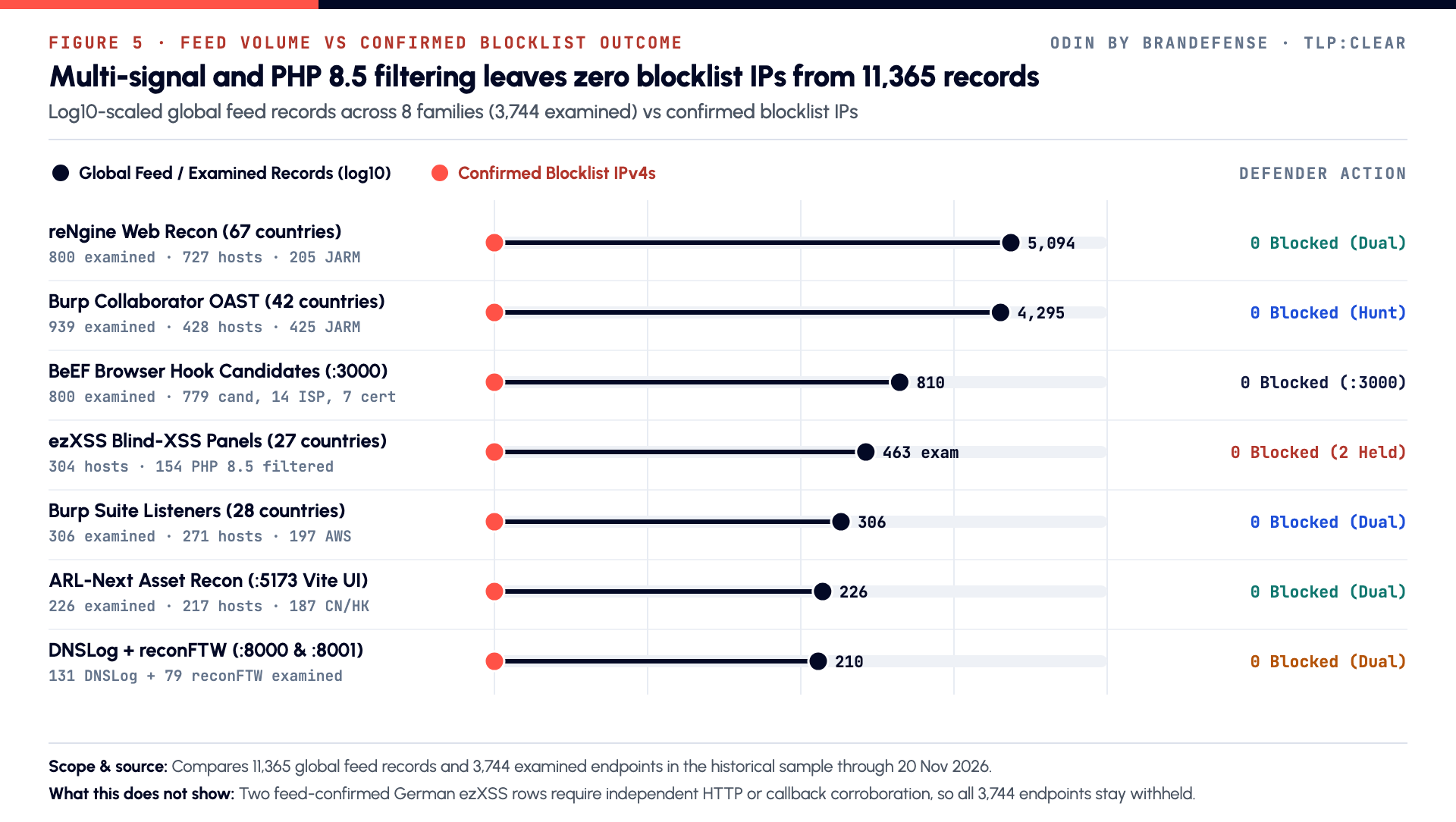
- Across 3,744 examined OAST, blind-XSS, browser-hook, and web recon endpoints on 2,944 hosts, zero addresses qualify for IP blocking without callback proof.
- Six dual-use tools, led by Burp Collaborator (939 endpoints) and reNgine (800), make up 2,481 endpoints that belong in egress hunting, not firewall blocks.
- Over three-quarters of suspected ezXSS feed entries (154 of 202) were ordinary PHP 8.5 websites falsely matched on X-Powered-By response headers.
- One open directory in China held asset reconnaissance, PentAGI penetration-testing, and Langfuse tracing files, without showing who owned them or whether they ran.
- Withhold single-signal ezXSS feed IPs, hunt outbound POST /callback requests, enforce strict admin CSP rules, and alert when servers query OAST domains.
Raw OAST and recon feeds mixed callback candidates with 154 benign PHP 8.5 header collisions. Across a historical feed sample through 20 November 2026, Odin by Brandefense reviewed 3,744 endpoints on 2,944 hosts. The sample drew from 11,365 global feed records across eight callback, blind-XSS, browser-hooking, and web reconnaissance tools. We also examined an open HTTP directory in China reporting 3,001 exposed files (538 sampled entries).
Even the two feed-confirmed German ezXSS HTTP servers required independent callback corroboration, leaving zero addresses for IP blocking. Pushing the rest of the feed straight into a blocklist would break authorized penetration tests, interfere with mail-submission ports, and cut off 123 legitimate PHP 8.5 business websites.
Why should defenders hunt outbound OAST callbacks instead of blocking dual-use tools?
Security teams and attackers rely on the exact same commercial and open-source reconnaissance and callback suites. Six dual-use platforms account for 2,481 of our 3,744 examined endpoints across 1,841 hosts. PortSwigger Burp Collaborator (939 endpoints on 428 hosts) and reNgine (800 on 727 hosts) lead the set.
Burp Suite (306 on 271 hosts), ARL-Next (226 on 217 hosts), DNSLog (131 on 124 hosts), and reconFTW (79 on 79 hosts) account for the rest. Together these six tools represent 135 of the 137 endpoints that upstream feeds labelled confirmed.
Blocking those dual-use addresses creates immediate collateral damage. Sixty-one Burp Collaborator endpoints listen on SMTPS port 465 (34) and SMTP port 587 (27). In addition, 64.4% of Burp Suite instances (197 of 306) sit on Amazon Web Services in Ireland and the United States. Every dual-use address is therefore withheld from blocklists; defenders can use cyber threat intelligence to guide callback hunts instead.
The right defensive trigger is direction of travel. Teams using external attack surface management should treat inbound probes from reNgine or Burp Suite as routine internet background traffic. An outbound DNS query or HTTP request from an internal Java, PHP, Node.js, Python, or .NET server to .oastify[.]com, .burpcollaborator[.]net, or .dnslog[.]cn is completely different. Such callbacks, along with Server: Burp Collaborator responses, point directly to active blind SSRF, SQL injection, XXE, or remote code execution testing.
How did PHP 8.5 response headers cause 154 false ezXSS alerts?
Blind cross-site scripting tools like ezXSS target internal administrators rather than public APIs. An attacker submits a <script> tag into a support ticket, contact form, or HTTP header. When a staff member later views that record inside an unhardened admin panel, the browser loads the external script and posts cookies, localStorage, sessionStorage, and DOM snapshots to /callback.
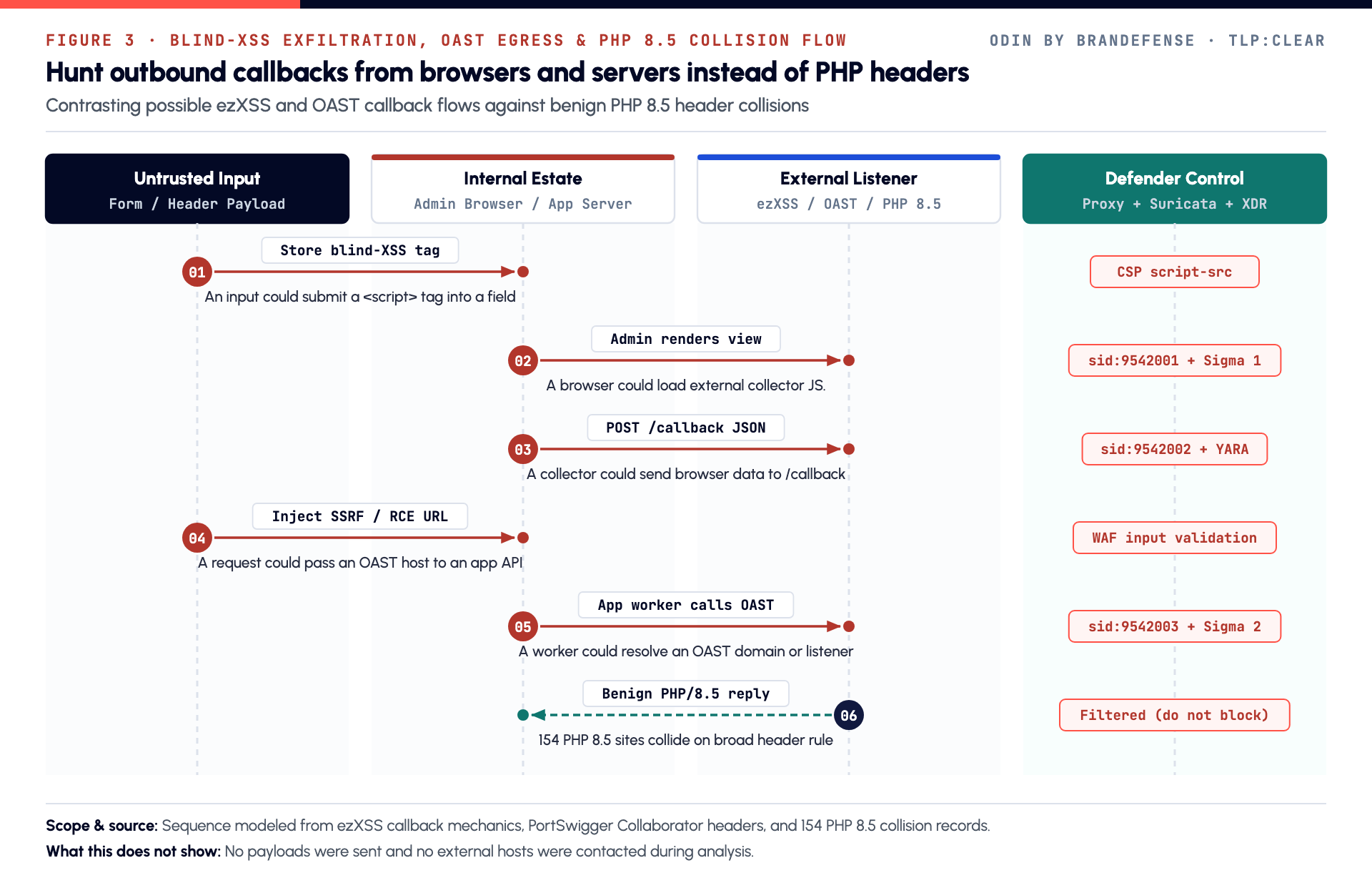
Out of 463 examined ezXSS records on 304 hosts, upstream feeds marked two dedicated HTTP servers in Germany as confirmed on M247 Europe SRL and DigitalOcean, LLC. Because neither row includes an independent HTTP response or callback capture, both addresses stay withheld until corroborated.
When we inspected the 202 ezXSS endpoints marked suspected by upstream feeds, 154 endpoints across 123 hosts (76.2%) were ordinary PHP 8.5 websites. Ninety-eight sit on AWS, 17 on Hetzner, and 13 on Contabo. Because ezXSS is written in PHP, an overly broad upstream signature matched X-Powered-By: PHP/8.5.x headers alongside standard PHP session headers without checking for /callback routes. Suppressing those 154 collisions prevented widespread false blocks.
A similar single-signal problem affects BeEF (Browser Exploitation Framework). All 800 examined BeEF candidates sit on TCP port 3000, the same default port used by Grafana, Metabase, Gitea, Node.js, and Next.js. None of the 800 port-3000 hosts held up for IP blocking; defenders should match /hook.js (BEEFHOOK and beef.init) and the BEEFHOOK= cookie instead.
What did the China open directory contain?
Zero shared IP addresses or certificates connect the two feed-confirmed ezXSS servers, the dual-use cohorts, and the China open directory. Because no technical indicator links them, we treat them as an analytical model rather than one group. The open directory (3,001 reported files, 538 sampled, 220 detailed entries) held files for mapping an attack surface alongside penetration-testing tools. The evidence does not establish an operator or show that the tools ran.
Alongside a 10-entry ARL-plus Docker Git repository, two PentAGI directory trees (59 and 128 entries) held 80 PostgreSQL migration and model files. Those trees also held 35 multi-agent role prompt templates and 27 Langfuse LLM tracing Go files.
They sat beside Fast Reverse Proxy v0.51.0 tunnel configuration files, a SnakeYAML deserialization test archive, four JavaScript command-injection PoCs, and six PentAGI environment files. Because an authorized red team could also leave a test server open by mistake, the server's address, port, paths, and file hashes are withheld.
What to do now
- Hunt blind-XSS callbacks instead of uncorroborated feed IPs. Keep single-signal ezXSS feed addresses off blocklists until HTTP or callback proof is recorded, and check 30 days of proxy logs for
POST /callbackrequests. - Lock down internal admin browsers with CSP. Enforce strict
Content-Security-Policyscript-srcandconnect-srcdirectives plusHttpOnlysession cookies on internal support, CRM, and administration portals to stop blind-XSS and BeEF hooks. - Alert on production server OAST callbacks. Restrict outbound internet DNS and HTTP access from production application tiers. Alert via the published Sentinel KQL and Sigma rules when
java,php-fpm,node,python3, ordotnetworkers resolve.oastify[.]com,.burpcollaborator[.]net, or.dnslog[.]cn. - Disable PHP version banners and banner-only feeds. Set
expose_php = Offinphp.iniso PHP 8.5 servers stop emittingX-Powered-Byheaders, and keep dual-use OAST/recon feeds and port-3000 BeEF candidates out of automated IP blocklists. - Audit red-team labs for open HTTP servers. Ban
python3 -m http.serverbound to0.0.0.0on hosts runningARL,reNgine, orPentAGI, and deploy the Suricata and YARA rules from the full report's Detection rules tab.
What is…?
Short explanations of the tools and families named in this study.
What is ezXSS?
ezXSS is an open-source collector for blind cross-site scripting (XSS) payloads. It records pages where a payload fires.
More about ezXSSTechniqueWhat is OAST?
Out-of-band application security testing (OAST) detects blind vulnerabilities by making a target call back to a server the tester controls, usually over DNS or HTTP.
More about OASTOAST serviceWhat is Burp Collaborator?
Burp Collaborator is PortSwigger's callback service for Burp Suite, used to detect out-of-band vulnerabilities.
More about Burp CollaboratorAI offensive toolWhat is PentAGI?
PentAGI is an open-source autonomous penetration testing system that coordinates AI agents and security tools in containers.
More about PentAGIReconnaissance platformWhat is reNgine?
reNgine is an open-source reconnaissance framework that chains tools such as subfinder, httpx and nuclei in containers.
More about reNgineOAST serviceWhat is DNSLog?
DNSLog is a family of open-source DNS callback collectors used to confirm blind injection and SSRF flaws.
More about DNSLogFrequently asked questions
Why should defenders hunt outbound OAST callbacks instead of blocking dual-use tools?
Security teams and attackers rely on the exact same commercial and open-source reconnaissance and callback suites. Six dual-use platforms account for 2,481 of our 3,744 examined endpoints across 1,841 hosts. PortSwigger Burp Collaborator (939 endpoints on 428 hosts) and reNgine (800 on 727 hosts) lead the set.
How did PHP 8.5 response headers cause 154 false ezXSS alerts?
Blind cross-site scripting tools like ezXSS target internal administrators rather than public APIs. An attacker submits a <script> tag into a support ticket, contact form, or HTTP header. When a staff member later views that record inside an unhardened admin panel, the browser loads the external script and posts cookies, localStorage, sessionStorage, and DOM snapshots to /callback.
What did the China open directory contain?
Zero shared IP addresses or certificates connect the two feed-confirmed ezXSS servers, the dual-use cohorts, and the China open directory. Because no technical indicator links them, we treat them as an analytical model rather than one group. The open directory (3,001 reported files, 538 sampled, 220 detailed entries) held files for mapping an attack surface alongside penetration-testing tools. The evidence does not establish an operator or show that the tools ran.