
Key takeaways
- Only seven dedicated cloud and VPS endpoints across six IPv4 addresses survived collision filtering across 3,500 examined rows, and all six addresses remain withheld pending independent C2 corroboration.
- All 700 examined Ramnit endpoints (from 6,804 global sightings) carry an upstream victim label and were withheld; infection or sinkhole status was not verified on every host.
- Two hundred eight examined endpoints sit on broadband telecom carriers or shared Cloudflare (73) and Akamai (21) edge proxies.
- Twenty-seven of 34 feed-labelled confirmed rows failed review due to victim tags, broadband telecom listings, financial-lure certs, or port 3389 RDP collisions.
- Avoid static IP blocks from uncorroborated feed exports, and catch loader and stealer traffic using HTTP, SOAP, and endpoint process rules.
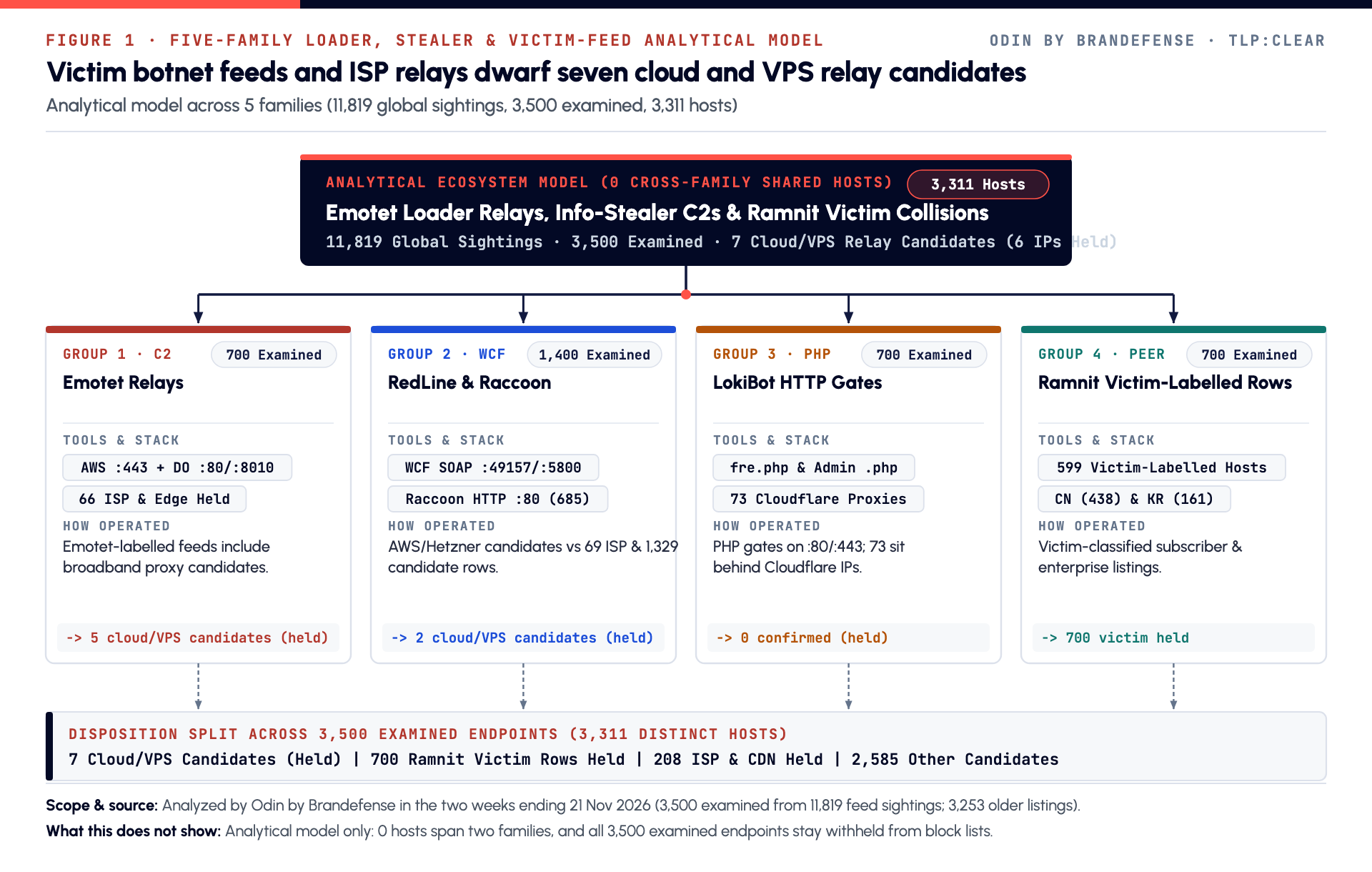
Only seven of 3,500 examined endpoints remained as cloud or VPS relay candidates without independent C2 corroboration; 908 hit victim-labelled, ISP, or CDN collision rows. In practice, a cyber threat intelligence platform can help defenders separate rented attacker servers from home broadband routers, Cloudflare reverse proxies, and victim-labelled customer networks in unverified feeds. Blocking every listed address creates self-inflicted outages while missing panels that defenders can review with external attack surface management.
Odin by Brandefense analyzed 3,500 endpoints across 3,311 hosts from 11,819 global feed sightings in the two weeks ending 21 November 2026. Only 247 sampled rows had last-seen dates in that window; 3,253 were older feed listings.
Only seven dedicated cloud and virtual private server endpoints across six unique IPv4 addresses survived initial collision checks, and none had independent C2 beacon or protocol proof. All 3,500 examined endpoints across 3,311 hosts therefore stay withheld from public block lists to protect victim-labelled hosts, telecom users, shared CDN proxies, and unverified tenants.
The full report carries the hosting breakdown, eight published JARM indicators, five wire signatures, and four deployable rule files; the Odin Research blog collects related cases.
Why do Ramnit and Emotet feeds blackhole innocent networks?
More than half of all sightings in our study (6,804 of 11,819, or 57.6%) carry a Ramnit label under an explicit victim category. Across 700 examined Ramnit endpoints on 599 hosts, exposed ports belong to ordinary FTP, web, and router services. These include ports 21, 80, 81, 82, 88, 8081, and 8088.
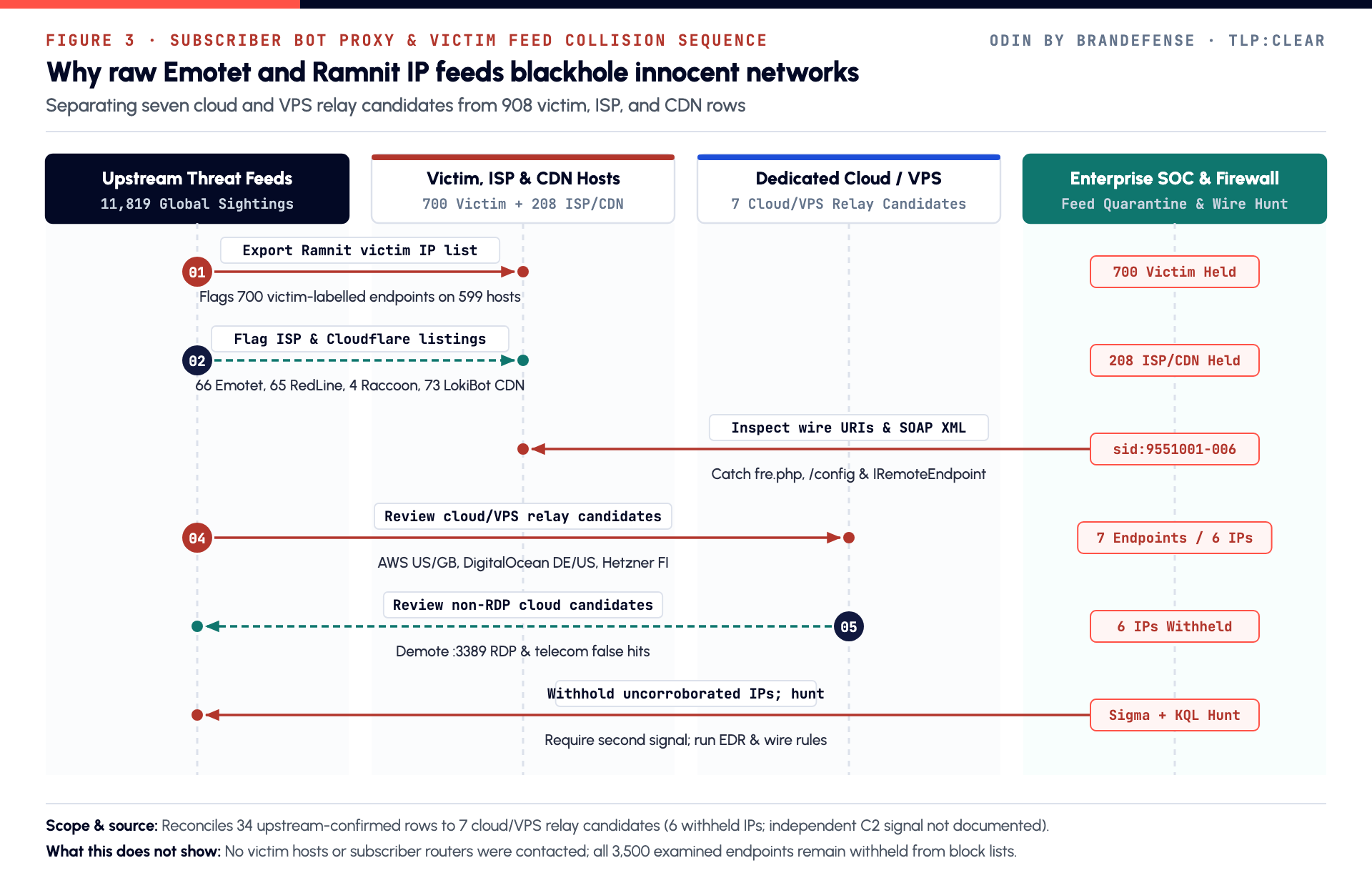
Four Ramnit entries even carried a "confirmed" tag despite sitting on victim-labelled FTP and telecom hosts in China and Thailand. Overall, 93.6% of examined Ramnit rows sit in China (438), South Korea (161), Thailand (34), and Indonesia (22). Blocking a Ramnit feed cuts off 599 victim-labelled hosts instead of an attacker server.
A second collision pool spans 208 endpoints across 42 broadband telecom and shared CDN networks:
- 73 LokiBot endpoints resolve to Cloudflare, Inc. anycast addresses, where static IP blocks cut off thousands of benign websites while leaving the origin PHP server online.
- 66 Emotet-labelled endpoints sit on telecom carriers (45) or Akamai Connected Cloud ranges (21). Infection and proxy behavior were not verified for each host.
- 65 RedLine rows and 4 Raccoon rows sit on subscriber ISPs, led by 57 RedLine port 25920 leases on a national telecom carrier in Uruguay.
Why do even the six remaining cloud and VPS relays require corroboration?
Reviewing all 34 upstream "confirmed" records eliminated 27 rows (79.4%) on collision grounds. Those 27 rows included four victim-labelled Ramnit rows, two broadband Emotet listings, two Dutch port 3389 Remote Desktop collisions, six Huawei Cloud financial-lure rows, and 13 single-batch cloud rows.
Seven dedicated endpoints across six unique IPv4 addresses remained on commercial cloud and VPS providers. Independent protocol, beacon, or workbench C2 corroboration was not documented for those six addresses, so all seven endpoints remain withheld from static block lists:
| Family | Endpoint profile (address withheld) | Hosting and country | Review finding |
|---|---|---|---|
| Emotet | Dedicated TLS port 443 endpoint | Amazon.com, Inc., US | Custom domain cert and 29d29d07d29d JARM; C2 beacon uncorroborated |
| Emotet | Dual-port droplet HTTP port 80 | DigitalOcean, LLC, DE | Custom domain cert; independent HTTP POST C2 signal not documented |
| Emotet | Dual-port droplet HTTP port 8010 | DigitalOcean, LLC, DE | Alternate port on the same German droplet; C2 uncorroborated |
| Emotet | Paired US droplet #1 HTTP port 80 | DigitalOcean, LLC, US | Shared custom cert profile; independent C2 signal not documented |
| Emotet | Paired US droplet #2 HTTP port 80 | DigitalOcean, LLC, US | Shared custom cert profile; independent C2 signal not documented |
| RedLine Stealer | High-port TCP 49157 endpoint | Amazon.com, Inc., GB | Default Windows host cert; WCF SOAP beacon not documented |
| RedLine Stealer | Dedicated TCP 5800 endpoint | Hetzner Online GmbH, FI | Port 5800 listener; WCF SOAP payload not documented |
How do you catch proxy-hidden stealers without blocking Cloudflare or ISPs?
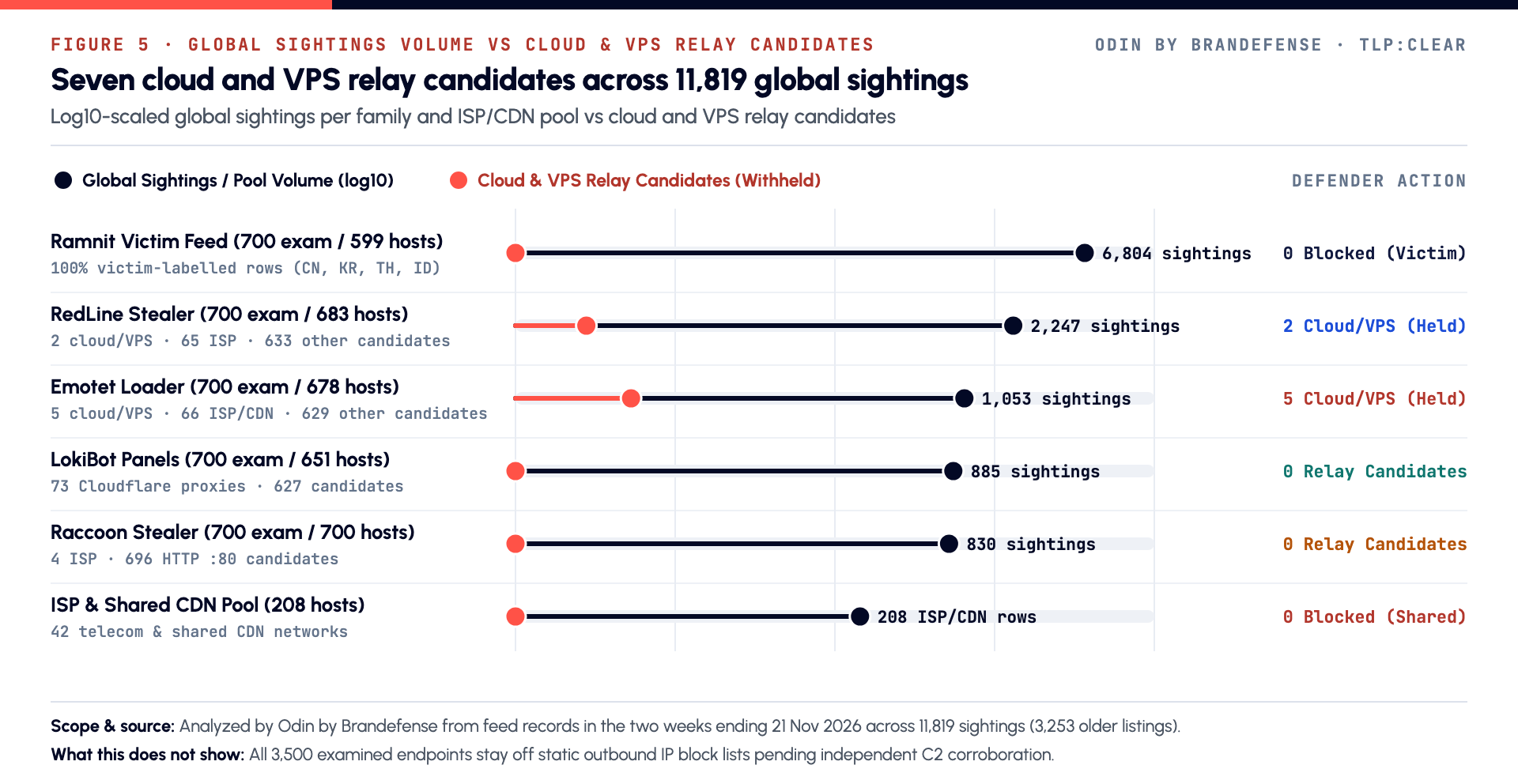
Raccoon Stealer (700 examined rows, 97.9% on HTTP port 80, listed on or before December 2025) produced zero corroborated block-list servers. LokiBot (700 rows on ports 80 and 443, listed through May 2026) also produced zero corroborated block-list servers. Three Windows TLS JARM hashes also occur across 79 RedLine rows and 55 Ramnit victim-labelled rows. Instead of blocking recycled VPS or CDN addresses, inspect protocol payloads and process behavior:
- RedLine WCF SOAP contracts: Alert on HTTP
POSTrequests withSOAPActionheaderhxxp://tempuri[.]org/IRemoteEndpoint/or XML methodsCheckConnectandScanResult. - LokiBot and Raccoon HTTP gates: Alert on
/PvqDq929BSx_A_D_M_I_N_a.php,/fre.phpposts withCharon; InfernoUser-Agent headers, andPOST /configbodies containingbot_idandconfig_id. - Emotet and RedLine host processes: Alert when
regsvr32.exeorrundll32.execonnects to Emotet ports, or when.NETutilities open RedLine high ports.
Are these five families operated by one group?
No evidence links them to one operator. Zero hosts among all 3,311 distinct hosts carry labels from two families, and the 21 shared /24 blocks may reflect co-tenant VPS hosting. We present the five families as an analytical model to help teams separate durable C2 signals from victim and ISP noise.
What to do now
- Do not import raw Emotet, RedLine, Raccoon, LokiBot, or Ramnit IP feeds into firewall block lists without an independent protocol, beacon, or endpoint signal.
- Quarantine victim-tagged Ramnit feeds, broadband telecom ISPs, and Cloudflare or Akamai ranges out of automated firewall block lists.
- Deploy the six Suricata 7 signatures from the full report's Detection rules tab to catch RedLine SOAP envelopes, LokiBot
/fre.phpgates, Raccoon/configcheck-ins, and Emotet POST beacons. - Enable the Sentinel KQL hunt and two Sigma rules to isolate Windows endpoints initiating suspicious
regsvr32.exe,rundll32.exe, or.NEThigh-port connections. - Scan unpacked payloads and memory dumps with the three YARA rules for RedLine WCF configs, LokiBot gates, and Raccoon check-in parameters.
What is…?
Short explanations of the tools and families named in this study.
What is RedLine?
RedLine is an infostealer sold as malware-as-a-service. It steals browser credentials, cookies and crypto wallets. Law enforcement disrupted its infrastructure in 2024.
More about RedLineMalware loaderWhat is Emotet?
Emotet is a long-running modular malware loader and botnet spread by malicious email attachments. It was disrupted by law enforcement in 2021 and later resurfaced.
More about EmotetBanking trojanWhat is Ramnit?
Ramnit is a long-running banking trojan and worm. Many of its infrastructure records are old feed entries.
More about RamnitTechniqueWhat is JARM?
JARM is an open TLS server fingerprinting method from Salesforce. It hashes how a server answers a set of crafted TLS handshakes.
More about JARMFrequently asked questions
Why do Ramnit and Emotet feeds blackhole innocent networks?
More than half of all sightings in our study (6,804 of 11,819, or 57.6%) carry a Ramnit label under an explicit victim category. Across 700 examined Ramnit endpoints on 599 hosts, exposed ports belong to ordinary FTP, web, and router services. These include ports 21, 80, 81, 82, 88, 8081, and 8088.
Why do even the six remaining cloud and VPS relays require corroboration?
Reviewing all 34 upstream "confirmed" records eliminated 27 rows (79.4%) on collision grounds. Those 27 rows included four victim-labelled Ramnit rows, two broadband Emotet listings, two Dutch port 3389 Remote Desktop collisions, six Huawei Cloud financial-lure rows, and 13 single-batch cloud rows.
How do you catch proxy-hidden stealers without blocking Cloudflare or ISPs?
Raccoon Stealer (700 examined rows, 97.9% on HTTP port 80, listed on or before December 2025) produced zero corroborated block-list servers. LokiBot (700 rows on ports 80 and 443, listed through May 2026) also produced zero corroborated block-list servers. Three Windows TLS JARM hashes also occur across 79 RedLine rows and 55 Ramnit victim-labelled rows. Instead of blocking recycled VPS or CDN addresses, inspect protocol payloads and process behavior:
Are these five families operated by one group?
No evidence links them to one operator. Zero hosts among all 3,311 distinct hosts carry labels from two families, and the 21 shared /24 blocks may reflect co-tenant VPS hosting. We present the five families as an analytical model to help teams separate durable C2 signals from victim and ISP noise.