
Key takeaways
- Asymmetric private keys rank #1 across all 28 secret types in our 14-day dataset, accounting for 316 of 800 findings (39.50%).
- Across 49 misconfigured open-directory servers reporting 103,410 files and 752 sampled artifacts, 85.71% (42 hosts) sit on standard ports 80 and 443.
- All six Laravel Passport OAuth2 signing-key servers (100%) simultaneously expose framework debug log files reaching 2.47 GB on Host A.
- Separate misconfigured servers expose Symfony LexikJWT keys, compiled LightSAML caches, payment merchant mTLS bundles, and 7 PKCS#12 .pfx keystores.
- Restrict Laravel, Symfony, and Craft web roots to their dedicated public directories; move signing keys to KMS, turn off APP_DEBUG, and filter test fixtures.
Misconfigured web directories listed 752 signing-key, certificate, SAML cache, and debug-log artifacts across seven classes on 49 servers. Odin by Brandefense observed these listings in a two-week window ending 21 November 2026. The servers reported 103,410 files in total. Signing keys exposed this way belong on any dark web monitoring watch list.
In the broader 14-day dataset, 316 of 800 secret findings (39.50%) were asymmetric private_key detections, the largest of 28 types. We also reviewed 120 crypto and OAuth records across 24 separate servers. We treated all 73 servers as misconfigured owner systems, opened no key bodies, forged no tokens, and withheld all IP addresses, host-linked ports, paths, filenames, and file hashes.
What did we find across the 49 misconfigured web servers?
Single sign-on portals, stateless REST APIs, and payment gateways rely on asymmetric RSA and ECDSA private keys. Those keys sign tokens and authenticate payouts. Frameworks such as Laravel and Symfony expect only the public web folder to sit inside the web server's document root, which defenders can audit with external attack surface management.
When an administrator points Apache or Nginx at the parent repository folder, signing keys become directly downloadable over HTTP and HTTPS. Saving merchant certificates inside a public upload folder causes the same exposure. For defenders using cyber threat intelligence, obscure debug ports are rare: 42 of 49 servers (85.71%) use port 443 (23 hosts) or port 80 (19 hosts).
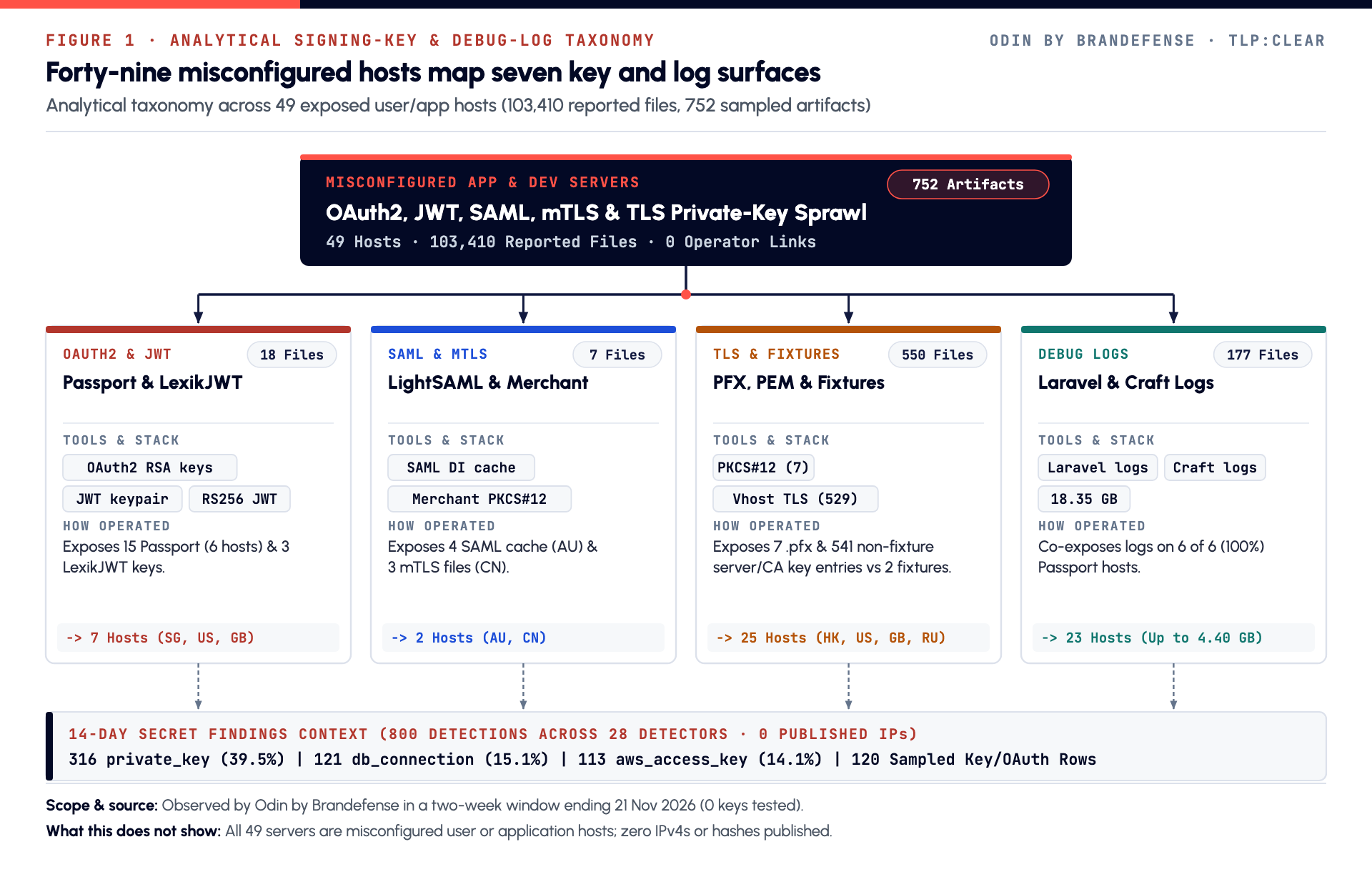
Six representative misconfiguration patterns stand out across the 752 sampled files:
- Laravel Passport OAuth2 keys and debug logs (6 servers, 15 key files). Misconfigured owner servers in Singapore (3 hosts), the United States (2), and Great Britain (1) exposed nine OAuth2 RSA private keys and six public keys. Seven private keys measured 3,322 bytes, two measured 3,292 bytes, and all six public keys measured 812 bytes. On Host A in the United States (10,000 reported files), an OAuth2 key sat beside 19 Laravel logs totaling 3.06 GB, led by a 2.47 GB log. All host ports, paths, and filenames are withheld.
- Symfony LexikJWT API keys (3 entries). A misconfigured owner server exposed three JWT key entries totaling 7,344 bytes; its port, paths, and filenames are withheld.
- Compiled Symfony LightSAML cache (4 files). On Host C in Australia (244 reported files), a misconfigured owner server exposed four compiled SAML container cache files totaling 100,824 bytes. Three files were compiled credential-store and resolver service classes (1,126, 1,228, and 1,638 bytes) beside a 96,832-byte container file; its port, paths, and filenames are withheld.
- Payment-gateway merchant mTLS bundles (3 files). On Host D in China (10,000 reported files), a public upload folder exposed three payment-gateway mTLS files totaling 5,987 bytes. These comprised a 2,774-byte PKCS#12 client bundle, a 1,704-byte PEM private key (encryption status unverified), and a 1,509-byte PEM certificate. A separate server in China in our 120-row sample exposed two more merchant private keys; all ports, paths, and filenames are withheld.
- Binary PKCS#12
.pfxkeystores (Host E, 2 servers, 7 files). Two misconfigured owner servers exposed seven PKCS#12 archives totaling 29,498 bytes. A server in the United States (6,203 reported files) exposed a 6,701-byte.pfxarchive beside three PEM.keyfiles. A server in Great Britain (1,878 reported files) exposed six.pfxkeystores (3,736 to 3,849 bytes); ports, paths, and filenames are withheld.
- Reverse-proxy TLS keys vs unit-test fixtures (Host F, 24 servers, 543 PEM keys). Fifteen servers in Hong Kong exposed 529 virtual-host TLS key files alongside 12 standalone application and CA keys on seven servers (541 non-fixture server and CA key entries). By contrast, two servers in the United States (Host F, 1,539 reported files each) exposed 1,679-byte unit-test signing-key fixtures; all ports, paths, and filenames are withheld.
Why does 100% debug-log overlap multiply offline token-forgery risk?
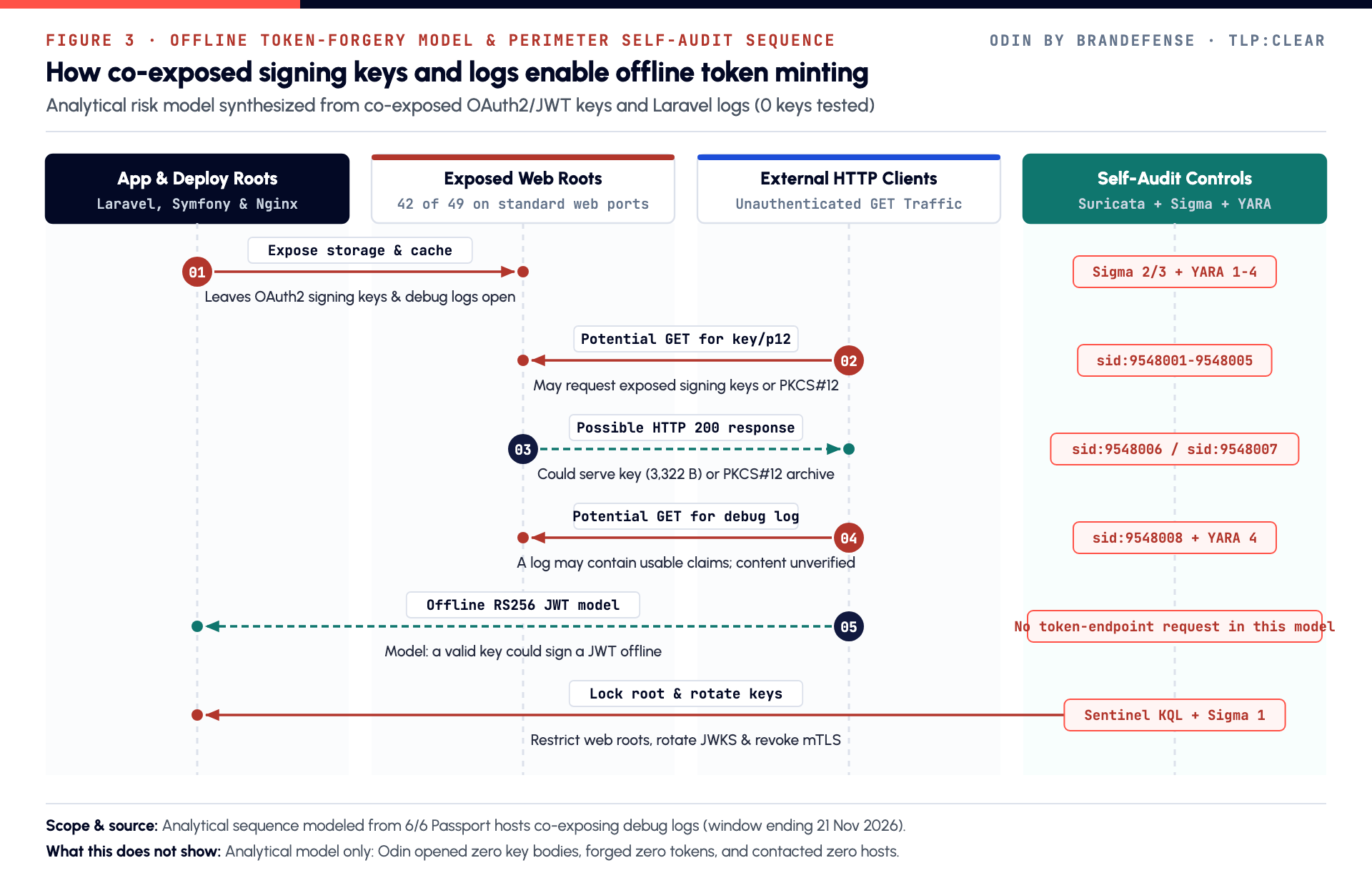
Across all 49 servers, 23 hosts expose 177 debug logs (171 Laravel log files and 6 Craft CMS log files) totaling 18.35 GB. Five single logs exceed 1.0 GB, peaking at 4.40 GB on a server in Singapore. In total, 100% (6 of 6) of the servers exposing Laravel Passport OAuth2 private keys also expose framework debug logs.
In an analytical risk model, a valid OAuth2 private key could sign an RS256 bearer JWT offline without a token-endpoint request. The logs might contain relevant claims, but their contents, key validity, and API jti revocation checks were not verified.
Why must posture teams separate unit-test fixtures from non-fixture key entries, and why are all IPs withheld?
Asymmetric private_key detections (316 of 800, 39.50%) outnumber db_connection (121) and aws_access_key (113) combined in our 14-day dataset. However, scanning web roots strictly for -----BEGIN RSA PRIVATE KEY----- headers mixes live application signing keys with bundled open-source and unit-test fixture files. Those include the two 1,679-byte test signing keys on Host F. Separating test-fixture folders from live application key folders lets defenders fix unlocked document roots without triggering false breach pages.
All 49 open-directory servers and all 24 secret-sample servers are misconfigured owners rather than adversary infrastructure. Publishing IP addresses, host-linked ports, file paths, filenames, or file hashes would put authentication and payment systems at risk.
What to do now
- Restrict Laravel, Symfony, and Craft web roots to their dedicated public directories. Keep application storage, JWT configuration, compiled cache, TLS key, and certificate directories outside Apache and Nginx document roots, and never link full internal storage trees into public folders. Disable directory indexing and shut down ad-hoc Python HTTP listeners.
- Move signing and merchant mTLS keys into KMS or HSM vaults. Replace flat OAuth2, JWT, PKCS#12, and merchant mTLS key files on disk with non-exportable KMS signing APIs. Publish
kid-pinned JWKS endpoints, enforcejtichecks, and never store merchant.p12or.pembundles in public upload folders.
- Disable
APP_DEBUGand enforce log rotation. Turn off verbose exception dumps in production and redactAuthorizationandCookieheaders. Cap log sizes so multi-gigabyte framework debug logs (2.47 to 4.40 GB) never accumulate on disk.
- Deploy perimeter self-audit rules. Load our Suricata rules (
sid:9548001to 9548008), Sentinel KQL query, Sigma rules, and YARA checks to catch exposed key extensions and outbound HTTP 200 PEM, SAML cache, and PKCS#12 responses early.
The full report's Indicators tab holds 0 network addresses and 0 file hashes. All 73 server addresses, host-linked ports, paths, filenames, and secret-bearing file digests are withheld; the full report lists 18 structural self-audit classes. The full report's Detection rules tab provides Suricata, Sentinel KQL, Sigma, and YARA rules.
Frequently asked questions
What did we find across the 49 misconfigured web servers?
Single sign-on portals, stateless REST APIs, and payment gateways rely on asymmetric RSA and ECDSA private keys. Those keys sign tokens and authenticate payouts. Frameworks such as Laravel and Symfony expect only the public web folder to sit inside the web server's document root, which defenders can audit with external attack surface management.
Why does 100% debug-log overlap multiply offline token-forgery risk?
Across all 49 servers, 23 hosts expose 177 debug logs (171 Laravel log files and 6 Craft CMS log files) totaling 18.35 GB. Five single logs exceed 1.0 GB, peaking at 4.40 GB on a server in Singapore. In total, 100% (6 of 6) of the servers exposing Laravel Passport OAuth2 private keys also expose framework debug logs.
Why must posture teams separate unit-test fixtures from non-fixture key entries, and why are all IPs withheld?
Asymmetric private_key detections (316 of 800, 39.50%) outnumber db_connection (121) and aws_access_key (113) combined in our 14-day dataset. However, scanning web roots strictly for -----BEGIN RSA PRIVATE KEY----- headers mixes live application signing keys with bundled open-source and unit-test fixture files. Those include the two 1,679-byte test signing keys on Host F. Separating test-fixture folders from live application key folders lets defenders fix unlocked document roots without triggering false breach pages.