
1. Executive Summary
In short
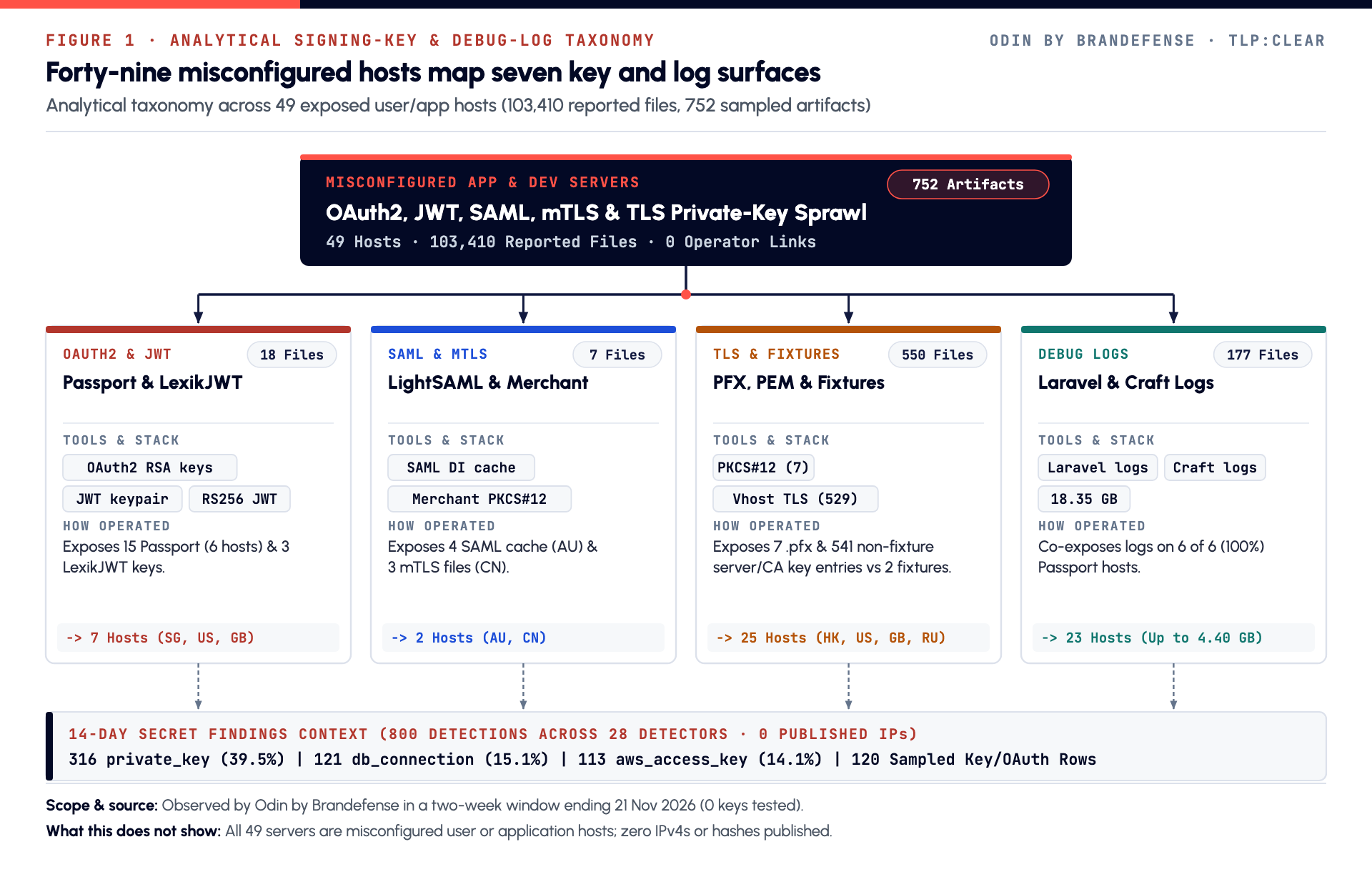
In a two-week observation window ending 21 November 2026, Odin by Brandefense observed 49 misconfigured open web directories reporting 103,410 files and exposing 752 signing-key, certificate, SAML cache, and debug-log files across seven classes. All 49 servers belong to misconfigured users and organizations with zero adversary attributions, so all IP addresses and file hashes are withheld. Together they expose Laravel Passport keys, Symfony LexikJWT keys, LightSAML caches, merchant mTLS bundles, and debug logs. Lock web document roots to public folders and move signing keys into KMS vaults.
Single sign-on federation, stateless REST APIs, and payment settlement gateways rely on asymmetric private keys to vouch for user identities and financial payouts. Across a two-week observation window ending 21 November 2026, Odin by Brandefense reviewed 49 misconfigured application and developer web servers reporting 103,410 files. Those servers exposed 752 signing-key, keystore, SAML cache, and debug-log artifacts. Signing keys exposed this way belong on any dark web monitoring watch list.
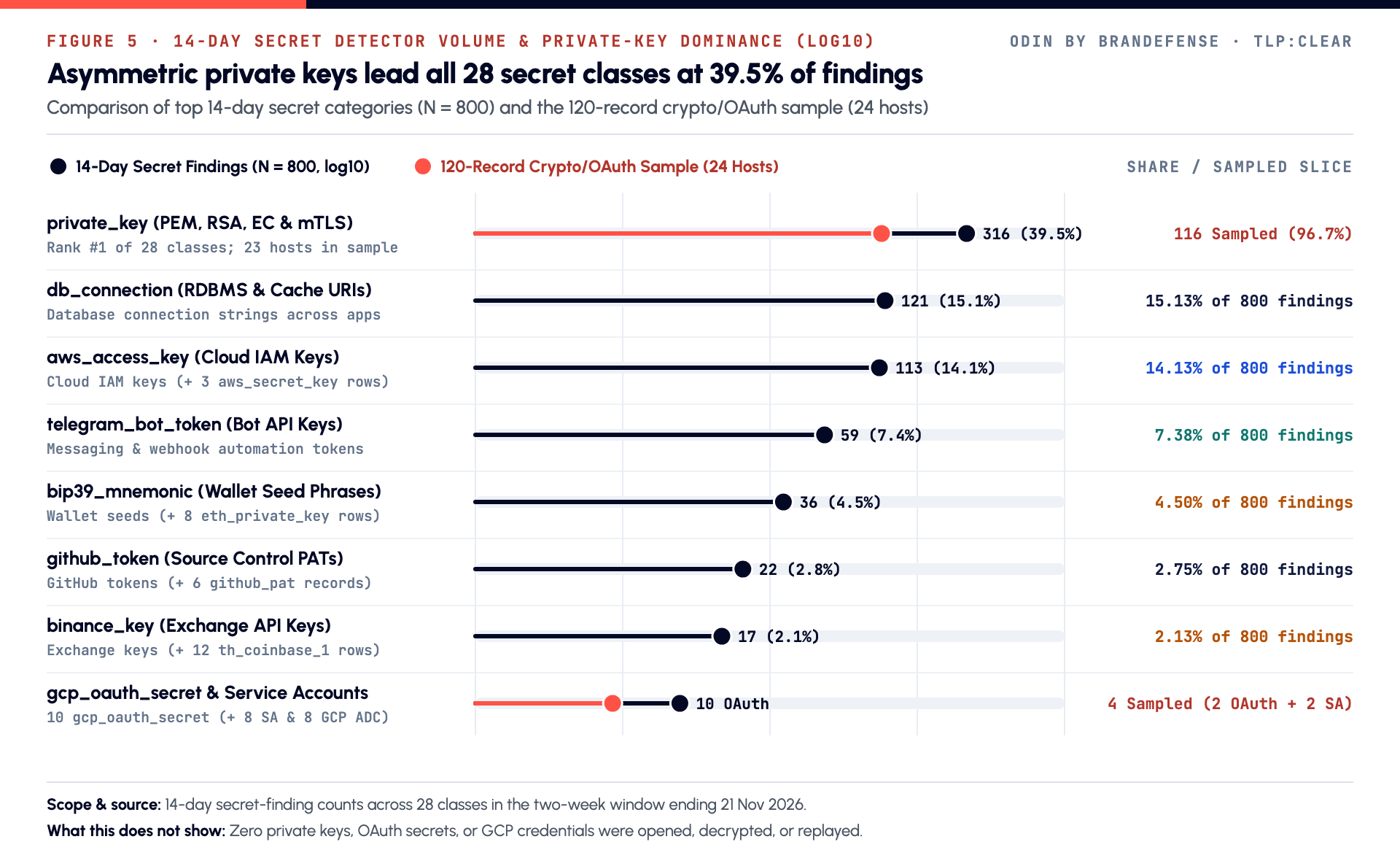
Across our broader 14-day set of 800 secret findings spanning 28 secret types, asymmetric private keys ranked first at 39.50% (316 findings). We opened zero key bodies, forged zero tokens, treated all hosts as misconfigured owners rather than operators, and withheld all addresses and hashes.
Asymmetric private keys lead 14-day secret leaks while standard web ports drive exposure.
Private keys account for 316 of 800 14-day secret findings (39.50%), outnumbering database connection strings (121) and AWS access keys (113) combined (234). Among the 49 open-directory signing-key servers, 42 hosts (85.71%) listen on standard HTTP or HTTPS ports 80 and 443 rather than obscure debug ports.
Every exposed Laravel Passport signing-key server also exposes application debug logs.
Six Apache servers expose 15 Laravel Passport OAuth2 key files, including nine RSA private keys sized 3,292 to 3,322 bytes. Separate hosts expose Symfony LexikJWT keys and compiled LightSAML container caches. All six Passport servers (100%) also expose framework debug log files reaching 2.47 GB on Host A. Whether those logs contain token claims was not verified.
Merchant mTLS bundles, PKCS#12 keystores, and test fixtures require context-aware triage.
Public upload and certificate directories expose payment-gateway client bundles (three files on Host D in China) alongside seven .pfx keystores and 543 PEM keys. Two merchant keys in a separate 120-record sample corroborate that pattern. Separating two unit-test signing fixtures (Host F) from 541 server and CA keys prevents false breach alerts.
Three Decisions for Leaders
- Restrict Laravel, Symfony, and Craft web roots to their dedicated public directories. Keep application storage, JWT configuration, compiled cache, and TLS key folders outside all HTTP document roots, and disable directory auto-indexing on every virtual host.
- Move OAuth2, JWT, SAML, and merchant mTLS signing keys into KMS or HSM vaults. Replace flat
.key,.pem,.p12, and.pfxfiles on disk with cloud KMS signing APIs, publishkid-pinned JSON Web Key Sets, and restrict merchant mTLS calls by source IP. - Turn off production debug logs and filter unit-test key fixtures during triage. Set
APP_DEBUG=falsefor production error display, and configure application loggers to redact bearer tokens and claims, while separating test-fixture sample keys from non-fixture key incidents.
The Study in Numbers
| Number | What it is |
|---|---|
| 49 / 103,410 | Misconfigured open-directory servers and combined reported files reviewed (0 adversary hosts) |
| 752 | Sampled files across 7 signing-key, certificate, SAML cache, and debug-log classes (0 hashes published) |
| 316 / 800 (39.50%) | Share of 14-day secret findings held by private_key (rank 1 across 28 secret types) |
| 120 / 24 | Corroborating private-key and cloud OAuth records sampled across 24 separate servers |
| 6 of 6 (100%) | Laravel Passport signing-key servers that co-expose framework debug log files |
| 18.35 GB / 4.40 GB | Total sampled debug-log volume across 177 files and single largest exposed debug log |
| 541 vs 2 | Non-fixture server, reverse-proxy, and CA PEM key entries separated from unit-test signing fixtures |
How to use this report.
Security leaders and identity architects can start with Chapters 1, 5, and 6. Application, IAM, and payment engineers should read Chapters 3, 4, and 6. SOC analysts and detection engineers can use cyber threat intelligence to prioritize alerts, alongside Chapters 7 and 8 and the Detection rules tab. Scope boundaries and sources sit in Chapters 9 and 10.
2. Fourteen-Day Secret Findings and the Seven-Surface Signing Model
In short
In the two-week window ending 21 November 2026, private_key ranked first across 28 secret types at 39.50% (316 of 800 findings), backed by 120 sampled crypto and OAuth rows across 24 servers. Reviewing open web directories isolated 49 misconfigured servers reporting 103,410 files and 752 artifacts across seven classes. Audit standard HTTP and HTTPS virtual hosts for exposed application storage, JWT configuration, compiled cache, and TLS key folders.
Stateless bearer tokens and mutual TLS (mTLS) let microservices, single sign-on portals, and payment APIs verify requests without querying a central session store on every call (T1552.004). That design places immense trust in small private-key files on disk. Unlike a leaked password affecting one user, an exposed OAuth2 signing key, JWT key, or SAML credential store weakens authentication trust across an entire application (T1606.002).
When an Apache, Nginx, or Python web root exposes its parent project tree or certificate folder without authentication, those signing artifacts become readable from the internet. We reviewed file paths, byte sizes, and secret-type counts statically without opening key bodies, testing passphrases, forging tokens, or contacting any server.
The broader 14-day secret-finding context
During the two-week observation window ending 21 November 2026, Odin by Brandefense recorded 800 secret findings across 28 secret types. Asymmetric private_key findings ranked first overall with 316 detections (39.50%), exceeding database URLs (121, 15.13%) and AWS access keys (113, 14.13%) combined (234, 29.25%). Bot, wallet, exchange, and cloud OAuth secrets follow, led by telegram_bot_token (59), bip39_mnemonic (36), github_token (22), binance_key (17), and th_coinbase_1 (12). Next come th_azuresastoken (11), gcp_oauth_secret (10), square_token (10), th_azure_openai (9), and gcp_service_account (8).
We also reviewed a 120-record sample across 24 additional servers (0 overlap with the 49 directory servers; addresses withheld). It holds 116 private_key rows (96.67%), 2 gcp_service_account rows (1.67%), and 2 gcp_oauth_secret rows (1.67%). Across 10 geographies, China (62), Hong Kong (37), and India (11) lead, followed by 2 each in Germany, Spain, and Great Britain. Vietnam, Indonesia, Italy, and the US account for 1 each.
| Secret type (28 total) | 14-day count (800) | Share of 14d | 120-row sample | Sample servers (24) | Credential or signing role |
|---|---|---|---|---|---|
private_key | 316 | 39.50% | 116 | 23 | PEM RSA, PKCS#8, EC, TLS, JWT, and merchant mTLS private keys (T1552.004) |
db_connection | 121 | 15.13% | 0 | 0 | Relational, document, and cache database connection URLs (T1552.001) |
aws_access_key (+ 3 secret) | 113 | 14.13% | 0 | 0 | AWS IAM access keys (113) alongside 3 aws_secret_key findings |
telegram_bot_token | 59 | 7.38% | 0 | 0 | Automated messaging bot and webhook API tokens (T1528) |
bip39_mnemonic (+ 8 ETH) | 36 | 4.50% | 0 | 0 | Wallet seed phrases (36) alongside 8 eth_private_key findings |
github_token (+ 6 PAT) | 22 | 2.75% | 0 | 0 | GitHub tokens (22) plus 6 github_pat personal access tokens |
binance_key (+ 12 Coinbase) | 17 | 2.13% | 0 | 0 | Exchange and payment keys (17 Binance, 12 Coinbase, 10 Square, 4 Stripe) |
th_azuresastoken & Azure keys | 11 | 1.38% | 0 | 0 | Azure SAS (11), Azure OpenAI (9), APIM (2), ACR (1), Function (1) |
gcp_oauth_secret | 10 | 1.25% | 2 | 1 | Google Cloud OAuth2 client secrets (1 GB server; port withheld) |
gcp_service_account (+ 8 ADC) | 8 | 1.00% | 2 | 2 | GCP service-account JSON keys (Spain and HK; ports withheld) plus 8 ADC |
| Remaining 18 secret types | 87 | 10.88% | 0 | 0 | Discord (8), Alibaba (7), Slack (2), Tailscale (2), CS (2), CF/DO (2) |
Forty-nine misconfigured signing-key and debug-log servers
Reviewing open web directories for OAuth2/JWT keys, SAML caches, merchant mTLS bundles, PKCS#12 keystores, PEM keys, and debug logs identified 49 servers (addresses, ports, paths, and filenames withheld). Together they report 103,410 files (244 to 10,000 per host) and 752 sampled artifacts (18,346,654,294 bytes, or 18.35 GB).
- Standard web ports account for 85.71% of hosts. Twenty-three servers (46.94%) listen on port 443 and 19 (38.78%) listen on port 80 (42 of 49). Seven servers (14.29%) use ports 8000 (2), 8888 (2), 8080 (1), 8081 (1), and 81 (1); host-to-port assignments are withheld.
- Apache and Nginx make up 93.88% of hosts. Apache runs on 28 hosts (57.14%), Nginx on 18 (36.73%), and Python HTTP on 3 (6.12%). Across 10 geographies, the US (17, 34.69%) and Hong Kong (16, 32.65%) lead, followed by Singapore (5), India (3), Great Britain (2), and Canada (2). China, Russia, the UAE, and Australia account for 1 each. Nine hosts (18.37%) expose two classes simultaneously.
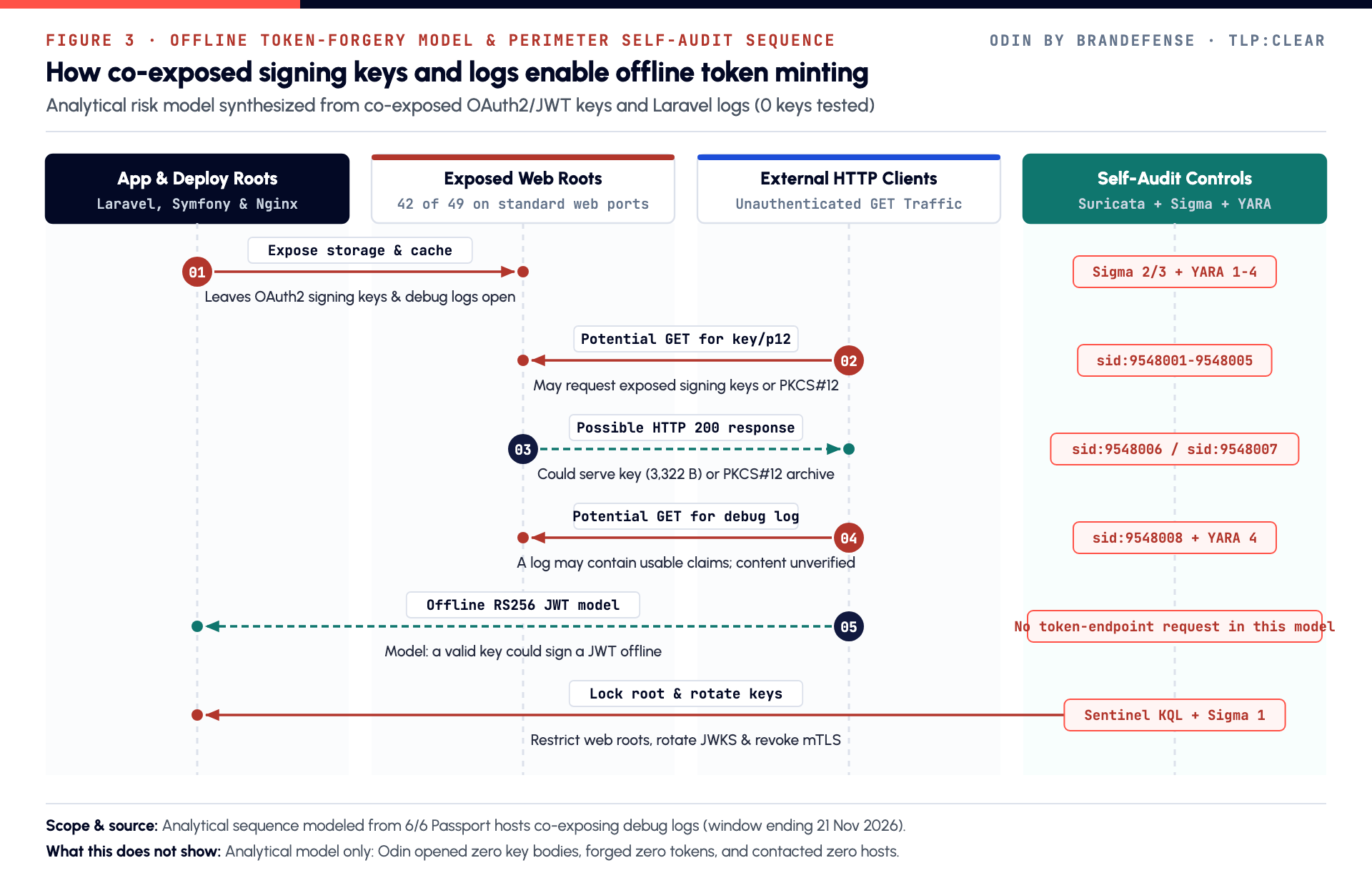
| Exposure class | Sampled files (752) | Share | Servers (49) | Size range (bytes) | Total bytes | Main misconfiguration pattern |
|---|---|---|---|---|---|---|
| Generic PEM or TLS private keys | 543 | 72.21% | 24 | 32 to 3,212 | 916,247 | 529 HK virtual-host TLS keys, 12 app/CA keys, 2 unit-test fixtures (ports/paths withheld) |
| Framework debug log sprawl | 177 | 23.54% | 23 | 4,851 to 4,402,341,478 | 18,345,559,684 | 171 Laravel debug logs (28 unsized) + 6 Craft CMS debug logs (paths withheld) |
| Laravel Passport OAuth2 keys | 15 | 1.99% | 6 | 812 to 3,322 | 34,710 | 9 OAuth2 RSA private keys + 6 public keys (100% co-exposed with debug logs) |
TLS .pfx private keystores | 7 | 0.93% | 2 | 3,736 to 6,701 | 29,498 | Binary PKCS#12 keystore bundles on 1 US and 1 GB server (ports/paths withheld) |
| Symfony SAML credential cache | 4 | 0.53% | 1 | 1,126 to 96,832 | 100,824 | Compiled LightSAML DI container service cache files (port/paths withheld) |
| Payment merchant mTLS certs | 3 | 0.40% | 1 | 1,509 to 2,774 | 5,987 | Payment PKCS#12 client bundle, PEM private key, and X.509 cert (port/paths withheld) |
| Symfony LexikJWT signing keys | 3 | 0.40% | 1 | 800 to 3,272 | 7,344 | Two RSA private-key entries and one public-key entry on 1 US server (port/paths withheld) |
3. Laravel Passport OAuth2 Keys, LexikJWT, and Debug-Log Overlap
In short
Pointing a web server document root at a PHP repository folder instead of its public web directory exposes OAuth2 and JWT signing keys directly over HTTP. Across six Laravel Passport servers (15 key files, including 9 RSA private keys sized 3,292 to 3,322 bytes), 100% (6 of 6) also expose framework debug logs reaching 2.47 GB on Host A. Restrict document roots to public directories, move signing keys into KMS, and turn off APP_DEBUG.
PHP web frameworks generate RSA or ECDSA keypairs on local disk to issue stateless JSON Web Tokens (RFC 7519, RFC 6749). Laravel Passport and Symfony LexikJWTAuthenticationBundle write 4096-bit RSA private and public key files into application storage or configuration directories (T1552.004).
Both frameworks assume that only the public front-controller directory sits inside the web server's document root, which defenders can audit with external attack surface management. When an administrator points a web server at the parent project directory and leaves directory indexing active, internal storage and JWT configuration folders become readable over HTTP.
Laravel Passport OAuth2 signing-key sprawl across six servers
Six misconfigured owner servers expose 15 Laravel Passport key files (34,710 bytes total) across Singapore (3), the United States (2), and Great Britain (1). These comprise 9 OAuth2 RSA private-key files and 6 public-key files. Individual server ports, paths, and filenames are withheld.
Byte sizes across all 15 files match standard 4096-bit RSA PEM keys:
- Private signing keys (9 files across 9 application folders). Seven OAuth2 private-key files measure exactly 3,322 bytes, while two private-key files on a server in Singapore measure 3,292 bytes.
- Public verification keys (6 files). All six OAuth2 public-key files measure 812 bytes.
- Multi-tenant shared web roots. Two servers in Singapore host multiple Laravel applications beneath a single open document root. One Singapore server (7,132 reported files) exposed three separate 3,322-byte OAuth2 private keys across three app folders. A second Singapore server (10,000 reported files) exposed two complete private-and-public keypairs. On the Great Britain server (3,075 reported files), an OAuth2 private key sat in the top-level storage tree.
Why 100% (6 of 6) debug-log overlap raises offline RS256 forgery risk
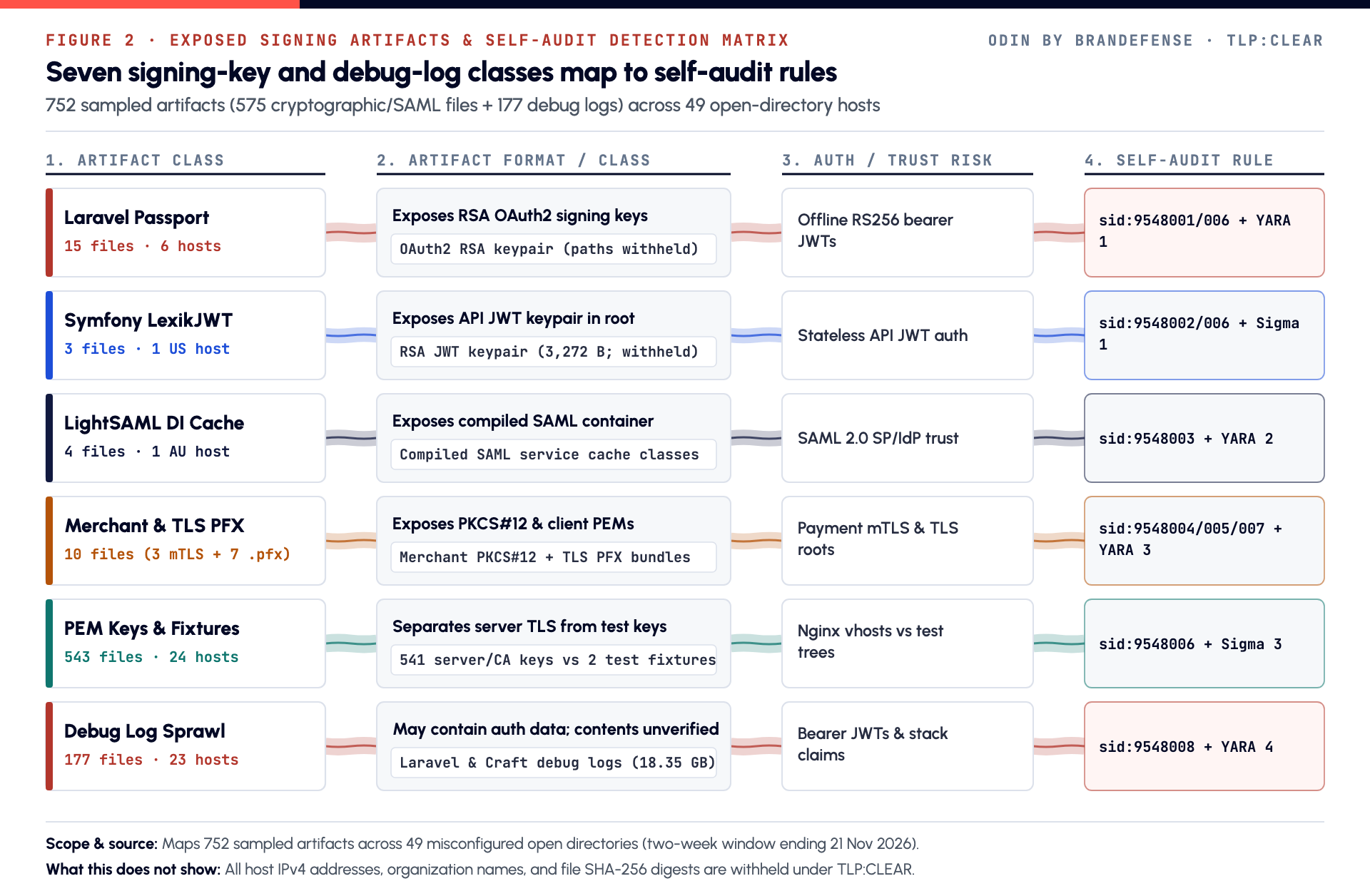
In an analytical risk model (Odin opened zero files and forged zero tokens), using an exposed OAuth2 private key still requires valid JWT claims (iss, aud, sub, jti, scopes) (RFC 7519, T1552.004). Because Laravel stores both OAuth2 keys and application logs under the same storage tree, all six (100%) of the Passport servers co-expose framework debug logs (30 logs):
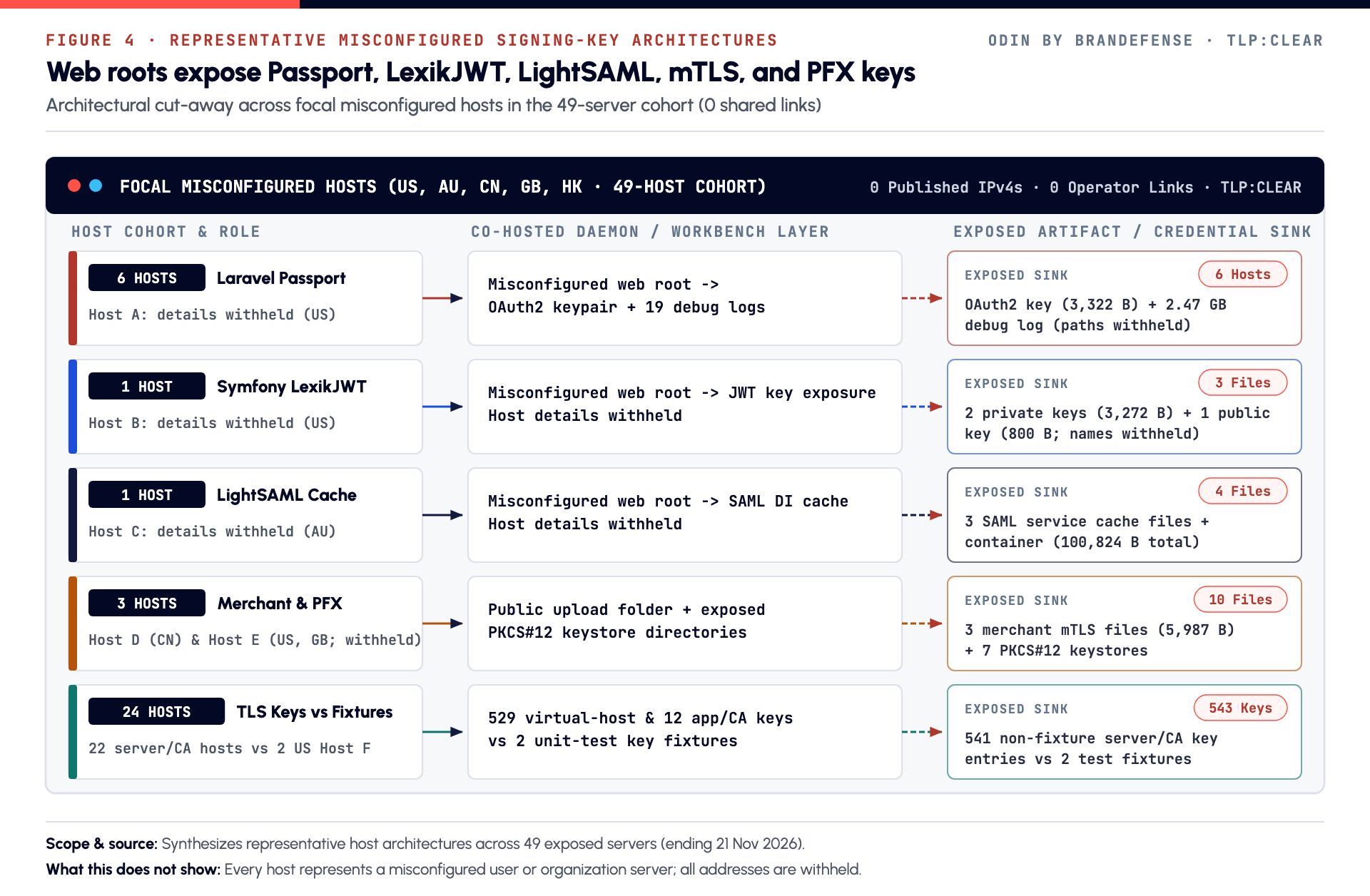
- Host A (United States, 10,000 reported files; address, port, paths, and filenames withheld). This misconfigured owner server exposed an OAuth2 private key (3,322 bytes) and public key (812 bytes) alongside 19 Laravel logs totaling 3,060,213,581 bytes (3.06 GB). Those include a 2,469,606,195-byte (2.47 GB) primary log, a 583.01 MB log, a same-app 1.05 MB log, and 14 daily rotated log files.
- Singapore, Great Britain, and second US Passport servers. One Singapore server (1,541 reported files) paired an OAuth2 private key with a 620,176,544-byte (620.18 MB) debug log in the same app folder. The dual-app Singapore server paired two 3,292-byte keys with 108.13 MB and 5.04 MB logs. The remaining Singapore, Great Britain, and United States servers (502 reported files) also exposed debug logs; all ports, paths, and filenames are withheld.
If an exposed key is valid and a log contains usable claims, an attacker could attempt offline RS256 signing without querying the token endpoint. Log contents, key validity, and API revocation behavior were not tested.
Symfony LexikJWTAuthenticationBundle keypair on Host B
Host B, a misconfigured owner server in the United States, exposed three Symfony JWT key entries totaling 7,344 bytes. Its port, paths, and filenames are withheld.
Symfony LexikJWTAuthenticationBundle uses an RSA keypair by default for stateless API JWT authentication (RS256, RS384, or RS512). Across 1,192 reported files on Host B, two 3,272-byte private-key entries and one 800-byte public-key entry are consistent with a 4096-bit RSA keypair. Whether the key can sign accepted JWTs, or grant administrative access, was not tested.
| Server profile | Host details | Country | Reported files | Key files (bytes) | Co-exposed debug logs | Co-exposure pattern |
|---|---|---|---|---|---|---|
| Host A (Passport + logs) | Port/paths withheld | US | 10,000 | 1 priv (3,322), 1 pub (812) | 19 logs (3.06 GB; max 2.47 GB) | Same-app OAuth2 keypair + 1.05 MB & 2.47 GB debug logs |
| Dual-app Passport server | Port/paths withheld | SG | 10,000 | 2 priv (3,292), 2 pub (812) | 2 logs (108.13 MB & 5.04 MB) | Two Passport keypairs paired 1:1 with framework debug logs |
| Multi-app Passport server | Port/paths withheld | SG | 7,132 | 3 priv (3,322 each) | 6 logs (2.15 MB max, 4 unsized) | Three multi-tenant OAuth2 private keys across app trees |
| Root Passport server | Port/paths withheld | GB | 3,075 | 1 priv (3,322), 1 pub (812) | 1 log (unsized) | Top-level OAuth2 keypair exposed from web root |
| Single-app Passport server | Port/paths withheld | SG | 1,541 | 1 priv (3,322), 1 pub (812) | 1 log (620.18 MB) | Same-app OAuth2 keypair + 620.18 MB debug log |
| Compact Passport server | Port/paths withheld | US | 502 | 1 priv (3,322), 1 pub (812) | 1 log (unsized) | Exposed application OAuth2 keypair + debug log |
| Host B (Symfony LexikJWT) | Port/paths withheld | US | 1,192 | 2 priv (3,272), 1 pub (800) | 0 sampled logs | Exposed Symfony JWT private-and-public keypair |
4. Symfony LightSAML Caches, Merchant mTLS Bundles, and PKCS#12 Keystores
In short
Private-key sprawl also hits enterprise SAML 2.0 federation caches, payment-gateway mutual TLS client bundles, and PKCS#12 archives. Our 49-server cohort includes Symfony LightSAML caches on Host C, merchant mTLS bundles on Host D, 7 .pfx keystores on Host E, and 541 server PEM keys alongside 2 unit-test fixtures (Host F). Block compiled cache directories, public keystore uploads, and private-key extensions at reverse proxies.
Beyond OAuth2 and API JWT files, single sign-on and payment settlement systems rely on other asymmetric credentials. These include SAML 2.0 X.509 certificates, payment merchant mTLS client bundles, and RFC 7292 PKCS#12 keystores (T1552.004, T1606.002).
Compiled Symfony LightSAML container cache on Host C
Host C, a misconfigured owner server in Australia (244 reported files; address, port, paths, and filenames withheld), exposed 4 compiled Symfony SAML cache files totaling 100,824 bytes. Inside an exposed production cache directory, three dependency-injection (DI) container PHP service factories sat beside a 96,832-byte compiled container file:
- Own-credential store service factory (1,126 bytes; filename withheld)
- Credential-resolver service factory (1,228 bytes; filename withheld)
- Federation credential-store service factory (1,638 bytes; filename withheld)
Symfony applications using lightsaml/sp-bundle or lightsaml/symfony-bridge compile SAML parameters into PHP factory classes inside the production container cache. The observed entries correspond to LightSAML credential-store and resolver services. The cache bodies were not inspected, so whether they expose key paths, passphrases, or entity IDs remains unverified.
If a static alias or backup virtual host serves .php files as plain text, HTTP GET can expose compiled SAML container arguments. Even when PHP runs normally, open directory listings reveal the compiled SAML service inventory (T1606.002). If an application also exposes its SAML signing key, an attacker could attempt to forge AuthnRequest, LogoutRequest, or <saml:Assertion> XML signatures.
Payment-gateway merchant mTLS bundles on Host D
Host D, a misconfigured owner server in China (10,000 reported files; address, port, paths, and filenames withheld), exposed 3 payment-gateway merchant mTLS files totaling 5,987 bytes inside a public upload directory:
- Binary PKCS#12 merchant client certificate and key archive (2,774 bytes; filename and UUID prefix withheld)
- PEM merchant client private key (1,704 bytes; filename withheld; key type, bit length, and encryption status unverified)
- PEM-encoded X.509 merchant client certificate (1,509 bytes; filename withheld)
Asian mobile-payment and merchant-acquiring SDKs issue this three-file bundle to authenticate mutual TLS order refunds, enterprise B2C payouts, and settlement queries (T1552.004). Although .p12 archives typically carry password wrapping, saving the 1,704-byte PEM private key inside a public upload folder exposes the key file directly; its encryption status was not verified. Our 120-record secret sample independently corroborates this upload pattern on a separate server in China (address, port, and paths withheld) exposing two merchant PEM private-key files across two tenant folders.
PKCS#12 .pfx keystores (Host E) and 543 PEM keys vs. unit-test fixtures (Host F)
Two remaining classes account for 550 of the 752 sampled files (73.14%):
- Binary PKCS#12
.pfxkeystores (Host E: 7 files across 2 servers, 29,498 bytes). A misconfigured server in the United States (6,203 reported files) exposed a 6,701-byte.pfxarchive beside three PEM.keyfiles (1,743, 251, and 251 bytes). A server in Great Britain (1,878 reported files) exposed six.pfxkeystores (3,736 to 3,849 bytes) across a certificate directory and its web root (RFC 7292, T1552.004). All addresses, ports, paths, and filenames are withheld. - Generic PEM and TLS private keys (543 files across 24 servers, 916,247 bytes). Fifteen servers in Hong Kong (515 to 694 reported files each) exposed 529 TLS key files (522 virtual-host
.keyfiles and 7 server TLS.keyfiles, led by 377 1,705-byte RSA keys). Shared TLS folder structure across those 15 servers and 3 Hong Kong sample servers fits a multi-vhost panel template. Seven standalone servers across the United States, Hong Kong, and Russia exposed 12 keys (32 to 3,212 bytes). Those include three 227-byte ECDSA P-256 keys (one in a CA subfolder) on a US server and a 255-byte configuration key on another US server. By contrast, Host F comprises two servers in the United States (1,539 reported files each) exposing 1,679-byte unit-test signing-key fixtures. All addresses, ports, paths, and filenames are withheld.
| Exposure group | Host details | Country | Files | Size (bytes) | Artifact pattern and posture risk |
|---|---|---|---|---|---|
| Host C: LightSAML DI cache | Port/paths withheld | AU | 4 | 1,126 to 96,832 | Three compiled LightSAML credential-service classes + container cache |
| Host D: Merchant mTLS bundle | Port/paths withheld | CN | 3 | 1,509 to 2,774 | Public upload folder with PKCS#12 bundle, PEM key (1,704 B), and X.509 cert |
Host E: US .pfx keystore | Port/paths withheld | US | 1 | 6,701 | .pfx archive co-exposed beside 3 PEM .key files (251 to 1,743 B) |
Host E: GB .pfx keystores | Port/paths withheld | GB | 6 | 3,736 to 3,849 | One certificate-folder .pfx file (3,849 B) plus 5 web-root .pfx bundles |
| Clustered vhost TLS keys | Ports/paths withheld (15) | HK | 529 | 1,679 to 1,730 | 522 virtual-host TLS .key files + 7 server TLS .key files (35 to 38/host) |
| Standalone app & CA keys | Ports/paths withheld (7) | US, HK, RU | 12 | 32 to 3,212 | Includes CA-scoped ECDSA key (227 B) and configuration key (255 B) |
| Host F: Unit-test fixtures | Ports/paths withheld (2) | US | 2 | 1,679 | Unit-test signing-key fixtures (route to cleanup, not breach paging) |
5. Private-Key Dominance, Multi-Gigabyte Logs, and Owner Boundaries
In short
Pairing our 49-server open-directory cohort (752 files) with the 800-finding 14-day secret dataset and 120-row sample shows two clear takeaways. Asymmetric private keys form the single largest secret-leak class (39.50%), while naive .pem and .key checks mix unit-test fixtures with live application OAuth2 and JWT signing keys. Pair context-aware key triage with strict log rotation.
Security teams often focus secret-scanning budgets on cloud IAM keys and database URLs while treating .pem and .key alerts on web servers as low-priority TLS noise. In our 14-day dataset, private_key findings (316 of 800, 39.50%) outnumber db_connection (121) by 2.61x and aws_access_key (113) by 2.80x.
Multi-gigabyte Laravel and Craft debug-log sprawl (177 files, 18.35 GB)
Across the 49 open-directory servers, 23 hosts (46.94%: 22 Apache and 1 Nginx across the US, Singapore, India, Canada, Great Britain, and the UAE) expose 177 framework debug logs. Those 177 entries (149 sized from 4,851 to 4,402,341,478 bytes plus 28 unsized entries) total 18,345,559,684 bytes (18.35 GB decimal, or 99.994% of all sampled bytes):
- Laravel debug logs (171 files across 22 servers). Five Laravel log files exceed 1.0 GB, and 15 exceed 100 MB. A server in Singapore holds the largest file at 4,402,341,478 bytes (4.40 GB). Next come 3.48 GB on a US server, 2.47 GB on Host A, and 2.04 GB plus 1.72 GB on another US server. That US server also exposed a 104.86 MB daily log inside its public storage tree after an administrator linked the full internal storage folder into the public directory. All ports, paths, and filenames are withheld.
- Craft CMS / Yii2 web debug logs (6 files on 1 US server). Co-exposed beside a 255-byte configuration
.keyfile sat six daily web debug log files (19.15 MB to 112.79 MB, 454.41 MB total). All ports, paths, and filenames are withheld, and the log bodies were not inspected.
Separating unit-test fixtures from non-fixture key entries and corroborating the 120-row sample
Deploying third-party dependency or test directories inside a web root exposes bundled RSA unit-test keys. Examples include open-source library test keys and the two 1,679-byte unit-test signing-key fixtures on Host F in the United States (ports, paths, and filenames withheld). Production OAuth2, JWT, SAML, and mTLS endpoints do not trust unit-test fixtures unless fatally misconfigured.
Route test-fixture matches to web-root cleanup rather than emergency breach paging. Reserve urgent rotation for the 541 non-fixture server and CA PEM key entries, 9 OAuth2 private keys, and 2 JWT private-key rows. Apply the same priority to the 4 LightSAML caches, 3 merchant mTLS files, and 7 .pfx keystores.
The 120-record sample across 24 separate servers reinforces the same pattern across ports 8000 (49), 443 (38), 80 (23), 10081 (4), 8080 (3), 554 (2), and 9999 (1); host-level ports and paths are withheld.
| Server group in 120-row sample | Servers (24) | Records (120) | Secret types matched | Exposed artifact classes (ports/paths withheld) |
|---|---|---|---|---|
| China multi-key server | 1 | 49 | private_key (49) | Certificate-directory .key and .pem private-key trees |
| Hong Kong virtual-host TLS cluster | 3 | 35 | private_key (35) | Reverse-proxy and virtual-host TLS private-key files |
| China application and merchant servers | 4 | 13 | private_key (13) | Two multi-tenant merchant mTLS private keys + 11 PEM keys |
| India application web servers | 7 | 11 | private_key (11) | App-scoped .key, .pem, and configuration key files |
| GCP OAuth & service-account hosts | 3 | 6 | 2 OAuth, 2 SA, 2 key | GB (2 OAuth), Spain (1 SA, 1 key), HK (1 SA, 1 key) |
| DE, US, VN, ID, IT web servers | 6 | 6 | private_key (6) | Data-directory and application PEM private-key files |
Owner-versus-operator boundaries
- All 73 servers (49 directory hosts plus 24 sample hosts) are misconfigured owners. Each reflects an unlocked web root, mislinked storage directory, exposed compiled container cache, public upload folder, or ad-hoc HTTP listener. That includes the 15 Hong Kong virtual-host TLS servers (0 offensive tools observed; all ports, paths, and filenames withheld).
- Zero keys opened or tokens forged. Odin tested 0 passphrases, decrypted 0
.p12/.pfxbundles, and forged 0 OAuth2, JWT, SAML, or mTLS requests.
6. What Defenders Should Do
Web platform and virtual-host engineering
- Point Laravel, Symfony, and Craft web roots strictly at their dedicated public web directories and disable directory indexing.
- Never symlink internal application storage trees into public web folders, and block storage, JWT configuration, compiled cache, TLS key, and certificate directories at reverse proxies.
- Shut down ad-hoc Python HTTP file listeners on non-standard ports, and strip dependency and unit-test fixture folders from production web builds.
Identity, OAuth2, JWT, and SAML architecture
- Move Laravel Passport OAuth2, Symfony LexikJWT, and LightSAML signing keys out of flat files into non-exportable cloud KMS or HSM signing APIs.
- Publish
kid-pinned JWKS endpoints so signing keys can rotate cleanly, and enforcejtitoken revocation checks on sensitive API endpoints.
Payment security, logging, and SOC
- Never save payment-gateway merchant mTLS bundles inside public upload trees. Move merchant keys into secret vaults, enforce payment API caller IP allowlists, and revoke any exposed client certificate.
- Set
APP_DEBUG=falsein production and redactAuthorizationandCookieheaders in application loggers. Enforce size-capped log rotation so multi-gigabyte framework debug logs never build up, and deploy the rules in Chapter 7.
7. Detection Rules
The full rules are in the Detection rules tab. Static syntax checks (lint_suricata.py with 0 problems, plus modifier and fixture checks) passed cleanly. Suricata, YARA, Sigma, and Kusto engines were not installed in this environment, and rules were not replayed against live traffic. Test and tune them in staging before production inline blocking.
| Rule file | What it catches |
|---|---|
odin_exposed_oauth_jwt_saml_signing_keys.rules | Suricata 7: eight rules for inbound requests on .key, .pem, .p12, .pfx, and .log URIs plus outbound HTTP 200 PEM, compiled SAML cache, and PKCS#12 responses |
sentinel_exposed_signing_keys_and_saml_cache_hunt.kql | Sentinel and Defender XDR: http.server, key-generation commands, or .key, .pem, .p12, .pfx, and .log processes joined with active web ports |
sigma_exposed_oauth_jwt_saml_and_merchant_keys.yml | Sigma (3 rules): web HTTP 200/206 key, keystore, or log downloads, Linux http.server or key chmod commands, and key files written inside web document roots |
odin_exposed_signing_keys_saml_and_merchant_certs.yar | YARA (4 rules): PEM RSA/EC private keys, compiled Symfony LightSAML cache classes, RFC 7292 PKCS#12 keystores, and Laravel/Craft auth debug logs under 50 MB; use URI or webserver checks for larger logs |
How the Suricata signatures work
| SID | Looks for | Why |
|---|---|---|
| 9548001 | Inbound GET ending in .key | Catches HTTP requests for private-key file extensions (block candidate) |
| 9548002 | Inbound GET ending in .pem | Catches HTTP requests for PEM key or certificate extensions (block candidate) |
| 9548003 | Outbound 200 body with SymfonyComponentDependencyInjection and LightSamlCredential | Self-audit alert when an internal host serves compiled LightSAML container cache classes |
| 9548004 | Inbound GET ending in .p12 | Catches HTTP requests for PKCS#12 .p12 client bundles (block candidate) |
| 9548005 | Inbound GET ending in .pfx | Catches HTTP requests for binary PKCS#12 .pfx keystores (block candidate) |
| 9548006 | Outbound 200 body containing -----BEGIN ... PRIVATE KEY----- | Self-audit alert when an internal host serves a PEM private key |
| 9548007 | Outbound 200 body with ASN.1 30 82, 02 01 03 30, and pkcs7-data OID | Self-audit alert when an internal host serves a PKCS#12 archive |
| 9548008 | Inbound GET ending in .log | Catches HTTP requests for application debug-log file extensions (block candidate) |
Deploy SIDs 9548001, 9548002, 9548004, 9548005, and 9548008 as alerts; add separately validated proxy or WAF blocks for those URI extensions. Treat any SID 9548003, 9548006, or 9548007 outbound 200 alert on your network as a self-audit exposure check, verifying first whether a matched key sits inside a unit-test fixture folder.
How the KQL, Sigma, and YARA rules work
The Sentinel KQL query looks back 7 days across DeviceProcessEvents and DeviceNetworkEvents. It finds python, php, openssl, chmod, cp, mv, tar, nginx, or apache2 commands referencing http.server, passport:keys, lexik:jwt:generate-keypair, pkcs12 -export, genrsa, ecparam, or .key, .pem, .p12, .pfx, and .log extensions. It joins those processes with active sockets on ports 80, 443, 8000, 8080, and 8443 outside two build hosts (pki-vault-builder-01.corp[.]example and ci-artifact-signer-01.corp[.]example).
Sigma rule 1 flags web HTTP 200/206 responses on URIs ending in .key, .pem, .p12, .pfx, or .log. Sigma rule 2 flags Linux http.server or key chmod commands outside the two build hosts, and Sigma rule 3 flags .key, .pem, .p12, or .pfx files written under /var/www/, /public_html/, or /htdocs/.
| YARA rule | Fires when |
|---|---|
ODIN_Exposed_PEM_RSA_Or_EC_Private_Signing_Key | Under 64 KB, PEM BEGIN/END private key blocks pair with ASN.1 Base64 markers |
ODIN_Compiled_Symfony_LightSAML_Credential_Store_Cache | Under 256 KB, LightSamlCredential, X509Credential, or KeyHelper::createPrivateKey pair with Symfony DI container markers |
ODIN_PKCS12_Merchant_Or_TLS_Keystore_Bundle | Under 128 KB, RFC 7292 PKCS#12 v3 bytes pair with pkcs7-data and bag OIDs |
ODIN_Exposed_Laravel_Or_Craft_Debug_Log_With_Auth_Context | Under 50 MB, Laravel or Craft error markers pair with Authorization, Bearer eyJ, or LeagueOAuth2Server |
MITRE ATT&CK mapping
| Tactic | Technique | Observed exposure pattern | Detection |
|---|---|---|---|
| Credential Access | T1552.004 Private Keys | 9 OAuth2 private keys, 2 JWT private keys, 3 merchant mTLS files, 7 .pfx, 541 PEM keys | SIDs 9548001, 9548002, 9548004 to 9548007; Sigma 1 to 3; YARA 1 & 3; KQL |
| Credential Access | T1606.002 SAML Tokens (risk model) | Compiled LightSAML DI container cache; SAML key exposure and token forgery unverified | SID 9548003; YARA 2 (compiled container content checks) |
| Credential Access | T1552.001 Credentials In Files | 177 Laravel & Craft debug logs (18.35 GB, 6 of 6 Passport hosts) | SID 9548008; Sigma 1; KQL; YARA 4 only for files under 50 MB |
8. Indicators
The Indicators tab holds 0 published indicators: 0 network addresses and 0 file hashes. All 49 open-directory server addresses, all 24 sample server addresses, and all file SHA-256 digests, ports, paths, and filenames are withheld because every host is a misconfigured owner rather than adversary infrastructure. Eighteen structural artifact and URI classes appear in this report only for defensive self-audit.
| Type | Count | Where to use it |
|---|---|---|
| Network addresses (Indicators tab) | 0 | All 73 misconfigured server addresses are withheld |
| File hashes (Indicators tab) | 0 | All private-key, certificate, cache, and log hashes are withheld |
| Self-audit artifact and URI classes (in text) | 17 | Audit owned web roots, compiled caches, and public upload folders |
| Unit-test fixture class (in text) | 1 | Separate unit-test fixture sample keys from non-fixture key alerts |
Structural self-audit patterns in this report
| Pattern | Type | Exposure surface | Defensive self-audit use |
|---|---|---|---|
| OAuth2 private-key exposure | URI class | Laravel Passport OAuth2 | Audit owned web roots for accessible signing keys; rotate exposed keys |
| OAuth2 public-key exposure | URI class | Laravel Passport OAuth2 | Audit owned web roots for exposed OAuth2 verification keys and storage trees |
| API JWT private-key exposure | URI class | Symfony LexikJWT | Audit owned web roots for accessible JWT signing keys; rotate keypairs |
| API JWT public-key exposure | URI class | Symfony LexikJWT | Remove JWT configuration directories from web document roots |
| Compiled DI cache directory exposure | Directory class | Symfony LightSAML cache | Block HTTP access to compiled production container cache directories |
| SAML own-credential store cache | Artifact class | Symfony LightSAML cache | Audit web roots for compiled LightSAML own-credential store classes |
| SAML federation credential-store cache | Artifact class | Symfony LightSAML cache | Audit web roots for compiled LightSAML federation credential stores |
| SAML credential-resolver cache | Artifact class | Symfony LightSAML cache | Audit web roots for compiled LightSAML credential-resolver classes |
| Merchant mTLS PKCS#12 bundle | Artifact class | Payment merchant mTLS | Block public downloads; revoke and reissue merchant payment mTLS bundles |
| Merchant mTLS PEM private key | Artifact class | Payment merchant mTLS | Purge exposed merchant PEM private-key files from public upload trees |
| Merchant mTLS X.509 certificate | Artifact class | Payment merchant mTLS | Audit public upload folders for merchant X.509 client certificates |
| TLS PKCS#12 keystore directory | Directory class | TLS .pfx keystores | Block certificate directories and web-root .pfx keystore downloads |
| Reverse-proxy TLS private key | URI class | Reverse-proxy PEM keys | Move virtual-host and web-server TLS keys outside web document roots |
| Data-directory PEM private key | URI class | Generic PEM private keys | Scan application data and CA subfolders for exposed PEM private keys |
| Primary Laravel debug-log exposure | URI class | Framework debug logs | Block public log access; turn off APP_DEBUG and rotate logs |
| Daily rotated Laravel debug logs | URI class | Framework debug logs | Block HTTP access to dated application debug-log archives |
| Daily rotated Craft/Yii2 debug logs | URI class | Framework debug logs | Block HTTP access to Craft CMS and Yii2 web debug-log dumps |
| Unit-test signing-key fixture | Fixture class | Unit-test calibration | Separate unit-test sample keys from non-fixture signing-key alerts |
Withheld: all 49 open-directory server IPv4s, all 24 sample server IPv4s, host ports, file paths, filenames, organization folder names, merchant UUID prefixes, compiled container hashes, secret values, and file SHA-256 digests.
9. Scope and Limits
- Window. All observations come from a two-week observation window ending 21 November 2026.
- Static review, zero keys opened or tokens forged. File paths, sizes, and secret counts were reviewed statically without opening private keys, testing passphrases, forging tokens, or contacting any server. Passphrase strength and API
jtichecks are unmeasured.
- Offline forgery sequence is an analytical model. Figure 3 models how co-exposed OAuth2 private keys and framework debug logs interact architecturally; Odin performed zero token minting.
- Misconfigured owners, not operators. All 49 open-directory hosts and 24 sample hosts are treated as user, developer, or organization servers, including the 15 Hong Kong virtual-host TLS servers. All host addresses, host-linked ports, paths, filenames, and file hashes are withheld.
- Server file dates vs observation window. Upload directories (on Host D) and daily rotated framework debug logs carry server dates on disk (withheld in this public edition). Earlier 2026 first-seen timestamps on directory records are historical metadata, never Odin monitoring before November 2026.
- Rule testing. Static checks (
lint_suricata.pywith 0 problems, plus modifier and fixture checks) passed on 21 November 2026. Suricata, YARA, Sigma, and Kusto engines were not installed locally, so validate rules before production enforcement.
10. Sources
- MITRE ATT&CK. T1552.004 Unsecured Credentials: Private Keys. https://attack.mitre.org/techniques/T1552/004/ (verified 21 November 2026)
- MITRE ATT&CK. T1606.002 Forge Web Credentials: SAML Tokens. https://attack.mitre.org/techniques/T1606/002/ (verified 21 November 2026)
- MITRE ATT&CK. T1552.001 Unsecured Credentials: Credentials In Files. https://attack.mitre.org/techniques/T1552/001/ (verified 21 November 2026)
- MITRE ATT&CK. T1528 Steal Application Access Token. https://attack.mitre.org/techniques/T1528/ (verified 21 November 2026)
- IETF RFC 7519. JSON Web Token (JWT). https://www.rfc-editor.org/rfc/rfc7519 (verified 21 November 2026)
- IETF RFC 6749. The OAuth 2.0 Authorization Framework. https://www.rfc-editor.org/rfc/rfc6749 (verified 21 November 2026)
- IETF RFC 7292. PKCS #12: Personal Information Exchange Syntax v1.1. https://www.rfc-editor.org/rfc/rfc7292 (verified 21 November 2026)
- OASIS Standard. Assertions and Protocols for the OASIS Security Assertion Markup Language (SAML) V2.0. https://docs.oasis-open.org/security/saml/v2.0/saml-core-2.0-os.pdf (verified 21 November 2026)
- Laravel Documentation. Laravel Passport OAuth2 Server (v11.x). https://laravel.com/docs/11.x/passport (verified 21 November 2026)
- Symfony Documentation. LexikJWTAuthenticationBundle. https://symfony.com/bundles/LexikJWTAuthenticationBundle (verified 21 November 2026)
- OWASP Cheat Sheet Series. OAuth 2.0 Protocol Cheat Sheet. https://cheatsheetseries.owasp.org/cheatsheets/OAuth2_Cheat_Sheet.html (verified 21 November 2026)
Frequently asked questions
What did we find across the 49 misconfigured web servers?
Single sign-on portals, stateless REST APIs, and payment gateways rely on asymmetric RSA and ECDSA private keys. Those keys sign tokens and authenticate payouts. Frameworks such as Laravel and Symfony expect only the public web folder to sit inside the web server's document root, which defenders can audit with external attack surface management.
Why does 100% debug-log overlap multiply offline token-forgery risk?
Across all 49 servers, 23 hosts expose 177 debug logs (171 Laravel log files and 6 Craft CMS log files) totaling 18.35 GB. Five single logs exceed 1.0 GB, peaking at 4.40 GB on a server in Singapore. In total, 100% (6 of 6) of the servers exposing Laravel Passport OAuth2 private keys also expose framework debug logs.
Why must posture teams separate unit-test fixtures from non-fixture key entries, and why are all IPs withheld?
Asymmetric private_key detections (316 of 800, 39.50%) outnumber db_connection (121) and aws_access_key (113) combined in our 14-day dataset. However, scanning web roots strictly for -----BEGIN RSA PRIVATE KEY----- headers mixes live application signing keys with bundled open-source and unit-test fixture files. Those include the two 1,679-byte test signing keys on Host F. Separating test-fixture folders from live application key folders lets defenders fix unlocked document roots without triggering false breach pages.