
1. Executive Summary
In short
In a two-week observation window ending 21 November 2026, Odin by Brandefense observed five misconfigured open web directories reporting 17,255 files alongside 250 internet-wide TacticalRMM endpoints. All five directories belong to misconfigured owners or MSP administrators with zero cross-host links. They expose payment-kiosk card-reader drivers, paths resembling a Linux root tree, organization-named NinjaOne and Action1 installers, and medical DICOM binaries. Two TacticalRMM endpoints carry webmail-lure certificate labels, but their abuse remains unconfirmed. Close open web shares, disable FollowSymLinks, gate RMM installers, and require behavioral evidence before blocking.
Payment kiosks, cloud virtual machines, healthcare gateways, and MSP shares hold sensitive drivers, system files, and RMM installers. Leaving directory indexing open or exposing a root-like path inside a web root makes those files readable over HTTP. We reviewed directory metadata statically, installed zero packages, and contacted zero consoles. We withheld all five owner addresses (Host A through Host E), all file hashes, and all 250 TacticalRMM endpoints (248 hosts).
Open kiosk and cloud directories expose hardware drivers and root-like paths.
One dual-listener server (Host A) exposes 180 payment-kiosk entries, including .NET debug symbols, motorized smart-card and RFID libraries, 134 invoice logs, and camera JPEGs. In Canada, an Apache server (Host B) lists 10,000 reported paths resembling Linux root files under a symlink-named web path, including a cloud guest-agent binary and TLS material.
Open MSP shares expose organization-named RMM installers and a 20.4 GB backup ISO.
Two United States web shares (Host C reporting 684 files and Host D reporting 6,366 files) expose eight NinjaOne .msi installers and one mirrored Action1 .msi installer. Host C also lists a 20.40 GB Veeam 13.0.1 backup ISO. If those RMM packages contain reusable enrollment credentials and the console allows automatic enrollment, an outside party could register an unapproved agent.
Two of 250 TacticalRMM endpoints carry webmail-lure certificate labels without confirmed abuse.
Although 117 of 250 examined TacticalRMM endpoints sit on commercial cloud VPS providers, 115 use standard custom-domain TLS certificates consistent with normal MSP deployments. Two cloud VPS endpoints (0.80%) have webmail-lure certificate labels in the source register. Their abuse remains unconfirmed; withhold both addresses until independent protocol or behavioral evidence supports blocking.
Three Decisions for Leaders
- Move MSP RMM installers behind authenticated portals and rotate any reusable tokens. Delete organization-named
NinjaOne,Action1, and remote-support.msifiles from public HTTP or FTP folders. If a package carries a reusable tenant token, rotate it and require manual console approval for new agent registrations. - Disable web symbolic-link traversal and isolate kiosk and medical shares. Set
Options -Indexes -FollowSymLinks -SymLinksIfOwnerMatchon Apache anddisable_symlinks on;on Nginx, and verify that zero symbolic links insideDocumentRootpoint outside the web root. Restrict the payment-kiosk listeners and close the unauthenticated HTTP directory servingDCMTKbinaries. - Require independent behavioral evidence before blocking dual-use RMM infrastructure. Keep the two webmail-lure TacticalRMM endpoints and the 115 custom-domain cloud RMM servers on review watchlists until protocol or endpoint telemetry confirms abuse. Monitor cloud RMM activity through endpoint
msiexeclogs rather than single-signal IP blocklists.
The Study in Numbers
| Number | What it is |
|---|---|
| 17,255 | Combined files reported or listed across five owner shares (925 sampled entries, 582 unique paths) |
| 5 + 0 | Misconfigured owner hosts (Host A to Host E, 0 published IPs) with 0 overlap against 250 TacticalRMM rows |
| 180 & 10,000 | Payment-kiosk entries across 4 sub-trees (Host A) and root-like web paths reported on Host B (CA) |
| 9 + 20.40 GB | Eight NinjaOne and one organization-named Action1 .msi files, plus a 20.40 GB Veeam 13.0.1 ISO |
| 25 | Static Linux DCMTK 3.6.9 medical imaging binaries exposed on an unauthenticated HTTP listener (Host E) |
| 39,887 / 250 | Global TacticalRMM sightings across 119 countries (340 feed-verified) and 250 examined endpoints (248 hosts) |
| 2 (0.80%) / 0 | Webmail-lure TacticalRMM endpoints (abuse unconfirmed) and 0 published blocklist IPs or hashes in the Indicators tab |
How to use this report.
Leaders and MSP directors can start with Chapters 1, 5, and 6. Cloud, point-of-sale, healthcare, and IT platform engineers should review Chapters 3 and 4, then run the checklist in Chapter 6. SOC analysts and threat hunters should go to Chapters 5, 7, and 8, plus the Detection rules tab and the Indicators tab. Attribution boundaries and limits sit in Chapter 9.
2. Five Open Directories and 250 TacticalRMM Endpoints
In short
Five open web directories listed 17,255 files (925 sampled entries and 582 unique paths across 11 slices) in the two-week window ending 21 November 2026. Paired with 250 TacticalRMM endpoints (248 hosts, 0 shared hosts), they show how accidental owner exposure differs from unconfirmed dual-use RMM candidates. Audit your own perimeter for open shares and require behavioral evidence before blocking RMM endpoints.
Treating every open directory or dual-use RMM server as hostile disrupts legitimate MSPs, clinics, and retail operators. Ignoring world-readable shares that defenders can find through external attack surface management leaves RMM installers, debug symbols, and root-like Linux paths exposed (T1190, T1219, T1552.001).
We grouped the five open directories (Host A through Host E) as an analytical five-surface defensive model alongside a 250-endpoint TacticalRMM comparison. Nothing links the five open-directory servers to one another (0 shared IPs, certificates, or tenant IDs). In addition, 0 hosts overlap between the five shares and the 250 TacticalRMM rows.
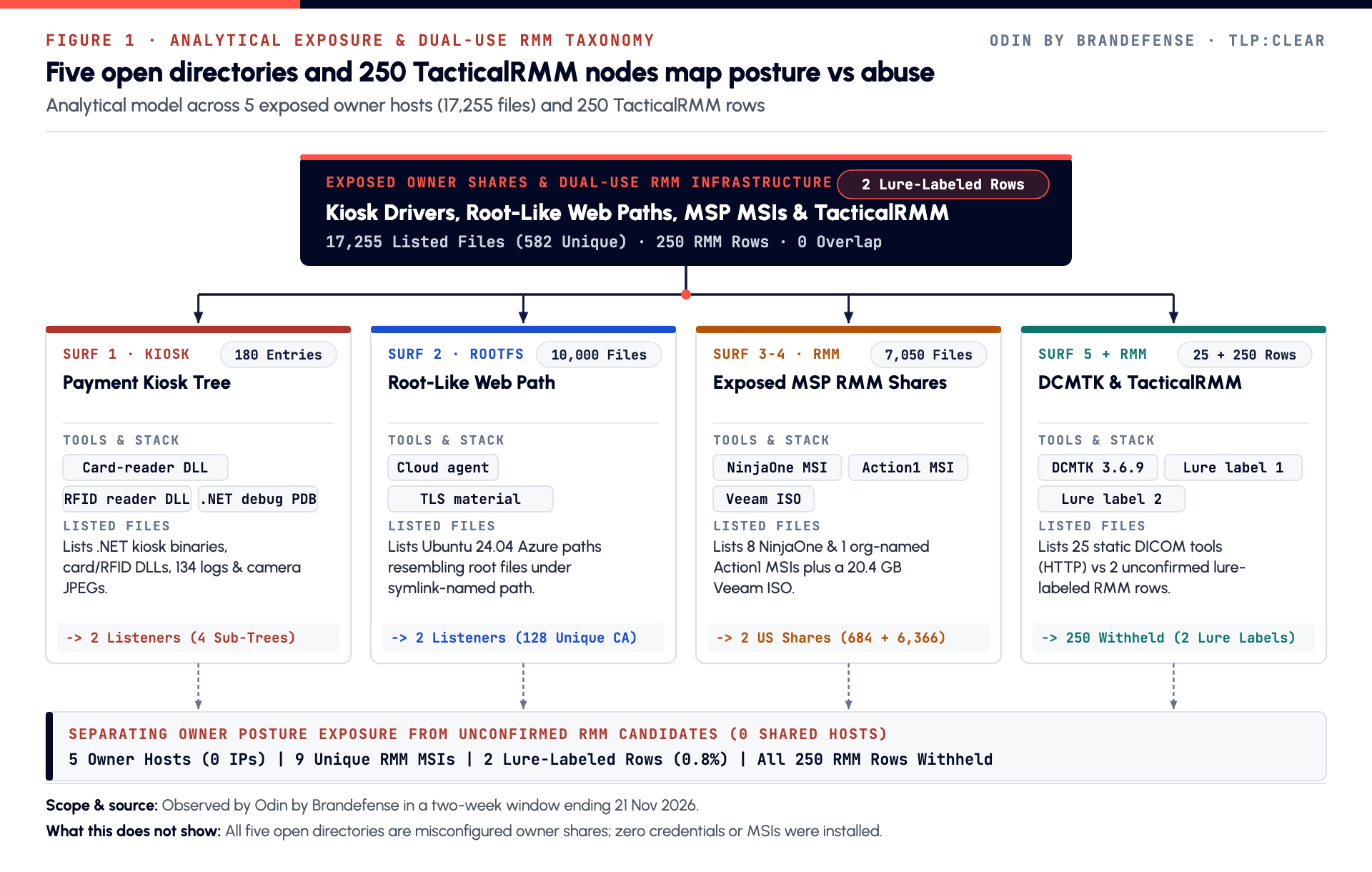
Five misconfigured owner and MSP shares (Host A through Host E)
Across 11 directory slices, the five hosts list 17,255 combined per-host files, yielding 925 sampled rows and 582 unique paths (568 sized plus 14 unsized entries on Host E). Every server reflects an unattended kiosk, cloud virtual machine, MSP/IT share, or medical utility folder left open over HTTP rather than adversary infrastructure.
The directory listings do not establish defects in the named software or hardware libraries. Those products include NinjaOne, Action1, Veeam, Splashtop, Datto RMM, SonicWALL, Cisco, Apache, Nginx, Microsoft WALinuxAgent, and OFFIS DCMTK. The listings show public HTTP exposure; Odin did not verify the web-server directives, symlink construction, or folder permissions.
| Host alias | Listeners & country | Slices | Listed / unique | Sampled size | Key exposed operational files |
|---|---|---|---|---|---|
Host A (kiosk) | Two listeners | 4 | 180 / 180 | 10,128,354 B (10.13 MB) | .NET kiosk binaries, .pdb debug symbols, card-reader and RFID DLLs, 134 invoice logs, 3 camera JPEGs |
Host B (root-like path) | Two listeners (CA) | 2 | 10,000 / 128 | 133,399,463 B (133.40 MB) | Cloud guest agent, TLS material, Python library files, and cloud Linux kernel images under a root-like web path |
Host C (MSP share) | Two listeners (US) | 2 | 684 / 120 | 141,992,037,486 B (141.99 GB) | 8 NinjaOne .msi packages (6 at 72.35 MB) and a Veeam 13.0.1 backup ISO (20.40 GB) |
Host D (Action1 FTP) | Two listeners (US) | 2 | 6,366 / 129 | 3,187,066,013 B (3.19 GB) | Mirrored Action1 .msi (6.65 MB, 3 paths), Cisco VPN predeploy .zip, 43 ARM SBC .xz images |
Host E (DCMTK tools) | One HTTP listener | 1 | 25 / 25 | 54,099,776 B (11 sized) | Static Linux DCMTK 3.6.9 binaries (image codec tools, clinical document converters, and DICOM network utilities) |
Connecting exposed MSP shares to internet-wide TacticalRMM observations
Host C and Host D show how legitimate RMM administration packages leak when organization-named .msi installers sit in public web folders. Meanwhile, threat actors deploy self-hosted TacticalRMM servers on rented cloud VPS instances for post-intrusion access (T1219).
In the two-week window ending 21 November 2026, TacticalRMM (management category) generated 39,887 global sightings across 119 countries (340 feed-verified). We reviewed 250 confirmed-status endpoints across 248 hosts (0 overlap with Host A through Host E). The results show why defenders using cyber threat intelligence must pair hosting type with X.509 certificate themes before blocking dual-use RMM servers.
| Study population | Scope | Examined rows | Hosts | Published IPs | Withheld rows | Action |
|---|---|---|---|---|---|---|
Five open shares (Host A to Host E) | 17,255 files | 925 (582 unique) | 5 | 0 | 5 hosts (100%) | Self-audit & gate installers |
| Webmail-lure TacticalRMM candidates | (39,887 global) | 2 (0.80%) | 2 | 0 | 2 (100%) | Withheld; review before blocking |
| Dual-use cloud VPS TacticalRMMs | (340 verified) | 115 (46.00%) | 115 | 0 | 115 (100%) | Hunt via msiexec logs |
| Regional & MSP hosting candidates | (119 countries) | 111 (44.40%) | 110 | 0 | 111 (100%) | Watchlist only |
| Subscriber & mail collisions | (ISP / CDN) | 22 (8.80%) | 21 | 0 | 22 (100%) | Do not block |
3. Exposed Payment Kiosks and Root-Like Web Paths
In short
Unprotected maintenance listeners on physical payment terminals and root-like web paths on cloud Linux servers expose hardware command libraries, debug symbols, and system files. Host A exposes 180 kiosk entries across two listeners, including .NET debug symbols, card-reader and RFID DLLs, 134 invoice logs, and camera JPEGs. In Canada, Host B reports 10,000 paths resembling Linux root files under a root-like web path. Isolate kiosk listeners and disable FollowSymLinks.
Cyber-physical terminals and cloud virtual machines rarely trigger CVE-only vulnerability scans when misconfigured. However, open HTTP directories on these assets expose peripheral drivers and OS file paths (T1190, T1552.001).
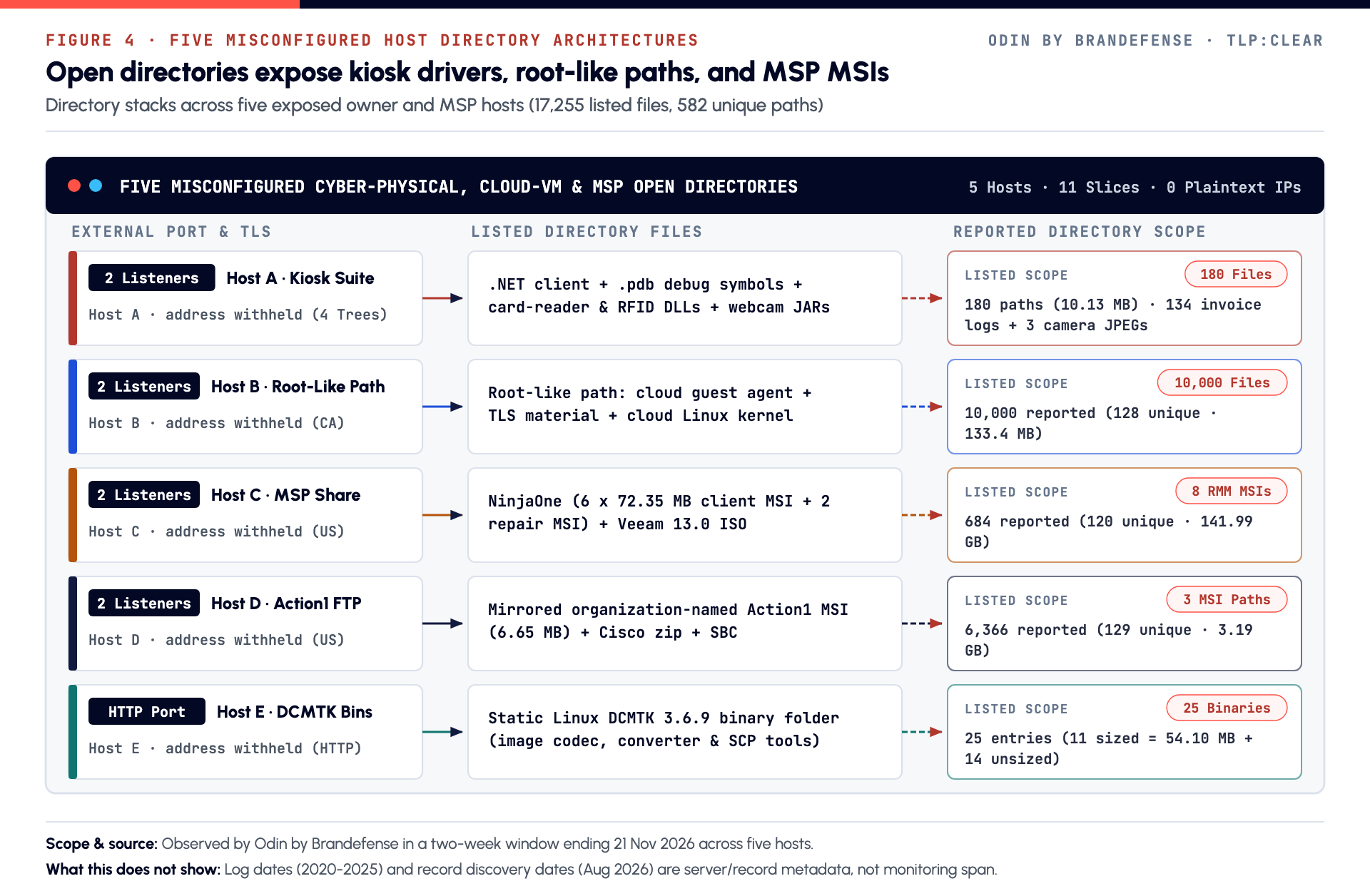
Motorized card-reader drivers, .pdb symbols, and invoice logs on Host A
Host A (address and ports withheld) exposes four sub-trees across a primary HTTP listener (177 entries) and an HTTPS listener (3 entries). Together they total 180 unique sized paths (10,128,354 B / 10.13 MB, observed on 21 November 2026). Its four Spanish-language application, utility, invoice-log, and camera folders belong to an unattended payment and invoicing kiosk.
One kiosk application sub-tree lists 11 entries totaling 396,501 B, including a .NET client and debug host. The client measures 187,904 B and the debug host measures 22,696 B. The folder also lists five XML and application configuration files (3,128 B, 1,163 B, 835 B, 490 B, and 34 B) and a 27 B shutdown batch script.
Beside them sits a .NET debug-symbol file (106,496 B) whose contents Odin did not inspect. The directory also serves two Windows DLLs (40,960 B and 32,768 B) for motorized smart-card readers and dispensers.
A second primary-listener sub-tree lists 32 entries totaling 9,434,398 B. It exposes the main kiosk executable (238,648 B), a companion Java archive (212,536 B), and a reset archive (7,818 B). It pairs those binaries with two contactless RFID reader and communications DLLs (307,712 B and 257,024 B). Nine Java archives in a library subfolder map the peripheral stack and cover JNA, media, JDBC, webcam, barcode, and serial support.
Beside those libraries sit two printer and application configuration files (984 B and 88 B) and three batch scripts (64 B, 64 B, and 24 B). The folder also lists 13 legacy log files dated 2020-3-10 to 2022-11-9 on disk (33 B to 1,237 B).
The third primary-listener sub-tree exposes 134 electronic invoice monitor logs (7,508 B total, 32 B to 456 B). Those files span 131 calendar dates on disk from 2024-6-22 to 2025-1-8. They consist of 131 daily log files, two configuration logs (270 B and 161 B), and one error log dated 2024-7-2 (116 B).
On the HTTPS listener, a fourth sub-tree (3 entries, 289,947 B) serves three kiosk camera JPEG captures (156,672 B, 133,120 B, and 155 B). All 2020 to 2025 log dates are local file dates on disk, not Odin's observation period.
Root-like web path exposure on a Canada cloud VM (Host B)
In Canada (CA), Host B (address and ports withheld) serves an Apache tree across two web listeners, reporting 10,000 files per listener on 20 November 2026. The directory record carries an initial discovery date of 9 August 2026.
We sampled 240 rows, or 120 per listener, and found 128 unique sized paths. They total 133,399,463 B (133.40 MB), with file sizes from 72 B to 49,386,400 B. The listeners share 112 paths; each has eight listener-specific paths.
The sampled paths resemble Linux root files under a symlink-named web path on an Ubuntu 24.04 Azure VM; Odin did not verify the link target (CWE-59, T1190, T1552.001). Odin also did not inspect the Apache configuration or establish how the path tree was created:
- System library subtree under the root-like web path (92 unique paths). The listing includes TLS material, six Python files, and 11 Ubuntu Pro scripts. The TLS bundle measures 180,744 B, the Python 3.12 module measures 1,984 B, and a hardware database binary measures 12,292,121 B. The subtree also lists 62 shared libraries, including 433,152 B TLS and 1,258,291 B NSS files.
- System configuration subtree under the root-like web path (22 unique paths). The listing includes cloud-init shell profile scripts, service init scripts, runlevel links, a kernel-module configuration file, and a Python startup customization script.
- Runtime binary subtrees under the root-like web path (10 unique paths). The listing includes Python 3.12 (8,020,928 B), PHP 8.3 (5,833,168 B), text-editor (4,130,640 B), Perl
5.38.2(4,023,408 B), and dynamic-linker (236,616 B) binaries. - Boot and system-administration subtrees under the root-like web path (4 unique paths). The listing includes an initial ramdisk (49,386,400 B), an Azure Linux kernel (16,777,216 B), a kernel symbol map (10,380,902 B), and the Azure Guest Agent (252,384 B).
Security tests often use a symlink folder name when checking link-following flaws. Because 0 webshells or implants sit in the 128 sampled paths, directory metadata cannot separate an uncleaned owner test from an earlier upload check. We therefore withhold Host B's address.
| Host & listener | Sub-tree or root group | Unique paths | Size range (B) | Key exposed files | Posture risk |
|---|---|---|---|---|---|
Host A (primary listener) | Kiosk terminal suite sub-tree | 11 | 27 to 187,904 | .NET client (187,904 B), .NET debug symbols (106,496 B), two motorized card-reader DLLs (40,960 B and 32,768 B) | .NET symbol file & card-dispenser DLL exposure |
Host A (primary listener) | Payment kiosk application sub-tree | 32 | 24 to 2,681,931 | Main kiosk executable (238,648 B), two RFID reader and communications DLLs (307,712 B and 257,024 B), 9 Java archives | RFID protocol mapping, JDBC recon & 13 (2020 to 2022) logs |
Host A (primary listener) | Electronic invoice log sub-tree | 134 | 32 to 456 | 131 daily log files (2024-6-22 to 2025-1-8 file dates), 2 config logs, 1 error log | Electronic invoicing activity & config disclosure |
Host A (HTTPS listener) | Kiosk camera capture sub-tree | 3 | 155 to 156,672 | Three kiosk camera JPEG captures (156,672 B, 133,120 B, and 155 B) | Privacy leak from physical kiosk camera captures |
Host B (two listeners) | Boot & system-binary subtrees (CA) | 4 | 252,384 to 49,386,400 | Cloud guest agent (252,384 B), initial ramdisk (49.39 MB), cloud Linux kernel image, and kernel symbol map | Azure Guest Agent read, ramdisk & kernel symbols |
Host B (two listeners) | System library & config subtrees (CA) | 114 | 72 to 12,292,121 | TLS material (180,744 B), six Python 3.12 files (1,984 B), 11 Ubuntu Pro scripts, 62 shared libraries | Root-like config & TLS bundle disclosure |
4. Exposed MSP RMM Shares and Medical DICOM Binaries
In short
Staging organization-named MSP RMM .msi installers on world-readable HTTP or FTP servers exposes client deployment packages alongside backup media and virtual disks. Two US shares (Host C with 684 files and Host D with 6,366 files) expose eight NinjaOne .msi files, one mirrored Action1 .msi file, and a 20.40 GB Veeam ISO. Host E exposes 25 static DCMTK tools over HTTP. Gate RMM shares and rotate any reusable tokens.
MSPs and corporate IT teams generate .msi packages from cloud RMM portals (NinjaOne, Action1, Datto RMM, Splashtop) for endpoint onboarding (T1219, T1552.001). Leaving client-named .msi shares on open HTTP or FTP directories exposes those installers to external visitors.
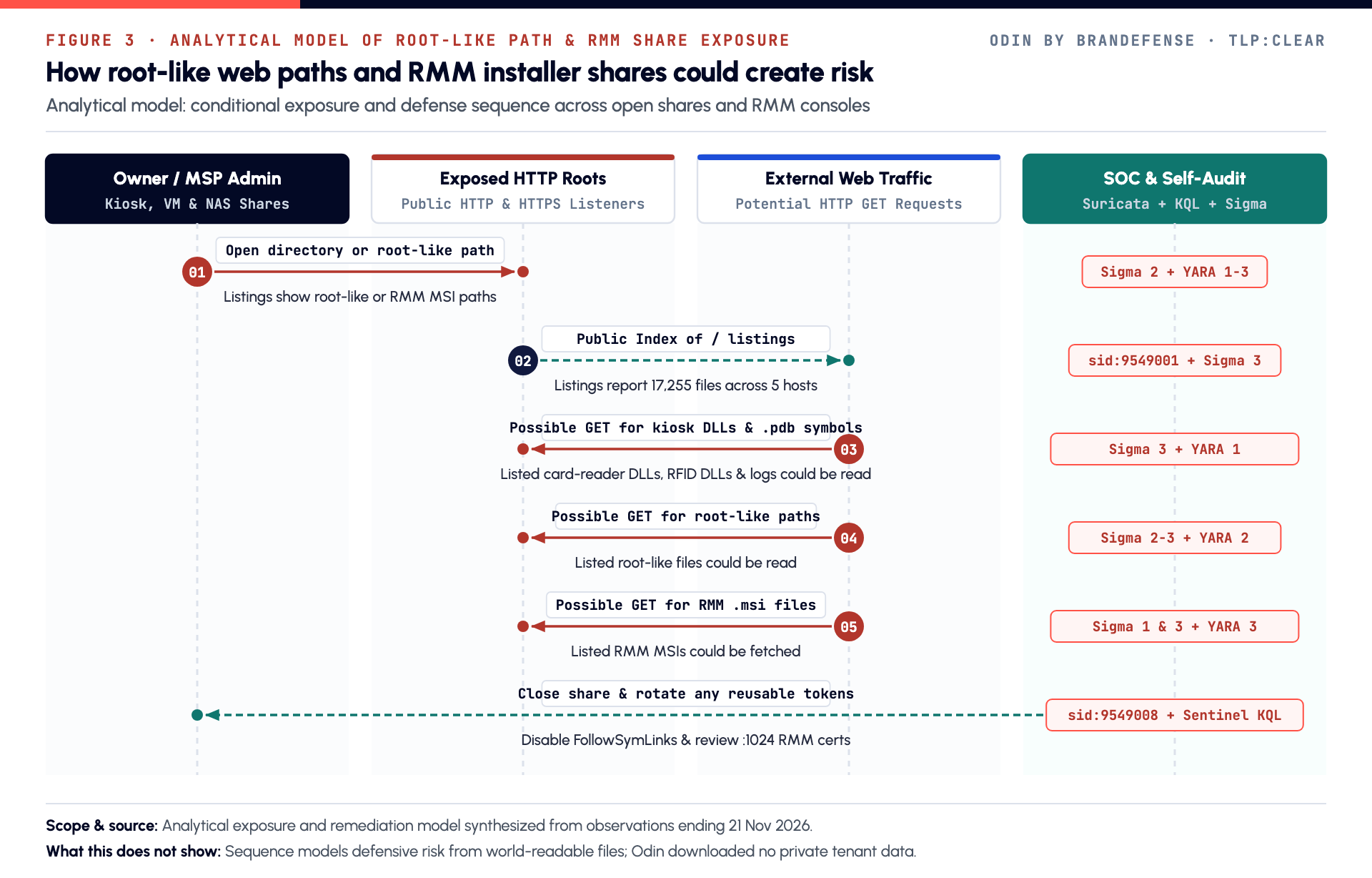
Organization-named NinjaOne MSIs and a 20.40 GB Veeam ISO on Host C (US)
In the United States, Host C (address and ports withheld) serves identical public directory trees over two Apache listeners. Each listener reported 684 files on 20 November 2026 (record discovery date 11 August 2026), and NAS indexing metadata indicates a NAS-backed share. Across 120 unique paths (141,992,037,486 B / 141.99 GB), Host C exposes 66 .exe installers, 20 .msi packages, 14 scripts, 6 .iso images, and 2 .vhdx disks:
- Six 72,351,744 B (72.35 MB) client-folder
NinjaOneMSIs. Six client subfolders (tenant names withheld) each expose a 72,351,744 B 64-bitNinjaOneagent.msiinstaller under a client-office path. - Two 51,380,224 B (51.38 MB) repair MSIs and six scripts. Repair and removal subfolders expose two 51,380,224 B
NinjaRMM.msifiles. Beside them sit six PowerShell and shell cleanup scripts (14,338 B, 9,059 B, 6,656 B, 1,262 B, 983 B, and 91 B). The folders also list a 209.72 MB network management installer and a 35.65 MB remote-control installer. - Backup ISOs, Hyper-V virtual disks, and VPN installers (141.99 GB). Co-hosted folders expose a 20,401,094,656 B (20.40 GB)
Veeam 13.0.1.1071backup ISO and two Hyper-V Windows.vhdxvirtual disks (48.32 GB and 20.40 GB). Adjacent folders serve aSplashtop Streamerbinary,Datto RMMuninstallers, fourDNSFilter.msipackages (2.00 MB to 15.61 MB), and twoSonicWALL NetExtender.msifiles. They also list anOpenVPN Connect.msi(71.30 MB), a password-recovery.msi(285.21 MB), and a SQL backup script.ziparchive.
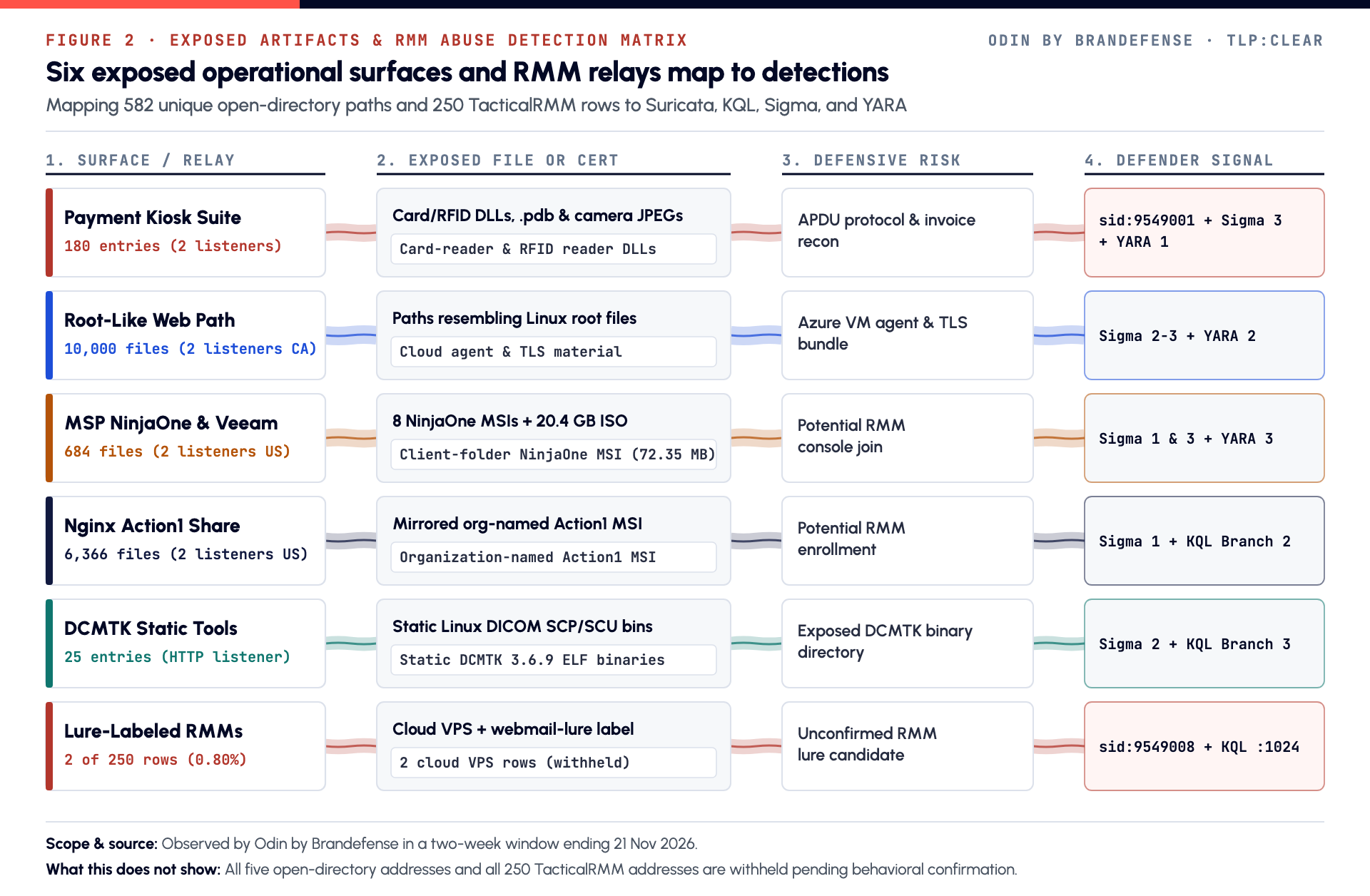
Why world-readable MSP RMM installers create risk.
The exposed NinjaOne and Action1 .msi paths carry client folder or organization names, though Odin did not inspect the packages or verify tenant parameters (T1552.001, T1219). If the packages contain reusable enrollment credentials and the console allows automatic enrollment, an outside party could register an unapproved agent. Odin did not test either condition. Co-hosted folders also reveal client names, DNSFilter agents, SonicWALL and OpenVPN clients, and Veeam 13.0.1.1071 backup media.
Mirrored Action1 RMM installer and embedded Linux archives on Host D (US)
In the United States, Host D (address and ports withheld) serves Nginx directory listings across two web listeners. Each listener reported 6,366 files on 20 November 2026, with an initial record discovery date of 12 August 2026. We sampled 240 rows (120 per listener) and found 129 unique sized paths. They total 3,187,066,013 B (3.19 GB), with file sizes from 6 B to 158,902,046 B.
Most of Host D serves embedded ARM single-board computer archives. These include 43 .xz rootfs and USB images (21.46 MB to 25.68 MB, dated 2022 to July 2026) and 15 .sh Yocto/Poky toolchains (up to 158.90 MB). Beside 4 Debian 12/13 software bill-of-materials manifests and 15 C-language Modbus utilities, administrators staged internal IT packages under mirrored HTTP and FTP subfolders:
- Organization-named
Action1RMM.msi(6,647,808 B). An organization-namedAction1agent.msiinstaller (6.65 MB, organization name withheld) sits across three mirrored HTTP and FTP paths. The filename contains an organization name. Odin did not inspect the package or test whether the name affects console enrollment. - VPN predeploy bundle and customer test file. Alongside the
Action1.msi, a sibling subfolder exposes a 135,925,569 B (135.93 MB) Cisco Windows VPN predeploy.ziparchive. A neighboring customer subfolder exposes a 6 B test text file mirrored across the HTTP and FTP directories.
Static medical imaging DCMTK binary directory on Host E
Host E (address and port withheld) exposes a static Linux DCMTK 3.6.9 binary directory over an unauthenticated HTTP listener (observed on 21 November 2026). The directory lists 25 entries (24 extensionless Linux ELF paths plus 1 partial download file). Eleven sized static x86_64 executables total 54,099,776 B (54.10 MB, 2,105,432 B to 8,158,056 B), alongside 14 unsized binary entries.
Exposed utilities include three clinical document and structured-report converters (3,762,760 B, 3,762,760 B, and one unsized XML converter). Diagnostic image codec binaries include three compression and rendering tools (8,158,056 B, 7,125,608 B, and 6,716,008 B). The folder also lists a decompression tool (6,703,720 B) and a 4,980,736 B image-scaling binary. Smaller codec and display helpers measure 4,282,952 B, 3,795,528 B, 2,706,216 B, and 2,105,432 B.
The 14 unsized entries include DICOM network storage, query-retrieve, and print SCP/SCU utilities. Zero patient DICOM studies sit in the folder, yet an open HTTP binary directory flags an unhardened medical-imaging integration host.
| Host & listener | Exposed directory group | Unique paths | Size (B) | Representative packages or binaries | Posture risk |
|---|---|---|---|---|---|
Host C (two listeners, US) | RMM client subfolders (6 tenants) | 11 | 213 to 209,715,200 | 6 client-folder NinjaOne .msi (72,351,744 B) and 2 management .exe installers | Potential unapproved agent registration if credentials remain active |
Host C (two listeners, US) | RMM repair and removal subfolders | 9 | 91 to 51,380,224 | 2 repair NinjaRMM .msi (51,380,224 B) and 6 cleanup scripts (91 B to 14,338 B) | Repair MSI reuse & removal script study |
Host C (two listeners, US) | Backup, virtual-disk, and support folders | 100 | 0 to 48,318,382,080 | Veeam 13.0.1 backup ISO (20.40 GB) and 2 Hyper-V .vhdx virtual disks (48.32 GB & 20.40 GB) | Base VM inspection (68.72 GB VHDXs) & stack recon |
Host D (two listeners, US) | Mirrored HTTP and FTP IT subfolders | 9 | 6 to 135,925,569 | Organization-named Action1 .msi (6,647,808 B, 3 paths) and Cisco VPN .zip (135.93 MB) | Potential unapproved Action1 enrollment if credentials are active & VPN bundle leak |
Host D (two listeners, US) | Embedded ARM SBC & Modbus folders | 120 | 44 to 158,902,046 | 43 .xz SBC images, 15 .sh Poky toolchains, 4 SBOM manifests, 15 C Modbus tools | Engineering mirror mixed with internal IT MSIs |
Host E (HTTP listener) | Static Linux DCMTK 3.6.9 binary folder | 25 | 2,105,432 to 8,158,056 (11 sized) | Image codec binaries (8.16 MB and 7.13 MB), document converters (3.76 MB), and DICOM network tools | Unauthenticated HTTP directory serving DCMTK binaries |
5. Separating Lure-Labeled TacticalRMM Candidates From Standard MSP Servers
In short
Global TacticalRMM observations total 39,887 sightings across 119 countries (340 feed-verified), making single-signal IP blocking unsafe for defenders. Across 250 examined confirmed-status endpoints (248 hosts, 0 overlap with Host A to Host E), 117 sit on commercial cloud VPS providers. Two endpoints (0.80%) carry webmail-lure certificate labels in the source register, but their abuse remains unconfirmed. Withhold all 250 addresses and hunt RMM usage through behavioral telemetry.
Self-hosted TacticalRMM combines a Django administration API, a MeshCentral remote relay, and signed Windows and Linux agents. That architecture makes the tool popular both with legitimate MSPs and with threat actors seeking persistent C2 (T1219).
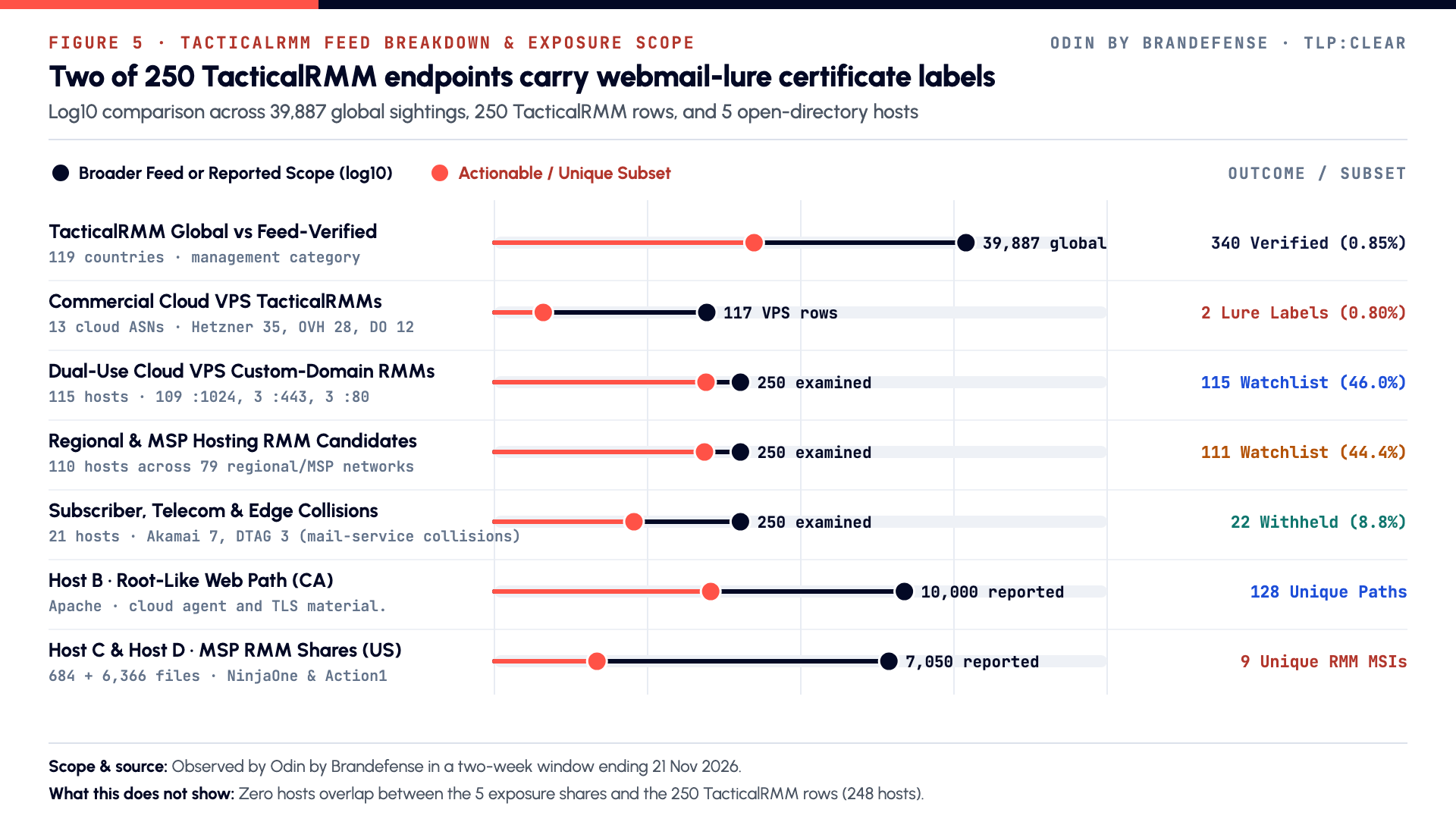
Why cloud VPS hosting alone does not make a TacticalRMM server malicious
All 250 comparative TacticalRMM endpoints (248 distinct hosts observed from 13 to 19 November 2026) carried an upstream confirmed service status. Port 1024 accounts for 227 rows (90.80%), followed by port 80 (14, 5.60%) and port 443 (3, 1.20%). Six ports (587, 800, 993, 8000, 8080, and 8088) carry 1 row each (0.40%).
Leading countries in the sample are the United States (57), Germany (57), Brazil (45), France (23), and the Netherlands (11). Canada (8), Finland (8), the United Kingdom (7), and 21 other countries (34 rows) account for the rest.
Within that sample, 117 endpoints (46.80%, 117 hosts) sit on 13 commercial cloud and VPS providers. Leading networks include Hetzner Online GmbH (35), OVH SAS (28), Hostinger (16), DigitalOcean (12), and Contabo GmbH (11). Smaller cloud shares appear on Amazon.com, Inc. (4), Contabo Inc. (3), Microsoft (2), Contabo Asia (2), and four single-row providers (Kamatera, LeaseWeb, M247, and IONOS SE).
Blocking all 117 cloud VPS hosts would disrupt legitimate IT teams. Amidaware's official TacticalRMM documentation directs MSPs to deploy on Hetzner, DigitalOcean, Vultr, OVH, AWS, or Azure with custom DNS certificates. Checking X.509 certificate themes splits those 117 cloud VPS rows into two groups:
- Two unconfirmed cloud VPS endpoints with webmail-lure certificate labels (0.80% of 250). Two cloud VPS endpoints (addresses and ports withheld, observed 13 November 2026) carry webmail-lure certificate labels in the source register. Because the records hold no raw certificate, protocol response, beacon, or behavior log, their abuse remains unconfirmed and both addresses are withheld.
- One hundred fifteen dual-use cloud VPS servers with custom domains (46.00% of 250). The other 115 commercial VPS hosts (109 on :1024, 3 on :443, and 3 on :80) use standard custom-domain TLS certificates with zero phishing lure themes, so all 115 addresses are withheld on a watchlist.
Regional MSP candidates and telecom or mail-port collisions
The remaining 133 TacticalRMM rows (131 distinct hosts, 0 network overlap with the 13 cloud VPS providers) fall into two non-blocking groups. Defenders should keep these addresses off perimeter IP blocklists:
- One hundred eleven regional and MSP hosting candidates (44.40%, 110 hosts). These rows span 79 regional networks, led by
netcup GmbH(6),Locaweb(5),Brasil Site Informatica(5), andTelefonica Brasil(4, including 1 dual-port host). Three rows each sit onHostPapa,Scaleway,EVEO, andConstant Company, while top countries are Brazil (28), the US (25), Germany (15), and the Netherlands (10). One hundred rows use :1024, seven use :80, and four use :800/:8000/:8080/:8088 (110 custom-domain CNs, 1 empty CN; addresses withheld). - Twenty-two subscriber, telecom, and CDN collisions (8.80%, 21 hosts). These rows sit on 14 broadband, telecom, and edge networks (
Akamai Technologies, Inc.7,Deutsche Telekom AG3,Verizon Business1,Vodafone Portugal1,CLARO S.A.1, and 9 regional ISPs). One telecom host matched on mail-service ports. That match shows how mail-port TLS banners on ISP lines collide with service signatures (addresses withheld).
| TacticalRMM group | Rows (250) | Share | Hosts (248) | Certificate theme | Ports | Action |
|---|---|---|---|---|---|---|
| Unconfirmed webmail-lure candidates | 2 | 0.80% | 2 | Webmail-lure certificate label | Withheld (2) | Withheld; review before blocking |
| Dual-use cloud VPS servers | 115 | 46.00% | 115 | Custom-domain CN (115) | :1024 (109), :443 (3), :80 (3) | Watchlist; correlate msiexec |
| Regional & MSP candidates | 111 | 44.40% | 110 | Custom-domain (110), empty (1) | :1024 (100), :80 (7), 4 other | Watchlist; withheld |
| Subscriber & mail collisions | 22 | 8.80% | 21 | Custom-domain CN (22) | :1024 (16), :80 (4), 2 mail ports | Do not block; withheld |
| Commercial cloud / VPS provider | Cloud rows (117) | Lure-labeled (unconfirmed) | Dual-use watchlist | Countries in sample |
|---|---|---|---|---|
Hetzner Online GmbH | 35 | 1 (withheld) | 34 | DE (26), FI (7), US (2) |
OVH SAS | 28 | 0 | 28 | FR (16), CA (5), GB (4), DE/PL/SG (3) |
Hostinger International Limited | 16 | 0 | 16 | BR (8), US (5), FR/GB/LT (3) |
DigitalOcean, LLC | 12 | 0 | 12 | US (6), DE (3), BR/GB/SG (3) |
Contabo GmbH | 11 | 0 | 11 | DE (7), BR (4) |
Amazon.com, Inc. | 4 | 0 | 4 | US (4) |
Contabo Inc. | 3 | 1 (withheld) | 2 | US (3) |
Microsoft Corporation & Contabo Asia | 4 | 0 | 4 (2 + 2) | US (2), SG/BR (2) |
Kamatera, LeaseWeb, M247, IONOS SE | 4 | 0 | 4 (1 each) | US (1), NL (1), FR (1), DE (1) |
6. What Defenders Should Do
Managed service providers and IT deployment teams
- Remove organization-named
NinjaOne,Action1,Splashtop, and VPN.msior.exepackages from public HTTP folders, public NAS shares, and anonymous FTP mirrors. MoveVeeamISOs and.vhdxdisks to authenticated storage. - If an RMM installer exposed in a public folder contains a reusable enrollment token, rotate it. Require expiring onboarding links and manual technician approval before newly registered RMM agents receive scripts or policies.
Cloud web operations
- Audit Apache and Nginx settings across cloud virtual machines. Set
Options -Indexes -FollowSymLinks -SymLinksIfOwnerMatchin Apache andautoindex off; disable_symlinks on;in Nginx, and verify that zero symbolic links insideDocumentRootpoint outside the web root.
Payment-kiosk and healthcare asset owners
- Isolate unattended payment-kiosk listeners on private VLANs or APNs, and close the unauthenticated HTTP directory serving
DCMTKbinaries. Strip.pdbdebug symbols from production builds and store kiosk camera captures outside web roots.
SOC and threat hunting teams
- Keep all 250 TacticalRMM endpoints off single-signal perimeter IP blocklists until independent protocol or behavioral telemetry confirms abuse. Hunt unapproved RMM activity through
TCP 1024TLS certificate checks and endpointmsiexeclogs using the rules in Chapter 7.
7. Detection Rules
The full rules are in the Detection rules tab. Static syntax checks (lint_suricata.py with 0 problems across sid:9549001 and sid:9549008 and Sigma modifier checks) passed cleanly. Suricata, YARA, Sigma, and Kusto engines were not installed in our environment, and the rules were not replayed against live traffic or tested against actual captured directory-index pages. Validate and tune them in staging before production use.
| Rule file | What it catches |
|---|---|
odin_exposed_kiosks_symlink_roots_and_rmm_shares.rules | Suricata 7: two generic rules for open-directory HTTP responses serving installer, debug-symbol, virtual-disk, ISO, or DLL files (sid:9549001) and TCP 1024 TLS server certificates (sid:9549008) |
sentinel_kiosk_symlink_and_rmm_installer_hunt.kql | Sentinel and Defender XDR: outbound TCP 1024 TacticalRMM port sessions, msiexec.exe execution of remote or downloaded .msi files, and web-root symlink or ad-hoc HTTP server processes |
sigma_rmm_msi_enrollment_and_symlink_exposure.yml | Sigma (3 rules): Windows msiexec remote or downloaded .msi installs, Linux web-root ln or ad-hoc HTTP server commands, and web GET requests for exposed .msi, .pdb, .vhdx, .iso, or Linux root-like paths |
odin_kiosk_symlink_and_rmm_share_artifacts.yar | YARA (3 rules): open-directory HTML indexes exposing .NET debug-symbol and DLL suites, Linux FHS root-like directory trees, or .msi installer and disk-image shares |
How the Suricata signatures work
| SID | Looks for | Why |
|---|---|---|
| 9549001 | Outbound 200 with Index of / and .msi, .pdb, .vhdx, .iso, or .dll file links | Self-audit alert when an internal web server exposes an open directory serving installers, debug symbols, disk images, or libraries |
| 9549008 | Inbound TLS server certificate (CN=) from $EXTERNAL_NET on port 1024 | Flags TLS sessions on the default TacticalRMM port (:1024) for certificate and host correlation (hunt only) |
We removed the six host-specific URI rules (sid:9549002 to 9549007) so the public ruleset contains no owner-derived filenames or path fragments. Keep both sid:9549001 and sid:9549008 in alert mode for self-audit and certificate review. Treat any sid:9549001 alert on your own perimeter as a posture incident: close the open directory, strip .pdb debug symbols, and rotate any reusable RMM enrollment tokens.
How the KQL, Sigma, and YARA rules work
The Sentinel KQL query looks back 7 days across DeviceNetworkEvents and DeviceProcessEvents in three branches. Branch 1 flags outbound connections to RemotePort == 1024 outside two exact approved hosts (msp-repo-prod-01.corp[.]example and sec-posture-audit-01.corp[.]example). Branch 2 catches msiexec.exe command lines referencing .msi alongside http://, https://, ftp://, Downloads, or Temp outside those same two approved distribution hosts.
Branch 3 inspects ln, python, python3, httpd, apache2, or nginx commands referencing http.server, SimpleHTTPServer, /var/www, DocumentRoot, or FollowSymLinks. It correlates those processes within 15 minutes of port 80, 443, or 1024 network activity outside the two approved hosts.
Sigma rule 1 flags Windows msiexec.exe commands installing .msi packages from HTTP, HTTPS, FTP, Downloads, or Temp paths outside exact servers MSP-DEPLOY-SRV01 and IT-SCCM-DIST01. Sigma rule 2 flags Linux ln commands targeting /var/www/, /srv/http/, or /usr/share/nginx/html and ad-hoc http.server or SimpleHTTPServer processes outside SEC-POSTURE-AUDIT-01; a match does not establish external HTTP exposure.
Sigma rule 3 flags web GET requests ending in .msi, .pdb, .vhdx, or .iso, or containing /etc/passwd, /etc/shadow, /boot/vmlinuz, or /boot/initrd. Three file-size-bounded YARA rules (512 KB and 1 MB caps) inspect captured HTML directory indexes for .pdb and DLL suites, Linux FHS directory trees, and .msi installer shares.
8. Indicators
The Indicators tab holds 0 published indicators: 0 network addresses and 0 file hashes. All five misconfigured open-directory addresses (Host A through Host E) and all file digests on those shares are withheld. All 250 TacticalRMM addresses (2 unconfirmed webmail-lure cloud VPS endpoints, 115 dual-use cloud VPS servers, 111 regional MSP candidates, and 22 telecom collisions) are also withheld because none carries independent behavioral confirmation of abuse. Eleven self-audit patterns stay in the table below, while four TLS fingerprints from non-confirmed rows are withheld.
Unconfirmed webmail-lure TacticalRMM candidates (addresses withheld)
Two unconfirmed webmail-lure endpoints were observed; addresses, ports, and host-level details are withheld.
Self-audit exposure categories (text-only)
| Exposure surface | Artifact category to audit on your own perimeter | Listener scope | Defensive use |
|---|---|---|---|
Payment kiosk (Host A) | Kiosk .NET client and .pdb debug-symbol files | Primary HTTP listener | Audit kiosk subnets & strip .pdb debug symbols |
Payment kiosk (Host A) | Motorized smart-card reader and dispenser DLLs (2 files) | Primary HTTP listener | Block external HTTP access to card-reader DLLs |
Payment kiosk (Host A) | Contactless RFID reader and communications DLLs (2 files) | Primary HTTP listener | Block external HTTP access to RFID DLLs |
Payment kiosk (Host A) | Electronic invoice log folder (134 log files) | Primary HTTP listener | Restrict kiosk invoice logs to private VLANs |
Payment kiosk (Host A) | Kiosk camera capture folder (3 JPEG files) | HTTPS listener | Remove & block public kiosk camera JPEGs |
Root-like web path (Host B) | Symlink-named web path exposing Linux system directories | Two web listeners | Disable FollowSymLinks & block root-like paths at proxies |
Root-like web path (Host B) | Cloud Linux guest-agent binary under a root-like web path | Two web listeners | Audit cloud Linux VMs for root-like web paths |
MSP share (Host C) | Client-folder NinjaOne agent MSIs (72.35 MB) | Two web listeners | Remove public MSIs & rotate any reusable tokens |
MSP share (Host C) | Backup ISO (20.40 GB) and Hyper-V .vhdx disks | Two web listeners | Move backup media and virtual disks to private storage |
Nginx/FTP share (Host D) | Mirrored organization-named Action1 MSI (6.65 MB) | Two web listeners | Remove mirrored Action1 MSIs & rotate any reusable tokens |
Medical imaging (Host E) | Static Linux DCMTK 3.6.9 binary directory (25 entries) | HTTP listener | Close the unauthenticated HTTP directory serving DCMTK binaries |
Withheld TLS fingerprints
Four TLS fingerprints were observed on non-confirmed rows. Their values and host-level context are withheld.
9. Scope and Limits
All observations in this report come from a two-week observation window ending 21 November 2026. Five key limits apply to the analysis:
- Owner-versus-operator separation.
Host AthroughHost Eare misconfigured owner or MSP file shares rather than adversary infrastructure, and nothing links them to one another or to the 250 TacticalRMM rows (0 shared hosts). All owner addresses, client or municipal folder names, and victim-specific file paths are withheld. - Neutral vendor posture. None of the observations imply a defect in
NinjaOne,Action1,Veeam,Splashtop,Datto RMM,SonicWALL,Cisco,Apache,Nginx,Microsoft WALinuxAgent,OFFIS DCMTK, or card-reader and RFID libraries. The listings show public HTTP exposure; Odin did not verify the underlying web-server directives, symlink targets, or folder permissions. - Unestablished origin and target of the web-root symlink path on
Host B. Directory metadata cannot show how the web-root symlink path on the Canada Ubuntu 24.04 Azure VM was created. Odin did not verify whether it resolved to a live root filesystem or which Apache options were set (0 webshells or implants observed). - Zero installer testing or file content inspection. Odin installed 0
.msifiles, contacted 0 RMM consoles, and opened 0 backups, logs, or camera JPEGs beyond directory listing metadata. - Pre-November file and record dates. Kiosk log filenames from 2020 to 2025 (
Host A) and archive build dates from 2022 toJuly 2026(Host CandHost D) are file timestamps on disk. Initial directory-record discovery dates of 9 to 12 August 2026 (Host BtoHost D) are record metadata, not Odin's monitoring period, and our rules were checked statically without live engines.
10. Sources
- CISA, Joint Cybersecurity Advisory AA23-025A: Protecting Against Malicious Use of Remote Monitoring and Management (RMM) Software: https://www.cisa.gov/news-events/cybersecurity-advisories/aa23-025a (verified on 21 November 2026).
- Apache Software Foundation, Apache HTTP Server 2.4 Core Features: Options FollowSymLinks and SymLinksIfOwnerMatch: https://httpd.apache.org/docs/2.4/mod/core.html (verified on 21 November 2026).
- Apache Software Foundation, Apache Module mod_autoindex Documentation: https://httpd.apache.org/docs/2.4/mod/mod_autoindex.html (verified on 21 November 2026).
- Microsoft Learn, Azure Linux Virtual Machine Agent (WALinuxAgent / waagent) Overview: https://learn.microsoft.com/en-us/azure/virtual-machines/extensions/agent-linux (verified on 21 November 2026).
- MITRE ATT&CK, Technique T1219: Remote Access Software: https://attack.mitre.org/techniques/T1219/ (verified on 21 November 2026).
- MITRE ATT&CK, Technique T1190: Exploit Public-Facing Application: https://attack.mitre.org/techniques/T1190/ (verified on 21 November 2026).
- MITRE ATT&CK, Sub-technique T1552.001: Unsecured Credentials - Credentials In Files: https://attack.mitre.org/techniques/T1552/001/ (verified on 21 November 2026).
- MITRE CWE, CWE-59: Improper Link Resolution Before File Access ('Link Following'): https://cwe.mitre.org/data/definitions/59.html (verified on 21 November 2026).
- OFFIS e.V., DICOM Toolkit (DCMTK) Official Source Repository: https://github.com/DCMTK/dcmtk (verified on 21 November 2026).
- Amidaware, Tactical RMM Official Documentation: https://docs.tacticalrmm.com/ (verified on 21 November 2026).
What is…?
Short explanations of the tools and families named in this study.
Frequently asked questions
What did we find across the five misconfigured directories?
Site owners and technicians sometimes leave directory indexing (Index of /) open on maintenance ports, NAS folders, or FTP mirrors. Some servers also expose root-like paths inside web roots. We reviewed listing metadata statically, installed zero .msi files, and contacted zero RMM consoles. The directory listings do not establish defects in the named software or hardware libraries.
Why do exposed MSP RMM installers and TacticalRMM servers need careful handling?
The exposed NinjaOne and Action1 .msi paths carry client folder or organization names, though Odin did not inspect the packages or verify tenant enrollment parameters. If the packages contain reusable enrollment credentials and the console allows automatic enrollment, an outside party could register an unapproved agent. Odin did not test either condition.