
1. Executive Summary
In short
In a two-week observation window ending 21 November 2026, Odin by Brandefense reviewed 2,002 endpoints across 1,781 hosts from 33,042 feed sightings spanning ScopeSentry, CyberStrikeAI, Sliver, GoPhish, and Evilginx. We also reviewed directory metadata for a ten-file PHP phishing kit in the Netherlands. Filtering 500 dual-use ScopeSentry consoles, 62 subscriber ISP and CDN edge collisions, and 1,408 unverified candidates leaves 32 upstream-confirmed endpoints on 30 unique IPv4 addresses. Review those 30 withheld candidates before blocking, inspect X.509 certificate subjects and trust chains, and audit web roots.
External attack-surface management (EASM) consoles, autonomous AI penetration-testing platforms, implant command-and-control (C2) servers, and phishing kits share cloud networks and TLS patterns. Security teams and bug-bounty hunters use ScopeSentry to map external subdomains and open ports. Red teams and intrusion operators use CyberStrikeAI, Sliver, GoPhish, and Evilginx behind custom or deceptive X.509 certificates.
Pushing raw threat feeds for these tools straight into firewalls blocks authorized assessments and cuts off broadband subscribers or shared CDN edges. We reviewed all 2,002 endpoints and the ten-file Netherlands PHP kit statically without running code or contacting external hosts.
Dual-use ScopeSentry consoles cluster on port 8082 and need watchlist monitoring.
Across 500 examined ScopeSentry endpoints on 486 hosts from 532 global sightings, 446 listen on TCP 8082 and four on 18082 (90.0% combined). Because corporate security teams and bug-bounty researchers operate ScopeSentry legitimately, all 500 addresses stay off IP blocklists, including seven marked confirmed upstream. Defenders should use external attack surface management to audit internal perimeters for unapproved port 8082 login pages instead of blocking ScopeSentry addresses.
CyberStrikeAI and C2 operators use typo-squatted CDN and brand-lure certificates.
Across 500 examined CyberStrikeAI endpoints on 467 hosts, 88 expose the default CN=cyberstrikeai self-signed certificate and 74 share one Go TLS JARM fingerprint. Other CyberStrikeAI endpoints present custom domains or typo-squatted Cloudflare subjects such as CN=cdn[.]cloduflare[.]com.
Across all 2,002 endpoints, 44 unverified listeners present OAuth, webmail, financial, or portal-mimic X.509 subjects, including lures on TCP port 31337 Sliver listeners. Look-alike certificate names like these are what phishing monitoring is designed to flag. Filtering subscriber ISPs and single-signal rows leaves 32 upstream-confirmed endpoints on 30 unique IPv4 addresses; all 30 stay withheld pending independent, address-specific corroboration.
Ten exposed files in the Netherlands show a modular PHP phishing kit.
Separate from the endpoint set, an Apache server in the Netherlands exposes ten files totaling 17,101 bytes with zero shared hosts across the C2 set.
Directory metadata lists twin 1,638-byte scripts whose names suggest log retrieval and deletion beside files named for Base64 DOM obfuscation, cipher routines, database access, and client filtering. Their contents were not available to verify those functions. Because third-party web-host ownership cannot be ruled out, the server address, file paths, and file hashes stay withheld.
Three Decisions for Leaders
- Require address-specific corroboration before blocking upstream-confirmed cloud C2 candidates. Review the 30 upstream-confirmed CyberStrikeAI, Sliver, and GoPhish address candidates against local telemetry; do not publish or block an address until independent, address-specific corroboration is recorded.
- Inspect X.509 certificate subjects and trust chains instead of trusting familiar CDN or OAuth names. Configure TLS-inspecting proxies to alert when self-signed or untrusted certificates present subjects claiming
cdn[.]cloduflare[.]com,CN=cyberstrikeai, single-sign-on portals, webmail verification pages, or banking brands. - Keep ScopeSentry off automated IP blocklists and audit web servers for exposed PHP kits. Use ScopeSentry intelligence strictly to audit internal port 8082 and 18082 exposure, disable open directory listings, and use heuristic YARA rules to review web roots.
The Study in Numbers
| Number | What it is |
|---|---|
| 33,042 | Global feed sightings across ScopeSentry, CyberStrikeAI, Sliver, GoPhish, and Evilginx |
| 2,002 | Endpoints examined by Odin by Brandefense across 1,781 distinct hosts and 1,515 /24 subnets |
| 30 | Upstream-confirmed IPv4 candidates (32 endpoints: 3 CyberStrikeAI, 8 Sliver, 21 GoPhish; withheld pending corroboration) |
| 500 | Dual-use ScopeSentry endpoints on 486 hosts (450 on TCP 8082 or 18082; all withheld) |
| 44 | Endpoints across 41 hosts presenting OAuth, webmail, financial, or portal-mimic X.509 certificates |
| 62 | Subscriber telecom ISP and shared CDN edge endpoints across 53 hosts suppressed from blocking |
| 10 / 17,101 B | Exposed files and total bytes on the Netherlands Apache PHP phishing log-panel server |
How to use this report.
Security leaders can start with Chapters 1, 6, and 7. Cloud security, PKI, and attack-surface engineers should read Chapters 3, 4, 5, and 7. SOC analysts and detection engineers should go straight to Chapters 8 and 9. Threat intelligence analysts will find full cohort tables and scope limits in Chapters 2, 4, 6, and 10.
2. Four Functional Groups, One Analytical Model
In short
Zero shared IP addresses or TLS certificates connect the 30 upstream-confirmed C2 and phishing candidates or the Netherlands PHP kit to the ScopeSentry cohort. We present the four functional groups together as an analytical model for defenders.
Intrusion and credential-theft operations rely on four distinct building blocks: external reconnaissance consoles, autonomous AI offense panels, implant C2 and spearphishing relays, and lightweight PHP credential-collection kits. In commercial threat feeds, all four layers arrive mixed under confirmed, suspected, or candidate tags. Blocking every feed entry without cyber threat intelligence review disrupts authorized scanners, blacklists broadband subscribers, and cuts off shared CDN proxies.
We compared host addresses, /24 subnets, and X.509 certificates across all 1,781 hosts in the 2,002-endpoint set and the Netherlands Apache server. Zero shared hosts link the 30 upstream-confirmed IPv4 candidates or the PHP kit to any other family.
Within the remaining cohorts, 13 hosts expose two families at once. Five pair GoPhish with ScopeSentry, three pair CyberStrikeAI with ScopeSentry, three pair ScopeSentry with Sliver, and two pair CyberStrikeAI with Sliver. Because no technical indicator ties these populations to one actor, we present them as an analytical model. Figure 1 shows the four groups and their defender actions.
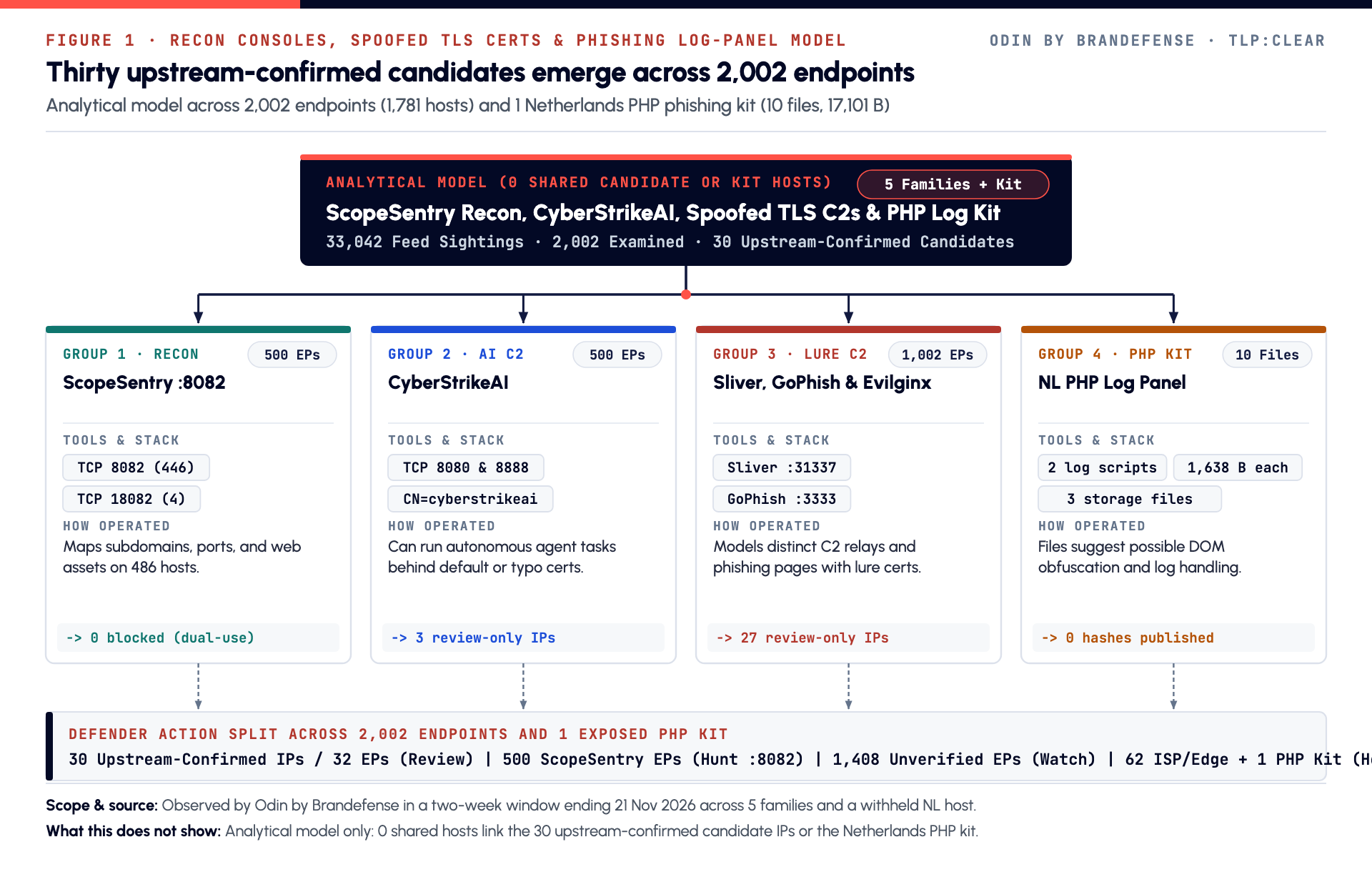
How the five endpoint families and the PHP kit compare
Across the five endpoint families, upstream feeds listed 33,042 global sightings (71 marked verified upstream). We examined 2,002 endpoints across 1,781 distinct hosts and 1,515 /24 subnets (1,794 summed per-family hosts before the 13 two-family hosts).
| Family or kit | Functional role | Global sightings | Verified | Countries | Examined | Hosts / /24s | Upstream-confirmed (review) | Suppressed ISP/edge | Withheld (watch) |
|---|---|---|---|---|---|---|---|---|---|
| GoPhish | Phishing server | 23,355 | 36 | 119 | 501 | 455 / 447 | 21 (19 IPs) | 26 | 454 |
| Sliver | Implant & mTLS C2 | 5,670 | 19 | 83 | 500 | 385 / 375 | 8 (8 IPs) | 22 | 470 |
| CyberStrikeAI | AI offense console | 3,484 | 16 | 42 | 500 | 467 / 273 | 3 (3 IPs) | 14 | 483 |
| ScopeSentry | Dual-use EASM | 532 | 0 | 32 | 500 | 486 / 449 | 0 | 0 | 500 |
| Evilginx | AiTM proxy | 1 | 0 | 1 | 1 | 1 / 1 | 0 | 0 | 1 |
| 5-Family Subtotal | Endpoints | 33,042 | 71 | -- | 2,002 | 1,781 / 1,515 | 32 (30 IPs) | 62 | 1,908 |
| Netherlands PHP kit | Apache PHP kit | 10 files | 0 | 1 | 10 (17,101 B) | 1 / 1 | 0 | 1 (log) | 9 (review) |
Two GoPhish hosts each appeared on TCP 80 and TCP 443. Thus, 32 upstream-confirmed endpoints resolve to 30 unique addresses. In upstream metadata, 663 rows carry record first-seen dates earlier than 7 November 2026 (extending back to record dates of 8 August 2025). All Odin observations occurred during the two-week window ending 21 November 2026.
Why upstream feed tags cannot drive automated IP blocks
Upstream feeds marked 78 of the 2,002 examined endpoints confirmed, 215 suspected, and 1,709 candidate. Blocking all 78 upstream confirmed rows would immediately misfire on 46 records (59.0%). Seven are dual-use ScopeSentry consoles, six sit on telecom or shared CDN networks, and 33 sit on multi-tenant hosts (HostPapa, Alibaba, Tencent) without relay proof. The remaining 32 upstream-confirmed rows (30 unique IPv4s) record only feed status, hosting, JARM, and certificate fields without an independent response, beacon, or workbench link. All 30 therefore stay withheld for review rather than automated blocking. Figure 2 maps each slice to TLS, URI, and heuristic YARA detections.
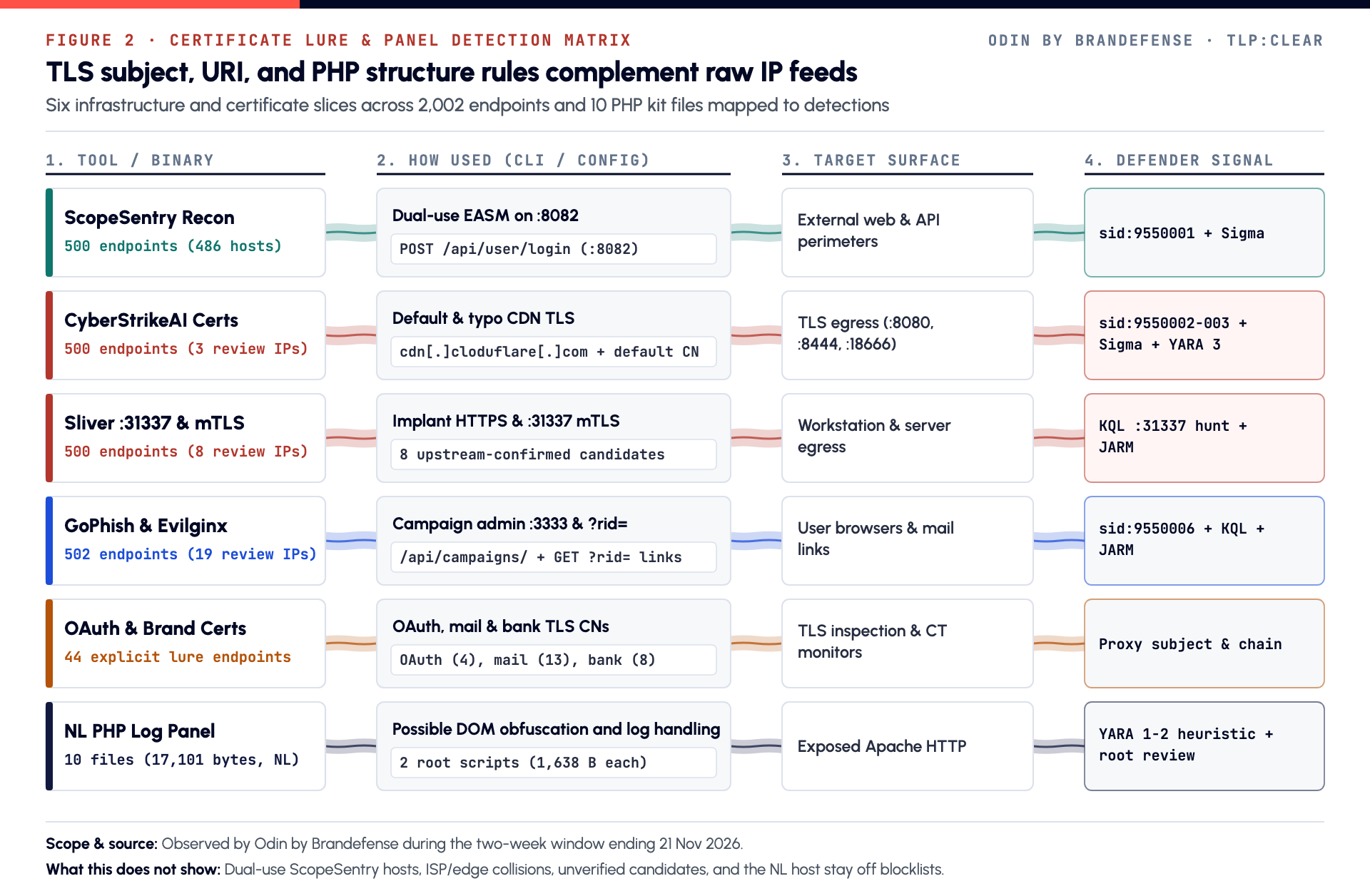
3. Dual-Use ScopeSentry Consoles and CyberStrikeAI Certificate Typos
In short
ScopeSentry (500 endpoints on 486 hosts) and CyberStrikeAI (500 endpoints on 467 hosts across 273 /24 subnets) show why defenders must separate dual-use recon tools from offensive agent servers. Nine in ten ScopeSentry instances (450 of 500) listen on TCP 8082 or 18082 and stay withheld. CyberStrikeAI yields three upstream-confirmed candidate addresses, 88 CN=cyberstrikeai certificates, and CN=cdn[.]cloduflare[.]com certificate typos. Audit port 8082 internally and alert on both certificate subjects.
External asset discovery tools and AI-orchestrated offense panels sit side by side in assessment workflows (T1595.002, T1583.003, T1587.003). Corporate security teams run ScopeSentry continuously to inventory subdomains, whereas CyberStrikeAI exposes automated exploit agents behind default or spoofed TLS certificates.
ScopeSentry (500 endpoints on 486 hosts): port 8082 concentration
Open-source ScopeSentry pairs a Python and Vue web console backed by MongoDB and Redis with distributed nodes running Subfinder, Naabu, Httpx, Katana, Rad, and Nuclei. Across 532 sightings in 32 countries (0 verified upstream), our 500 examined endpoints on 486 hosts (449 /24 subnets) show three clear patterns:
- 90.0% concentration on TCP 8082 and 18082. Exactly 446 endpoints (89.2%) listen on default Docker console port 8082, and four listen on container port 18082 in Hong Kong (1), China (2), and France (1). Only 50 endpoints use other ports, led by 443 (7), 80 (6), and 8443 (4).
- Cloud and VPS distribution. China (155, 31.0%), Hong Kong (105, 21.0%), the United States (90, 18.0%), Singapore (32), Japan (31), South Korea (15), France (13), and the Netherlands (11) lead geographically. Top hosts are Tencent (77), Alibaba (52 combined), HostPapa (37), LUCIDACLOUD (18), cognetcloud (16), Contabo (9), and Vultr (9).
- Plain HTTP login pages and watchlist withholding. Over seven in ten instances (354, 70.8%) serve
POST /api/user/loginwithout a certificate CN. The rest use 107 custom domains, 14 IP certificates, 10CN=localhost, 8 portal mimics, and 7 Windows host certificates. ScopeSentry also sits on 11 of the 13 two-family hosts, and all 500 addresses remain withheld.
CyberStrikeAI (500 endpoints): /24 sweeps, CN=cyberstrikeai, and cdn[.]cloduflare[.]com
CyberStrikeAI is an AI-driven offense panel in Go and Python exposing HTTP/WebSocket APIs and Model Context Protocol (MCP) wrappers over more than 100 security tools. Across 3,484 sightings in 42 countries (16 verified upstream), our 500 examined endpoints (467 hosts across 273 /24 subnets) show four distinct traits:
- Port distribution (8080, 8888, 18666, 8444). Console port 8080 leads with 230 endpoints (46.0%, plus 5 on 18080), followed by 8888 (96, 19.2%), 8085 (24), 443 (22), and 80 (17). Ports 8081 (11), 8443 (10), 8084 (9), and 8087 (9) follow. Seven endpoints listen on MCP/agent port 18666 on PEG TECH INC in the United States. One Hong Kong host listens on port 8444 alongside five Sliver and one ScopeSentry port 8444 listeners.
- Single-subnet sweeps in Lithuania and the Netherlands. Exactly 95 Lithuanian hosts on UAB Host Baltic (94 on port 8888, 1 on 9443) sit inside one
/24subnet. Another 38 Dutch hosts (44 endpoints on ports 8084 to 8087 and 9090) on NForce Entertainment B.V. also sit inside one/24subnet. Cloudie Limited (37), Tencent (35), Alibaba (35 combined), and CTG Server (34) follow. - Default
CN=cyberstrikeai(88 endpoints) and 3 upstream-confirmed candidates. Eighty-eight endpoints (17.6%, plus 2CN=localhost) serveCN=cyberstrikeai, and 74 share Go TLS JARM40d40d40d00000000043d43d00043d6aff5ab0f4fc31897186312c9e639319. Three cloud servers (two on AWS US and one on OVH France) carry upstreamconfirmedtags while servingCN=cyberstrikeai. All three addresses remain withheld pending independent, address-specific corroboration. - Typo-squatted Cloudflare certificates (
CN=cdn[.]cloduflare[.]com). The cohort also includes custom-domain certificates (110 rows across 96 domains), IP certificates (45), Windows hostnames (13), and brand lures (6). Profiling CyberStrikeAI TLS certificates also reveals self-signed X.509 certificates withCN=cdn[.]cloduflare[.]com, swappingudtoduincloudflare(T1587.003). Under RFC 5280, self-signed certificate generation checks no DNS ownership. The subject can resemble a Cloudflare name in a quick review; hunt the exact typo in certificate subjects. Non-brand custom domains are grouped under custom domain certificates in Chapter 4.
| Attribute | ScopeSentry (dual-use watchlist) | CyberStrikeAI (offense & MCP C2) |
|---|---|---|
Sightings / examined / hosts / /24s | 532 / 500 / 486 / 449 (1.08 hosts//24) | 3,484 / 500 / 467 / 273 (1.71 hosts//24) |
| Main TCP ports | 8082 (446, 89.2%), 443 (7), 80 (6), 18082 (4), 8443 (4) | 8080 (230, 46.0%), 8888 (96), 8085 (24), 443 (22), 80 (17), 18666 (7), 8444 (1) |
| Top providers | Tencent (77), Alibaba (52), HostPapa (37), LUCIDACLOUD (18) | UAB Host Baltic (95 in 1 /24), NForce (44 in 1 /24), Cloudie (37), Tencent (35) |
| Upstream-confirmed IPv4s | 0 (all 500 withheld as dual-use EASM) | 3 (2 AWS US on :8080 and :80, 1 OVH FR on :8080; all withheld for review) |
4. Nine TLS Certificate Lure Classes Across Sliver, GoPhish, and Evilginx
In short
Across all 2,002 examined endpoints, X.509 certificates fall into nine classes led by no-CN endpoints (1,055), custom domains (605), and framework defaults (165). Forty-four endpoints across 41 hosts present explicit OAuth, webmail, financial, or portal-mimic lures, while 8 Sliver and 19 GoPhish upstream-confirmed IPv4 candidates remain withheld pending address-specific corroboration. Inspect X.509 certificate subjects and trust chains on TLS proxies.
Phishing servers (GoPhish, Evilginx) and implant C2 frameworks (Sliver) customize X.509 certificates for user deception and passive log camouflage (T1587.003, T1566.002, T1557). On browser-facing GoPhish (443, 80) and Evilginx ports, SSO, webmail, and banking certificates reinforce credential lures. On non-browser C2 ports like Sliver port 31337, operators load OAuth or regional webmail-verification names into X.509 certificates so persistent C2 traffic blends into TLS inventories. Figure 3 traces this modeled handshake and collection flow.
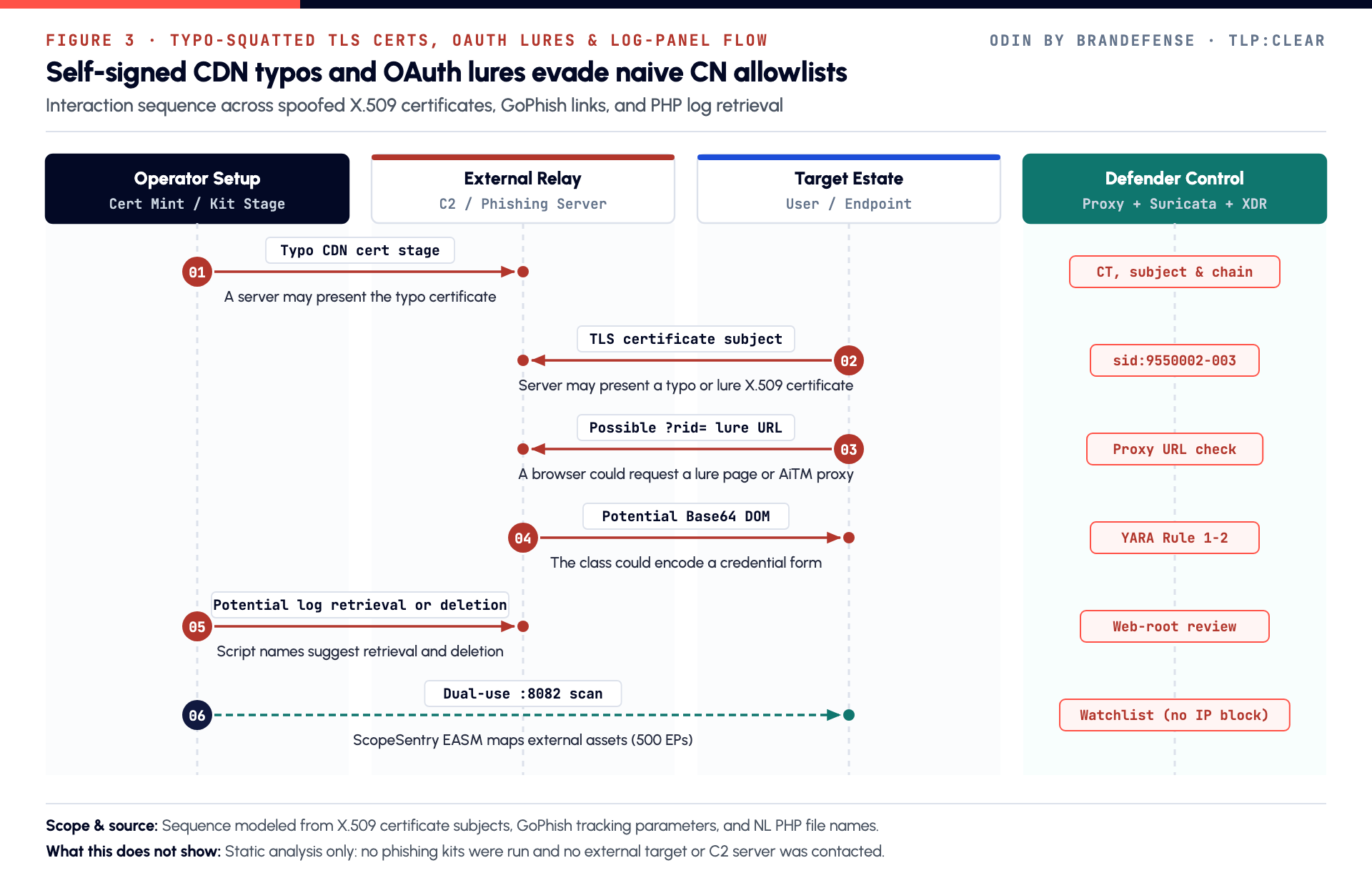
Nine-class X.509 certificate breakdown (2,002 endpoints)
Every real impersonated organization or unverified custom domain is withheld to protect third parties. Only CN=cyberstrikeai, CN=localhost, and cdn[.]cloduflare[.]com are named.
| X.509 certificate class | Endpoints | Hosts | Distinct CNs | ScopeSentry | CyberStrikeAI | Sliver | GoPhish | Evilginx | Upstream-confirmed |
|---|---|---|---|---|---|---|---|---|---|
| Plain HTTP or no Subject CN | 1,055 | 961 | 1 | 354 | 236 | 272 | 192 | 1 | 10 |
| Custom domain certificate | 605 | 548 | 433 | 107 | 110 | 110 | 278 | 0 | 16 |
Framework default (cyberstrikeai / localhost) | 165 | 157 | 2 | 10 | 90 | 63 | 2 | 0 | 6 |
| Self-signed literal IP certificate | 108 | 104 | 1 | 14 | 45 | 45 | 4 | 0 | 0 |
| Default Windows hostname certificate | 25 | 24 | 22 | 7 | 13 | 5 | 0 | 0 | 0 |
| Generic big-tech portal mimic | 19 | 19 | 4 | 8 | 3 | 2 | 6 | 0 | 0 |
| Webmail or account-verification lure | 13 | 12 | 12 | 0 | 2 | 2 | 9 | 0 | 0 |
| Financial or payment brand lure | 8 | 7 | 7 | 0 | 1 | 0 | 7 | 0 | 0 |
| Enterprise OAuth / SSO lure | 4 | 3 | 3 | 0 | 0 | 1 | 3 | 0 | 0 |
| Total (9 Classes) | 2,002 | 1,781* | 485 | 500 | 500 | 500 | 501 | 1 | 32 (30 IPs) |
**Multi-port hosts spanning two certificate classes count once per class (1,835 summed class-hosts across 1,781 unique hosts).*
Inside the 44 OAuth, webmail, financial, and portal-mimic certificates
The 44 explicit lure endpoints span 41 unverified hosts and 26 distinct scrubbed certificate subjects:
- Enterprise OAuth and SSO lures (4 endpoints on 3 hosts, 3 CNs). One AWS Germany GoPhish host exposes ports 80 and 443 under an SSO subject, and one Hetzner Germany GoPhish host exposes port 3333 under a second OAuth subject. A United States Sliver server on Zillion Network Inc. places a third OAuth subject directly on TCP port 31337.
- Webmail and account-verification lures (13 endpoints on 12 hosts, 12 CNs). Nine GoPhish endpoints sit on port 443 (Microsoft US, C2NET Czechia, OVH Poland, WULDI Germany). Others use ports 3333, 80, 28333, and 2176 across Hong Kong, Kazakhstan, Germany, Russia, and Türkiye. Two Sliver listeners also use regional webmail-verification lures on port 31337 (ALEXHOST S.R.L. in Moldova) and port 5061 (OVH SAS in Canada). One dual-port Japanese CyberStrikeAI host (80 and 443) uses another.
- Financial lures (8 endpoints on 7 hosts) and portal mimics (19 endpoints on 19 hosts). Seven GoPhish endpoints on ports 3333, 443, 80, and 92 impersonate financial brands across Microsoft US/India, Alibaba Hong Kong, AWS US, Contabo France, and AI Datacenter Russia. One CyberStrikeAI port 8080 endpoint also impersonates a financial brand. Four reused big-tech portal strings span ScopeSentry (8), GoPhish (6), CyberStrikeAI (3), and Sliver (2).
Sliver (8 upstream-confirmed IPs), GoPhish (19 upstream-confirmed IPs), and Evilginx (1 candidate)
Out of 5,670 global sightings in 83 countries, our 500 examined Sliver endpoints on 385 hosts center on port 443 (128, 25.6%) and port 8888 (101, 20.2%). Multiplayer/mTLS port 31337 (87, 17.4%) and port 8443 (38, 7.6%) follow, led by the United States (111), Hong Kong (72), China (48), and Germany (46). Ninety-nine Sliver endpoints share Sliver's default Go mTLS JARM (00000000000000000043d43d00043de2a97eabb398317329f027c66e4c1b01), and 63 serve CN=localhost.
Thirty-one Sliver endpoints (26 on port 31337, 3 on 443, 1 on 8090, 1 on 8888) reuse a single custom certificate domain. Three port 31337 servers and five additional servers in Finland, the United Kingdom, the United States, and Moldova carry upstream-confirmed tags. All eight addresses stay withheld pending independent corroboration.
Out of 23,355 global sightings in 119 countries, we examined 501 GoPhish endpoints on 455 hosts. They split between admin port 3333 (192, 38.3%, plus 4 on 3334), port 443 (167, 33.3%), and port 80 (67, 13.4%). Nearly half (223, 44.5%) sit on AWS, including a 62-endpoint AWS France suspected cluster sharing one custom domain on ports 80 (32) and 443 (30).
Forty-eight GoPhish endpoints share family-exclusive JARM 28d28d28d00028d00041d28d28d41dd279b0cf765af27fa62e66d7c8281124 (including 7 upstream-confirmed rows). Overall, 21 endpoints across 19 unique IPv4s carry upstream-confirmed tags on dedicated cloud networks, and all 19 stay withheld. Only one Evilginx candidate (:8080 in Germany) surfaced because Evilginx AiTM proxies (T1557) drop requests lacking valid lure tokens.
5. Ten Exposed PHP and Log Files on a Netherlands Apache Server
In short
An open Apache HTTP directory in the Netherlands exposes ten files totaling 17,101 bytes from a modular PHP phishing log-panel kit. Because third-party ownership cannot be ruled out, its host address, file paths, and file hashes stay withheld while defenders disable open directory listings and audit web roots.
On 20 November 2026, an open directory was observed on a withheld Dutch Apache server. It listed ten PHP kit files totaling 17,101 bytes. One entry is a withheld log file (87 bytes; filename dated 7 March 2025). We withhold the server address, file paths, and file hashes because third-party web-host upload cannot be ruled out. Figure 4 shows its five structural layers.
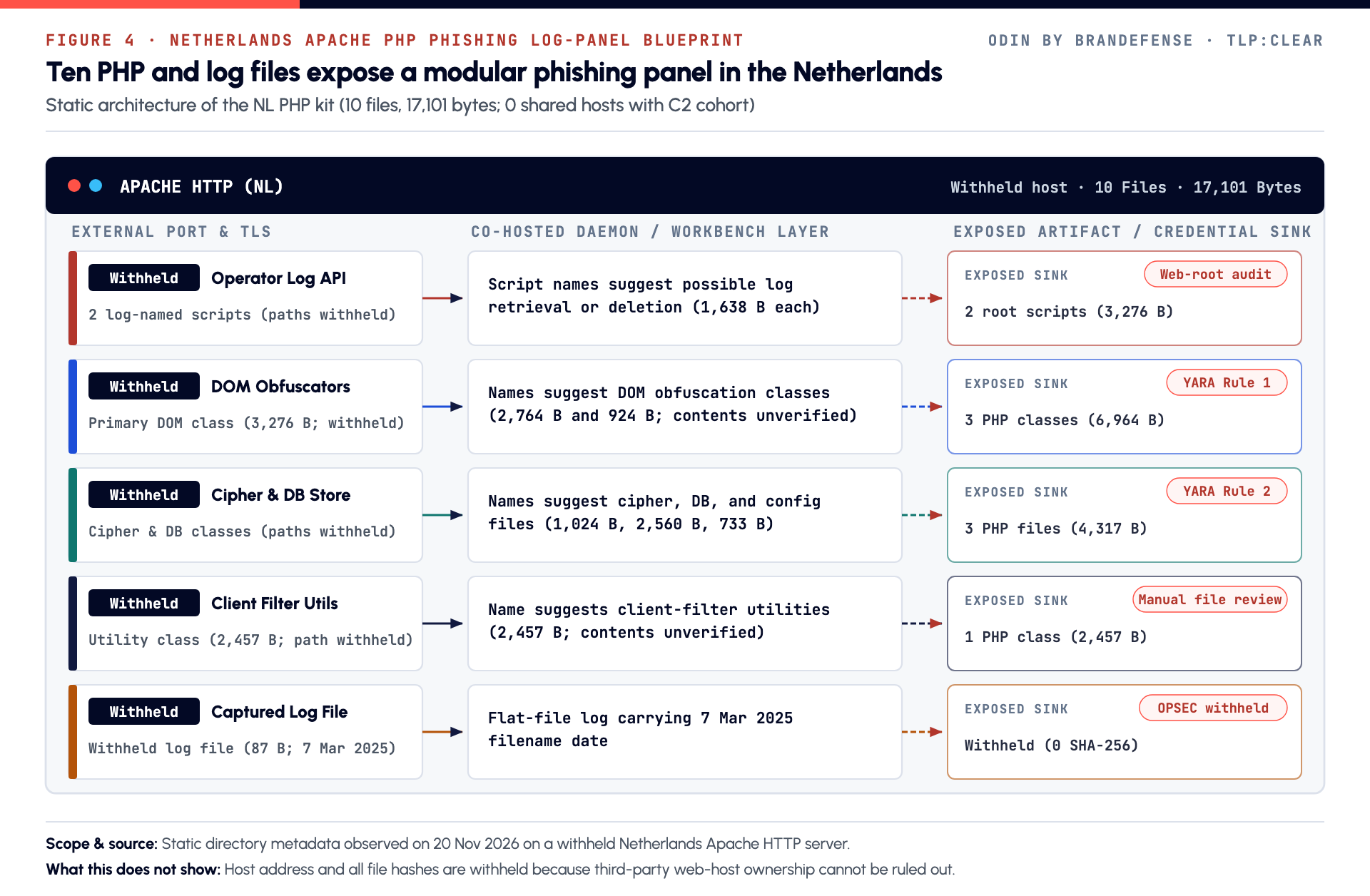
| Exposed artifact (paths withheld) | Size (bytes) | Functional group | Hashes | What the filename and metadata suggest (contents unverified) |
|---|---|---|---|---|
| Primary Base64 DOM obfuscator class (path withheld) | 3,276 | DOM obfuscation | 0 | Filename suggests a Base64 DOM obfuscation helper class |
| Core string obfuscator class (path withheld) | 2,764 | DOM obfuscation | 0 | Filename suggests a core string or identifier obfuscator class |
| Database storage class (path withheld) | 2,560 | Cipher & DB storage | 0 | Filename suggests a database-access wrapper class |
| Client-filter utility class (path withheld) | 2,457 | Client filters | 0 | Filename suggests a general utility or client-filter class |
| First operator log script (path withheld) | 1,638 | Operator log API | 0 | Filename suggests possible log retrieval; contents not available |
| Second operator log script (path withheld) | 1,638 | Operator log API | 0 | Same size (1,638 B); filename suggests possible log deletion |
| French-named cipher class (path withheld) | 1,024 | Cipher & DB storage | 0 | French-named class suggesting payload or log encryption |
| Companion Base64 obfuscator class (path withheld) | 924 | DOM obfuscation | 0 | Filename suggests a companion Base64 obfuscation class |
| French-named constants include file (path withheld) | 733 | Cipher & DB storage | 0 | French-named include file suggesting configuration constants |
| a withheld log file (87 bytes; filename dated 7 March 2025) | 87 | Captured log | 0 | Flat-file log carrying a 7 March 2025 filename date (withheld) |
The two scripts are each 1,638 bytes. Their names suggest possible log retrieval and deletion, but their contents were not available to verify those functions. The remaining seven PHP files (13,738 bytes combined) are likewise grouped by their filenames and recorded sizes because their file contents were not available.
6. Global Feed Sightings Against Upstream-Confirmed Candidates
In short
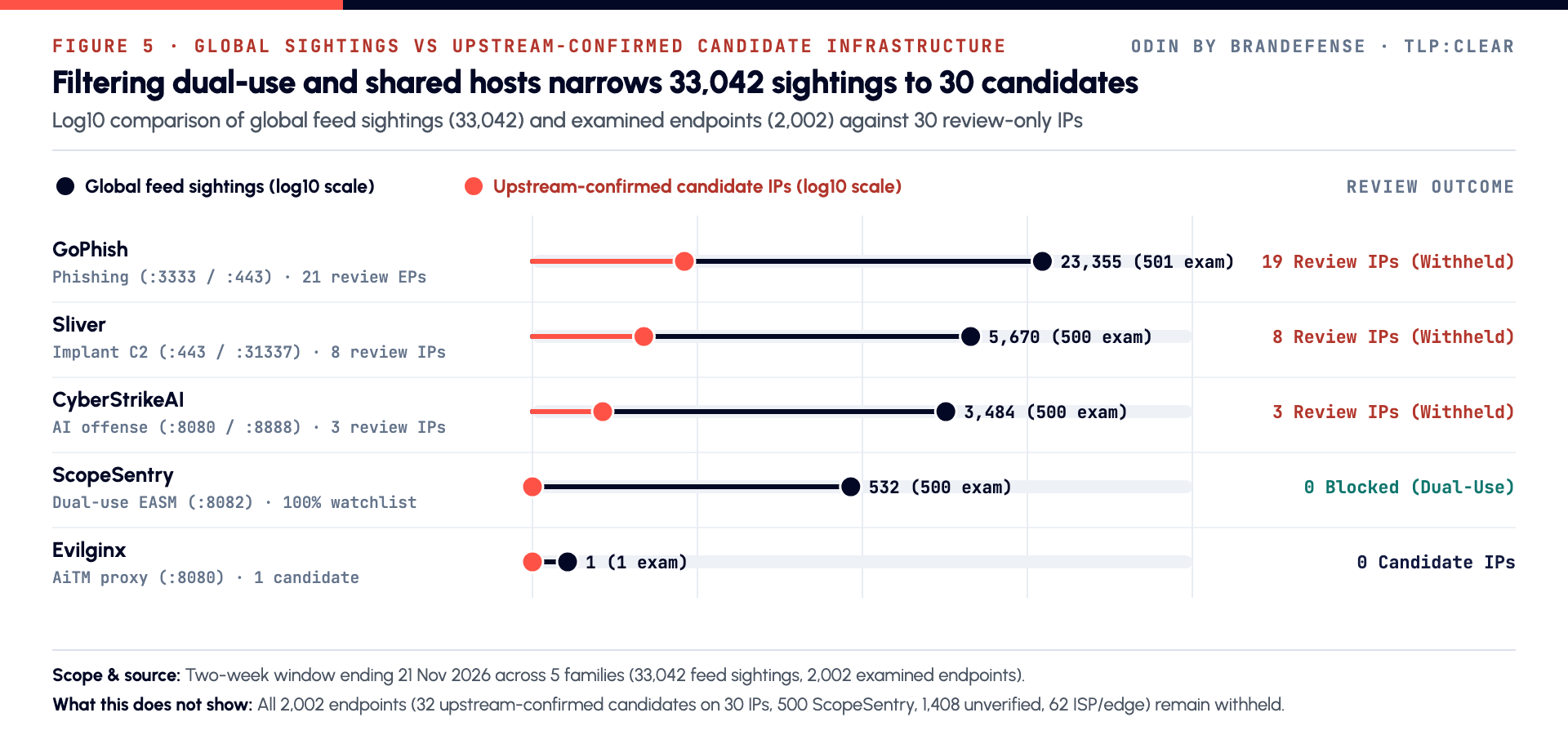
Only 32 of 2,002 examined endpoints (1.60%), representing 30 unique IPv4 addresses, carry upstream-confirmed tags on dedicated cloud networks. Withholding those 30 uncorroborated candidates alongside 500 dual-use ScopeSentry consoles, 62 subscriber ISP and CDN edge collisions, and 1,408 other unverified rows avoids self-inflicted outages. Review candidates against local telemetry before blocking.
Figure 5 compares log10-scaled global feed sightings (33,042) and examined counts (2,002) against the 30 upstream-confirmed candidate IPv4 addresses.
Five plain boundaries govern these findings:
- Separate populations, not one actor. Zero shared addresses or certificates link the 30 upstream-confirmed candidate servers, the 13 two-family watchlist servers, and the Netherlands PHP kit.
- ScopeSentry stays off IP blocklists. All 500 ScopeSentry rows (450 on ports 8082 and 18082) stay withheld because legitimate EASM teams and bug-bounty hunters run the same platform.
- Telecom subscriber pools and CDN edges are suppressed. Sixty-two endpoints on 53 hosts span 27 carrier and CDN networks, including China Telecom, China Mobile, China Unicom, Korea Telecom, Viettel, Charter, and Telefonica. That suppressed set also covers Akamai (7), Cloudflare (2), and Magyar Telekom (4 rows on ports 993, 143, and 3389).
- TLS JARMs are hunt-only. Across 970 JARM-enabled endpoints (220 distinct JARMs), even strong family JARMs identify TLS stacks rather than malicious intent. Meanwhile, Go JARM
40d40d40d00000000043d43d00043d6aff5ab0f4fc31897186312c9e639319spans 87 endpoints across four families (74 CyberStrikeAI, 9 GoPhish, 3 Sliver, 1 ScopeSentry). - TLS 1.3 encrypts certificates on the wire. Passive network IDS appliances see
CN=cyberstrikeaiandCN=cdn[.]cloduflare[.]comonly on TLS 1.2 handshakes, whereas TLS-inspecting forward proxies see both TLS 1.2 and TLS 1.3 certificates.
7. What Defenders Should Do
Network firewall and web proxy
- Review the 30 upstream-confirmed address candidates; do not publish or block an address until independent, address-specific corroboration is recorded. Where local logs corroborate an address, review AWS, Azure, and DigitalOcean blocks after 7 days and VPS blocks after 14 days.
- Search 30 days of firewall, DNS, and proxy logs for connections to TCP port 31337, MCP port 18666, GoPhish
/api/campaigns/endpoints, or?rid=phishing links.
TLS inspection and identity
- Configure TLS-inspecting proxies to alert on or block self-signed server certificates presenting subjects that claim
CN=cyberstrikeai,CN=cdn[.]cloduflare[.]com, or corporate SSO, webmail, and payment domains. - Monitor Certificate Transparency (
CT) logs for lookalike corporate SSO domains, and enforce FIDO2/WebAuthn passkeys to stop both GoPhish forms and Evilginx AiTM proxies.
Attack-surface consoles and hosted web servers
- Keep ScopeSentry feeds off IP blocklists. Bind internal :8082 and :18082 consoles behind VPN or mTLS controls, and list approved scanner hostnames in SIEM allowlists.
- Disable Apache directory listings (
Options -Indexes) on PHP web servers and review web roots with the heuristic YARA rules in the Detection rules tab.
8. Detection Rules
The full rules are in the Detection rules tab. All four published rule files passed static syntax checks; they were not loaded on live engines on our build host. Test and tune them before enabling inline blocks.
| Rule file | What it catches |
|---|---|
odin_scopesentry_typosquat_certs_and_oauth_lures.rules | Suricata 7 (4 rules, SIDs 9550001 to 9550003 and 9550006): ScopeSentry :8082/:18082 logins, CN=cyberstrikeai and CN=cdn[.]cloduflare[.]com server certificates, and GoPhish /api/campaigns/ requests |
sentinel_scopesentry_typosquat_certs_and_oauth_lure_hunt.kql | Microsoft Sentinel and Defender XDR: RemoteUrl contains matches for cdn[.]cloduflare[.]com or /api/campaigns/, connections to ports 31337/18666/18082, and unapproved ScopeSentry or CyberStrikeAI processes |
sigma_scopesentry_typosquat_certs_and_phish_panel.yml | Sigma (1 rule): Linux execution of ScopeSentry, CyberStrikeAI, or OpenSSL certificate commands naming CN=cyberstrikeai or cdn[.]cloduflare[.]com outside approved hosts |
odin_scopesentry_cyberstrikeai_and_php_phish_kit.yar | YARA (3 rules): heuristic PHP DOM obfuscation check, heuristic match for at least two listed kit strings including at least one PDO or OpenSSL function string (neither PHP rule validated against the observed files), and CyberStrikeAI or cdn[.]cloduflare[.]com configs |
In Suricata, SID 9550001 hunts POST /api/user/login on ports 8082 and 18082, while SIDs 9550002 and 9550003 match CN=cyberstrikeai and CN=cdn[.]cloduflare[.]com server certificate subjects. SID 9550006 hunts GoPhish /api/campaigns/ requests carrying an Authorization: header. Keep SIDs 9550001 and 9550006 in alert-only mode where approved internal scanners run, and maintain exact host allowlists (EASM-SCOPESENTRY-01, REDTEAM-SIM-SRV-01) in KQL and Sigma.
MITRE ATT&CK mapping
| Tactic | Technique | How it shows up in this study | Detection coverage |
|---|---|---|---|
| Resource Development | T1587.003 Digital Certificates | CN=cyberstrikeai (88 endpoints), CN=cdn[.]cloduflare[.]com typo, and 44 OAuth, webmail, bank, and portal certs | SIDs 9550002 and 9550003; Sigma; YARA 3 |
| Resource Development | T1583.003 Virtual Private Server | Upstream-confirmed candidates on AWS, DigitalOcean, Microsoft, OVH, Hetzner, IONOS, and ALEXHOST, plus /24 sweeps | KQL port hunt; 4 JARMs |
| Reconnaissance | T1595.002 Vulnerability Scanning | ScopeSentry external attack-surface consoles (446 on port 8082, 4 on port 18082) | SID 9550001; KQL; Sigma |
| Initial Access | T1566.002 Spearphishing Link | GoPhish servers (192 on port 3333, 167 on port 443, 21 upstream-confirmed) and Netherlands PHP kit | SID 9550006; KQL; YARA 1 and 2 (heuristic) |
| Credential Access | T1557 Adversary-in-the-Middle | Evilginx candidate (:8080) and enterprise OAuth/SSO certificate lures (4 endpoints) | Proxy X.509 subject and trust-chain checks; FIDO2/WebAuthn |
9. Indicators
The Indicators tab holds 4 published indicators: 0 IPv4 addresses, 4 TLS JARM fingerprints, and 0 file hashes. All 30 upstream-confirmed IPv4 candidates (32 endpoints) and the 1,970 other endpoint rows stay withheld because no independent response, beacon, behaviour, or workbench link is recorded. Five additional certificate and HTTP hunting patterns appear in this report only. The Netherlands Apache server address, its ten file paths, and all ten file hashes stay withheld.
| Type | Count | Where to use it |
|---|---|---|
| Upstream-confirmed IPv4 candidates (32 endpoints) | 0 published (30 withheld) | Withheld pending independent, address-specific corroboration; do not block uncorroborated feed tags |
| TLS JARM fingerprints | 4 | Published in the Indicators tab for TLS hunting only; never block on JARM alone |
| File hashes (SHA-256) | 0 | Zero PHP kit file hashes are published because host ownership is not established |
| Certificate and HTTP patterns | 5 | Listed below for IDS, proxy, and SIEM hunting |
TLS JARM fingerprints to hunt (in the Indicators tab)
| JARM fingerprint | Stack | Context |
|---|---|---|
00000000000000000043d43d00043de2a97eabb398317329f027c66e4c1b01 | Sliver mTLS | 100 endpoints (99 Sliver, including 2 upstream-confirmed port 31337 candidates); hunt only |
40d40d40d00000000043d43d00043d6aff5ab0f4fc31897186312c9e639319 | CyberStrikeAI / Go | 87 endpoints (74 CyberStrikeAI, including 2 upstream-confirmed port 8080 candidates); hunt only |
28d28d28d00028d00041d28d28d41dd279b0cf765af27fa62e66d7c8281124 | GoPhish Go TLS | 48 GoPhish endpoints (family-exclusive, 7 upstream-confirmed candidates); hunt only |
29d29d00029d29d00041d41d00041dcb3f8752a2d70d1dbf446fc46ab5df96 | GoPhish proxy | 57 endpoints (56 GoPhish, 3 upstream-confirmed AWS candidates); hunt only |
Certificate and HTTP patterns (report only)
| Pattern | Family | Where to hunt |
|---|---|---|
CN=cyberstrikeai | CyberStrikeAI | Server X.509 certificate subject (88 endpoints; SID 9550002) |
CN=cdn[.]cloduflare[.]com | CyberStrikeAI | Typo-squatted Cloudflare X.509 certificate subject (SID 9550003) |
POST /api/user/login | ScopeSentry | Unapproved :8082 and :18082 web consoles (SID 9550001) |
?rid= | GoPhish | Outbound browser URLs carrying recipient tracking IDs |
/api/campaigns/ | GoPhish | Campaign management API traffic on TCP 3333 (SID 9550006, KQL) |
10. Scope and Limits
This report covers observations from a two-week window ending 21 November 2026 across 2,002 examined endpoints drawn from 33,042 global sightings. It also covers directory metadata from one exposed Apache HTTP directory in the Netherlands (10 files, 17,101 bytes).
Our analysis is strictly static and passive. We did not run any PHP file, authenticate to any external server, or read file or log contents. Nothing in our data confirms whether any downstream organization suffered a breach through the 30 upstream-confirmed candidate addresses, the 44 brand-lure certificates, or the Netherlands Apache server. All 2,002 endpoint addresses, impersonated brand domains, and the Netherlands PHP server address, file paths, and hashes stay withheld.
11. Sources
- MITRE ATT&CK, Enterprise Sub-Technique T1587.003: Develop Capabilities - Digital Certificates: attack.mitre.org/techniques/T1587/003/ (verified on 21 November 2026).
- MITRE ATT&CK, Enterprise Sub-Technique T1583.003: Acquire Infrastructure - Virtual Private Server: attack.mitre.org/techniques/T1583/003/ (verified on 21 November 2026).
- MITRE ATT&CK, Enterprise Technique T1557: Adversary-in-the-Middle: attack.mitre.org/techniques/T1557/ (verified on 21 November 2026).
- MITRE ATT&CK, Enterprise Sub-Technique T1595.002: Active Scanning - Vulnerability Scanning: attack.mitre.org/techniques/T1595/002/ (verified on 21 November 2026).
- MITRE ATT&CK, Enterprise Sub-Technique T1566.002: Phishing - Spearphishing Link: attack.mitre.org/techniques/T1566/002/ (verified on 21 November 2026).
- Internet Engineering Task Force (IETF), RFC 5280: Internet X.509 Public Key Infrastructure Certificate and Certificate Revocation List (CRL) Profile: www.rfc-editor.org/rfc/rfc5280 (verified on 21 November 2026).
- ScopeSentry Project (Autumn-27), ScopeSentry External Attack Surface Management and Recon Automation Architecture: github.com/Autumn-27/ScopeSentry (verified on 21 November 2026).
- Salesforce Engineering, JARM: An Active Transport Layer Security (TLS) Server Fingerprinting Tool: github.com/salesforce/jarm (verified on 21 November 2026).
- Gophish Project, Gophish Official User Guide: Admin Server (TCP 3333) and Phishing Campaign Listener Architecture: Gophish Official User Guide (verified on 21 November 2026).
- Bishop Fox, Sliver Adversary Emulation Framework Documentation: mTLS, Multiplayer (TCP 31337), and HTTPS Listeners: Sliver Official Documentation (verified on 21 November 2026).
What is…?
Short explanations of the tools and families named in this study.
What is ScopeSentry?
ScopeSentry is an open-source asset discovery and scanning platform that maps subdomains, ports and web services.
More about ScopeSentryPhishing frameworkWhat is GoPhish?
GoPhish is an open-source phishing simulation framework. Companies use it for awareness training and attackers use it for real campaigns.
More about GoPhishAI offensive toolWhat is CyberStrikeAI?
CyberStrikeAI is a public AI-driven offensive security platform. It spreads its operator interface, API and agent listener across several ports on one host and exposes tools through MCP.
More about CyberStrikeAIC2 frameworkWhat is Sliver?
Sliver is an open-source command-and-control (C2) framework from Bishop Fox, written in Go. Red teams use it for adversary emulation, and criminal and state operators use it as a free alternative to Cobalt Strike.
More about SliverPhishing frameworkWhat is Evilginx2?
Evilginx2 is an open-source adversary-in-the-middle phishing proxy that captures credentials and session cookies.
More about Evilginx2TechniqueWhat is JARM?
JARM is an open TLS server fingerprinting method from Salesforce. It hashes how a server answers a set of crafted TLS handshakes.
More about JARMFrequently asked questions
Why should defenders monitor ScopeSentry on port 8082 instead of blocking its IP addresses?
Corporate external attack-surface management (EASM) teams, penetration testers, and bug-bounty researchers use open-source ScopeSentry. It automates Subfinder, Naabu, Httpx, Katana, and Nuclei scans. Across 532 global sightings in 32 countries, we examined 500 ScopeSentry endpoints on 486 hosts across 449 /24 subnets.
How do CyberStrikeAI, Sliver, and GoPhish operators abuse X.509 certificates?
Unlike dual-use consoles, CyberStrikeAI, Sliver, GoPhish, and Evilginx often present self-signed or deceptive X.509 certificates. These TLS certificates can mimic trusted services in network logs. CyberStrikeAI appeared on 500 endpoints across 467 hosts and 273 /24 subnets. Port 8080 accounted for 230 endpoints and port 8888 for 96. Seven US listeners used port 18666. Two dense sweeps covered 95 Lithuanian and 38 Dutch hosts.
What does the Netherlands PHP phishing log-panel kit expose?
Zero shared IP addresses or certificates link the 30 upstream-confirmed candidate servers, the ScopeSentry cohort, and the Netherlands Apache server. Because nothing ties them to one actor, we treat them as an analytical model. Observed on 20 November 2026, that Apache directory exposes ten files (17,101 bytes) from a modular PHP phishing kit.