
Key takeaways
- Across 2,002 examined endpoints on 1,781 hosts drawn from 33,042 sightings, 32 upstream-confirmed endpoints on 30 cloud IPv4s remain withheld for review.
- Nine in ten ScopeSentry instances (450 of 500) listen on TCP ports 8082 or 18082 and stay withheld because corporate EASM teams and bug-bounty hunters share them.
- CyberStrikeAI operators pair 88 default CN=cyberstrikeai certificates with custom domains and typo-squatted CN=cdn[.]cloduflare[.]com TLS subjects.
- Forty-four endpoints across GoPhish, Sliver (:31337), CyberStrikeAI, and ScopeSentry present OAuth, webmail, financial, or portal-mimic X.509 certificates.
- Ten exposed files on a Netherlands Apache server include twin 1,638-byte scripts whose names suggest log retrieval and deletion, alongside DOM and storage classes.
Only 32 of 2,002 examined endpoints carried upstream-confirmed tags on dedicated cloud networks, representing 30 unique IPv4 addresses. Because the dataset records no independent response, beacon, or workbench link per address, all 30 stay withheld for review rather than automated blocking. Odin by Brandefense reviewed the cohort in a two-week window ending 21 November 2026.
The endpoints covered 1,781 hosts drawn from 33,042 global sightings of ScopeSentry, CyberStrikeAI, Sliver, GoPhish, and Evilginx. We also examined directory metadata for ten PHP phishing kit files exposed by a Netherlands Apache server, the kind of lure infrastructure phishing monitoring watches for. Blocking raw feed entries without address-specific corroboration would disrupt authorized assessments and shared infrastructure.
Why should defenders monitor ScopeSentry on port 8082 instead of blocking its IP addresses?
Corporate external attack-surface management (EASM) teams, penetration testers, and bug-bounty researchers use open-source ScopeSentry. It automates Subfinder, Naabu, Httpx, Katana, and Nuclei scans. Across 532 global sightings in 32 countries, we examined 500 ScopeSentry endpoints on 486 hosts across 449 /24 subnets.
Nine in ten examined ScopeSentry consoles (450 of 500, 90.0%) listen on default Docker web port 8082 (446 endpoints) or port 18082 (4 endpoints). Deployments cluster in China (155), Hong Kong (105), the United States (90), Singapore (32), and Japan (31). Top hosts are Tencent (77), Alibaba (52 combined), and HostPapa (37). Over seven in ten (354, 70.8%) serve /api/user/login over plain HTTP without a certificate Common Name.
Upstream feeds labelled seven ScopeSentry servers confirmed. Eleven hosts run ScopeSentry beside GoPhish (5), CyberStrikeAI (3), or Sliver (3). Even so, blocking ScopeSentry addresses without cyber threat intelligence review breaks authorized asset monitoring and does little to slow attackers on disposable virtual machines. Every ScopeSentry address is therefore withheld from blocklists while defenders use external attack surface management to audit their own perimeters for unapproved port 8082 consoles.
How do CyberStrikeAI, Sliver, and GoPhish operators abuse X.509 certificates?
Unlike dual-use consoles, CyberStrikeAI, Sliver, GoPhish, and Evilginx often present self-signed or deceptive X.509 certificates. These TLS certificates can mimic trusted services in network logs.
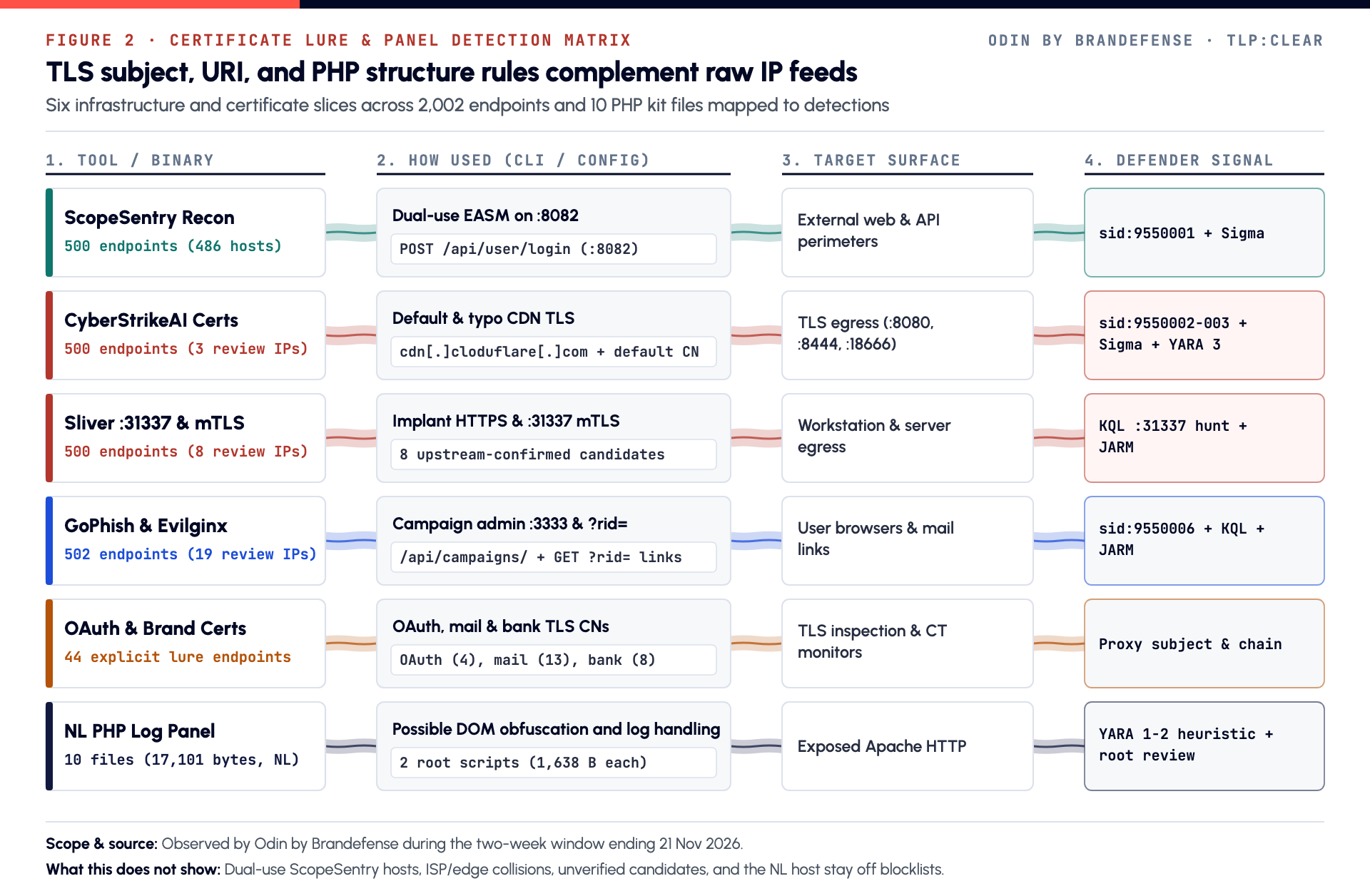
CyberStrikeAI appeared on 500 endpoints across 467 hosts and 273 /24 subnets. Port 8080 accounted for 230 endpoints and port 8888 for 96. Seven US listeners used port 18666. Two dense sweeps covered 95 Lithuanian and 38 Dutch hosts.
Eighty-eight endpoints served CN=cyberstrikeai, including three upstream-confirmed candidate relays withheld pending address-specific corroboration. The cohort also contained 110 custom-domain certificate rows and self-signed CN=cdn[.]cloduflare[.]com subjects. That spelling swaps ud to du in cloudflare; the evidence does not establish why those subjects were chosen.
Across all 2,002 endpoints, X.509 certificates fall into nine classes. Plain HTTP or no Subject CN leads (1,055), followed by custom domains (605) and framework defaults (165). IP certificates (108), Windows hostnames (25), and 44 explicit brand or portal lures across 41 hosts make up the rest. Those 44 lure rows include 19 generic big-tech portal mimics, 13 regional webmail and account-verification lures, 8 financial-brand lures, and 4 enterprise OAuth/SSO lures.
Brand-lure certificates are not limited to browser phishing pages. GoPhish accounts for 25 of the 44 explicit lures across ports 443, 3333, and 80. Sliver listeners also present OAuth and regional webmail-verification subjects on TCP port 31337 (Zillion Network in the United States and ALEXHOST in Moldova).
Another Sliver listener uses a webmail lure on port 5061 (OVH in Canada). Filtering 62 telecom ISP and shared CDN edge collisions leaves 8 upstream-confirmed Sliver IPv4 candidates (3 on port 31337) and 19 upstream-confirmed GoPhish IPv4 candidates (21 endpoints). All remain withheld until independent corroboration is recorded.
What does the Netherlands PHP phishing log-panel kit expose?
Zero shared IP addresses or certificates link the 30 upstream-confirmed candidate servers, the ScopeSentry cohort, and the Netherlands Apache server. Because nothing ties them to one actor, we treat them as an analytical model. Observed on 20 November 2026, that Apache directory exposes ten files (17,101 bytes) from a modular PHP phishing kit.
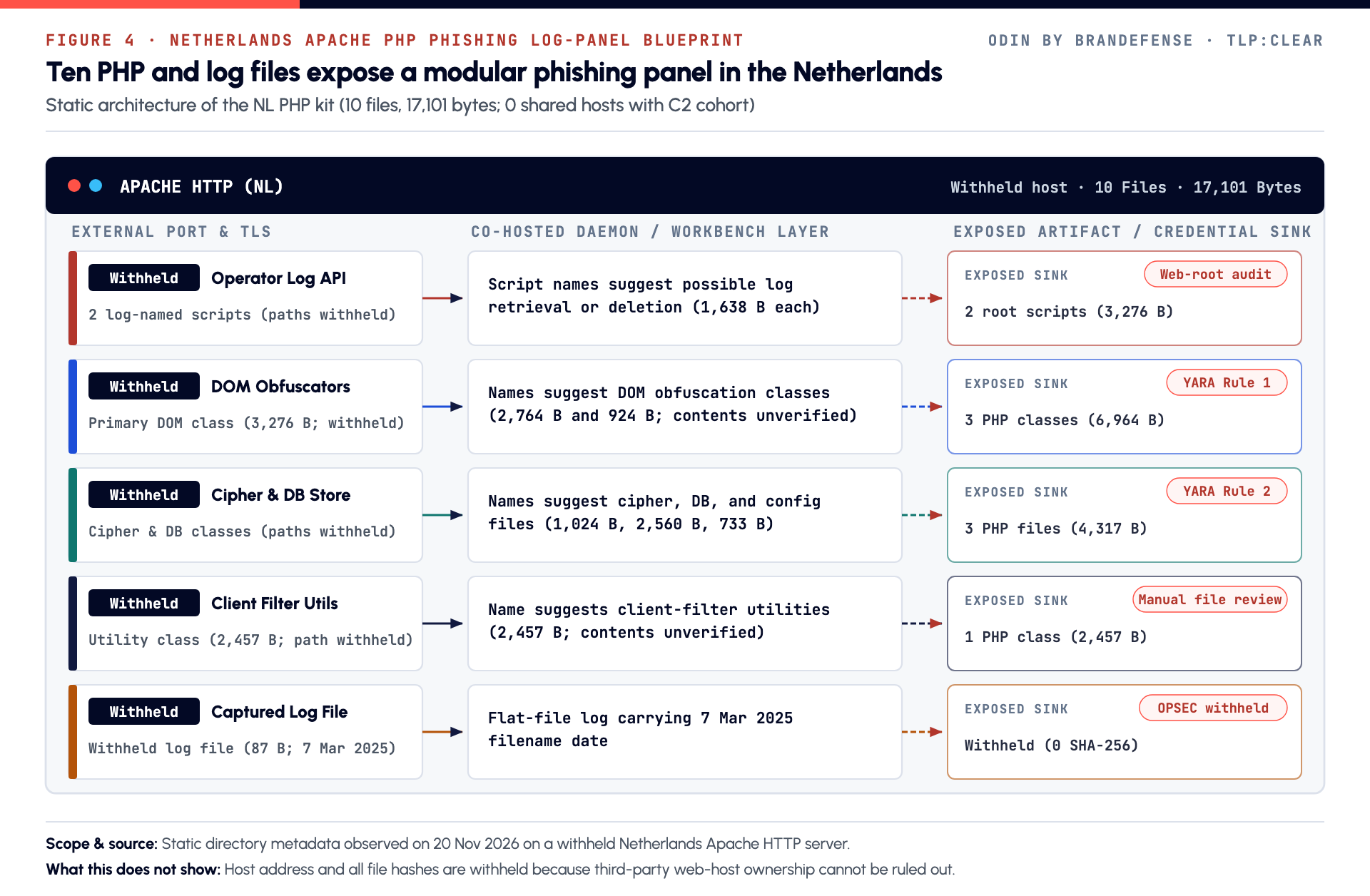
The web root lists two 1,638-byte PHP scripts whose paths are withheld because third-party web-host ownership cannot be ruled out. The two files have the same recorded size; their names suggest possible log retrieval and deletion. Their contents were not available to verify those functions.
Three withheld class files (3,276, 2,764, and 924 bytes) carry names suggesting Base64 and string DOM obfuscation. Three more files (2,560, 1,024, and 733 bytes) carry French or English names suggesting database access, cipher routines, and configuration constants, alongside a 2,457-byte utility class. Their contents were not available to verify those functions, and a withheld log file (87 bytes; filename dated 7 March 2025) sits in a log subdirectory. The host address, file paths, and file hashes remain withheld.
What to do now
- Review upstream-confirmed C2 and phishing candidates before blocking. Review the 30 upstream-confirmed CyberStrikeAI (3), Sliver (8), and GoPhish (19) address candidates, and do not publish or block an address until independent, address-specific corroboration is recorded. Where local telemetry corroborates an address, review cloud blocks after 7 days and VPS blocks after 14 days.
- Inspect X.509 certificate subjects and trust chains on TLS proxies. Alert on or block self-signed server certificates claiming
CN=cyberstrikeai,CN=cdn[.]cloduflare[.]com, or corporate SSO, webmail, and banking domains. Use the four published TLS JARM fingerprints strictly for hunting. - Require FIDO2/WebAuthn passkeys on SSO and webmail portals. Phishing-resistant passkeys stop both GoPhish
?rid=credential forms and Evilginx AiTM reverse proxies. External feed scans rarely catch short-lived AiTM relays. - Govern internal ScopeSentry consoles instead of blocking their IPs. Keep ScopeSentry feeds off firewall blocklists and place internal :8082 and :18082 consoles behind VPN or mTLS gateways. List approved scanner hostnames in SIEM allowlists.
- Deploy the published Suricata, KQL, Sigma, and YARA rules. Load the four rule files from the full report's Detection rules tab. They hunt spoofed TLS handshakes, ScopeSentry :8082 logins, GoPhish
/api/campaigns/requests, and heuristic PHP kit strings (not validated against the observed files).
What is…?
Short explanations of the tools and families named in this study.
What is ScopeSentry?
ScopeSentry is an open-source asset discovery and scanning platform that maps subdomains, ports and web services.
More about ScopeSentryPhishing frameworkWhat is GoPhish?
GoPhish is an open-source phishing simulation framework. Companies use it for awareness training and attackers use it for real campaigns.
More about GoPhishAI offensive toolWhat is CyberStrikeAI?
CyberStrikeAI is a public AI-driven offensive security platform. It spreads its operator interface, API and agent listener across several ports on one host and exposes tools through MCP.
More about CyberStrikeAIC2 frameworkWhat is Sliver?
Sliver is an open-source command-and-control (C2) framework from Bishop Fox, written in Go. Red teams use it for adversary emulation, and criminal and state operators use it as a free alternative to Cobalt Strike.
More about SliverPhishing frameworkWhat is Evilginx2?
Evilginx2 is an open-source adversary-in-the-middle phishing proxy that captures credentials and session cookies.
More about Evilginx2TechniqueWhat is JARM?
JARM is an open TLS server fingerprinting method from Salesforce. It hashes how a server answers a set of crafted TLS handshakes.
More about JARMFrequently asked questions
Why should defenders monitor ScopeSentry on port 8082 instead of blocking its IP addresses?
Corporate external attack-surface management (EASM) teams, penetration testers, and bug-bounty researchers use open-source ScopeSentry. It automates Subfinder, Naabu, Httpx, Katana, and Nuclei scans. Across 532 global sightings in 32 countries, we examined 500 ScopeSentry endpoints on 486 hosts across 449 /24 subnets.
How do CyberStrikeAI, Sliver, and GoPhish operators abuse X.509 certificates?
Unlike dual-use consoles, CyberStrikeAI, Sliver, GoPhish, and Evilginx often present self-signed or deceptive X.509 certificates. These TLS certificates can mimic trusted services in network logs. CyberStrikeAI appeared on 500 endpoints across 467 hosts and 273 /24 subnets. Port 8080 accounted for 230 endpoints and port 8888 for 96. Seven US listeners used port 18666. Two dense sweeps covered 95 Lithuanian and 38 Dutch hosts.
What does the Netherlands PHP phishing log-panel kit expose?
Zero shared IP addresses or certificates link the 30 upstream-confirmed candidate servers, the ScopeSentry cohort, and the Netherlands Apache server. Because nothing ties them to one actor, we treat them as an analytical model. Observed on 20 November 2026, that Apache directory exposes ten files (17,101 bytes) from a modular PHP phishing kit.