
Key takeaways
- Five misconfigured open web directories report 17,255 files (582 unique paths) across kiosks, cloud Linux VMs, MSP shares, and DICOM tools.
- A payment kiosk server exposes .NET debug symbols, motorized card-reader and RFID DLLs, 134 invoice logs, and camera JPEGs.
- Two US shares expose eight NinjaOne MSIs and one organization-named Action1 MSI alongside a 20.40 GB Veeam 13.0.1 backup ISO.
- Across 250 TacticalRMM endpoints (117 on cloud VPS networks), two (0.80%) carry webmail-lure certificate labels without independent confirmation of abuse.
- Close open HTTP shares, disable Apache FollowSymLinks, rotate any reusable RMM enrollment tokens, and require independent evidence before blocking TacticalRMM hosts.
Five open directories reported 17,255 files, while two TacticalRMM endpoints carried webmail-lure certificate labels. Odin reviewed them in the two weeks ending 21 November 2026. The five open web directories yielded 925 sampled entries and 582 unique paths across 11 slices. We also reviewed 250 TacticalRMM endpoints across 248 distinct hosts and found zero shared hosts between the two sets.
All five open directories belong to site owners or MSP teams rather than threat actors. We therefore withheld all five owner addresses (Host A through Host E) and all file hashes. Together they show how exposed hardware drivers, root-like web paths, and MSP RMM .msi files create real risk. Defenders can use cyber threat intelligence and certificate checks to separate lure-labeled TacticalRMM candidates from standard MSP servers.
What did we find across the five misconfigured directories?
Site owners and technicians sometimes leave directory indexing (Index of /) open on maintenance ports, NAS folders, or FTP mirrors. Some servers also expose root-like paths inside web roots. We reviewed listing metadata statically, installed zero .msi files, and contacted zero RMM consoles. The directory listings do not establish defects in the named software or hardware libraries.
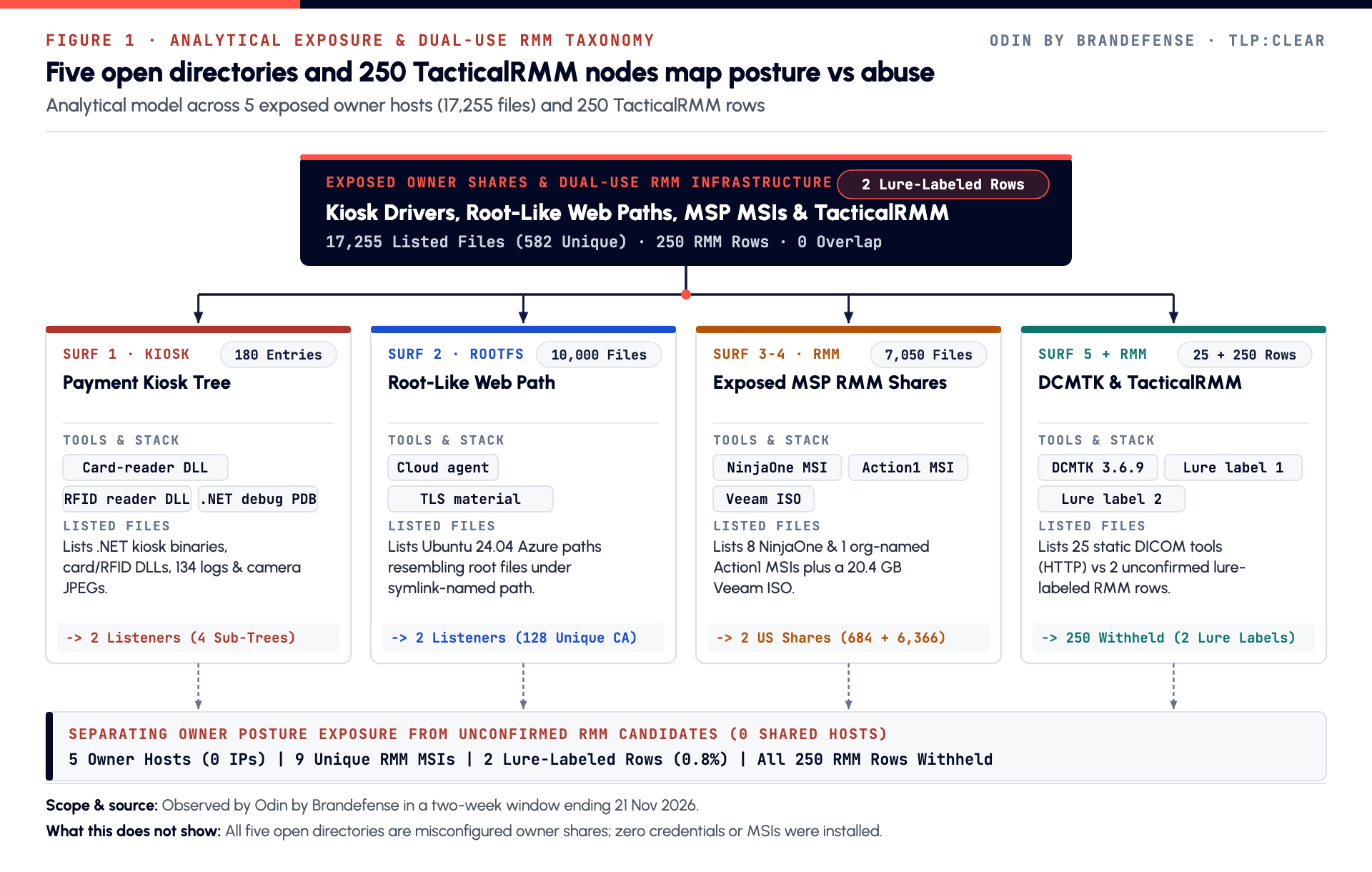
Nothing links the five open-directory hosts to one another. They share zero IP addresses, TLS certificates, or tenant names. Teams can use external attack surface management to find and close each open share:
- Physical payment kiosk (
Host A). Four public folders across two listeners list 180 files totaling 10.13 MB. They include a .NET client, debug symbols, card-reader and RFID libraries, 134 invoice logs, and three camera JPEGs.
- Root-like web path on a cloud Linux VM (
Host B, Canada). Each of two Apache listeners reports 10,000 files, with 128 unique sampled paths totaling 133.40 MB (first recorded 9 August 2026). The sampled paths resemble Linux root files under a symlink-named web path, though Odin did not verify the link target or Apache settings. Listed files include a cloud guest-agent binary, TLS certificate material, Python library files, an initial ramdisk image, and cloud Linux kernel images.
- MSP
NinjaOneandVeeamshare (Host C, US). Each of two Apache listeners reports 684 files, with 120 unique paths totaling 141.99 GB (first recorded 11 August 2026). The share lists six 72.35 MB client-folderNinjaOne.msifiles, two 51.38 MB repair.msifiles, and six cleanup scripts. It also lists a 20.40 GBVeeam 13.0.1backup ISO and two Hyper-V.vhdxdisks (48.32 GB and 20.40 GB).
- Nginx and FTP
Action1share (Host D, US). Each of two web listeners reports 6,366 files, with 129 unique paths totaling 3.19 GB (first recorded 12 August 2026). The server mirrors one organization-namedAction1.msifile (6.65 MB) across three HTTP and FTP paths. Co-hosted folders hold a 135.93 MB Cisco VPN predeploy.ziparchive, a 6 B test text file, and 43 ARM Linux.xzimages.
- Medical
DCMTKstatic binary share (Host E). This HTTP folder lists 25DCMTK 3.6.9static Linux entries with 0 patient files. Eleven sized ELF binaries total 54.10 MB, including diagnostic image codec tools and clinical document converters. Fourteen unsized entries include DICOM network SCP and SCU utilities.
Why do exposed MSP RMM installers and TacticalRMM servers need careful handling?
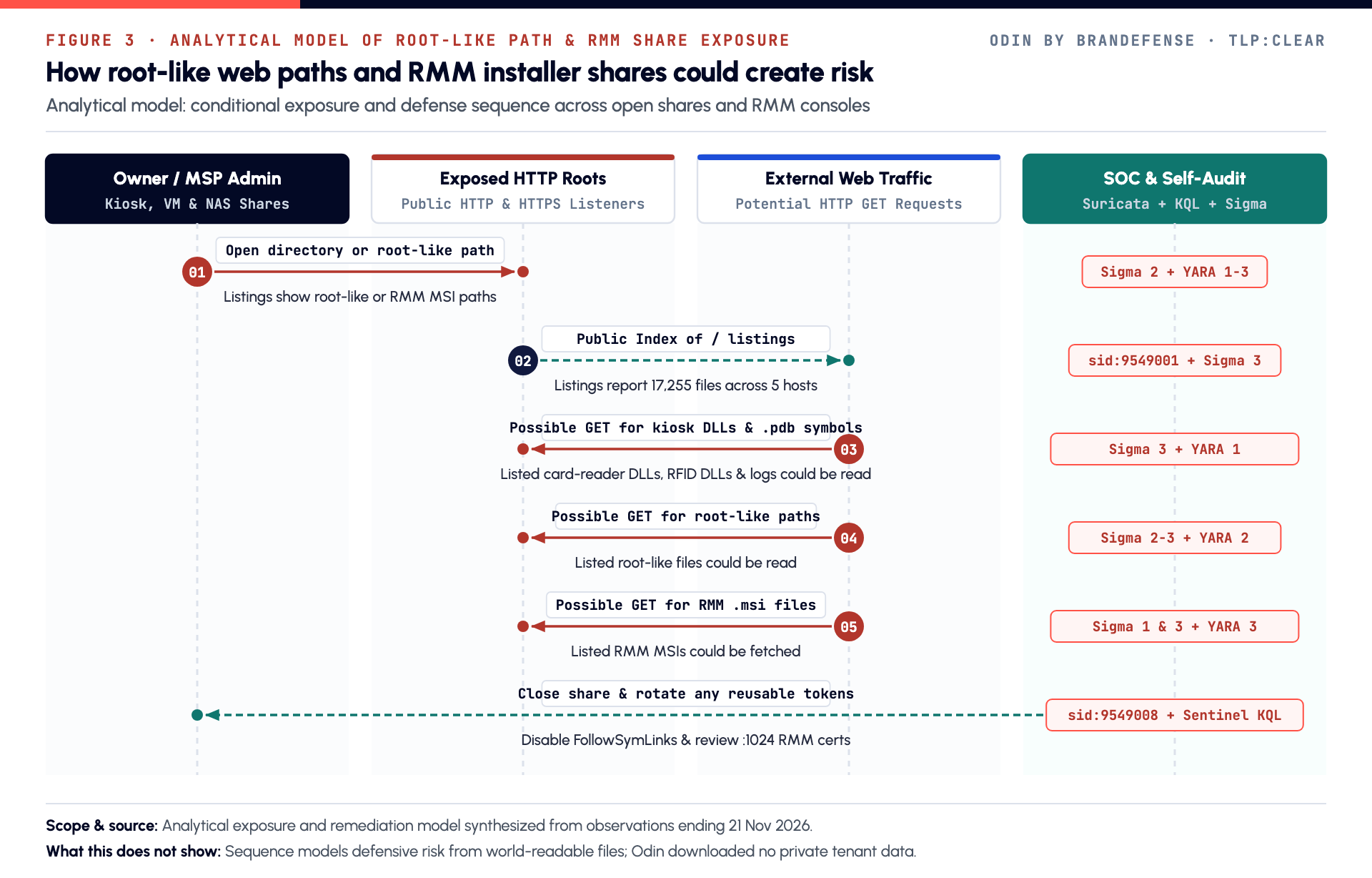
The exposed NinjaOne and Action1 .msi paths carry client folder or organization names, though Odin did not inspect the packages or verify tenant enrollment parameters. If the packages contain reusable enrollment credentials and the console allows automatic enrollment, an outside party could register an unapproved agent. Odin did not test either condition.
Folder and archive names on those same shares also reveal client names, backup versions, Hyper-V base images, and VPN bundles. MSP consoles should hold new agents in a pending queue until a technician approves them. If a package contains a reusable enrollment token, rotate it and require manual approval for new agents.
On the external feed side, TacticalRMM generated 39,887 global sightings across 119 countries (340 feed-verified). We reviewed 250 confirmed-status endpoints across 248 hosts. Port 1024 accounts for 227 rows (90.80%), port 80 holds 14 (5.60%), port 443 holds three (1.20%), and six other ports hold one row each. The United States and Germany lead with 57 rows each, followed by Brazil (45) and France (23).
Within those 250 endpoints, 117 run on 13 cloud VPS providers (Hetzner 35, OVH 28, Hostinger 16, DigitalOcean 12, Contabo GmbH 11). Yet official TacticalRMM guides direct MSPs to install their servers on those same cloud VPS networks with custom domains. Checking X.509 certificate labels separates the 250 endpoints into two groups:
- Unconfirmed webmail-lure candidates (2 rows, 0.80%). Two cloud VPS endpoints (addresses and ports withheld) have webmail-lure certificate labels in the source register. Their abuse remains unconfirmed without protocol or behavioral evidence.
- Withheld dual-use, regional, and telecom rows (248 rows, 99.20%). We keep 115 cloud VPS custom-domain servers (46.00%) and 111 regional MSP candidates (44.40%) withheld on watchlists. Another 22 telecom and edge rows (8.80%, including mail-service collisions) stay withheld so teams do not block valid networks.
What to do now
- Gate MSP RMM shares and rotate any reusable tokens. Delete organization-named
NinjaOne,Action1, and remote-support.msifiles from public HTTP, NAS, and FTP folders. If an exposed package contains a reusable token, rotate it and require manual approval for new RMM agents.
- Disable web symlink traversal and isolate kiosk and DICOM shares. Set
Options -Indexes -FollowSymLinks -SymLinksIfOwnerMatchin Apache anddisable_symlinks on;in Nginx. Verify that zero symbolic links insideDocumentRootpoint outside the web root. Strip.pdbdebug symbols from kiosk builds, and move the payment-kiosk listeners andDCMTKutility share onto private VLANs.
- Review TacticalRMM traffic and load self-audit detections. Withhold unconfirmed TacticalRMM hosts from single-signal IP blocklists and hunt custom-domain usage through port 1024 TLS checks and
msiexec.exelogs. Load our Suricata (sid:9549001andsid:9549008), Sentinel KQL, Sigma, and YARA rules, and test them in staging before production deployment.
The full report on exposed kiosks, root-like web paths, and RMM shares holds 0 published blocklist indicators (0 network addresses and 0 file hashes). All five misconfigured share addresses and all 250 TacticalRMM addresses, including both unconfirmed webmail-lure endpoints, are withheld. The full report also lists 11 self-audit patterns and provides Suricata, KQL, Sigma, and YARA detection rules.
What is…?
Short explanations of the tools and families named in this study.
Frequently asked questions
What did we find across the five misconfigured directories?
Site owners and technicians sometimes leave directory indexing (Index of /) open on maintenance ports, NAS folders, or FTP mirrors. Some servers also expose root-like paths inside web roots. We reviewed listing metadata statically, installed zero .msi files, and contacted zero RMM consoles. The directory listings do not establish defects in the named software or hardware libraries.
Why do exposed MSP RMM installers and TacticalRMM servers need careful handling?
The exposed NinjaOne and Action1 .msi paths carry client folder or organization names, though Odin did not inspect the packages or verify tenant enrollment parameters. If the packages contain reusable enrollment credentials and the console allows automatic enrollment, an outside party could register an unapproved agent. Odin did not test either condition.