
1. Executive Summary
In short
During a two-week observation window ending 21 November 2026, Odin by Brandefense analyzed 1,084 sampled entries across five open HTTP ports on two servers. We also examined a 373,784-byte callback log (3,292 lines across 271 peers) alongside 600 Interactsh endpoints from 31,117 sightings. Hunt outbound OAST and SMTP callbacks, enforce mutual TLS on CDN origins, and alert on backend image canary requests.
Perimeter defenses often assume external reconnaissance starts at a content delivery network (CDN) edge. The files suggest three reconnaissance paths that could work around web application firewalls (WAFs): unpacked Android packages, one-byte server-side request forgery (SSRF) canaries, and CDN origin mapping.
We reviewed static file metadata and callback logs across five open HTTP ports on two servers observed from 13 to 20 November 2026. We also examined 600 recent Interactsh endpoints from 31,117 sightings. No captured binary was run and no external target was contacted. Because independent per-address confirmation is absent for the 600 Interactsh endpoints, all 407 OAST host addresses, both open directories, 271 callback peers, and all 929 file hashes stay withheld.
A four-port US server pairs unpacked Android packages with one-byte SSRF canaries.
Observed from 13 to 20 November 2026 across four withheld HTTP listener ports, a US workspace exposes unpacked .apk archives, ARM64 libraries, JavaScript bundles, and GlobalProtect login pages. Its canary listener serves a one-byte image canary (filename withheld), while its callback listener logs 1,877 HTTP requests, including 166 requests targeting the image canary and 356 automated bot hits.
A Hong Kong server stages CDN origin hunting beside 114 PHP templates.
Observed from 13 to 20 November 2026 on a withheld HTTP listener port, a second directory reports 2,132 files centered on a 128.88-megabyte SQLite origin database and 57 scheduled logs. Beside cloud ASN files and FOFA tables sit 114 PHP and gateway YAML templates, a CVE-2019-11043 PHP-FPM exploit binary, and captured appliance pages.
Upstream feed labels mark 194 cloud Interactsh ports across 120 unconfirmed IPv4s.
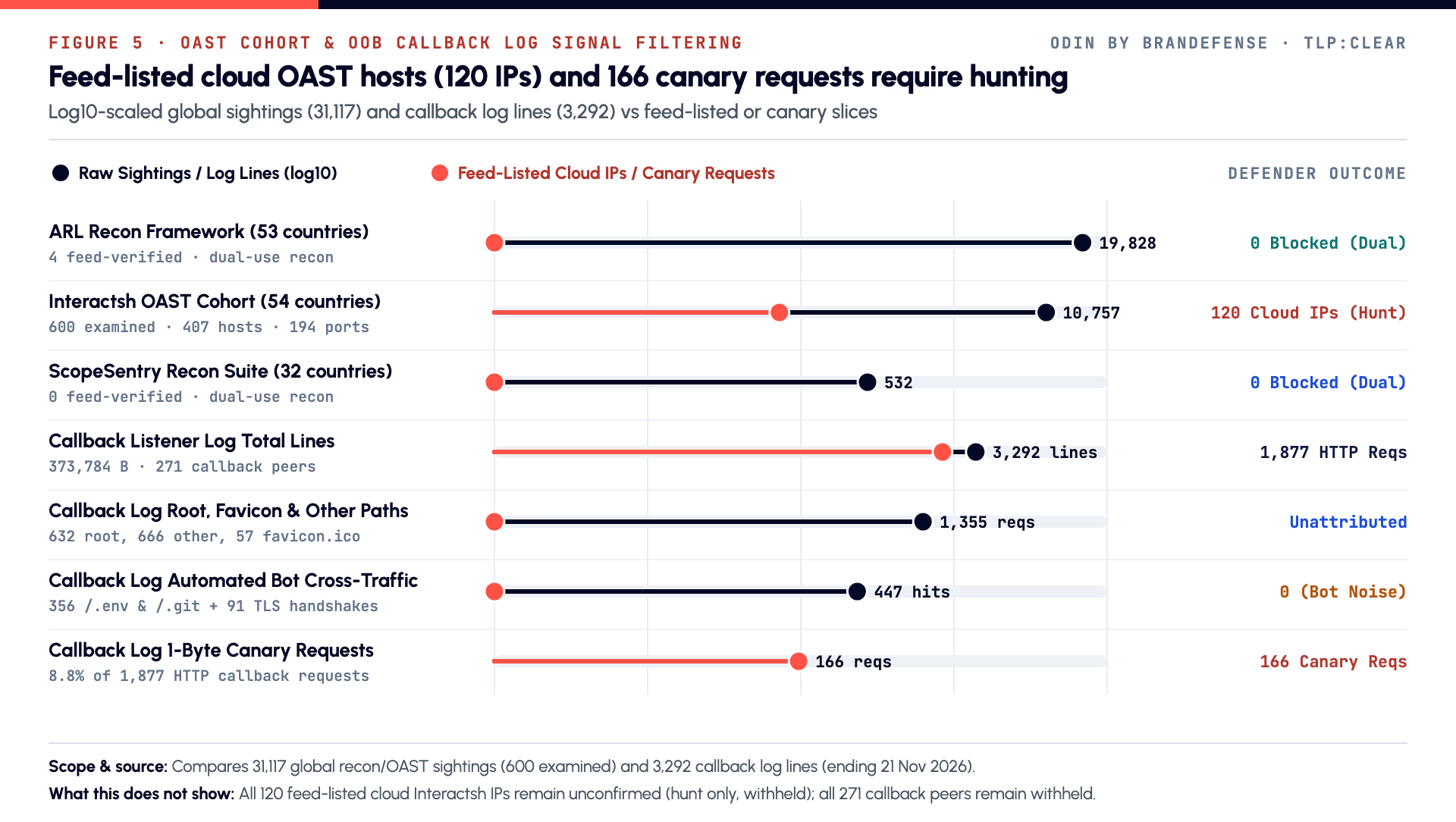
Out of 31,117 sightings spanning ARL (19,828), Interactsh (10,757), and ScopeSentry (532), we reviewed 600 Interactsh endpoints across 407 hosts. The upstream feed labels 194 cloud ports on 120 IPv4s as confirmed, including 186 on SMTP ports 465 and 587 across 115 hosts. All 600 endpoints lack independent per-address confirmation and stay withheld.
Three Decisions for Leaders
- Lock down outbound URL fetchers and enforce session-based cloud metadata. Restrict avatar, webhook, and preview workers to approved external hosts, block private and link-local IPs, and require AWS
IMDSv2across all workloads. - Close direct-to-origin HTTP and HTTPS paths behind CDN perimeters. Accept origin traffic solely from published CDN IP ranges and require mutual TLS (
Authenticated Origin Pulls) to prevent edge WAF bypasses. - Hunt outbound OAST callbacks and block unauthorized application SMTP egress. Hunt outbound TCP 26, 80, 443, 465, and 587 traffic for
Interactshdomains before blocking any feed-listed cloud host, and block direct outbound SMTP from non-mail application subnets.
The Study in Numbers
| Number | What it is |
|---|---|
| 2 Hosts / 5 Ports | Open HTTP workspaces in the US (4 ports) and Hong Kong (1 port), addresses and ports withheld (0 shared hosts) |
| 11,947 / 1,084 | Reported directory files across the five listeners and 1,084 sampled entries across six artifact groups |
| 3,292 / 1,877 | Lines inside the 373,784-byte callback log and 1,877 HTTP requests across 271 peers |
| 166 vs 356 | 166 HTTP requests targeting the image canary vs 356 opportunistic /.env, /.git, and config bot hits on the callback listener |
| 57 + 114 | 57 scheduled CDN origin-discovery logs and 114 staged PHP and gateway YAML templates on the origin-hunt listener |
| 31,117 / 600 | Sightings across ARL, Interactsh, and ScopeSentry, with 600 Interactsh endpoints reviewed on 407 hosts |
| 194 / 120 | Feed-labelled Interactsh cloud ports (186 on SMTP ports 465 and 587) across 120 withheld cloud IPv4s |
How to use this report.
Security leaders should read Chapters 1, 6, and 7. Mobile, API, and cloud architects should review Chapters 3, 4, and 7. SOC analysts and detection engineers should use Chapters 5, 8, and 9 with the Detection rules and Indicators tabs.
2. Multi-Port Recon, SSRF Canary, and Origin-Hunt Analytical Model
In short
Odin by Brandefense reviewed 1,084 sampled entries (11,947 reported files) across five open HTTP ports alongside 600 Interactsh endpoints across 407 hosts. Zero shared IPv4 addresses connect the two open directories or the Interactsh hosts. Treat these findings as an analytical model and hunt outbound OAST, SSRF canary, and origin-bypass traffic.
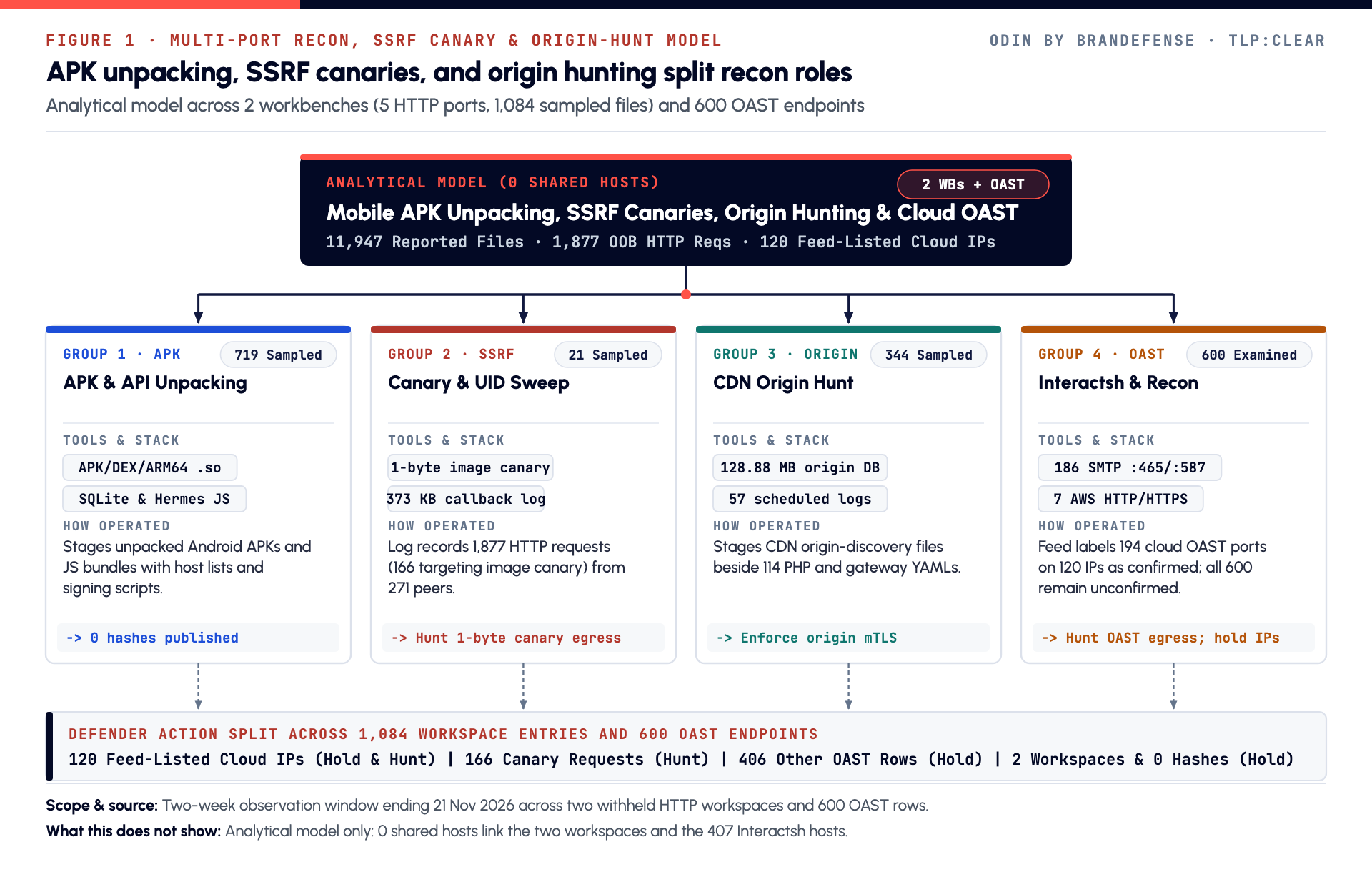
Comparing the US four-port workspace, the Hong Kong origin-hunt workspace, and all 407 Interactsh hosts shows zero shared IPv4 addresses and zero shared /24 subnets. We therefore present them explicitly as an analytical model of application reconnaissance for cyber threat intelligence teams rather than a single actor. Figure 1 maps the four functional groups to their defensive actions.
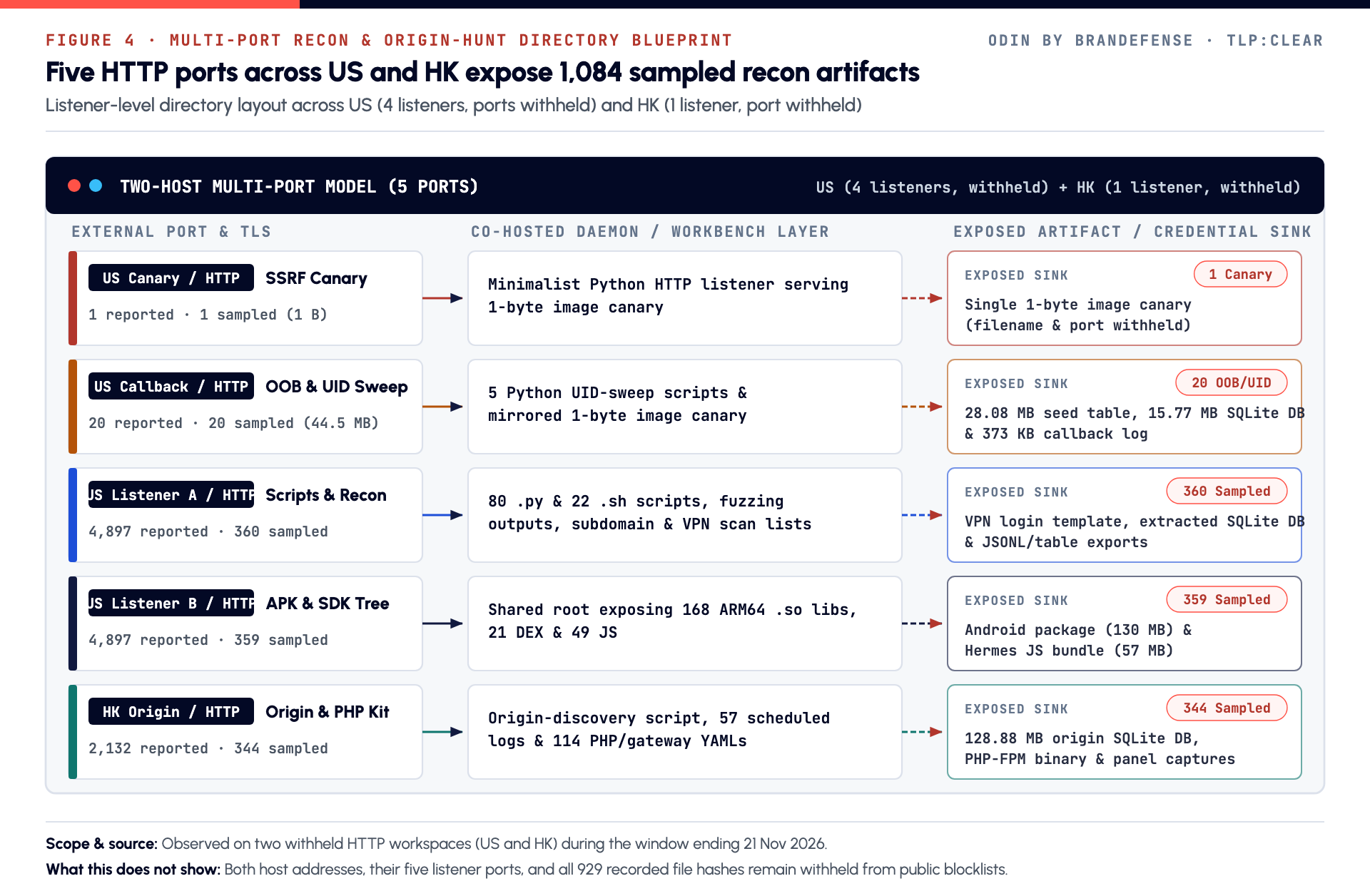
Five Open HTTP Directory Listeners Across Two Hosts (1,084 Sampled Entries)
Operators on rented virtual private servers often start unauthenticated Python HTTP servers across multiple high ports to move scripts, inspect logs, or serve SSRF callback files. Binding those listeners to 0.0.0.0 exposes the underlying folders that external attack surface management can help defenders find. Table 2.1 summarizes all five listeners across both withheld hosts.
| Workspace & listener | Geo | Engine | Reported | Sampled | Hash rec. | Unhashed | Observed dates | Primary staged contents |
|---|---|---|---|---|---|---|---|---|
| Workspace 1, shared-directory listener A | US | python | 4,897 | 360 | 336 | 24 | 13 to 20 Nov 2026 | 80 .py & 22 .sh scripts, VPN login template, fuzzing outputs & .apk |
| Workspace 1, shared-directory listener B | US | python | 4,897 | 359 | 236 | 123 | 13 to 20 Nov 2026 | Shared 4,897-file root (168 ARM64 .so, 21 DEX & 49 JS) |
| Workspace 1, callback listener | US | python | 20 | 20 | 19 | 1 | 13 to 20 Nov 2026 | UID sweep scripts, 28.08 MB seed CSV, 15.77 MB SQLite DB & callback log |
| Workspace 1, canary listener | US | python | 1 | 1 | 1 | 0 | 13 to 20 Nov 2026 | Standalone HTTP listener serving 1-byte image canary (filename withheld) |
| Workspace 2, origin-hunt listener | HK | python | 2,132 | 344 | 337 | 7 | 13 to 20 Nov 2026 | Origin-discovery script & DB, 57 logs, 114 PHP/gateway YAMLs & captures |
| Total | US/HK | python | 11,947 | 1,084 | 929 | 155 | 13 to 20 Nov 2026 | 0 shared hosts; 0 ports or file hashes published |
On Workspace 1, shared-directory listeners A and B expose the same 4,897-file root and share 261 sampled paths. The callback listener isolates 20 UID-sweep and callback files (44,497,959 B combined), while the canary listener serves solely the 1-byte image canary.
Six Artifact Groups Across the 1,084 Sampled Entries
Publishing file digests from open reconnaissance workspaces would sweep legitimate Android SDK libraries, GeoIP country databases, and scraped tables into endpoint blocklists. Because owner authorization is also unestablished on both servers, zero file SHA-256 digests are published. Static review partitions all 1,084 sampled entries into six mutually exclusive groups (460 + 237 + 163 + 107 + 92 + 25 = 1,084):
| Artifact group | Entries | Share | Hash rec. | Unhashed | Workspace | Size range (B) | Defensive handling |
|---|---|---|---|---|---|---|---|
Mobile APK, DEX, ARM64 .so & JS unpacking | 460 | 42.4% | 353 | 107 | US (shared listeners A/B) | 235 to 130,575,320 | Hold SDK/APK digests; harden API signing |
| CDN origin hunt & PHP/gateway YAML templates | 237 | 21.9% | 230 | 7 | HK (origin-hunt listener) | 286 to 128,880,640 | Enforce origin mTLS; patch PHP-FPM |
| API signing, VPN & subdomain recon scripts | 163 | 15.0% | 159 | 4 | US (shared listeners A/B) | 13 to 2,135,517 | Enforce API auth & VPN phishing-resistant MFA |
| Appliance config captures & build cache | 107 | 9.9% | 107 | 0 | HK (origin-hunt listener) | 221 to 11,995,616 | Hold captured configs & Go cache files |
| Harvested portal datasets & table exports | 92 | 8.5% | 56 | 36 | US (shared listeners A/B) | 108 to 875,148,439 | Hold exported tables; UID rate limits |
| SSRF image canary & UID sweep pipeline | 25 | 2.3% | 24 | 1 | US (canary, callback & listener A) | 1 to 28,080,948 | Alert on 1-byte JPEG responses (SID 9547002) |
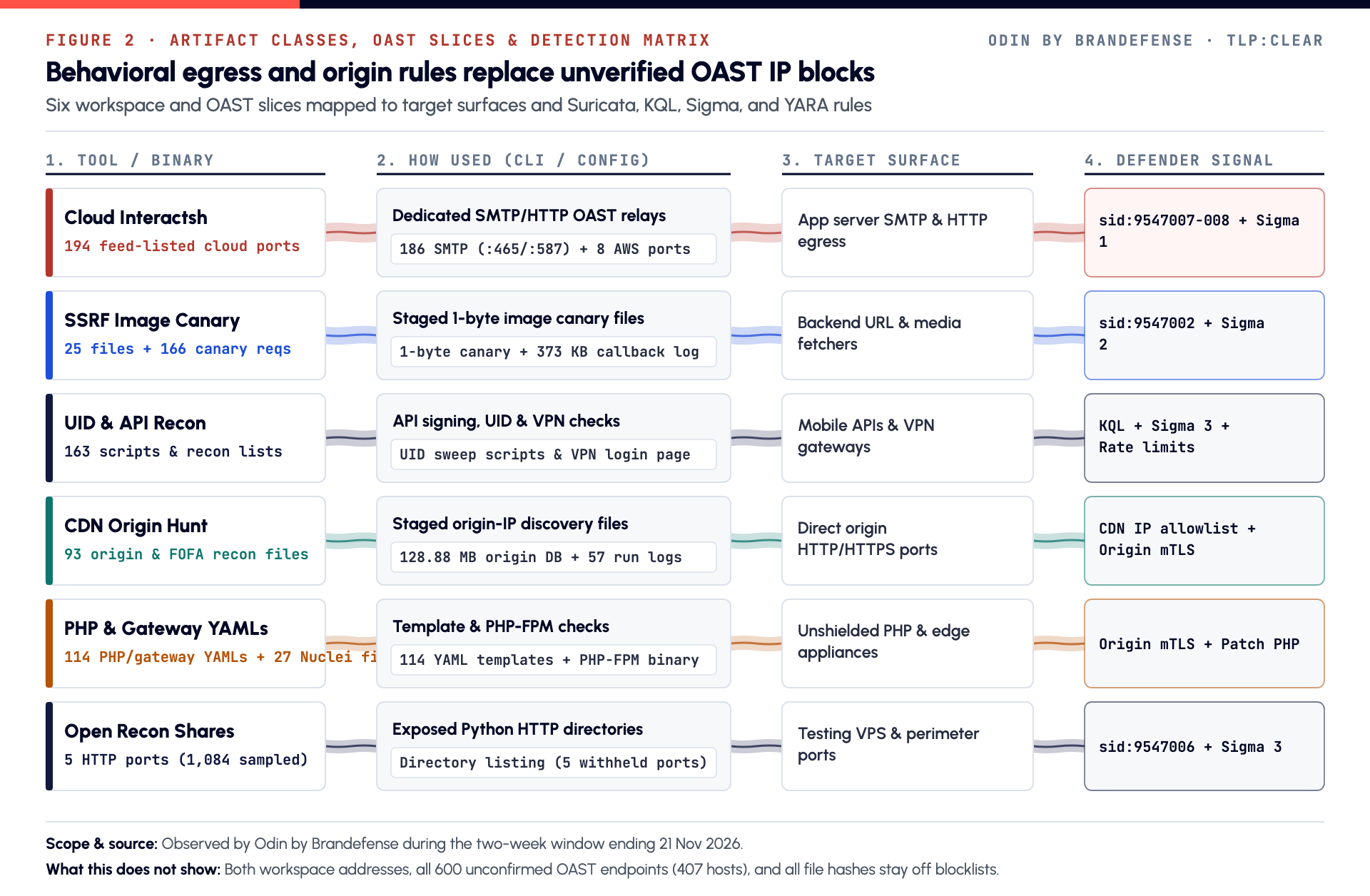
Figure 2 connects these slices and the 194 feed-listed cloud Interactsh ports to target surfaces and published rules.
3. US Four-Port Workspace: Mobile APK Unpacking, SSRF Canaries, and Callback Logs
In short
Observed in the United States from 13 to 20 November 2026, Workspace 1 exposes 740 sampled entries across four withheld HTTP listener ports. Its 373,784-byte callback log records 3,292 lines (1,877 HTTP requests across 271 peers), including 166 requests targeting the one-byte image canary and 356 automated bot requests. Restrict backend URL fetchers and enforce per-account API rate limits.
Workspace 1 (United States, address withheld) spans 238 ARM64 .so libraries, 102 .js bundles, 92 .py scripts, 76 .txt lists, 62 .jsonl files, 43 .dex files, and 23 .sh scripts. Smaller groups cover 14 .log files, 12 .html pages, 12 .json files, 9 .csv files, 4 .apk packages, 3 SQLite .db files, and 2 1-byte image canaries.
Shared-Directory Listeners A and B: Mobile APK Unpacking, API Signing, and VPN Recon
Mobile binaries often embed staging subdomains, storage buckets, local SQLite schemas, and request-signing keys omitted from browser apps:
- Unpacked Android
.apk,.dex, ARM64.so, and SQLite assets (460 entries). The directory holds two Android packages (130,575,320 B and 86,224,736 B) and Dalvik bytecode. Unpacked ARM64 native libraries include application (18,154,416 B), mapping-SDK (13,323,992 B), Flutter (11,037,032 B), Hermes (2,338,376 B and 1,978,248 B), and HTTP-DNS (255,328 B) binaries. Extracted assets include a SQLite database (245,760 B), a decompiledHermesJavaScript bundle (57,802,087 B), and three application JavaScript bundles (770,989 B, 751,798 B, and 644,198 B). - API signature testing and subdomain mapping (163 entries). Asset-extraction scripts generate extracted URL and host lists (50,251 B, 12,672 B, and 645 B). Root scripts test signatures, JWTs, IDOR, SQL injection, storage buckets, and virtual hosts (558 B to 1,686 B). Beside them sit two fuzzing JSON files (2,295 B and 1,693 B), two subdomain enumeration files (1,615 B and 874 B), and two port-scan logs (2,902 B and 654 B).
- GlobalProtect VPN template and timing scripts. Shared-directory listener A stages a Palo Alto GlobalProtect login page (11,705 B), a generic login page (3,371 B), password lists and a proxy list (10,373 B). It also holds eight GlobalProtect authentication and timing scripts, while 92
.jsonland table exports stay withheld.
Callback and Canary Listeners: One-Byte Image Canary, UID Sweeps, and Callback Log Forensics
The callback listener (20 files) and canary listener (1 file) form a dedicated SSRF canary and UID-sweep pair, joined on shared-directory listener A by companion SSRF, LDAP-listener, and header-testing scripts:
- One-byte image canary and UID sweep files. A one-byte image canary was mirrored across two listeners to test filename suffix checks on avatar and media fetchers; its filename and listener ports are withheld. The callback listener also stages five Python UID-sweep scripts (2,340 B, 2,294 B, 1,446 B, 800 B, and 658 B). Beside them sit a CSV seed table (28,080,948 B), a SQLite database (15,769,600 B), five worker logs (29,546 B, 22,033 B, plus three shard logs), and six shard text files (310 B to 122,863 B).
- Inside the 3,292 lines of the callback log (373,784 B). Carrying log dates from 11 to 18 November 2026, the callback listener log holds 1,877 HTTP requests from 271 external peers, 91 TLS handshakes on the HTTP port, and 1,324
Python400/404 status lines. Table 3.1 breaks down all 1,877 HTTP requests.
| Callback log dimension | Category | Count | Share | Plain meaning |
|---|---|---|---|---|
| Request path | Other HTTP paths | 666 | 35.5% | Non-canary URI checks and unattributed path requests |
| Request path | Root path (/) | 632 | 33.7% | Root reachability checks and internet port sweeps |
| Request path | Automated bot cross-traffic | 356 | 19.0% | Opportunistic /.env, /.git/config & config bots hitting the callback listener |
| Request path | SSRF image canary (filename withheld) | 166 | 8.8% | Requests targeting the 1-byte image canary logged on the listener |
| Request path | Favicon (/favicon.ico) | 57 | 3.0% | Browser or preview-renderer /favicon.ico requests |
| HTTP verb | GET and HEAD | 1,662 / 167 | 88.5% / 8.9% | Standard requests (GET) and header checks (HEAD) |
| HTTP verb | OPTIONS, POST, PRI, CONNECT | 13 / 12 / 8 / 8 | 2.2% combined | CORS preflights, POST tests, HTTP/2 PRI & proxy checks |
| HTTP verb | Seven 4-letter random verbs | 7 | 0.4% | YTBO, ONWO, RTXJ, USDB, AGNL, SWVZ, QFUL (1 each) |
| Non-HTTP lines | TLS (91) + HTTP errors (1,324) | 1,415 | (of 3,292) | TLS handshakes sent to HTTP port + Python 400/404 lines |
Daily HTTP requests rose from 27 on 11 November to 608 on 17 November. They fell to 54 on 18 November.
The top 15 peers sent 1,367 requests (72.8%); the other 256 sent 510 (27.2%). The log also includes 356 configuration-path requests and 91 TLS handshakes from internet scanners. All 271 peer addresses remain withheld.
4. Hong Kong Workspace: Scheduled CDN Origin Hunting and PHP Templates
In short
Observed in Hong Kong on a withheld HTTP listener port from 13 to 20 November 2026, Workspace 2 reports 2,132 files (344 sampled) for scheduled CDN origin discovery. Beside a 128.88 MB origin-discovery SQLite database and 57 scheduled logs sit 114 PHP and gateway YAML templates, a CVE-2019-11043 exploit binary, and captured appliance pages. Restrict origin ingress to CDN IP ranges and require mutual TLS origin pulls.
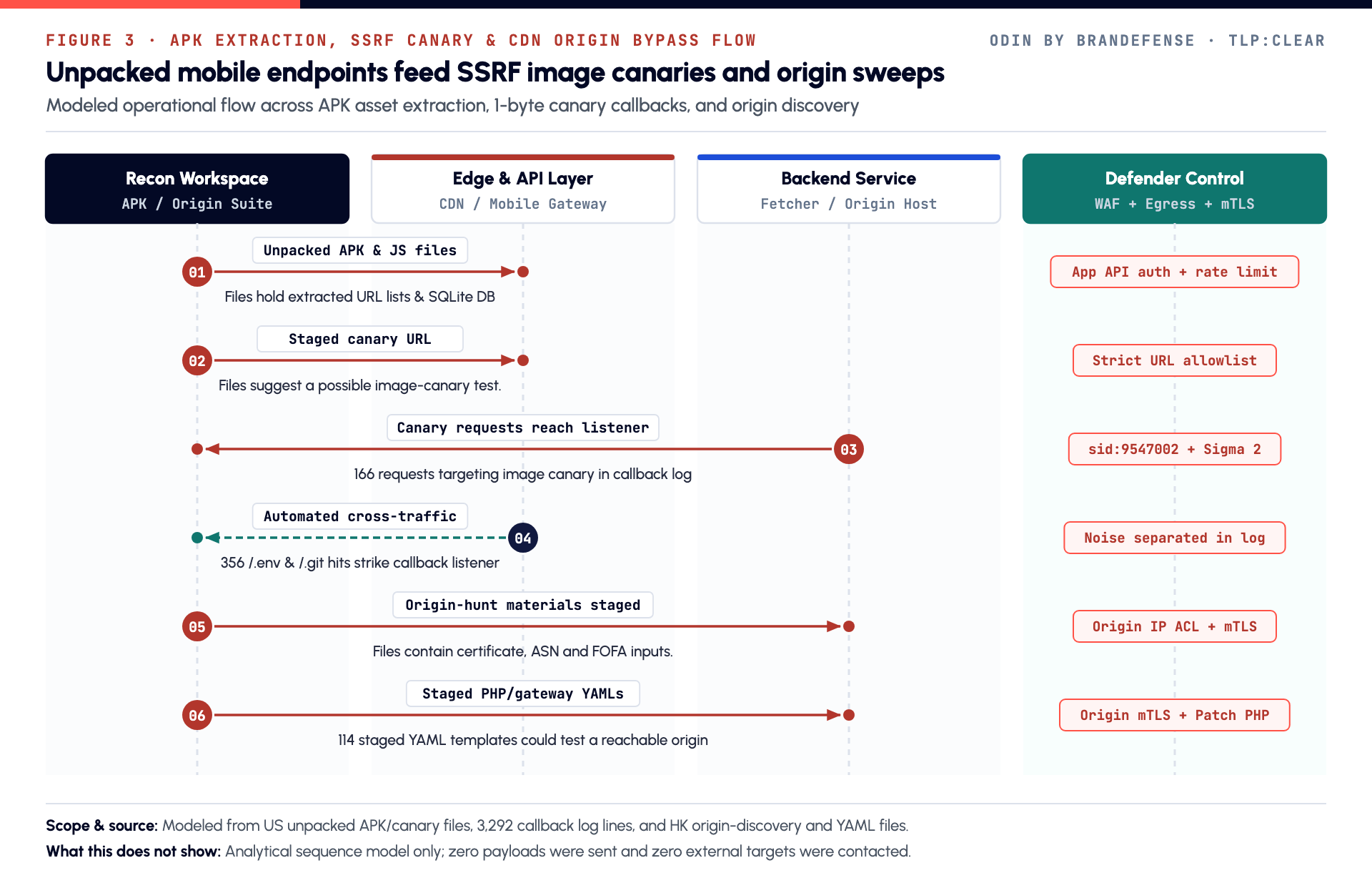
Putting a cloud CDN in front of an application protects nothing if the origin server still answers direct HTTP or HTTPS requests from the internet. Workspace 2 (Hong Kong, address and listener port withheld) exposes 2,132 reported files (344 sampled) built for origin-IP discovery and direct template scanning. Figures 3 and 4 map the modeled sequence and five-port workspace layout.
Origin-Discovery Suite, 57 Scheduled Logs, Cloud ASN Tables, and FOFA Exports (93 Entries)
- Active 128.88 MB SQLite database vs 65.5 KB clean baseline. A clean baseline directory (5 entries) holds a template Python origin-discovery script (18,807 B), an empty SQLite database (65,536 B), a GeoIP country database (3,389,216 B), and two Alibaba Cloud prefix tables (156,140 B and 33,581 B). The active origin-discovery directory (66 entries) expands the Python script to 24,112 B (plus a 9 November 2026 backup at 21,899 B), adds a temporary port-scan file (216,984 B), and populates a 128,880,640 B (
122.91 MiB) SQLite database. - Fifty-seven scheduled logs and certificate/FOFA inputs. Inside the log subfolder, 57 scheduled log files carry filename dates from 6 to 20 November 2026 (up to 5,889 B). Companion FOFA files (4 entries, including a 14,882 B origin-IP CSV and a 15,443 B host-mapping JSON) supply candidate subdomains. Reconnaissance folders (18 entries) add certificate subjects: archived subdomain and DNS scanners at 10.31 MB and 9.83 MB, subdomain and scan lists at 1.31 MB and 2.57 MB, and certificate CSVs at 254,538 B and 254,227 B.
Custom PHP and Gateway Templates (114 YAML Files), CVE-2019-11043 Exploit Binary, and Appliance Captures
- Curated PHP and gateway template suite (114 YAML files) and stock Nuclei templates (27 files). Alongside 27 stock
Nucleifiles and aNucleiconfiguration file (15,402 B), a custom template directory stages 114 YAML templates (51 miscellaneous, 40 PHP, 12 backup, and 11 across seven smaller category folders). - Compiled exploit binary for
CVE-2019-11043(9,904,337 B, filename withheld). Staged alongside 23 Go cache files, a compiled Go exploit binary targetsCVE-2019-11043. Per NIST NVD,CVE-2019-11043is aPHP-FPMbuffer underflow in PHP 7.1.x below7.1.33, 7.2.x below7.2.24, and 7.3.x below7.3.11under vulnerable Nginxfastcgi_split_path_inforules (fixed in7.1.33,7.2.24, and7.3.11). - Network-appliance management captures (80 entries). Three configuration folders (29, 28, and 7 entries) plus 16 archived panel pages store captured management outputs (10,012 B to 42,725 B), including password, backup, rate-limit, menu, and system-configuration pages. All captures stay withheld.
| Workspace & listener | Staged artifact or group | Byte size (B) | Role & indicator handling |
|---|---|---|---|
Workspace 1 (US, canary listener) | Standalone 1-byte image canary | 1 | Dedicated SSRF canary (filename withheld) · Alert on 1-byte JPEG responses (SID 9547002) |
Workspace 1 (US, callback listener) | Callback log & mirrored 1-byte image canary | 373,784 / 1 | 3,292 lines (166 canary requests) · Filename, peers & hash withheld |
Workspace 1 (US, callback listener) | Five Python UID-sweep scripts & seed datasets | 658 to 28,080,948 | UID enumeration scripts & tables · Paths & hashes withheld |
Workspace 2 (HK, origin-hunt listener) | Origin-discovery Python script & SQLite database | 24,112 / 128,880,640 | CDN origin matcher & populated DB · Paths & hashes withheld |
Workspace 2 (HK, origin-hunt listener) | Scheduled origin-discovery logs (57 files) | up to 5,889 | Scheduled run logs (file dates 6 to 20 Nov 2026) · Withheld |
Workspace 2 (HK, origin-hunt listener) | Custom PHP/gateway YAML templates (114) & CVE-2019-11043 binary | up to 4,004 / 9,904,337 | PHP YAML suite & PHP-FPM exploit binary · Filename & hashes withheld |
5. Cloud Interactsh OAST Cohort: 120 Feed-Labelled Cloud Addresses vs Dual-Use Suites
In short
Drawn from 31,117 sightings across ARL, Interactsh, and ScopeSentry, our 600-endpoint Interactsh review across 407 hosts identifies 194 feed-labelled cloud listener ports on 120 IPv4 addresses. Dedicated SMTP and SMTPS callback ports 465 and 587 account for 186 of those 194 ports (95.9%). Because independent per-address confirmation is absent, withhold all 407 hosts and hunt outbound OAST and SMTP egress.
We reviewed 31,117 sightings across ARL, Interactsh, and ScopeSentry and examined 600 recent Interactsh endpoints (observed 13 to 18 November 2026) across 407 distinct hosts and 398 /24 subnets. Table 5.1 summarizes all three cohorts.
| Tool | Category | Sightings | Feed-verified | Countries | Reviewed | Hosts | Feed-confirmed cloud (Hunt) | Other rows (Withheld) |
|---|---|---|---|---|---|---|---|---|
ARL | Asset recon | 19,828 | 4 | 53 | (baseline) | - | 0 | Dual-use recon suite (hunt only) |
Interactsh | OAST callback | 10,757 | 530 | 54 | 600 | 407 | 194 (120 IPs withheld) | 406 (287 hosts withheld) |
ScopeSentry | Recon suite | 532 | 0 | 32 | (baseline) | - | 0 | Dual-use recon platform (hunt only) |
| Total | 3 Tools | 31,117 | 534 | - | 600 | 407 | 194 (120 IPs withheld) | 406 endpoints (287 hosts) |
194 Feed-Labelled Interactsh Ports Across 120 Commercial Cloud IPv4s
We reviewed 600 Interactsh endpoints (300 feed-labelled confirmed and 300 feed-labelled suspected). The upstream feed labels 194 endpoints on 120 cloud IPv4 addresses as confirmed; independent per-address confirmation is absent, so these addresses remain unconfirmed.
- SMTP submission (:587) and SMTPS (:465) dominance (186 of 194 ports = 95.9%). Self-hosted
Interactshservers bind SMTP/SMTPS alongside DNS and HTTP/HTTPS to catch mail-header andJavaMailSSRF callbacks. Among the 120 feed-labelled cloud IPv4s, 71 hosts expose paired 465 + 587 listeners (142 ports), 37 expose 587, 7 expose 465, and one AWS host in France exposes port 26. - Four feed-labelled AWS US HTTP/HTTPS hosts (7 ports). Three US
Amazon.com, Inc.hosts (addresses withheld) expose paired :80 and :443 listeners sharing one custom certificate domain (withheld) and Go TLS JARM29d29d00029d29d00041d41d00041dcb3f8752a2d70d1dbf446fc46ab5df96, while a fourth US AWS host exposes HTTP :80. - Eight cloud providers across 18 countries. The 120 feed-labelled cloud hosts span
Amazon.com, Inc.(44 hosts / 70 ports),DigitalOcean, LLC(34 / 55),Hetzner Online GmbH(15 / 25), andContabo GmbH(11 / 18). Remaining hosts sit onOVH SAS(6 / 10),Microsoft Corporation(5 / 8),Contabo Inc.(4 / 6), andLEASEWEB SINGAPORE PTE. LTD.(1 / 2). Top countries are the US (49), Germany (26), Singapore (9), the Netherlands (7), France (6), and India (5). Withhold all 120 addresses from blocklists and hunt egress until each address is validated.
| Cloud slice (addresses withheld) | Port(s) | Geo & cloud provider | Protocol / TLS profile | Action |
|---|---|---|---|---|
| 3 Dual-port AWS HTTP/HTTPS hosts | 80, 443 | US · Amazon.com, Inc. | HTTP/HTTPS Interactsh; shared cert & Go TLS JARM | Withheld (hunt egress; validate first) |
| 1 Plaintext AWS HTTP host | 80 | US · Amazon.com, Inc. | Plaintext HTTP Interactsh listener | Withheld (hunt egress; validate first) |
| 1 Alternate-port AWS SMTP host | 26 | FR · Amazon.com, Inc. | Alternate SMTP Interactsh listener | Withheld (hunt egress; validate first) |
| 39 Additional AWS SMTP/SMTPS hosts | 465, 587 | 9 countries · Amazon.com, Inc. | 62 SMTP/SMTPS ports (23 dual, 14 :587, 2 :465) | Withheld (hunt egress; validate first) |
| 34 DigitalOcean SMTP/SMTPS hosts | 465, 587 | 6 countries · DigitalOcean, LLC | 55 SMTP/SMTPS ports (21 dual, 10 :587, 3 :465) | Withheld (hunt egress; validate first) |
| 42 Hetzner/Contabo/OVH/Azure/Leaseweb hosts | 465, 587 | 10 countries · 6 cloud providers | 69 SMTP/SMTPS ports (27 dual, 13 :587, 2 :465) | Withheld (hunt egress; validate first) |
Three Patterns Behind the Remaining 406 Withheld Interactsh Endpoints
- Shared edge and cloud space on
Akamai(9 endpoints on 6 hosts). Nine feed-confirmed :465 and :587 rows inNL,DE,GB, andUSsit onAkamai Technologies, Inc., where shared edge or reassigned cloud addresses risk collateral disruption. - Unverified secondary-provider SMTP listeners (97 endpoints on 63 hosts). Ninety-seven :587 (61), :465 (35), and :2525 (1) rows across
Google LLC(18),Oracle Corporation(11),Scaleway SAS(6),The Constant Company, LLC(6),Alibaba(6), and regional hosts lack secondary domain or HTTP confirmation. - Suspected AWS custom-domain TLS candidates and JARM collisions (300 endpoints on 218 hosts). All 300 feed-suspected rows sit on
Amazon.com, Inc.(296 US, 3 SG, 1 JP) across ports 443 (211), 80 (87), and 5000 (2), with 297 presenting custom-domain TLS certificates. JARM29d29d00029d29d00041d41d00041dcb3f8752a2d70d1dbf446fc46ab5df96sits on 3 feed-confirmed AWSInteractshhosts and 141 feed-suspected endpoints (144 total), confirming why defenders must never block on JARM alone.
6. Why Most Feed Records and Callback Log Entries Stay Off Blocklists
In short
Review across 31,117 sightings, 1,084 sampled directory files, and 3,292 callback log lines places zero IPv4 addresses and zero file hashes on public blocklists. All 600 Interactsh endpoints (including 194 feed-confirmed cloud ports on 120 IPv4s) lack independent per-address confirmation. Hunt outbound OAST and canary requests instead of blocking unverified feed rows.
Figure 5 compares log10-scaled sightings and callback log line counts against the 120 feed-listed cloud Interactsh IPv4s and 166 logged requests targeting the one-byte image canary.
- Analytical model across zero shared hosts. Zero IPv4 addresses,
/24subnets, or custom TLS certificates link Workspace 1, Workspace 2, and the 407Interactshhosts. They represent complementary reconnaissance workflows, not one threat group. - Callback logs mix test requests, third-party servers, and bot noise. The log records 166 requests targeting the one-byte image canary between 11 and 18 November 2026; it does not establish successful image fetches. Moreover, an HTTP log cannot separate operator self-tests, authorized checks, third-party fetchers, and internet noise (356
/.envand/.githits plus 91 TLS handshakes). All 271 peer addresses stay withheld. - Staged files and templates do not establish downstream breaches. The servers held unpacked Android packages, a GlobalProtect login template, UID-sweep scripts, an origin-discovery database, 114 YAML files, and a
CVE-2019-11043exploit binary. These files show staging between 13 and 20 November 2026. They do not establish a breach of an external target. Either server could belong to an unauthorized operator or to a practitioner who exposedpython -m http.serveron a testing VPS. - Dual-use suites require egress and origin controls. Security teams use
ARL,ScopeSentry,Nuclei,Subfinder, andInteractshdaily; restricting backend egress and locking down CDN origins stops unauthorized callbacks without breaking legitimate testing.
7. What Defenders Should Do
Cloud, network, and SMTP egress security
- Hunt outbound TCP 26, 80, 443, 465, and 587 connections for
Interactshdomains and TLS certificates, and validate any feed-listed cloud OAST address with an independent second signal before blocking. - Block direct outbound SMTP and SMTPS (25, 26, 465, 587) from application and container subnets outside designated corporate mail relays.
Application SSRF and cloud metadata hardening
- Enforce strict URL egress allowlists and private/link-local IP blocks (
RFC 1918,169.254.169.254) on avatar, webhook, PDF, and media-preview fetchers regardless of image filename suffixes. - Require session-oriented cloud instance metadata (
AWS IMDSv2withHttpTokens=requiredand hop limit 1) across every cloud workload.
CDN origin and mobile API protection
- Lock origin firewalls exclusively to published CDN IP ranges, enable mutual TLS (
Authenticated Origin Pulls), and patch legacyPHP-FPMservers pastCVE-2019-11043(PHP 7.1.33,7.2.24,7.3.11). - Strip staging URLs, SQLite seed secrets, and static signing keys from mobile
.apkbuilds andHermesbundles, and enforce per-account UID rate limits. - Require phishing-resistant MFA on
GlobalProtectVPN portals, and ban unauthenticatedpython3 -m http.servershares on testing VPS hosts.
8. Detection Rules
The full deployable files sit in the Detection rules tab. On 21 November 2026, all four rule files passed static validation (0 Suricata lint problems across four rules, structured KQL check, three Sigma rules, and one bounded YARA rule). Because live engines were not run against production traffic on our build host, test and tune each file in staging before production deployment.
| Rule file | What it catches |
|---|---|
odin_apk_unpacking_ssrf_oob_and_origin_hunt.rules | Suricata 7: four signatures for 1-byte JPEG canary responses, open HTTP directories exposing unpacked mobile packages, and Interactsh OAST HTTP/TLS connections |
sentinel_apk_ssrf_oob_origin_and_oast_hunt.kql | Microsoft Sentinel & Defender XDR: seven-day union of separate hunts for unapproved application-server SMTP egress (:26/:465/:587), server-worker OAST domain callbacks, and unapproved Python http.server directory shares |
sigma_ssrf_oob_canary_origin_hunt_and_oast.yml | Sigma (3 rules): Windows application workers initiating SMTP/SMTPS connections (:26/:465/:587), Linux workers resolving .oast.* or .interact.sh domains, and unapproved Linux python3 -m http.server directory shares |
odin_apk_recon_ssrf_oob_and_origin_hunt_artifacts.yar | YARA (1 bounded rule): captured Python HTTP open-directory listings exposing unpacked Android .apk, .dex, and ARM64 native library assets |
How the Suricata Signatures Work
| SID | Looks for | Operational intent |
|---|---|---|
| 9547002 | Inbound HTTP 200 with Content-Length: 1 and image/jpeg | Catch one-byte JPEG canary responses to internal fetchers |
| 9547006 | HTTP 200 Directory listing for / exposing .apk or classes*.dex | Spot exposed HTTP directories staging unpacked mobile packages |
| 9547007 | Outbound HTTP :80 with Interactsh OAST Host domains (feed-listed AWS node IPs withheld) | Alert on outbound HTTP requests whose Host matches an Interactsh OAST domain |
| 9547008 | Inbound TLS cert (CN=) on :443 matching Interactsh OAST domains (feed-listed AWS node IPs withheld) | Alert when a visible server-certificate subject matches an Interactsh OAST domain |
Scope SID 9547002 to backend server subnets and hunt outbound proxy logs for backend fetchers requesting unexpected external image files. Pair SIDs 9547007 and 9547008 with application-subnet SMTP egress controls on ports 26, 465, and 587.
How the KQL, Sigma, and YARA Rules Work
The KQL and Sigma host allowlists use exact hostnames (APPSEC-OAST-SCANNER-01, REDTEAM-RECON-LAB-01, CORP-SMTP-RELAY-01, CORP-SMTP-RELAY-02). Sigma worker selections use exact binary paths; KQL uses executable basenames. Defenders should also audit process and HTTP logs in general terms for backend worker requests to untrusted image URLs and anomalous PHP-FPM child processes.
| Engine & rule | Severity | Fires when |
|---|---|---|
| Sigma 1: App Server Unapproved Outbound SMTP/SMTPS | High | Windows web or application worker binaries initiate outbound TCP 26, 465, or 587 connections outside approved mail relays |
Sigma 2: Worker Resolving Interactsh Domains | High | Exact Linux worker binaries query .oast[.]pro, .oast[.]live, .oast[.]site, .oast[.]online, .oast[.]fun, .oast[.]me, or .interact[.]sh |
| Sigma 3: Unapproved Python HTTP Directory Share | High | Linux python3 runs http.server outside approved security testing hosts (REDTEAM-RECON-LAB-01) |
| YARA 1: Bounded APK Unpacking OpenDir Rule | High | Matches captured Python HTTP open-directory listings exposing unpacked Android .apk, classes.dex, arm64-v8a, or libhermes.so assets |
High-Level MITRE ATT&CK Tactic Mapping
| Parent tactic | Observed reconnaissance or callback behavior | Published detection coverage |
|---|---|---|
Reconnaissance (TA0043) | Mobile .apk/JS unpacking, scheduled CDN origin discovery (57 logs), and ARL/ScopeSentry/Subfinder mapping | SID 9547006; KQL; Sigma 3; YARA 1 |
Initial Access (TA0001) | Blind SSRF testing via 1-byte image canaries, staged PHP/gateway YAML templates (114), and origin CVE-2019-11043 exploit binary | SID 9547002; KQL; Sigma 2 |
Command and Control (TA0011) | Commercial-cloud Interactsh callback listeners across SMTP/SMTPS (:465, :587, :26) and HTTP/HTTPS (:80, :443) | SIDs 9547007–9547008; KQL; Sigma 1–2 |
9. Indicators
The Indicators tab holds 0 published indicators: 0 IPv4 addresses and 0 file hashes. The upstream feed labels 194 endpoints on 120 cloud Interactsh IPv4 addresses as confirmed. Independent confirmation is absent, so all 120 addresses remain unconfirmed. We withhold them and all 929 directory file hashes. Four shared TLS JARM fingerprints and three behavioral hunt patterns sit below as text-only reference patterns for hunting.
| Indicator type | Published in tab | Recommended action |
|---|---|---|
Feed-labelled Interactsh cloud IPv4 addresses (194 ports) | 0 | All 120 cloud IPv4s withheld (no independent per-address second signal; hunt egress first) |
| File SHA-256 digests | 0 | All 929 recorded directory hashes withheld (SDKs, tools, logs & captures) |
| Shared TLS JARM fingerprints (text-only below) | 0 (4 in text) | TLS hunting only; never block on JARM alone |
| Behavioral HTTP, OAST, and process hunt patterns (text-only below) | 0 (3 in text) | Proxy, NDR, and XDR command-line hunting |
Withheld Feed-Labelled Cloud Interactsh Slices (120 IPv4s Withheld)
| Provider or protocol group (addresses withheld) | Port(s) | Hosting & operational note |
|---|---|---|
| 3 AWS Dual-Port HTTP/HTTPS Hosts | 80, 443 | AWS (US) · Feed-labelled HTTP/HTTPS Interactsh listeners; shared JARM; hunt only |
| 1 AWS Plaintext HTTP Host | 80 | AWS (US) · Feed-labelled HTTP Interactsh listener; hunt only |
| 1 AWS Alternate-Port SMTP Host | 26 | AWS (FR) · Feed-labelled port 26 SMTP Interactsh listener; hunt only |
| 115 Dedicated SMTP/SMTPS Cloud Hosts | 465, 587 | 71 dual 465/587, 37 :587, and 7 :465 cloud hosts across 8 providers (all 115 withheld) |
Text-Only JARM and Behavioral Hunt Patterns (7 Reference Patterns)
| Pattern or JARM | Context | Where to hunt |
|---|---|---|
29d29d00029d29d00041d41d00041dcb3f8752a2d70d1dbf446fc46ab5df96 | 3 feed-confirmed AWS :443 hosts + 141 feed-suspected endpoints | Go TLS hunt only (never block) |
29d29d00029d29d21c29d29d29d29dab965d4179316d1f3a3c5dbe7d8829db | 47 unconfirmed AWS :443 custom-domain candidates | App-server TLS hunt only |
29d29d00029d29d00029d29d29d29da8f16e8f0a21d89b06fef5080cbd1b2a | 19 unconfirmed AWS :443 custom-domain candidates | App-server TLS hunt only |
29d29d00029d29d21c29d29d29d29df87756699516520cdc45e9e59a5a77db | 4 unconfirmed AWS :443 custom-domain candidates | App-server TLS hunt only |
Content-Length: 1 + image/jpeg (HTTP 200) | 1-byte SSRF JPEG canary response profile (canary filename & listener ports withheld) | SID 9547002 and backend proxy egress hunting |
.oast.* / .interact.sh + SMTP :26/:465/:587 | Outbound OAST domain resolution and application-server SMTP egress | KQL and Sigma 1–2 for SMTP egress; SIDs 9547007–9547008 for HTTP/TLS OAST domains |
python -m http.server + Directory listing for / (.apk / classes*.dex) | Unapproved Python HTTP directory shares exposing unpacked mobile assets | KQL and Sigma 3 for processes; SID 9547006 and YARA 1 for directory listings |
Withheld: both open-directory host addresses, their five HTTP listener ports, all 271 callback peer addresses, and all 407 reviewed Interactsh host addresses remain unpublished. The latter comprise 120 feed-labelled cloud hosts across 194 ports and 287 other hosts across 406 endpoints. Custom certificate domain names, host-derived directory filenames and paths (including the one-byte image canary filename and the CVE-2019-11043 binary filename), and all 929 recorded directory file hashes also stay withheld.
10. Scope and Limits
This public edition covers a two-week observation window ending 21 November 2026 across five open HTTP listeners (1,084 sampled entries) and 600 reviewed Interactsh endpoints (407 hosts). Earlier dates inside the callback listener log (11 to 18 November 2026) and the 57 scheduled origin-discovery logs (6 to 20 November 2026) are timestamps inside files on those servers. They do not represent an extended monitoring period by Odin by Brandefense.
All workspace findings rest on static directory listings and log metadata; no captured binary, script, or template was run, and no external system was contacted. Zero shared IPv4 addresses connect the two workspaces or the 407 reviewed Interactsh hosts, so treat this study strictly as an analytical model. Validate any feed-listed Interactsh cloud IPv4 address with an independent second signal before placing it on a firewall blocklist.
11. Sources
- OWASP Cheat Sheet Series, Server-Side Request Forgery Prevention Cheat Sheet: https://cheatsheetseries.owasp.org/cheatsheets/Server_Side_Request_Forgery_Prevention_Cheat_Sheet.html (verified on 21 November 2026).
- OWASP Foundation, OWASP Mobile Application Security Testing Guide (MASTG): https://mas.owasp.org/MASTG/ (verified on 21 November 2026).
- ProjectDiscovery, Interactsh: Out-of-Band Interaction Gathering Server and Client: https://github.com/projectdiscovery/interactsh (verified on 21 November 2026).
- ProjectDiscovery, Nuclei: Fast and Customizable YAML Vulnerability Scanner: https://github.com/projectdiscovery/nuclei (verified on 21 November 2026).
- ProjectDiscovery, Subfinder: Fast Passive Subdomain Enumeration Tool: https://github.com/projectdiscovery/subfinder (verified on 21 November 2026).
- Cloudflare Fundamentals Documentation, Protect Your Origin Server: https://developers.cloudflare.com/fundamentals/security/protect-your-origin-server/ (verified on 21 November 2026).
- MITRE ATT&CK, Enterprise Tactic TA0043: Reconnaissance: https://attack.mitre.org/tactics/TA0043/ (verified on 21 November 2026).
- NIST National Vulnerability Database, CVE-2019-11043 Detail (PHP-FPM
fastcgi_split_path_infoBuffer Underflow in PHP < 7.1.33, < 7.2.24, < 7.3.11): https://nvd.nist.gov/vuln/detail/CVE-2019-11043 (verified on 21 November 2026). - Amazon Web Services Documentation, Use the Instance Metadata Service (IMDSv2) to Access Instance Metadata: https://docs.aws.amazon.com/AWSEC2/latest/UserGuide/configuring-instance-metadata-service.html (verified on 21 November 2026).
What is…?
Short explanations of the tools and families named in this study.
What is Interactsh?
Interactsh is ProjectDiscovery's open-source OAST server and client for catching DNS, HTTP and other callbacks.
More about InteractshTechniqueWhat is OAST?
Out-of-band application security testing (OAST) detects blind vulnerabilities by making a target call back to a server the tester controls, usually over DNS or HTTP.
More about OASTTechniqueWhat is JARM?
JARM is an open TLS server fingerprinting method from Salesforce. It hashes how a server answers a set of crafted TLS handshakes.
More about JARMReconnaissance platformWhat is ARL?
ARL (Asset Reconnaissance Lighthouse) is an open-source asset discovery platform, popular with Chinese-speaking testers and attackers.
More about ARLReconnaissance platformWhat is ScopeSentry?
ScopeSentry is an open-source asset discovery and scanning platform that maps subdomains, ports and web services.
More about ScopeSentryFrequently asked questions
How do multi-port APK unpacking and one-byte SSRF canaries work together?
The full report on APK, SSRF, and CDN origin recon records no shared IPv4 addresses between the two servers and 407 Interactsh hosts. We therefore treat them as an analytical model for cyber threat intelligence teams, and withhold both open-directory host addresses and all 929 recorded file hashes.
What was inside the 3,292-line HTTP callback log?
The 373,784 B callback log on the callback listener holds entries carrying log dates from 11 to 18 November 2026, peaking at 608 HTTP requests on 17 November. Breaking down all 3,292 lines isolates 1,877 valid HTTP requests across 271 external client addresses. The remaining lines hold 91 non-HTTP TLS ClientHello handshakes and 1,324 companion Python HTTP 400 and 404 status lines.
How does the Hong Kong workspace hunt CDN origin servers?
The Hong Kong origin-hunt listener reports 2,132 files (344 sampled entries). The active folder contains a Python matcher (24,112 B) and a populated 128.88 MB SQLite database. A companion folder holds a clean 65.5 KB baseline database.
Which Interactsh OAST servers should defenders block versus hunt?
Across 31,117 sightings spanning ARL (19,828), Interactsh (10,757), and ScopeSentry (532), we examined 600 recent Interactsh endpoints across 407 hosts. The upstream feed marks 194 listener ports on 120 cloud IPv4 addresses as confirmed. The hosts span AWS (44), DigitalOcean (34), Hetzner (15), Contabo (15), OVH (6), Azure (5), and Leaseweb (1). Independent per-address confirmation is absent, so all 120 addresses remain unconfirmed and withheld.