
1. Executive Summary
In short
In a two-week observation window ending 20 November 2026, Odin by Brandefense observed five misconfigured open web directories reporting 55,974 files and exposing 90 secret records across eight secret types. All five servers belong to misconfigured developers, traders, or cluster administrators with zero infrastructure links, so we group them as an analytical five-surface model. Together they expose trading-bot .env.bak chains, WeChat trading agents, Model Context Protocol wallet tools, BIP-39 seed derivers, and plain-text Kubernetes Secret dumps. Close open HTTP directories, encrypt cluster backups, and isolate signing keys.
Algorithmic trading bots, agentic crypto-wallet tools, and self-managed Kubernetes clusters store financial signing keys and database credentials on cloud servers. When a developer, trader, or administrator leaves an unauthenticated HTTP directory listing open, every file inside that workspace becomes readable from the internet. Keys exposed this way are exactly what dark web monitoring is meant to catch. We reviewed file metadata and secret counts statically and tested zero credentials. We treated all five hosts strictly as misconfigured users rather than adversary operators, and withheld all IP addresses and file hashes.
Five open directories account for over four-fifths of Ethereum and Binance key records.
Nothing connects the five servers to one owner or operator, so we present them as an analytical five-surface defensive model. Together they hold 49 crypto-native secret records (23 BIP-39 seed phrases, 17 Binance API keys, and 9 Ethereum private keys) alongside 41 database, GitHub, AWS, and Telegram records.
Recursive .env.bak scripts and MCP wallet caches leave signing-key material in plain text.
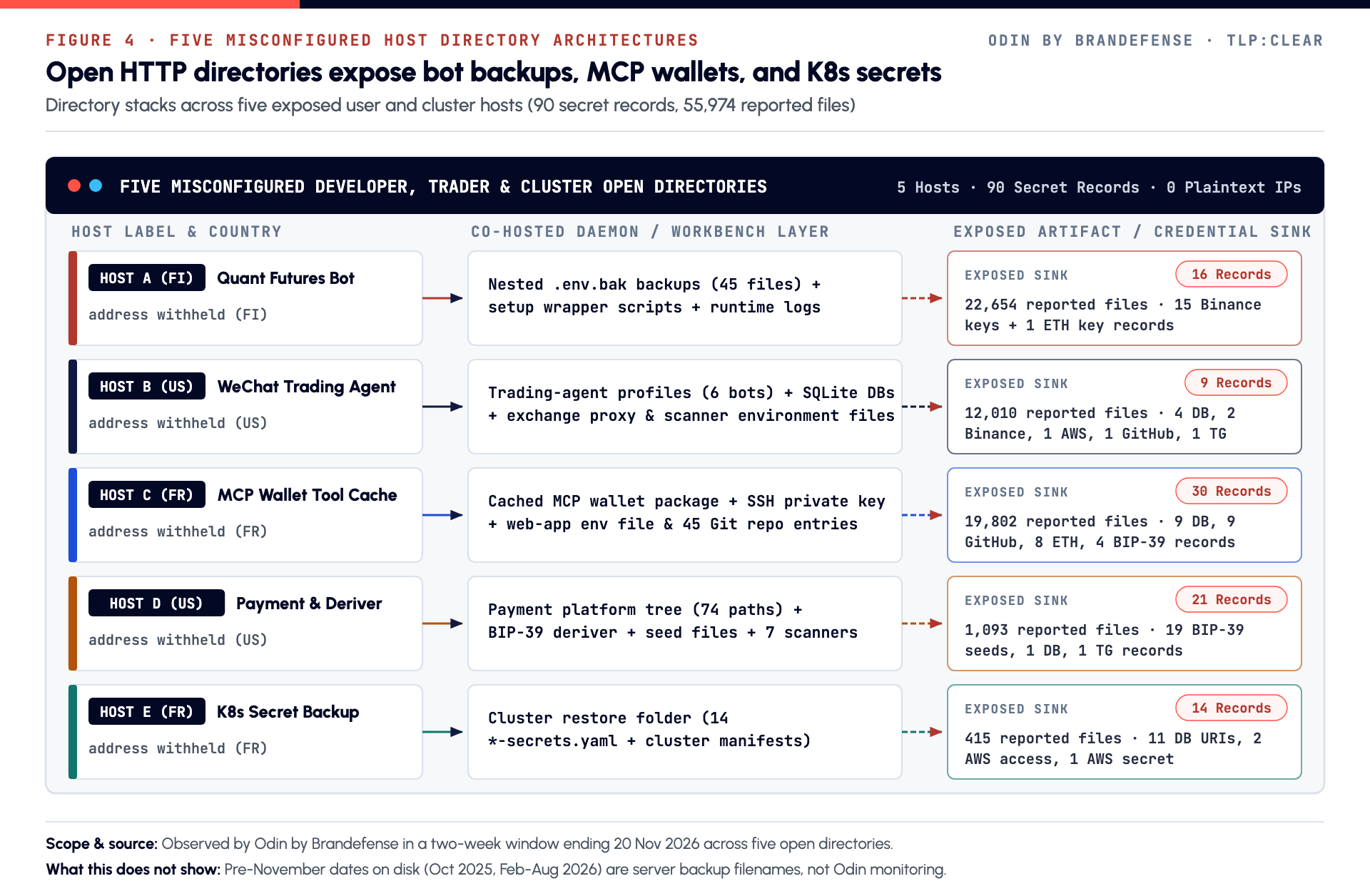
Host A in Finland holds 15 Binance-key and 1 Ethereum-key records across 45 timestamped backup files. Host B in the United States exposes six WeChat trading-agent profiles. Host C in France, a developer host with a cached MCP wallet package, exposes 30 secret records, including 8 Ethereum-key and 4 BIP-39 seed records.
Seed-derivation trees and plain-text Kubernetes YAML backups widen the blast radius.
Host D in the United States exposes a payment platform beside Python wallet-derivation scripts and 19 BIP-39 seed phrases. Host E in France exposes a restore folder with 14 plain-text Kubernetes *-secrets.yaml files holding 11 database URLs and 3 AWS keys. That static dump contrasts sharply with a separate host exposing a mounted pod ServiceAccount token.
Three Decisions for Leaders
- Shut down ad-hoc HTTP file servers and stop saving
.env.bakcopies. Block directory listings at cloud firewalls and reverse proxies, ban timestamped.envbackups on trading hosts, and store keys in managed vaults. - Encrypt Kubernetes Secret backups and scope pod ServiceAccount tokens. Never dump plain-text
kubectl get secrets -o yamlmanifests to local folders. Encrypt exported backups before storage, separately enable KMS encryption at rest for etcd, and disable unneeded pod token mounts. - Isolate MCP wallet tool caches from source-control tokens and production databases. Run agentic wallet tools in dedicated sandboxes with withdrawal allowlists, separated from GitHub tokens, SSH keys, and customer databases.
The Study in Numbers
| Number | What it is |
|---|---|
| 55,974 | Combined files reported across the five misconfigured open directories (4,334 sampled entries) |
| 5 | Independent developer, trader, and cluster hosts reviewed (0 shared links; 0 published IPs) |
| 90 | Secret records exposed across 8 secret types on the five servers (0 hashes published) |
| 49 (54.44%) | Crypto-native secret records on the five hosts (23 BIP-39 seeds, 17 Binance keys, 9 ETH keys) |
| 81.82% & 80.95% | Share of arrival-set Ethereum-key records (9 of 11) and Binance-key records (17 of 21) on two hosts |
| 30 | Secret records exposed on Host C in France, the MCP wallet tool-cache host (highest single-host count) |
| 14 + 1 | Plain-text namespace *-secrets.yaml files on Host E (FR) vs 1 separate pod token host |
How to use this report.
Leaders can start with Chapters 1, 5, and 6. Trading, Web3, AI-agent, and Kubernetes teams should read Chapters 3, 4, and 6. SOC and attack-surface teams should go to Chapters 7 and 8, plus the Detection rules tab. Platform architects will find attribution boundaries and limits in Chapters 5 and 9.
2. Five Misconfigured Hosts and the Five-Surface Taxonomy
In short
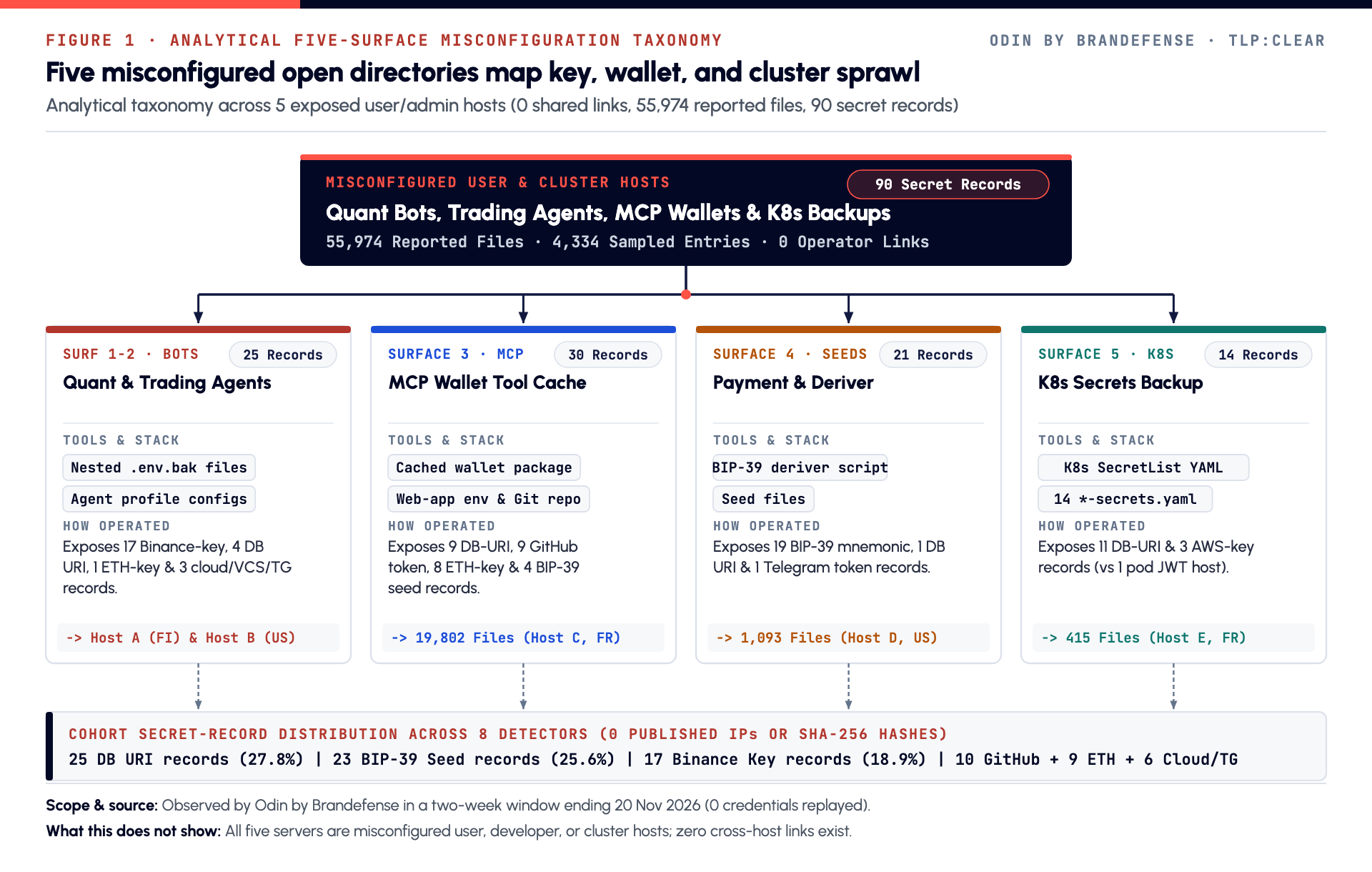
Five open web directories reported 55,974 files (4,334 sampled entries) and exposed 90 secret records across eight types in the two-week window ending 20 November 2026. Because the five hosts belong to separate misconfigured users and admins with zero shared links, we group them into five defensive exposure surfaces.
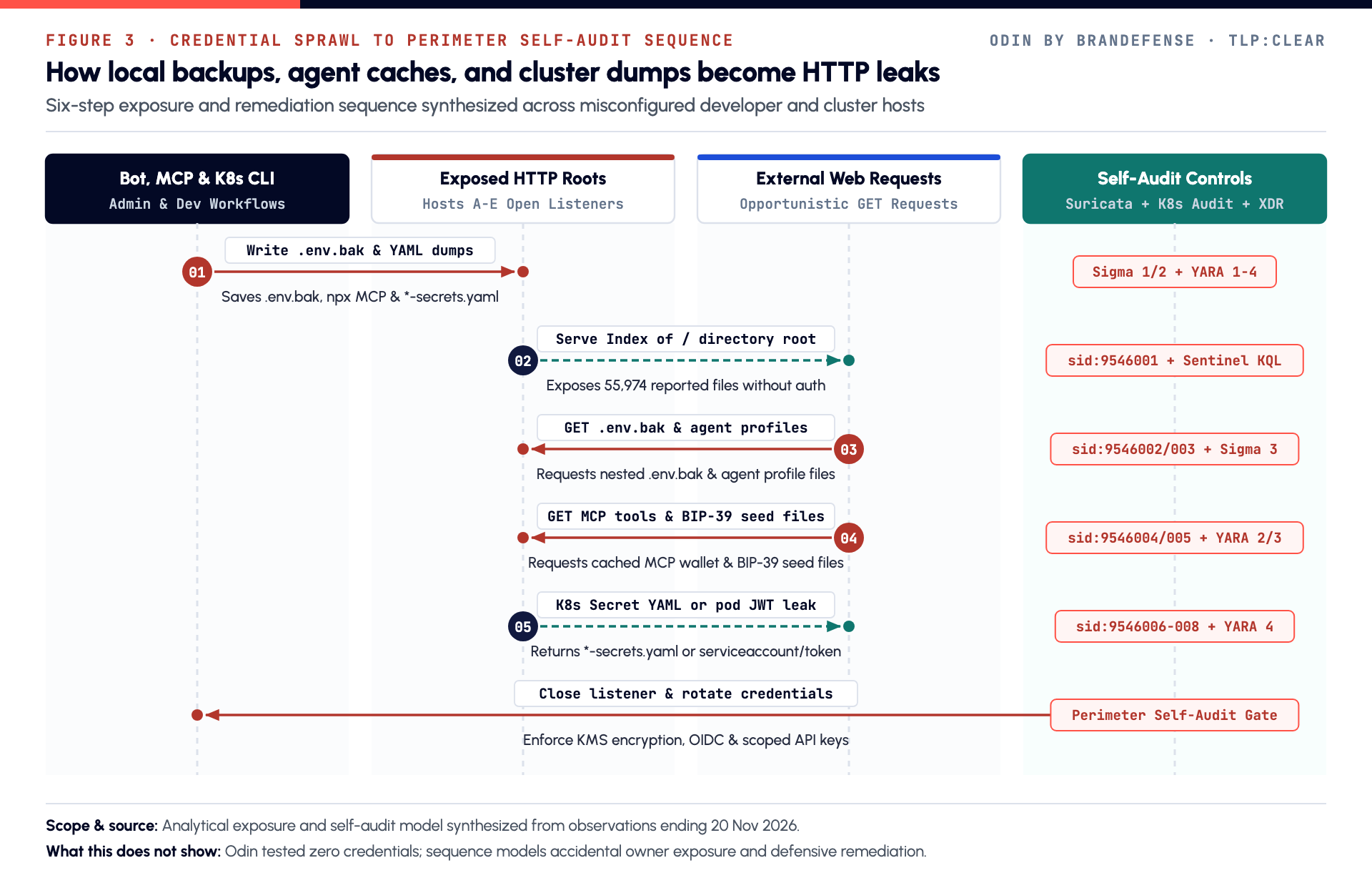
Cloud breaches and wallet drains often start with accidental self-exposure rather than software exploits. Developers start python3 -m http.server to copy logs, traders back up .env files inside web folders, and cluster admins save kubectl YAML dumps on staging nodes without authentication (T1552.001).
Defenders can use external attack surface management to find public HTTP directory listings that expose workspace trees to anyone scanning the web. We inspected file paths, byte sizes, and secret counts statically, without running scripts, deriving wallet addresses, testing keys, or contacting any server.
The broader latest arrival context
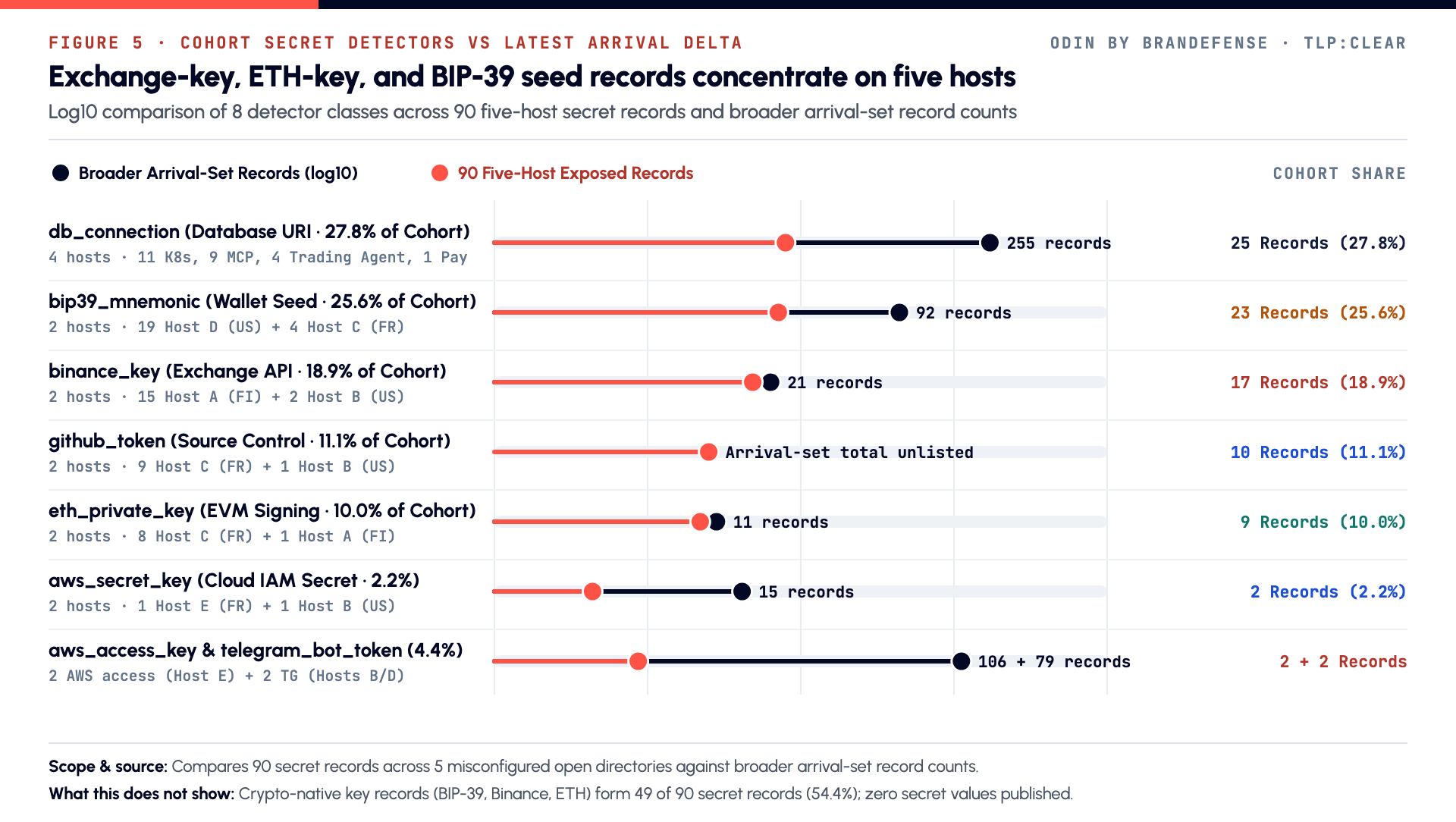
In the two-week observation window ending 20 November 2026, Odin by Brandefense tracked major credential classes in the latest arrival set. In that set, database connection strings lead (255), followed by AWS access keys (106) and Telegram bot tokens (79). Google Cloud service accounts (39) and AWS secret keys (15) follow.
Alongside those cloud and database credentials, cryptocurrency signing and exchange keys form a concentrated high-risk group: BIP-39 wallet seed phrases (92), Binance API keys (21), and Ethereum private keys (11). One separate host in that arrival set also exposed a mounted Kubernetes pod ServiceAccount token at /run/secrets/kubernetes.io/serviceaccount/token.
| Secret or exposure type | Five-host cohort (90) | Cohort share | Broader arrival set | Share of arrival set | Main exposure location |
|---|---|---|---|---|---|
db_connection | 25 | 27.78% | 255 | 9.80% | Host E K8s *-secrets.yaml (11), Host C MCP (9), Host B trading agent (4), Host D payment (1) |
bip39_mnemonic | 23 | 25.56% | 92 | 25.00% | Host D (US) payment/deriver (19) and Host C (FR) MCP tool cache (4) |
binance_key | 17 | 18.89% | 21 | 80.95% | Host A (FI) .env.bak chains (15) and Host B (US) trading-agent proxy (2) |
github_token | 10 | 11.11% | Unlisted in slice | N/A | Host C (FR) MCP/webapp (9) and Host B (US) trading agent (1) |
eth_private_key | 9 | 10.00% | 11 | 81.82% | Host C (FR) MCP tool cache (8) and Host A (FI) quant bot (1) |
aws_access_key | 2 | 2.22% | 106 | 1.89% | Host E (FR) unencrypted Kubernetes namespace backup (2) |
aws_secret_key | 2 | 2.22% | 15 | 13.33% | Host E (FR) K8s backup (1) and Host B (US) trading agent (1) |
telegram_bot_token | 2 | 2.22% | 79 | 2.53% | Host B (US) trading agent (1) and Host D (US) notifier (1) |
Mounted pod serviceaccount/token | 0 (separate host) | N/A | 1 host | Contrasted | Mounted container runtime token vs Host E static YAML backups |
Why these five hosts are users and admins, not operators
Across 104 directory-site records, the five open-directory servers report 55,974 exposed files (4,334 sampled entries and 1,037 detailed rows), holding 90 secret records across 8 secret types.
Nothing links these five servers to each other or to an adversary group (0 shared IPs, certificates, SSH keys, or bot tokens). Every server reflects a developer, trader, or cluster administrator who left a workspace or backup folder exposed over HTTP. Defenders can use cyber threat intelligence to prioritize this five-surface self-audit map across bot backups, trading agents, MCP wallets, seed derivers, and Kubernetes backups.
| Exposure surface | Host and country | Reported / sampled files | Detailed rows | Secrets (90) | Exposed artifact classes |
|---|---|---|---|---|---|
| Surface 1: Quant futures bot | Host A (FI) | 22,654 / 1,370 | 220 | 16 | Nested .env.bak backup chains, Python venv, setup scripts |
| Surface 2: WeChat trading agent | Host B (US) | 12,010 / 1,169 | 220 | 9 | Trading-agent profile folders, DEX CLI tools, exchange proxy environment files |
| Surface 3: MCP wallet tool cache | Host C (FR) | 19,802 / 1,189 | 220 | 30 | Cached MCP wallet package, web-app environment file, Git repository entries |
| Surface 4: Payment & seed deriver | Host D (US) | 1,093 / 449 | 220 (183 unique) | 21 | Payment platform tree, BIP-39 deriver script, plain-text seed file |
| Surface 5: K8s secrets backup | Host E (FR) | 415 / 157 | 157 | 14 | Cluster restore folder with 14 namespace *-secrets.yaml manifests |
3. Quantitative Trading Bot Backups and WeChat Trading Agents
In short
Automated trading servers leak exchange API keys when scripts copy .env files before strategy edits or expose multi-bot agent folders over HTTP. Host A in Finland holds 15 Binance keys and 1 Ethereum key across 45 backup files, while Host B in the United States exposes six WeChat trading-agent profiles. Stop creating .env.bak copies and lock exchange keys to fixed server IPs.
Independent traders and small quant teams often run Python or Node.js trading engines on single cloud instances connected to centralized exchanges such as api.binance[.]com and fapi.binance[.]com. Instead of pulling short-lived secrets at startup, these setups usually read plain-text .env files on disk and duplicate them before changing strategy parameters (T1552.001, T1528).
Recursive .env.bak chains on Host A (Finland)
On Host A in Finland (address withheld), an open directory reports 22,654 exposed files, with 1,370 sampled entries and 220 detailed rows in our review. Across this server, 16 secret records sit exposed: 15 Binance API keys (71.43% of the 21 arrival-set Binance-key records) and 1 Ethereum private key.
Of the 220 detailed rows, 152 belong to a Python 3.12 virtual environment containing pycryptodome-3.23.0, aiohttp, and websockets. The remaining 68 detailed rows sit inside the trading-bot workspace, alongside broader sampled bot folders and a local secret-finder script. That workspace holds 45 sized .env and setup backup files ranging from 118 to 2,811 bytes. They sit next to 23 runtime log files measuring 107 to 11,023 bytes, including logs of 4,939 and 11,023 bytes.
Two setup wrapper scripts on the server (1,559 bytes and a 1,550-byte dated backup) are written to copy earlier backups without deleting old versions:
- Triple- and quadruple-nested backup filenames. The directory held nested, dated environment backups. Three examples measured 391, 203, and 540 bytes.
- Separate exchange and strategy snapshots. Additional plain-text exchange, root
.env.OLD, and strategy backup copies measured 165, 437, and 2,811 bytes.
When a trader updates the active .env file without revoking older keys at the exchange, unrevoked keys in .bak and .OLD files remain exposed. The October 2025 and February 2026 strings are filename dates on the server, not Odin's observation period.
Autonomous WeChat trading-agent profiles on Host B (United States)
On Host B in the United States (address withheld), an open directory reports 12,010 exposed files, with 1,169 sampled entries and 220 detailed rows. Nine secret records sit exposed across five types: 4 database connection strings, 2 Binance API keys, 1 AWS secret key, 1 GitHub token, and 1 Telegram bot token.
The web root exposes a developer folder with trading-agent configuration, SQLite state databases, and a backup script. Across six WeChat and trading-bot profile folders, each profile keeps its own environment file, SQLite state database, and gateway logs. Eleven scheduled curator log folders carry June to August 2026 folder timestamps on disk.
Inside a bundled Node.js module tree, the host includes a decentralized-exchange CLI across 10 rows alongside MCP skill-packaging tools. In the surrounding workspace, the directory exposes exchange-proxy, token-scanner, trading-bot, and stock-analysis environment files, 20 June 2026 log files, a Telegram notification script, and a secret-linter configuration file. Across the 220 detailed rows sit 25 environment, package-manager, and secret-linter configuration entries plus 13 SQLite database and SQL files.
| Host and country | Workspace artifact group | Detailed rows | Size (bytes) | Host secret total | Role on the misconfigured server |
|---|---|---|---|---|---|
| Host A (FI) | Root .env.bak.* and .env.OLD_* backups | 6 | 344 to 522 | 15 Binance, 1 ETH | Root .env backups with triple .bak and .backup suffixes |
| Host A (FI) | Exchange .env backup directory copies | 15 | 118 to 855 | (Host total: 16) | Exchange backup copies (Oct 2025 and Feb 2026 file dates) |
| Host A (FI) | Strategy .env.bak.* backups and setup scripts | 22 | 225 to 2,811 | (Host total: 16) | Strategy backups plus two setup wrapper scripts (1,550 and 1,559 B) |
| Host A (FI) | Runtime strategy logs and secret-finder script | 23 | 107 to 11,023 | Runtime context | Strategy execution logs and local secret-finder script |
| Host B (US) | Trading-agent root and profile environment files (6 bots) | 7 | Unsized | 4 DB, 2 Binance, 1 AWS, 1 GH, 1 TG | Autonomous WeChat and trader bot environment files |
| Host B (US) | Exchange-proxy, scanner, and saved environment backups | 6 | Unsized | (Host total: 9) | Exchange proxy, token scanner, and trading-bot environment backups |
| Host B (US) | Bundled DEX CLI and MCP skill-generator modules | 23 | Unsized | Agent CLI tools | Bundled DEX trading tool and MCP skill-generator packages |
| Host B (US) | Agent SQLite state databases and curator log folders | 35 | Unsized | State & logs | 8 agent SQLite databases plus 11 dated curator folders (Jun-Aug 2026) |
4. MCP Wallet Tool Caches, Seed Derivers, and Kubernetes Secret Backups
In short
Leaving MCP wallet caches, payment source trees, and Kubernetes restore folders on open HTTP ports exposes raw wallet seed phrases, Ethereum keys, and cluster-wide database credentials. Three servers in France and the United States hold 65 secret records across these surfaces, including 23 BIP-39 seeds, 8 Ethereum keys, and 14 Kubernetes *-secrets.yaml files. Isolate MCP wallets and encrypt all cluster backups.
Three additional misconfiguration surfaces show what happens when AI-agent wallet plugins, multi-chain payment tools, and Kubernetes backup scripts share unprotected web roots (T1552.001, T1552.007).
MCP Wallet Tool Cache on Host C (France)
On Host C in France (address withheld), an open directory reports 19,802 exposed files, with 1,189 sampled entries and 220 detailed rows. It holds 30 secret records (33.33% of the cohort): 9 database URLs, 9 GitHub tokens, 8 Ethereum keys, and 4 BIP-39 seeds. The Ethereum key records represent 72.73% of the 11 arrival-set records.
Inside a package-runner cache (70 detailed rows), the directory exposes cached MCP wallet credential modules across 8 files alongside wallet and transaction SDK packages. MCP wallet packages let AI agents invoke external wallet tools.
On this developer host, those modules share the directory with a web-app environment file, 45 Git repository entries, and 8 web-application build chunks. Broader sampled entries include wallet folders, exchange audit logs, agent configuration folders, and an SSH private key, linking wallet keys to Git repositories and databases.
Crypto payment platform and BIP-39 wallet deriver on Host D (United States)
On Host D in the United States (address withheld), HTTP and HTTPS directory listings (37 and 183 rows) report 1,093 files (449 sampled entries, 183 unique detailed paths). Twenty-one secret records sit exposed: 19 BIP-39 seed phrases (20.65% of the 92 arrival-set seed records), 1 Telegram bot token, and 1 database URL.
Seventy-four unique paths belong to an unpacked crypto payment platform. They include SQL schema and migration files (3,174 and 5,017 bytes), token-backup and Telegram bot code (7,475 and 9,625 bytes), and a 6,348-byte exchange-token script. The folder also holds two agent instruction files measuring 16,384 and 81,920 bytes, with an October 2025 file-date suffix on disk.
Beside that tree, a 25-file wallet-checking directory exposes a 20,480-byte BIP-39 derivation script, a 72-byte plain-text seed file, a 184-byte example file, and a 7,680-byte Telegram notifier. The same directory includes seven multi-chain balance scanners (up to 20,480 bytes across Bitcoin, EVM, Solana, and UTXO chains). It also sits beside 16 OAuth files, 13 email-service files, and 24 .zip archives.
Plain-text Kubernetes *-secrets.yaml backups on Host E (France) vs. mounted pod tokens
On Host E in France (address withheld), an open directory reports 415 exposed files and 157 sampled entries (149 sized from 1 to 65,734 bytes plus 8 unsized entries). Fourteen secret records sit exposed: 11 database URLs, 2 AWS access keys, and 1 AWS secret key.
One exposed restore directory held 119 Kubernetes YAML files, including 14 namespace Secret manifests ranging from 68 to 1,503 bytes. Their namespace names and file paths are withheld. Alongside them sat a 340-byte single-Secret manifest, a 2,081-byte deployment manifest, and cluster namespace and persistent-volume manifests (21,612 and 27,212 bytes). The folder also held k3s-1.34.3, restic cache files, and an 8-byte HTTP server PID file.
Kubernetes Secret YAML files store values in plain Base64 under data:, not ciphertext. Saving kubectl get secrets -o yaml output into an open restore folder leaks database URLs, identity-provider credentials, and AWS keys at rest. That static backup mistake differs from the 1 separate arrival-set host that exposed /run/secrets/kubernetes.io/serviceaccount/token (T1552.007). Static *-secrets.yaml files leak stored application credentials, whereas a mounted serviceaccount/token grants bearer access to the Kubernetes API server until expiration or pod shutdown.
| Host and country | Workspace artifact group | Detailed rows | Size (bytes) | Host secret total | Exposure risk |
|---|---|---|---|---|---|
| Host C (FR) | Package-runner cache with MCP wallet and SDK modules | 70 | Unsized | 9 DB, 9 GH, 8 ETH, 4 BIP-39 | Agentic MCP wallet credential modules in an open directory |
| Host C (FR) | Web-app environment file, Git repository entries (45), and build chunks (8) | 54 | Unsized | (Host total: 30) | Web-app wallet environment file, exposed Git objects, and SSH private key |
| Host D (US) | Unpacked crypto payment platform source tree | 74 (unique) | 93 to 827,392 | 19 BIP-39, 1 DB, 1 TG | Unpacked payment stack, SQL schemas, token-backup, and Telegram bot code |
| Host D (US) | BIP-39 wallet deriver, plain-text seed file, and 7 scanners | 25 (unique) | 0 to 25,600 | (Host total: 21) | BIP-39 seed derivation (20,480 B), seed file (72 B), Telegram notifier (7,680 B) |
| Host E (FR) | Cluster restore folder with 14 namespace *-secrets.yaml manifests | 14 | 68 to 1,503 | 11 DB, 2 AWS access, 1 secret | Base64 Kubernetes SecretList and Secret namespace dumps |
| Host E (FR) | Single-Secret and cluster YAML manifests (105), k3s-1.34.3, restic | 124 | 1 to 65,734 | (Host total: 14) | Cluster manifests, persistent volumes, and restic cache |
| Host E (FR) | Redis /tmp test or intrusion entries | 19 | Not separately stated | (Host total: 14) | RDB snapshots, probe markers, and modules |
5. Crypto Signing Key Concentration and Owner Boundaries
In short
Crypto-native records make up 49 of 90 secrets (54.44%) across the five directories. They comprise 23 BIP-39 seed phrases, 17 Binance keys, and 9 Ethereum private keys. Because all five hosts are misconfigured user or cluster servers rather than adversary infrastructure, all addresses and file hashes are withheld.
Comparing the 90 secret records across these five servers against the broader arrival set shows how heavily crypto signing-key records cluster on developer and trading hosts. Two servers (Host C in France and Host A in Finland) account for 9 of 11 Ethereum private-key records (81.82%) in the arrival set.
Two servers (Host A in Finland and Host B in the United States) account for 17 of 21 Binance-key records (80.95%). Two servers (Host D in the United States and Host C in France) account for 23 of 92 BIP-39 seed-phrase records (25.00%).
Unlike an API token that can be revoked in place, a leaked BIP-39 seed phrase or raw Ethereum key cannot be rotated. Move assets to a new wallet and revoke token allowances on the exposed address; do not reuse the old key.
Supporting credentials form the other 41 records (45.56%): 25 database URLs, 10 GitHub tokens, 2 AWS access keys, 2 AWS secret keys, and 2 Telegram bot tokens. Our dataset records secret counts per host and secret type (16, 9, 30, 21, and 14) rather than per individual file.
| Secret type | Category | Five-host records (90) | Cohort share | Hosts | Broader arrival set | Share of arrival set |
|---|---|---|---|---|---|---|
db_connection | Database | 25 | 27.78% | 4 | 255 | 9.80% |
bip39_mnemonic | Crypto wallet | 23 | 25.56% | 2 | 92 | 25.00% |
binance_key | Crypto exchange | 17 | 18.89% | 2 | 21 | 80.95% |
github_token | Source control | 10 | 11.11% | 2 | Unlisted | N/A |
eth_private_key | Crypto wallet | 9 | 10.00% | 2 | 11 | 81.82% |
aws_access_key | Cloud IAM | 2 | 2.22% | 1 | 106 | 1.89% |
aws_secret_key | Cloud IAM | 2 | 2.22% | 2 | 15 | 13.33% |
telegram_bot_token | Messaging / alert | 2 | 2.22% | 2 | 79 | 2.53% |
Owner-versus-operator boundaries and co-hosted test files
Treating exposed developer or cluster hosts as threat actors would misdirect defenders and harm careless owners:
- Misconfigured users and administrators. Host A (Finland), Host B (United States), and Host C (France) are trading and developer trees left behind open HTTP listeners. Kubernetes namespace names on Host E (France) and brand names in
.zipfiles on Host D (United States) are withheld.
- Co-hosted Redis
/tmptest files on Host E and multi-use scripts on Host D. On Host E in France, 19 entries inside asystemd-privateRedis/tmpfolder hold RDB snapshots,authorized_keys, pentest probe markers, and.somodules. They fit either a testbed or a probed K3s and Redis server. On Host D in the United States, the payment-platform tree sits beside a BIP-39 derivation script, a plain-text seed file, and 24.ziparchives; all addresses and hashes remain withheld.
- Zero credentials or wallet balances tested. Odin replayed 0 credentials and derived 0 wallet addresses from the 23 seed phrases or 9 Ethereum keys, so funded balances and active-key ratios are unmeasured.
6. What Defenders Should Do
Cloud perimeter and web engineering
- Scan all cloud VPS, lab, and staging subnets for unauthenticated
Index of /HTTP listeners across standard and high TCP ports, and bind local development servers strictly to127.0.0.1. - Block inbound HTTP requests for
.env*,.bak*, and Git repository paths at reverse proxies, CDNs, and WAFs.
Quantitative trading and Web3 wallet security
- Delete
.env.bak.*and.env.OLDbackups from trading hosts, and revoke every historical exchange key stored inside them. Enforce source IP allowlists onapi.binance[.]comandapi.bitget[.]com, and disable withdrawal permissions on trading API keys. - Move BIP-39 seed phrases and raw EVM or Stacks keys out of flat seed or web-app environment files into hardware wallets, MPC signers, or KMS enclaves. Sweep funds to a fresh seed if any wallet file ever sat in an open directory.
AI agent and Model Context Protocol (MCP) environments
- Run MCP wallet packages, trading agents, and similar agentic wallet tools inside isolated containers separated from SSH private keys, GitHub tokens, and production database URLs, and require human approval before signing high-value transactions.
Kubernetes platform administration and SOC
- Stop exporting plain-text
kubectl get secrets -o yamlfiles (*-secrets.yaml) to disk. Encrypt each exported backup before storage and use encrypted backup operators. Separately enable KMS encryption at rest for etcd. SetautomountServiceAccountToken: falseon pods that do not call the Kubernetes API. - Deploy the self-audit Suricata, Sentinel KQL, Sigma, and YARA rules in Chapter 7 to catch accidental open directories and plain-text cluster dumps early.
7. Detection Rules
The full rules are in the Detection rules tab. Static syntax checks (lint_suricata.py with 0 problems, plus modifier and fixture checks) passed cleanly. Suricata, YARA, Sigma, and Kusto engines were not installed in this environment, and the rules were not replayed against live traffic. Test and tune them in staging before production enforcement.
| Rule file | What it catches |
|---|---|
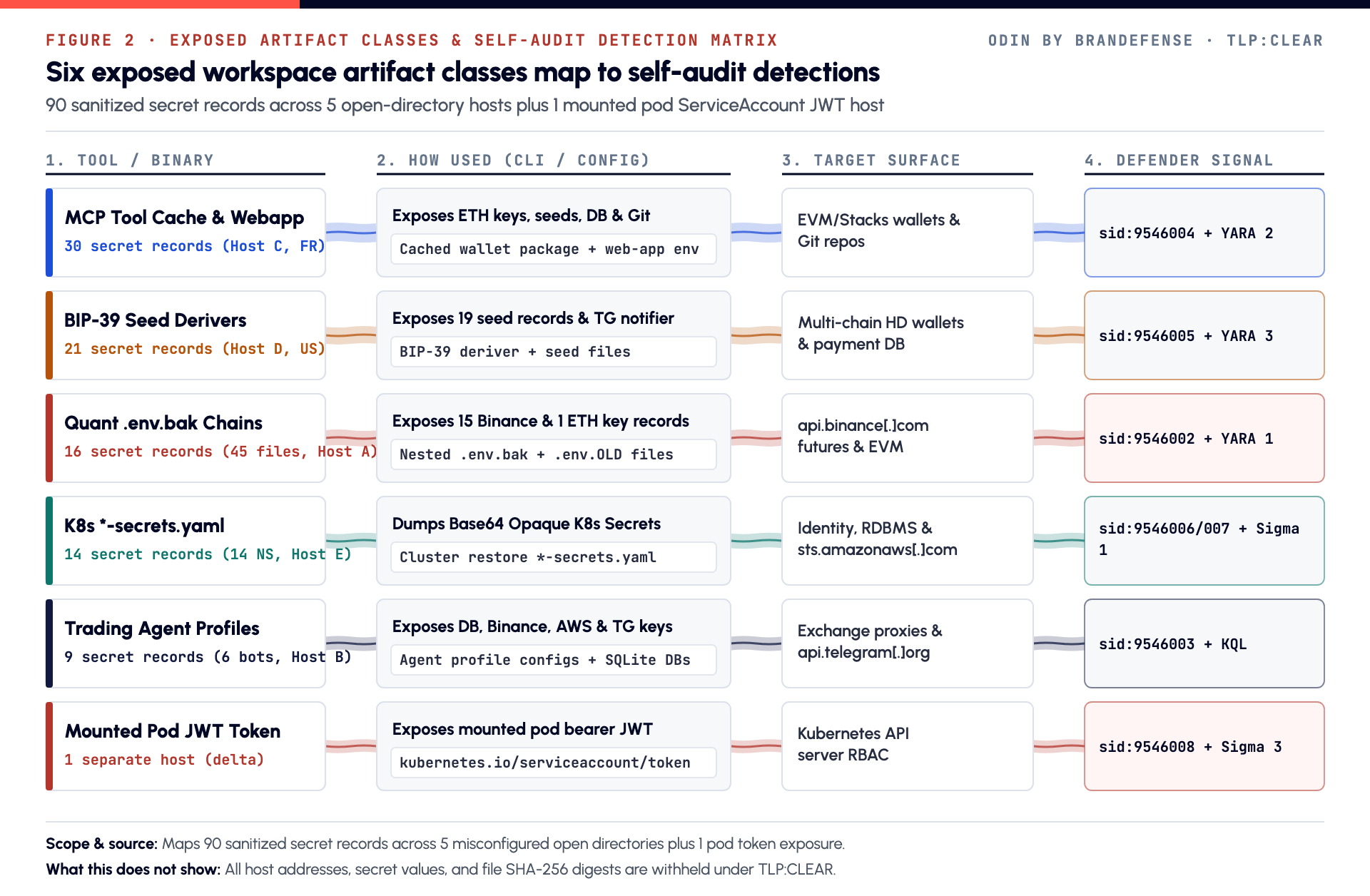
odin_exposed_trading_bots_mcp_wallets_and_k8s_secrets.rules | Suricata 7: eight rules for open directories, .env.bak chains, trading-agent profiles, cached MCP wallet modules, wallet seed files, *-secrets.yaml, HTTP kind: Secret leaks, and pod serviceaccount/token URIs |
sentinel_exposed_trading_bot_mcp_and_k8s_secret_hunt.kql | Sentinel and Defender XDR: http.server, *-secrets.yaml, MCP wallet, or .env.bak processes matched by initiating process ID and creation time to listening ports or exchange/cloud API sessions |
sigma_k8s_secret_backup_and_mcp_wallet_exposure.yml | Sigma (3 rules): K8s audit secrets list/get calls, Linux http.server or -secrets.yaml commands, and web hits on exposed bot, MCP wallet, or K8s paths |
odin_exposed_bot_mcp_wallet_and_k8s_secret_artifacts.yar | YARA (4 rules): quant bot .env backups, cached MCP wallet tools, BIP-39 derivers with scanners/Telegram, and plain-text K8s Secret YAMLs |
How the Suricata signatures work
| SID | Looks for | Why |
|---|---|---|
| 9546001 | Outbound 200 with Index of / and .env.bak, trading-agent profile .env, mcp-server, or -secrets.yaml | Self-audit alert when an internal host exposes a sensitive directory |
| 9546002 | Inbound GET for .env.bak, .env.backup, or .env.old | Catches requests targeting exposed .env backup chains (block candidate) |
| 9546003 | Inbound GET under /profiles/ for .env, SQLite .db/.sqlite/.sql files, or logs/ | Catches requests for exposed trading-agent profiles and state databases |
| 9546004 | Inbound GET under /node_modules/ or /_npx/ for cached mcp-server module files | Flags HTTP access to cached MCP wallet package modules |
| 9546005 | Inbound GET for plain-text seed, wallet_seed, or bip39_seed files | Flags HTTP access to exposed BIP-39 wallet seed files |
| 9546006 | Inbound GET ending in -secrets.yaml | Catches retrieval of plain-text K8s namespace Secret files (block candidate) |
| 9546007 | Outbound 200 containing apiVersion: v1, kind: Secret, and data: | Self-audit alert when an internal HTTP port serves plain-text K8s Secret YAML |
| 9546008 | Inbound URI containing /kubernetes.io/serviceaccount/token | Catches requests for mounted pod ServiceAccount tokens (block candidate) |
Test SIDs 9546002, 9546006, and 9546008 in staging. Deploy equivalent path blocks at reverse proxies, or convert verified Suricata alerts to drop rules in an inline IPS. Treat any SID 9546001 or 9546007 outbound 200 alert on your own network as an immediate posture incident: close the listener and rotate every exposed credential.
How the KQL, Sigma, and YARA rules work
The Sentinel KQL query looks back 7 days across DeviceProcessEvents and DeviceNetworkEvents. It finds python, node, npx, kubectl, bash, sh, or restic commands naming http.server, SimpleHTTPServer, mcp-server, wallet-sdk, get secrets, -secrets.yaml, serviceaccount/token, .env.bak, .env.backup, or .env.old. It matches ProcessId and ProcessCreationTime to InitiatingProcessId and InitiatingProcessCreationTime across six listed listening ports and five exchange, messaging, and cloud API services. Two exact example hosts are excluded.
Sigma rule 1 flags Kubernetes audit secrets list or get calls from kubectl/, curl/, python-requests/, or Go-http-client/ outside two exact backup ServiceAccounts. Sigma rule 2 flags Linux -m http.server, SimpleHTTPServer, mcp-server, wallet-sdk, get secrets, -secrets.yaml, or .env.bak commands outside the two exact audit hosts. Sigma rule 3 flags web requests for .env.bak, .env.backup, .env.old, /profiles/, mcp-server/, /.git/, /.ssh/, -secrets.yaml, or /kubernetes.io/serviceaccount/token.
| YARA rule | Fires when |
|---|---|
ODIN_Exposed_Quant_Bot_Env_Backup_Chain | Under 256 KB, at least two Binance or Ethereum private-key variable names appear in a scanned backup folder |
ODIN_Exposed_MCP_Crypto_Wallet_Credential_Tool | Under 512 KB, an MCP server or SDK marker appears with two crypto-wallet SDK or mnemonic markers |
ODIN_Exposed_BIP39_Wallet_Deriver_And_Notifier | Under 512 KB, a BIP-39 HD path or seed generator appears with two wallet-scanner or Telegram markers |
ODIN_Unencrypted_Kubernetes_Secret_Manifest_Dump | Under 10 MB, apiVersion: v1 and kind: Secret, SecretList, or List appear with type: and a root or indented data: map |
MITRE ATT&CK mapping
| Tactic | Technique | Observed exposure pattern | Detection |
|---|---|---|---|
| Credential Access | T1552.001 Unsecured Credentials: Credentials In Files | 45 .env.bak files, cached MCP wallet modules, plain-text seed files, and 14 *-secrets.yaml files | SIDs 9546001 to 9546007; Sigma rules 1 to 3; YARA rules 1 to 4 |
| Credential Access | T1552.007 Unsecured Credentials: Container API | Mounted pod /run/secrets/kubernetes.io/serviceaccount/token vs static K8s YAML backups | SID 9546008; Sigma rules 1 and 3; YARA rule 4; KQL |
| Credential Access | T1528 Steal Application Access Token | 17 Binance API keys, 10 GitHub tokens, and 2 Telegram bot tokens in exposed workspaces | SIDs 9546002 and 9546003; KQL; Sigma rules 2 and 3; YARA rule 1 |
| Defense Evasion, Persistence | T1078.004 Valid Accounts: Cloud Accounts | 2 AWS access keys and 2 AWS secret keys exposed in *-secrets.yaml and trading-agent configs | SIDs 9546006 and 9546007; KQL; Sigma rule 1; YARA rule 4 |
8. Indicators
The Indicators tab holds 0 published indicators: 0 network addresses and 0 file hashes. All five open-directory server addresses and all file SHA-256 digests are withheld because every host in this study is a misconfigured developer, trader, or cluster server rather than adversary infrastructure. Sixteen defensive self-audit file, directory, and container-token path patterns appear in this report only.
| Type | Count | Where to use it |
|---|---|---|
| Network addresses (Indicators tab) | 0 | All five misconfigured host addresses are withheld |
| File hashes (Indicators tab) | 0 | All secret-bearing and unestablished file hashes are withheld |
| Self-audit workspace paths (in text) | 15 | Block at WAFs and scan your own cloud VPS, build, and backup folders |
| Container runtime token path (in text) | 1 | Block inbound HTTP traversal and audit pod automountServiceAccountToken settings |
Self-audit exposure patterns in this report
| Pattern or artifact class | Type | Exposure surface | Defensive self-audit use |
|---|---|---|---|
*.env.bak* | Workspace file pattern | Surface 1 (Host A) | Block .env.bak* at WAFs and purge nested backup chains |
*.env.OLD* | Workspace file pattern | Surface 1 (Host A) | Audit trading servers for dated .env.OLD copies and revoke keys |
*binance*.env* | Workspace file pattern | Surface 1 (Host A) | Block at WAFs and revoke historical exchange keys |
*.env.backup* | Workspace file pattern | Surface 1 (Host A) | Audit trading hosts for dated .env.backup files |
| Trading-agent profile directories | Workspace directory class | Surface 2 (Host B) | Block HTTP access to multi-bot profile environment and state files |
| Agent SQLite state databases | Workspace database class | Surface 2 (Host B) | Block HTTP access to trading-agent SQLite state databases |
| Editor-saved environment backups | Workspace file class | Surface 2 (Host B) | Remove editor-saved environment backup artifacts from trading workspaces |
| Cached MCP wallet modules | Package cache class | Surface 3 (Host C) | Audit developer hosts exposing cached MCP wallet packages |
| Web-app local environment files | Workspace file class | Surface 3 (Host C) | Block HTTP access to web-application wallet environment files |
| Exposed Git repository metadata | Repository metadata class | Surface 3 (Host C) | Block HTTP access to Git repository directories in web roots |
| Exposed SSH private keys | Credential file class | Surface 3 (Host C) | Never serve user home directories or SSH private keys over HTTP |
*seed*.txt | Workspace file pattern | Surface 4 (Host D) | Audit servers for plain-text BIP-39 seed phrase files |
*deriver*.py | Workspace file pattern | Surface 4 (Host D) | Audit servers for exposed BIP-39 HD wallet derivation scripts |
*-secrets.yaml | Workspace file pattern | Surface 5 (Host E) | Scan backup hosts for plain-text Kubernetes Secret dumps |
| Single-Secret Kubernetes YAML manifests | Workspace manifest class | Surface 5 (Host E) | Block HTTP access and encrypt exported Kubernetes Secret manifests |
/run/secrets/kubernetes.io/serviceaccount/token | Container token path | Surface 5 (K8s runtime) | Block web traversal and restrict pod token automounting |
api.binance[.]com, fapi.binance[.]com, api.bitget[.]com, sts.amazonaws[.]com, and api.telegram[.]org are legitimate public services. Never block them globally at the firewall; audit internal hosts that expose configuration files while connecting to those endpoints.
Withheld: all five server IP addresses, Kubernetes namespace names on Host E (France), and third-party brand names in .zip archives on Host D (United States). All victim-specific paths, secret values, and file SHA-256 digests are also withheld.
9. Scope and Limits
- Window. All observations come from a two-week observation window ending 20 November 2026.
- Static review, zero credentials tested. File paths, sizes, and secret counts were reviewed statically without running scripts, testing any of the 90 secret records, deriving wallet addresses, or contacting any server. Active key ratios and wallet balances are unmeasured.
- Five surfaces are an analytical taxonomy. The five servers share 0 IP addresses, certificates, SSH keys, or bot tokens. Grouping them into five surfaces maps posture controls across bot, wallet, and cluster environments rather than naming an actor.
- Misconfigured owners, not adversary operators. All five servers are treated as developer, trader, or cluster administrator hosts, including Host E in France where the cluster restore folder sat alongside 19 Redis
/tmptest or intrusion files. All host addresses and file hashes are withheld.
- Server file dates vs observation window. October 2025 and February 2026 suffixes on Host A in Finland are filename dates on disk. June to August 2026 curator folders on Host B in the United States and the October 2025 file-date suffix on Host D are server file dates, not Odin's monitoring window.
- Rule testing. Static checks (
lint_suricata.pywith 0 problems, plus modifier and fixture checks) passed on 21 November 2026. Suricata, YARA, Sigma, and Kusto engines were not installed locally, so test and tune rules before production use.
10. Sources
- MITRE ATT&CK. T1552.001 Unsecured Credentials: Credentials In Files. https://attack.mitre.org/techniques/T1552/001/ (verified 21 November 2026)
- MITRE ATT&CK. T1552.007 Unsecured Credentials: Container API. https://attack.mitre.org/techniques/T1552/007/ (verified 21 November 2026)
- MITRE ATT&CK. T1528 Steal Application Access Token. https://attack.mitre.org/techniques/T1528/ (verified 21 November 2026)
- MITRE ATT&CK. T1078.004 Valid Accounts: Cloud Accounts. https://attack.mitre.org/techniques/T1078/004/ (verified 21 November 2026)
- Kubernetes Documentation. Good practices for Kubernetes Secrets. https://kubernetes.io/docs/concepts/security/secrets-good-practices/ (verified 21 November 2026)
- Kubernetes Documentation. Managing Service Accounts. https://kubernetes.io/docs/reference/access-authn-authz/service-accounts-admin/ (verified 21 November 2026)
- Model Context Protocol Documentation. Tools Specification and Security Considerations. https://modelcontextprotocol.io/docs/concepts/tools (verified 21 November 2026)
- OWASP Cheat Sheet Series. Secrets Management Cheat Sheet. https://cheatsheetseries.owasp.org/cheatsheets/Secrets_Management_Cheat_Sheet.html (verified 21 November 2026)
Frequently asked questions
What did we find across the five misconfigured directories?
Developers, algorithmic traders, and cluster administrators sometimes start an unauthenticated HTTP file server (python3 -m http.server). Others point a web root at a working directory to copy logs or backup files. Defenders can use external attack surface management to find public HTTP directories where anyone scanning the web can browse the workspace.
Why do signing keys and Kubernetes backups create lasting risk?
Comparing these five servers against the broader arrival set shows sharp concentration in financial signing keys. Across that arrival set, Odin tracked 255 database URLs, 106 AWS access keys, 92 BIP-39 seeds, 79 Telegram bot tokens, and 39 GCP service accounts. It also held 21 Binance API keys, 15 AWS secret keys, 11 Ethereum private keys, and 1 separate host exposing a mounted pod ServiceAccount token.
Why are all host addresses and file hashes withheld?
Every host in this study is treated as a misconfigured user, developer, trader, or cluster administrator server rather than an adversary operator. Even on Host E in France, where the cluster backup folder sat beside 19 Redis /tmp test or intrusion files, exposed keys belong to users and clusters. Publishing IP addresses, tenant namespace names, or file hashes would put those wallets, exchange accounts, and databases at risk.