
Key takeaways
- Five misconfigured open web directories report 55,974 files and expose 90 secret records across eight secret types with zero cross-host links.
- Two servers account for 9 of 11 Ethereum private-key records (81.82%) and two account for 17 of 21 Binance-key records (80.95%) in the broader arrival set.
- Host C (France), a developer host with an MCP wallet tool cache, exposes 30 secret records across cached wallet packages, web-app environment files, and 45 Git repository entries.
- Host E (France), a cluster restore folder, exposes 14 plain-text Kubernetes *-secrets.yaml files, contrasting with mounted pod ServiceAccount token leaks.
- Close open HTTP directory listeners, purge .env.bak chains, isolate MCP wallet tools, and encrypt all Kubernetes Secret backups before storage.
Five misconfigured open web directories exposed 90 secret records across trading bots, MCP wallets, and Kubernetes backups. They reported 55,974 files, with 4,334 sampled entries, in a two-week window ending 20 November 2026.
The five servers have no observed cross-host link. Together, they show how environment backups, agent tools, seed files, and Kubernetes YAML exports can expose credentials over HTTP. Exposed keys like these are what dark web monitoring is meant to catch early.
What did we find across the five misconfigured directories?
Developers, algorithmic traders, and cluster administrators sometimes start an unauthenticated HTTP file server (python3 -m http.server). Others point a web root at a working directory to copy logs or backup files. Defenders can use external attack surface management to find public HTTP directories where anyone scanning the web can browse the workspace. We reviewed file metadata and sanitized secret counts statically, tested zero keys, derived zero wallet addresses, and withheld all five server addresses and all file hashes.
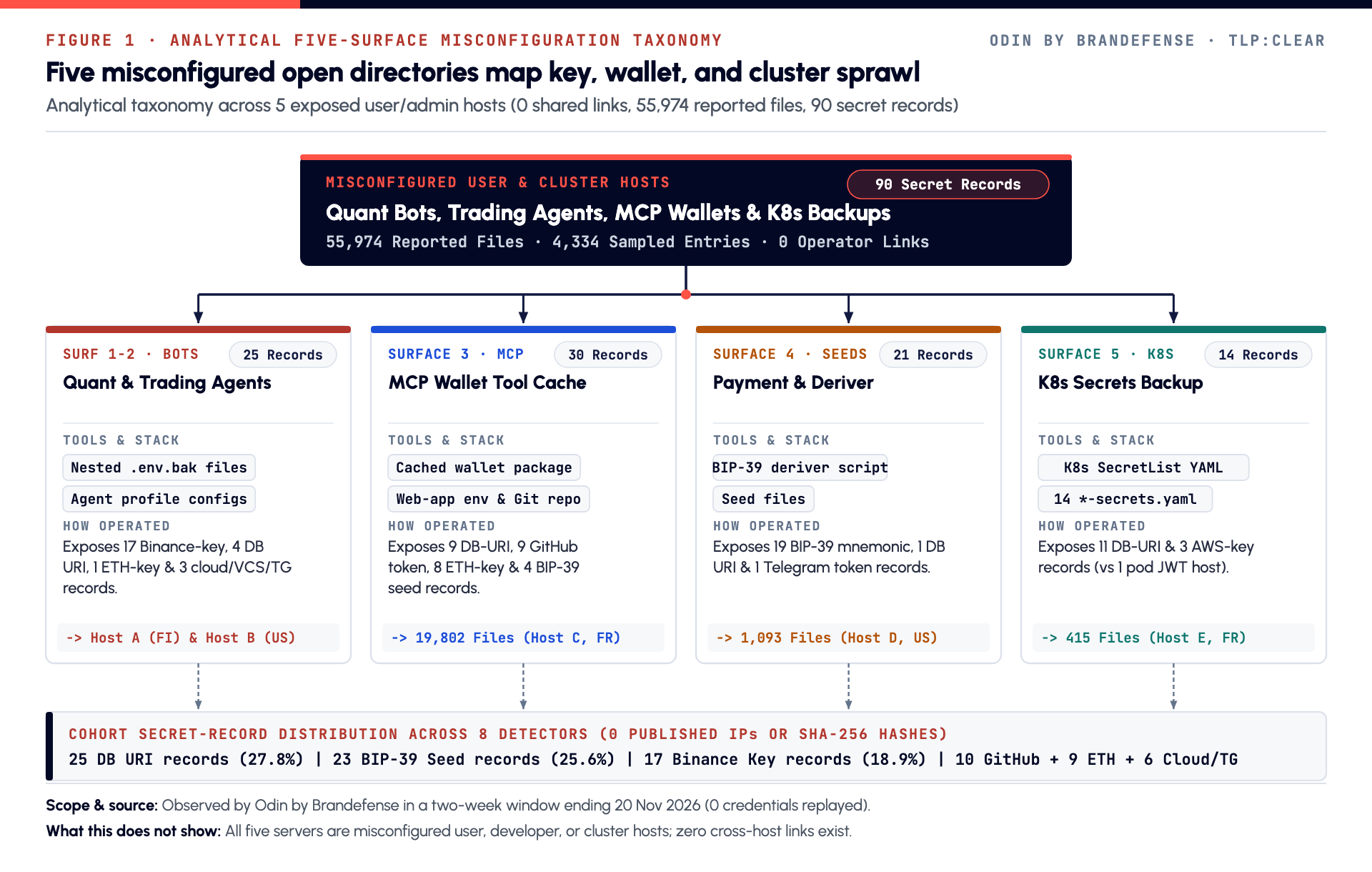
Each of the five servers highlights a distinct credential-sprawl surface that defenders can prioritize with cyber threat intelligence:
- Host A (Finland): trading bot backups. The directory reported 22,654 files (1,370 sampled) and exposed 16 secret records: 15 Binance API keys and 1 Ethereum private key. It held 45 sized environment and setup backups (118 to 2,811 bytes).
- Host B (United States): autonomous WeChat trading agent. The directory reported 12,010 files (1,169 sampled) and exposed 9 secret records: 4 database URLs, 2 Binance keys, 1 AWS secret key, 1 GitHub token, and 1 Telegram bot token. It held six agent profiles, 11 curator folders carrying June to August 2026 folder timestamps, bundled DEX CLI tools, and exchange proxy environment files.
- Host C (France): developer host with a cached Model Context Protocol wallet package. The directory reported 19,802 files (1,189 sampled) and exposed 30 secret records, the highest count of the five servers. Those records include 9 database URLs, 9 GitHub tokens, 8 Ethereum private keys, and 4 BIP-39 seed phrases. A cached wallet package sat beside a web-app environment file, 45 Git repository entries, agent configuration folders, and an SSH private key.
- Host D (United States): crypto payment platform and BIP-39 seed deriver. The directory reported 1,093 files (449 sampled, 183 unique detailed paths) and exposed 21 secret records: 19 BIP-39 seed phrases, 1 Telegram bot token, and 1 database URL. Seventy-four payment-platform paths sat beside a 20,480-byte wallet derivation script, a 72-byte plain-text seed file, a 7,680-byte Telegram notifier script, and seven multi-chain balance scanners.
- Host E (France): Kubernetes namespace Secret backup directory. The directory reported 415 files (157 sampled) and exposed 14 secret records across 119 YAML files in an exposed restore folder. Those records hold 11 database URLs, 2 AWS access keys, and 1 AWS secret key. Fourteen namespace
*-secrets.yamlmanifests (68 to 1,503 bytes) sat alongside cluster manifests,k3s-1.34.3, andresticcache files.
Why do signing keys and Kubernetes backups create lasting risk?
Comparing these five servers against the broader arrival set shows sharp concentration in financial signing keys. Across that arrival set, Odin tracked 255 database URLs, 106 AWS access keys, 92 BIP-39 seeds, 79 Telegram bot tokens, and 39 GCP service accounts. It also held 21 Binance API keys, 15 AWS secret keys, 11 Ethereum private keys, and 1 separate host exposing a mounted pod ServiceAccount token.
Crypto-native keys account for 49 of the 90 secret records (54.44%) in our five-host cohort. The other 41 records (45.56%) are database, source-control, cloud, and messaging credentials:
- Ethereum private keys (9 records, 10.00% of cohort). Accounts for 81.82% of all 11 Ethereum private-key records in the arrival set, split across Host C in France (8) and Host A in Finland (1).
- Binance API keys (17 records, 18.89% of cohort). Accounts for 80.95% of all 21 Binance-key records in the arrival set, split across Host A in Finland (15) and Host B in the United States (2).
- BIP-39 wallet seed phrases (23 records, 25.56% of cohort). Accounts for 25.00% of all 92 seed-phrase records in the arrival set, split across Host D in the United States (19) and Host C in France (4).
Unlike a cloud API key that can be rotated in place, an exposed BIP-39 seed phrase or raw Ethereum private key cannot be re-keyed. Move assets to a new wallet and revoke token allowances on the exposed address; do not reuse the old key. Old .env backup chains are a credentials in files risk; defenders should revoke historical exchange keys even after updating the active file.
On the cluster side, Host E highlights an important Kubernetes distinction. Kubernetes Secret YAML files encode secrets in plain Base64 (data:), not encryption. Exporting *-secrets.yaml files to an open folder leaks database URLs and AWS keys at rest. By contrast, the separate host exposing /run/secrets/kubernetes.io/serviceaccount/token leaks a mounted bearer JWT for the Kubernetes API server.
Why are all host addresses and file hashes withheld?
Every host in this study is treated as a misconfigured user, developer, trader, or cluster administrator server rather than an adversary operator. Even on Host E in France, where the cluster backup folder sat beside 19 Redis /tmp test or intrusion files, exposed keys belong to users and clusters. Publishing IP addresses, tenant namespace names, or file hashes would put those wallets, exchange accounts, and databases at risk. Defensive value comes from scanning your own perimeter for these exact misconfiguration patterns.
What to do now
- Close open HTTP directories and delete
.env.bakbackup chains. Scan cloud VPS and lab subnets forIndex of /listeners across standard and high TCP ports, and bind dev servers to127.0.0.1. Revoke every exchange key stored in.env.bakfiles, enforce IP allowlists, and disable withdrawals.
- Move wallet seeds out of flat files and isolate MCP wallet tools. Store BIP-39 seeds and EVM keys in hardware wallets, MPC signers, or KMS enclaves rather than plain-text seed or web-app environment files. Run MCP wallet packages and trading agents in sandboxes separated from GitHub tokens, SSH private keys, and production databases.
- Encrypt Kubernetes Secret backups and restrict pod tokens. Never save plain-text
kubectl get secrets -o yamlexports (*-secrets.yaml) in unencrypted folders. Encrypt each backup before storage and use an encrypted backup operator. Separately enable KMS encryption at rest for etcd. SetautomountServiceAccountToken: falsewhere pods do not need API access.
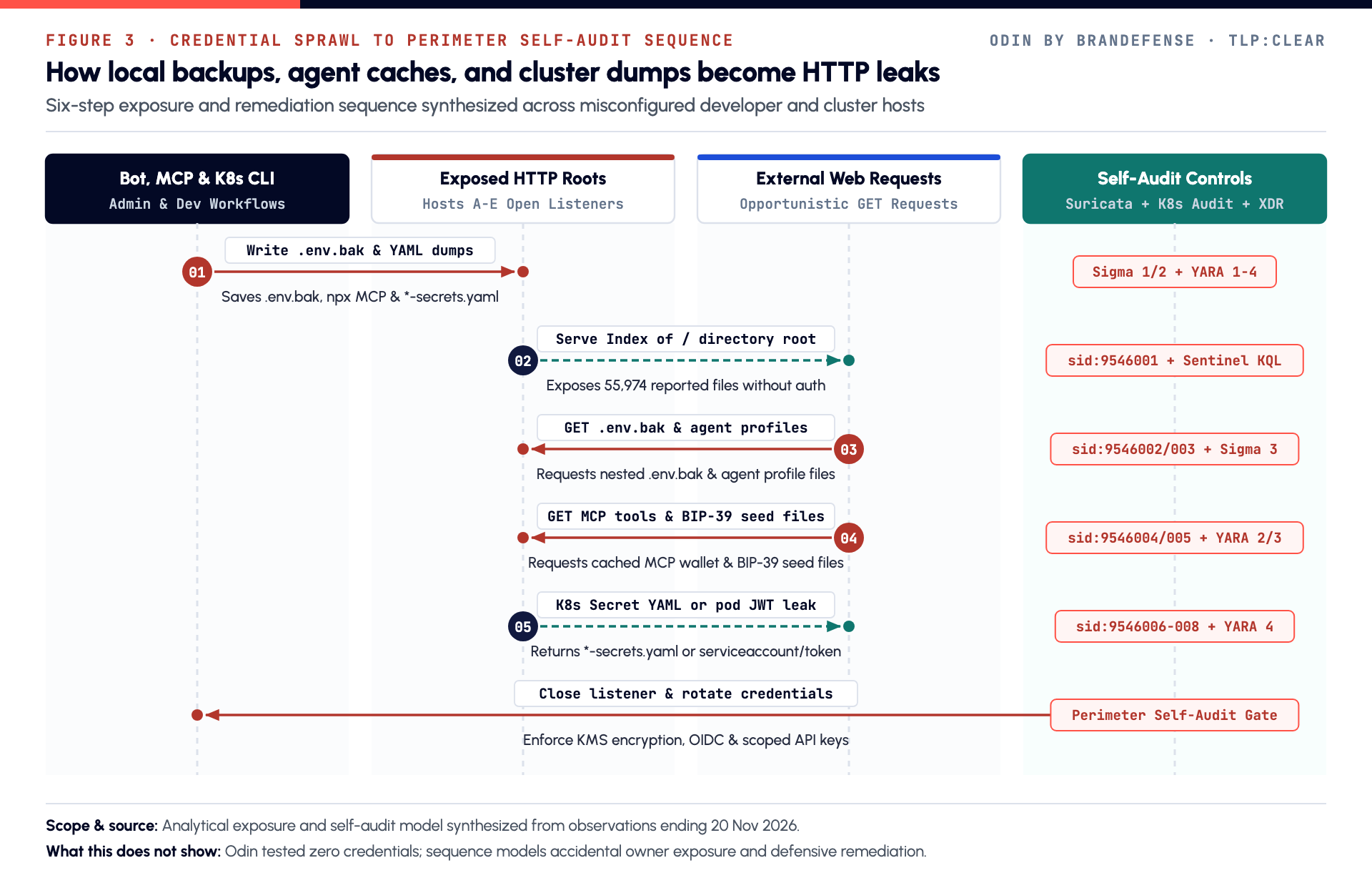
- Deploy perimeter self-audit rules. Load our Suricata rules (
sid:9546001to 9546008), Sentinel KQL query, Kubernetes and Linux Sigma rules, and YARA workspace checks to catch accidental HTTP exposure before external scanners do.
The full report's Indicators tab holds 0 network addresses and 0 file hashes because all five misconfigured host addresses and secret-bearing file digests are withheld. The full report lists 16 self-audit file, directory, and container-token path patterns. The full report's Detection rules tab provides Suricata, Sentinel KQL, Sigma, and YARA rules.
Frequently asked questions
What did we find across the five misconfigured directories?
Developers, algorithmic traders, and cluster administrators sometimes start an unauthenticated HTTP file server (python3 -m http.server). Others point a web root at a working directory to copy logs or backup files. Defenders can use external attack surface management to find public HTTP directories where anyone scanning the web can browse the workspace.
Why do signing keys and Kubernetes backups create lasting risk?
Comparing these five servers against the broader arrival set shows sharp concentration in financial signing keys. Across that arrival set, Odin tracked 255 database URLs, 106 AWS access keys, 92 BIP-39 seeds, 79 Telegram bot tokens, and 39 GCP service accounts. It also held 21 Binance API keys, 15 AWS secret keys, 11 Ethereum private keys, and 1 separate host exposing a mounted pod ServiceAccount token.
Why are all host addresses and file hashes withheld?
Every host in this study is treated as a misconfigured user, developer, trader, or cluster administrator server rather than an adversary operator. Even on Host E in France, where the cluster backup folder sat beside 19 Redis /tmp test or intrusion files, exposed keys belong to users and clusters. Publishing IP addresses, tenant namespace names, or file hashes would put those wallets, exchange accounts, and databases at risk.