
1. Executive Summary
In short
In a historical feed review completed 20 November 2026, Odin by Brandefense examined 2,385 endpoints across 2,294 distinct hosts spanning five initial-access loaders and five post-exploitation command-and-control frameworks. We also reviewed an open web directory in Japan reporting 2,025 files that exposed Covenant credential models and sRDI shellcode converters. Five dedicated cloud and virtual private server relay candidates lacked independent confirmation, so all 2,385 addresses are withheld. Withhold unverified relay blocks, hunt default PoshC2 and Covenant TLS certificates, and monitor in-memory .NET assembly loads.
Enterprise intrusions rarely use one implant from initial delivery through Active Directory escalation. Commodity malware loaders take the early risk on user workstations before operators bring in post-exploitation frameworks built in C#, PowerShell, Python, or Nim.
None of the 1,495 loader hosts in this study is shared with the 799 post-exploitation hosts or the Japanese open directory. We therefore present this two-stage handoff strictly as an analytical model, and we withhold all 2,385 unconfirmed endpoints and every workbench file hash.
Five initial-access loader feeds span 1,549 endpoints with zero confirmed relays.
Pikabot leads the loader set with 721 endpoints on 708 hosts, followed by Amadey (509), Latrodectus (225), and Matanbuchus (85). Nine more suspected endpoints on 5 hosts carry the upstream Coruna feed label.
Five Pikabot records carried a confirmed label in upstream feeds, yet two Italian hosts sat on standard FTP port 21. Three Pikabot relay candidates on Amazon and Microsoft cloud networks lacked an independent second signal, so their addresses stay withheld.
Five post-exploitation C2 families add 836 endpoints with two PoshC2 relay candidates.
Covenant accounts for 340 endpoints on 334 hosts, with 92.1% on default port 7443, alongside ValleyRAT (265), PoshC2 (124), BYOB (90), and NimPlant (17). Thirteen PoshC2 servers still present the framework's built-in certificate name CN=P18055077, including two unconfirmed relay candidates in Germany and Australia. Fourteen Covenant listeners keep CN=Covenant, and 11 of 17 NimPlant listeners use HTTP port 80.
An open directory in Japan exposes Covenant credential models and sRDI scripts.
Reporting 2,025 files on HTTP port 80 across 308 sampled entries, the server exposes Covenant C# classes for Kerberos tickets, NTLM hashes, passwords, and custom HTTP listener headers. Nearby folders hold SharpSploit credential tasks, embedded Mimikatz and Donut libraries, and 14 sRDI reflective DLL shellcode scripts next to Microsoft .NET SDK archives and synthetic data-loss test files.
Three Decisions for Leaders
- Withhold unverified relay blocks and keep noisy loader feeds out of firewalls. Require an independent confirmation signal before blocking the five Pikabot and PoshC2 relay candidates, and send shared web-hosting, FTP, DNS, and residential telecom records to hunting.
- Hunt default C2 certificates and watch in-memory .NET assembly loads. Alert on
CN=P18055077andCN=Covenantserver certificates, and turn on Windows AMSI and .NET Common Language Runtime logging to catch reflective DLL or C# loads from PowerShell and Nim processes. - Harden Kerberos tickets and lock down internal testing directories. Protect privileged service accounts against Kerberoasting and ticket extraction, and ban unauthenticated HTTP file servers on hosts that store red-team tools or data-loss test suites.
The Study in Numbers
| Number | What it is |
|---|---|
| 2,385 / 2,294 | Examined endpoints on 2,294 distinct hosts across 10 loader and post-exploitation families |
| 1,549 / 1,495 | Initial-access loader endpoints on 1,495 hosts (Pikabot, Amadey, Latrodectus, Matanbuchus, Coruna) |
| 836 / 799 | Post-exploitation C2 endpoints on 799 hosts (Covenant, ValleyRAT, PoshC2, BYOB, NimPlant) |
| 5 / 0 | Dedicated cloud and VPS relay candidates (3 Pikabot and 2 PoshC2; 0 independently confirmed or published) |
| 2,385 / 2,294 | Unconfirmed endpoints on 2,294 hosts kept out of block lists (all addresses withheld) |
| 2,025 / 308 | Reported and sampled files on the Japanese Covenant and sRDI HTTP workbench (0 hashes published) |
| 0 | Shared hosts between the loader group, the post-exploitation group, and the Japanese workbench |
How to use this report.
Security leaders can focus on Chapters 1, 6, and 7. Active Directory, Windows endpoint, and cloud engineers should read Chapters 3, 4, 5, and 7. SOC analysts and detection engineers can go straight to Chapters 8 and 9. Analysts using cyber threat intelligence will find the hosting breakdown and study limits in Chapters 2, 3, 4, 6, and 10.
2. Two Stages of Intrusion Infrastructure in One Analytical Model
In short
None of the 1,495 loader hosts shares an IPv4 address with the 799 post-exploitation C2 hosts or the Japanese open directory. We present them together as an analytical model of how modern intrusions split delivery from post-exploitation, and we withhold block-list guidance until relay candidates are independently confirmed.
Modern Windows intrusions divide work across two separate layers of infrastructure. Phishing and malvertising campaigns rely on initial-access loaders such as Pikabot, Latrodectus, Amadey, and Matanbuchus. Those loaders survive fast takedowns on disposable cloud instances or hijacked web servers. When a target host matches an operator's interest, interactive control shifts to post-exploitation frameworks in .NET, PowerShell, Nim, or Python, including Covenant, PoshC2, NimPlant, BYOB, and ValleyRAT.
Treating every feed record across both layers as a firewall block breaks shared websites, DNS resolvers, FTP servers, and broadband users. None of the 1,549 loader endpoints shares a host with the 836 post-exploitation endpoints or the Japanese workbench. Inside the post-exploitation set alone, three unconfirmed hosts carry two framework labels. One German host pairs Covenant port 7443 with PoshC2 port 443, and two US and UK hosts pair Covenant port 7443 with BYOB port 5000.
Because no host links the loader group to the post-exploitation group, the connection between them is functional rather than a single attributed operator. Figure 1 maps the four groups in this analytical model and shows what defenders can do with each one.
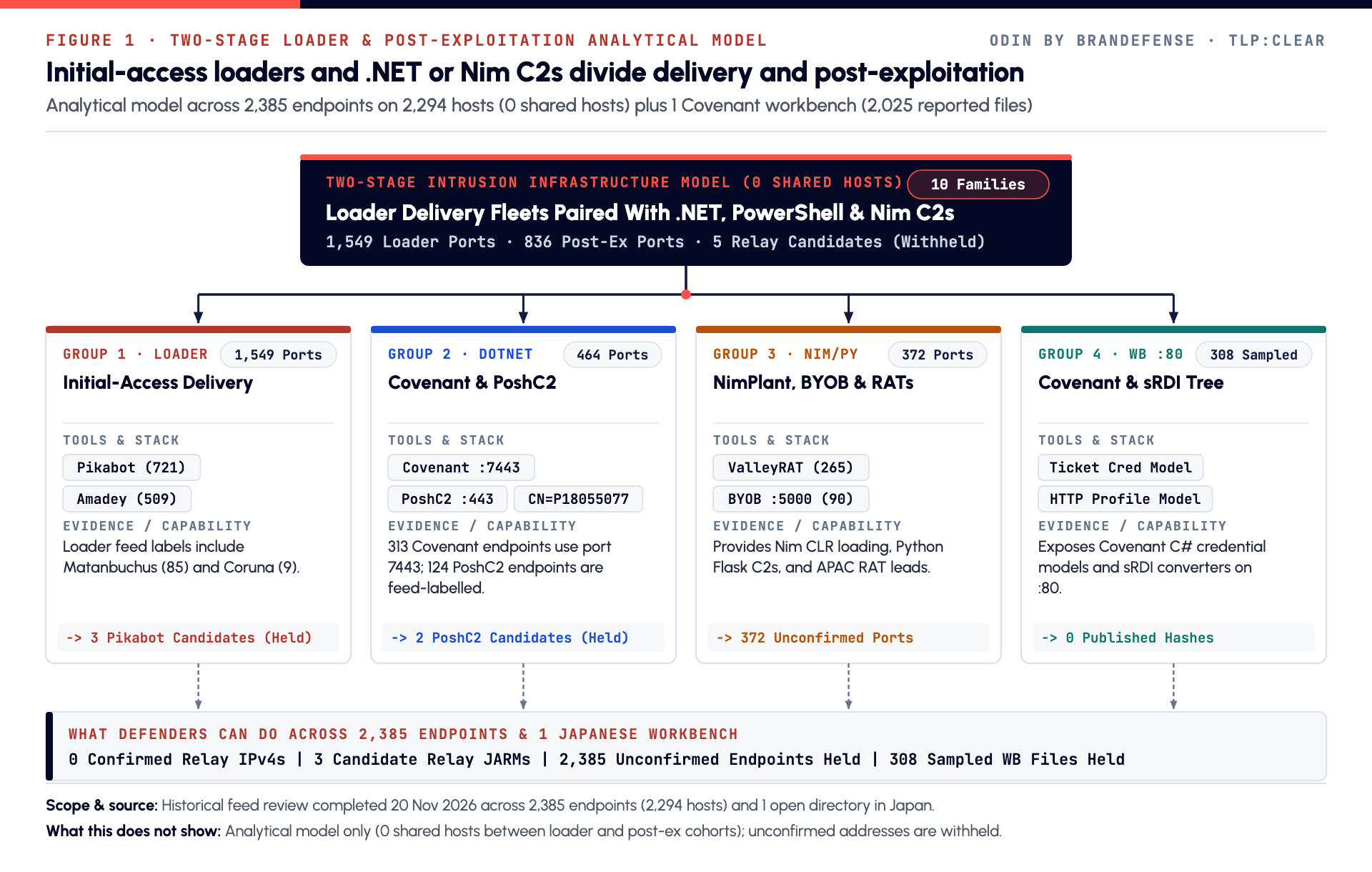
| Study group | Feed or server records | Distinct hosts | Published addresses | Recommended defender action |
|---|---|---|---|---|
| Initial-access loaders (5 families) | 1,549 endpoints | 1,495 | 0 | Withhold 3 Pikabot relay candidates; hunt TLS and HTTP |
| Post-exploitation C2s (5 families) | 836 endpoints | 799 | 0 | Withhold 2 PoshC2 relay candidates; hunt default certs |
| Japanese Covenant and sRDI workbench | 2,025 reported files (308 sampled) | 1 | 0 | Hunt class and function markers; harden Kerberos and CLR |
Where the 2,385 endpoints are hosted
Hosting choices differ sharply between mass-delivery loader leads and operator-managed C2 servers. The United States (623, 26.1%), unattributed codes (435, 18.2%), Hong Kong (188, 7.9%), and Germany (185, 7.8%) lead the corpus. The Netherlands (182, 7.6%), Russia (136, 5.7%), and the United Kingdom (97, 4.1%) bring those seven groups to 77.4% of the 2,385 endpoints.
Unconfirmed Pikabot records sit heavily on domain registrars and shared web-hosting providers, where external attack surface management can help defenders check abused folders before blocking shared IPs. By contrast, Latrodectus candidates cluster on three European hosting providers, Covenant and PoshC2 favor major cloud platforms, and ValleyRAT clusters in Hong Kong.
| Hosting provider | Endpoints | Primary families on this network |
|---|---|---|
| Railnet LLC | 149 | Latrodectus (141 on TCP 443), Amadey |
| Network Solutions, LLC | 115 | Pikabot shared-hosting candidates |
| Amazon.com, Inc. | 113 | Covenant (46), PoshC2 (30, 1 relay candidate), Pikabot (16, 2 relay candidates), BYOB (14) |
| Cloudflare, Inc. | 79 | Pikabot (73), Amadey (6) reverse-proxied origins |
| GoDaddy.com, LLC | 76 | Pikabot (75) shared-hosting candidates |
| DigitalOcean, LLC | 73 | Covenant (48), PoshC2 (18), BYOB (6) |
| Namecheap, Inc. | 44 | Pikabot (41), NimPlant (1) |
| Unified Layer | 41 | Pikabot (41) shared-hosting candidates |
| dus.net GmbH | 37 | Latrodectus (37 on TCP 443) |
| CTG Server Limited | 36 | ValleyRAT (36 in Hong Kong) |
| Hetzner Online GmbH | 35 | Pikabot (18), PoshC2 (3, 1 relay candidate), Covenant |
| Akamai Connected Cloud | 34 | Covenant (13), BYOB (11), PoshC2 (5) |
Fifteen additional endpoints sit on institutional networks whose names are withheld, and 15 Amadey candidate rows sit on an individual registrant allocation whose name is also withheld.
3. Five Initial-Access Loader Feeds and Three Pikabot Relay Candidates
In short
Five loader feeds account for 1,549 endpoints across 1,495 hosts, or 64.9% of the dataset. Three dedicated Pikabot relay candidates on Amazon and Microsoft cloud networks lacked an independent confirmation signal, while two other feed-confirmed entries hit FTP port 21. Withhold all 1,549 loader addresses from block lists and route them to TLS and proxy hunting.
Initial-access loaders act as delivery brokers. They start on a user workstation through an email attachment, script, or malvertising archive. Next, they check the local environment and pull down a second-stage payload over HTTP or HTTPS (T1071.001).
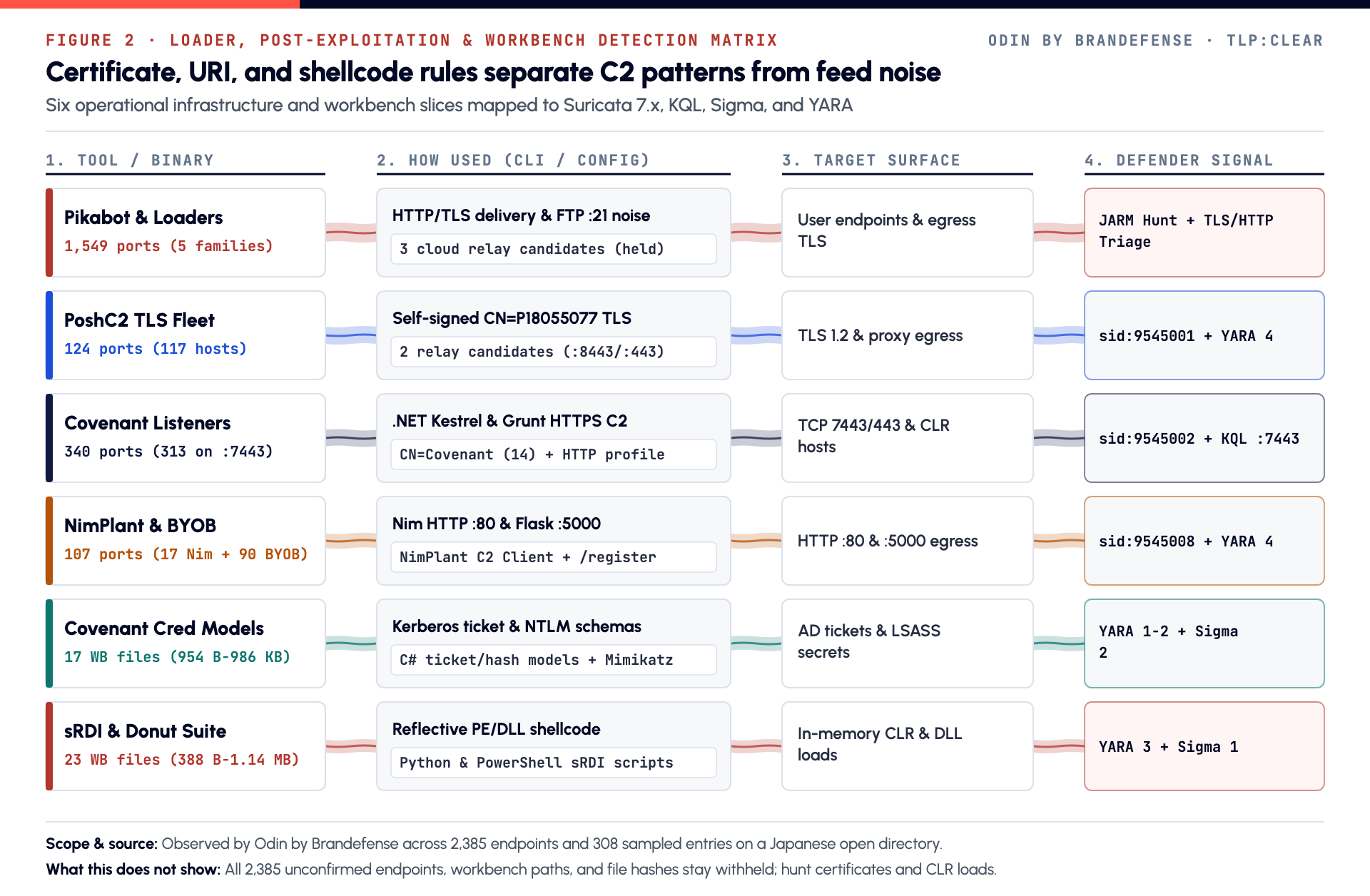
Because threat feeds mix dedicated loader C2 servers with hijacked websites that briefly hosted a stage-one payload, blocking an unverified loader feed causes immediate collateral damage. Figure 2 links each loader, post-exploitation, and workbench group to the detection rules in Chapter 8.
Pikabot: three unconfirmed cloud relay candidates and 718 other records
Pikabot (MITRE ATT&CK S1145) is the largest single family in the study, with 721 endpoints across 708 hosts in 44 countries. TCP 443 accounts for 661 endpoints (91.7%). Other ports are 80 (13), 1194 (9), 2083 (8), and 2222 (7). Ports 2224 and 5000 each have four; port 13783 has three.
Five Pikabot endpoints carried a confirmed label in upstream feed records, yet two did not hold up under inspection. Both sat on standard FTP port 21 at an Italian domain and web-hosting registrar, which points to abused shared FTP accounts rather than dedicated Pikabot C2 listeners.
Three Pikabot endpoints observed on 19 November 2026 sit on commercial cloud instances without shared-hosting panels and share one withheld TLS certificate domain. The package does not document an independent protocol response, beacon, or workbench link for those three relay candidates, so their addresses stay withheld:
| Family | Relay candidate and port | Country and provider | Transport and JARM | Defender action |
|---|---|---|---|---|
| Pikabot | Withheld IPv4 (port 80) | Germany, Amazon.com, Inc. | Plain HTTP relay candidate | Withhold block until verified |
| Pikabot | Withheld IPv4 (port 443) | Germany, Amazon.com, Inc. | HTTPS TLS relay candidate | Withhold block until verified |
| Pikabot | Withheld IPv4 (port 443) | Ireland, Microsoft Corporation | HTTPS, JARM in Chapter 9 | Hunt JARM; withhold block |
These cloud records lack an independent second confirmation signal, and elastic IPv4 leases on AWS and Microsoft Azure rotate quickly. Defenders should therefore hunt their TLS fingerprint rather than blocking the addresses.
The other 718 Pikabot endpoints stay unpublished. They comprise 11 suspected endpoints, 2 FTP port 21 collisions, 18 telecom ISP addresses, 11 shared-certificate collisions, 1 open-directory collision, and 675 single-signal candidates. Within those candidates, 149 endpoints share one default Apache and cPanel TLS JARM fingerprint on shared web-hosting servers, showing why JARM values on web ports must never drive automatic blocks.
Amadey, Latrodectus, Matanbuchus, and the Coruna feed label
Four other loader families make up the remaining 828 initial-access endpoints across 787 hosts, with zero confirmed block-list addresses:
- Amadey (509 endpoints on 490 hosts, S1025). Unlike TLS-heavy loaders, 485 of 509 Amadey candidates (95.3%) use HTTP port 80 (24 use 443) for PHP panel check-ins across 21 attributed countries and 343 unattributed records. Russia leads with 69 endpoints, followed by the Netherlands (20), Germany (20), Finland (19), and the United States (12), with 2 shared-certificate rows and 507 candidates.
- Latrodectus (225 endpoints on 225 hosts, S1160). Every Latrodectus candidate (100.0%) uses TCP 443 across the Netherlands (110), Germany (68), the United Kingdom (35), unattributed records (8), and the United States (4). Railnet LLC (141, 62.7%), dus.net GmbH (37, 16.4%), and metaspinner net GmbH (22, 9.8%) host 200 of 225 servers (88.9%), alongside 14 institutional rows and 6 shared-certificate rows.
- Matanbuchus (85 endpoints on 67 hosts). Matanbuchus combines ports 443 (46) and 80 (28) with high ports 59619 (4), 4433 (3), 4443 (2), and 63994 (2) across unattributed networks (51), Russia (28), I-SERVERS LTD (17), and M247 Europe SRL (9).
- Coruna feed label (9 suspected endpoints on 5 hosts). Coruna is an upstream feed label rather than a verified malware family or actor. Observed on 13 and 19 November 2026 across Hong Kong (4 endpoints), Singapore (4), and the United States (1), four of its five hosts use paired ports. Two Singapore hosts on Antbox Networks Limited listen on 7001 and 7443 with the same JARM. One Hong Kong host on cognetcloud INC listens on 7000 and 7001, a second on NetLab Global listens on 80 and 443, and one US host on HostPapa listens on 7000. All five addresses are withheld, and Chapter 6 reconciles all five loader families.
4. Post-Exploitation .NET, PowerShell, Nim, and Python C2 Fleets
In short
Five post-exploitation families account for 836 endpoints across 799 hosts. Two dedicated PoshC2 relay candidates present the built-in CN=P18055077 certificate but lack an independent confirmation signal, so all 836 addresses are withheld. Hunt CN=P18055077 and CN=Covenant certificates alongside 313 Covenant port 7443, 78 BYOB port 5000, and 11 NimPlant port 80 listeners.
Frameworks built on the .NET Common Language Runtime (CLR), PowerShell's System.Management.Automation engine, or Nim with inline CLR hosting let operators load post-exploitation assemblies straight from memory (T1620, T1059.001). Because Covenant, PoshC2, NimPlant, and BYOB are public open-source repositories used by internal red teams every day, single-signal port matches must stay out of automatic block lists.
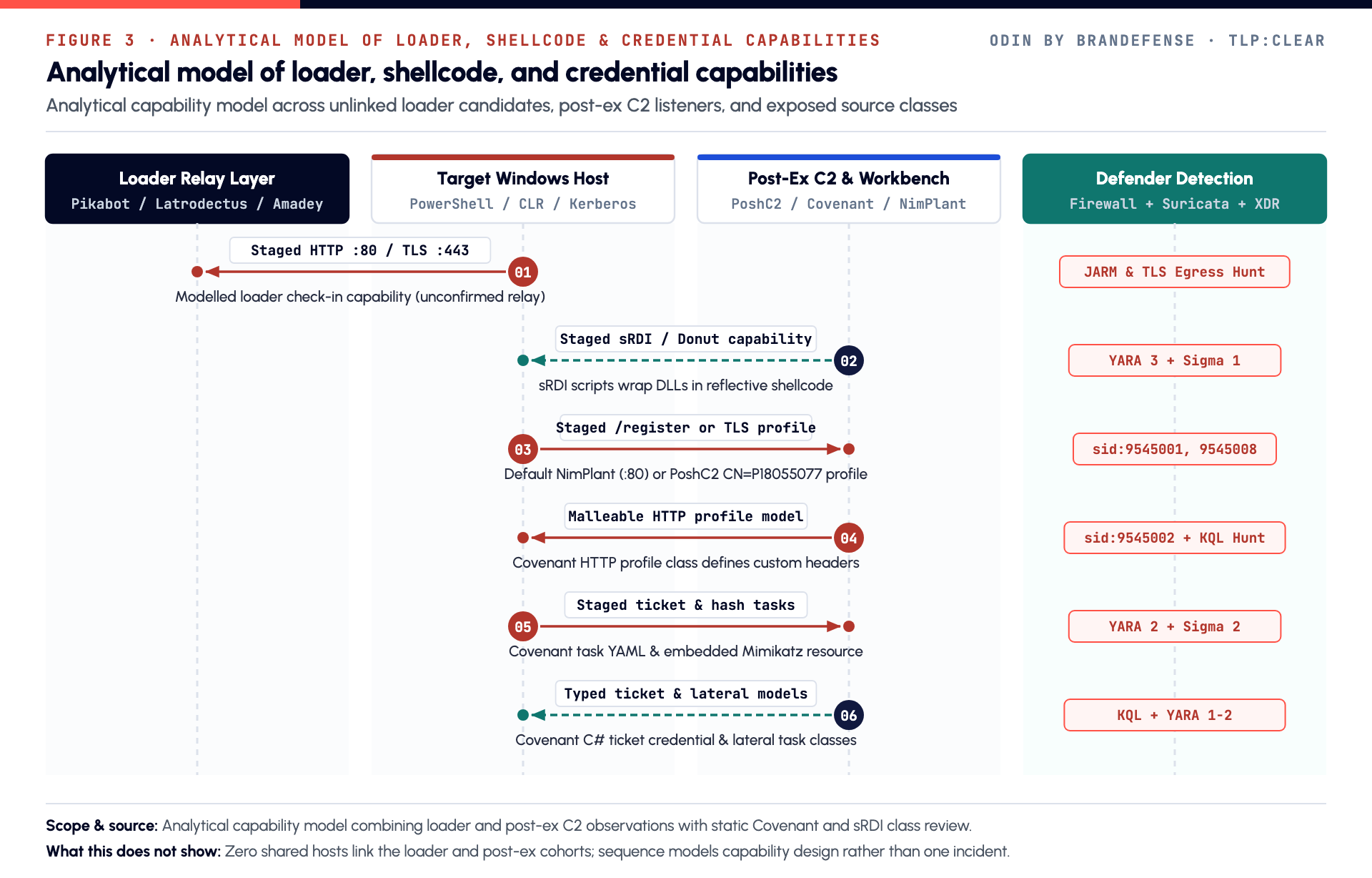
Figure 3 shows how initial loader delivery, sRDI shellcode conversion, NimPlant or PoshC2 profiles, and Covenant ticket models fit together in our analytical capability model.
Covenant on port 7443 and two PoshC2 relay candidates with CN=P18055077
Covenant (S1155) and PoshC2 (S0378) make up 464 of the 836 post-exploitation endpoints (55.5%).
Covenant accounts for 340 endpoints on 334 hosts across 38 countries. Of those, 313 endpoints (92.1%) listen on TCP 7443, Covenant's default Kestrel HTTPS management port. The rest use ports 443 (12), 8443 (5), 27443 (2), 9443 (2), and 32768 (2).
Fourteen listeners still present Covenant's default CN=Covenant certificate. Eighteen listeners share one Kestrel TLS JARM fingerprint, including all four suspected port 443 servers observed on 17 and 19 November 2026 on Amazon and Microsoft cloud networks. Port 7443 portals are common in test labs, and 17 candidates hit telecom ISP (10), shared ingress certificate (6), or open-directory (1) collisions. All 340 Covenant addresses are therefore withheld.
PoshC2 contributes 124 endpoints on 117 hosts across 21 countries, with 98 (79.0%) on its default BindPort: 443, plus 5 on 8443 and 5 on 80. Thirteen PoshC2 servers (10.5%) present the certificate Common Name CN=P18055077. Nettitude's open-source PoshC2 codebase generates a 2,048-bit RSA self-signed certificate on first run. Its hardcoded subject fields are C=US, ST=Minnesota, L=Minnetonka, O=Pajfds, OU=Jethpro, and CN=P18055077.
Two dedicated PoshC2 relay candidates presenting CN=P18055077 lack an independent protocol response or beacon in the package, so their addresses stay withheld:
| Family | Relay candidate and port | Country and provider | Certificate and JARM | Defender action |
|---|---|---|---|---|
| PoshC2 | Withheld IPv4 (port 8443) | Germany, Hetzner Online GmbH | CN=P18055077, JARM in Chapter 9 | Hunt cert and JARM; do not block |
| PoshC2 | Withheld IPv4 (port 443) | Australia, Amazon.com, Inc. | CN=P18055077, JARM in Chapter 9 | Hunt cert and JARM; do not block |
One candidate was observed on 19 November 2026 on Hetzner (port 8443), and the second from 13 to 19 November 2026 on AWS Sydney (port 443). Both belong in certificate and JARM hunts until each address is independently verified. The other 122 PoshC2 records (3 telecom ISP, 2 Kubernetes fake-certificate collisions, and 117 single-signal candidates) also stay withheld.
NimPlant on HTTP port 80, BYOB on port 5000, and ValleyRAT in Hong Kong
Compiled Nim implants and Python or C++ frameworks cover the remaining 372 post-exploitation endpoints across 349 hosts:
- NimPlant (17 endpoints on 17 hosts). Written in Nim by Cas van Cooten, NimPlant supports in-memory
execute-assembly,powershell, andshinjectcommands underriskyMode = true. Its default configuration usestype = "HTTP",port = 80,userAgent = "NimPlant C2 Client", and/register,/task, and/result. Eleven of 17 endpoints (64.7%) listen on HTTP port 80, alongside 443 (3) and single ports on 8080, 8443, and 8880. They span the United States (5), Hong Kong (3), Australia (2), Pakistan (2), and five single-host countries. One port 80 server on Microsoft Azure (19 November 2026) is suspected, two hit shared certificates, one uses a telecom ISP, and 13 are candidates. - BYOB (90 endpoints on 87 hosts). Build Your Own Botnet binds its Python Flask web app on TCP 5000 by default, accounting for 78 of 90 endpoints (86.7%), plus 443 (7) and 80 (2). Five use dynamic telecom ISPs and 85 are candidates.
- ValleyRAT (265 endpoints on 247 hosts). ValleyRAT clusters in Asia-Pacific, with 176 of 265 endpoints (66.4%) in Hong Kong, followed by the United States (24), South Korea (16), Singapore (16), China (9), and Japan (9). Common ports include 80 (44), 6666 (24), 8888 (17), 90 (10), and 288 (9). Six records hit standard DNS port 53, 5 hit Cloudflare Origin certificates, 3 sit on telecom ISPs, and 1 co-hosts an open directory, leaving all 265 withheld (see Chapter 6).
5. Inside an Open Covenant Credential-Model and sRDI Directory in Japan
In short
An open HTTP directory on port 80 in Japan reported 2,025 exposed files, with 308 sampled entries and 220 retained file paths totaling 3.09 GB. Static review separates 68 Covenant C# credential-model, HTTP-profile, and sRDI shellcode files from 152 .NET SDK archives, runtime DLLs, and synthetic data-loss test blobs. Lock down testing directories and harden Kerberos ticket hygiene.
External port scans show where listeners sit, whereas an exposed directory shows how a .NET C2 server models stolen credentials, edits HTTP headers, and prepares shellcode. In our historical feed review completed 20 November 2026, one server in Japan on TCP port 80 exposes a Covenant and sRDI workbench. It sits beside a 7,574-byte Python file (path withheld).
Seventy retained rows were first listed from 3 to 12 August 2026; 150 were first listed on 18 November 2026. Across 25 directory records reporting 2,025 files, 308 entries were sampled and 220 path records were retained (88 residual entries were omitted at source). Figure 4 breaks down all five layers on that server.
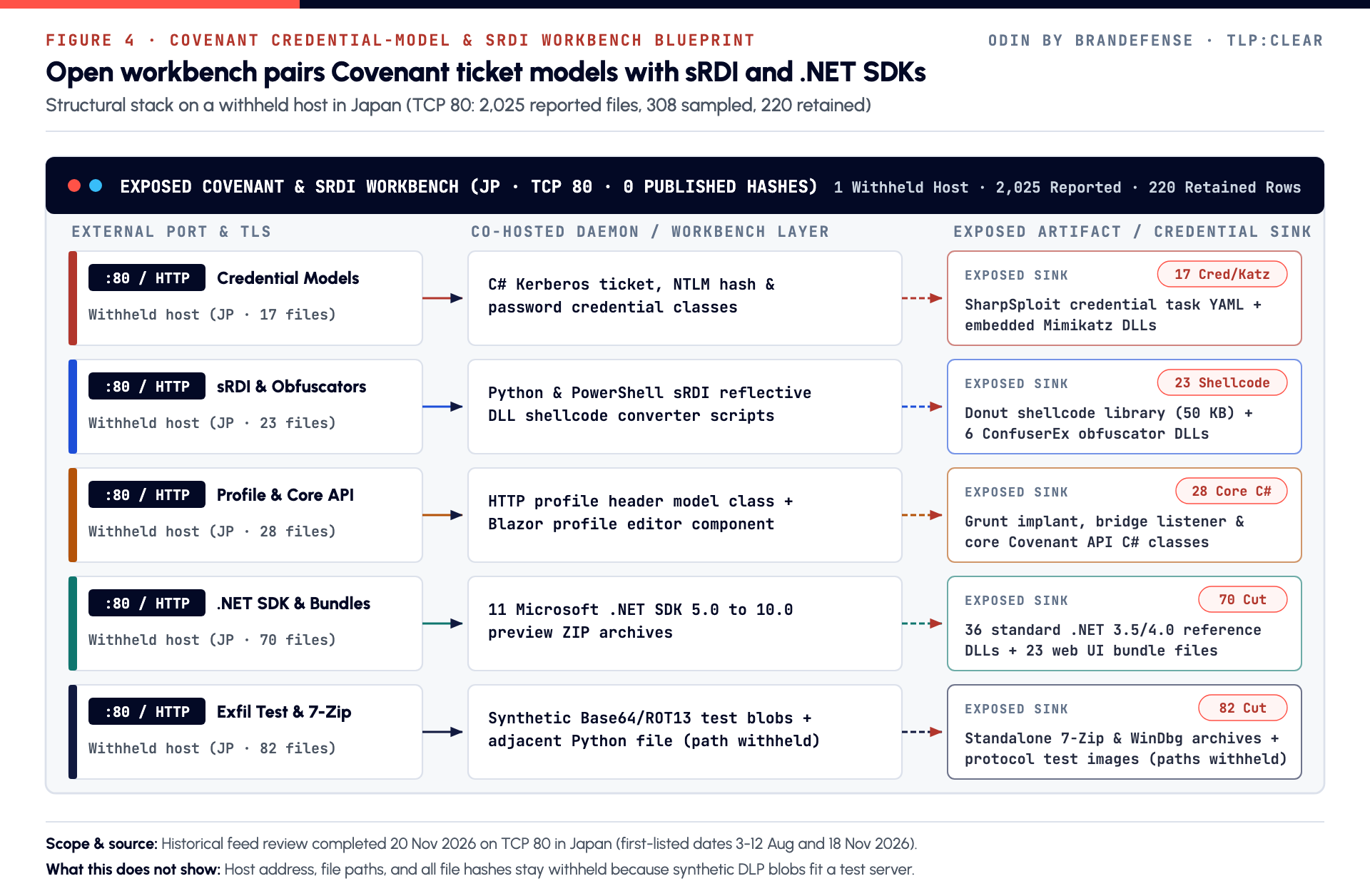
How Covenant structures harvested Kerberos tickets, NTLM hashes, and HTTP profiles
Inside the Covenant source tree (113 entries total; paths withheld), 17 files (7.7% of the 220 retained rows) define Covenant's credential models and Mimikatz integration. Another 28 files (12.7%) define HTTP profiles and Grunt management.
Rather than saving plain text logs, Covenant parses stolen Windows secrets into typed C# model classes served by an 11,850-byte credential API controller (paths withheld). Six Blazor UI components render those credential tables, led by an 8,869-byte credential form, a 2,880-byte ticket table, and a 2,485-byte hash table. Three smaller Blazor components (2,121, 1,295, and 954 bytes; paths withheld) handle password tables and credential creation:
| Exposed Covenant file class (path withheld) | Size (bytes) | Technical role in .NET post-exploitation |
|---|---|---|
| Kerberos ticket credential model (C# source) | 2,787 | Stores stolen Kerberos TGT and TGS tickets, service principal names, and .kirbi byte strings (T1558) |
| NTLM hash credential model (C# source) | 2,541 | Indexes NTLM, LM, and NetNTLMv1/v2 password hashes by hash type for pass-the-hash reuse |
| Password credential model (C# source) | 2,131 | Stores plaintext domain or local account passwords tied to realm and username |
| Base credential model and credential-type enum (C# source) | 1,882 and 1,787 | Base credential class and enum (companion server credential model adds 12,014 bytes) |
| SharpSploit credential task definition (YAML) | 47,957 | Defines C# Grunt credential-extraction tasks, paired with a 56,741-byte DPAPI reference document |
| Embedded 64-bit Mimikatz resource library (DLL) | 986,624 | Embedded 64-bit Mimikatz binary (32-bit companion adds 936,960 bytes) compiled into Grunt tasks |
| HTTP profile header model (C# source) | 1,279 | Defines custom HTTP request and response headers (companion Blazor editor adds 2,492 bytes) |
| SharpSploit lateral-movement task definition (YAML) | 24,316 | Defines WMI, DCOM, PowerShell remoting, and SCM lateral-movement tasks for Grunt implants |
Alongside the HTTP profile header model, the server exposes C# source files for Grunt implants (12,813 bytes), bridge listeners (8,364 bytes), a script launcher (8,183 bytes), and embedded resources (1,462 bytes; paths withheld). It also exposes core API and service source files (1,061,292 and 250,630 bytes) and an OpenAPI specification (176,559 bytes; paths withheld). Together they show why port-only or default-header signatures miss customized Covenant listeners once an operator edits HTTP profile headers.
Reflective DLL shellcode (sRDI), Donut, ConfuserEx, and why zero hashes are published
Twenty-three retained files (10.5%; paths withheld) supply reflective shellcode conversion and .NET assembly obfuscation (T1620). Fourteen files belong to Nick Landers' open-source sRDI suite. They include two Python shellcode converter scripts (29,707 and 2,445 bytes) and a PowerShell shellcode converter (40,563 bytes; paths withheld). The suite also holds PowerShell shellcode loader, output, and PE-header helper scripts (23,485, 940, and 47,376 bytes; paths withheld).
Nine companion reference libraries (paths withheld) add a Donut .NET assembly-to-shellcode DLL (50,688 bytes) alongside .NET metadata and PE parser libraries (1,144,320 and 152,576 bytes). That group also holds six ConfuserEx obfuscator libraries, led by renamer and core modules (313,344 and 178,688 bytes; paths withheld).
The remaining 152 retained rows (69.1%) are ordinary build chains and synthetic test files. Seventy entries (31.8%; paths withheld) include 11 Microsoft .NET SDK archives (.NET 5.0 through .NET 10.0 preview, up to 308,891,280 bytes). That group also holds 36 standard .NET 3.5 and 4.0 reference assemblies and 23 web UI bundle files.
Another 82 entries (37.3%; paths withheld) combine 8 standalone 7-Zip archiver files and 2 WinDbg debugger archives (192.5 MB each). They sit beside synthetic Base64 and ROT13 data-loss test blobs and protocol test images (paths and filenames withheld).
| Workbench file class (paths withheld) | Retained rows | Share | Size range (bytes) | What it holds and how we handle it |
|---|---|---|---|---|
| Covenant credential and ticket models | 17 | 7.7% | 954 to 986,624 | C# ticket, hash, and password model classes, SharpSploit credential task YAML, and embedded Mimikatz DLLs (hunt class markers) |
| sRDI and .NET shellcode tooling | 23 | 10.5% | 388 to 1,144,320 | Python and PowerShell sRDI shellcode converters, Donut shellcode library, and ConfuserEx obfuscator DLLs (hunt CLI and YARA) |
| Covenant HTTP profile and core source | 28 | 12.7% | 133 to 1,061,292 | HTTP profile header models, Grunt and bridge listener classes, and core Covenant API source (hunt class markers) |
| .NET SDKs, runtime DLLs, and web bundles | 70 | 31.8% | 6,448 to 308,891,280 | 11 Microsoft .NET SDK archives, 36 standard .NET reference assemblies, and 23 web UI bundle files (do not block) |
| Synthetic exfil test blobs and archivers | 82 | 37.3% | 1,079 to 192,459,823 | Synthetic Base64 and ROT13 test payloads, 7-Zip archivers, WinDbg archives, and protocol test images (do not block) |
Because the open directory mixes public Covenant and sRDI source trees with synthetic Base64 and ROT13 test payloads, the host could belong to an enterprise data-loss-prevention or purple-team engineer. We therefore withhold the server's address, its file paths and filenames, and all 308 sampled file hashes.
6. Feed Labels Against Unconfirmed Relay Candidates
In short
Turning all 2,385 feed-labelled loader and C2 endpoints into firewall blocks would disrupt GoDaddy and Network Solutions shared web hosts, Cloudflare origins, FTP and DNS servers, and residential broadband users. Because even the five dedicated relay candidates (0.21%) lack an independent second signal, withhold all 2,385 addresses from block lists and hunt certificates and runtime behavior instead.
Good infrastructure defense depends as much on what stays out of a block list as on what goes in. Figure 5 compares the total number of examined endpoints per family against the five dedicated relay candidates.
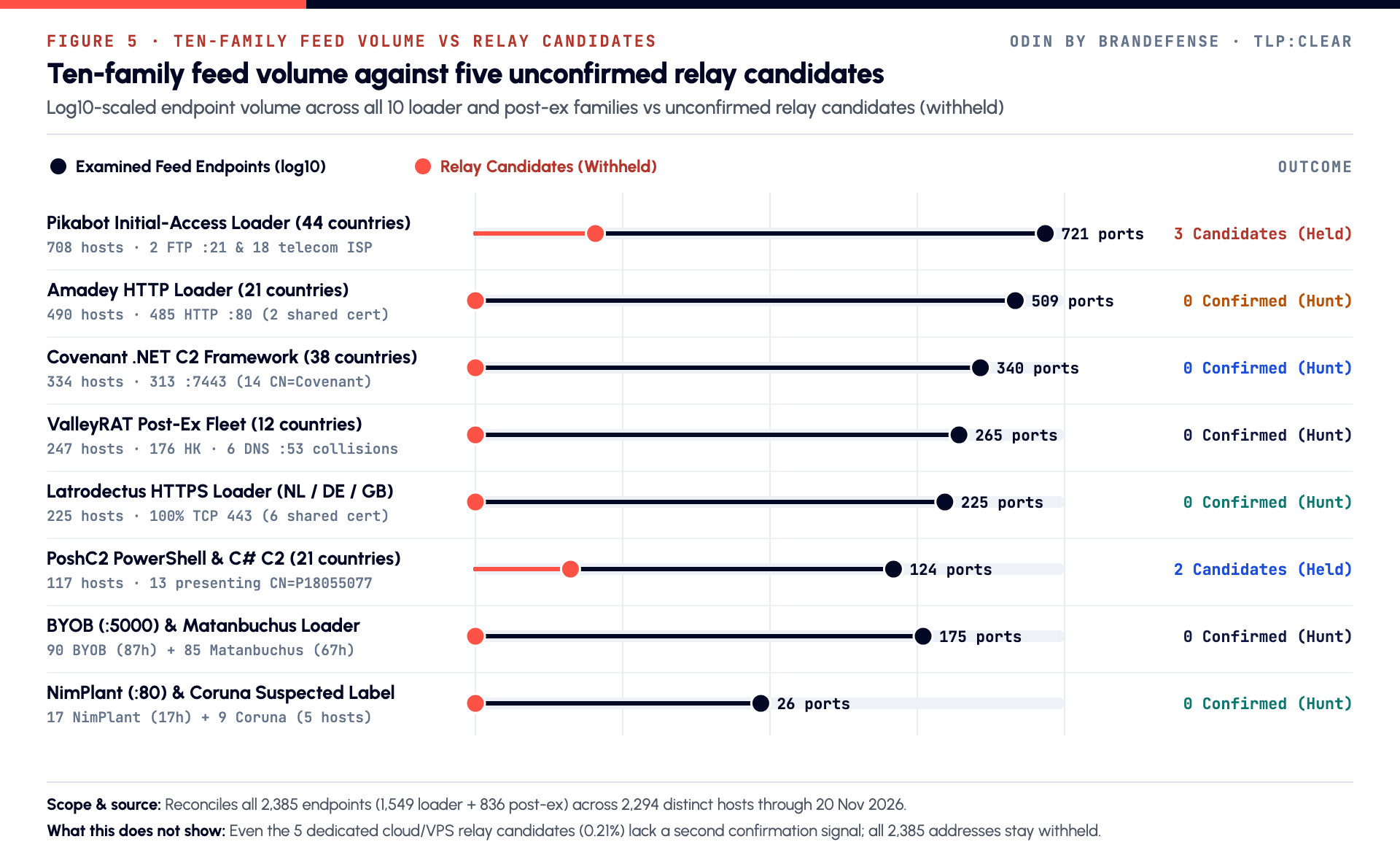
| Family | Group | Endpoints | Hosts | Relay candidates (withheld) | Other unconfirmed records (hunt only, addresses withheld) |
|---|---|---|---|---|---|
| Pikabot | Loader | 721 | 708 | 3 | 718 (11 suspected, 2 FTP 21, 18 telecom ISP, 11 shared cert, 1 open dir, 675 candidates) |
| Amadey | Loader | 509 | 490 | 0 | 509 (2 shared cert, 507 HTTP/HTTPS candidates) |
| Covenant | Post-ex C2 | 340 | 334 | 0 | 340 (4 suspected, 10 telecom ISP, 6 shared cert, 1 open dir, 319 port 7443/443 candidates) |
| ValleyRAT | Post-ex C2 | 265 | 247 | 0 | 265 (6 DNS port 53, 5 shared cert, 3 telecom ISP, 1 open dir, 250 candidates) |
| Latrodectus | Loader | 225 | 225 | 0 | 225 (6 shared cert, 219 TCP 443 candidates) |
| PoshC2 | Post-ex C2 | 124 | 117 | 2 | 122 (3 telecom ISP, 2 shared cert, 117 candidates) |
| BYOB | Post-ex C2 | 90 | 87 | 0 | 90 (5 telecom ISP, 85 port 5000/443 candidates) |
| Matanbuchus | Loader | 85 | 67 | 0 | 85 (1 shared cert, 84 candidates) |
| NimPlant | Post-ex C2 | 17 | 17 | 0 | 17 (1 suspected, 2 shared cert, 1 telecom ISP, 13 HTTP/HTTPS candidates) |
| Coruna (feed label) | Loader | 9 | 5 | 0 | 9 suspected across HK, SG, and US |
| Total | 10 families | 2,385 | 2,294 | 5 (0 confirmed) | 2,380 across 2,289 hosts (all 2,385 withheld) |
Four other ways to read the evidence
- Authorized testing and DLP validation. Covenant on port 7443, PoshC2, NimPlant on port 80, and BYOB on port 5000 are common red-team tools. The Japanese open directory also holds synthetic Base64, ROT13, and DNS or protocol test images typical of data-loss tests (paths withheld). Withholding unconfirmed C2 hosts, workbench paths, and all 308 sampled hashes protects testing teams and unmodified GitHub clones.
- Hijacked shared web hosting. Over 345 Pikabot candidates sit on Network Solutions, GoDaddy, Cloudflare, Unified Layer, and Namecheap, where one IPv4 address serves many benign sites beside one abused PHP folder. Even the three dedicated AWS and Azure Pikabot relay candidates stay withheld until an independent signal confirms each address.
- Port and shared-certificate collisions. Two feed-confirmed Pikabot records sat on FTP port 21 in Italy, and six ValleyRAT records sat on DNS port 53. Another 35 endpoints presented
CloudFlare Origin Certificate(12),Kubernetes Ingress Controller Fake Certificate(3), or shared multi-tenant JARMs (20). Never block on a port or JARM alone. - Broadband IP churn and feed labels. Forty candidates sit on residential or regional telecom ISPs (
Comcast Cable,Korea Telecom,Telecom Italia,Vodafone Italia,Orange,Vietnam Posts and Telecommunications), where DHCP leases rotate. Meanwhile, the nine Coruna rows reflect an upstream feed label across five hosts without malware samples.
7. What Defenders Should Do
Network and firewall
- Withhold outbound firewall blocks on the five unconfirmed Pikabot and PoshC2 relay candidates until an independent protocol response, beacon, or workbench link verifies each address.
- Inspect outbound TLS 1.2 handshakes and decrypted proxy sessions for default
CN=P18055077(PoshC2) andCN=Covenantserver certificates, plus outbound HTTP requests usingNimPlant C2 Clienton/register,/task, or/result.
Windows endpoints and .NET runtime
- Enable Windows AMSI, PowerShell Script Block Logging (Event ID 4104), and .NET CLR ETW assembly-load logging on workstations and servers to catch in-memory Donut, SharpSploit, Mimikatz, and NimPlant
execute-assemblyloads. - Alert on PowerShell or Python processes invoking sRDI reflective DLL shellcode conversion functions (
ConvertTo-Shellcode,Invoke-Shellcode,Out-Shellcode,ShellcodeRDI, orSRDI_CLEARHEADER) outside registered red-team hosts.
Active Directory and Kerberos identity
- Harden service accounts against Covenant Kerberos ticket and NTLM hash capture workflows (T1558) by requiring 256-bit AES Kerberos encryption and disabling RC4 where supported. Rotate
krbtgttwice on schedule, put privileged admins inProtected Users, and enable Windows Credential Guard.
Cloud platforms and threat intelligence
- Audit internal red-team, purple-team, and DLP-testing servers to make sure Covenant, sRDI, and exfiltration test folders are never exposed on unauthenticated
0.0.0.0:80HTTP listeners. - Keep shared web-hosting, FTP port 21, DNS port 53, Cloudflare/Kubernetes default certificates, and residential telecom ISP feed hits out of automatic firewall blocks.
8. Detection Rules
The full rules are in the Detection rules tab. The Suricata file passes a static syntax lint (0 problems). These rules were checked statically. They were not loaded on live Suricata, Sentinel, Sigma, or YARA engines, so test and tune them before production enforcement.
| Rule file | What it catches |
|---|---|
odin_covenant_poshc2_nimplant_and_pikabot_loaders.rules | Suricata 7.x (3 signatures): PoshC2 (CN=P18055077) and Covenant (CN=Covenant) TLS certificates and NimPlant default HTTP check-ins |
sentinel_postex_dotnet_nim_c2_and_loader_hunt.kql | Microsoft Sentinel and Defender XDR: estimated distinct IP:port pairs on port 7443 or NimPlant URIs and independent sRDI or Covenant process-token hits |
sigma_covenant_poshc2_srdi_and_loader_relays.yml | Windows Sigma (2 rules): PowerShell or Python sRDI shellcode conversion functions and Covenant or SharpSploit credential class activity |
odin_covenant_credential_models_srdi_and_poshc2.yar | YARA (4 rules): Covenant C# ticket and hash credential classes, SharpSploit and HTTP profile classes, sRDI converter flags, and NimPlant or PoshC2 configs |
How the Suricata signatures work
| SID | Looks for | Why |
|---|---|---|
| 9545001 | Server certificate subject CN=P18055077 | PoshC2's built-in self-signed TLS certificate (O=Pajfds, OU=Jethpro) |
| 9545002 | Server certificate subject CN=Covenant on ports 443, 7443, 8443, 9443, or 27443 | Covenant's default Kestrel HTTPS listener certificate |
| 9545008 | HTTP User-Agent: NimPlant C2 Client paired with /register, /task, or /result | NimPlant's default HTTP implant check-in and tasking profile |
TLS 1.3 encrypts server certificates on the wire, so SIDs 9545001 and 9545002 trigger on TLS 1.2 handshakes or behind a TLS-decrypting forward proxy. Signatures for the five unconfirmed relay candidates and the Japanese open-directory paths are withheld until independent host verification is established.
How the KQL, Sigma, and YARA rules work
The Sentinel KQL query looks back seven days across DeviceProcessEvents and DeviceNetworkEvents. It estimates distinct remote IP and port pairs for port 7443 and NimPlant HTTP URI candidates. It reports network hits and post-exploitation command-line hits independently; either signal can appear without the other. Exact host allowlists (REDTEAM-SIM-WIN-01, PURPLE-DOTNET-LAB-01, DLP-EXFIL-TEST-SRV-01) tune lab hosts.
| Sigma or YARA rule | Scope | Fires when |
|---|---|---|
| Sigma 1: sRDI shellcode converter | High (Windows) | PowerShell or Python runs ConvertTo-Shellcode, Invoke-Shellcode, Out-Shellcode, ShellcodeRDI, or SRDI_CLEARHEADER outside exact lab hosts |
| Sigma 2: Covenant or SharpSploit activity | High (Windows) | Command line references Covenant.API.Models, CapturedTicketCredential, CapturedHashCredential, SharpSploit.Credentials, or MimikatzCommand outside exact lab hosts |
ODIN_Covenant_Captured_Credential_and_Ticket_Model_Source | YARA (< 256 KB) | Covenant namespace pairs with Captured*Credential and ticket or hash fields |
ODIN_Covenant_SharpSploit_Credentials_and_HttpProfile_Config | YARA (< 512 KB) | Covenant pairs with SharpSploit.* and powerkatz_x64/MimikatzCommand, or HttpProfileHeader |
ODIN_sRDI_Reflective_DLL_Shellcode_Converter_Suite | YARA (< 256 KB) | ConvertTo-Shellcode, ShellcodeRDI, or ConvertToShellcode pairs with SRDI_CLEARHEADER or function hashing |
ODIN_NimPlant_and_PoshC2_Listener_Config_Indicators | YARA (< 256 KB) | NimPlant C2 Client pairs with registerPath/riskyMode, or P18055077 pairs with Pajfds and Jethpro |
MITRE ATT&CK mapping
| Tactic | Technique | How it shows up in this study | Detection |
|---|---|---|---|
| Resource Development | T1583.003 Acquire Infrastructure: Virtual Private Server | Cloud/VPS C2 relay candidates and the open directory Covenant/sRDI workbench | SID 9545002; KQL; Sigma rule 2 |
| Execution | T1059.001 Command and Scripting Interpreter: PowerShell | PoshC2 implants and PowerShell sRDI shellcode conversion and loader functions | SID 9545001; KQL; Sigma rule 1; YARA |
| Defense Evasion | T1620 Reflective Code Loading | sRDI PE-to-shellcode conversion, Donut assembly-to-shellcode library, and NimPlant execute-assembly / shinject | KQL; Sigma rule 1; YARA |
| Credential Access | T1558 Steal or Forge Kerberos Tickets | Covenant Kerberos ticket credential models, SharpSploit credential tasks, and embedded Mimikatz DLLs | KQL; Sigma rule 2; YARA |
| Command and Control | T1071.001 Application Layer Protocol: Web Protocols | Pikabot, PoshC2, Covenant HTTP profile header models, and NimPlant HTTP/HTTPS C2 channels | SIDs 9545001, 9545002, and 9545008; KQL |
9. Indicators
The Indicators tab holds 3 published indicators: 3 JARM fingerprints for TLS correlation hunting. All five relay candidate IPv4 addresses and all 308 sampled workbench file hashes are withheld. Fourteen more indicators and generalized file-class descriptions appear in this report only: two default TLS certificate names, one HTTP User-Agent string, and eleven Covenant and sRDI workbench file classes (paths withheld).
| Type | Count | Where to use it |
|---|---|---|
| Confirmed IPv4 addresses published | 0 | All five relay candidates are withheld pending independent confirmation |
| Candidate-relay JARM fingerprints (in the Indicators tab) | 3 | TLS hunting and correlation only, never block on a JARM alone |
| Default TLS certificate names and HTTP User-Agent (text-only) | 3 | Suricata, Zeek, and proxy hunting |
| Generalized Covenant and sRDI workbench file classes (text-only) | 11 | Endpoint command-line hunting and YARA scans (all paths withheld) |
Relay candidates withheld pending independent confirmation
| Relay candidate and port | Family | Hosting | Note |
|---|---|---|---|
| Withheld IPv4 (port 80) | Pikabot | Germany, Amazon.com, Inc. | Plain HTTP relay candidate; withhold block until verified |
| Withheld IPv4 (port 443) | Pikabot | Germany, Amazon.com, Inc. | HTTPS relay candidate; withhold block until verified |
| Withheld IPv4 (port 443) | Pikabot | Ireland, Microsoft Corporation | HTTPS relay candidate; hunt JARM, withhold block |
| Withheld IPv4 (port 8443) | PoshC2 | Germany, Hetzner Online GmbH | HTTPS (CN=P18055077); hunt certificate, withhold block |
| Withheld IPv4 (port 443) | PoshC2 | Australia, Amazon.com, Inc. | HTTPS (CN=P18055077); hunt certificate, withhold block |
JARM fingerprints to hunt (in the Indicators tab)
| JARM | Family | Context |
|---|---|---|
2ad2ad16d2ad2ad22c2ad2ad2ad2ad47321614530b94a96fa03d06e666d6d6 | Pikabot | Unconfirmed cloud relay candidate in Ireland (port 443, address withheld) |
2ad2ad0002ad2ad00042d42d000000ad9bf51cc3f5a1e29eecb81d0c7b06eb | PoshC2 | Six candidate PoshC2 endpoints including a German VPS relay candidate (addresses withheld) |
2ad2ad0002ad2ad0002ad2ad2ad2adf05f3b95c2927ff44a7871306bfc5465 | PoshC2 | Unconfirmed cloud relay candidate in Australia (port 443, address withheld) |
Text-only certificate, HTTP, and workbench markers
| Indicator | Type | Context and use |
|---|---|---|
CN=P18055077 | Default TLS certificate name | PoshC2 default self-signed subject seen on 13 endpoints including two relay candidates |
CN=Covenant | Default TLS certificate name | Covenant default self-signed subject seen on 14 endpoints |
NimPlant C2 Client | HTTP User-Agent | NimPlant default implant User-Agent paired with /register, /task, and /result |
| Covenant base credential model | File class (path withheld) | 1,882-byte C# source |
| Covenant Kerberos ticket credential model | File class (path withheld) | 2,787-byte Kerberos ticket model C# source |
| Covenant NTLM hash credential model | File class (path withheld) | 2,541-byte NTLM hash model C# source |
| Covenant password credential model | File class (path withheld) | 2,131-byte password model C# source |
| Covenant HTTP profile header model | File class (path withheld) | 1,279-byte malleable HTTP listener header C# source |
| Covenant SharpSploit credential task definition | File class (path withheld) | 47,957-byte credential-harvesting task YAML |
| Covenant SharpSploit lateral-movement task definition | File class (path withheld) | 24,316-byte lateral-movement task YAML |
| Covenant embedded 64-bit Mimikatz resource | File class (path withheld) | 986,624-byte embedded Mimikatz DLL (hash withheld) |
| Covenant .NET-to-shellcode reference library | File class (path withheld) | 50,688-byte Donut assembly-to-shellcode DLL (hash withheld) |
| sRDI Python reflective DLL shellcode converter | File class (path withheld) | 29,707-byte Python reflective DLL shellcode script |
| sRDI PowerShell reflective DLL shellcode converter | File class (path withheld) | 40,563-byte PowerShell reflective DLL shellcode script |
Withheld: all 2,385 unconfirmed loader and post-exploitation endpoints across 2,294 hosts, including five Pikabot and PoshC2 relay candidates. We also withhold the Japanese workbench address and paths, unverified certificate domains, institutional and individual registrant network names, and 308 sampled file hashes.
10. Scope and Limits
- Historical feed review. Findings cover a historical feed review completed 20 November 2026. Earlier dates on 2,346 of 2,385 endpoint records (before 7 November 2026) reflect upstream record metadata, not Odin monitoring duration. Workbench first-listed dates (3 to 12 August 2026 on 70 retained rows and 18 November 2026 on 150 rows) are also upstream directory metadata.
- Analytical model, not one actor. Zero shared IPv4 addresses link the 1,495 loader hosts, the 799 post-exploitation hosts, and the Japanese workbench. Figures 1 and 3 show a functional model rather than one campaign.
- Feed labels are not attribution. Upstream labels, especially the nine suspected Coruna endpoints across five hosts, reflect feed heuristics without captured malware samples or actor attribution.
- Dual-use and testing servers. Covenant, PoshC2, NimPlant, BYOB, and sRDI are used by corporate red teams, and the open directory includes synthetic Base64 and ROT13 files consistent with data-loss validation. All unconfirmed hosts, all workbench file paths, and all 308 sampled workbench hashes stay withheld.
- Unconfirmed relay candidates and cloud IP rotation. Even the five dedicated Pikabot and PoshC2 relay candidates lack an independent protocol response, beacon, or workbench link in the package, and four sit on AWS or Microsoft Azure where addresses rotate quickly. Their addresses and block recommendations stay withheld until each address is independently verified.
- Static rule checks. Published rules were linted and reviewed statically without replay on live network traffic or endpoint engines.
11. Sources
- MITRE ATT&CK. S1155 Covenant. https://attack.mitre.org/software/S1155/ (verified 21 November 2026)
- MITRE ATT&CK. S0378 PoshC2. https://attack.mitre.org/software/S0378/ (verified 21 November 2026)
- Cas van Cooten. NimPlant: lightweight first-stage C2 implant written in Nim. https://github.com/chvancooten/NimPlant (verified 21 November 2026)
- MITRE ATT&CK. S1145 Pikabot. https://attack.mitre.org/software/S1145/ (verified 21 November 2026)
- MITRE ATT&CK. S1160 Latrodectus. https://attack.mitre.org/software/S1160/ (verified 21 November 2026)
- MITRE ATT&CK. S1025 Amadey. https://attack.mitre.org/software/S1025/ (verified 21 November 2026)
- MITRE ATT&CK. T1558 Steal or Forge Kerberos Tickets. https://attack.mitre.org/techniques/T1558/ (verified 21 November 2026)
- Salesforce Engineering. JARM: active TLS server fingerprinting. https://github.com/salesforce/jarm (verified 21 November 2026)
What is…?
Short explanations of the tools and families named in this study.
Frequently asked questions
Why did zero out of 2,385 endpoints make the block list?
We compared all 2,294 hosts across both groups and the Japanese open directory. That check showed zero shared IPv4 addresses between the 1,495 loader hosts and the 799 post-exploitation hosts. We therefore present the handoff from initial loader delivery to post-exploitation C2 as an analytical model. It shows how intrusion infrastructure divides work, not one threat actor.
What default footprints do Covenant, PoshC2, and NimPlant leave behind?
Across the 836 post-exploitation endpoints on 799 hosts, operators and testers alike often leave framework defaults untouched: Covenant, PoshC2, NimPlant, and BYOB are widely used by corporate red teams. All 836 post-exploitation endpoints therefore remain unpublished and belong in TLS and proxy hunts rather than automatic block lists.
What did the open Covenant and sRDI directory in Japan reveal?
An open directory on HTTP port 80 in Japan reported 2,025 files across 25 directory records. We sampled 308 entries and retained 220 path records totaling 3.09 GB. Static review separated 68 Covenant and shellcode tooling files (30.9%) from 152 standard build and test files (69.1%). Exposed Covenant C# model files (paths withheld) handle stolen Kerberos tickets (2,787 bytes), NTLM password hashes (2,541 bytes), and plaintext passwords (2,131 bytes).