
Key takeaways
- Across 2,385 endpoints on 2,294 hosts spanning 10 loader and C2 families, zero endpoints met independent confirmation for outbound blocking.
- Three Pikabot and two PoshC2 relay candidates on cloud and VPS networks lack a second confirmation signal, so their addresses stay withheld.
- Covenant clusters 92.1% of its 340 endpoints on port 7443, BYOB puts 86.7% on port 5000, and NimPlant puts 64.7% on HTTP port 80.
- An open directory in Japan exposes Covenant C# Kerberos ticket models and sRDI shellcode scripts beside .NET SDKs and synthetic DLP test files.
- Withhold unverified relay blocks, alert on CN=P18055077 and CN=Covenant certificates, and enable AMSI and .NET CLR assembly-load logging.
Zero of 2,385 examined loader and C2 endpoints met independent confirmation for blocking. Commodity malware loaders absorb early takedowns on user workstations before operators bring in interactive command-and-control (C2) frameworks written in .NET, PowerShell, Nim, or Python.
In a historical feed review completed 20 November 2026, Odin by Brandefense examined 2,385 endpoints on 2,294 hosts across 10 loader and C2 families. Earlier dates on 2,346 of 2,385 endpoint records reflect upstream record metadata, and we also reviewed an open HTTP directory in Japan reporting 2,025 files.
The main lesson for security leaders using cyber threat intelligence is restraint paired with deeper runtime visibility. Out of 2,385 feed-labelled endpoints, even the five top cloud and virtual private server relay candidates (0.21%) lacked an independent confirmation signal. Pushing unverified feed records straight into an outbound firewall would block shared GoDaddy and Network Solutions websites. It would also block Cloudflare origins, FTP and DNS servers, and home broadband subscribers.
Why did zero out of 2,385 endpoints make the block list?
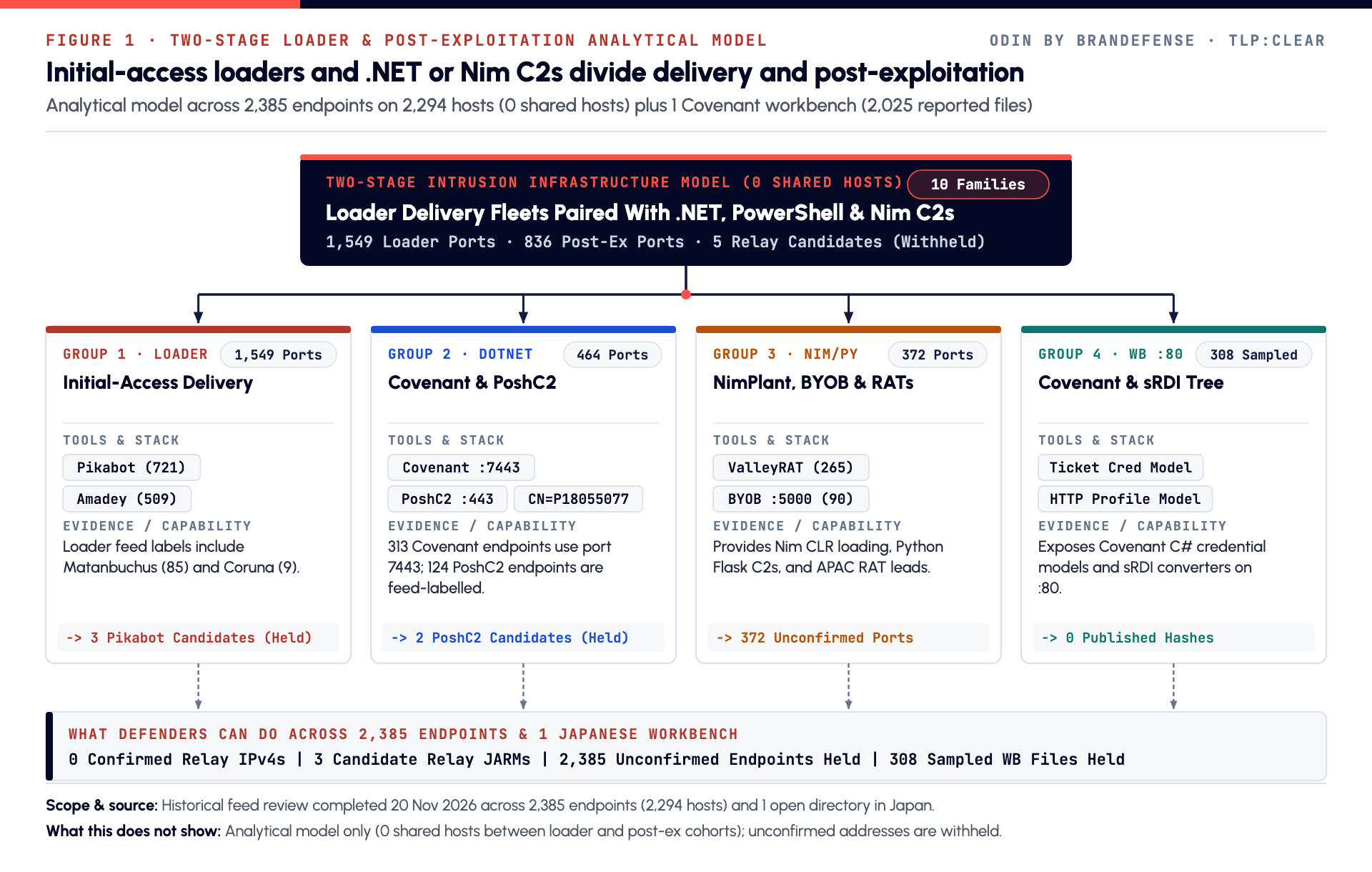
We compared all 2,294 hosts across both groups and the Japanese open directory. That check showed zero shared IPv4 addresses between the 1,495 loader hosts and the 799 post-exploitation hosts. We therefore present the handoff from initial loader delivery to post-exploitation C2 as an analytical model. It shows how intrusion infrastructure divides work, not one threat actor.
Within the 1,549 loader endpoints, Pikabot leads with 721 endpoints on 708 hosts across 44 countries. Amadey follows with 509 endpoints, with 95.3% on plain HTTP port 80. Latrodectus adds 225 endpoints (all on TCP 443 and 62.7% on Railnet LLC), and Matanbuchus adds 85. Nine more suspected endpoints on five hosts in Hong Kong, Singapore, and the United States carry the upstream Coruna feed label.
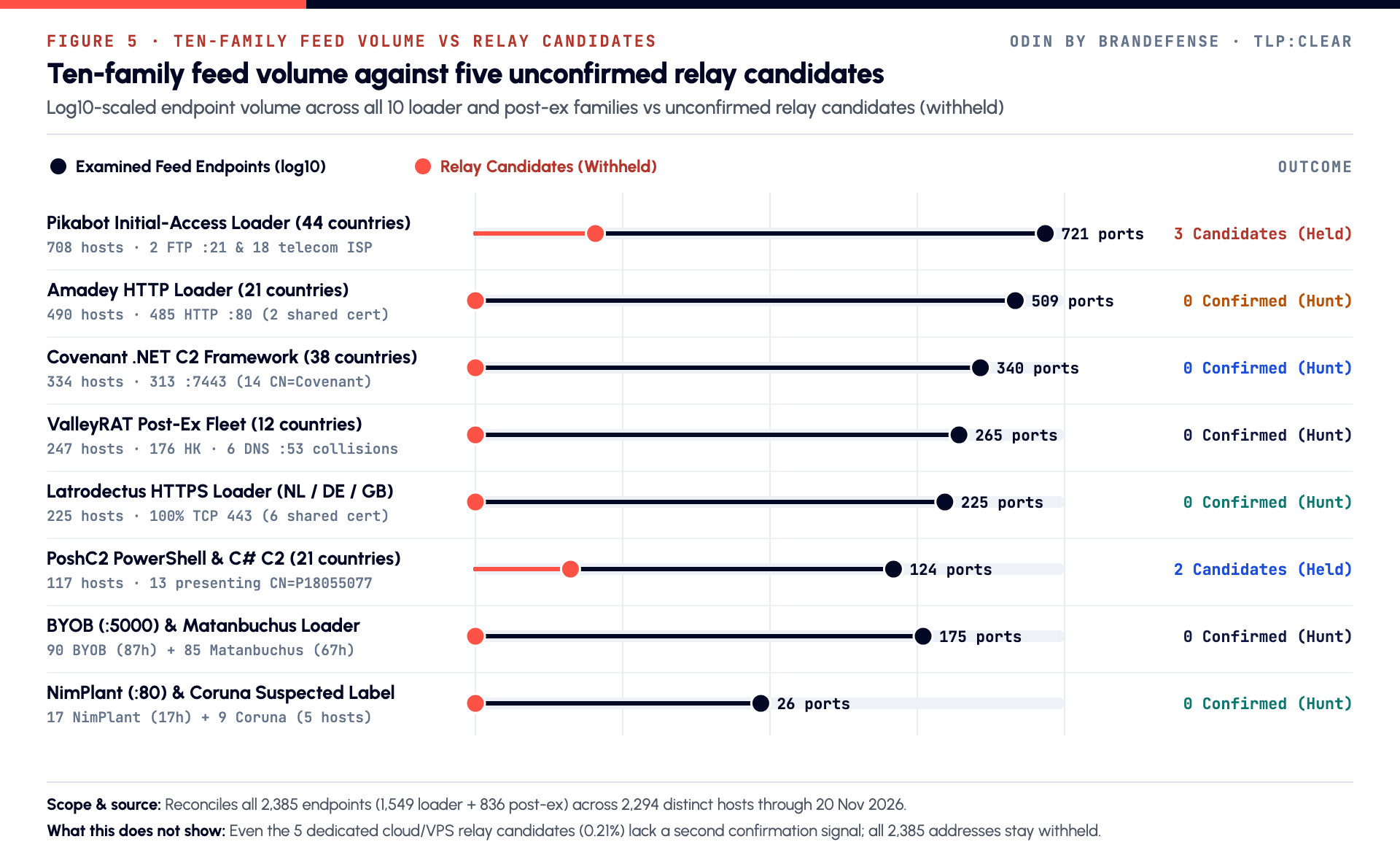
Even when an upstream feed marks a record as confirmed, external attack surface management can help defenders check exposed services. Five Pikabot entries carried a confirmed feed label, yet two sat on standard FTP port 21 at an Italian web-hosting registrar. Those two records point to abused shared FTP accounts rather than dedicated C2 servers.
More than 345 other Pikabot candidates sat on shared web-hosting providers and reverse proxies (Network Solutions, GoDaddy, Cloudflare, Unified Layer, and Namecheap). On those networks, blocking one IPv4 address takes dozens of unrelated businesses offline.
The package does not document independent confirmation for the five relay candidates. Withhold their addresses and block recommendations until each address is verified.
| Family | Relay candidate and port | Hosting | Key detail |
|---|---|---|---|
| Pikabot | Withheld IPv4 (port 80) | Amazon.com, Inc., Germany | Plain HTTP relay candidate; review, do not block |
| Pikabot | Withheld IPv4 (port 443) | Amazon.com, Inc., Germany | HTTPS relay candidate; review, do not block |
| Pikabot | Withheld IPv4 (port 443) | Microsoft Corporation, Ireland | HTTPS relay candidate; review, do not block |
| PoshC2 | Withheld IPv4 (port 8443) | Hetzner Online GmbH, Germany | Default CN=P18055077 TLS candidate; hunt certificate |
| PoshC2 | Withheld IPv4 (port 443) | Amazon.com, Inc., Australia | Default CN=P18055077 TLS candidate; hunt certificate |
What default footprints do Covenant, PoshC2, and NimPlant leave behind?
Across the 836 post-exploitation endpoints on 799 hosts, operators and testers alike often leave framework defaults untouched:
- PoshC2 (
CN=P18055077). Across 124 PoshC2 endpoints on 117 hosts (79.0% on port 443), 13 servers still presentCN=P18055077. That value is the hardcoded self-signed certificate name in Nettitude's PoshC2 server generator (O=Pajfds,OU=Jethpro), and it appears on both dedicated relay candidates in Germany and Australia. - Covenant (port 7443 and
CN=Covenant). Across 340 Covenant endpoints on 334 hosts, 313 endpoints (92.1%) listen on Covenant's default Kestrel HTTPS management port 7443. Fourteen servers still present its defaultCN=Covenantcertificate. - NimPlant (HTTP port 80) and BYOB (port 5000). NimPlant is a lightweight Nim implant that supports in-memory
.NETexecute-assemblyandshinjectloading. Its default configuration uses HTTP port 80,User-Agent: NimPlant C2 Client, and/register,/task, and/resultpaths. Eleven of its 17 observed endpoints (64.7%) listen on port 80. Meanwhile, 78 of 90 BYOB candidates (86.7%) bind Flask port 5000. ValleyRAT clusters 176 of its 265 endpoints (66.4%) in Hong Kong and produces six DNS port 53 collisions.
Covenant, PoshC2, NimPlant, and BYOB are widely used by corporate red teams. All 836 post-exploitation endpoints therefore remain unpublished and belong in TLS and proxy hunts rather than automatic block lists.
What did the open Covenant and sRDI directory in Japan reveal?
An open directory on HTTP port 80 in Japan reported 2,025 files across 25 directory records. We sampled 308 entries and retained 220 path records totaling 3.09 GB.
Static review separated 68 Covenant and shellcode tooling files (30.9%) from 152 standard build and test files (69.1%). Exposed Covenant C# model files (paths withheld) handle stolen Kerberos tickets (2,787 bytes), NTLM password hashes (2,541 bytes), and plaintext passwords (2,131 bytes).
The directory also exposes a SharpSploit credential task definition (47,957 bytes; path withheld) and an embedded 64-bit Mimikatz DLL (986,624 bytes; path withheld). A 1,279-byte HTTP profile header class (path withheld) customizes Grunt HTTP listener headers.
An adjacent reflective shellcode folder (path withheld) exposes 14 files from the open-source sRDI toolkit. They include a Python shellcode converter (29,707 bytes) and two PowerShell shellcode conversion and loader scripts (40,563 and 23,485 bytes; paths withheld). Nine Covenant reference libraries (paths withheld) add a 50,688-byte Donut assembly-to-shellcode DLL and six ConfuserEx obfuscator libraries.
The remaining 152 files (paths withheld) include 11 Microsoft .NET SDK archives, 36 standard .NET reference assemblies, and standalone 7-Zip and WinDbg archives. They also include synthetic Base64 and ROT13 payloads and protocol test images that fit an enterprise data-loss-prevention or purple-team test server. We therefore withhold the host address, all file paths, and all file hashes.
What to do now
- Withhold blocks on the five unconfirmed Pikabot and PoshC2 relay candidates until an independent protocol response, beacon, or workbench link verifies each cloud or VPS address.
- Hunt default framework certificates and headers using the Suricata rules in the full report's Detection rules tab. Look for
CN=P18055077,CN=Covenant, andNimPlant C2 Clientrequests to/register,/task, or/result. - Turn on Windows AMSI and .NET CLR assembly-load logging alongside PowerShell Script Block Logging (Event ID 4104). These logs catch
sRDI,Donut,SharpSploit, andNimPlantexecute-assemblyactivity in memory. - Harden Active Directory against Kerberos ticket theft by requiring AES-256 Kerberos encryption and rotating
krbtgton schedule. Place privileged admins inProtected Usersand enable Credential Guard. - Keep shared web hosting, FTP port 21, DNS port 53, and telecom ISP hits out of firewall feeds and check that internal red-team or DLP test servers never expose open HTTP directories on port 80.
What is…?
Short explanations of the tools and families named in this study.
Frequently asked questions
Why did zero out of 2,385 endpoints make the block list?
We compared all 2,294 hosts across both groups and the Japanese open directory. That check showed zero shared IPv4 addresses between the 1,495 loader hosts and the 799 post-exploitation hosts. We therefore present the handoff from initial loader delivery to post-exploitation C2 as an analytical model. It shows how intrusion infrastructure divides work, not one threat actor.
What default footprints do Covenant, PoshC2, and NimPlant leave behind?
Across the 836 post-exploitation endpoints on 799 hosts, operators and testers alike often leave framework defaults untouched: Covenant, PoshC2, NimPlant, and BYOB are widely used by corporate red teams. All 836 post-exploitation endpoints therefore remain unpublished and belong in TLS and proxy hunts rather than automatic block lists.
What did the open Covenant and sRDI directory in Japan reveal?
An open directory on HTTP port 80 in Japan reported 2,025 files across 25 directory records. We sampled 308 entries and retained 220 path records totaling 3.09 GB. Static review separated 68 Covenant and shellcode tooling files (30.9%) from 152 standard build and test files (69.1%). Exposed Covenant C# model files (paths withheld) handle stolen Kerberos tickets (2,787 bytes), NTLM password hashes (2,541 bytes), and plaintext passwords (2,131 bytes).