
Key takeaways
- Two open HTTP workspaces in the US and Hong Kong exposed 1,084 sampled files (from 11,947 reported) across five Python HTTP ports.
- The US server pairs unpacked Android packages and Hermes JS bundles with a 1-byte image canary and a 3,292-line callback log across 271 peers.
- Inside that callback log, 166 requests targeting the image canary sit alongside 356 opportunistic /.env and /.git bot requests hitting the listener itself.
- The Hong Kong origin-hunt listener pairs a 128.88 MB origin-discovery SQLite database and 57 scheduled logs with 114 PHP and gateway YAML templates.
- Out of 600 reviewed Interactsh endpoints (31,117 sightings across 3 tools), an upstream feed labels 194 cloud ports on 120 IPv4s as confirmed; all stay hunt-only.
Two open reconnaissance servers exposed 1,084 sampled entries across five HTTP ports. During the two-week observation window ending 21 November 2026, Odin by Brandefense also reviewed 600 Interactsh callback endpoints drawn from 31,117 sightings across ARL, Interactsh, and ScopeSentry. These records show three reconnaissance paths that could bypass edge web application firewalls: unpacked mobile apps, SSRF image canaries, and CDN origin discovery.
How do multi-port APK unpacking and one-byte SSRF canaries work together?
The full report on APK, SSRF, and CDN origin recon records no shared IPv4 addresses between the two servers and 407 Interactsh hosts. We therefore treat them as an analytical model for cyber threat intelligence teams, and withhold both open-directory host addresses and all 929 recorded file hashes.
For external attack surface management teams, four open Python HTTP listeners on the United States server reveal distinct parts of the workflow. Shared-directory listeners A and B expose the same 4,897-file directory (360 and 359 sampled entries, sharing 261 paths).
The directory holds two unpacked Android packages, including one at 130.58 MB. It also holds 168 ARM64 .so libraries, Dalvik .dex bytecode, a 245,760 B SQLite database, and 57.80 MB of decompiled Hermes JavaScript. Python scripts for API signature testing, JWT cracking, and virtual-host scanning sit beside fuzzing outputs, subdomain lists, VPN scan logs, and a GlobalProtect login template (11,705 B).
Meanwhile, the canary listener serves a single 1-byte image canary, mirrored in a subdirectory on the callback listener; its filename and listener ports are withheld. The callback listener (20 files) also stages five Python UID-sweep scripts, a 28.08 MB CSV seed table, a 15.77 MB SQLite database, and a 373,784 B callback log. Many avatar uploaders and webhook previewers reject URLs without an image suffix. Serving a 1-byte image canary passes naive filename suffix checks with minimal socket overhead.
What was inside the 3,292-line HTTP callback log?
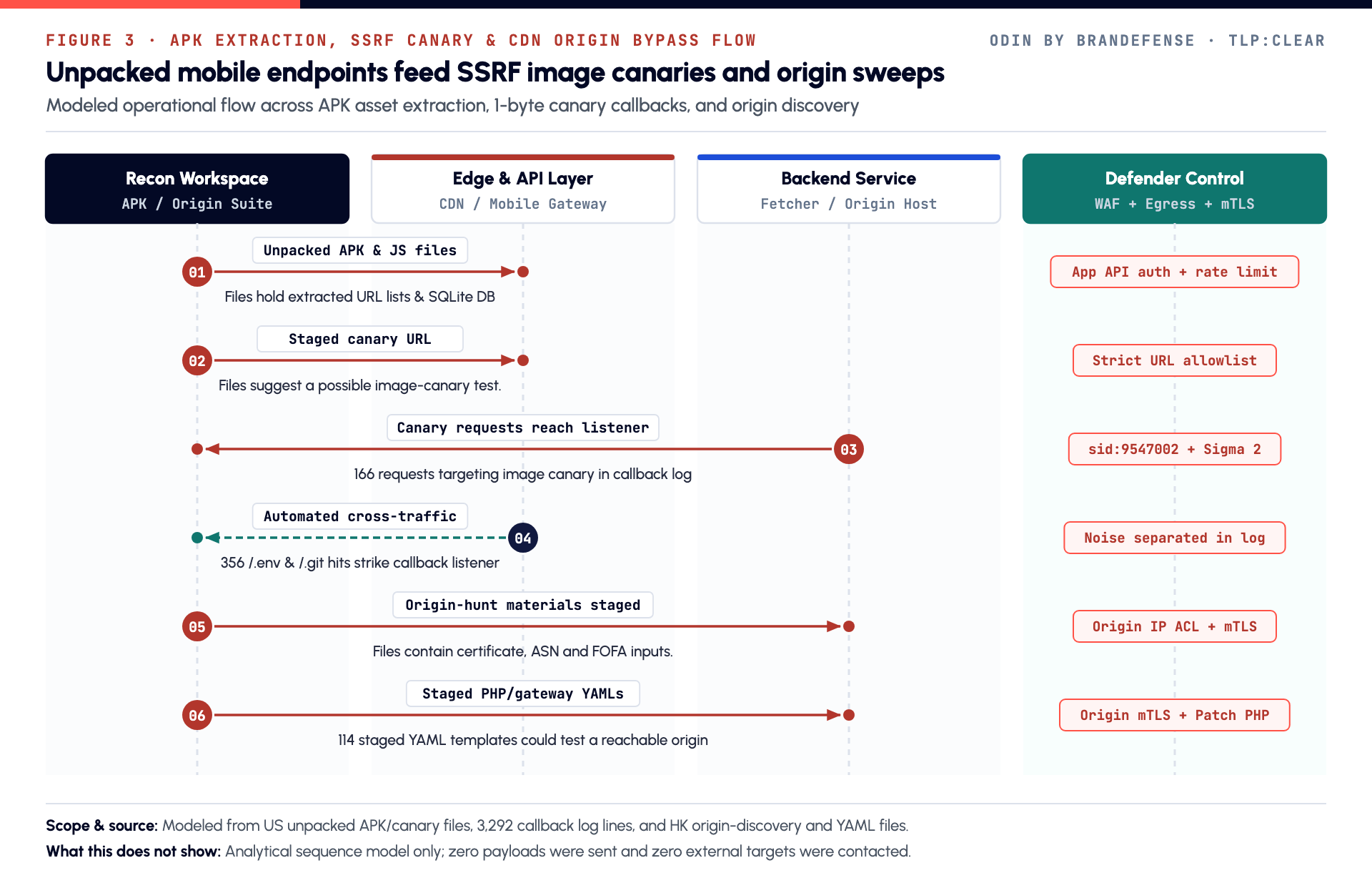
The 373,784 B callback log on the callback listener holds entries carrying log dates from 11 to 18 November 2026, peaking at 608 HTTP requests on 17 November. Breaking down all 3,292 lines isolates 1,877 valid HTTP requests across 271 external client addresses. The remaining lines hold 91 non-HTTP TLS ClientHello handshakes and 1,324 companion Python HTTP 400 and 404 status lines.
Across those 1,877 HTTP requests, 166 requests (8.8%) targeted the image canary on the external listener; the log does not establish who initiated them or whether image fetches succeeded. Another 632 hit / (33.7%), 666 hit other paths (35.5%), and 57 requested /favicon.ico (3.0%).
In addition, 356 requests (19.0%) probed /.env, /.git/config, and configuration paths, coming from automated internet bots scanning the operator's own open listener. Treating every IP in a captured callback log as a breached victim would misclassify commodity scanners alongside third-party servers, so all 271 peer addresses remain withheld.
How does the Hong Kong workspace hunt CDN origin servers?
The Hong Kong origin-hunt listener reports 2,132 files (344 sampled entries). The active folder contains a Python matcher (24,112 B) and a populated 128.88 MB SQLite database. A companion folder holds a clean 65.5 KB baseline database.
Fifty-seven scheduled run logs carry filename dates from 6 to 20 November 2026 alongside a GeoIP country database and two Alibaba Cloud ASN prefix files. The workspace also holds a temporary port-scan file, FOFA export tables, archived subdomain and DNS scanners, and TLS certificate CSVs.
If a mapped origin accepts direct requests, those requests bypass the CDN’s edge WAF. Beside the origin-discovery folder, the workspace stages 114 PHP and gateway YAML templates and captured appliance management pages. It also holds a compiled exploit binary (9.90 MB, filename withheld) targeting unpatched PHP-FPM servers (CVE-2019-11043 in PHP < 7.1.33, < 7.2.24, and < 7.3.11).
Which Interactsh OAST servers should defenders block versus hunt?
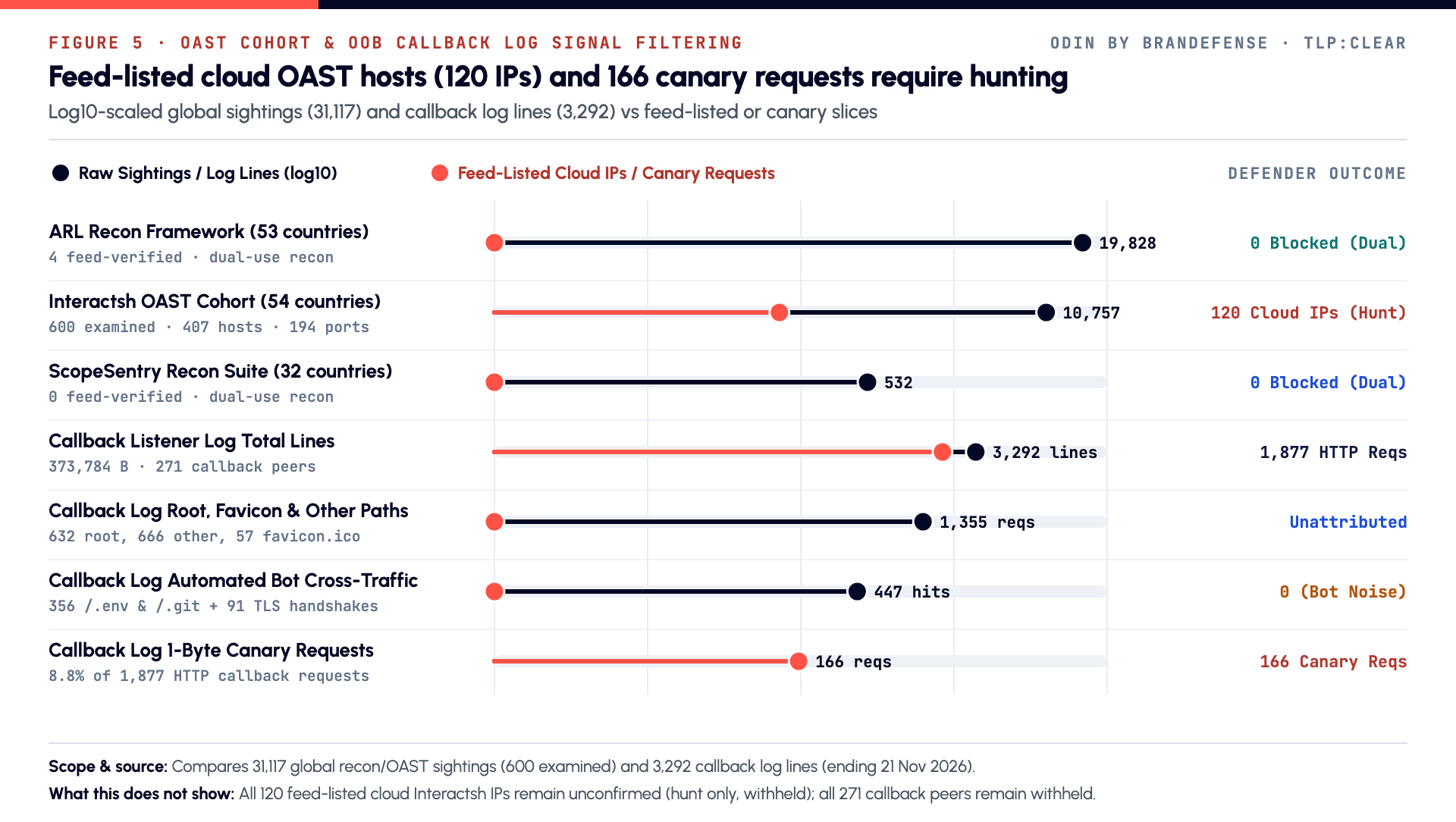
Across 31,117 sightings spanning ARL (19,828), Interactsh (10,757), and ScopeSentry (532), we examined 600 recent Interactsh endpoints across 407 hosts. The upstream feed marks 194 listener ports on 120 cloud IPv4 addresses as confirmed. The hosts span AWS (44), DigitalOcean (34), Hetzner (15), Contabo (15), OVH (6), Azure (5), and Leaseweb (1). Independent per-address confirmation is absent, so all 120 addresses remain unconfirmed and withheld.
Absent from typical web-only checks, 186 of those 194 feed-listed ports (95.9%) listen on SMTP submission (:587, 108) and SMTPS (:465, 78). Those ports run across 115 cloud hosts to catch mail-header and JavaMail SSRF callbacks.
The other eight ports span five AWS hosts: three HTTP/HTTPS pairs, one HTTP listener, and one port 26 listener. Meanwhile, 406 other endpoints (9 on Akamai, 97 uncorroborated multi-tenant SMTP rows, and 300 AWS custom-domain TLS candidates where one Go JARM spans 144 endpoints) also stay off blocklists.
What to do now
- Hunt outbound OAST callbacks and restrict application SMTP egress. Hunt outbound TCP 26, 80, 443, 465, and 587 connections for
Interactshdomains before blocking any feed-listed cloud host, and block direct outbound :465/:587 from non-mail application subnets. - Harden backend URL fetchers and enforce
IMDSv2. Restrict media, avatar, and webhook workers to strict egress allowlists, block private and link-local IPs regardless of image extensions, and enforceAWS IMDSv2(HttpTokens=required, hop limit 1). - Close direct-to-origin CDN bypasses. Lock origin firewall ingress to published CDN IP ranges, require mutual TLS (
Authenticated Origin Pulls), and patch legacyPHP-FPMservers pastCVE-2019-11043. - Protect mobile APIs and VPN portals. Strip staging hosts and static signing secrets from Android
.apkandHermesbundles, enforce per-account UID rate limits, and require phishing-resistant MFA onGlobalProtectgateways. - Deploy the published Suricata, KQL, Sigma, and YARA rules. Load the four Suricata signatures (
SIDs 9547002, 9547006, 9547007, and 9547008), the Sentinel KQL union hunt, Sigma Rules 1 to 3, and the bounded open-directory YARA rule from the full report's Detection rules tab.
What is…?
Short explanations of the tools and families named in this study.
What is Interactsh?
Interactsh is ProjectDiscovery's open-source OAST server and client for catching DNS, HTTP and other callbacks.
More about InteractshTechniqueWhat is OAST?
Out-of-band application security testing (OAST) detects blind vulnerabilities by making a target call back to a server the tester controls, usually over DNS or HTTP.
More about OASTTechniqueWhat is JARM?
JARM is an open TLS server fingerprinting method from Salesforce. It hashes how a server answers a set of crafted TLS handshakes.
More about JARMReconnaissance platformWhat is ARL?
ARL (Asset Reconnaissance Lighthouse) is an open-source asset discovery platform, popular with Chinese-speaking testers and attackers.
More about ARLReconnaissance platformWhat is ScopeSentry?
ScopeSentry is an open-source asset discovery and scanning platform that maps subdomains, ports and web services.
More about ScopeSentryFrequently asked questions
How do multi-port APK unpacking and one-byte SSRF canaries work together?
The full report on APK, SSRF, and CDN origin recon records no shared IPv4 addresses between the two servers and 407 Interactsh hosts. We therefore treat them as an analytical model for cyber threat intelligence teams, and withhold both open-directory host addresses and all 929 recorded file hashes.
What was inside the 3,292-line HTTP callback log?
The 373,784 B callback log on the callback listener holds entries carrying log dates from 11 to 18 November 2026, peaking at 608 HTTP requests on 17 November. Breaking down all 3,292 lines isolates 1,877 valid HTTP requests across 271 external client addresses. The remaining lines hold 91 non-HTTP TLS ClientHello handshakes and 1,324 companion Python HTTP 400 and 404 status lines.
How does the Hong Kong workspace hunt CDN origin servers?
The Hong Kong origin-hunt listener reports 2,132 files (344 sampled entries). The active folder contains a Python matcher (24,112 B) and a populated 128.88 MB SQLite database. A companion folder holds a clean 65.5 KB baseline database.
Which Interactsh OAST servers should defenders block versus hunt?
Across 31,117 sightings spanning ARL (19,828), Interactsh (10,757), and ScopeSentry (532), we examined 600 recent Interactsh endpoints across 407 hosts. The upstream feed marks 194 listener ports on 120 cloud IPv4 addresses as confirmed. The hosts span AWS (44), DigitalOcean (34), Hetzner (15), Contabo (15), OVH (6), Azure (5), and Leaseweb (1). Independent per-address confirmation is absent, so all 120 addresses remain unconfirmed and withheld.