
Key takeaways
- Five independent open directories stage 193 secret records within 4,656 two-week findings, mapping a five-stage harvesting model.
- One US directory concentrates 106 GitHub tokens and 34 Stripe API keys in two plain-text files.
- A Singapore directory pairs AWS CLI v2 with shell scripts holding 19 AWS access keys and 2 secret keys for STS checks.
- Because harvesters hold victim keys and can include bug-bounty or honeypot setups, all host addresses and file hashes are withheld.
- Block /.git/config web paths, strip cloud keys from frontend builds, move to short-lived OIDC roles, and alert on GetCallerIdentity bursts.
Five open web directories held 193 secret records across 15 files, plus 199 HTTP callback logs. Odin by Brandefense observed 4,656 unique secret findings during the two weeks ending 20 November 2026. The latest arrival set contained 1,001 records across 35 types.
Nothing links the five servers to one operator, so we treat them as an analytical five-stage model. Together they show how leaked credentials move from exposed .git folders and browser JavaScript bundles into sorted token dumps, AWS IAM liveness checks, and Telegram alert channels. Leaked tokens like these are what dark web monitoring is built to catch.
What did we find on the five open directories?
Automated scripts scan websites and code repositories around the clock for leaked API tokens that defenders can track with cyber threat intelligence. When an operator or researcher leaves their own working folder open over HTTP, external attack surface management can help defenders find the exposed scripts and output files. We reviewed file metadata and sanitized detector counts only, tested zero credentials, and withheld all five server addresses, ports, credential-file paths, and file hashes.
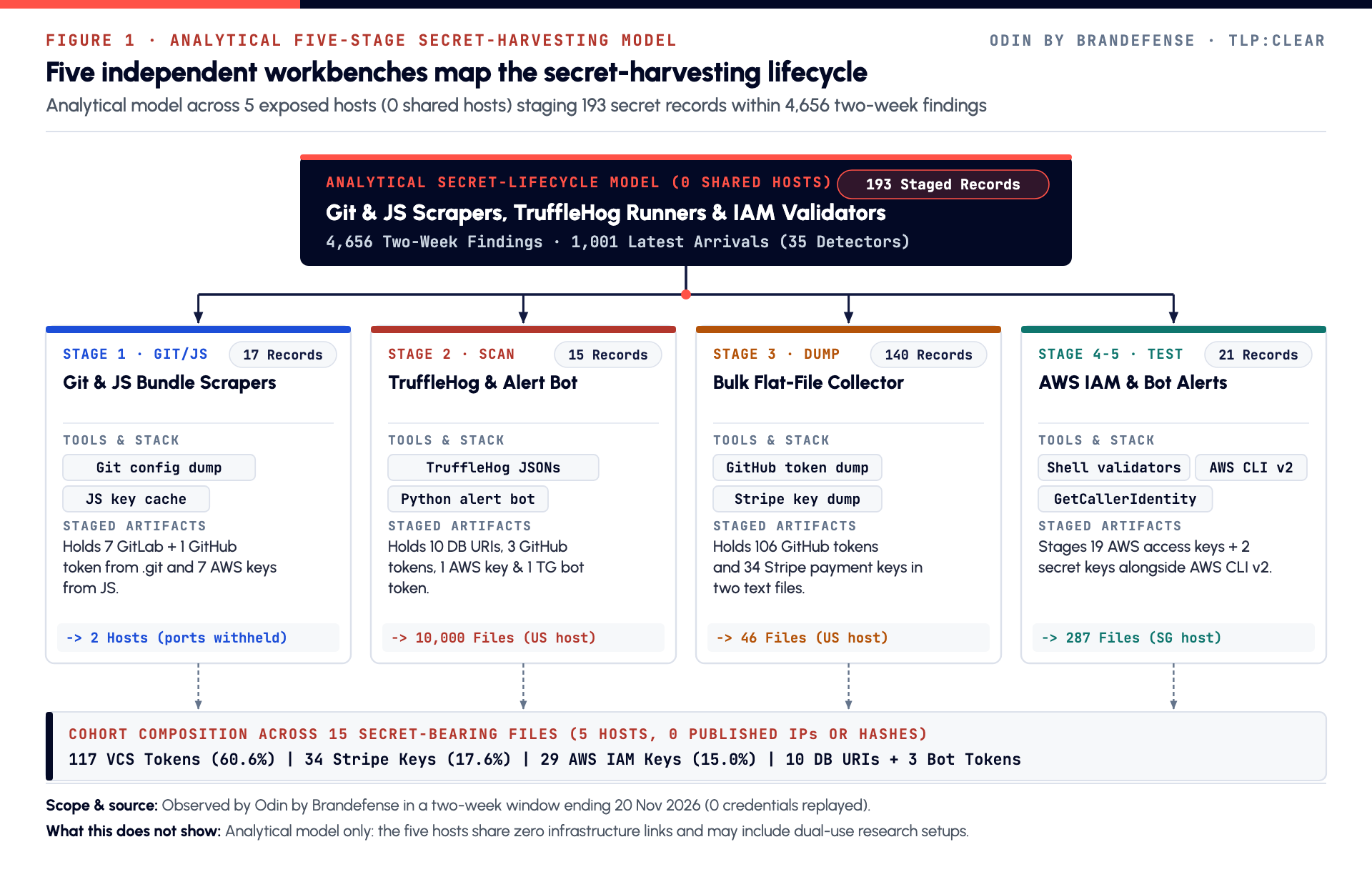
Each of the five servers covers one or more stages of the credential-harvesting workflow:
- Exposed Git collector. A text dump held 7 GitLab tokens and 1 GitHub token found in public Git metadata.
- JavaScript bundle key scraper. A cached key file held 7 AWS access keys next to a Telegram bot config and a second Telegram bot token (9 records total).
- TruffleHog, alerting bot and callback server (US). Reports 10,000 files (293 sampled) and holds 15 secret records across TruffleHog scan JSONs, a 78,125-byte Python alerting bot with two backups, and a key-check script. It also holds 199 HTTP callback logs from 119 source addresses with June and July 2026 filename prefixes.
- Bulk GitHub and Stripe aggregator (US). Exposes 46 files, led by two text dumps with 106 GitHub tokens and 34 Stripe keys beside a Python receiver and 17 archives.
- AWS IAM credential validator (Singapore). Reports 287 files (150 sampled) and holds 21 AWS key records across two shell scripts alongside unpacked AWS CLI v2 binaries. One script holds 17 access keys, and the second holds 2 access keys and 2 secret keys.
How do raw web leaks become tested cloud access?
Raw secret leaks across the internet look different from what harvesters keep. In the latest set, database connection strings rank first at 255 records (25.5%). GitHub tokens account for 143, AWS access keys 106, wallet seed phrases 92, and Telegram bot tokens 79.
Inside the five workbenches, database connection strings drop to 10 of 193 records (5.2%). Many leaked .env URLs point to localhost or private networks, which are unreachable from outside.
Instead, three credential types for internet-facing services make up 180 of the 193 workbench records (93.3%):
- Source-control tokens (117 records, 60.6%). Includes 108 GitHub tokens, 7 GitLab tokens, and 2 GitHub personal access tokens. Active tokens let an attacker clone private repositories or inspect CI pipelines.
- Stripe payment API keys (34 records, 17.6%). All 34 sit in one plain-text file on the US aggregator host, representing 85.0% of the 40 Stripe keys in the latest arrival set.
- AWS IAM keys (29 records, 15.0%). Includes 27 AWS access keys and 2 secret keys across three hosts.
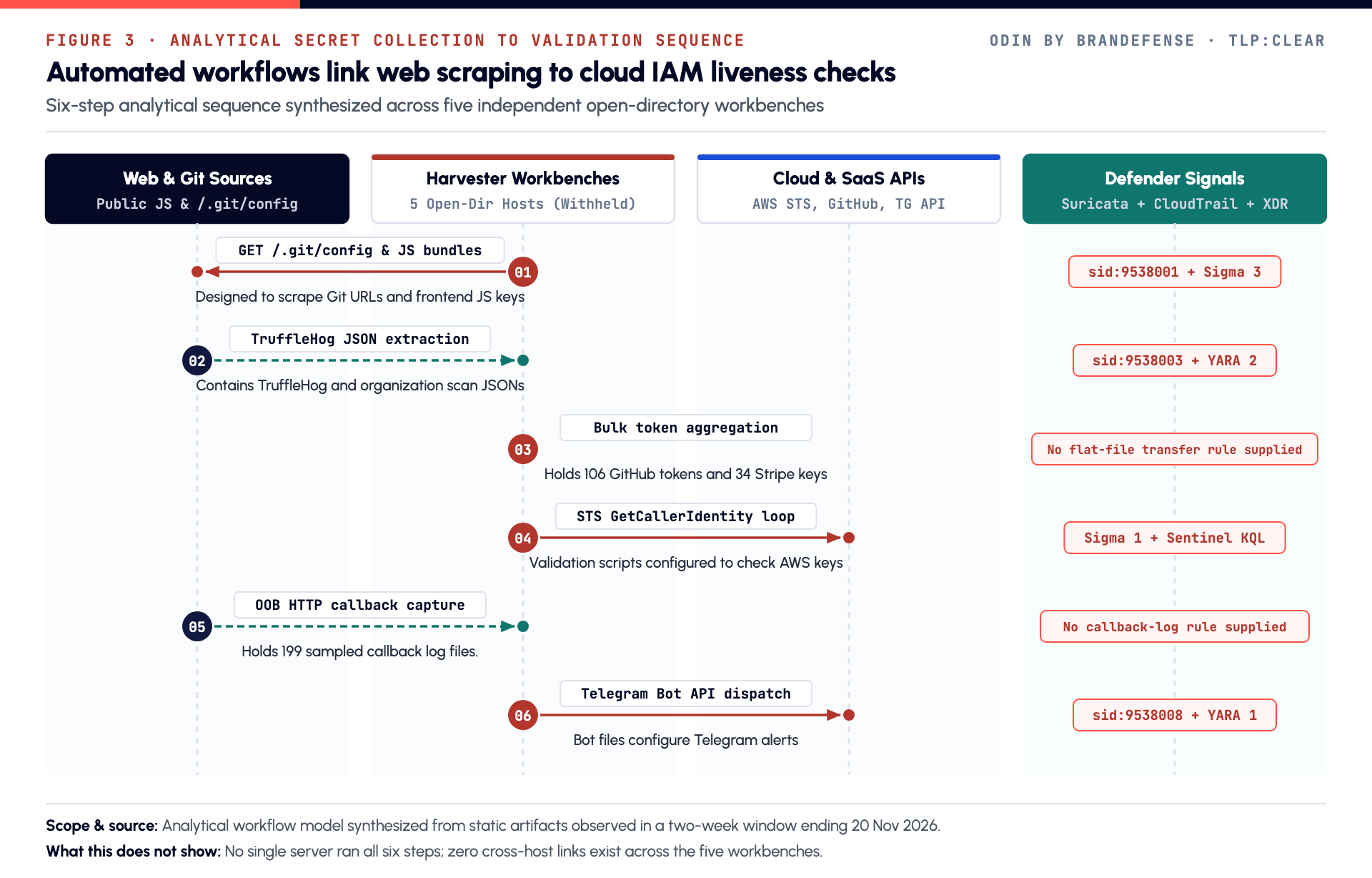
To check which AWS keys still work, the staged shell and Python validation scripts call GetCallerIdentity on sts.amazonaws[.]com. That API call works for any active key regardless of IAM permissions, returning the AWS Account ID and user or role ARN. For defenders, every check also writes a CloudTrail log entry inside the victim's AWS account.
Network and endpoint signals show up at the other stages as well. Inbound GET /.git/config requests reveal automated repository harvesters probing web servers. Outbound TLS connections from production servers to api.telegram[.]org flag secret-alerting bot scripts where chat clients have no business running. Correlating process command lines with cloud and messaging API connections lets SOC teams catch an unapproved harvester or validator host before stolen keys are used further.
Could some of these servers belong to security researchers?
Yes. Bug-bounty hunters, contracted red teams, and honeypot researchers use the same TruffleHog scanners, JavaScript scrapers, and AWS CLI check scripts. On the Singapore validator server, the AWS key-check scripts sit beside three ffuf web-fuzzing JSON files and 47 vulnerability report PDFs. On the US aggregator server, the GitHub and Stripe token files sit beside honeypot deployment archives and collection scripts.
Because owner authorization is not established and the files contain victim keys, publishing server IPs, ports, credential-file paths, or file hashes would put third parties at risk. Even when a server belongs to a researcher, leaving harvested third-party keys on an unauthenticated HTTP directory exposes every victim key to anyone else scanning the web.
What to do now
- Block
/.git/and.envweb paths, and audit frontend builds. Deny/.git/configrequests at your WAF or reverse proxy, deploy from clean build stages, and verify that frontend.jsbundles exclude cloud or bot keys.
- Move off long-lived GitHub, AWS and Stripe keys. Turn on GitHub and GitLab push protection, use short-lived OIDC roles instead of static AWS
AKIAkeys, and replace broad Stripe keys with IP-restricted keys.
- Alert on
GetCallerIdentitybursts and unexpected Telegram egress. Watch CloudTrail forsts.amazonaws[.]comGetCallerIdentitycalls from CLI or Python SDK user agents on unfamiliar networks, and flag server connections toapi.telegram[.]org.
- Check your own cloud hosts for open HTTP directories. Scan internal lab and cloud VPS subnets for
Index of /responses so test folders never leak scan outputs or keys.
The full report's Indicators tab holds no host addresses or file hashes. The full report lists behavioral URI and cloud API hunt indicators. The full report's Detection rules tab provides Suricata, Sentinel KQL, Sigma and YARA rules.
Frequently asked questions
What did we find on the five open directories?
Automated scripts scan websites and code repositories around the clock for leaked API tokens that defenders can track with cyber threat intelligence. When an operator or researcher leaves their own working folder open over HTTP, external attack surface management can help defenders find the exposed scripts and output files. We reviewed file metadata and sanitized detector counts only, tested zero credentials, and withheld all five server addresses, ports, credential-file paths, and file hashes.
How do raw web leaks become tested cloud access?
Raw secret leaks across the internet look different from what harvesters keep. In the latest set, database connection strings rank first at 255 records (25.5%). GitHub tokens account for 143, AWS access keys 106, wallet seed phrases 92, and Telegram bot tokens 79.
Could some of these servers belong to security researchers?
Yes. Bug-bounty hunters, contracted red teams, and honeypot researchers use the same TruffleHog scanners, JavaScript scrapers, and AWS CLI check scripts. On the Singapore validator server, the AWS key-check scripts sit beside three ffuf web-fuzzing JSON files and 47 vulnerability report PDFs. On the US aggregator server, the GitHub and Stripe token files sit beside honeypot deployment archives and collection scripts.