

1. Executive Summary
In short
In a two-week observation window ending 20 November 2026, Odin by Brandefense observed five open web directories holding 193 secret records within 4,656 secret findings and 1,001 arrivals. No network links connect the five servers, so we group them as an analytical five-stage model. Together they show exposed Git and JavaScript scrapers, TruffleHog repository scans, plain-text GitHub and Stripe dumps, AWS IAM check scripts, and Telegram alert bots. Block web access to .git folders, keep cloud keys out of frontend bundles, and alert on burst AWS identity checks.
Cloud intrusions often start with leaked keys rather than software exploits, a risk teams can monitor through cyber threat intelligence. Automated tools scan websites for exposed .git folders and client-side JavaScript files, extract tokens, sort them by provider, and test which ones still work.
When operators or security researchers leave their own working directories open over HTTP, external attack surface management can help defenders find those exposed files. We reviewed the files statically, tested zero credentials, and withheld all five host addresses, ports, credential-file paths, and file hashes.
Five separate open directories show each step of automated secret collection and cloud key testing.
Nothing links the five hosts to one operator, so we present their combined workflow as an analytical model. Separate directories hold scraped .git/config files, cached JavaScript keys, TruffleHog scan outputs, plain-text GitHub and Stripe lists, shell scripts that check AWS IAM keys, and Telegram bot configs.
One United States server concentrates 140 GitHub and Stripe tokens in two plain-text files.
An open aggregator directory holds 106 GitHub tokens in one flat file and 34 Stripe API keys in a second text dump. Across all five hosts, version-control tokens make up 117 of the 193 secret records (60.6%), followed by 34 Stripe keys (17.6%) and 29 AWS IAM keys (15.0%).
Cloud key test scripts and callback folders leave clear defensive signals.
A Singapore directory pairs AWS CLI version 2 files with shell scripts holding 19 AWS access keys and 2 secret keys. A United States directory holds TruffleHog outputs, a Python alerting bot, key-check scripts, and 199 HTTP callback logs from 119 source addresses.
Three Decisions for Leaders
- Keep secrets out of web roots and browser code. Block HTTP requests to
/.git/and.envpaths at the reverse proxy, verify that frontend builds never embed AWS or bot keys, and turn on repository push protection. - Replace long-lived cloud and payment keys with scoped tokens. Move CI/CD jobs from static AWS
AKIAkeys to short-lived OpenID Connect (OIDC) roles, use fine-grained GitHub tokens, and replace broad Stripe secret keys with restricted keys. - Watch cloud identity checks and server egress. Alert in AWS CloudTrail when
GetCallerIdentitycalls spike from unfamiliar networks, flag server connections toapi.telegram[.]org, and check your own cloud subnets for open directory listings.
The Study in Numbers
| Number | What it is |
|---|---|
| 4,656 | Unique secret findings observed in the two-week window ending 20 November 2026 |
| 1,001 | Secret records in the latest arrival set across 35 secret types |
| 5 | Open-directory harvester and key-testing servers reviewed (0 shared hosts; all addresses and ports withheld) |
| 193 | Secret records across 15 files on the five servers (4.15% of the two-week total) |
| 140 | Tokens in two plain-text files on one US aggregator host (106 GitHub tokens and 34 Stripe keys) |
| 29 | AWS IAM key records across three hosts (27 access keys and 2 secret keys) |
| 199 | Sampled HTTP callback log files from 119 source addresses on the US TruffleHog and callback host |
How to use this report.
Security leaders can start with Chapters 1, 5 and 6. Cloud IAM, AppSec and web platform teams should read Chapters 3, 4 and 6. SOC analysts and detection engineers should go to Chapters 7 and 8, along with the Detection rules tab. CTI analysts will find the workspace breakdown and alternative explanations in Chapters 2 through 5.
2. Five Workbenches and the Five-Stage Model
In short
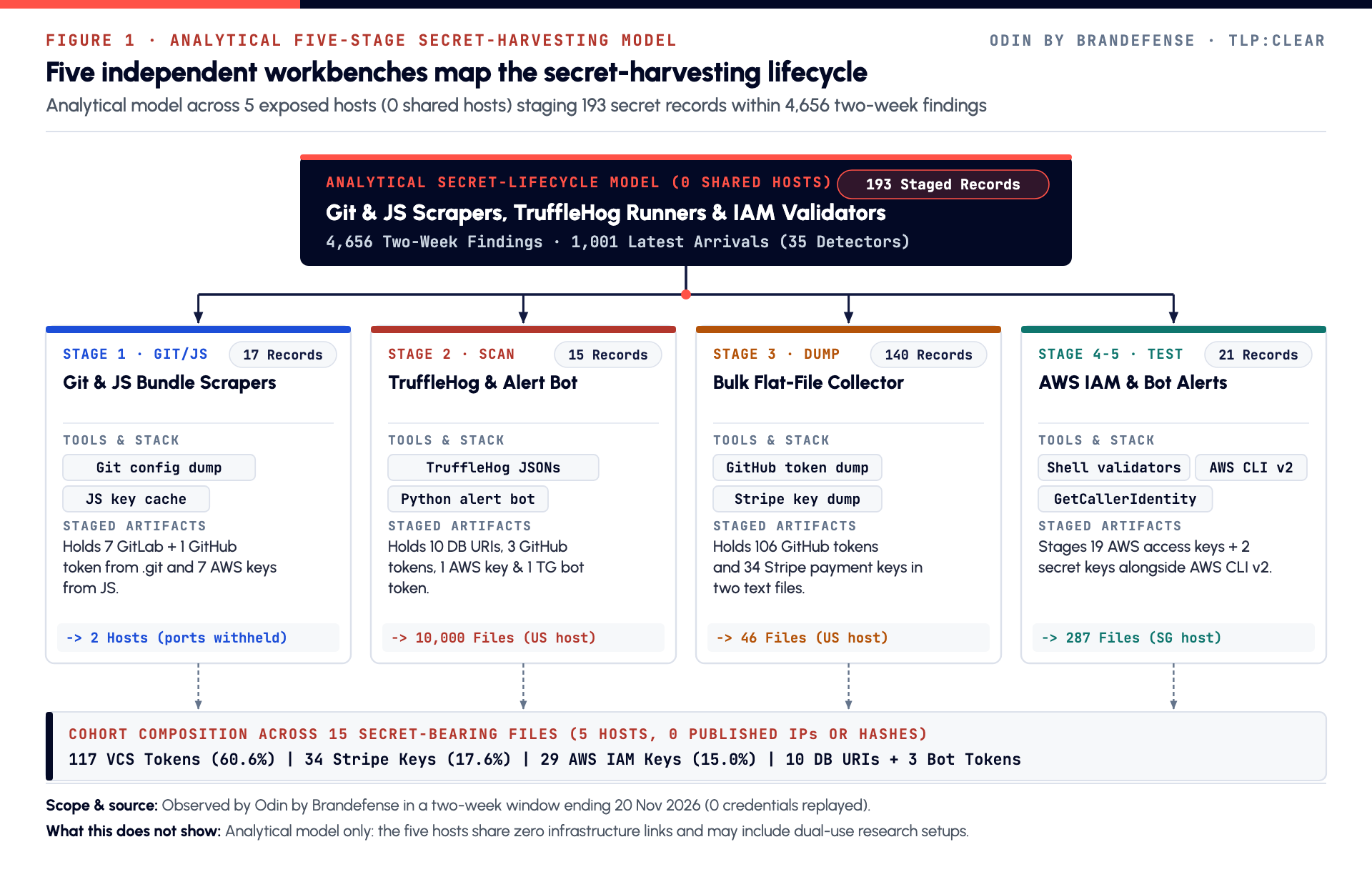
Five open web directories held 193 secret records across 15 files within 4,656 two-week findings. Because the five hosts share no infrastructure links, we treat their tools as a five-stage analytical model for defenders rather than one actor group. Review each workbench separately before blocking.
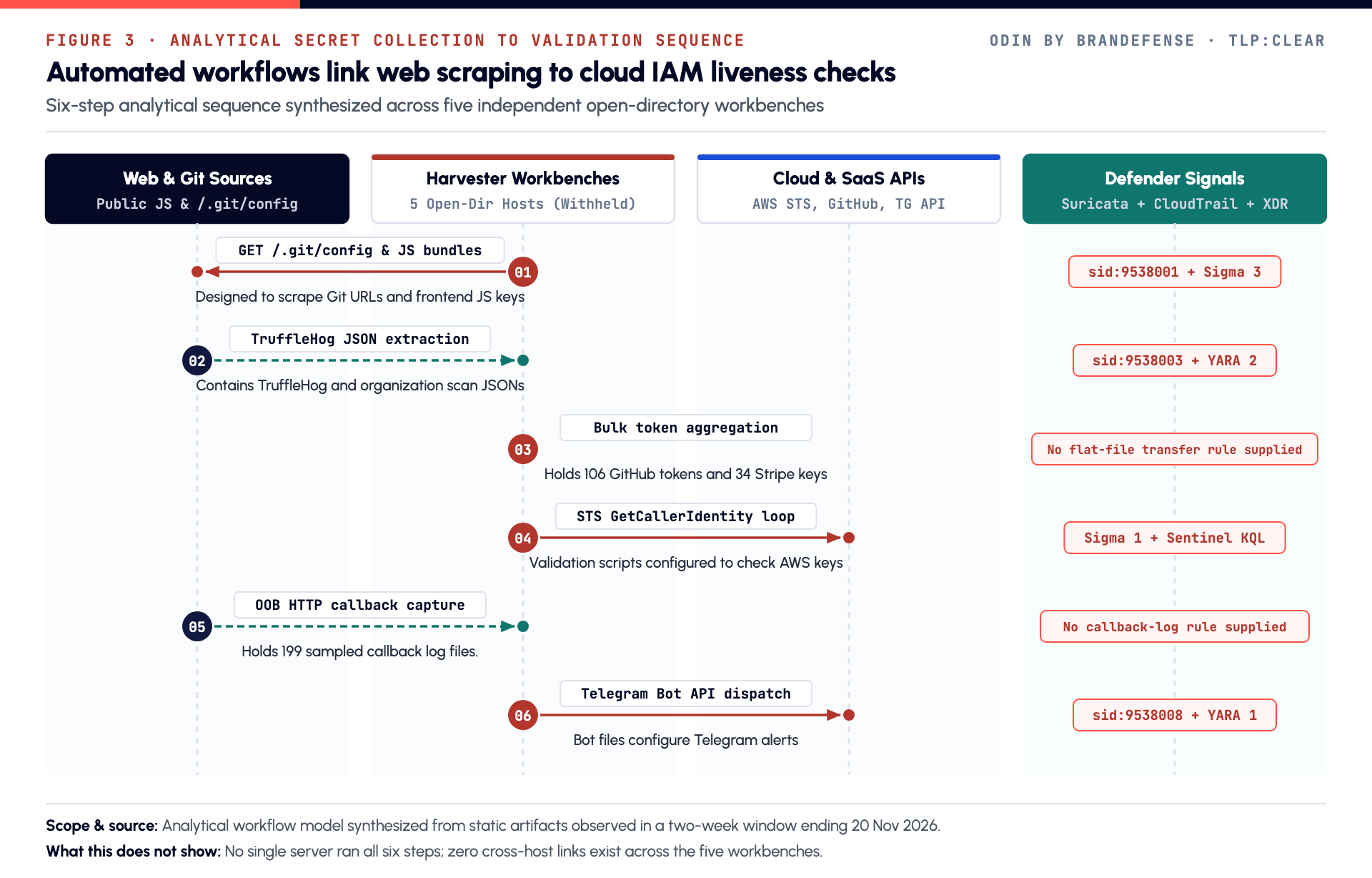
Public repositories are only one place where credentials leak, which is why dark web monitoring looks well beyond code hosts. Deployed websites also expose .git/config files when teams pull code straight into a web root, and single-page web apps often bake API keys into compiled JavaScript bundles. Once a script collects those strings, a second set of tools filters out dead keys by calling cloud and SaaS identity endpoints.
When someone leaves an unauthenticated HTTP file listing open over a working folder, the directory layout shows how the workflow is organized. We read file metadata and sanitized secret counts only. We did not run any of the scripts, test any of the keys, or contact any system named in them.
The wider two-week secret baseline
In the two-week observation window ending 20 November 2026, Odin by Brandefense observed 4,656 unique secret findings. Within that set, the latest arrival slice holds 1,001 records across 35 secret types. Five types make up 675 of the 1,001 latest arrivals (67.4%). They are database connection strings (255), GitHub tokens (143), AWS access keys (106), BIP-39 wallet seed phrases (92), and Telegram bot tokens (79).
Enterprise cloud, source-control and payment credentials fill out the next tier of arrivals. Private keys account for 69 records, Stripe API keys for 40, Google Cloud service accounts for 39, Binance keys for 21, and Square tokens for 19. Twenty-five other secret types account for the remaining 138 records, including 16 Google OAuth secrets, 15 AWS secret keys, 15 GitHub personal access tokens, and 11 GitLab tokens.
| Secret type | Latest arrivals (1,001) | Share | Typical source |
|---|---|---|---|
db_connection | 255 | 25.47% | Exposed .env files, container configs and TruffleHog JSON scans |
github_token | 143 | 14.29% | Plain-text token dumps, .git/config files and bot scripts |
aws_access_key | 106 | 10.59% | Shell IAM check scripts, JavaScript bundle caches and cloud configs |
bip39_mnemonic | 92 | 9.19% | Wallet backup files and stealer logs |
telegram_bot_token | 79 | 7.89% | Alerting bot configs, .env files and web controllers |
private_key | 69 | 6.89% | Exposed TLS, SSH and service PEM private keys |
stripe_key | 40 | 4.00% | Payment key flat files and backend .env configs |
gcp_service_account | 39 | 3.90% | Google Cloud service-account JSON key files |
binance_key | 21 | 2.10% | Exchange bot configs and .env files |
square_token | 19 | 1.90% | Merchant checkout configs and backend scripts |
| Remaining 25 types | 138 | 13.79% | Includes 16 GCP OAuth secrets, 15 AWS secret keys, 15 GitHub PATs and 11 GitLab tokens |
Why we model five stages instead of one actor
Five open-directory servers in our dataset focus specifically on harvesting, sorting or testing third-party credentials. Together they hold 193 secret records across 15 secret-bearing files (4.15% of the 4,656 two-week total). Exactly 192 of the 193 records sit inside the 1,001-record arrival slice, plus one Telegram bot token in a bot environment file on the US TruffleHog workbench.
Nothing ties these five servers to each other. They share 0 IP addresses, 0 TLS certificates, 0 SSH keys and 0 bot tokens. Grouping them as an analytical five-stage model maps each defensive control point, from .git and JavaScript scraping through TruffleHog scanning, flat-file aggregation, AWS IAM testing, and bot alerting.
| Workbench role | Country | Exposed / sampled files | Secret records (193) | Main artifacts on the server |
|---|---|---|---|---|
| Exposed Git collector | Unattributed | Secret index only | 8 | Consolidated Git config text dump (7 GitLab, 1 GitHub) |
| JavaScript key scraper | Unattributed | Secret index only | 9 | Cached JS key dump (7 AWS), Telegram bot configs (2) |
| TruffleHog and alerting host | US | 10,000 / 293 (220 rows) | 15 | TruffleHog scan JSONs, Python alerting bot, 199 callback logs |
| Bulk GitHub and Stripe dump | US | 46 / 46 | 140 | GitHub token dump (106), Stripe key dump (34), 17 archives |
| AWS IAM validator | SG | 287 / 150 | 21 | Two AWS IAM check scripts (17 and 4 records), AWS CLI v2 |
3. Git and JavaScript Scrapers, TruffleHog Scans, and Callback Logs
In short
Three open directories show how harvesters pull credentials out of web roots, frontend JavaScript bundles and Git repositories while logging HTTP callbacks and Telegram alerts. Block web requests for /.git/config and strip cloud keys out of client builds.
Upstream collection targets mistakes made during web deployment and source-code management. One mistake is deploying an application with git clone inside the public web root, which leaves /.git/config readable over HTTP. Another is passing cloud keys into frontend build variables that compile straight into public .js files (T1552.001).
The US TruffleHog, alerting bot and callback workbench
In the United States, an open directory reports 10,000 exposed files, with 293 sampled entries (220 detailed rows in our review). Fifteen secret records sit across seven files on this host. They comprise 10 database connection strings, 2 GitHub personal access tokens, 1 GitHub token, 1 AWS access key, and 1 Telegram bot token.
In its scan directory, the host keeps a filtered TruffleHog JSON summary file (2 database connection strings) next to two full organization scan files. All target organization names and file paths are withheld. The first organization scan JSON is 55,916 bytes and holds 6 database connection strings; the second is 3,807 bytes and holds 1 database connection string. One more database connection string sits in a 584-byte application template file (name and path withheld).
A companion bot folder holds seven files that make up a custom Python alerting and key-testing setup:
- Alerting bot script and two versioned backups. The main Python script is 78,125 bytes and holds 1 GitHub token. Beside it sit two numbered backup copies (72,010 bytes and 78,125 bytes).
- Configuration and environment files. A TOML configuration file (37,656 bytes) defines the bot's rules and targets, while an environment file (415 bytes) holds 2 GitHub personal access tokens and 1 Telegram bot token.
- Key and token verifiers. Two modular Python verifier scripts (3,435 bytes, holding 1 AWS access key, and 2,934 bytes) separate key checks from the main bot loop.
The same workbench holds TLS material, three cloud blob scripts, a small configuration file, and callback logs. The sampled callback folder contains 199 files associated with 119 source addresses; 118 are external and withheld. Of those files, 173 have recorded sizes, while 26 directory entries have no size.
The callback log filenames use date prefixes in June and July 2026 (20260616, 20260622, 20260718 to 20260721, and 20260724). Those dates are timestamps inside filenames stored on the server, not Odin's observation period.
| Artifact on the US TruffleHog workbench | Size (bytes) | Secret records | Purpose in the workspace |
|---|---|---|---|
| Organization TruffleHog scan A JSON | 55,916 | 6 db_connection | Full TruffleHog scan output for an anonymized target organization |
| TruffleHog summary JSON | Unsized | 2 db_connection | Filtered TruffleHog JSON summary output |
| Organization TruffleHog scan B JSON | 3,807 | 1 db_connection | Secondary organization TruffleHog JSON scan output |
| Application template file (name withheld) | 584 | 1 db_connection | Template file holding one database connection string |
| Custom Python alerting bot (+ two backups) | 78,125 (72,010 / 78,125) | 1 github_token | Custom secret-alerting bot across versioned backups |
| Bot TOML configuration file | 37,656 | 0 | Configuration file for the alerting bot |
| Bot environment file | 415 | 2 github_pat, 1 telegram_bot_token | Bot environment credentials |
| Python key and token verifier scripts | 3,435 / 2,934 | 1 aws_access_key | Modular cloud-key and token verification scripts |
Callback TLS certificate and key, blob scripts, C2 .env | 1,123 / 1,704; 2,953 to 4,476; 25 | 0 | Co-hosted listener TLS material, three blob scripts, and a 25-byte config |
| Sampled HTTP callback log files | 12 to 24,965 | 0 (199 log files) | Out-of-band HTTP callback logs across 119 source addresses (118 external + 127.0.0.1) |
JavaScript bundle scraping and Git metadata harvesting
Two smaller workbenches show specialized web scraping before any repository clone or cloud login takes place:
- JavaScript bundle key scraper (address withheld). Stores 7 AWS access keys in a cached JavaScript file beside a Telegram bot config and a PHP controller (2 bot tokens; 9 records total).
- Exposed Git collector (address withheld). Stores 8 secret records in a text dump (7 GitLab tokens and 1 GitHub token) pulled from public
/.git/configURLs such ashxxps://oauth2:<token>@gitlab[.]com/...(T1552.001, T1528).
4. Bulk GitHub and Stripe Token Dumps and AWS IAM Validators
In short
The staged files may contain example, expired or active keys; their status was not tested. One US server holds 140 GitHub and Stripe token records in two text files. A Singapore server holds 21 AWS key records in two shell scripts. Review your own exposed directories and rotate affected credentials.
Raw scraping produces noise: example keys from documentation, expired tokens, and internal database URLs that do not resolve from the internet. Two open directories show how operators turn raw text hits into sorted provider lists and AWS IAM credential-check scripts.
Bulk GitHub and Stripe aggregation (US)
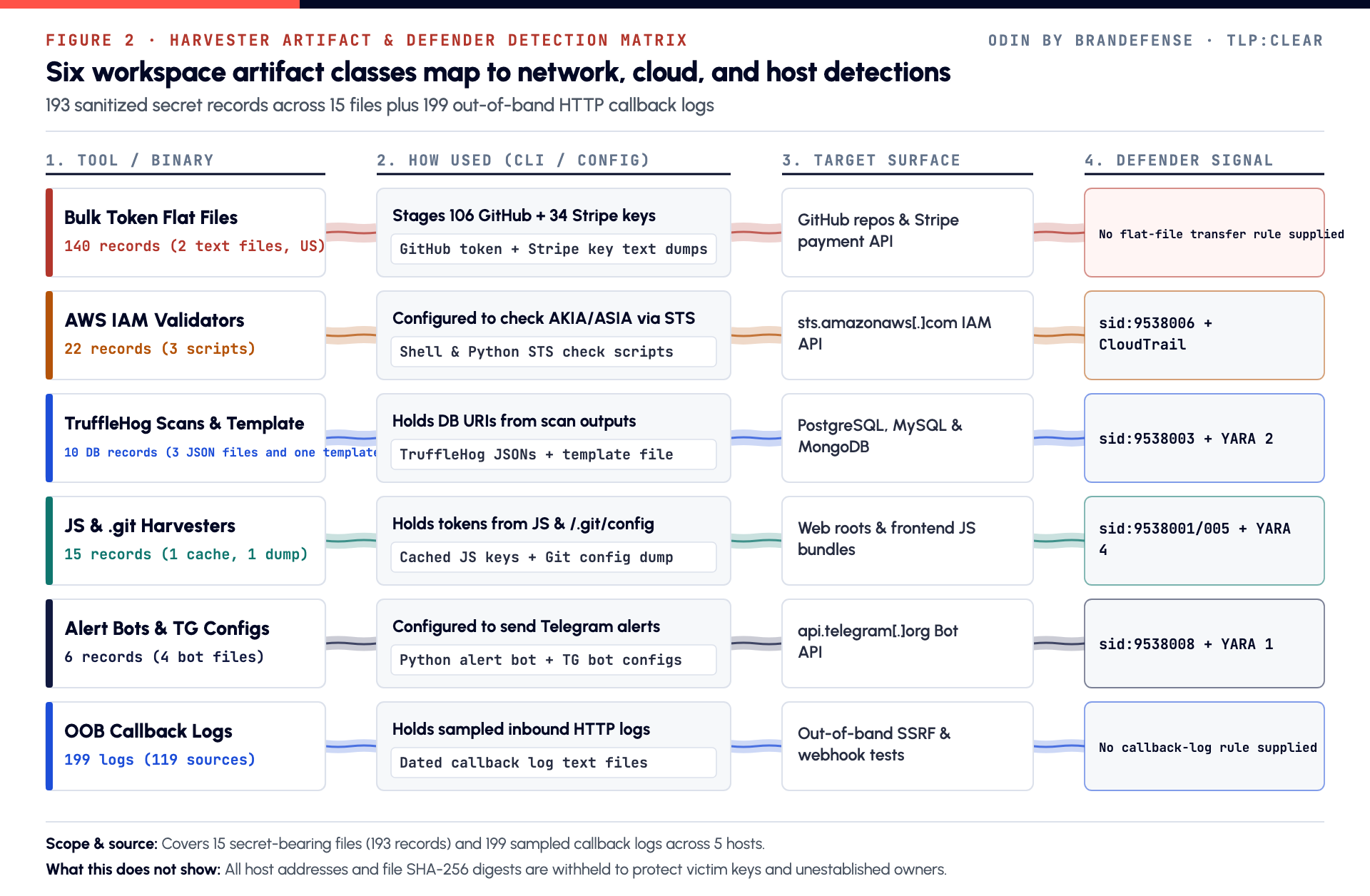
In the United States, an open aggregator directory exposes 46 files in its root folder. Those files comprise 18 text and log files, 17 archives, 8 scripts, and 3 key or PID files. Two plain-text files hold 140 secret records, which is 72.5% of all 193 secrets across the five workbenches:
- GitHub token flat file (106
github_tokenrecords). Collects 106 GitHub tokens in one newline-separated text dump for repository cloning or CI inspection (T1528).
- Stripe key flat file (34
stripe_keyrecords). Collects 34 Stripe API keys next to unindexed sibling key lists for cloud, AI and email providers. Unrestricted Stripe secret keys allow balance checks, customer reads, or refund calls unless scoped with restricted keys and IP allowlists.
The other 44 files suggest a receiver and packaging setup. They include two Python listeners, several logs, six shell scripts, five host summary files, and 17 archives. Their names and locations are withheld because the exposed server may still serve credential-bearing files.
Automated AWS IAM key validation (Singapore)
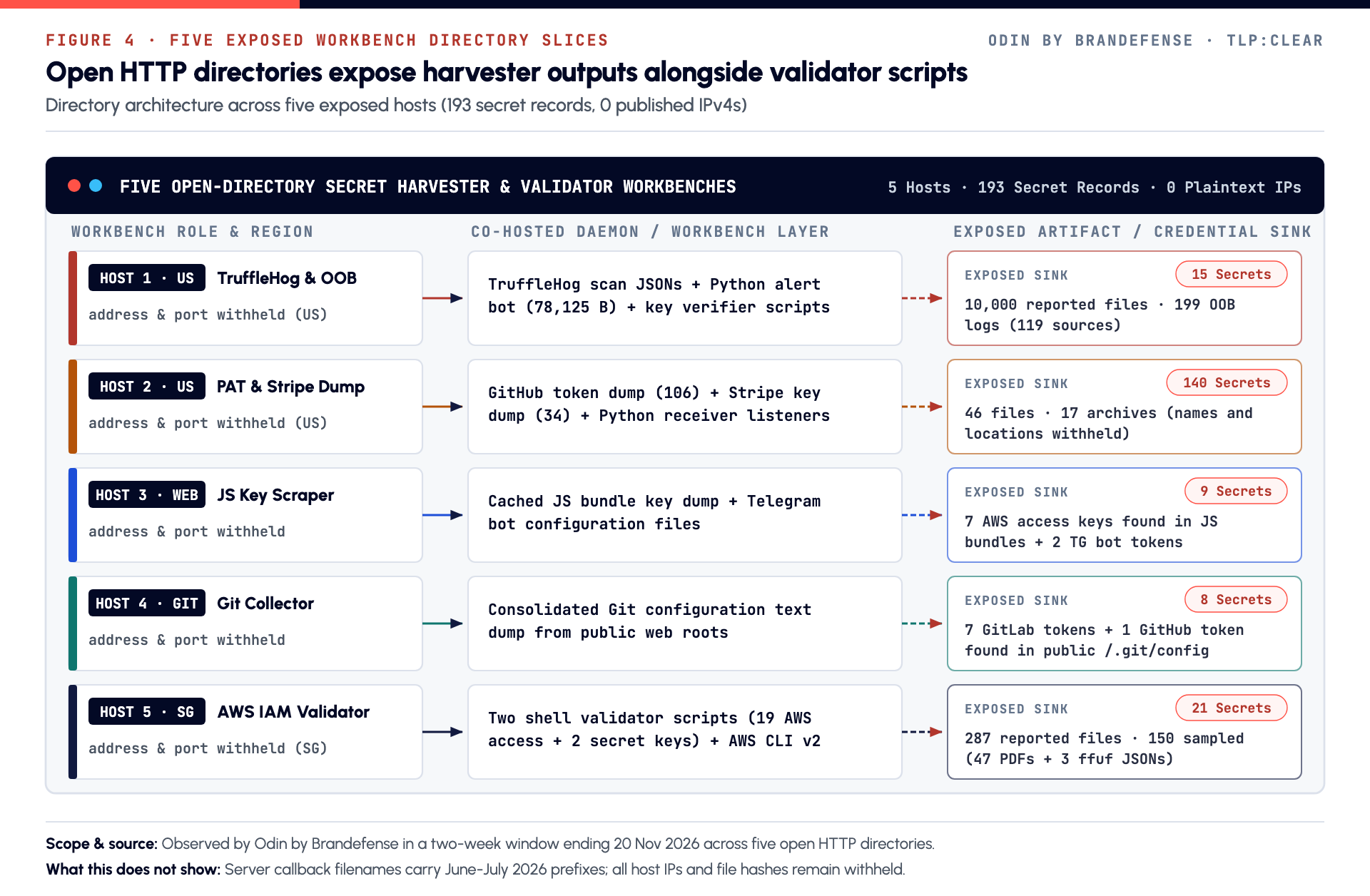
In Singapore, an open directory reports 287 exposed files, with 150 sampled entries in our review. Those 150 files include 61 text/HTML/JSON files, 47 PDFs, 25 cookie/runtime files, 9 scripts, 4 shared libraries, and 4 archives. Twenty-one AWS IAM credential records sit inside two shell validation scripts: one holding 17 aws_access_key records and a second holding 2 aws_access_key and 2 aws_secret_key records.
Beside those two files sit unpacked AWS CLI v2 installation files, four cloud check scripts, and three SMTP test scripts. Batch AWS validators call the AWS Security Token Service (STS) GetCallerIdentity action at sts.amazonaws[.]com (T1078.004, T1580). An IAM permission policy cannot deny sts:GetCallerIdentity. Any active AKIA or ASIA key therefore returns its Account ID and ARN while writing a CloudTrail event inside the owning account.
| Workbench | Artifact group | Files | Secret records | Role in the workspace |
|---|---|---|---|---|
| US aggregator | GitHub token flat file | 1 | 106 github_token | Bulk GitHub token list (54.9% of all 193 workbench records) |
| US aggregator | Stripe key flat file | 1 | 34 stripe_key | Bulk Stripe API key list (85.0% of the 40 latest Stripe arrivals) |
| US aggregator | Packaged archives (names withheld) | 17 | Unindexed | Credential and honeypot archives withheld to protect exposed data |
| US aggregator | Collection listeners and shell scripts | 8 | 0 | Two Python collection listeners and six host-processing shell scripts |
| SG validator | Two AWS IAM validation shell scripts | 2 | 19 access, 2 secret | Shell scripts staging 21 AWS IAM key records for testing |
| SG validator | AWS CLI v2 and S3 discovery scripts | 4 | 0 | Unpacked AWS CLI v2 key-check and S3 enumeration scripts |
| SG validator | SMTP credential test scripts | 3 | 0 | Python SMTP credential and mail-relay test scripts |
| SG validator | Web-fuzzing JSONs (3) and report PDFs (47) | 50 | 0 | Web-fuzzing outputs and report PDFs (consistent with research use) |
5. What Secrets Harvesters Keep, and Other Explanations
In short
Version-control tokens, Stripe keys and AWS IAM keys make up 93.3% of the 193 workbench records, even though database URLs lead raw leaks. Dual-use bug-bounty and honeypot explanations remain plausible across these five hosts, which is why all host addresses are withheld. Hunt for exposed keys in your own web roots.
Comparing the 193 secret records inside the five workbenches against the 1,001 latest arrivals across all exposed files shows a sharp filter. Database connection strings lead raw arrivals (255 of 1,001, or 25.5%), yet they make up only 10 of the 193 workbench records (5.2%). Many database URLs inside leaked .env files point to localhost or private container networks that cannot be reached from outside.
Harvester dumps and validation scripts instead keep credentials intended for internet-facing cloud, code and payment APIs. Three categories account for 180 of the 193 workbench records (93.3%). They are version-control tokens (117, or 60.6%), Stripe payment keys (34, or 17.6%), and AWS IAM keys (29, or 15.0%).
The 108 github_token records on these workbenches represent 75.5% of all 143 github_token arrivals in the latest slice. The 34 stripe_key records represent 85.0% of all 40 stripe_key arrivals.
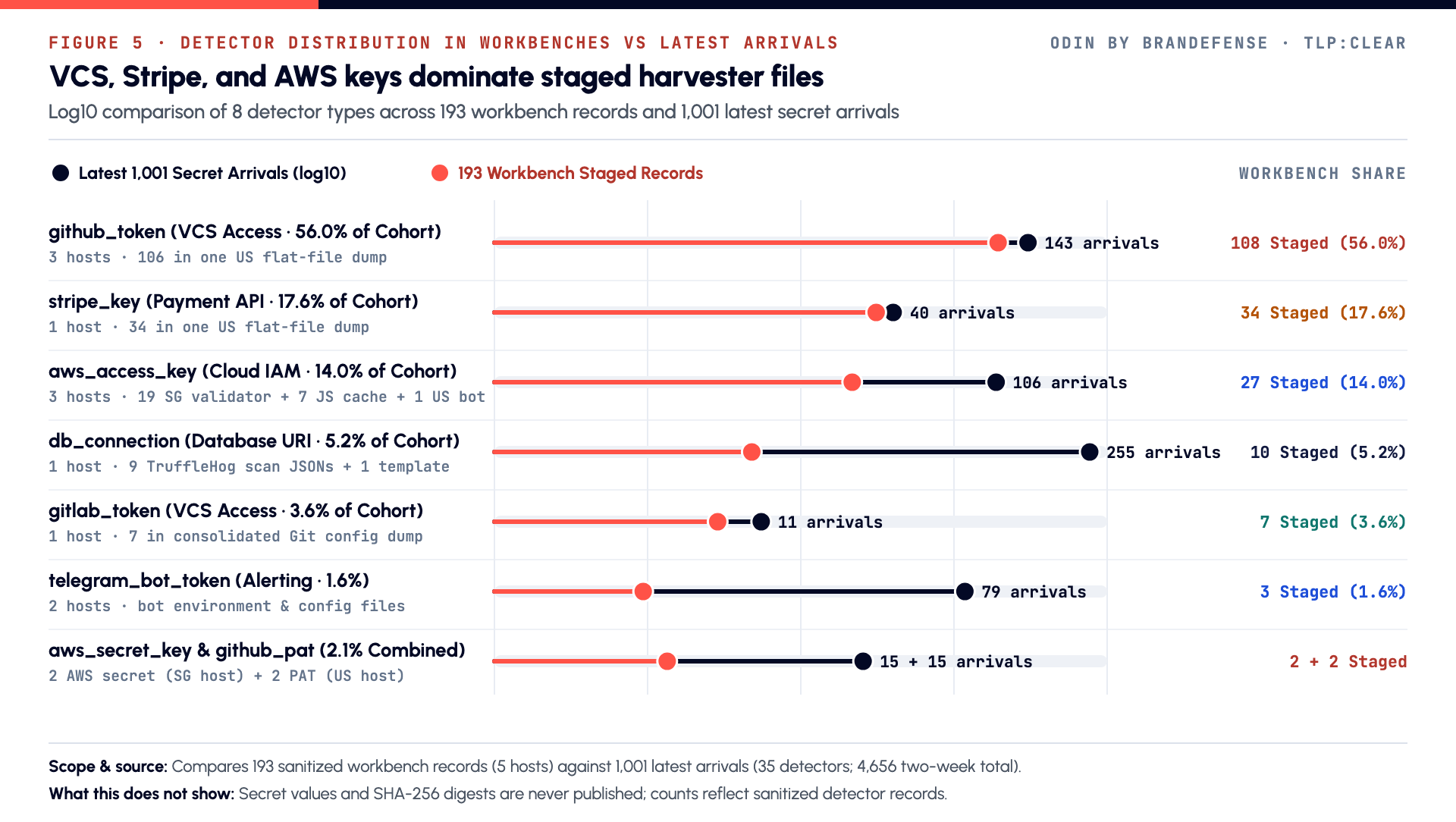
| Secret type | Category | Workbench records (193) | Workbench share | Hosts | Files | Latest arrivals (1,001) |
|---|---|---|---|---|---|---|
github_token | Source control | 108 | 55.96% | 3 | 3 | 143 |
stripe_key | Payments | 34 | 17.62% | 1 | 1 | 40 |
aws_access_key | Cloud IAM | 27 | 13.99% | 3 | 4 | 106 |
db_connection | Database | 10 | 5.18% | 1 | 4 | 255 |
gitlab_token | Source control | 7 | 3.63% | 1 | 1 | 11 |
telegram_bot_token | Messaging / alert | 3 | 1.55% | 2 | 3 | 79 |
aws_secret_key | Cloud IAM | 2 | 1.04% | 1 | 1 | 15 |
github_pat | Source control | 2 | 1.04% | 1 | 1 | 15 |
Other ways to read the five workbenches
Open directories that hold scanners and harvested keys are not automatically criminal infrastructure. Three alternative readings matter before any SOC writes detection or blocking policy:
- Bug-bounty hunters or red-team operators. On the Singapore validator server, the AWS check scripts sit alongside three
ffufweb-fuzzing JSON files, redirect lists, and 47 vulnerability report PDFs. On the US TruffleHog server, organization scan JSONs sit near a red-team C2 configuration file. Either server could belong to a researcher who left an HTTP folder open, though exposed victim keys remain at risk.
- Honeypot or threat-research collectors. On the US aggregator server, the GitHub and Stripe token files share the root folder with honeypot deployment archives, collection scripts, and host summary files. That mix fits either an attacker reusing honeypot scripts or a deception researcher exposing captured material.
- Unverified key liveness. Because Odin replayed 0 credentials against AWS, GitHub, GitLab, Stripe or Telegram, we do not know how many of the 193 staged records were active versus already revoked.
6. What Defenders Should Do
Web and frontend engineering
- Block inbound HTTP access to
/.git/,.env*and.bak*paths at reverse proxies, CDNs and WAFs. Deploy containers from clean build artifacts rather thangit clonefolders inside web roots. - Audit frontend build variables (
NEXT_PUBLIC_*,VITE_*,REACT_APP_*) so AWS IAM keys, database URLs and Telegram bot tokens never compile into public JavaScript bundles.
Source control and CI/CD
- Turn on GitHub and GitLab secret scanning and push protection across all repositories. Remove embedded
oauth2:or PAT credentials from.git/configremote URLs on build runners. - Replace classic long-lived GitHub personal access tokens with short-lived, fine-grained tokens scoped to named repositories, and require SAML SSO authorization.
Cloud IAM and payment APIs
- Retire static AWS IAM user keys (
AKIA*) in CI/CD and developer workflows in favor of short-lived OIDC federated roles (AssumeRoleWithWebIdentity). - Replace unrestricted Stripe secret keys with restricted keys limited to the exact API endpoints an application needs, and enforce source IP allowlists where supported.
SOC and attack-surface monitoring
- Alert on AWS CloudTrail
GetCallerIdentitycalls coming from AWS CLI, Boto3 or curl user agents on unfamiliar networks, and deploy the rules in Chapter 7. - Scan your own cloud VPS and lab ranges for unauthenticated
Index of /HTTP listeners (python3 -m http.server) so internal test workbenches never expose scan outputs or keys.
7. Detection Rules
The full rules are in the Detection rules tab. Static syntax checks passed, including lint_suricata.py with zero problems. Suricata, YARA, Sigma, and Kusto engines were unavailable locally, and the rules were not replayed against live traffic. Test and tune them in your own environment before production enforcement.
| Rule file | What it catches |
|---|---|
odin_automated_secret_harvesters_and_cloud_validators.rules | Suricata 7: eight signatures for /.git/config and /.env probes, exposed harvester directory listings, TruffleHog JSON transfers, .git metadata requests, batch AWS validator scripts, STS HTTP queries, and server TLS sessions to api.telegram[.]org |
sentinel_secret_harvester_and_cloud_key_validation_hunt.kql | Microsoft Sentinel and Defender XDR: unapproved trufflehog, /.git/config or get-caller-identity processes joined by initiating process identity to connections in the next 15 minutes for AWS STS, GitHub, GitLab, Stripe or Telegram API egress |
sigma_trufflehog_harvester_and_aws_iam_key_validation.yml | Sigma (3 rules): CloudTrail GetCallerIdentity calls from CLI or SDK user agents, Linux harvester or validator command lines, and web requests for /.git/config, /.git/credentials or /.env |
odin_secret_harvester_and_cloud_validator_artifacts.yar | YARA (4 rules): secret-scanning and Telegram alert bots, TruffleHog JSON scan outputs, batch AWS IAM validator scripts, and consolidated .git/config or token dumps |
How the Suricata signatures work
| SID | Looks for | Why |
|---|---|---|
| 9538001 | Inbound GET with /.git/config in the URI | Catches automated .git/config token harvesters probing web roots (block candidate) |
| 9538002 | Outbound 200 response with Index of / and harvester markers | Flags an internal server accidentally exposing TruffleHog, AWS CLI or .git/config artifacts |
| 9538003 | HTTP GET request for TruffleHog .json scan outputs | Catches retrieval of exposed TruffleHog repository scan JSON files |
| 9538004 | Inbound GET request for /.env environment files | Catches automated harvesters probing web roots for environment secrets |
| 9538005 | Inbound GET request for /.git/HEAD, /.git/credentials or /.git/index | Catches repository-dump tools pulling exposed Git metadata |
| 9538006 | HTTP file transfer containing AWS_SECRET_ACCESS_KEY and GetCallerIdentity | Catches retrieval of staged cloud IAM validation scripts |
| 9538007 | HTTP request URI containing Action=GetCallerIdentity | Flags unencrypted or proxied AWS STS identity check requests |
| 9538008 | Outbound TLS SNI api.telegram[.]org from server segments | Hunt only: flags server-tier processes contacting the Telegram Bot API |
Enforce SID 9538001 in inline block mode at web reverse proxies. Keep SID 9538008 scoped to production server and CI subnets rather than staff workstation networks.
How the KQL, Sigma and YARA rules work
The Sentinel KQL query looks back seven days across DeviceProcessEvents and DeviceNetworkEvents for unapproved secret-scanning or cloud-validation command lines. It joins each process to outbound API connections using the initiating process identity. The corrected query tests connections in the next 15 minutes to AWS STS, GitHub, GitLab, Stripe or Telegram.
Correlated matches receive REVIEW_UNAPPROVED_HARVESTER or INVESTIGATE_BULK_KEY_VALIDATION outside two exact allowlisted scanner hosts. Process-only matches receive HUNT_UNAPPROVED_SECRET_SCANNER without qualifying API egress.
Sigma rule 1 reads AWS CloudTrail logs and flags sts.amazonaws[.]com GetCallerIdentity calls from aws-cli/, Boto3/, botocore/, curl/ or python-requests/ user agents outside two exact CI role ARNs. Sigma rule 2 flags Linux process creation for secret-scanning and cloud-validation command lines outside the two exact scanner hostnames. Sigma rule 3 flags web-server access logs requesting /.git/config, /.git/HEAD, /.git/credentials or /.env.
| YARA rule | Fires when |
|---|---|
ODIN_Keyleak_Secret_Scanner_And_Alert_Bot | Under 512 KB, two secret-scanner or token markers appear alongside api.telegram[.]org/bot, api.github[.]com or GetCallerIdentity |
ODIN_TruffleHog_Org_Secret_Scan_Output | Under 10 MB, three TruffleHog JSON schema keys (SourceMetadata, DetectorName, DetectorType, Verified) appear with a database or cloud detector name |
ODIN_AWS_IAM_Batch_Credential_Validator_Script | Under 256 KB, AWS_ACCESS_KEY_ID and AWS_SECRET_ACCESS_KEY appear with get-caller-identity or aws s3 ls and a shell or Boto3 loop |
ODIN_JS_Bundle_And_GitConfig_Token_Aggregator | Under 5 MB, [remote "origin"] and a Git remote url = line appear with GitHub or GitLab domains, or two token-aggregator and Telegram Bot API markers appear |
MITRE ATT&CK mapping
| Tactic | Technique | How the pipeline uses it | Detection |
|---|---|---|---|
| Credential Access | T1552.001 Unsecured Credentials: Credentials In Files | Scraping /.git/config, JavaScript bundles, .env files and TruffleHog JSON outputs | SIDs 9538001 to 9538004; Sigma rules 2 and 3; YARA rules 2 and 4 |
| Credential Access | T1528 Steal Application Access Token | Aggregating 108 GitHub tokens, 2 GitHub PATs, 7 GitLab tokens and 34 Stripe keys | No flat-file transfer rule supplied; SID 9538005 covers Git metadata probes, while KQL and Sigma rule 2 provide process context |
| Defense Evasion, Persistence | T1078.004 Valid Accounts: Cloud Accounts | Staging 27 AWS access keys and 2 secret keys inside shell validation scripts | SIDs 9538006 and 9538007; KQL; Sigma rule 1; YARA rule 3 |
| Discovery | T1580 Cloud Infrastructure Discovery | Batch GetCallerIdentity and S3 enumeration wrappers | KQL; Sigma rule 1; YARA rule 3 |
| Exfiltration | T1567 Exfiltration Over Web Service | Potential Telegram-based exfiltration configured in bot files; no transmission observed | SID 9538008; KQL; YARA rule 1 |
8. Indicators
The Indicators tab holds 0 published indicators: 0 network addresses and 0 file hashes. All five open-directory host addresses, ports, server credential-file paths, and file digests are withheld to protect victim credentials and account for dual-use security-research hosts. Two behavioral URI and cloud API hunt indicators appear in this report only.
| Type | Count | Where to use it |
|---|---|---|
| Network addresses and ports (Indicators tab) | 0 | All five host addresses and ports are withheld |
| File hashes and server file paths (Indicators tab) | 0 | All credential-bearing paths, archives and file hashes are withheld |
| Inbound web probe URI (in text) | 1 | Block at the WAF and reverse proxy |
| Cloud API action pattern (in text) | 1 | Hunt caller context in AWS CloudTrail; never block the domain |
Behavioral indicators in this report
| Indicator | Type | Pipeline stage | Use |
|---|---|---|---|
/.git/config | Web probe URI | Stage 1: Git collection | Block inbound HTTP requests at the WAF |
sts.amazonaws[.]com/?Action=GetCallerIdentity | Cloud API pattern | Stage 4: Cloud check | Watch unusual callers in CloudTrail; do not block |
sts.amazonaws[.]com and api.telegram[.]org are legitimate public services. Never block sts.amazonaws[.]com at the firewall; inspect CloudTrail caller identities, source ASNs and user-agent strings instead.
Withheld values include all five server IP addresses and ports, all server credential-file and archive paths, and all 118 external callback source IPs. Target organization names, third-party names in co-hosted files, and all SHA-256 digests of secret-bearing or unestablished files are also withheld.
9. Scope and Limits
- Window. All observations come from a two-week observation window ending 20 November 2026.
- Static review, no key testing. File metadata and detector counts were reviewed without running scripts, replaying any of the 193 secret records, or contacting target systems. Live-key ratios are unmeasured.
- Five stages are an analytical model. The five servers share 0 IP addresses, certificates, keys or bot tokens. Grouping them into five stages maps controls across the credential lifecycle rather than naming one actor.
- Dual-use research and honeypots remain plausible. Fuzzing files and report PDFs on the Singapore host and honeypot archives on the US aggregator fit research use, so all identifiers are withheld.
- Server file dates vs observation window. June and July 2026 date strings (20260616 to 20260724) inside callback log filenames on the US TruffleHog host are server file timestamps, not Odin's monitoring window.
- Rule testing. Static checks (
lint_suricata.pywith 0 problems, plus syntax and fixture checks) passed on 21 November 2026. Suricata, YARA, Sigma and Kusto engines were not installed locally, so test and tune rules before production use.
10. Sources
- MITRE ATT&CK. T1552.001 Unsecured Credentials: Credentials In Files. https://attack.mitre.org/techniques/T1552/001/ (verified 20 November 2026)
- MITRE ATT&CK. T1528 Steal Application Access Token. https://attack.mitre.org/techniques/T1528/ (verified 20 November 2026)
- MITRE ATT&CK. T1078.004 Valid Accounts: Cloud Accounts. https://attack.mitre.org/techniques/T1078/004/ (verified 20 November 2026)
- MITRE ATT&CK. T1580 Cloud Infrastructure Discovery. https://attack.mitre.org/techniques/T1580/ (verified 20 November 2026)
- Amazon Web Services. AWS Security Token Service API Reference: GetCallerIdentity. https://docs.aws.amazon.com/STS/latest/APIReference/API_GetCallerIdentity.html (verified 20 November 2026)
- Amazon Web Services. AWS Identity and Access Management User Guide: Security best practices in IAM. https://docs.aws.amazon.com/IAM/latest/UserGuide/best-practices.html (verified 20 November 2026)
- GitHub Docs. Code Security: About secret scanning. https://docs.github.com/en/code-security/secret-scanning/introduction/about-secret-scanning (verified 20 November 2026)
- Stripe Documentation. API keys. https://docs.stripe.com/keys (verified 20 November 2026)
Frequently asked questions
What did we find on the five open directories?
Automated scripts scan websites and code repositories around the clock for leaked API tokens that defenders can track with cyber threat intelligence. When an operator or researcher leaves their own working folder open over HTTP, external attack surface management can help defenders find the exposed scripts and output files. We reviewed file metadata and sanitized detector counts only, tested zero credentials, and withheld all five server addresses, ports, credential-file paths, and file hashes.
How do raw web leaks become tested cloud access?
Raw secret leaks across the internet look different from what harvesters keep. In the latest set, database connection strings rank first at 255 records (25.5%). GitHub tokens account for 143, AWS access keys 106, wallet seed phrases 92, and Telegram bot tokens 79.
Could some of these servers belong to security researchers?
Yes. Bug-bounty hunters, contracted red teams, and honeypot researchers use the same TruffleHog scanners, JavaScript scrapers, and AWS CLI check scripts. On the Singapore validator server, the AWS key-check scripts sit beside three ffuf web-fuzzing JSON files and 47 vulnerability report PDFs. On the US aggregator server, the GitHub and Stripe token files sit beside honeypot deployment archives and collection scripts.