
Key takeaways
- Three open web directories in China and Hong Kong exposed 269 sampled files across 1,039 reported entries.
- One server pairs JeecgBoot JimuReport CVE-2023-4450 and Quartz RCE scripts with GIF and JPEG polyglot JSP webshells.
- A second server stages a race exploit for WordPress Core CVE-2026-119977, targeting predictable staging folders during upgrades.
- Over 60 percent of the sampled files are client bundles, stubs, wordlists, or logs that must stay out of hash blocklists.
- Patch JimuReport to 1.6.1+ and WordPress to 7.1.4 or fixed branch releases, block /wp-content/upgrade/, and re-encode uploads.
Three open HTTP directories in China and Hong Kong exposed JimuReport scanners, polyglot JSP webshells, and WordPress upgrade-race tooling. Odin by Brandefense reviewed 269 sampled entries from 1,039 reported files recorded between 13 and 21 November 2026.
Together, the servers show how attackers target two common enterprise web layers: Java reporting and job-scheduling services, and WordPress content management systems. For defenders, the takeaway is clear: unpatched reporting templates, header-only upload checks, and web-reachable upgrade folders give attackers simple paths to server code execution.
What did we find on the three servers?
Open web directories left on virtual private servers show more than a single attack packet. Defenders can use cyber threat intelligence to assess the vulnerability scanners, fallback brute-force scripts, webshells, and downloaded client code sitting in an operator's folder. We reviewed file paths, sizes, dates, and SHA-256 digests without running any script or contacting any external system.
Because zero shared IP addresses, zero shared file hashes, and zero shared script names connect the three servers, we treat them as an analytical model rather than one threat group. All three host addresses and ports are withheld.
- Workbench A (China, port withheld) reports 988 files, with 218 entries sampled between 13 and 20 November 2026. It holds 68 Python, shell, bytecode, and JSP offense files aimed at JeecgBoot Java stacks, plus 150 downloaded front-end JavaScript and HTML files.
- Workbench B (Hong Kong, port withheld) exposes 47 files, all indexed on 21 November 2026 after the directory was first seen late on 20 November. It pairs a race exploit for WordPress Core CVE-2026-119977 with CMS exploit scripts, XML-RPC brute-forcers, PHP webshell uploaders, FTP helpers, and password wordlists.
- Workbench C (China, port withheld) exposes 4 text entries around 148 KB each, sampled on 20 November 2026. They cover a
/VICIdial/phonecall-center softphone route, a portal login-registration probe, a backslash path-normalization probe, and a saved enumeration log (workbench paths withheld).
How do the Java reporting probes and polyglot JSP shells work?
Many business portals in Asia-Pacific run Spring Boot frameworks such as JeecgBoot, which combine JimuReport dashboards, Quartz background jobs, Fastjson, Apache Shiro, and Nacos. Defenders can use vulnerability intelligence to prioritize the JeecgBoot components targeted by Workbench A.
Two Python scripts lead the folder: a 3,199-byte JimuReport probe and a 4,464-byte Quartz probe (filenames withheld). The first tests CVE-2023-4450, a critical Template Handler injection flaw in JeecgBoot JimuReport versions 1.0 through 1.6.0. Sending crafted FreeMarker expressions to routes such as /jmreport/queryFieldBySql can run operating-system commands on unpatched servers. JeecgBoot fixed the flaw in version 1.6.1.
The second script tests exposed Java Quartz scheduler routes where an attacker can register a malicious job class. Companion scripts test Fastjson deserialization, Apache Shiro RememberMe keys, Nacos SSRF, SQL injection, and JWT secrets.
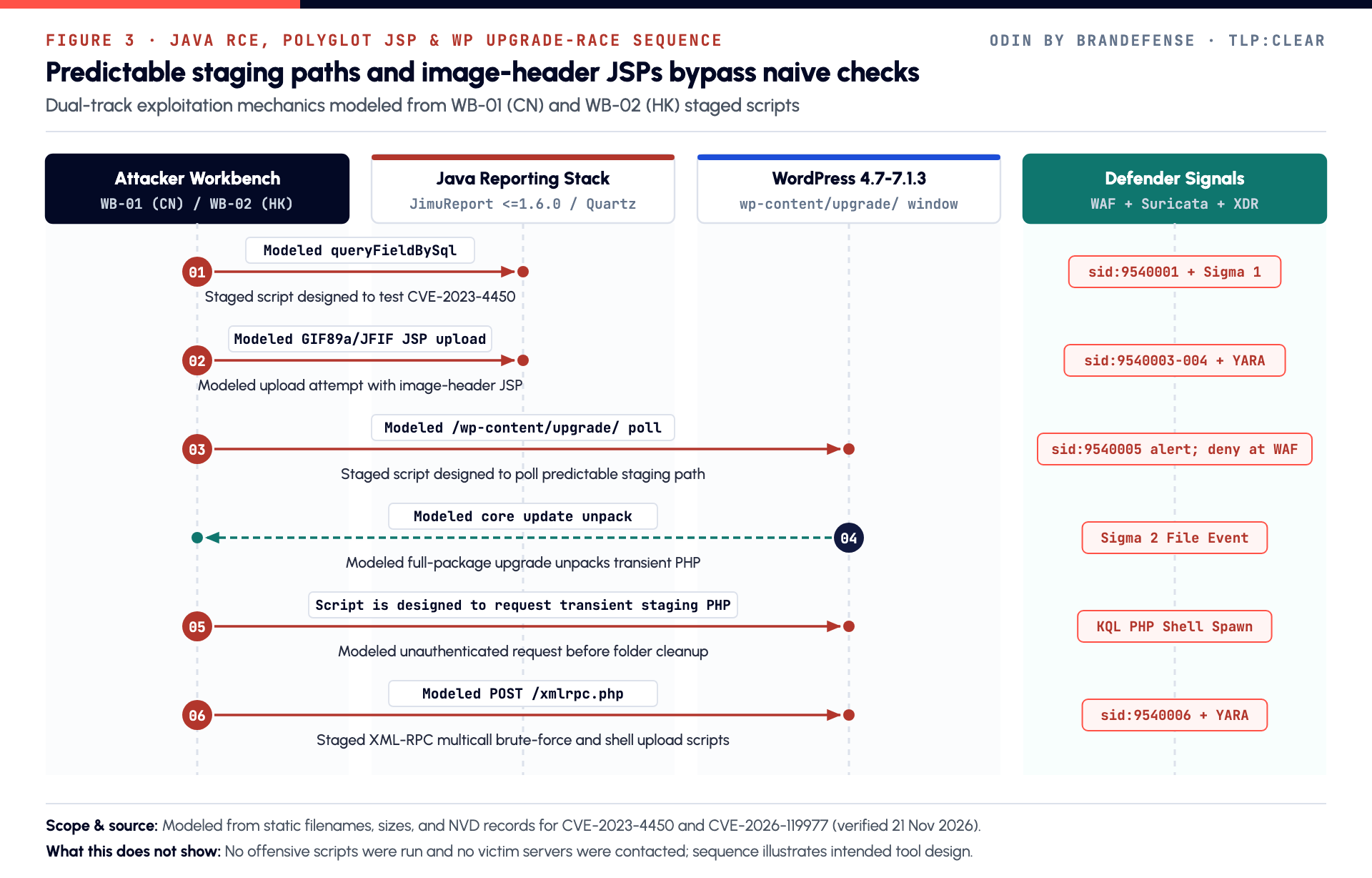
Next to several upload-testing scripts sit two polyglot JSP webshells (filenames withheld). Each file starts with valid GIF (GIF89a) or JPEG (FF D8 FF) image bytes, followed by <% JSP code. An upload filter that checks only the Content-Type header or the first few magic bytes treats the file as an image. If an extension-whitelist gap lets that .jsp file land inside a Java servlet directory, Tomcat or Jetty compiles and runs the embedded JSP scriptlet.
How does the WordPress upgrade-window race exploit work?
Workbench B was observed on 20 November 2026, twenty days after CVE-2026-119977 was published in the National Vulnerability Database on 31 October 2026 (CVSS v3.1 8.1 High). Its lead Python race script (4,377 bytes; filename withheld) is written specifically for that flaw.
CVE-2026-119977 affects WordPress Core 4.7 through 7.1.3 across 25 release branches. During a full-package core update, WordPress unpacks the new release into a temporary folder inside wp-content/upgrade/ under the web root before moving the files into place and cleaning up.
In unpatched versions, those temporary paths are predictable and reachable over HTTP while the update runs. A multi-threaded race script is designed to poll those predictable paths continuously so an unauthenticated caller can request newly unpacked PHP files during the brief upgrade window.
When a target site is not running an upgrade, Workbench B stages fallback options. It holds an 84,986-byte CMS exploit script and a 25,020-byte theme catalog. Its login brute-forcers include a 2,056-byte WordPress credential script and a 1,327-byte XML-RPC system.multicall script that packs many password guesses into one POST request. It also stages a Duplicator backup scanner, FTP and PHP stream-wrapper helpers, and two WordPress webshell deployers (filenames withheld).
Why did we cut 164 files from the indicator list?
Pulling every hash from an open directory into a SOC blocklist causes immediate damage. Out of the 269 sampled entries (240 unique SHA-256 digests), 152 files (56.5%) are client bundles, open-source packages, or HTTP error stubs. Another 12 files (4.5%) are password wordlists or reconnaissance logs.
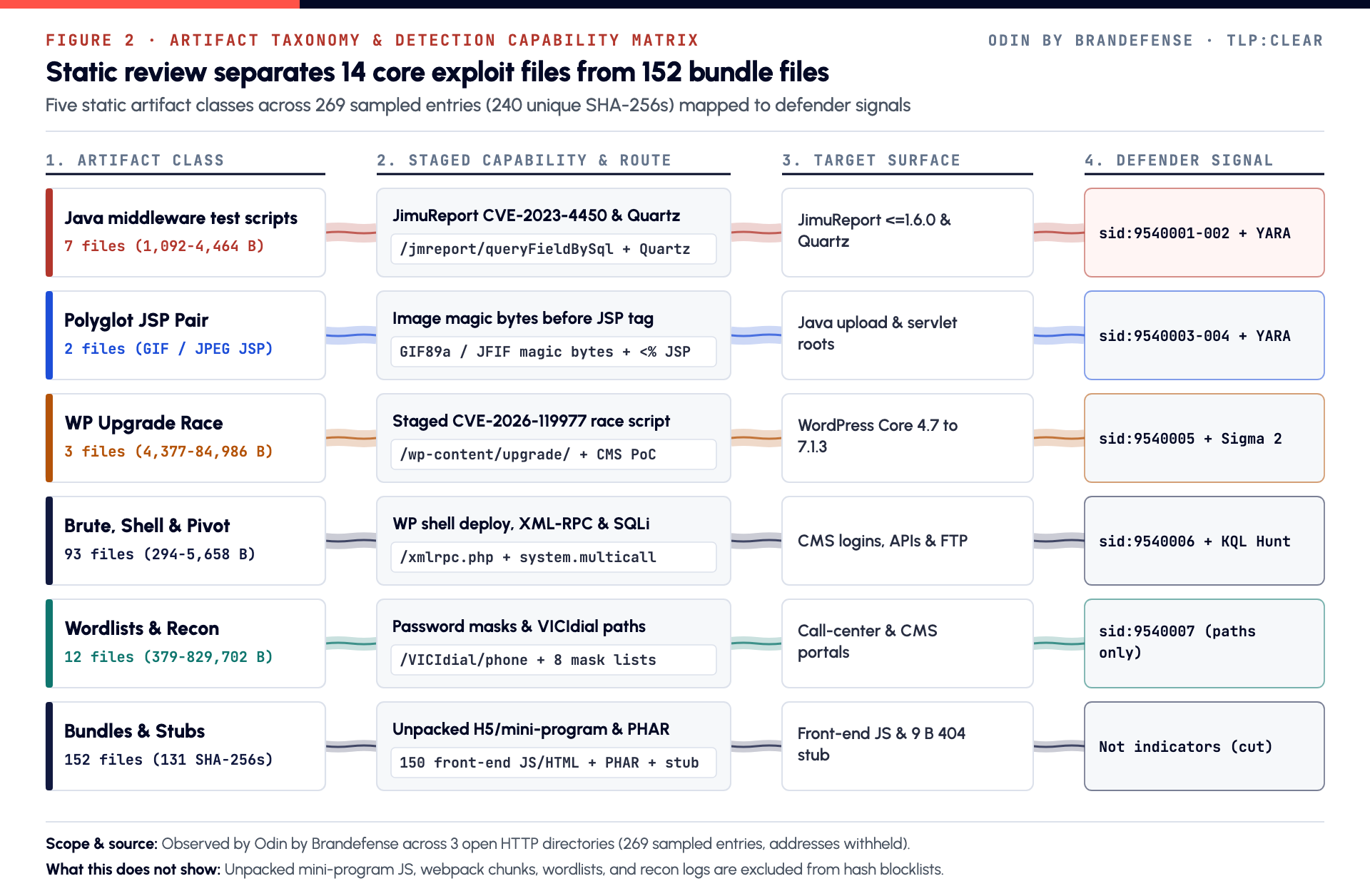
On Workbench A, 110 files sit inside an unpacked mini-program folder (path and AppID withheld) alongside 38 Vue webpack chunks duplicated across two front-end asset folders. Both sets are unpacked client applications that the operator downloaded to study API routes offline.
On Workbench B, a 7.14 MB PHAR archive is the legitimate open-source WordPress CLI tool. Beside it, a 9-byte HTTP error stub contains the literal text Not Found. Blocking that 9-byte hash would flag every Not Found stub across your fleet. Workbench C's four 148 KB entries cover /VICIdial/phone, a portal login probe, a backslash probe, and an enumeration log. These reconnaissance captures have withheld hashes.
What to do now
- Patch JimuReport and lock scheduler routes. Upgrade JeecgBoot JimuReport to 1.6.1 or later for CVE-2023-4450, require authentication on
/jmreport/*and Quartz job endpoints, and rotate static Apache Shiro keys. - Patch WordPress Core and block
/wp-content/upgrade/. Update WordPress to 7.1.4, 7.0.8, 6.9.11, 6.8.12, 6.7.11, 6.6.11, or your branch's fixed update for CVE-2026-119977, and block external HTTP requests to/wp-content/upgrade/at the reverse proxy and WAF. - Harden file uploads beyond magic bytes. Store uploads outside servlet and PHP web roots, turn off script execution on media folders, and re-encode GIF and JPEG uploads so appended JSP or PHP code is stripped.
- Restrict XML-RPC and call-center panels. Disable
/xmlrpc.phpor blocksystem.multicallwhen unneeded, and place/VICIdial/phoneagent interfaces behind VPNs. - Deploy the published detection rules. File hashes and host addresses from the unconfirmed workbenches are withheld, while the full report's Detection rules tab ships Suricata, Sentinel KQL, Linux Sigma, and YARA rules.
Frequently asked questions
What did we find on the three servers?
Open web directories left on virtual private servers show more than a single attack packet. Defenders can use cyber threat intelligence to assess the vulnerability scanners, fallback brute-force scripts, webshells, and downloaded client code sitting in an operator's folder. We reviewed file paths, sizes, dates, and SHA-256 digests without running any script or contacting any external system.
How do the Java reporting probes and polyglot JSP shells work?
Many business portals in Asia-Pacific run Spring Boot frameworks such as JeecgBoot, which combine JimuReport dashboards, Quartz background jobs, Fastjson, Apache Shiro, and Nacos. Defenders can use vulnerability intelligence to prioritize the JeecgBoot components targeted by Workbench A.
How does the WordPress upgrade-window race exploit work?
Workbench B was observed on 20 November 2026, twenty days after CVE-2026-119977 was published in the National Vulnerability Database on 31 October 2026 (CVSS v3.1 8.1 High). Its lead Python race script (4,377 bytes; filename withheld) is written specifically for that flaw.
Why did we cut 164 files from the indicator list?
Pulling every hash from an open directory into a SOC blocklist causes immediate damage. Out of the 269 sampled entries (240 unique SHA-256 digests), 152 files (56.5%) are client bundles, open-source packages, or HTTP error stubs. Another 12 files (4.5%) are password wordlists or reconnaissance logs.