
1. Executive Summary
In short
From 13 to 21 November 2026, Odin by Brandefense reviewed 269 sampled files across three open web directories in China and Hong Kong reporting 1,039 files. The servers stage Python scanners for JeecgBoot JimuReport and Java Quartz schedulers, GIF and JPEG polyglot JSP webshells, and a race exploit for WordPress Core upgrades. Patch JimuReport to 1.6.1 or later, update WordPress to 7.1.4 or fixed branch releases, block external requests to upgrade folders, and re-encode uploaded images.
Many enterprise networks run Java reporting services and scheduled job engines next to PHP content management systems behind the same web proxies. That setup speeds up business reporting and publishing, yet it widens the external attack surface across template routes, upload forms, and maintenance folders.
This report examines 269 sampled entries across three open HTTP directories in Asia-Pacific to show how attackers target both stacks. We did not run any recovered scripts, and we did not contact any server named in the files.
Java reporting scanners sit beside image-header polyglot JSP webshells.
One open directory in China (port withheld) reports 988 files. Its 218 sampled entries include Python scripts written to test JeecgBoot JimuReport flaw CVE-2023-4450, which defenders can prioritize with vulnerability intelligence, and Java Quartz job schedulers. Next to Fastjson, Apache Shiro, and Nacos scripts sit two JSP webshells that start with GIF and JPEG image headers to slip past basic upload checks.
A Hong Kong workbench stages a WordPress core upgrade-race exploit.
Observed on 20 November 2026 in Hong Kong (port withheld), a 47-file directory holds a 4,377-byte Python race script for CVE-2026-119977, published in NVD on 31 October 2026. WordPress Core 4.7 through 7.1.3 uses predictable, web-reachable staging paths during full-package core upgrades. Co-hosted scripts handle WordPress login brute-forcing, XML-RPC multicall amplification, backup checks, FTP tests, and webshell uploads.
More than half of the sampled files are client bundles or stubs.
Out of 269 sampled entries and 240 unique SHA-256 digests, 152 files are unpacked mini-program components, duplicated webpack chunks, an open-source WordPress CLI archive, and a nine-byte HTTP 404 stub. Another 12 files are password wordlists and call-center portal captures from a third server (port withheld). Because directory ownership is unestablished, all file hashes stay withheld.
Three Decisions for Leaders
- Patch Java reporting engines and WordPress core across every tier. Update JeecgBoot JimuReport to 1.6.1 or later, remove public access to Quartz scheduler routes, and upgrade WordPress to 7.1.4, 7.0.8, 6.9.11, or your branch's fixed release while blocking
/wp-content/upgrade/at the perimeter. - Stop trusting file extensions and leading image bytes on uploads. Store user uploads outside Java servlet and PHP web roots, disable script handlers on media folders, and re-encode uploaded GIF and JPEG images on the server.
- Filter downloaded client bundles and HTTP stubs before feeding blocklists. Keep unpacked front-end JavaScript libraries, open-source administration archives, wordlists, and reconnaissance logs out of automated EDR hash blocks.
The Study in Numbers
| Number | What it is |
|---|---|
| 3 | Open HTTP directories in China and Hong Kong modeled in this study (0 shared hosts) |
| 1,039 | Total exposed files reported across the three directories (988, 47, and 4) |
| 269 | Sampled directory entries reviewed (240 unique SHA-256 digests, 10 digests withheld at source) |
| 14 | Core RCE, upgrade-race, polyglot JSP webshell, and WordPress shell-deployment files |
| 91 | Supporting Python, shell, and PHP scripts for login brute force, XML-RPC, SQLi, IDOR, and FTP |
| 164 | Non-indicator files kept out of hash feeds (152 bundles and stubs plus 12 wordlists and logs) |
| 0 | File hashes or host addresses published in the Indicators tab (withheld pending ownership confirmation) |
How to use this report.
Security leaders can start with Chapters 1, 6, and 7. Java platform, CMS, and WebOps engineers should read Chapters 3, 4, and 7. SOC analysts and detection engineers should go to Chapters 8 and 9. Analysts using cyber threat intelligence will find the three-workbench breakdown and model limits in Chapters 2, 5, 6, and 10.
2. What Was Found: 269 Sampled Entries Across Three Open Directories
In short
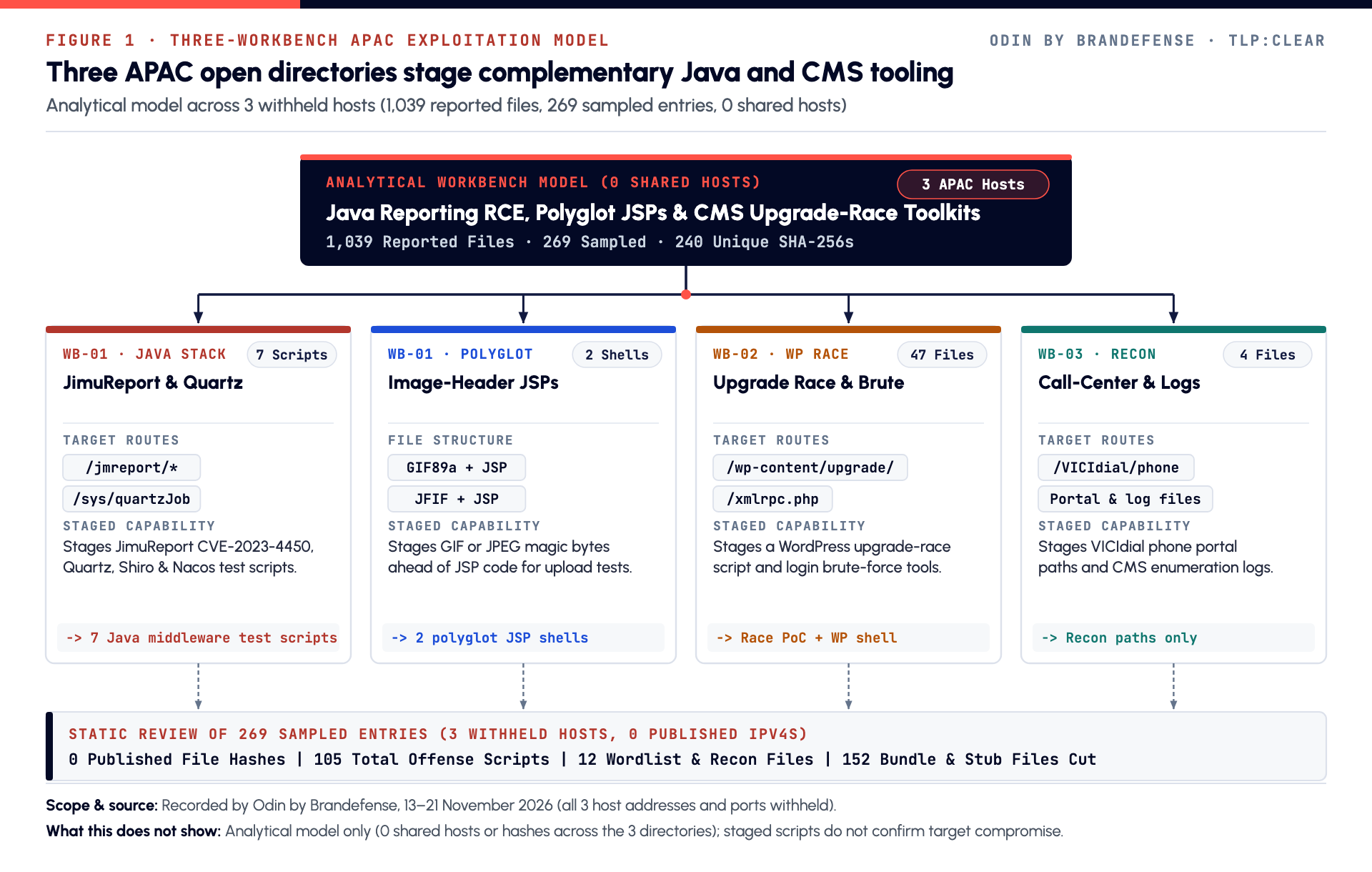
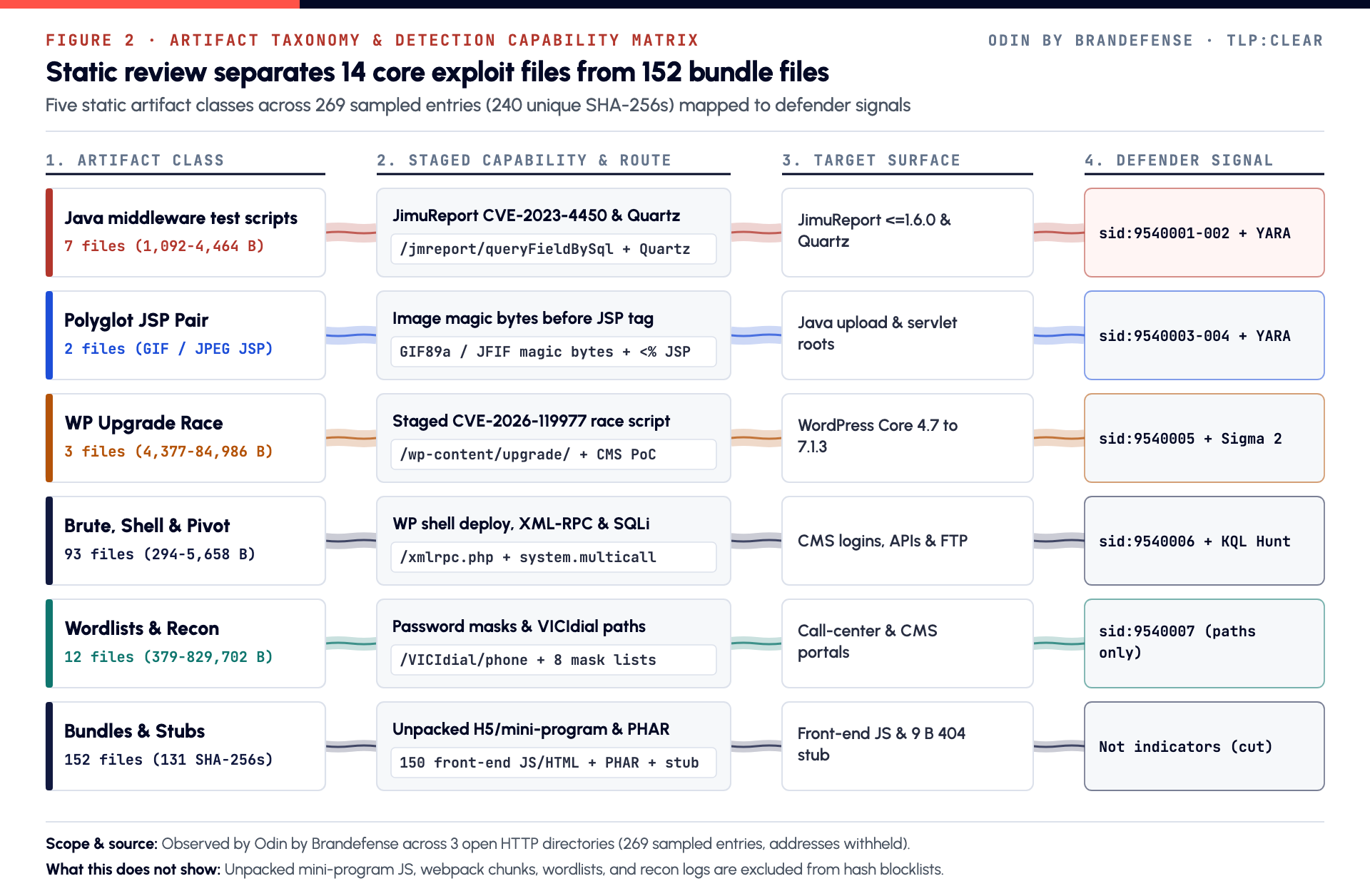
Three open HTTP directories in China and Hong Kong reported 1,039 exposed files, of which 269 entries were sampled. Static review separates 14 core exploit and webshell files and 91 supporting scripts from 164 front-end bundles, stubs, wordlists, and logs.
Firewall logs show individual exploit requests arriving at a web server. Open HTTP directories left on virtual private servers show the fuller workspace behind those requests. They reveal how an operator pairs vulnerability scanners with upload-bypass webshells, wordlists, and downloaded target scripts.
Odin by Brandefense recorded three such directories between 13 and 21 November 2026. The three hosts share zero IP addresses, zero file hashes, and zero script names. Because no technical indicator links them to one operator, we present them as an analytical model of current web and middleware intrusion tooling in Asia-Pacific. All three server addresses and ports are withheld.
Three distinct workbenches
Workbench A in China (port withheld) reports 988 exposed files, with 218 entries sampled between 13 and 20 November 2026. Workbench B in Hong Kong (port withheld) exposes 47 files. All 47 were indexed on 21 November 2026 after the directory was first seen late on 20 November. Workbench C in China (port withheld) exposes 4 text entries, all 4 sampled on 20 November 2026.
| Workbench | Location | Reported files | Sampled entries | Unique SHA-256 | Digests withheld at source | Main contents |
|---|---|---|---|---|---|---|
Workbench A (WB-01) | China (port withheld) | 988 | 218 | 191 | 8 | JimuReport and Quartz RCE scripts, GIF/JPEG JSP shells, and unpacked client bundles |
Workbench B (WB-02) | Hong Kong (port withheld) | 47 | 47 | 46 | 1 | WordPress CVE-2026-119977 race script, CMS exploit script, XML-RPC brute tools, and FTP helpers |
Workbench C (WB-03) | China (port withheld) | 4 | 4 | 3 | 1 | /VICIdial/phone call-center path, portal login probe, backslash probe, and enumeration log |
Five classes of file
Across all 269 sampled entries, there are 149 JavaScript files, 90 Python scripts, 9 text files, 7 shell scripts, and 4 PHP files. The remaining entries are 4 extensionless files, 2 JSP webshells, 1 HTML page, 1 JSON catalog, 1 PHAR archive, and 1 compiled .pyc file. Two hundred fifty-nine entries carry recorded SHA-256 digests, and 10 login or portal entries have no published digest.
Deduplicating the 259 hashed rows leaves 240 unique SHA-256 digests. All 19 duplicate pairs sit on Workbench A, where 19 compiled Vue webpack chunks in one front-end folder appear a second time byte-for-byte in a second front-end folder (paths withheld).
| Artifact class | Sampled files | Share | Unique SHA-256 | Hosts | Size range (bytes) | What it contains |
|---|---|---|---|---|---|---|
| RCE and race exploits | 10 | 3.7% | 10 | 2 | 1,092 to 84,986 | Java reporting/middleware test scripts and WordPress upgrade-race tooling |
| Webshells and droppers | 4 | 1.5% | 4 | 2 | 1,374 to 2,172 (JSPs chunked) | GIF and JPEG polyglot JSP webshells plus two WordPress shell uploaders |
| Auth, brute, and pivot scripts | 91 | 33.8% | 84 | 2 | 294 to 5,658 | Login brute-forcers, XML-RPC multicall, SQLi, IDOR, upload, and FTP helpers |
| Wordlists and recon captures | 12 | 4.5% | 11 | 2 | 379 to 829,702 | Password mask lists plus VICIdial and CMS enumeration files |
| Bundles, packages, and stubs | 152 | 56.5% | 131 | 2 | 9 to 7,142,777 | Unpacked mini-program/H5 JavaScript, WordPress CLI PHAR archive, and a 9-byte 404 stub |
Two polyglot JSP rows on Workbench A (GIF-header and JPEG-header JSP files; filenames withheld) record a content length of -1. The HTTP server sent them without a fixed Content-Length header, while their bodies still hashed to two distinct SHA-256 digests.
Why raw directory hashes make bad blocklists
Scraping every hash from an open directory creates immediate false positives. One hundred fifty-two of the 269 sampled entries (56.5%) are ordinary front-end JavaScript bundles, open-source tools, or HTTP error text.
On Workbench B, a 7,142,777-byte PHAR archive is the legitimate open-source WordPress command-line administration tool. Right beside it sits a 9-byte HTTP error stub (path withheld). Although its directory path on the server borrows the name of a public PHP-FPM exploit tool, its 9-byte content is the literal ASCII string Not Found. Blocking that SHA-256 digest in an EDR tool would flag every 9-byte Not Found file across an enterprise.
3. Workbench A: JimuReport and Quartz RCE Scripts With Polyglot JSP Webshells
In short
Workbench A targets Java enterprise stacks built around JeecgBoot. It combines Python scanners for JimuReport CVE-2023-4450 and Quartz job schedulers with GIF and JPEG polyglot JSP webshells designed to bypass simple image upload filters.
Across Asia-Pacific, many internal portals and public business platforms use Spring Boot low-code stacks such as JeecgBoot. A typical deployment bundles JimuReport for data dashboards, Quartz for scheduled background jobs, and Fastjson for JSON parsing. It also pairs Apache Shiro for session cookies and Nacos for service configuration with a UniApp or WeChat mini-program client.
Workbench A (China, port withheld) lines up directly with that stack. Out of 218 sampled entries, 68 are Python, shell, bytecode, and JSP offense files, while 150 are downloaded front-end JavaScript and HTML files.
Probing JimuReport (CVE-2023-4450) and Java Quartz schedulers
Two Python scripts sit at the core of Workbench A's server-side tooling: a 3,199-byte JimuReport probe and a 4,464-byte Quartz probe (filenames withheld). Both carry file observation dates from 13 to 20 November 2026 (T1190).
The 3,199-byte script targets CVE-2023-4450, a critical template injection flaw in JeecgBoot JimuReport. NVD lists JimuReport 1.0 through 1.6.0 as affected by CVE-2023-4450. The flaw is in the Template Handler and was published on 21 August 2023. NVD rates it 9.8 Critical under CVSS v3.1; VulDB rates it 6.3 Medium.
Crafted HTTP POST requests to routes such as /jmreport/queryFieldBySql or /jmreport/show can pass FreeMarker template expressions (freemarker.template.utility.Execute). Those requests can also invoke Java runtime calls that run operating-system commands. JeecgBoot fixed the vulnerability in JimuReport 1.6.1.
The 4,464-byte script targets Java Quartz job-scheduler interfaces, such as /sys/quartzJob/ or REST /scheduler/jobs routes often exposed on Spring Boot admin panels. Weak scheduler endpoints let untrusted callers create or edit jobs without strict authentication or class allowlists. An attacker can then submit a jobClassName or script parameter that invokes java.lang.Runtime, ProcessBuilder, or JNDI InitialContext when the trigger fires.
Five more scripts on Workbench A test adjacent Java middleware weaknesses:
| Script role (filename withheld) | Size (bytes) | Target component and role |
|---|---|---|
| JimuReport RCE test script (Python) | 3,199 | JeecgBoot JimuReport 1.0 to 1.6.0 Template Handler RCE (CVE-2023-4450) |
| Quartz job RCE test script (Python) | 4,464 | Java Quartz scheduler job-registration command execution |
| Fastjson gadget test script (Python) | 1,369 | Alibaba Fastjson deserialization gadget testing |
| Shiro cipher key scripts (2 Python files) | 2,707 and 2,710 | Apache Shiro RememberMe cipher key brute-forcing and verification |
| Nacos and middleware SSRF scripts (2 shell files) | 1,092 and 1,535 | Alibaba Nacos and middleware server-side request forgery checks |
Supporting API, SQL injection, and authentication test scripts
Alongside the seven middleware test scripts, Workbench A holds 59 supporting Python, shell, and .pyc utilities (618 to 5,658 bytes; filenames withheld). Several target JeecgBoot conventions directly, including a 2,700-byte dictionary lookup tester and a 2,842-byte request-signature tester. The folder also holds login test scripts (including Python 3.13 bytecode) and two admin brute-force tools.
Other scripts test boolean and UNION SQL injection (5,658 bytes and 2,044 bytes). Companion utilities test JWT secret guessing (2,725 bytes) and OAuth grant handling (2,446 bytes).
Additional helpers test padding-oracle recovery, CAPTCHA reuse, insecure direct object references, and automated record collection (5,486 bytes). Because owners of the server and custom API test scripts are not established, we withhold all file paths and hashes.
How GIF and JPEG polyglot JSP webshells bypass naive upload filters
Workbench A also stages two polyglot JSP webshells next to upload-testing scripts (2,192 bytes and 2,159 bytes; filenames withheld). Additional upload helpers include a 3,545-byte extension-whitelist tester, a 1,708-byte HTTP PUT tester, and a 953-byte upload shell script.
A polyglot JSP webshell is a single file that is valid for two parsers at once (T1505.003). Its opening bytes start with a standard image signature: GIF89a (or GIF87a) for GIF, or FF D8 FF (JFIF) for JPEG. Upload validators that inspect only the Content-Type header or the first few magic bytes classify the file as a harmless image.
Later in the same file sits a <% ... %> JSP scriptlet calling Java execution APIs such as Runtime.getRuntime() or ProcessBuilder. An attacker pairs that file with an extension-whitelist flaw, a path-parameter trick, or an open HTTP PUT route. Once saved as a .jsp file inside a servlet-parsed folder, Tomcat or Jetty treats the image header as template text and compiles the JSP code.
Unpacked mini-program and H5 front-end bundles
The remaining 150 sampled entries on Workbench A are downloaded client-side files rather than server exploits:
- Unpacked mini-program bundle (110 files). Stored in an unpacked mini-program folder (path withheld), this tree holds 109 JavaScript files and 1 HTML login page (452 bytes). It includes Babel runtime helpers, 47
wot-design-uniuser-interface components, and department user-picker widgets. It also holds an MD5 request-signing helper (filename withheld) and three voice/translation plugin files whose mini-program AppID is withheld. - Duplicated H5 webpack chunks (38 files) and root bundles (2 files). Two shell helpers (1,017 and 1,244 bytes; filenames withheld) support front-end downloading and route probing. Beside them, two front-end folders hold 19 identical pairs of Vue webpack chunks (up to 814,735 bytes; paths withheld). Two more 300,001-byte JavaScript bundles sit at the directory root.
Attackers unpack mini-programs and webpack chunks offline to read hidden API paths and request-signing logic before running server probes. None of these 150 client files is published as an indicator hash.
4. Workbench B: Racing WordPress Core Upgrades Alongside Brute-Force Tooling
In short
Observed on 20 November 2026 in Hong Kong, Workbench B stages tooling associated with WordPress Core CVE-2026-119977. Other files include CMS tests, XML-RPC brute-forcers, webshell uploaders, and FTP helpers.
While Workbench A focuses on Java middleware, Workbench B (Hong Kong, port withheld) targets PHP and WordPress environments across 47 exposed files. The directory was first seen late on 20 November 2026, twenty days after CVE-2026-119977 was published in NVD, and all 47 files were indexed on 21 November 2026.
Racing predictable staging paths in CVE-2026-119977
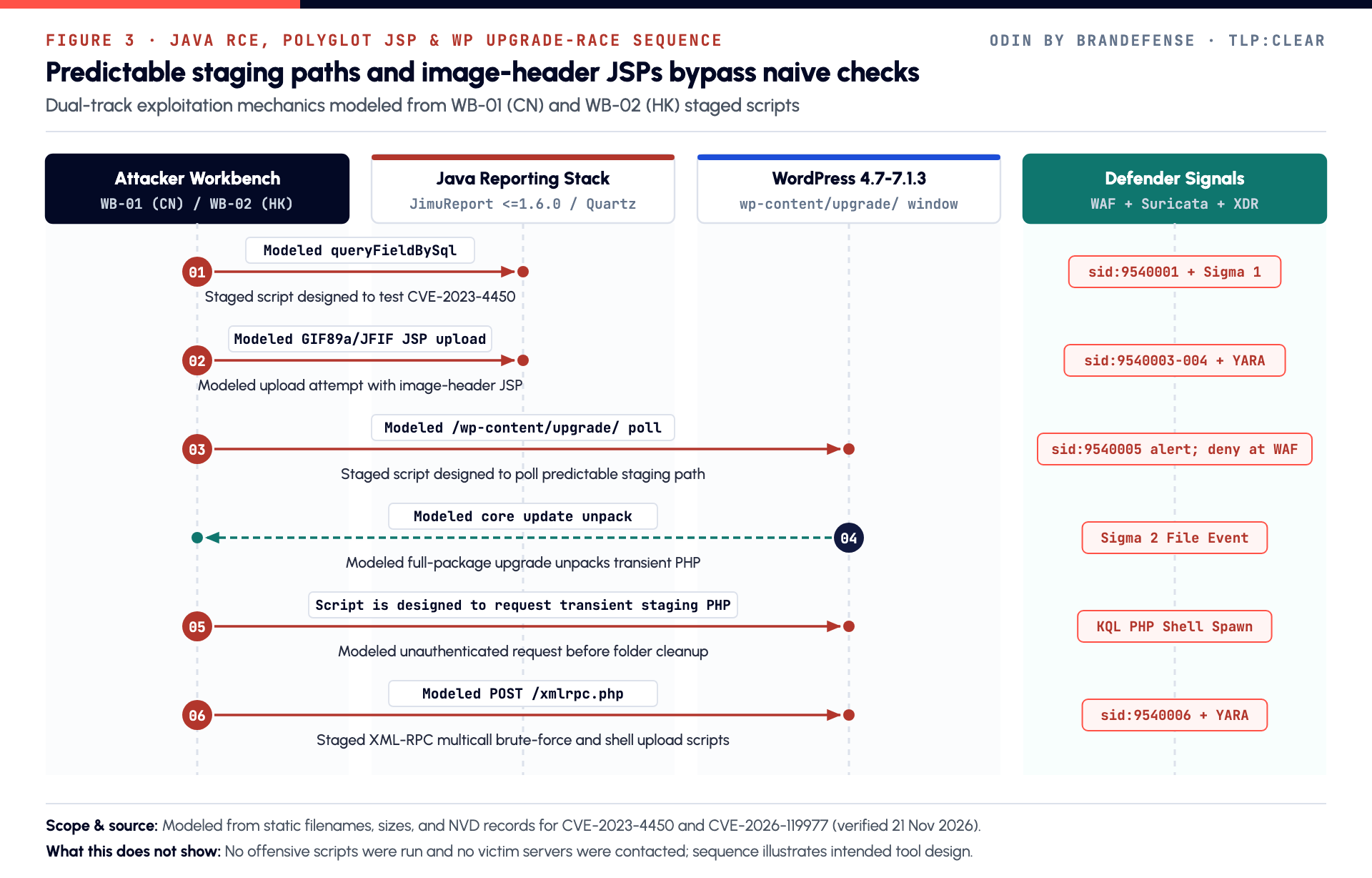
The standout file on Workbench B is a 4,377-byte Python upgrade-race script (filename withheld). It is built to exploit CVE-2026-119977, an unauthenticated remote code execution vulnerability in WordPress Core (T1190).
CVE-2026-119977 affects WordPress Core versions 4.7 through 7.1.3 across 25 release branches. NVD published the record on 31 October 2026 with a CVSS v3.1 score of 8.1 High (verified 21 November 2026). During a full-package core upgrade, WordPress extracts the new archive into a staging directory under wp-content/upgrade/ inside the web root. It then copies the files into place and removes the temporary folder.
In vulnerable versions, those staging paths are predictable and reachable over HTTP while the update is running. An attacker cannot trigger the upgrade without credentials, which is why CVSS rates attack complexity as High. Instead, the staged race script is designed to use concurrent worker threads to poll predictable /wp-content/upgrade/ paths and request newly unpacked PHP files during the brief upgrade window.
WordPress fixed CVE-2026-119977 in 7.1.4, 7.0.8, 6.9.11, 6.8.12, 6.7.11, and 6.6.11. It also shipped security point updates across older branches from 4.7.39 through 6.5.14. Blocking all external HTTP requests to /wp-content/upgrade/ at the reverse proxy or WAF closes the race window even before patching finishes.
Fallback CMS exploits, XML-RPC brute-forcing, and pivot helpers
Core upgrades happen infrequently on a single site. Workbench B also holds 44 other files, an open-source administration archive, and a 9-byte HTTP error stub:
| Tool group on Workbench B | Files | Sampled file sizes (filenames withheld) | Staged capability |
|---|---|---|---|
| Upgrade race and CMS PoC | 3 | Python race script (4,377 B), Python CMS PoC (84,986 B), JSON theme catalog (25,020 B) | Targets core upgrade paths and tests vulnerable WordPress themes |
| Webshell deployers | 2 | Two Python uploader scripts (2,172 B and 1,374 B) | Designed to upload PHP webshells through admin plugin or theme routes (T1505.003) |
| Login and XML-RPC brute force | 9 | Python login brute-forcer (2,056 B), XML-RPC multicall script (1,327 B), user enumerator (1,015 B), plus 6 helpers | Enumerates users and amplifies password guesses via system.multicall (T1110.001) |
| Recon and backup scanners | 5 | Duplicator backup scanner (1,353 B), two directory scanners (1,443 B and 1,786 B), REST summary script (1,009 B), plus 1 helper | Checks for exposed Duplicator backup archives, REST user lists, and directories |
| FTP, PHP wrappers, and network pivots | 18 | FTP test script (717 B), two PHP wrapper scripts (718 B and 294 B), redirect server (1,273 B), TCP forwarder (1,062 B), plus 13 helpers | Tests FTP credentials, PHP zlib:/ftp:// wrappers, HTTP redirects, and TCP forwarding |
| Wordlists and plugin lists | 8 | Eight .txt candidate lists (829,702 B, 357,076 B, 26,159 B, 941 B, and 4 smaller lists) | Supplies password masks, site-tailored candidates, and plugin probe names |
WordPress's /xmlrpc.php endpoint supports the system.multicall method, which packs hundreds of wp.getUsersBlogs login attempts into one HTTP POST request. The staged XML-RPC script is designed to use that feature to bypass naive per-request rate limits while testing candidates from the co-hosted password lists. The companion deployer scripts are written to automate PHP webshell uploads through authenticated admin routes.
5. Workbench C: Call-Center Web-Phone Probes and Enumeration Logs
In short
Workbench C was observed on 20 November 2026 in China (port withheld). Its four 148 KB text entries cover /VICIdial/phone, a portal login probe, an enumeration log, and a backslash probe. Defenders should lock call-center web panels behind VPNs and keep recon log hashes out of blocklists.
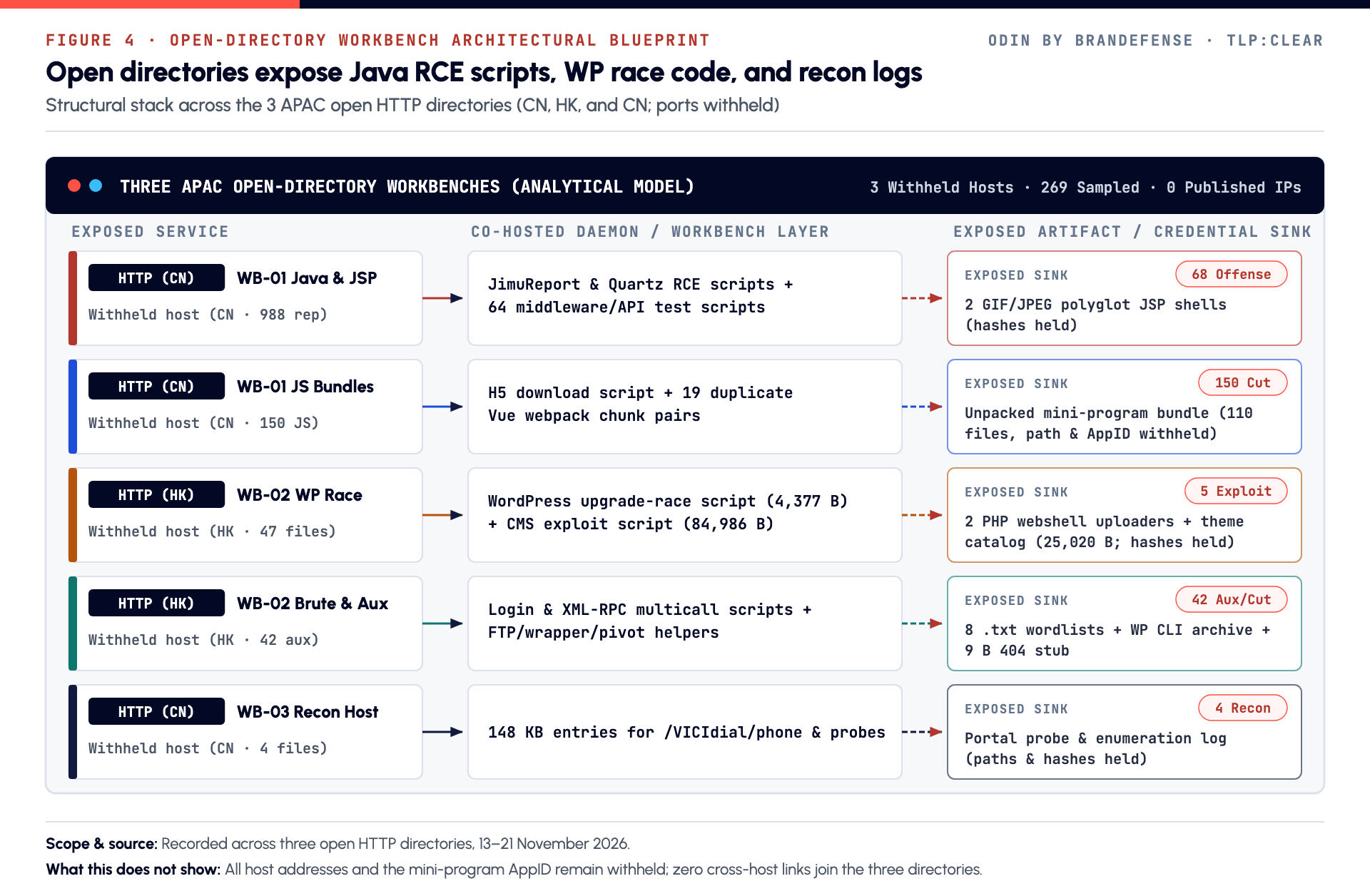
Workbench C (China, port withheld) is the smallest of the three open directories, reporting 4 exposed files that were all sampled on 20 November 2026. Figure 4 compares the directory layouts across the three servers.
All four entries on Workbench C are text files whose sizes cluster within a 68-byte band between 148,129 and 148,197 bytes:
| Entry on Workbench C | Size (bytes) | What it represents |
|---|---|---|
| Portal login-registration probe (path withheld) | 148,197 | Portal login and registration probe entry (digest withheld at source) |
| Backslash path-normalization probe | 148,180 | Backslash path-normalization probe testing proxy versus origin routing |
| Web-surface enumeration log (filename withheld) | 148,138 | Saved CMS and web-surface enumeration output log |
/VICIdial/phone route entry | 148,129 | Web-agent softphone route for the VICIdial call-center platform |
VICIdial is an open-source Asterisk contact-center suite used by customer-support and telemarketing teams. Attackers scan for internet-exposed /VICIdial/phone and /agc/ agent portals to abuse SIP trunks for toll fraud, read customer call records, or chain authenticated dialer vulnerabilities.
Because the four files on Workbench C are uniform 148 KB enumeration logs or templated HTTP responses rather than standalone exploit tools, we withhold all Workbench C hashes. Defenders should instead use /VICIdial/phone as a network hunt path to find any call-center interface left open to the public internet.
6. Analytical Model Boundaries and Alternative Explanations
In short
Zero shared IP addresses or file hashes connect the three directories, so we treat them as an analytical model rather than one group. Because directory ownership is unconfirmed and 164 sampled entries are bundles, stubs, wordlists, or logs, all file hashes are withheld. Defenders should hunt on request and process behavior.
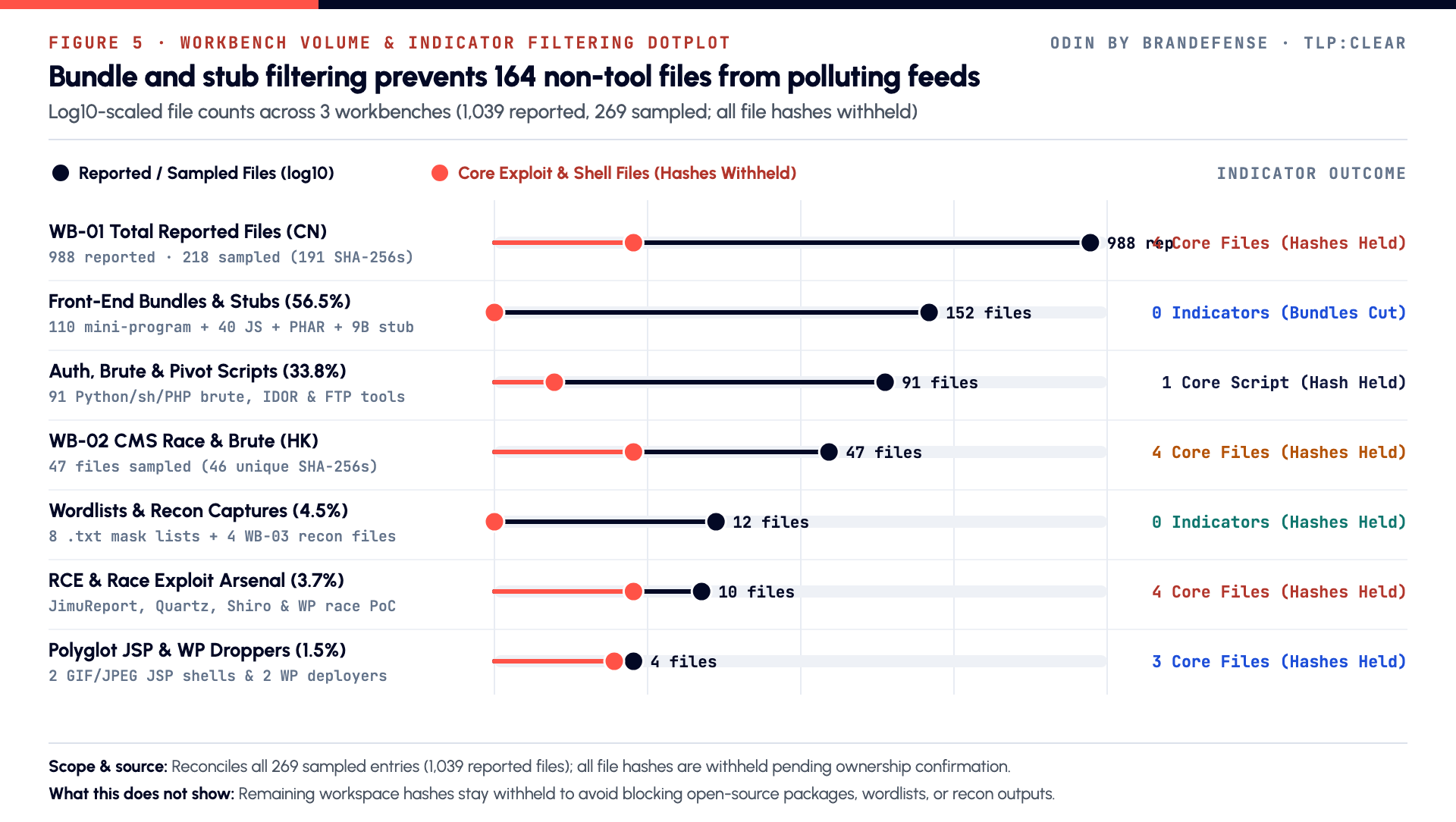
Four plain analytical boundaries apply to everything in this study:
- Three separate hosts, not one proven actor. Workbenches A, B, and C were recorded between 13 and 21 November 2026 and focus on web and middleware targets in Asia-Pacific. However, zero shared hosts, zero shared SHA-256 digests, and zero shared filenames connect them. Grouping them is an analytical model for defenders running hybrid Java and PHP stacks, not an attribution claim.
- Staged scripts do not confirm breaches. Finding JimuReport scanners, polyglot JSP webshells, or WordPress upgrade-race scripts on an open server shows what the operator prepared. Nothing in our dataset confirms whether any target JimuReport, Quartz, WordPress, or VICIdial system was breached.
- Client bundles and stubs are noise. Over three-fifths of the sampled entries (164 of 269, 61.0%) are unpacked client JavaScript bundles (150 files), the WordPress CLI PHAR archive (1 file), and the 9-byte
Not Foundstub (1 file). The rest of those 164 files are password wordlists (8 files) and Workbench C recon captures (4 files). Keeping all 164 out of hash feeds protects SOC teams from self-inflicted false alerts. - An exposed security-testing workspace is plausible on Workbench A. Test-style script roles on Workbench A (covering CAPTCHA reuse, configuration checks, and OAuth grant tests; filenames withheld) could fit an application-security consultant who left a testing directory open (port withheld). Even so, leaving live RCE scanners and polyglot JSP webshells on unauthenticated HTTP creates real risk, and all host addresses, ports, and file hashes stay withheld.
7. What Defenders Should Do
Java reporting and middleware
- Upgrade JeecgBoot JimuReport to version 1.6.1 or later across every environment to close CVE-2023-4450.
- Block direct internet access to
/jmreport/*,/sys/quartzJob/*,/scheduler/jobs, and Nacos admin endpoints at the reverse proxy, requiring strong authentication and role checks. - Rotate default or static Apache Shiro
RememberMeencryption keys and update Fastjson libraries to safe versions withsafeModeenabled.
WordPress and PHP platforms
- Update WordPress Core to 7.1.4, 7.0.8, 6.9.11, 6.8.12, 6.7.11, 6.6.11, or the fixed maintenance release for your branch to remediate CVE-2026-119977.
- Deny all external HTTP requests to
/wp-content/upgrade/at Nginx, Apache, and the WAF so no caller can reach transient files during core, plugin, or theme updates. - Disable
/xmlrpc.phpif Jetpack or mobile RPC clients are not used, or blocksystem.multicallat the WAF. Remove leftover Duplicator backup archives and setallow_url_include = Offinphp.ini.
File upload pipelines
- Store user-uploaded images and documents in object storage or outside Java servlet and PHP execution roots, and turn off script execution on all upload directories.
- Validate uploads with an explicit extension allowlist, generate random server-side filenames, and re-encode GIF and JPEG images so appended
<%JSP or PHP tags are stripped.
Network and call-center portals
- Place VICIdial agent interfaces (
/VICIdial/phoneand/agc/) behind corporate VPNs or IP allowlists, and audit staging VPS instances for open HTTP directory listings.
8. Detection Rules
The full rules are in the Detection rules tab. All four published rule files pass static syntax and lint checks; they were not replayed against live network traffic or running engines on our build host. Test and tune them in your own environment before turning on inline blocking or automated host isolation.
| Rule file | What it catches |
|---|---|
odin_jimureport_polyglot_jsp_and_wp_race_exploits.rules | Suricata 7: eight signatures for JimuReport CVE-2023-4450, Quartz job RCE, polyglot JSP uploads and hits, WordPress /wp-content/upgrade/ race requests, XML-RPC system.multicall, /VICIdial/phone recon, and exposed workbench listings |
sentinel_jimureport_polyglot_jsp_and_wp_race_hunt.kql | Microsoft Sentinel and Defender XDR: Java or PHP workers spawning shells or Python exploit command lines, with matching network calls shown only as context |
sigma_java_reporting_rce_polyglot_jsp_and_wp_race.yml | Sigma (3 Linux rules): java or php-fpm spawning shells, .php or .jsp creation in upgrade or upload paths, and Python command lines targeting product routes |
odin_polyglot_jsp_jimureport_and_wp_race_artifacts.yar | YARA (4 rules): GIF/JPEG-header JSP polyglots, JimuReport and Quartz RCE scripts, WordPress CVE-2026-119977 race scripts, and XML-RPC/deployer tools |
How the Suricata signatures work
| SID | Looks for | Why |
|---|---|---|
| 9540001 | Inbound POST to /jmreport/queryFieldBySql carrying FreeMarker Execute, ?new(), or java.lang.Runtime | Catches JimuReport CVE-2023-4450 template injection attempts (block candidate) |
| 9540002 | Inbound POST to Quartz job routes containing jobClassName with Runtime, ProcessBuilder, InitialContext, or GroovyShell | Catches Java Quartz scheduler command-execution probes |
| 9540003 | Inbound POST body naming .jsp that pairs GIF89a, GIF87a, or JPEG JFIF magic bytes with <% JSP tags | Catches multipart uploads of image-header polyglot JSP webshells (block candidate) |
| 9540004 | Inbound request URI targeting .jsp files inside /upload/, /uploads/, /files/, /media/, or /static/ | Catches direct HTTP access to uploaded JSP webshells in media folders (block candidate) |
| 9540005 | Inbound request URI targeting .php files inside /wp-content/upgrade/ | Catches CVE-2026-119977 upgrade-window race requests; visitors never need this path (block candidate) |
| 9540006 | Inbound POST to /xmlrpc.php containing system.multicall and wp.getUsersBlogs | Hunt or rate-limit signal for amplified WordPress password guessing |
| 9540007 | Inbound request URI matching /VICIdial/phone | Hunt signal for external reconnaissance against call-center agent portals |
| 9540008 | Inbound HTTP 200 Directory listing for / referencing CVE-2026-119977, CVE-2023-4450, jmreport, or xmlrpc | Flags exposed exploit workbenches during perimeter monitoring |
How the endpoint and file rules work
The Sentinel KQL query looks back 7 days and joins DeviceProcessEvents with DeviceNetworkEvents. On the process side, it flags java, php-fpm, apache2, httpd, or w3wp.exe starting shells or recon binaries. It also checks for Python or curl command lines referencing /jmreport/queryFieldBySql, /sys/quartzJob, /wp-content/upgrade/, or system.multicall. Network filtering uses contains on RemoteUrl for /jmreport/queryFieldBySql, /wp-content/upgrade/, /xmlrpc.php, and /VICIdial/phone. Use HTTP or WAF logs where RemoteUrl lacks a path, and keep exact hostnames in the named allowlists.
The three Linux Sigma rules cover auditd and eBPF telemetry. Rule 1 alerts when java or PHP web workers spawn shells outside named build or test servers. Rule 2 watches file creation for .jsp files in upload folders or .php files under /wp-content/upgrade/ outside a named runner. Rule 3 catches Python command lines targeting /jmreport/queryFieldBySql, /sys/quartzJob, /wp-content/upgrade/, system.multicall, or /VICIdial/phone.
| YARA rule | Fires when |
|---|---|
ODIN_Polyglot_Image_Header_JSP_Webshell | A file under 256 KB starts at byte 0 with GIF89a, GIF87a, or FF D8 FF and also contains <% plus a Java execution API |
ODIN_JimuReport_and_Quartz_RCE_Scanner_Script | A script under 128 KB combines JimuReport SQL/show routes or Quartz jobClassName routes with FreeMarker or Java execution calls |
ODIN_WordPress_CVE_2026_119977_Upgrade_Race_Exploit | A script under 256 KB combines /wp-content/upgrade/ with Python threading/async pools and CVE-2026-119977 or core-update markers |
ODIN_WordPress_XMLRPC_Multicall_and_Shell_Deployer | A script under 256 KB combines /xmlrpc.php, system.multicall, and wp.getUsersBlogs, or WordPress admin theme/plugin upload paths |
MITRE ATT&CK mapping
| Tactic | Technique | How the tooling uses it | Detection coverage |
|---|---|---|---|
| Initial Access | T1190 Exploit Public-Facing Application | JimuReport (CVE-2023-4450), Quartz job, and WordPress upgrade-race (CVE-2026-119977) scripts | SIDs 9540001, 9540002, 9540005; Sigma rules 1 to 3; YARA |
| Persistence | T1505.003 Server Software Component: Web Shell | GIF and JPEG polyglot JSP webshells and WordPress PHP shell upload scripts | SIDs 9540003, 9540004; KQL; Sigma rules 1 and 2; YARA |
| Credential Access | T1110.001 Brute Force: Password Guessing | WordPress login brute-force, XML-RPC system.multicall, and Shiro key scripts | SID 9540006; Sigma rule 3; YARA |
| Reconnaissance | T1595.002 Active Scanning: Vulnerability Scanning | /VICIdial/phone probing plus directory and backup scanners | SIDs 9540007, 9540008; KQL |
9. Indicators
The Indicators tab holds 0 published network addresses and 0 file hashes because directory ownership is not established. Six generic product routes and RPC patterns appear in this report for WAF rules, reverse proxies, and access-log hunts.
| Type | Count | Where to use it |
|---|---|---|
| Network addresses | 0 | All three open-directory host addresses and ports are withheld |
| File hashes (SHA-256) | 0 | All file hashes are withheld pending ownership confirmation |
| Product routes and RPC patterns | 6 | Listed below for WAF rules, reverse proxies, and access-log hunts |
File hashes withheld pending ownership confirmation
All SHA-256 file hashes from Workbenches A, B, and C are withheld because ownership of the exposed servers is not established. This includes the eight core exploit and webshell files as well as the 164 client bundle, PHAR, stub, wordlist, and reconnaissance files.
Behavioral request and path patterns (report only)
| Pattern | Type | How to use it |
|---|---|---|
/jmreport/queryFieldBySql | HTTP URI route | Restrict externally and inspect POST bodies for FreeMarker expressions |
/jmreport/show | HTTP URI route | Restrict externally and inspect requests for template injection expressions |
/sys/quartzJob/ | HTTP URI route | Restrict externally and audit job-registration requests for jobClassName |
/wp-content/upgrade/ | Staging path prefix | Block all external HTTP requests at the web server and WAF |
system.multicall on /xmlrpc.php | XML-RPC method | Block or rate-limit when XML-RPC batch authentication is unneeded |
/VICIdial/phone | Call-center URI | Restrict to internal agent VPNs and hunt external hits |
Withheld: all three open-directory IP addresses and ports, all workbench-specific file paths and script names, and the unpacked mini-program AppID. All 240 unique SHA-256 digests from the sampled directories are also withheld.
10. Scope and Limits
- Observation window. All findings come from directory samples recorded between 13 and 21 November 2026.
- Static files, not target telemetry. Our review covers directory listings, file sizes, paths, and SHA-256 digests. Nothing we observed shows whether these scripts were used against or breached any specific downstream organization.
- Analytical model, not a single group. Zero shared hosts, hashes, or filenames link Workbenches A, B, and C. We group them only to illustrate complementary threats to Java middleware and PHP CMS stacks.
- Assessment workspace possibility. Structured test script names on Workbench A could belong to a security assessment team that misconfigured a server, which is one reason all host addresses stay withheld.
- Strict hash filtering. Hashes of downloaded front-end bundles, open-source CLI archives, wordlists, and enumeration logs are withheld so they cannot cause false positives or expose target material.
- Rule validation. The Suricata, Sentinel KQL, Sigma, and YARA files were checked statically on 21 November 2026 and were not replayed against live traffic, so tune them locally before production enforcement.
11. Sources
- National Vulnerability Database (NIST). CVE-2023-4450 Detail: JeecgBoot JimuReport Template Handler Injection. https://nvd.nist.gov/vuln/detail/CVE-2023-4450 (verified 21 November 2026)
- National Vulnerability Database (NIST). CVE-2026-119977 Detail: WordPress Core Upgrade Staging Path Remote Code Execution. https://nvd.nist.gov/vuln/detail/CVE-2026-119977 (verified 21 November 2026)
- JeecgBoot Project. JimuReport Releases and Security Updates (v1.6.1+). https://github.com/jeecgboot/JimuReport/releases (verified 21 November 2026)
- Quartz Enterprise Job Scheduler. Official Documentation. https://www.quartz-scheduler.org/documentation/ (verified 21 November 2026)
- OWASP Cheat Sheet Series. File Upload Cheat Sheet. https://cheatsheetseries.owasp.org/cheatsheets/File_Upload_Cheat_Sheet.html (verified 21 November 2026)
- WordPress Documentation. Updating WordPress. https://wordpress.org/documentation/article/updating-wordpress/ (verified 21 November 2026)
- MITRE ATT&CK. T1190 Exploit Public-Facing Application. https://attack.mitre.org/techniques/T1190/ (verified 21 November 2026)
- MITRE ATT&CK. T1505.003 Server Software Component: Web Shell. https://attack.mitre.org/techniques/T1505/003/ (verified 21 November 2026)
Frequently asked questions
What did we find on the three servers?
Open web directories left on virtual private servers show more than a single attack packet. Defenders can use cyber threat intelligence to assess the vulnerability scanners, fallback brute-force scripts, webshells, and downloaded client code sitting in an operator's folder. We reviewed file paths, sizes, dates, and SHA-256 digests without running any script or contacting any external system.
How do the Java reporting probes and polyglot JSP shells work?
Many business portals in Asia-Pacific run Spring Boot frameworks such as JeecgBoot, which combine JimuReport dashboards, Quartz background jobs, Fastjson, Apache Shiro, and Nacos. Defenders can use vulnerability intelligence to prioritize the JeecgBoot components targeted by Workbench A.
How does the WordPress upgrade-window race exploit work?
Workbench B was observed on 20 November 2026, twenty days after CVE-2026-119977 was published in the National Vulnerability Database on 31 October 2026 (CVSS v3.1 8.1 High). Its lead Python race script (4,377 bytes; filename withheld) is written specifically for that flaw.
Why did we cut 164 files from the indicator list?
Pulling every hash from an open directory into a SOC blocklist causes immediate damage. Out of the 269 sampled entries (240 unique SHA-256 digests), 152 files (56.5%) are client bundles, open-source packages, or HTTP error stubs. Another 12 files (4.5%) are password wordlists or reconnaissance logs.