
Key takeaways
- Four open HTTP directories in the US, Hong Kong, China, and South Korea exposed 116 post-exploitation files (106 unique SHA-256 digests).
- One US build server pairs 21 Windows DNS and HTTP beacons (including 7 equal-length secondary copies) with 27 cross-OS Go and ELF agents.
- A Hong Kong server bundles a Linux root privilege-escalation script and ARM64 WebSocket stagers with a legitimate 25.3 MB RustDesk Debian installer.
- Out of 97,103 C2 feed rows (153 reviewed endpoints), 12 Cobalt Strike ports on 8 cloud hosts lack independent protocol confirmation and remain withheld.
- Hunt the 5 custom implant hashes and 4 Cobalt Strike TLS JARM fingerprints, inspect recursive DNS traffic, and ban unapproved RustDesk installs on Linux.
Four open HTTP directories exposed 116 staged files, including DNS and HTTP beacons, Linux agents, and a RustDesk installer. Odin by Brandefense reviewed those files and 153 C2 endpoints from 97,103 feed records in records dated 14–20 November 2026. The files cover Windows, Linux x86_64 and ARM64, and macOS. They do not show a beacon failing over to DNS or RustDesk being installed on a target.
What did we find across the four open directories?
Defenders can use external attack surface management to find unauthenticated HTTP directory listeners that expose entire build trees on virtual private servers. We reviewed file paths, byte sizes, dates, and SHA-256 digests across four directories without running any binary or contacting external targets.
Comparing their attack surface records found zero shared IPv4 addresses or custom hashes connecting the four directories to one another or to the command-and-control listeners we reviewed. We therefore treat them as an analytical model for cyber threat intelligence teams rather than one threat group, and all four directory host addresses remain withheld.
- Workbench A (United States, port 8000, 82 files) was observed between 19 and 20 November 2026. It stages 21 Windows DNS and HTTP beacons,
/backoper_agent.elf(6,430,904 B), and 26 Go implants across Linux, Windows, and macOS. Beside them sit 13 scripts, 15 logs, and 4 Windows credential dumpers added on the second day. - Workbench B (Hong Kong, port 8000, 12 files) was observed on 20 November 2026. It pairs
/root_pwn.sh(8,030 B) with 9,848 B Linux loaders and Linux x86_64 and ARM64 WebSocket stagers (/wsand/ws_linux_arm64). It also holds equal-length/c_agentand/c_abinaries (534,256 B), Windows executables, and a legitimate/rustdesk-1.5.1-x86_64.deb(25.34 MB) installer. - Workbenches C and D (China and South Korea, port 80, 21 files and 1 file) complete the lateral and legacy-Linux layers. Workbench C stages
fscan.exe,Win32andx64Mimikatz,mimidrv.sys,kiwi_passwords.yar, and 9.26 MB tool archives. Workbench D serves a single 32-bit Linux TCP stager (/tcp_linux_i386, 2,607,220 B).
How do fixed-size DNS beacons and Go implants evade single hashes?
On Workbench A, 14 root Windows beacon files sit alongside a 7-file secondary build folder. Each secondary file has the same byte length as its root counterpart but a different SHA-256 digest.
The seven pairs cover /beacon_dns_x64.dll (166,400 B), /beacon_dns_x64.exe (167,424 B), /beacon_http_x64.dll (103,936 B), and /beacon_http_x64.exe (104,448 B). The remaining three pairs cover /beacon_http_x64_shellcode.bin (103,935 B), /beacon_http_x64_svc.exe (104,448 B), and /beacon_http_x86.exe (95,232 B). The inventory does not show which bytes changed or establish configuration patching.
Comparing the two beacon transports also shows a consistent 62.5 KB to 63.0 KB size jump on the DNS builds. The DNS builds are 62,464 B to 62,976 B larger than their HTTP counterparts. The file inventory does not show which code accounts for that difference.
The same equal-length pattern shows up on Linux. Eighteen Linux x86_64 ELF files on Workbench A share the exact size 6,430,904 B while hashing to 18 unique SHA-256 digests. Those files include /backoper_agent.elf, /agent_custom_tag.bin, /gopher_linux_amd64.elf, and /g_4tomcat.elf.
Nine companion Go builds cover Linux ARM64 (5,963,960 B) and Windows x64 (6,048,256 B) or ARM64 (5,523,456 B). Two macOS .macho builds cover Intel (6,209,664 B) and Apple Silicon (5,854,658 B).
Why is a RustDesk Debian package staged next to root escalation scripts?
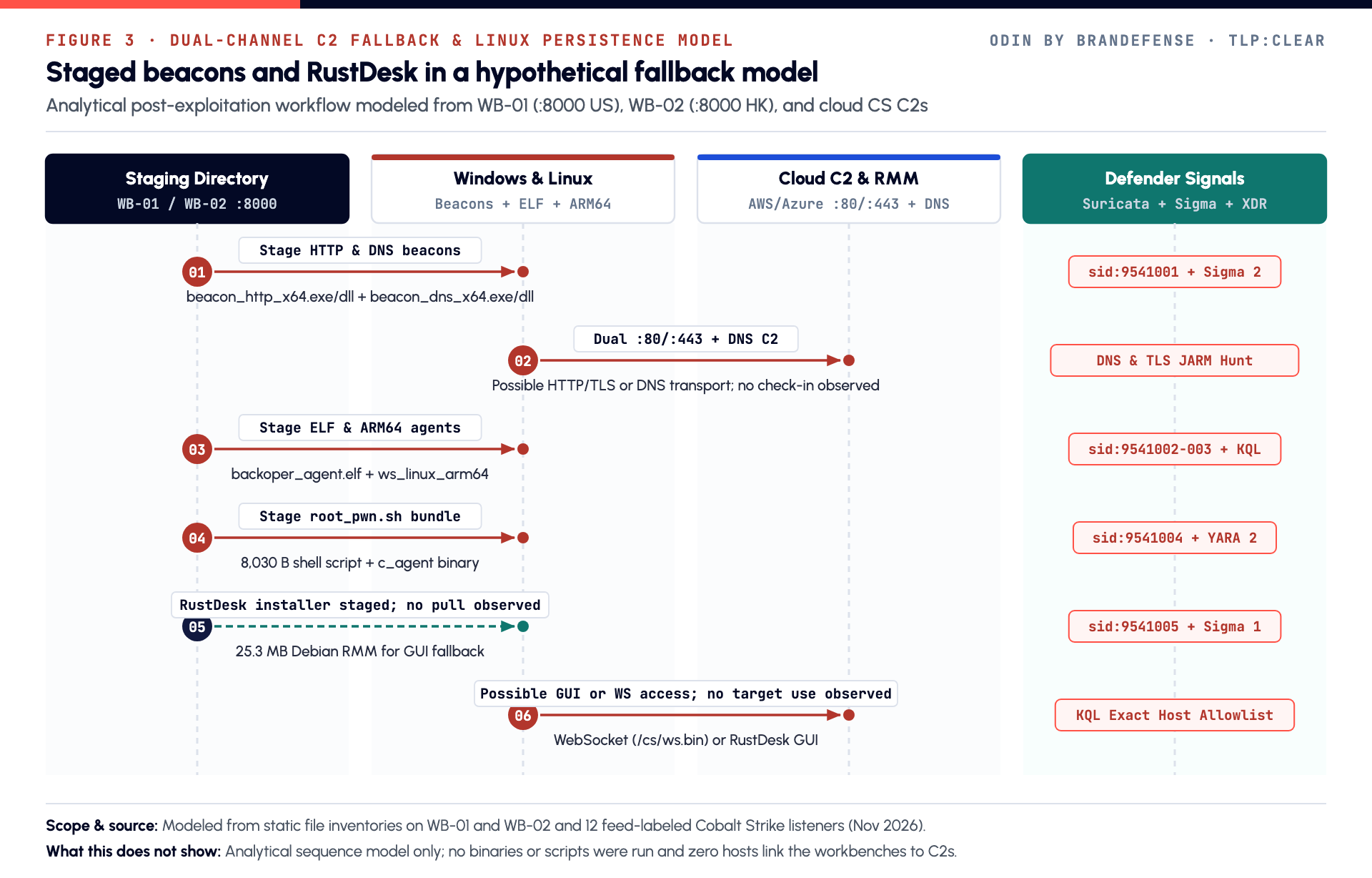
Workbench B holds /root_pwn.sh (8,030 B), /ws_linux_arm64 (10,816 B), and /cs/ws.bin (2,100 B). The same folder holds /rustdesk-1.5.1-x86_64.deb (25,337,156 B).
RustDesk is a legitimate open-source remote desktop program. If installed on a Linux host, the .deb package can register rustdesk.service and connect to relay servers. No installation or connection was observed here.
If an EDR sensor catches and quarantines /ws_linux_arm64 or /c_agent, an installed remote desktop service could keep running unless Linux policies forbid unapproved remote-access software. Because RustDesk is legitimate third-party software, we withhold its file hash and hunt unauthorized .deb downloads and dpkg/apt installs instead.
Which cloud C2 servers should defenders block versus hunt?
The four feeds contain 97,103 rows: Cobalt Strike (80,375), Cobalt Strike unverified (7,037), Sliver (5,592), and Metasploit (4,099). We examined 153 recently active endpoints across 137 hosts.
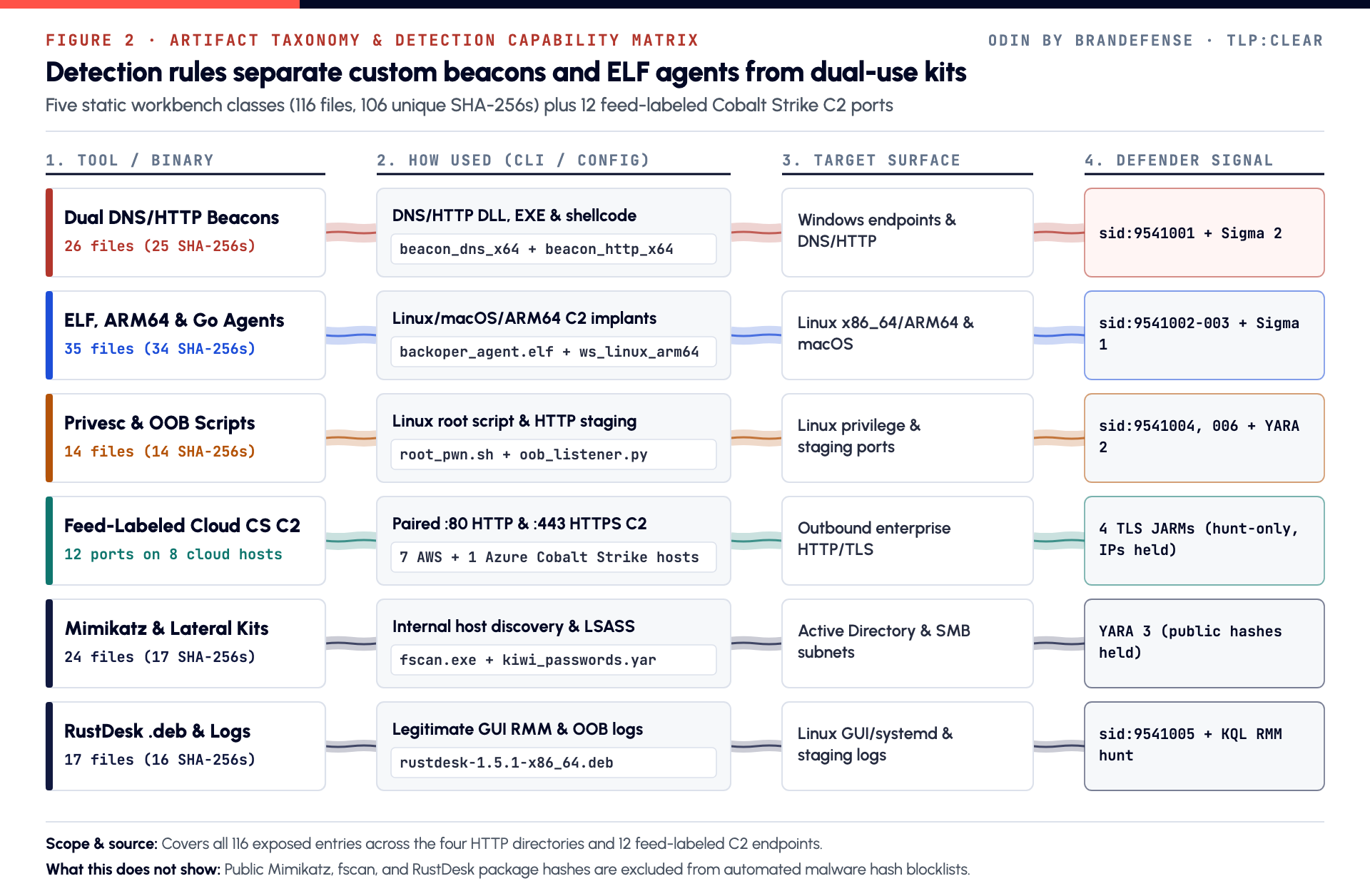
The source inventory labels 12 of 153 reviewed endpoints as confirmed Cobalt Strike, but the supplied records do not establish independent beacon or protocol confirmation. Those 12 ports sit on eight commercial cloud hosts (7 on AWS across the US, Germany, Australia, and Japan, plus 1 on Microsoft Azure in the US). Four of the AWS hosts pair ports :80 and :443, and all eight IPv4 addresses remain withheld.
All 141 remaining endpoints also stay off blocklists for clear operational reasons. Ten sit on dynamic telecom broadband networks (including two upstream feed rows tagged confirmed on Chinanet), where IP churn hurts innocent subscribers. One 62-character JARM fingerprint seen on four feed-confirmed Cobalt Strike AWS hosts also appears on 14 other AWS servers (including 12 Metasploit :443 hosts). Dozens of Sliver (:31337, CN=localhost) and Metasploit (:3790) entries match default configurations used daily by authorized red teams.
What to do now
- Require independent protocol confirmation before blocking feed C2 addresses. Keep unverified cloud and dynamic-ISP feed addresses off firewall blocklists, and use the four Cobalt Strike TLS JARM fingerprints strictly for multi-signal hunting.
- Inspect recursive DNS traffic for beacon tunneling. Force endpoints through internal DNS resolvers, block direct outbound port 53 and unapproved DoH/DoT, and alert on high-entropy subdomain or
TXT/AAAAquery bursts. - Ban unauthorized
RustDeskinstalls on Linux servers. Lockdpkgandaptto approved internal repositories, alert on unexpectedrustdesk.serviceunits, and restrict outbound ports 21115 to 21119. - Close ARM64 and Apple Silicon EDR gaps. Confirm that process and file-execution telemetry covers Linux
ARM64, Linuxx86_64/i386, WindowsARM64, and macOS.machoendpoints. - Deploy the published rules and 5 custom hashes. Load the Suricata (
SIDs 9541001to 9541006), Sentinel KQL, Sigma, and YARA rules from the full report's Detection rules tab alongside the 5 custom implant SHA-256 digests. Keep JARM fingerprints and public tool hashes hunt-only.
What is…?
Short explanations of the tools and families named in this study.
What is Cobalt Strike?
Cobalt Strike is commercial adversary simulation software. Its Beacon implant gives an operator remote control of a compromised host. Cracked and leaked copies are widely used by ransomware and espionage operators.
More about Cobalt StrikeTechniqueWhat is JARM?
JARM is an open TLS server fingerprinting method from Salesforce. It hashes how a server answers a set of crafted TLS handshakes.
More about JARMOffensive frameworkWhat is Metasploit?
Metasploit is an open-source penetration testing framework maintained by Rapid7. It bundles exploits, payloads and the Meterpreter post-exploitation agent.
More about MetasploitC2 frameworkWhat is Sliver?
Sliver is an open-source command-and-control (C2) framework from Bishop Fox, written in Go. Red teams use it for adversary emulation, and criminal and state operators use it as a free alternative to Cobalt Strike.
More about SliverFrequently asked questions
What did we find across the four open directories?
Defenders can use external attack surface management to find unauthenticated HTTP directory listeners that expose entire build trees on virtual private servers. We reviewed file paths, byte sizes, dates, and SHA-256 digests across four directories without running any binary or contacting external targets.
How do fixed-size DNS beacons and Go implants evade single hashes?
On Workbench A, 14 root Windows beacon files sit alongside a 7-file secondary build folder. Each secondary file has the same byte length as its root counterpart but a different SHA-256 digest.
Why is a RustDesk Debian package staged next to root escalation scripts?
Workbench B holds /root_pwn.sh (8,030 B), /ws_linux_arm64 (10,816 B), and /cs/ws.bin (2,100 B). The same folder holds /rustdesk-1.5.1-x86_64.deb (25,337,156 B). RustDesk is a legitimate open-source remote desktop program. If installed on a Linux host, the .deb package can register rustdesk.service and connect to relay servers. No installation or connection was observed here.
Which cloud C2 servers should defenders block versus hunt?
The four feeds contain 97,103 rows: Cobalt Strike (80,375), Cobalt Strike unverified (7,037), Sliver (5,592), and Metasploit (4,099). We examined 153 recently active endpoints across 137 hosts. The source inventory labels 12 of 153 reviewed endpoints as confirmed Cobalt Strike, but the supplied records do not establish independent beacon or protocol confirmation.