


Key takeaways
- Odin mapped 209 endpoints on 175 hosts across six offensive tool families; 23 are confirmed and ready to block.
- JavaChains Java exploit servers cluster on port 8011 in Chinese clouds; 16 are confirmed.
- Responder, an internal network tool, runs on public cloud servers to catch Windows login handshakes; 7 are confirmed.
- One exposed workbench holds scripts that carry QUIC shells and file transfers inside ICMP ping packets.
- Block the 23 servers, stop outbound SMB and NTLM, and inspect outbound ping traffic.
In a two-week observation window ending 18 November 2026, Odin by Brandefense mapped 209 endpoints on 175 hosts across six offensive tool families. We also found three exposed staging workbenches. Together they show a split of labor: one tool breaks into Java applications, another collects Windows login handshakes, and a third keeps a shell alive through a strict firewall. Of the 209 endpoints, 23 are confirmed and ready to block. For defenders, the lesson is that each stage leaves a different trace, and each can be stopped at the perimeter.
What did we find?
The 209 endpoints fall into four roles. This is our analytical model. Each tool was observed on its own, and nothing ties the families to a single operator.
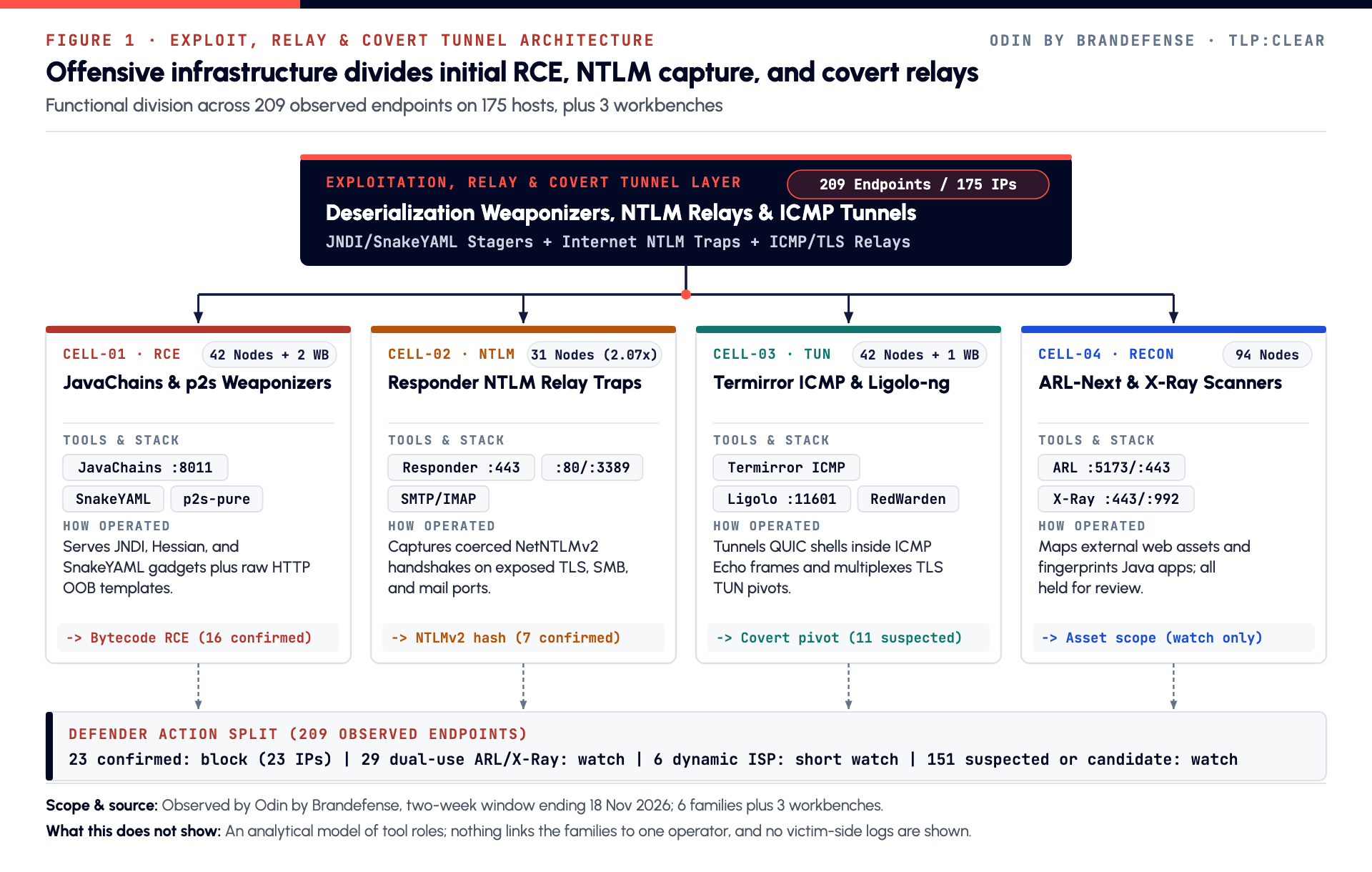
| Role | Tools | Endpoints | Confirmed to block |
|---|---|---|---|
| Java exploit delivery | JavaChains | 42 | 16 |
| Windows credential capture | Responder | 31 | 7 |
| Covert tunnels and C2 guardrails | Ligolo-ng, RedWarden | 42 | 0 |
| Reconnaissance | ARL-Next, X-Ray | 94 | 0 |
China hosts 87 of the endpoints, the United States 46 and Hong Kong 29. Java exploit servers sit mostly on Tencent and Alibaba clouds in China. The credential traps sit mostly on Namecheap, DigitalOcean and Amazon in the United States.
How do the Java exploit servers work?
Many Java applications turn incoming data back into objects. If that step is unsafe, an attacker can make the application download and run a remote Java class. JavaChains packages this attack. It builds payloads for common Java libraries and runs the callback servers that hand out the malicious code.
Of 42 JavaChains endpoints, 38 listen on port 8011. Sixteen are confirmed on dedicated cloud servers in China, Hong Kong and Germany. Three more sit on Chinese home-broadband networks, where addresses change hands, so we watch them instead of blocking.
Two exposed workbenches show the preparation side. One holds a reconnaissance worker next to a payload builder for RuoYi, a popular open-source Java admin framework. The builder abuses an unsafe YAML parser, tracked as CVE-2022-1471, to load a remote code archive and plant an in-memory web filter. The other workbench holds 123 files for replaying raw HTTP exploits, including a 317.8 MB log of out-of-band callbacks.
These are staged tools and attacker logs. They show intent. We did not confirm an exploit against any specific target.
Why put an NTLM trap on the internet?
Responder normally runs inside a company network. It answers name lookups and collects Windows login handshakes. Here we found 31 Responder endpoints on 15 public servers.
The trick is to make an internal Windows machine reach out. A link in a document, a file path or a forged web redirect can point at an external server. Windows then starts a login exchange on its own, and the trap records the handshake. The attacker can try to crack it offline or relay it.
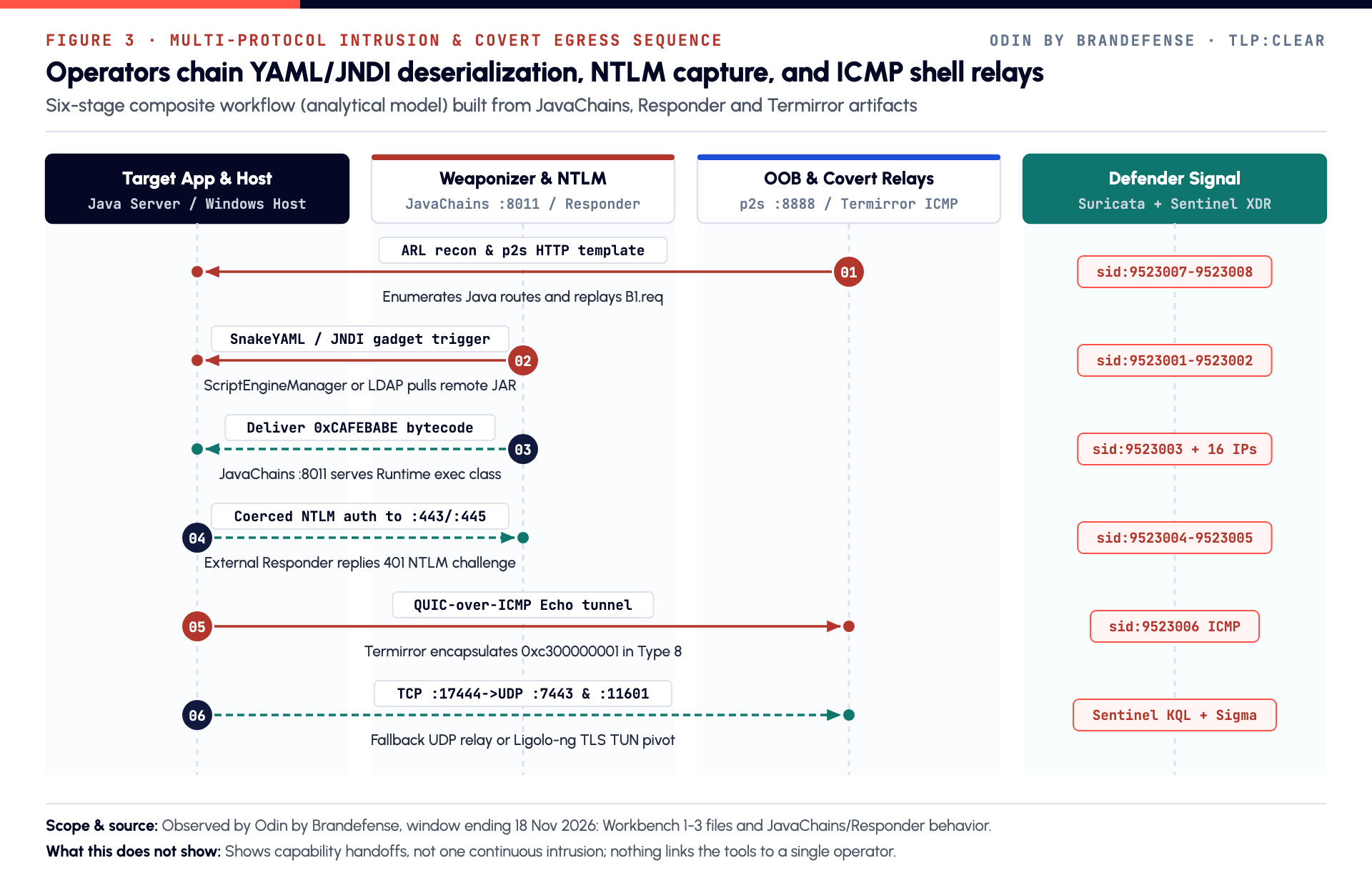
Seven Responder listeners are confirmed. Four use HTTPS on port 443, because many firewalls block outbound file sharing but allow web traffic. The others use remote desktop, SIP over TLS and port 5120. Two more servers run a full set of fake mail and FTP login services on six or seven ports at once.
The defense is simple and cheap. Windows authentication should never leave your network for an unknown internet host.
How can a shell hide inside ping traffic?
Many firewalls send web traffic through a proxy for inspection but still allow ping. The third workbench takes advantage of that. It holds a toolkit called Termirror that carries an encrypted QUIC shell inside ICMP Echo packets.
The operator's scripts are written to open eight shell sessions at once and to push a 4 MB file over ping. If ICMP is blocked, a small relay switches to TCP on port 17444 and hands the data to UDP port 7443. Matching key pairs on the server and client keep strangers out.
Normal ping packets do not contain QUIC headers, so this tunnel can be spotted. Our Suricata rule looks for the QUIC header bytes inside outbound ping requests.
Odin also found 36 Ligolo-ng tunnel endpoints and 6 RedWarden C2 proxies. Ligolo-ng gives an attacker a virtual network interface into a breached network over TLS. RedWarden screens visitors before they reach a C2 server. Red teams use both tools too, so we hold these endpoints for review.
Should we block the scanners too?
No. ARL-Next and X-Ray map websites and look for flaws. Attackers use them, but so do many security teams and bug-bounty hunters. None of the 94 scanner endpoints shares an address with a confirmed exploit server or NTLM trap. Blocking them would mostly hit legitimate testers. Watch them instead, and act when a second signal appears.
What to do now
- Block the 23 confirmed servers (16 JavaChains, 7 Responder). The full report's Indicators tab lists all 23 addresses. Review the blocks after 30 days, since cloud addresses get reassigned.
- Stop Windows authentication from leaving the network. Deny outbound SMB on ports 139 and 445, restrict the WebClient service, and limit outbound NTLM by policy.
- Patch and harden Java apps. Upgrade SnakeYAML to 2.0 or later, use its safe loader for untrusted input, and block outbound LDAP, RMI and JNDI callbacks from Java servers.
- Inspect outbound ping. Rate-limit ICMP from server subnets and alert on QUIC headers inside ping packets. The full report's Detection rules tab has Suricata, Sentinel KQL, Sigma and YARA rules.
- Keep dual-use tools on watchlists, not block lists, unless a second signal confirms hostile use.
The full report covers the infrastructure, workbench files, fingerprints and rule logic in detail.
What is…?
Short explanations of the tools and families named in this study.
What is JavaChains?
JavaChains is a Java exploitation toolkit that serves deserialization gadget chains and JNDI payloads from one server.
More about JavaChainsOffensive toolWhat is Responder?
Responder is an open-source tool that answers LLMNR, NBT-NS and mDNS name queries to capture NTLM authentication hashes.
More about ResponderTunneling toolWhat is Ligolo-ng?
Ligolo-ng is an open-source tunneling tool that builds a network tunnel from a compromised host through a TUN interface.
More about Ligolo-ngTechniqueWhat is JARM?
JARM is an open TLS server fingerprinting method from Salesforce. It hashes how a server answers a set of crafted TLS handshakes.
More about JARMTechniqueWhat is JNDI injection?
JNDI injection makes a Java application look up a remote object, usually over LDAP or RMI, and load attacker code. Log4Shell is the best-known example.
More about JNDI injectionReconnaissance platformWhat is ARL?
ARL (Asset Reconnaissance Lighthouse) is an open-source asset discovery platform, popular with Chinese-speaking testers and attackers.
More about ARLFrequently asked questions
What did we find?
The 209 endpoints fall into four roles. This is our analytical model. Each tool was observed on its own, and nothing ties the families to a single operator. China hosts 87 of the endpoints, the United States 46 and Hong Kong 29. Java exploit servers sit mostly on Tencent and Alibaba clouds in China. The credential traps sit mostly on Namecheap, DigitalOcean and Amazon in the United States.
How do the Java exploit servers work?
Many Java applications turn incoming data back into objects. If that step is unsafe, an attacker can make the application download and run a remote Java class. JavaChains packages this attack. It builds payloads for common Java libraries and runs the callback servers that hand out the malicious code.
Why put an NTLM trap on the internet?
Responder normally runs inside a company network. It answers name lookups and collects Windows login handshakes. Here we found 31 Responder endpoints on 15 public servers. The trick is to make an internal Windows machine reach out. A link in a document, a file path or a forged web redirect can point at an external server. Windows then starts a login exchange on its own, and the trap records the handshake.
How can a shell hide inside ping traffic?
Many firewalls send web traffic through a proxy for inspection but still allow ping. The third workbench takes advantage of that. It holds a toolkit called Termirror that carries an encrypted QUIC shell inside ICMP Echo packets.
Should we block the scanners too?
No. ARL-Next and X-Ray map websites and look for flaws. Attackers use them, but so do many security teams and bug-bounty hunters. None of the 94 scanner endpoints shares an address with a confirmed exploit server or NTLM trap. Blocking them would mostly hit legitimate testers. Watch them instead, and act when a second signal appears.