


1. Executive Summary
In short
In a two-week observation window ending 18 November 2026, Odin by Brandefense mapped 209 endpoints on 175 hosts across six offensive tool families, plus three exposed staging workbenches. Java deserialization servers, internet-facing NTLM capture listeners and covert ICMP or TLS tunnels each play a separate role. Of the 209 endpoints, 23 are confirmed and ready to block. Block those 23 addresses, stop outbound SMB and WebDAV authentication at the perimeter, and inspect outbound ICMP Echo traffic for tunneled QUIC frames.
Attackers rarely rely on one protocol. One tool delivers the first Java exploit. A second tricks Windows hosts into sending their login handshakes to the internet. A third keeps a shell alive through a firewall that blocks normal outbound traffic. This report maps the servers behind each of these roles and the exposed workbenches where operators prepare them.
JavaChains deserialization servers cluster on port 8011 in Chinese clouds.
Odin found 42 JavaChains endpoints on 41 hosts; 38 of them (90.5%) listen on TCP 8011. Sixteen are confirmed and sit on dedicated cloud servers. Two exposed workbenches add a large out-of-band exploit log and a RuoYi SnakeYAML payload builder.
Responder NTLM capture listeners sit on public cloud servers.
Responder is normally an internal network tool. Here, 31 endpoints on 15 hosts expose it to the internet on web, remote desktop, SIP and mail ports. Seven listeners on DigitalOcean, Namecheap, BL Networks and Blackfoot Telephone are confirmed.
A Termirror workbench hides QUIC shells inside ICMP Echo packets.
Scripts on the workbench run eight parallel shell streams and a 4 MB file transfer over ping traffic. A small relay falls back from TCP to UDP when ICMP is dropped. Ligolo-ng and RedWarden add TLS tunnels and C2 guardrails.
Three Decisions for Leaders
- Block the 23 confirmed servers, and only those. Block the 16 JavaChains and 7 Responder addresses. Keep dual-use scanners, dynamic telecom addresses, suspected tunnels and candidates on time-bound watchlists.
- Stop Windows authentication from leaving the network. Deny outbound SMB on ports 139 and 445, restrict the WebClient service, and limit outbound NTLM by policy. Upgrade SnakeYAML and restrict remote Java class loading.
- Inspect ICMP and odd TLS ports for tunnels. Alert on QUIC headers inside ICMP Echo requests and on unapproved Ligolo-ng or TCP-to-UDP relay processes.
The Study in Numbers
| Number | What it is |
|---|---|
| 209 | Endpoints across six tool families, on 175 distinct IPv4 hosts |
| 23 | Confirmed endpoints to block (11.0%): 16 JavaChains and 7 Responder, on 23 distinct addresses |
| 42 | JavaChains endpoints; 38 on port 8011 |
| 31 on 15 | Responder endpoints on 15 hosts (2.07 endpoints per host), led by 7-port and 6-port mail hubs |
| 3 | Exposed staging workbenches: Packet-to-Shell, Termirror ICMP and RuoYi SnakeYAML |
| 317.8 MB | Out-of-band exploit callback log staged on one workbench |
| 94 | ARL-Next (75) and X-Ray (19) scanner endpoints, all held for review, none blocked |
How to use this report.
Security leaders can read Chapters 1, 7 and 10. SOC and detection engineers should start with Chapters 7 to 9. CTI analysts will find the infrastructure and workbench detail in Chapters 2 to 6.
2. Four Roles, Six Tool Families
In short
The 209 endpoints split into four roles: Java exploit delivery, NTLM credential capture, covert tunnels and external reconnaissance. Each role uses its own tools and ports.
The four roles
Perimeters now strip inbound admin ports and inspect plain reverse shells. Operators respond with layered infrastructure. Each layer does one job.
| Role | Tools | What it does |
|---|---|---|
| Reconnaissance | ARL-Next, X-Ray | Maps external assets, Java frameworks and web gateways |
| Initial access | JavaChains, RuoYi SnakeYAML builders, p2s-pure | Triggers out-of-band class loading or memory-shell injection in Java apps |
| Credential capture | Responder | Collects coerced Windows NetNTLMv2 handshakes over TLS, SMB, RDP and mail ports |
| Covert transport | Termirror, Ligolo-ng, RedWarden | Keeps interactive access alive over ICMP or TLS, behind reverse-proxy guardrails |
This four-role picture is an analytical model. Each family was observed on its own. No address hosts two families, and nothing links the families to one operator. The model rests on how each tool works and on files staged together on the three workbenches. Workbenches 1 and 3 appear in Chapter 3; Workbench 2 appears in Chapter 5.
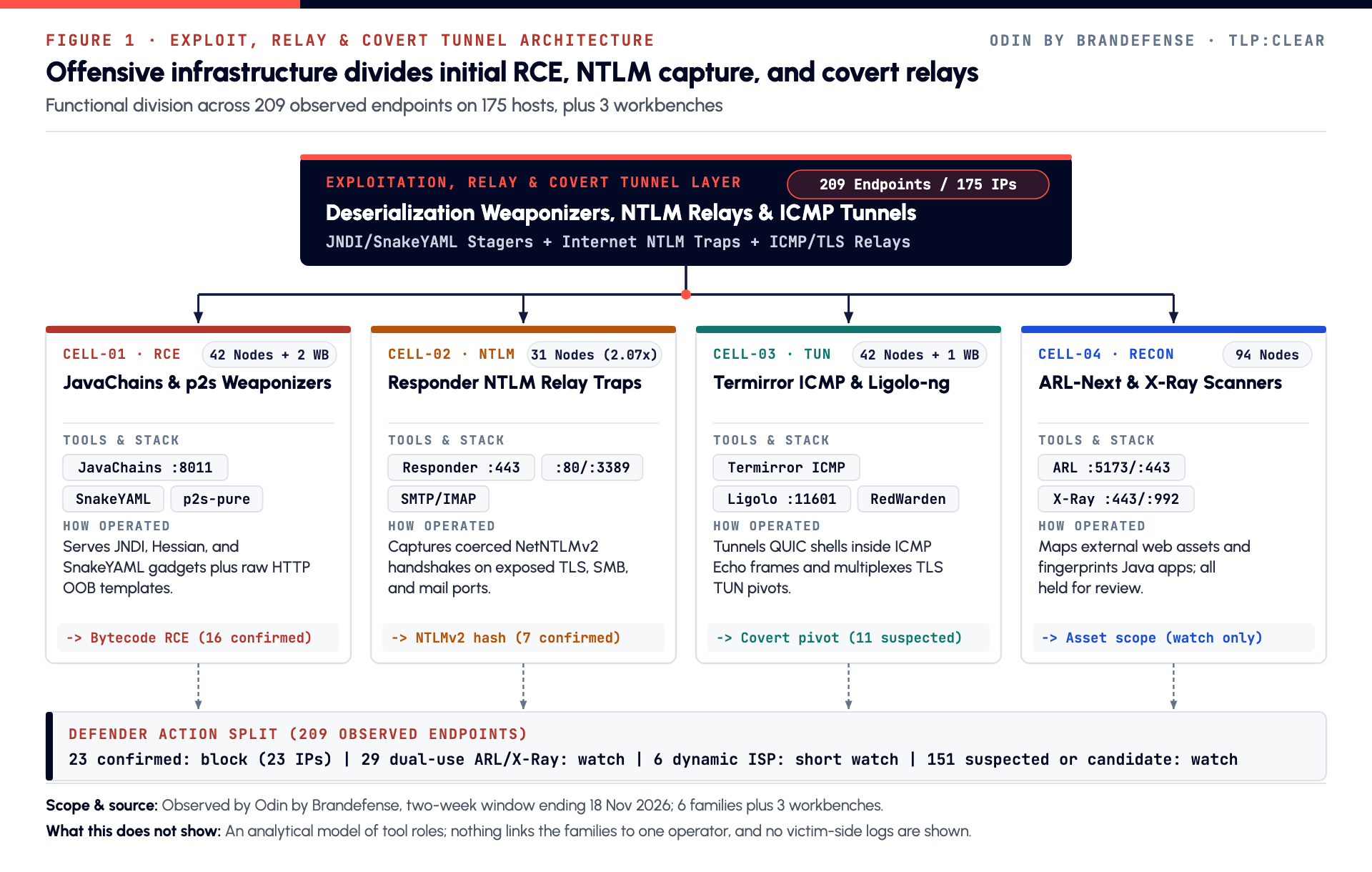
Counts by family
Each endpoint is an IP, port and tool combination.
| Family | Role | Endpoints | Hosts | Endpoints per host | To block | Held for review |
|---|---|---|---|---|---|---|
| ARL-Next | Dual-use recon scanner | 75 | 67 | 1.12 | 0 | 75 (15 dual-use confirmed, 2 dynamic ISP, 58 candidates) |
| JavaChains | Deserialization weaponizer | 42 | 41 | 1.02 | 16 | 26 (3 dynamic ISP, 23 candidates) |
| Ligolo-ng | TLS tunnel relay | 36 | 33 | 1.09 | 0 | 36 (7 suspected, 29 candidates) |
| Responder | NTLM capture | 31 | 15 | 2.07 | 7 | 24 (23 suspected, 1 candidate) |
| X-Ray | Dual-use vulnerability scanner | 19 | 13 | 1.46 | 0 | 19 (14 dual-use confirmed, 3 suspected, 2 candidates) |
| RedWarden | C2 reverse-proxy guardrail | 6 | 6 | 1.00 | 0 | 6 (4 suspected, 1 dynamic ISP, 1 candidate) |
| Total | 209 | 175 | 23 | 186 |
Twenty hosts expose more than one port. None hosts more than one family.
Where the endpoints sit
China hosts 87 endpoints (41.6%), the United States 46 (22.0%), Hong Kong 29 (13.9%) and Germany 15 (7.2%). India (7) and the Netherlands (6) follow.
Hosting follows tool lineage.
| Family | Main location | Main hosting networks |
|---|---|---|
| JavaChains | China (36 of 42) | Shenzhen Tencent Computer Systems, Hangzhou Alibaba Advertising |
| ARL-Next | China and Hong Kong (63 of 75) | Shenzhen Tencent Computer Systems, Hangzhou Alibaba Advertising |
| Responder | United States (24 of 31) | Namecheap (14), DigitalOcean (7), Amazon (6) |
| Ligolo-ng | Spread | OVH SAS (6), Microsoft (3), DigitalOcean (2) |
Across all families, Shenzhen Tencent hosts 48 endpoints and Hangzhou Alibaba 26.
3. Java Deserialization Weaponizers
In short
A single unsafe JNDI, Hessian, JDBC or SnakeYAML parser lets an attacker load remote Java code. JavaChains servers and two exposed workbenches show how operators pair gadget servers with bulk out-of-band exploit templates.
How the weaponizers work
A simple proof-of-concept embeds one hard-coded command. An integrated weaponizer is different. It runs LDAP, RMI, HTTP and rogue MySQL or JDBC listeners at the same time. A vulnerable target then pulls a second-stage Java class over the wire.
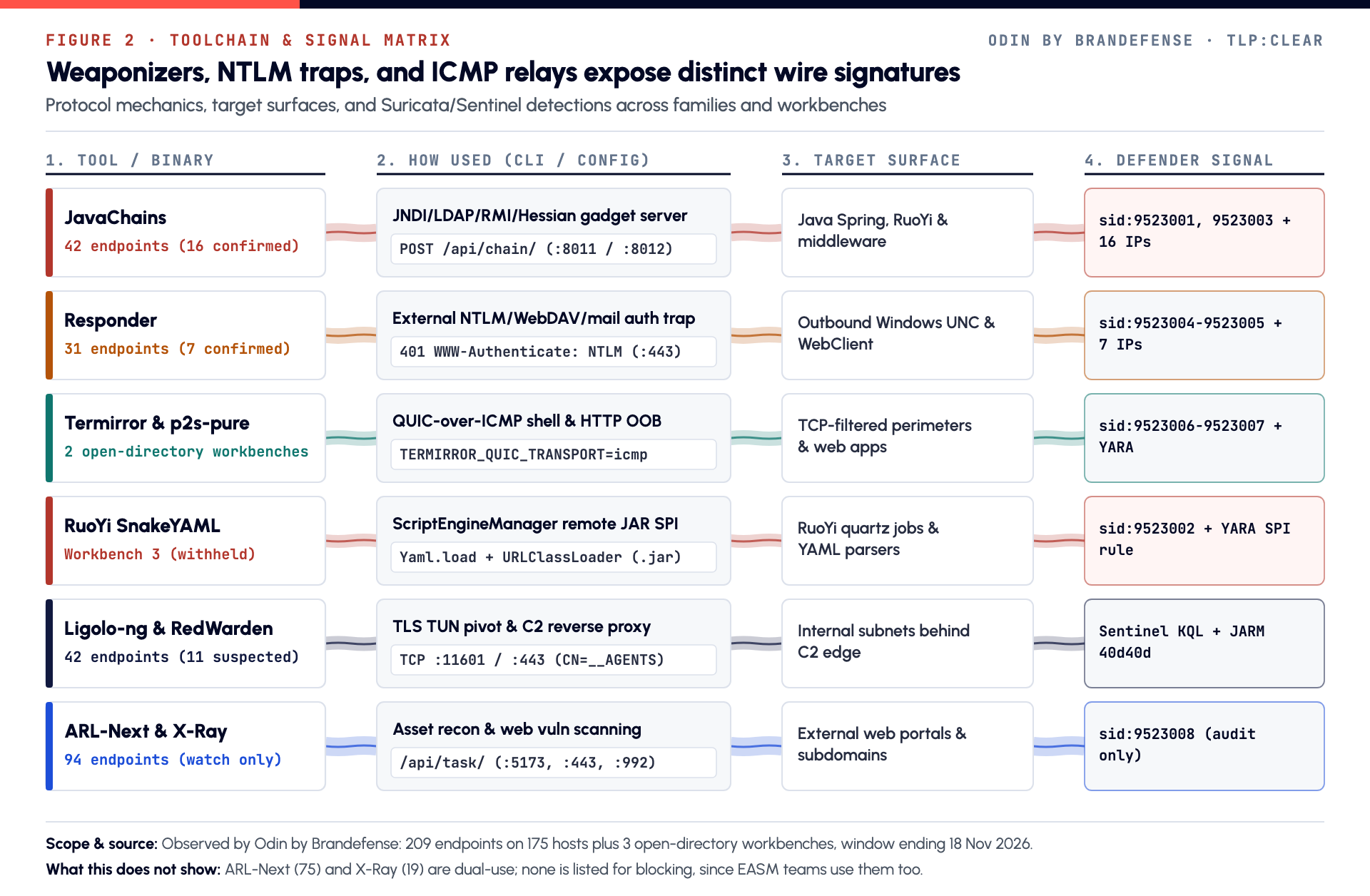
JavaChains bundles gadget generation for CommonsCollections, CommonsBeanutils, Fastjson, Jackson, Hessian and SnakeYAML. It adds built-in JNDI, LDAP and RMI callback listeners. A web control plane runs on TCP 8011 by default, with a secondary listener on 8012.
The JavaChains fleet
Of the 42 endpoints, 38 listen on 8011, 2 on 8012, and 1 each on 443 and 80.
The 16 confirmed servers run on dedicated cloud hosting.
| Hosting network | Confirmed servers |
|---|---|
| Shenzhen Tencent Computer Systems (CN) | 8 |
| Hangzhou Alibaba Advertising (CN) | 5 |
| Volcano Engine (CN) | 1 |
| UCloud Information Technology (HK) | 1 |
| Hetzner Online (DE) | 1 |
Fifteen of the 16 use 8011. The sixteenth, 49.233.77[.]89, fronts its weaponizer over TLS on 443. It shares JARM 2ad2ad0002ad2ad00042d42d00000000f78d2dc0ce6e5bbc5b8149a4872356 with a candidate host that listens on 8012 and 80. JARM is a fingerprint of how a server answers TLS handshakes.
| Endpoint | Hosting | Country |
|---|---|---|
| 124.220.216[.]115:8011 | Shenzhen Tencent | CN |
| 159.75.186[.]95:8011 | Shenzhen Tencent | CN |
| 128.1.131[.]142:8011 | UCloud HK | HK |
| 47.95.254[.]142:8011 | Hangzhou Alibaba | CN |
| 162.55.195[.]59:8011 | Hetzner Online | DE |
| 49.233.77[.]89:443 | Shenzhen Tencent | CN |
These are examples. All 16 appear in Chapter 9.
The feed marks three more JavaChains servers as confirmed, but they sit on China Unicom and China Mobile subscriber networks. This report holds them as dynamic-ISP endpoints, not confirmed C2. Their addresses rotate between customers, so they go on a 24-hour watchlist instead of a block list. Their addresses are not published.
Workbench 1: a Packet-to-Shell out-of-band workspace
Workbench 1 is an open directory on port 8888 of a host in China. Its address is withheld. It holds 123 files built around p2s-pure, an engine that replays raw HTTP exploit requests and records out-of-band callbacks.
| File type | Count |
|---|---|
.bin payloads | 30 |
.log traces | 20 |
.resp response captures | 13 |
.so shared libraries | 6 |
.sh runner scripts | 5 |
.req request templates | 4 |
.txt outputs | 2 |
These counts cover 80 listed entries. The workspace has 14 randomized run folders named /p2s-pure-<id>/ and /p2s-remote-<id>/. Each is built from raw request templates and stores a leak.resp response dump of 1.65 to 1.70 MB.
The operator does not craft each exploit by hand. Shell wrappers such as remote_run.sh, remote_fetch_test.sh, remote_svc_check.sh, remote_rebuild8088.sh and remote_diag.sh drive pre-built binary request blobs. Results are logged to pwn_loop.log, pwn_single.log and oob.log.
| Staged file | Size (bytes) | Role |
|---|---|---|
/oob.log | 317,828,319 | Out-of-band HTTP and DNS callback log (317.8 MB) |
/pkts/B1.req | about 33.1 MB | Stage-B raw HTTP request template |
b1.bin | 33,128,677 | Pre-built request blob |
/pkts/A1.req | 1,060,577 | Stage-A raw HTTP request template |
a.bin | 1,060,211 | Pre-built request blob |
/pkts/B1.resp | 1,668,549 | Captured response dump |
/rev_lst.log | 255,094 | Callback listener log for TCP 888 |
/native_libs/libencrypt.so | 428,480 | Staged crypto or JNI shared library |
The six compiled ELF libraries include liball_in_one.so, libapp.so, libencrypt.so, libcpatch.so and libAesJni.so. The listener log on TCP 888 records 26 or more inbound reverse connections.
These are staged files and attacker logs. They show tooling and intent. We did not confirm any exploit against a specific target.
Workbench 3: ARL reconnaissance next to a RuoYi SnakeYAML builder
Workbench 3 is an open directory on a host in China. Its address is withheld. The directory lists 224 files: 126 .jpg screenshots of web login pages and 98 build, source and configuration files.
Two toolsets sit side by side. The first is ARL-plus-docker, a packaged reconnaissance worker with wait-for-it.sh and a self-signed certificate script, gen_crt.sh. The second is a RuoYi SnakeYAML weaponizer project, yaml-payload-for-ruoyi.
| Item in the RuoYi project | Count |
|---|---|
.jar archives | 5 |
ScriptEngineFactory service files | 7 |
.java source files | 9 |
.class files | 13 |
RuoYi is a popular open-source Java admin framework. Its scheduled-task feature can pass attacker text to org.yaml.snakeyaml.Yaml.load. The payload abuses this to create javax.script.ScriptEngineManager around java[.]net.URLClassLoader. The class loader then fetches a remote .jar declared under META-INF/services/javax.script.ScriptEngineFactory.
The project is designed to register an in-memory filter on routes such as /login or /dev-api/. No JSP file is written to disk. Suricata SID 9523002 looks for this pattern in HTTP request bodies.
The unsafe constructor behind this attack is tracked as CVE-2022-1471. The CVE record says SnakeYAML's Constructor() class does not restrict which types it creates during deserialization. It recommends SafeConstructor for untrusted input and an upgrade to SnakeYAML 2.0 or later. The CNA score is CVSS 3.1 8.3 (High).
4. Internet-Exposed Responder NTLM Traps
In short
Responder is built for internal networks, where it answers name-resolution broadcasts. Here it runs on public cloud servers to collect Windows NTLM handshakes that internal hosts are tricked into sending out.
How the trap works
An internal Windows host can be made to open an attacker-supplied path. Examples are a UNC path, an Office template link, an SSRF redirect or a WebClient DAVWWWRoot URL. If that path points to an external address, Windows starts an NTLM challenge-response exchange on its own.
This only works when egress rules let the traffic out. The usual paths are SMB (445), HTTP or HTTPS (80 and 443), and some mail or RPC ports. The captured NetNTLMv2 response can then be cracked offline or relayed.
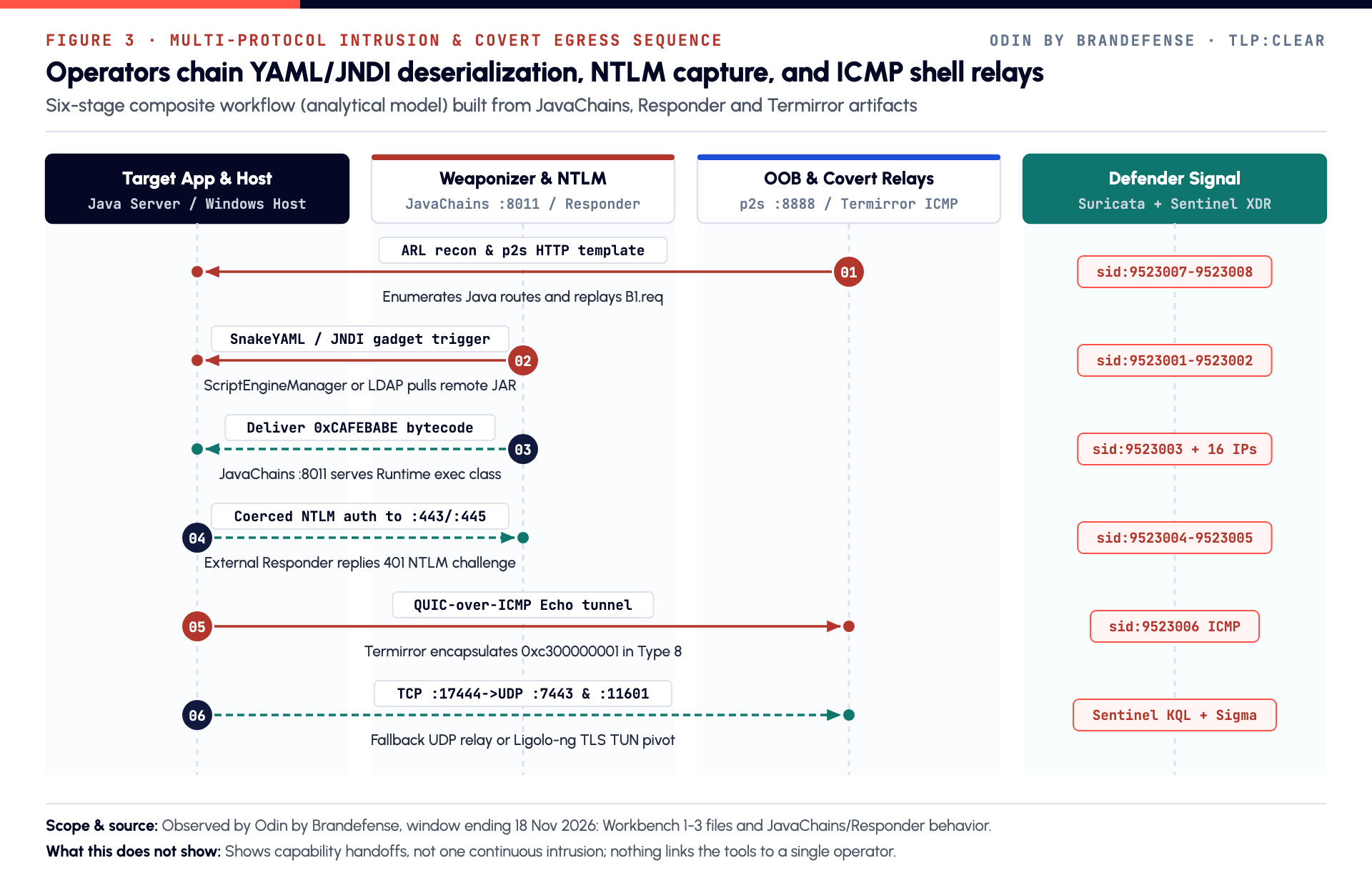
Figure 3 shows how a deserialization foothold, an external NTLM trap and an ICMP tunnel could chain together. It is a composite of separate tool behaviors, not one observed intrusion.
The fleet
Responder has the highest port density in this study: 31 endpoints on 15 hosts, or 2.07 per host. Most sit in the United States (24) and Germany (4). Namecheap (14), DigitalOcean (7) and Amazon (6) host most of them.
Seven confirmed listeners
Four confirmed listeners use TCP 443. There, an HTTP 401 reply with WWW-Authenticate: NTLM asks the client to authenticate. This gets through firewalls that block outbound SMB but allow HTTPS and WebDAV. Suricata SID 9523004 matches that reply.
The other three bind TLS sockets that can carry NTLM on non-web ports: remote desktop (3389), SIP over TLS (5061) and 5120.
| Endpoint | Hosting | Country | Note |
|---|---|---|---|
| 63.250.41[.]138:443 | Namecheap | US | HTTPS NTLM challenge |
| 142.93.190[.]214:443 | DigitalOcean | US | HTTPS NTLM challenge |
| 167.71.162[.]248:443 | DigitalOcean | US | HTTPS NTLM challenge |
| 167.172.40[.]16:443 | DigitalOcean | NL | HTTPS NTLM challenge |
| 193.149.176[.]161:3389 | BL Networks | US | RDP listener, JARM 14d14d16d14d14d08c14d14d14d14dfd9c9d14e4f4f67f94f0359f8b28f532 |
| 165.232.108[.]62:5061 | DigitalOcean | GB | SIP over TLS listener |
| 66.109.142[.]164:5120 | Blackfoot Telephone | US | TLS listener |
Mail and FTP authentication hubs
The 23 suspected Responder endpoints include two Namecheap servers in the United States. They share one TLS certificate and expose Responder's full rogue mail and FTP suite. Both addresses are withheld.
| Hub | Ports |
|---|---|
| 7-port hub | FTP 21, POP3 110, IMAP 143, SMTPS 465, SMTP submission 587, IMAPS 993, POP3S 995 |
| 6-port hub | 21, 110, 143, 587, 993, 995 |
| DigitalOcean mail listener | 143, 465, 993 |
| Three Amazon hosts | 80 and 443 on each |
A mail client that tries plain or NTLM login against these ports hands over credentials. Treat outbound connections from user subnets to unknown mail servers on these ports as suspicious.
5. Covert ICMP Shells: the Termirror Workbench
In short
Many firewalls send web traffic through a proxy but still allow ping. Workbench 2 holds scripts that carry multiplexed QUIC shells and file transfers inside ICMP Echo packets, with a TCP-to-UDP fallback relay.
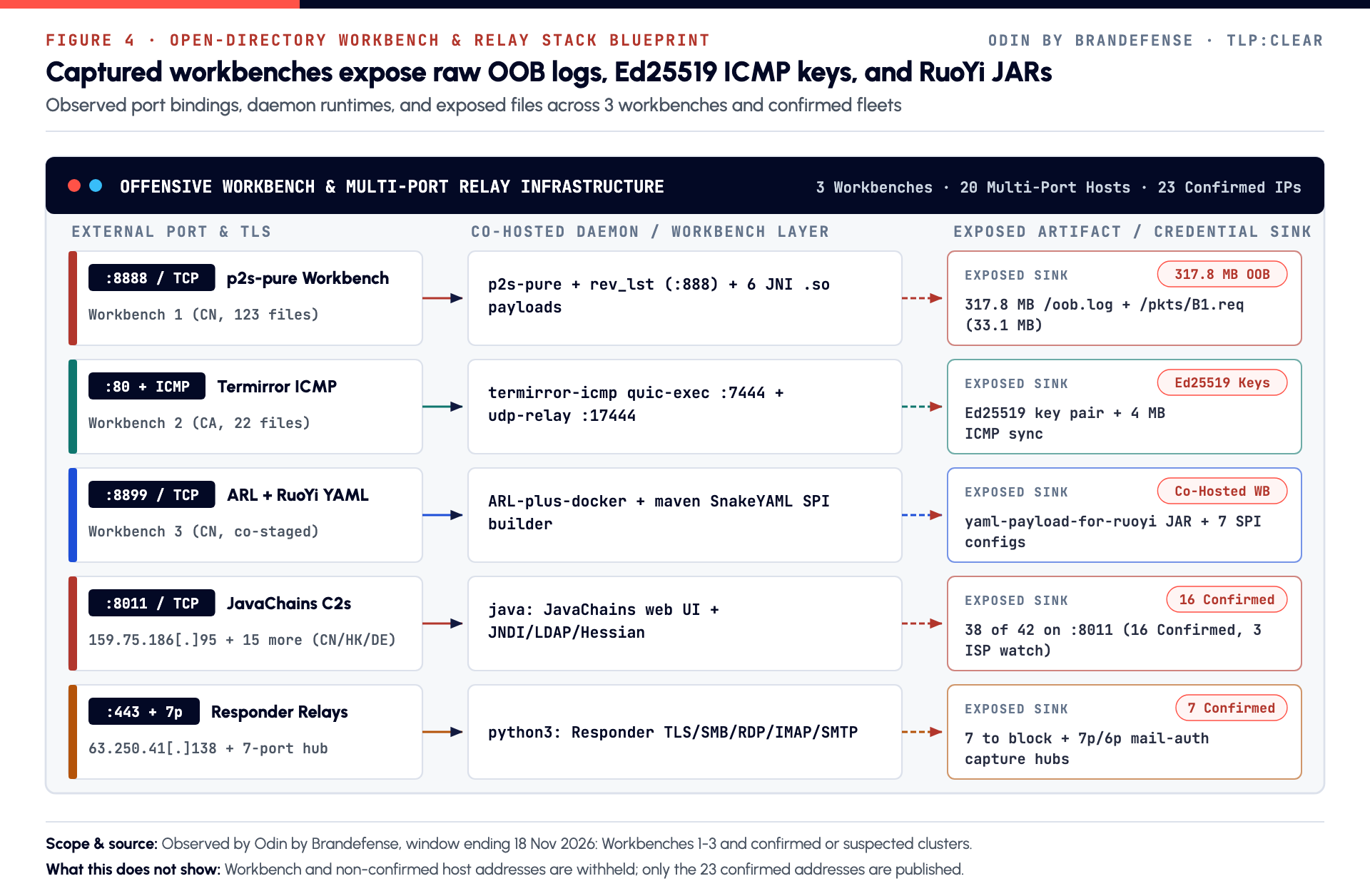
What the workbench holds
Workbench 2 is an open directory on port 80 of a host in Canada. Its address is withheld. It lists 42 entries across 30 distinct paths, with 22 unique operational files at the root.
The files form a complete covert-shell kit built around Termirror. The ATT&CK technique is Protocol Tunneling (T1572).
Mutual authentication keys. Two .termirror folders, one for a server and one for a client, each hold a 1,860-byte identity.pub public key, a 128-byte identity.key private key and a pinned known_servers list (92 and 473 bytes). An 81-byte ssh-ed25519 recovery public key sits at the root.
QUIC over ICMP. Two scripts, termirror-icmp-stress.sh and termirror-icmp-smoke.sh, set TERMIRROR_QUIC_TRANSPORT=icmp and TERMIRROR_QUIC_DIRECT=1. They call termirror-icmp-test quic-exec against a remote peer on port 7444. The peer address is withheld.
The stress script is written to open 8 concurrent shell streams, with outputs icmp-parallel-1.out to icmp-parallel-8.out, and 10 sequential latency checks. It then pushes a 256 KB (262,144-byte) and a 4 MB (4,194,304-byte) binary file with sync --to. All of this travels inside ICMP Echo and Echo Reply frames.
TCP-to-UDP fallback. Middleboxes sometimes drop raw ICMP or UDP QUIC packets. For that case, termirror-udp-relay-remote.py (1,776 bytes) listens on TCP 17444. It reads 4-byte big-endian length headers, up to 65,535 bytes per frame, and forwards each datagram to local UDP 7443. A matching local client wrapper probably runs on the operator's side.
| Staged file | Size (bytes) | Role |
|---|---|---|
identity.pub (server and client) | 1,860 each | Ed25519 identity public keys |
known_servers (client) | 473 | Pinned server list |
termirror-icmp-stress.sh | 1,839 | 8-stream and 4 MB ICMP test |
termirror-udp-relay-remote.py | 1,776 | TCP 17444 to UDP 7443 relay |
termirror-icmp-smoke.sh | 1,765 | 256 KB ICMP transfer check |
termirror-udp-relay-remote.cpython-312.pyc | 4,051 | Python 3.12 bytecode of the relay |
| SSH recovery public key | 81 | ssh-ed25519 key |
The scripts show what the operator built and tested. We did not see this tunnel carry traffic out of any victim network.
What a defender can see
A QUIC version 1 long-header packet sets the two top bits of its first byte and carries the version bytes 00 00 00 01 right after it. Termirror places that header inside the data field of an ICMP Type 8 request. Ordinary ping payloads do not look like this. Suricata SID 9523006 alerts when one source sends 8 such packets within 30 seconds.
6. Tunnels, Guardrails and Dual-Use Scanners
In short
Ligolo-ng and RedWarden provide encrypted pivots and C2 protection. ARL-Next and X-Ray map targets, but many security teams run them legitimately, so none of their 94 endpoints is listed for blocking.
Ligolo-ng TLS tunnel relays
Ligolo-ng replaces slow SOCKS proxies with a userland network interface built on gVisor, tunneled over TLS. Odin found 36 endpoints on 33 hosts. Fourteen use 443 and ten use the tool's usual port 11601. One more host binds 11602 and 11603.
Two fingerprints help hunters.
| Fingerprint | Where seen |
|---|---|
JARM 40d40d40d00040d00043d43d00043d3bef2bf79cd6719851e8198c1e8f9a14 | Nine Ligolo-ng endpoints; a Go TLS stack fingerprint |
Certificate CN=__AGENTS | Ligolo-ng's built-in -selfcert certificate, seen on a suspected relay on 4444 in Vietnam |
The Go JARM value is shared by many Go programs, so use it only together with a second signal. Seven Ligolo-ng endpoints are suspected and 29 are candidates. None is confirmed, and their addresses are withheld.
RedWarden C2 guardrails
RedWarden is a reverse proxy that sits in front of a C2 team server. It checks HTTP headers, TLS fingerprints and source geography before it lets a request through. Odin found 6 endpoints.
| Group | Endpoints | Detail |
|---|---|---|
| Suspected | 4 | OVH, DigitalOcean and Shock Hosting, on 81, 8080, 8083 and 8443 |
| Dynamic telecom ISP | 1 | Chinanet, port 7777 |
| Candidate | 1 | Port 443 |
ARL-Next and X-Ray
ARL-Next is an asset reconnaissance suite. Of its 75 endpoints, 45 use the Vite UI port 5173, 9 use 443, 6 use 80 and 4 use 8888. X-Ray is a web vulnerability scanner. Of its 19 endpoints, 8 use 443. Three Hong Kong hosts each expose 443, 992 and 5555 under one shared certificate.
Both tools map subdomains and web flaws. Both are also widely used by authorized attack-surface and bug-bounty teams. None of their hosts shares an address with a confirmed JavaChains or Responder listener. All 94 endpoints are therefore held for review, not blocked.
What not to block
The table gives an action for each handling group. Only the first group is ready to block.
| Group | Endpoints | Action |
|---|---|---|
| Confirmed JavaChains and Responder on dedicated hosting | 23 | Block, review after 30 days |
| Confirmed dual-use scanners (ARL-Next 15, X-Ray 14) | 29 | Watch, do not block |
| Dynamic telecom addresses (3 JavaChains, 2 ARL-Next, 1 RedWarden) | 6 | Short watchlist of about 24 hours |
| Suspected (Responder 23, Ligolo-ng 7, RedWarden 4, X-Ray 3) | 37 | Watch, look for a second signal |
| Candidates | 114 | Hold until corroborated |
Cloud addresses are reassigned over time. Re-check each blocked address before a block rule is renewed.
7. What Defenders Should Do
Within 24 hours
- Block the 23 confirmed JavaChains and Responder addresses at perimeter firewalls and web gateways. Review them after 30 days.
- Put dynamic-ISP addresses on a short watchlist, not a block list.
- Keep ARL-Next and X-Ray signals in alert-only mode.
Within 72 hours
- Deny outbound SMB on 445 and 139 from all internal subnets.
- Restrict auto-start of the Windows WebClient (WebDAV) service, and limit outbound NTLM with the
RestrictSendingNTLMTrafficpolicy. - Rate-limit or block outbound ICMP Echo from server subnets that have no need for it.
Within 7 to 30 days
- Upgrade SnakeYAML to 2.0 or later and use
SafeConstructorin RuoYi and Spring apps. - Turn on JDK
ObjectInputFilterserialization filters, and block outbound JNDI, LDAP and RMI callbacks from Java servers. - Deploy the Suricata, KQL, Sigma and YARA rules in Chapter 8, with allowlists for named red-team and scanner hosts only.
- Add the JARM values and
CN=__AGENTSto external attack-surface hunting, always paired with a second signal.
8. Detection Rules
The full rules are in the Detection rules tab. The only exclusions are exact hostnames in the KQL and Sigma allowlists.
| Rule file | What it catches |
|---|---|
odin_javachains_responder_icmp_tunnels.rules | Suricata 7: eight signatures for JavaChains, SnakeYAML, Responder NTLM, Termirror ICMP, p2s-pure and ARL-Next traffic |
sentinel_javachains_responder_ntlm_icmp_hunt.kql | Microsoft Sentinel and Defender XDR: contact with the 23 confirmed addresses, relay ports, ICMP bursts and matching processes |
sigma_javachains_responder_termirror_execution.yml | Sigma (3 rules): Linux processes for JavaChains and SnakeYAML builders, Termirror relays, and Responder, Ligolo-ng, ARL or X-Ray |
odin_javachains_p2s_termirror_ruoyi_artifacts.yar | YARA (4 rules): JavaChains configs, p2s-pure workbench files, Termirror scripts and RuoYi SnakeYAML SPI builders |
How the Suricata signatures work
| SID | Looks for | Why |
|---|---|---|
| 9523001 | Outbound POST to /api/chain/ on 8011, 8012 or 443 with "gadget" in the body | An internal host driving a JavaChains control API |
| 9523002 | Inbound HTTP body with javax.script.ScriptEngineManager followed by java[.]net.URLClassLoader | RuoYi or Spring SnakeYAML remote JAR load |
| 9523003 | HTTP 200 from 8011, 8012, 80 or 8899 whose body starts with CA FE BA BE and contains java/lang/Runtime | A Java class file with command execution delivered to an internal host |
| 9523004 | HTTP 401 from an external server with WWW-Authenticate: NTLM | An internet NTLM challenge trap |
| 9523005 | Outbound NTLMSSP negotiate message on 445, 139, 3389, 5061 or 5120 | Windows authentication leaving the network |
| 9523006 | ICMP Type 8 with QUIC v1 Initial bytes c3 00 00 00 01, 8 times in 30 seconds from one source | Termirror QUIC-over-ICMP tunnel (T1572) |
| 9523007 | Outbound request with /p2s-pure in the URI | Contact with a Packet-to-Shell workbench |
| 9523008 | Outbound /api/task/ with a Token: header on ARL ports | ARL-Next use; audit only, since the tool is dual-use |
Exempt documented external gateways, such as Azure AD Application Proxy, from SIDs 9523004 and 9523005 by exact destination address. Keep SID 9523008 in alert-only mode.
How the other rules work
The KQL query looks back 7 days. It flags devices that contact any of the 23 confirmed addresses. It also flags use of relay ports such as 8011, 11601 and 17444, or 25 or more public ICMP events, on hosts not in the allowlist. It joins these with process events that name JavaChains, Termirror, p2s-pure, Ligolo-ng or Responder.py.
The allowlist holds exact hostnames only. It never hides a match on a confirmed address. Each row gets an action: block, isolate a covert tunnel, or hunt a callback or NTLM leak. Network monitoring appliances that send many pings can be added to the allowlist by exact name.
The three Sigma rules need Linux process-creation logs. Rule 1 flags java, mvn, python3 or a shell whose command line names javachains, yaml-payload-for-ruoyi or javax.script.ScriptEngineManager. Rule 2 flags Termirror ICMP and relay command lines. Rule 3 flags Responder.py, Ligolo-ng on 11601 or with -selfcert, ARL-plus-docker or xray_linux_amd64, at medium level.
Each YARA rule is limited to files under 512 KB and needs strings from at least two groups.
| YARA rule | Fires when |
|---|---|
ODIN_JavaChains_Deserialization_Controller_Config | A JavaChains name, a 8011 or 8012 port string, and Hessian or jndi appear together |
ODIN_P2S_Pure_PacketToShell_Workbench_Manifest | A p2s-pure or p2s-remote name, a listener or OOB log name, and libAesJni.so or leak.resp appear together |
ODIN_Termirror_Covert_ICMP_QUIC_Relay_Script | quic-exec appears with a Termirror ICMP flag, or with both relay ports |
ODIN_RuoYi_SnakeYAML_SPI_Gadget_Manifest | A ScriptEngineManager or SPI service path appears with URLClassLoader, the SnakeYAML class or the RuoYi payload name |
9. Indicators
The Indicators tab holds 23 published indicators: 23 addresses and no hashes. These are the 16 confirmed JavaChains and 7 confirmed Responder endpoints.
| Type | Count | Where |
|---|---|---|
| Confirmed endpoints to block (IP and port) | 23 | Indicators tab and the table below |
| Workbench and multi-port watchlist hosts | 5 | Withheld |
| File hashes (SHA-256) | 0 | All workbench file hashes are withheld |
Supporting fingerprints stay in the text only: the JARM values in Chapters 3, 4 and 6, the certificate CN=__AGENTS, and the QUIC-in-ICMP byte pattern.
Withheld: the three workbench addresses, the mail hubs, the Ligolo-ng relay presenting CN=__AGENTS, all dynamic-ISP addresses, all suspected and candidate addresses, the tool certificate domains, and the hashes of all workbench files. The workbench owners are not established.
Confirmed endpoints to block
| Endpoint | Family | Hosting | Country |
|---|---|---|---|
| 124.220.216[.]115:8011 | JavaChains | Shenzhen Tencent | CN |
| 159.75.186[.]95:8011 | JavaChains | Shenzhen Tencent | CN |
| 111.229.216[.]164:8011 | JavaChains | Shenzhen Tencent | CN |
| 128.1.131[.]142:8011 | JavaChains | UCloud HK | HK |
| 47.95.254[.]142:8011 | JavaChains | Hangzhou Alibaba | CN |
| 8.134.112[.]14:8011 | JavaChains | Hangzhou Alibaba | CN |
| 124.223.36[.]16:8011 | JavaChains | Shenzhen Tencent | CN |
| 162.55.195[.]59:8011 | JavaChains | Hetzner Online | DE |
| 122.51.118[.]220:8011 | JavaChains | Shenzhen Tencent | CN |
| 39.106.171[.]189:8011 | JavaChains | Hangzhou Alibaba | CN |
| 49.233.77[.]89:443 | JavaChains | Shenzhen Tencent | CN |
| 101.96.216[.]248:8011 | JavaChains | Volcano Engine | CN |
| 124.221.179[.]152:8011 | JavaChains | Shenzhen Tencent | CN |
| 120.76.158[.]8:8011 | JavaChains | Hangzhou Alibaba | CN |
| 47.103.214[.]7:8011 | JavaChains | Hangzhou Alibaba | CN |
| 106.54.13[.]23:8011 | JavaChains | Shenzhen Tencent | CN |
| 63.250.41[.]138:443 | Responder | Namecheap | US |
| 142.93.190[.]214:443 | Responder | DigitalOcean | US |
| 66.109.142[.]164:5120 | Responder | Blackfoot Telephone | US |
| 193.149.176[.]161:3389 | Responder | BL Networks | US |
| 165.232.108[.]62:5061 | Responder | DigitalOcean | GB |
| 167.71.162[.]248:443 | Responder | DigitalOcean | US |
| 167.172.40[.]16:443 | Responder | DigitalOcean | NL |
10. Scope and Limits
- Window. The findings cover a two-week observation window ending 18 November 2026. Some records carry older first-seen dates from public sources. We do not use those as a tracking start.
- The tool, not the victim. A confirmed endpoint runs JavaChains or Responder. We did not see these servers succeed against any named target.
- The four roles are a model. No address hosts two families, and nothing links the families or workbenches to one operator.
- Workbenches show intent. Their files are staged tools, templates and attacker logs. Their owners are not established, so their addresses and file hashes are withheld.
- Dual-use tools are not proof of attack. ARL-Next, X-Ray, Ligolo-ng and RedWarden all have legitimate users. Treat them as leads.
- Rule testing. Every published rule file loads without errors in its engine (Suricata 7.0.12, YARA-X, pySigma and Microsoft's Kusto.Language analyzer, checked on 20 November 2026). The rules were not replayed against live traffic, so test and tune them in your own environment before production use.
11. Sources
- OWASP Foundation. Deserialization Cheat Sheet. https://cheatsheetseries.owasp.org/cheatsheets/Deserialization_Cheat_Sheet.html (verified 18 November 2026)
- NIST National Vulnerability Database. CVE-2022-1471 Detail. https://nvd.nist.gov/vuln/detail/CVE-2022-1471 (verified 18 November 2026)
- CVE Program. CVE-2022-1471 record. https://www.cve.org/CVERecord?id=CVE-2022-1471 (verified 20 November 2026)
- Microsoft Learn. NTLM overview. https://learn.microsoft.com/en-us/windows-server/security/kerberos/ntlm-overview (verified 18 November 2026)
- MITRE ATT&CK. Protocol Tunneling, T1572. https://attack.mitre.org/techniques/T1572/ (verified 18 November 2026)
- OISF. Suricata 7.0 User Guide, HTTP keywords. https://docs.suricata.io/en/suricata-7.0.0/rules/http-keywords.html (verified 18 November 2026)
- Salesforce Engineering. Easily Identify Malicious Servers on the Internet with JARM. https://engineering.salesforce.com/easily-identify-malicious-servers-on-the-internet-with-jarm-e095edac525a/ (verified 18 November 2026)
What is…?
Short explanations of the tools and families named in this study.
What is JavaChains?
JavaChains is a Java exploitation toolkit that serves deserialization gadget chains and JNDI payloads from one server.
More about JavaChainsOffensive toolWhat is Responder?
Responder is an open-source tool that answers LLMNR, NBT-NS and mDNS name queries to capture NTLM authentication hashes.
More about ResponderTunneling toolWhat is Ligolo-ng?
Ligolo-ng is an open-source tunneling tool that builds a network tunnel from a compromised host through a TUN interface.
More about Ligolo-ngTechniqueWhat is JARM?
JARM is an open TLS server fingerprinting method from Salesforce. It hashes how a server answers a set of crafted TLS handshakes.
More about JARMTechniqueWhat is JNDI injection?
JNDI injection makes a Java application look up a remote object, usually over LDAP or RMI, and load attacker code. Log4Shell is the best-known example.
More about JNDI injectionReconnaissance platformWhat is ARL?
ARL (Asset Reconnaissance Lighthouse) is an open-source asset discovery platform, popular with Chinese-speaking testers and attackers.
More about ARLFrequently asked questions
What did we find?
The 209 endpoints fall into four roles. This is our analytical model. Each tool was observed on its own, and nothing ties the families to a single operator. China hosts 87 of the endpoints, the United States 46 and Hong Kong 29. Java exploit servers sit mostly on Tencent and Alibaba clouds in China. The credential traps sit mostly on Namecheap, DigitalOcean and Amazon in the United States.
How do the Java exploit servers work?
Many Java applications turn incoming data back into objects. If that step is unsafe, an attacker can make the application download and run a remote Java class. JavaChains packages this attack. It builds payloads for common Java libraries and runs the callback servers that hand out the malicious code.
Why put an NTLM trap on the internet?
Responder normally runs inside a company network. It answers name lookups and collects Windows login handshakes. Here we found 31 Responder endpoints on 15 public servers. The trick is to make an internal Windows machine reach out. A link in a document, a file path or a forged web redirect can point at an external server. Windows then starts a login exchange on its own, and the trap records the handshake.
How can a shell hide inside ping traffic?
Many firewalls send web traffic through a proxy for inspection but still allow ping. The third workbench takes advantage of that. It holds a toolkit called Termirror that carries an encrypted QUIC shell inside ICMP Echo packets.
Should we block the scanners too?
No. ARL-Next and X-Ray map websites and look for flaws. Attackers use them, but so do many security teams and bug-bounty hunters. None of the 94 scanner endpoints shares an address with a confirmed exploit server or NTLM trap. Blocking them would mostly hit legitimate testers. Watch them instead, and act when a second signal appears.