


1. Executive Summary
In short
In a two-week observation window ending 18 November 2026, Odin by Brandefense mapped 193 endpoints on 165 hosts across 11 stealer, clipper, loader and RAT families. Two exposed workbenches sit beside them. One holds an OpenClaw agent set up to drive an existing Chromium profile through headless Playwright. The other stages wallet-brand recon and SaaS cookie capture. Twenty endpoints are confirmed C2 servers. Bind sessions to devices, block the 15 published C2 endpoints, and alert when non-browser processes read Chromium cookie stores.
Infostealers no longer need your password. They take the browser's cookie database, and a cookie for a logged-in session is often enough to act as the user. This report looks at both halves of that problem. The first is the commodity stealer, clipper and loader servers that collect browser data. The second is two exposed workbenches that show how an automation agent can drive a logged-in browser profile.
An exposed OpenClaw workbench drives a logged-in Chromium profile with headless Playwright.
An open directory on port 8888 of a server in China yielded 80 sampled files. They pair Playwright's headless Chromium build 1208 with an OpenClaw agent folder named browser-existing-session. That folder holds a Chromium Cookies store, Trust Tokens, History and an NSS key database, plus an agent action log.
A second workbench pairs wallet-brand recon with SaaS cookie capture.
A server in France exposed 59 target folders and 10,650 files on port 8080. It holds dangling-subdomain recon against a hardware crypto-wallet vendor and headless Chrome 149 scripts that save cookie jars from a design SaaS platform. Both brands are withheld.
Commodity stealers and loaders supply the stolen browser data.
Aurora and AuroraStealer account for 18 endpoints on 9 hosts, including a 3-port hub in Germany. StealC, RedLineStealer and 14 suspected LaplasClipper nodes follow. PikaBot, ChaluboRAT and Ramnit sit in the delivery tier. Of 193 endpoints, 20 are confirmed C2 servers.
Three Decisions for Leaders
- Bind web sessions to the device. Adopt Device Bound Session Credentials (DBSC) or continuous access evaluation, so a cookie copied to a headless Linux server fails when it is replayed from a new network.
- Block confirmed C2, watch the rest. Block the 15 published confirmed endpoints. Keep dynamic telecom addresses, suspected clusters and old Ramnit candidates on time-bound watchlists instead of permanent blocks.
- Close lure surfaces and guard profile stores. Remove dangling DNS records that a wallet or login lure could sit on. Alert when any process other than the browser reads Chromium
Cookies,Trust Tokensor extension storage.
The Study in Numbers
| Number | What it is |
|---|---|
| 193 | Endpoints across 11 active stealer, clipper, loader and RAT families, on 165 distinct hosts |
| 20 | Confirmed C2 endpoints on 18 IPs; 15 of them (13 IPs) are published for blocking |
| 80 | Sampled files on the OpenClaw and Playwright session-cloning workbench (port 8888) |
| 59 | Target folders (10,650 files) on the wallet and SaaS lure workbench (port 8080) |
| 18 | AuroraStealer (13) and Aurora (5) endpoints on 9 hosts; 6 are confirmed |
| 14 | Suspected LaplasClipper wallet-swap nodes, all on one US provider |
| 107 of 110 | Ramnit endpoints held on watchlists rather than blocked |
How to use this report.
Security leaders can read Chapter 1, Chapter 7 and Chapter 10. Identity and browser-security teams should read Chapters 2 and 3. SOC and detection engineers should start with Chapters 8 and 9. CTI analysts will find the stealer, clipper and loader infrastructure in Chapters 4 to 6.
2. How Stolen Sessions Get Replayed
In short
A browser cookie for a logged-in session can stand in for a password and an MFA prompt. This chapter sets out an analytical model of how stealers, clippers, loaders and browser automation fit together.
Why cookies matter more than passwords
Defenders used to answer an infostealer infection by resetting passwords. That no longer closes the door. Modern stealers copy the whole Chromium user-data folder: Default/Cookies, Default/Trust Tokens, Local Storage and the LevelDB folders where wallet extensions keep their data.
Identity providers check the device, the TLS fingerprint and a FIDO2 prompt at login. Once a session cookie is issued, many services simply trust it. So whoever holds a fresh cookie can often act as the user without seeing an MFA prompt.
Browser automation makes that easy at scale. Microsoft Playwright's launchPersistentContext API starts a Chromium instance on top of an existing user-data folder. Any script or AI agent driving that browser inherits the sessions stored in it. Playwright documents this as a normal feature for testing.
A four-part model
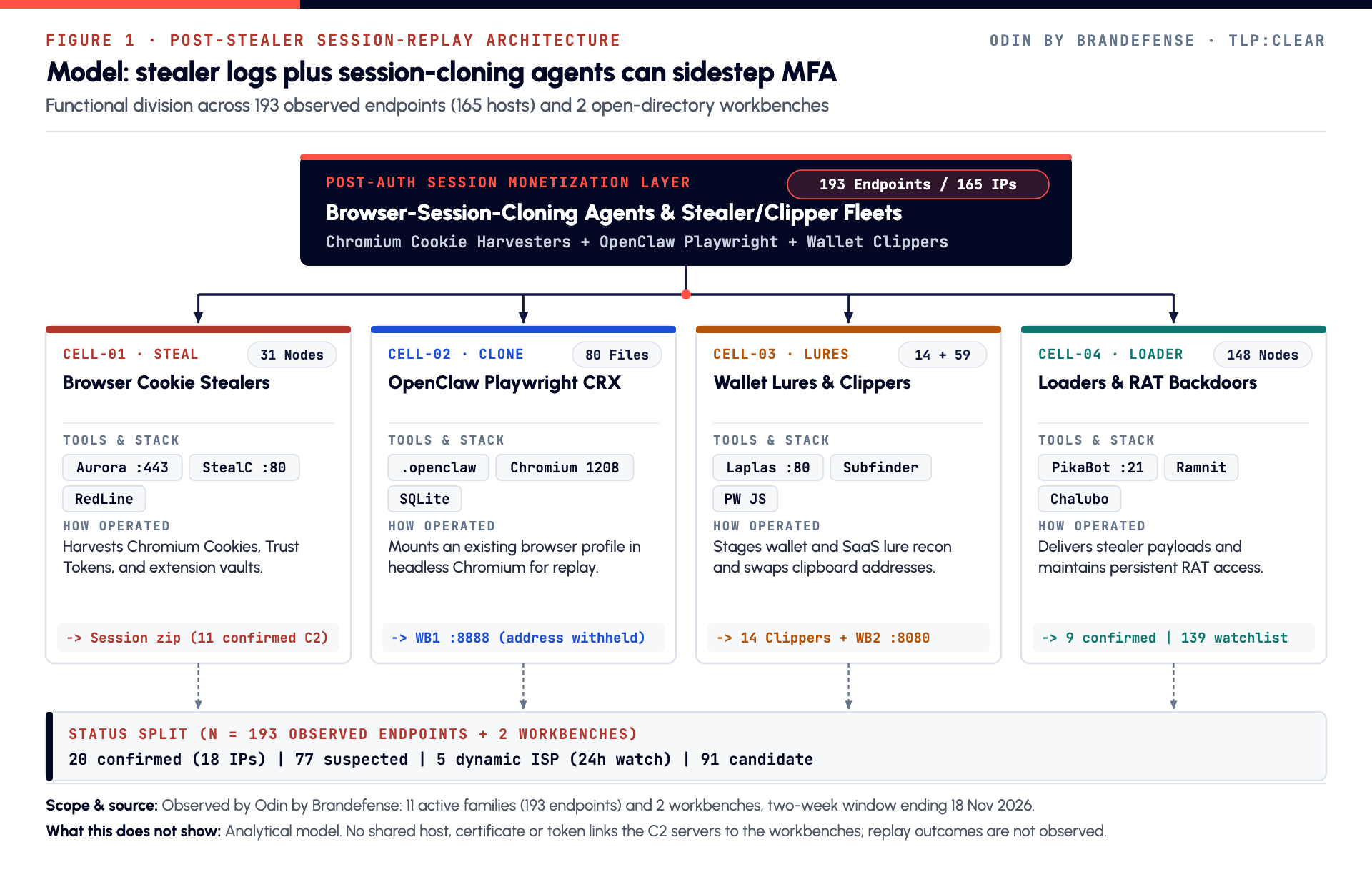
Figure 1 shows the four parts as an analytical model. The 193 endpoints and two workbenches were observed separately. No IP appears in more than one family, and no shared host, certificate or campaign token links the stealer servers to the workbenches.
| Part | What it does | Families or tools | Observed endpoints |
|---|---|---|---|
| Steal | Copies Chromium cookies, tokens and extension vaults | AuroraStealer, Aurora, StealC, RedLineStealer | 31 (11 confirmed) |
| Clone | Drives an existing browser profile with a headless agent | OpenClaw, Playwright Chromium 1208 | Workbench 1 (80 files) |
| Lure and clip | Stages wallet and SaaS lures, swaps copied wallet addresses | LaplasClipper, subfinder, Playwright scripts | 14 clipper nodes, Workbench 2 |
| Deliver and persist | Drops stealers and keeps remote access | PikaBot, TitanOmega, Ramnit, ChaluboRAT, RaptorRAT, BitRAT | 148 (9 confirmed) |
What the model does not show matters as much. We did not see any replay against a real account, and we saw no losses on the target side. The model explains why these pieces are worth defending against together.
Where the endpoints sit
The 193 endpoints spread across 13 tracked families, 11 of them with active endpoints. Two more families, Bumblebee and RaccoonStealer, had no active endpoints in the window. Nineteen hosts expose more than one port.
| Country | Endpoints | Share | Main driver |
|---|---|---|---|
| China | 78 | 40.4% | Ramnit |
| United States | 35 | 18.1% | 14 LaplasClipper and 8 TitanOmega nodes |
| Germany | 15 | 7.8% | RaptorRAT, AuroraStealer hub |
| Netherlands | 10 | 5.2% | RedLineStealer, StealC |
| Russia | 7 | AuroraStealer | |
| Hong Kong | 7 | ChaluboRAT, Ramnit | |
| South Korea | 7 | Ramnit |
The confirmed C2 servers look different from the bulk. They sit mostly on European and Asian VPS providers, including Hetzner Online, Netsec Limited, RootLayer Web Services, DigitalOcean, Google Cloud, Majestic Hosting and UFO Hosting.
All 20 confirmed endpoints were seen on 13 November 2026. Suspected Aurora and Ramnit staging was still being seen on 18 November 2026. Some old Ramnit records carry first-seen dates from earlier years; those are record dates, not the period of this study.
3. Two Exposed Workbenches
In short
Two open directories show the tooling side. One holds an OpenClaw agent wired to a logged-in Chromium profile. The other holds wallet-brand recon and Playwright cookie capture against a SaaS platform.
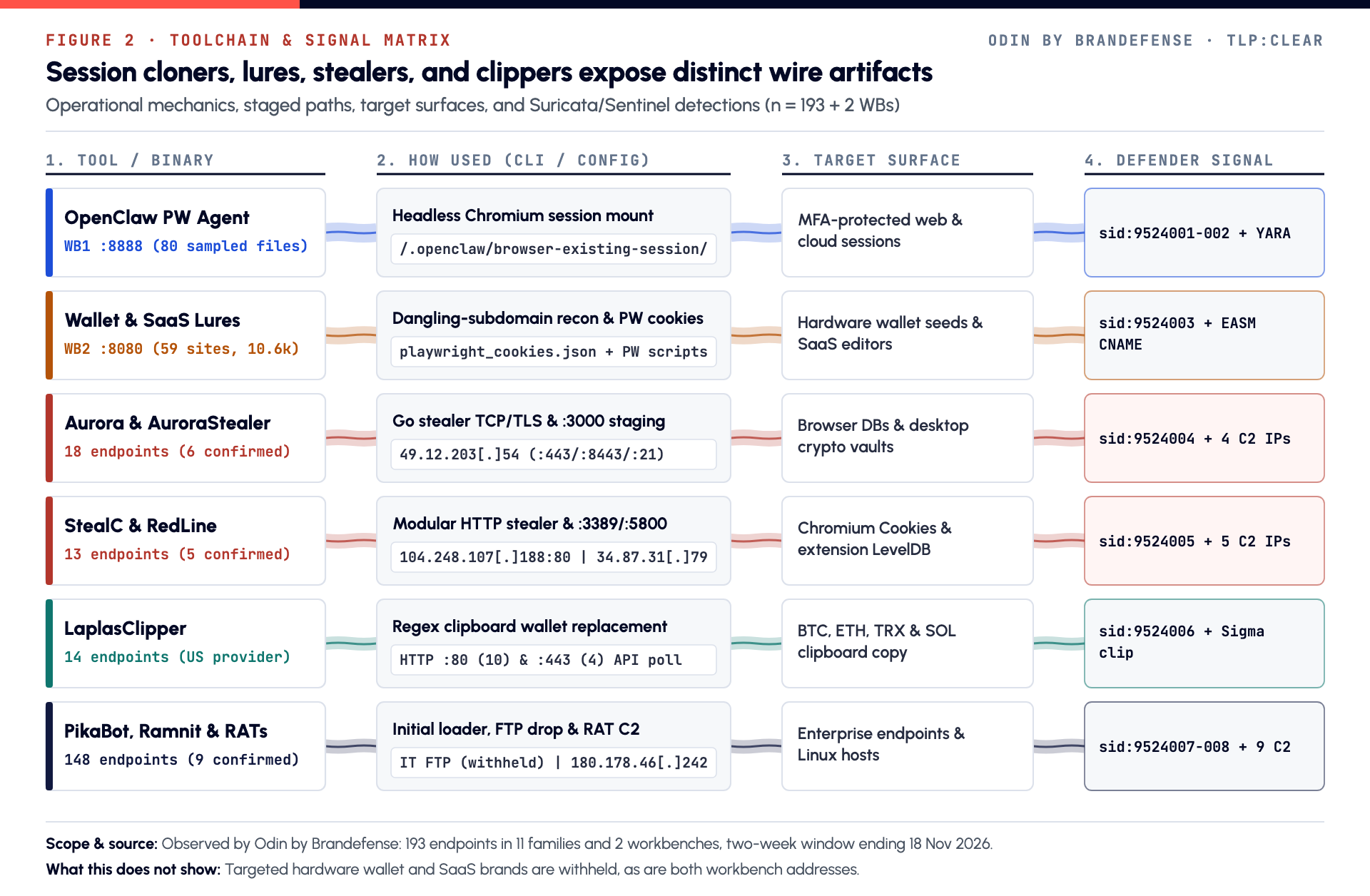
Figure 2 maps each tool group to how it is used, what it targets and which rule covers it.
Workbench 1: OpenClaw agent on a logged-in Chromium profile
Workbench 1 is a cloud server in China. It exposed an open directory on port 8888, and 80 files were sampled from it. Its address is withheld, because the owner and the origin of the browser data are not established.
The files pair two things. The first is Playwright's headless Chromium build 1208, stored under /.cache/ms-playwright/chromium_headless_shell-1208/. The second is an OpenClaw agent folder, /.openclaw/, with a subfolder named browser-existing-session. OpenClaw is an autonomous agent that can drive a browser.
That subfolder is a full Chromium profile. It holds a Cookies store, Trust Tokens, History, a cached extension package and an NSS key database (/.pki/nssdb/key4.db). The agent logs every step it takes to a trajectory file and keeps its state in SQLite. Messaging connector plugins for QQ (qqbot) and DingTalk (dingtalk-connector) are installed beside it.
| Path on Workbench 1 | Size (bytes) | Role |
|---|---|---|
/.openclaw/browser-existing-session/component_crx_cache/ (one cached file) | 9,541,687 | Cached Chromium component or extension package inside the mounted profile |
/.skillhub/skills_index.local.json | 9,257,868 | Local agent skill registry, next to skills_store_cli.py (156,228 bytes) |
/.cache/ms-playwright/chromium_headless_shell-1208/.../libvk_swiftshader.so | 4,361,888 | Software GPU renderer for headless Chromium 1208, with libGLESv2.so |
/.openclaw/agents/main/sessions/<session>.trajectory.jsonl | 2,355,006 | Step-by-step log of the agent's browser actions |
/.openclaw/state/openclaw.sqlite | 1,245,184 | Agent state database, with a 156,592-byte .sqlite-wal journal |
/.openclaw/browser-existing-session/Default/History | 163,840 | Chromium navigation history |
/.openclaw/browser-existing-session/Default/Trust Tokens | 36,864 | Chromium Trust Tokens store; key4.db is the same size |
/.openclaw/browser-existing-session/Default/Cookies | 20,480 | Chromium cookie store the headless browser loads |
The 80 sampled files break down as 22 .json, 14 extensionless Chromium SQLite and cache files, 7 .xlsx, 6 .so, 5 .md, 3 .jsonl, 3 .db and 2 .sqlite, plus a few singletons.
What this does and does not show.
The files show the mechanism: an agent set up to drive a logged-in browser profile without a fresh login. They do not show where the profile came from. It could be stolen stealer output, or the owner's own browser copied for automation. This report publishes no cookie values and no file hashes from this server.
Workbench 2: wallet-brand recon and SaaS cookie capture
Workbench 2 is a server in France with an open directory on port 8080. It holds 59 target folders and 10,650 files. Its address is withheld. An unhardened offensive-security contractor box is a possible explanation, so we treat its owner as unknown.
Among the 419 sampled entries, the largest groups are 131 .jpeg screenshots, 90 .txt recon lists and 67 .md reports. Next come 33 .html captures, 31 .json API and cookie logs, 31 .png captures and 20 .js scripts. Other file types make up the rest.
Two activities stand out:
- Wallet-brand recon. One folder targets a hardware crypto-wallet vendor. It looks for dangling staging subdomains, the kind of abandoned
CNAMErecord on which an attacker could host a seed-phrase recovery or login lure under the vendor's own name. - SaaS cookie capture. Another folder targets a collaborative design SaaS platform. Headless Chrome 149 scripts log in, call the platform's API and save cookie jars, including
playwright_cookies.json. An API call log (84,445 bytes) records requests sent with the client hintsec-ch-ua: "HeadlessChrome";v="149".
The folders also hold seven nuclei output logs and two subfinder staging-subdomain lists of 227,107 bytes each. Both target brands, their domains and the custom script names are withheld.
4. Stealers and Clippers
In short
Aurora, StealC, RedLineStealer and LaplasClipper supply the browser data and wallet theft. Of their 45 endpoints, 11 are confirmed C2 servers, and two suspected mail servers share one TLS fingerprint.
How the stealers work
Commodity stealers collect Chromium Login Data, Cookies, Web Data and wallet extension folders (MetaMask, Phantom and TronLink, for example) in memory. They package the result and send it over HTTP or TCP. A clipper module can stay behind to watch the clipboard and swap any copied wallet address for the attacker's own.
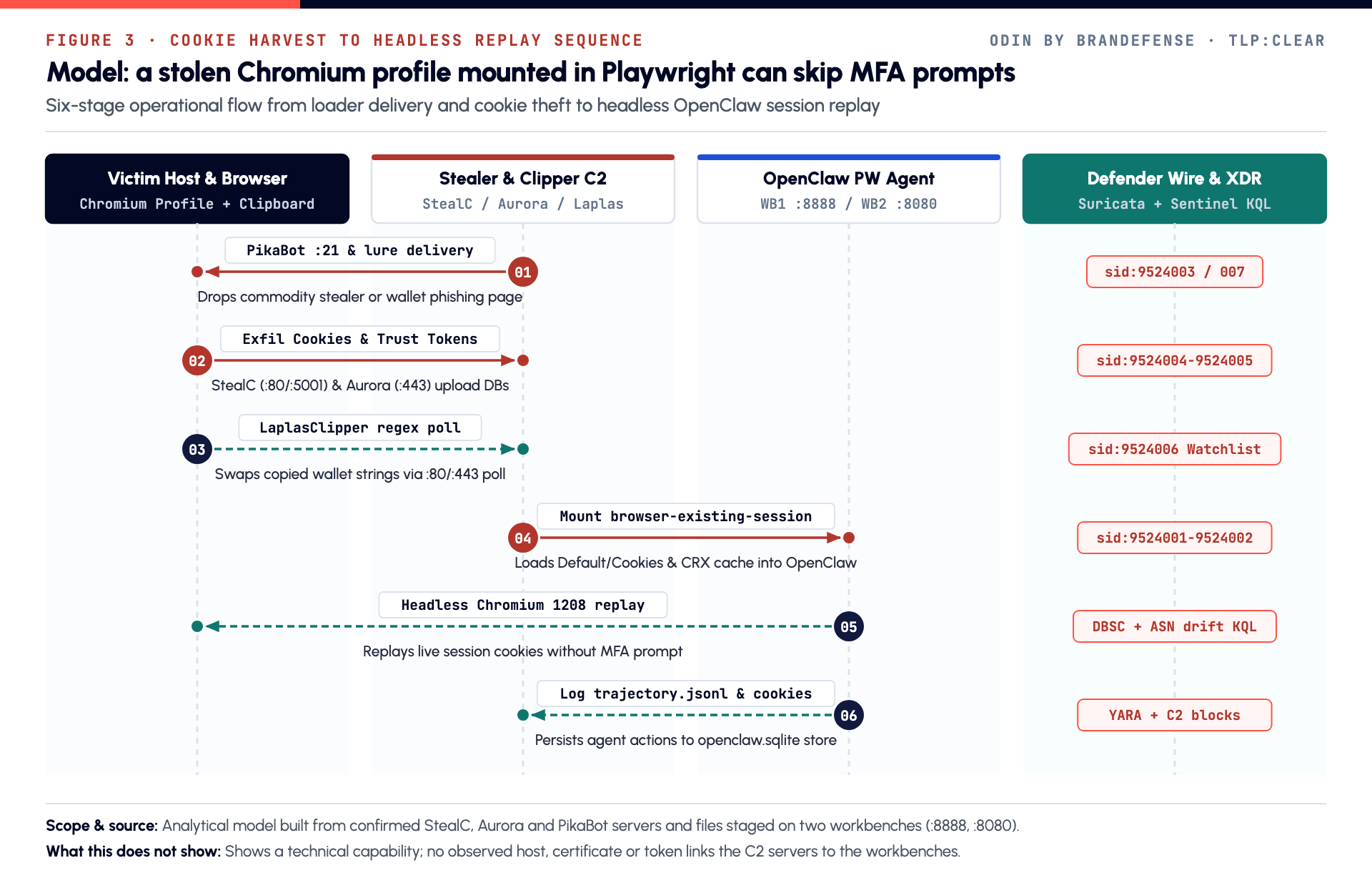
Figure 3 lays these steps out as a model sequence, from loader delivery to cookie theft to headless replay.
| Family | Endpoints | Hosts | Confirmed | Notes |
|---|---|---|---|---|
| AuroraStealer | 13 | 7 | 6 | Go stealer; one German host runs three C2 ports |
| Aurora | 5 | 2 | 0 | Suspected staging on ports 443, 3000 and 8080, seen 17 and 18 November |
| StealC | 7 | 4 | 2 | HTTP panels; one suspected 4-port mail host |
| RedLineStealer | 6 | 6 | 3 | Two Dutch hosts share one Windows certificate |
| LaplasClipper | 14 | 14 | 0 | All suspected, all on one US provider |
Confirmed stealer C2 servers
AuroraStealer is written in Go, which makes it easy to run several listeners on one server. The German host 49.12.203[.]54 on Hetzner exposed three confirmed C2 ports on 13 November 2026: 21, 443 and 8443. Its certificate name is withheld.
StealC has two confirmed HTTP panels, on DigitalOcean in Canada and Google Cloud in Singapore. RedLineStealer has one listener on port 5800 on Hetzner in Finland. Two more RedLine hosts on RootLayer Web Services in the Netherlands present the same Windows certificate, CN=WIN-UV1QM7FUHOK, on port 3389.
| Endpoint | Family | Country and network | Certificate or service |
|---|---|---|---|
| 135.181.107[.]76:443 | AuroraStealer | FI · Hetzner Online GmbH | CN=ubuntu-4gb-hel1-7 |
| 49.12.203[.]54:443 | AuroraStealer | DE · Hetzner Online GmbH | TLS C2, certificate name withheld |
| 49.12.203[.]54:8443 | AuroraStealer | DE · Hetzner Online GmbH | Alternate TLS C2 |
| 49.12.203[.]54:21 | AuroraStealer | DE · Hetzner Online GmbH | FTP listener |
| 191.101.130[.]41:3389 | AuroraStealer | US · Majestic Hosting Solutions | CN=WIN-MG87181M2AR |
| 45.144.31[.]252:3389 | AuroraStealer | RU · UFO Hosting LLC | CN=VM-ba764849-... |
| 104.248.107[.]188:80 | StealC | CA · DigitalOcean, LLC | HTTP panel |
| 34.87.31[.]79:5001 | StealC | SG · Google LLC | HTTP C2 on 5001 |
| 135.181.173[.]163:5800 | RedLineStealer | FI · Hetzner Online GmbH | TCP C2 on 5800 |
| 185.222.58[.]51:3389 | RedLineStealer | NL · RootLayer Web Services | CN=WIN-UV1QM7FUHOK |
| 45.137.22[.]249:3389 | RedLineStealer | NL · RootLayer Web Services | CN=WIN-UV1QM7FUHOK |
The two RedLine hosts also share the JARM value 2ad2ad16d2ad2ad22c2ad2ad2ad2adfd9c9d14e4f4f67f94f0359f8b28f532. JARM is a TLS server fingerprint. Many Windows servers share this kind of value, so pair it with the certificate name before acting.
A shared mail fingerprint across two families
Two suspected servers, one per family, present the exact same JARM on their IMAPS (993) and POP3S (995) ports: 0003fd00021d21d00042d43d000000e1eb348128a1eb0eda1c719dd71f6145.
| Host | Family | Country | Open ports |
|---|---|---|---|
| Suspected server A | AuroraStealer | RU, VPS provider | 443, 995, 110, 993, 143 |
| Suspected server B | StealC | NL, VPS provider | 995, 110, 993, 143 |
The most likely explanation is that both servers were built from the same VPS control-panel mail template. That is a hosting link, not proof of a shared operator. Both addresses are withheld.
The LaplasClipper cluster
All 14 LaplasClipper endpoints sit with one US provider: 10 on port 80 and 4 on port 443. The provider runs managed DNS and Anycast HTTP redirection ranges, which many unrelated customers share. So all 14 stay suspected and on watchlists. Detection relies on the clipper's polling pattern (SID 9524006) rather than on blocking these addresses.
5. Loaders and RAT Backdoors
In short
Loaders and backdoors make up 148 of the 193 endpoints across six families. Nine are confirmed C2 servers; four of them, a ChaluboRAT set in Hong Kong, are published for blocking.
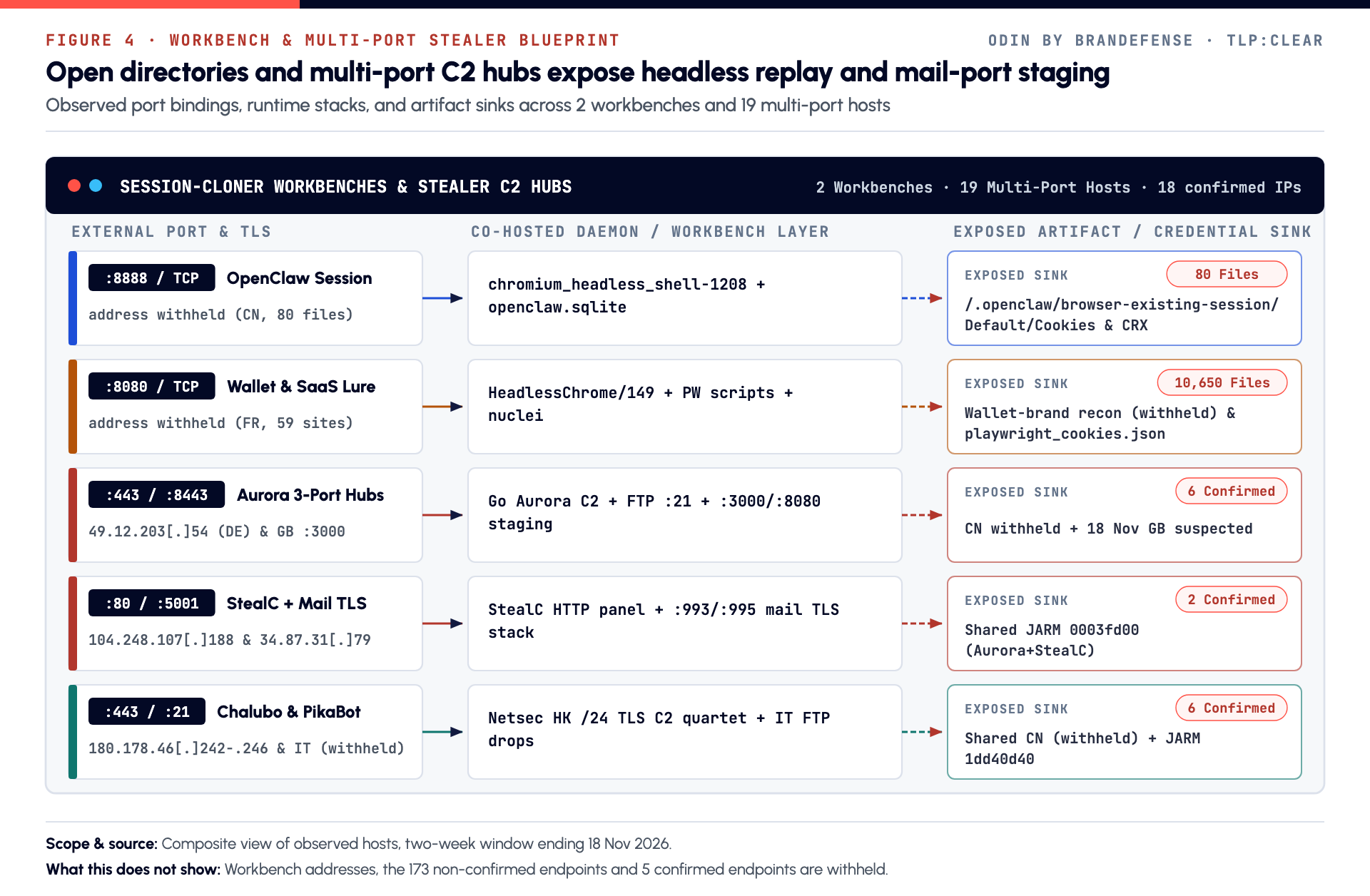
Stealers and clippers need a way in. Phishing loaders (PikaBot, TitanOmega), a long-running dropper network (Ramnit) and multi-platform RATs (ChaluboRAT, RaptorRAT, BitRAT) provide delivery and persistence. Figure 4 shows the port and service layout of the two workbenches and the main multi-port C2 hosts.
| Family | Endpoints | Hosts | Confirmed | Pattern |
|---|---|---|---|---|
| Ramnit | 110 | 98 | 3 | Mostly old, uncorroborated records; 5 on dynamic telecom networks |
| PikaBot | 11 | 8 | 2 | Two FTP drops in Italy; 9 suspected HTTP and HTTPS relays |
| RaptorRAT | 9 | 9 | 0 | All on Amazon AWS port 443, one shared JARM |
| TitanOmega | 8 | 8 | 0 | All on Liquid Web port 8080 |
| ChaluboRAT | 7 | 7 | 4 | Four Hong Kong nodes in one /24; three port 8853 candidates |
| BitRAT | 3 | 2 | 0 | One HTTPS node and one mail-port host |
ChaluboRAT: four nodes in one Hong Kong /24
ChaluboRAT targets Linux cloud servers. Four nodes in one Hong Kong /24 on Netsec Limited are confirmed C2: 180.178.46[.]242, .244, .245 and .246, all on port 443. They share one certificate name (withheld) and the JARM 1dd40d40d00040d00042d43d000000e1ea2a807a629b496b664cf07ad7c08d. Three more candidates on port 8853, in Romania, Moldova and Ukraine, stay on watchlists.
| Endpoint | Family | Country and network | Seen |
|---|---|---|---|
| 180.178.46[.]242:443 | ChaluboRAT | HK · Netsec Limited | 13 Nov 2026 |
| 180.178.46[.]244:443 | ChaluboRAT | HK · Netsec Limited | 13 Nov 2026 |
| 180.178.46[.]245:443 | ChaluboRAT | HK · Netsec Limited | 13 Nov 2026 |
| 180.178.46[.]246:443 | ChaluboRAT | HK · Netsec Limited | 13 Nov 2026 |
PikaBot and Ramnit: confirmed but withheld
PikaBot has two confirmed FTP drops on port 21 in Italy. Both sit on a shared web-hosting provider, where one address can serve many unrelated sites. Ramnit has three confirmed C2 endpoints: one TLS listener on port 8443 on a Thai broadband network, and two FTP listeners on port 21 on two Chinese networks.
We count these five as confirmed but do not publish their addresses. Shared hosting, broadband ranges and FTP listeners on infected machines can all belong to people other than the operator. Blocking them risks hitting third parties.
Uniform suspected clusters
PikaBot's nine suspected relays include three dual-port hosts (80 and 443) on Akamai and Amazon. TitanOmega binds port 8080 on all eight of its instances on Liquid Web in the United States. RaptorRAT runs on Amazon AWS only (7 in Germany, 2 in the United States), all on port 443 with the JARM 1dd40d40d00040d00042d43d000000831b6af40378e2dd35eeac4e9311926e.
BitRAT pairs one HTTPS node in the Netherlands with a dual-port mail host (465 and 587) in Romania. Uniform clusters like these are good hunting leads. On shared cloud networks they are not safe to block without a second signal.
6. Separating Signal from Noise
In short
Commodity malware feeds are noisy. Ramnit alone accounts for 110 endpoints, and Playwright and subdomain tools are also used by honest QA and red teams. Only 20 of 193 endpoints (10.4%) are confirmed.
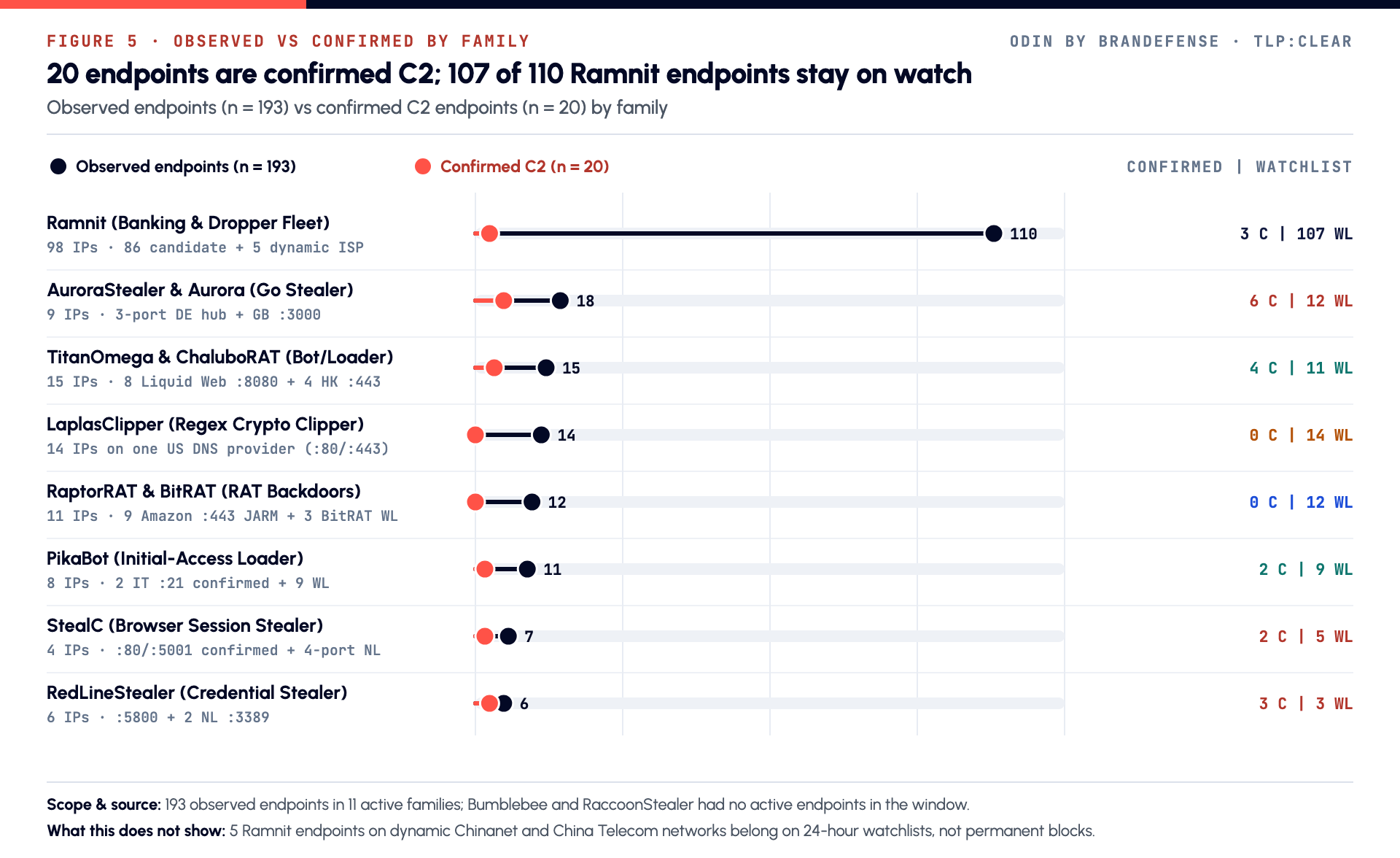
| Status | Endpoints | Network | Action |
|---|---|---|---|
| Confirmed C2 | 20 (on 18 IPs) | Mixed hosting | Block the 15 published endpoints; review blocks after 30 days |
| Suspected | 77 | Shared cloud, CDN or DNS networks | Watchlist; look for a second signal |
| Dynamic telecom | 5 | Ramnit endpoints on Chinanet and China Telecom subscriber ranges | 24-hour watchlist |
| Candidate | 91 | Mixed, mostly older feed records | Hold until corroborated |
Four questions before you block
Is it QA automation or session cloning?
Engineering teams run headless Chromium for end-to-end tests every day. A clean CI runner starts a fresh, empty browser context. It does not load a persistent browser-existing-session/Default/Cookies store next to chat-bot plugins. Allowlist your registered QA runners by exact hostname.
Is it a live server or an old record?
The 91 candidates include 86 Ramnit records, three ChaluboRAT nodes on port 8853 and two RedLineStealer nodes on ports 55615 and 1200. Some show corporate firewall certificates such as CN=SANGFOR and CN=FortiGate on reused addresses. These are not block-ready.
Is the address dynamic?
One Ramnit FTP node with a protocol match and four suspected Ramnit endpoints sit on dynamic Chinanet and China Telecom subscriber networks. Addresses there change hands often. A permanent block can cut off an unrelated customer later.
Is the network shared?
The 14 LaplasClipper nodes, 9 RaptorRAT nodes on Amazon and 8 TitanOmega nodes on Liquid Web sit on shared networks. They stay suspected until a payload or protocol match confirms them.
MITRE ATT&CK mapping
| Technique | Where it shows up |
|---|---|
| T1539 Steal Web Session Cookie | Stealers copy Chromium Cookies and Trust Tokens |
| T1550.004 Use Alternate Authentication Material: Web Session Cookie | Headless Playwright loads a logged-in profile |
| T1115 Clipboard Data | LaplasClipper swaps copied wallet addresses |
7. What Defenders Should Do
Within 24 hours
- Block the 15 published confirmed C2 endpoints (13 IPs) from the Indicators tab at the perimeter, and review them after 30 days.
- Put the 5 dynamic-telecom Ramnit endpoints and other dynamic addresses on 24-hour watchlists, not permanent blocks.
- Load Suricata SIDs 9524001 to 9524008 in alert mode and fill the KQL allowlist with exact QA hostnames.
Within 72 hours
- Turn on Chrome App-Bound Encryption on Windows endpoints.
- Alert when any process other than an installed browser reads Chromium
DefaultNetworkCookies,Trust TokensorLocal Extension Settings. - Revoke sessions when a token suddenly appears from a new ASN or a headless client.
Within 7 to 30 days
- Pilot Device Bound Session Credentials (DBSC) or continuous access evaluation for high-value SaaS and cloud consoles.
- Audit external DNS and remove dangling staging
CNAMErecords that a wallet or login lure could use. - Restrict browser extension sideloading by enterprise policy.
- Require a second, hardware-backed confirmation for corporate crypto treasury transfers, so a swapped address is caught before it is sent.
8. Detection Rules
The full rules are in the Detection rules tab. Each file targets a signal from this report. Every rule file loads without errors in its engine (Suricata 7.0.12, YARA-X, pySigma, Kusto.Language); the rules were not replayed against live traffic.
| Rule file | What it catches |
|---|---|
odin_playwright_session_cloners_and_stealers.rules | Suricata 7: eight signatures for exposed OpenClaw session folders, Playwright cookie jars, stealer uploads, clipper polling and loader or RAT check-ins |
sentinel_openclaw_session_clone_and_stealer_hunt.kql | Microsoft Sentinel and Defender XDR: contact with the published C2 addresses, joined with headless-browser and cookie-store process activity |
sigma_playwright_session_cloner_and_clipper_activity.yml | Sigma (3 rules): profile mounts by headless runtimes, non-browser access to Chromium vaults, and clipboard-swap command lines |
odin_openclaw_aurora_laplas_stealc_artifacts.yar | YARA (4 rules): OpenClaw session configs, Playwright cookie-capture scripts, Aurora and StealC vault manifests, and LaplasClipper regex configs |
How the Suricata signatures work
| SID | Looks for | Why |
|---|---|---|
| 9524001 | An HTTP 200 response on ports 8888, 8080 or 3000 whose body lists .openclaw/browser-existing-session/ and component_crx_cache | Flags an exposed session-cloning directory |
| 9524002 | Outbound POST /api/openclaw/session with browser-existing-session and trajectory in the body | Catches an agent syncing replay logs |
| 9524003 | A request for /playwright_cookies.json with a HeadlessChrome/ user agent | Catches cookie-jar transfer from a headless browser |
| 9524004 | Outbound POST /aurora/gate with BrowserCookies and CryptoWallets in the body | Catches AuroraStealer exfiltration (T1539) |
| 9524005 | Outbound multipart POST to a .php path with cookies_list and DefaultNetworkCookies | Catches StealC cookie and LevelDB uploads |
| 9524006 | A request to /bot/regex with an X-Laplas-Key: header | Catches LaplasClipper polling for swap rules (T1115) |
| 9524007 | Outbound POST /api/loader/stage with build_guid in the body | Catches PikaBot and TitanOmega stage check-ins |
| 9524008 | Outbound POST /gate/chalubo with a user agent starting Chalubo-Node/ | Catches ChaluboRAT heartbeats |
Exempt named QA Playwright subnets from SID 9524003 if your test suites use a fixture called playwright_cookies.json. Send SID 9524001 hits to analyst review when they come from threat-intelligence sandboxes that browse open directories.
How the other rules work
The KQL query looks back 7 days. It carries the 13 published confirmed C2 addresses. Any device that contacts one of them always surfaces, whatever its name. The host allowlist applies only to the heuristic branch: node, python, chrome-headless-shell, powershell.exe or rundll32.exe talking on stealer and workbench ports.
That network view is joined with process events that mention .openclaw, browser-existing-session, chromium_headless_shell, playwright_cookies.json, DefaultNetworkCookies, Local Extension Settings or laplas. A device also surfaces when it reaches 12 or more distinct remote IPs on those ports. Raise that threshold on Node build servers.
The first Sigma rule needs a headless runtime (chrome-headless-shell, chromium, node or python3) and a command line naming .openclaw/browser-existing-session or playwright_cookies.json. The second flags Windows command lines that touch Chromium cookie, token or extension paths, unless the process is an installed browser at its exact Program Files path. The third flags LaplasClipper polling strings or Get-Clipboard near a Bitcoin or Ethereum address pattern.
All Sigma allowlists use exact hostnames or exact executable paths. Per-user browser installs outside Program Files will show up and need local tuning.
| YARA rule | Fires when |
|---|---|
ODIN_OpenClaw_Playwright_Session_Cloner_Config | An OpenClaw session path or openclaw.sqlite appears with a Playwright headless-shell path, component_crx_cache or a .trajectory.jsonl name |
ODIN_Playwright_Cookie_Capture_Script | playwright_cookies.json appears with HeadlessChrome/ or the Playwright cookie APIs context.cookies( or storageState |
ODIN_Aurora_StealC_Browser_Vault_Manifest | /aurora/gate, BrowserCookies and CryptoWallets appear together, or cookies_list appears with DefaultNetworkCookies |
ODIN_LaplasClipper_Regex_Wallet_Swap_Config | A LaplasClipper header or poll path appears with a BTC, ETH or TRX regex rule name |
All four YARA rules stop at files under 512 KB.
9. Indicators
The Indicators tab holds 15 published indicators: 15 confirmed C2 endpoints (IP and port) on 13 distinct addresses, and no file hashes. Five more confirmed endpoints, all suspected and candidate endpoints, both workbench addresses and every workbench file hash are withheld.
| Type | Count |
|---|---|
| Confirmed C2 endpoints published for blocking (IP and port) | 15 (13 IPs) |
| Confirmed C2 endpoints withheld (shared hosting, broadband or possibly infected hosts) | 5 |
| Representative watchlist entries withheld (2 workbenches, 5 suspected cluster nodes, 1 dynamic-ISP node); the other non-confirmed endpoints are withheld too | 8 |
| File hashes | 0 published |
Supporting fingerprints, text only:
- JARM
2ad2ad16d2ad2ad22c2ad2ad2ad2adfd9c9d14e4f4f67f94f0359f8b28f532(RedLineStealer on 3389, pair withCN=WIN-UV1QM7FUHOK) - JARM
1dd40d40d00040d00042d43d000000e1ea2a807a629b496b664cf07ad7c08d(ChaluboRAT on 443) - JARM
0003fd00021d21d00042d43d000000e1eb348128a1eb0eda1c719dd71f6145(suspected Aurora and StealC mail ports) - JARM
1dd40d40d00040d00042d43d000000831b6af40378e2dd35eeac4e9311926e(suspected RaptorRAT on Amazon 443) - Certificate names
CN=ubuntu-4gb-hel1-7,CN=WIN-MG87181M2ARandCN=WIN-UV1QM7FUHOKon confirmed hosts
Published confirmed C2 endpoints
| Endpoint | Family | Country | Network | Seen |
|---|---|---|---|---|
| 135.181.107[.]76:443 | AuroraStealer | FI | Hetzner Online GmbH | 13 Nov 2026 |
| 191.101.130[.]41:3389 | AuroraStealer | US | Majestic Hosting Solutions | 13 Nov 2026 |
| 45.144.31[.]252:3389 | AuroraStealer | RU | UFO Hosting LLC | 13 Nov 2026 |
| 49.12.203[.]54:21 | AuroraStealer | DE | Hetzner Online GmbH | 13 Nov 2026 |
| 49.12.203[.]54:443 | AuroraStealer | DE | Hetzner Online GmbH | 13 Nov 2026 |
| 49.12.203[.]54:8443 | AuroraStealer | DE | Hetzner Online GmbH | 13 Nov 2026 |
| 180.178.46[.]242:443 | ChaluboRAT | HK | Netsec Limited | 13 Nov 2026 |
| 180.178.46[.]244:443 | ChaluboRAT | HK | Netsec Limited | 13 Nov 2026 |
| 180.178.46[.]245:443 | ChaluboRAT | HK | Netsec Limited | 13 Nov 2026 |
| 180.178.46[.]246:443 | ChaluboRAT | HK | Netsec Limited | 13 Nov 2026 |
| 135.181.173[.]163:5800 | RedLineStealer | FI | Hetzner Online GmbH | 13 Nov 2026 |
| 185.222.58[.]51:3389 | RedLineStealer | NL | RootLayer Web Services | 13 Nov 2026 |
| 45.137.22[.]249:3389 | RedLineStealer | NL | RootLayer Web Services | 13 Nov 2026 |
| 104.248.107[.]188:80 | StealC | CA | DigitalOcean, LLC | 13 Nov 2026 |
| 34.87.31[.]79:5001 | StealC | SG | Google LLC | 13 Nov 2026 |
VPS leases change hands after takedowns. Re-check each address before renewing a block after 30 days.
10. Scope and Limits
- What we saw. We saw servers, open ports, certificates and files in open directories. We did not see any victim machine, any replayed session or any loss on the target side.
- The model is a model. The four-part chain in Chapter 2 explains how the pieces could fit. Nothing we observed links a given stealer server to either workbench.
- Workbench owners are unknown. Workbench 1 could hold stolen browser data or its owner's own profile. Workbench 2 could belong to an attacker or to an unhardened security contractor.
- Confirmed is not complete. Twenty confirmed endpoints are a floor. Many of the 77 suspected and 91 candidate endpoints may be real C2 servers that lacked a second signal.
- Family names. Family names describe the malware, not a named threat group or operator.
- Dates. Seen dates are when we observed an endpoint. Older dates on some Ramnit records are record dates, not the length of this study.
- Third parties. Targeted wallet and SaaS brands, both workbench addresses and five confirmed endpoints on shared or subscriber networks are withheld.
11. Sources
- Google Chromium Security, Improving the Security of Chrome Cookies on Windows: security.googleblog.com/2024/07/improving-security-of-chrome-cookies-on.html (verified on 18 November 2026).
- Microsoft Playwright Documentation, BrowserType.launchPersistentContext: playwright.dev/docs/api/class-browsertype (verified on 18 November 2026).
- W3C Web Application Security Working Group, Device Bound Session Credentials: w3c.github.io/webappsec-dbsc (verified on 18 November 2026).
- MITRE ATT&CK, Steal Web Session Cookie (T1539): attack.mitre.org/techniques/T1539 (verified on 18 November 2026).
- CISA, Implementing Phishing-Resistant MFA: www.cisa.gov/resources-tools/resources/implementing-phishing-resistant-mfa (verified on 18 November 2026).
- OISF, Suricata 7.0 User Guide: HTTP Keywords: docs.suricata.io/en/suricata-7.0.0/rules/http-keywords.html (verified on 18 November 2026).
- Salesforce Engineering, Easily Identify Malicious Servers on the Internet with JARM: engineering.salesforce.com/easily-identify-malicious-servers-on-the-internet-with-jarm-e095edac525a (verified on 18 November 2026).
What is…?
Short explanations of the tools and families named in this study.
What is Ramnit?
Ramnit is a long-running banking trojan and worm. Many of its infrastructure records are old feed entries.
More about RamnitInfostealerWhat is Aurora Stealer?
Aurora Stealer is a Go-based infostealer sold as malware-as-a-service.
More about Aurora StealerAI agentWhat is OpenClaw?
OpenClaw is an open-source autonomous agent gateway that keeps trajectories, auth profiles and session logs on disk.
More about OpenClawTechniqueWhat is JARM?
JARM is an open TLS server fingerprinting method from Salesforce. It hashes how a server answers a set of crafted TLS handshakes.
More about JARMMalware loaderWhat is PikaBot?
PikaBot is a malware loader and backdoor distributed through phishing, used to deliver follow-on payloads.
More about PikaBotInfostealerWhat is RedLine?
RedLine is an infostealer sold as malware-as-a-service. It steals browser credentials, cookies and crypto wallets. Law enforcement disrupted its infrastructure in 2024.
More about RedLineFrequently asked questions
Why does a stolen cookie matter so much?
When you log in to a web service, it gives your browser a session cookie. From then on, many services trust that cookie and do not ask for your password or MFA again. Modern infostealers copy the whole Chromium profile folder, cookies included. Whoever holds a fresh cookie can often act as you.
What did the workbenches hold?
The first workbench is a cloud server in China with an open directory on port 8888. It holds Playwright's headless Chromium build 1208 and an OpenClaw agent folder named browser-existing-session. OpenClaw is an autonomous agent that can drive a browser. That folder is a complete Chromium profile, with a cookie store, Trust Tokens, browsing history and a key database. The agent logs each step it takes.
Who supplies the stolen data?
Commodity stealers do the collecting. Aurora and AuroraStealer account for 18 endpoints on 9 hosts. One German server runs three AuroraStealer C2 ports at once. StealC has 7 endpoints and RedLineStealer 6. Two RedLine servers in the Netherlands share the same Windows certificate.
What should we block, and what should we only watch?
Only 20 of the 193 endpoints are confirmed C2 servers. We publish 15 of them, on 13 addresses, in the Indicators tab. The other five sit on shared web hosting or broadband networks, where an address can belong to someone else. We withhold those.