


1. Executive Summary
In short
In a two-week observation window ending 18 November 2026, with data to 19 November, Odin by Brandefense found three open staging servers on port 8000. The largest holds a seven-file kit aimed at FortiGate 100E firewalls, 26 Adaptix gopher builds and 22 Windows beacons. Some builds are named for DRBD storage and Tomcat servers. Separately, 71 modular C2 endpoints sit on 68 hosts; 8 are confirmed. Block the 7 published controllers, check firewall integrity offline, and watch Linux storage and Tomcat hosts.
Perimeter firewalls rarely run endpoint agents. That makes them a quiet first step into a network. This report shows what one operator staged for that path: a small control kit for a FortiGate model, and implants named for the servers they would land on next. It also maps ten modular C2 and relay families seen in the same window, and separates the few confirmed controllers from the many leads.
One staging server pairs a FortiGate 100E kit with 48 implant builds.
Workbench 1, in the United States, exposes 77 files. A /fg100e/ folder holds a Python controller, a Node.js stage, a 212-byte second stage and two controller logs. Next to it sit 26 Adaptix gopher builds and 22 Windows beacon builds, each with its own SHA-256 hash.
Linux builds are named for the servers they target next.
All 17 Linux amd64 gopher builds are 6,430,904 bytes, yet every hash differs. Their names point at DRBD replicated storage nodes, Apache Tomcat servers, a back-office host and a relay. Two smaller workbenches in Finland and China stage a 23.08 MB Sliver implant and an SSRF callback server.
Only 8 of 71 modular C2 endpoints are confirmed controllers.
Six Nemo controllers on port 5000, one Xalgorix node on port 80 and one AtlasX node on port 8000 are confirmed. The other 63 endpoints are suspected or candidate listeners and stay on watchlists. Nothing links the C2 fleets to the three workbenches.
Three Decisions for Leaders
- Check FortiGate integrity out of band and limit appliance egress. Verify firmware and file system integrity on internet-facing FortiGate gateways using vendor guidance. Block outbound HTTP and custom-port traffic from appliance management networks to unapproved cloud addresses.
- Extend visibility to Linux storage and Tomcat servers. These tiers often run without endpoint agents. Add process and binary logging there, and alert on unsigned Go or ELF binaries that start next to replication or servlet services.
- Block what is confirmed, and hunt the rest. Block the 7 published controller addresses now. Feed the shared TLS fingerprints and the port 8080 and 2334 relay patterns into correlation rules, not into block lists.
The Study in Numbers
| Number | What it is |
|---|---|
| 71 | Modular C2 and relay endpoints across ten families, on 68 hosts |
| 8 | Confirmed controllers: 6 Nemo, 1 Xalgorix, 1 AtlasX (7 addresses published) |
| 3 | Open staging servers on port 8000 in the US, Finland and China, holding 133 files |
| 77 | Files on Workbench 1, including the seven-file /fg100e/ kit |
| 26 | Adaptix gopher builds with unique hashes across six OS and CPU targets |
| 22 | Windows beacon builds: HTTP, DNS, service, shellcode and IAT-obfuscated |
| 23.08 MB | Sliver implant staged on Workbench 2 |
How to use this report.
Security leaders can read Chapter 1 and Chapter 7. Firewall, Linux storage and middleware teams should read Chapters 3 and 4. SOC and detection engineers should start with Chapters 7 to 9. CTI analysts will find the fleet detail in Chapter 5 and the competing explanations in Chapter 6.
2. From the Edge to the Core
In short
The files on three port 8000 servers fall into four groups: an edge kit, role-named gopher agents, Windows beacons with a Sliver implant, and modular C2 fleets. Together they describe a path from a perimeter firewall to internal storage, as a model only.
Perimeter appliances sit outside normal endpoint detection. An operator who gains a foothold there can move toward Linux middleware, replicated storage and Windows domains. When such tooling sits in an open web directory, file names, sizes and build diversity show how the work is divided.
We read the staged files as a capability model. The files show what was prepared. They do not show that any step reached a target. We saw no logs from target systems.
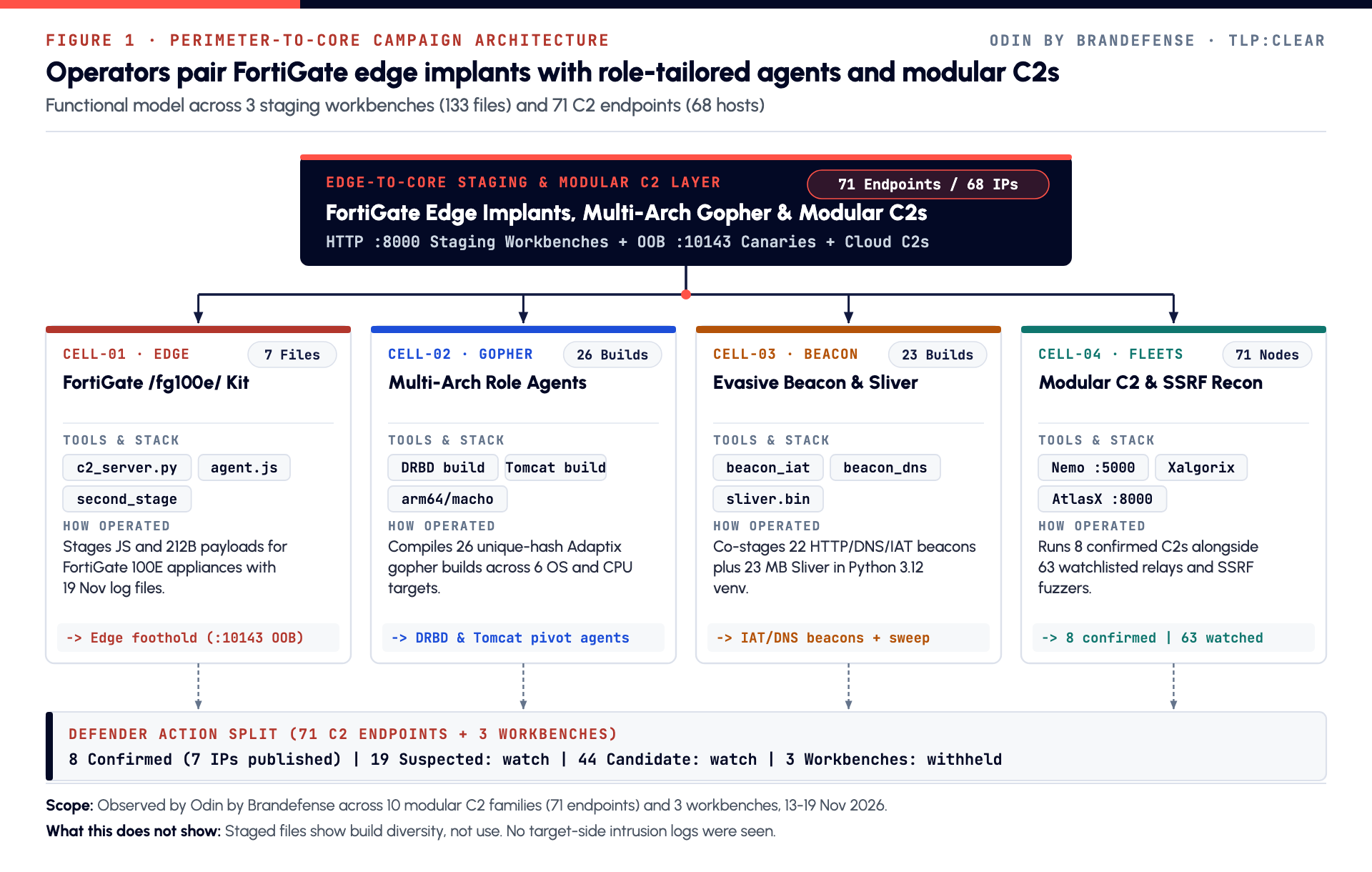
The four groups in Figure 1 are an analytical model. They reflect file roles, not proven teams or separate actors.
| Group | What it holds | Where |
|---|---|---|
| Edge | Seven-file /fg100e/ kit for FortiGate 100E firewalls, plus out-of-band (OOB) canary listeners | Workbench 1 |
| Gopher | 26 Adaptix gopher builds across six OS and CPU targets, several named for server roles | Workbench 1 |
| Beacon and Sliver | 22 Windows beacon builds on Workbench 1, and a 23.08 MB Sliver implant on Workbench 2 | Workbenches 1 and 2 |
| Fleets | 71 modular C2 and relay endpoints, plus an SSRF callback and fuzzing server | 68 hosts, and Workbench 3 |
The ten C2 and relay families
The 71 endpoints sit on 68 distinct IPv4 hosts. Three hosts each listen on two ports within one family. No host carries two families.
| Family | Role | Endpoints (hosts) | Confirmed | Suspected | Candidate |
|---|---|---|---|---|---|
| CobaltStrikeUnverified | Beacon and RAT staging | 15 (14) | 0 | 15 | 0 |
| Oktos | Edge and proxy relays | 12 (12) | 0 | 0 | 12 |
| GhostFrame | Edge and proxy relays | 10 (10) | 0 | 0 | 10 |
| Xalgorix | Modular C2 | 10 (8) | 1 | 1 | 8 |
| StrikeAgent | Modular implant candidates | 7 (7) | 0 | 0 | 7 |
| Nemo | Modular C2 | 6 (6) | 6 | 0 | 0 |
| AtlasX | Modular C2 | 4 (4) | 1 | 0 | 3 |
| PrismX | Beacon and RAT staging | 3 (3) | 0 | 2 | 1 |
| PupyC2 | Beacon and RAT staging | 2 (2) | 0 | 1 | 1 |
| CloudSorcererAPT | Modular implant candidates | 2 (2) | 0 | 0 | 2 |
| Total | 71 (68) | 8 | 19 | 44 |
Family names are the labels of the matching signatures. They are not attribution.
Where the endpoints run
China hosts 23 endpoints (32.4%), the United States 15 (21.1%), Hong Kong 8 (11.3%), Germany 6 (8.5%) and Ireland 5 (7.0%). The leading networks are Hangzhou Alibaba (11), Shenzhen Tencent (8), Amazon.com (8), BL Networks (6) and Hetzner Online (5).
All three workbenches serve files with a Python HTTP server on TCP 8000. The confirmed AtlasX controller also listens on port 8000. A shared default port is not a link between operators.
3. Workbench 1: The FortiGate 100E Kit and the Build Matrix
In short
Workbench 1 in the United States exposes 77 files. A seven-file /fg100e/ kit sits next to 26 gopher builds, 22 beacon builds and 22 helper scripts and logs for out-of-band callbacks, WebSocket command bridges and Windows sweeps.
Workbench 1 shows how one operator prepared payloads for a mixed enterprise network. It does not hold one generic implant. It holds separate builds for edge appliances, Linux storage and web servers, macOS endpoints, and x64 and ARM64 Windows hosts. A campaign subfolder repeats several of the builds.
| Content | Files |
|---|---|
/fg100e/ FortiGate 100E kit | 7 |
| Adaptix gopher builds | 26 |
| Windows beacon builds | 22 |
| OOB canary, WebSocket and lateral sweep helpers and logs | 22 |
| Total | 77 |
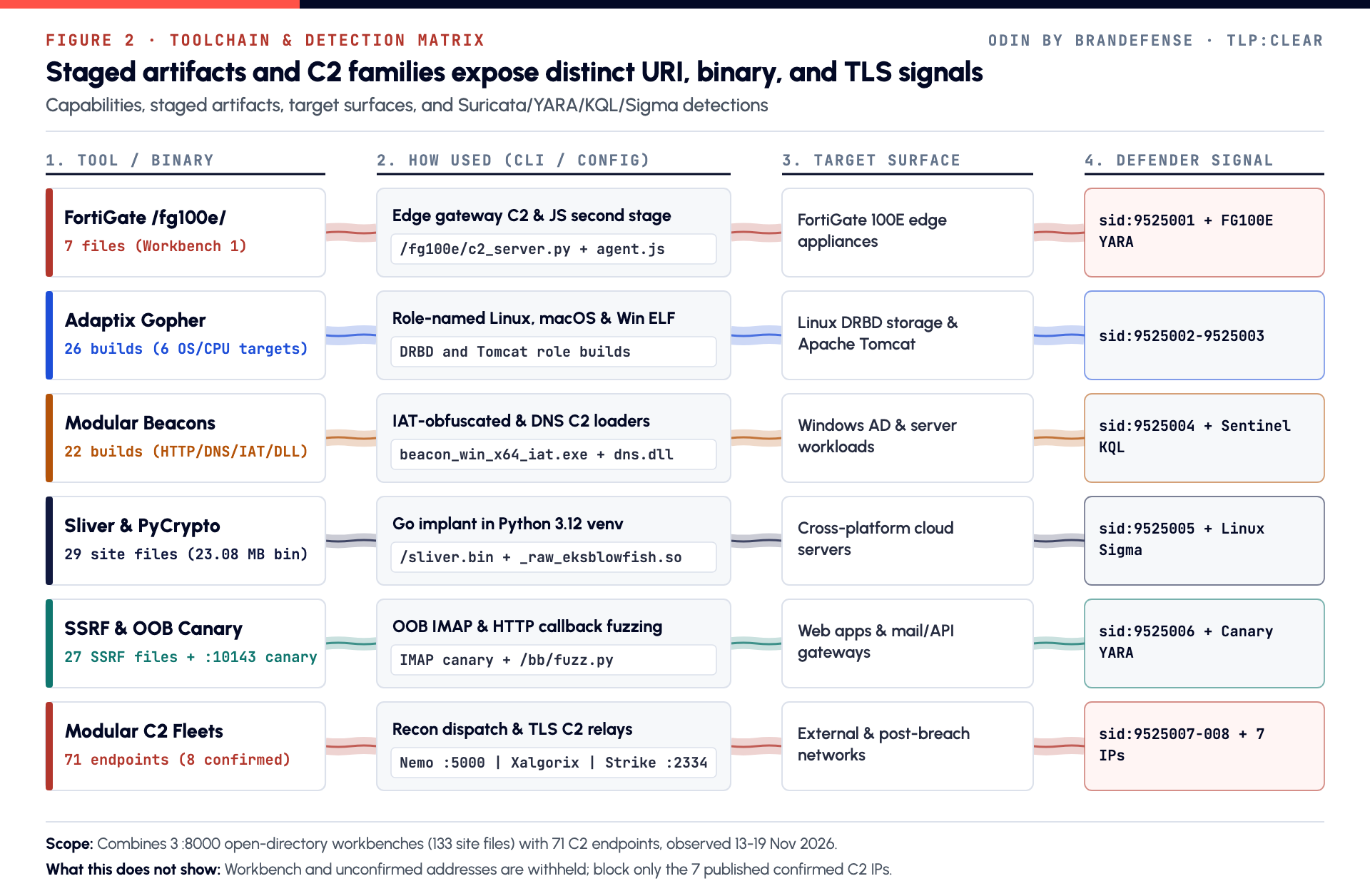
The /fg100e/ kit
The /fg100e/ folder holds a small controller and a staged implant chain for the FortiGate 100E (FG-100E) model. FortiOS combines custom Linux daemons with Node.js management components, and appliances do not run standard EDR. Small script and shellcode stages keep the disk footprint low.
| Staged file | Size (bytes) | Role |
|---|---|---|
/fg100e/c2_server.py | 5,198 | Python controller for implant check-ins |
/fg100e/agent.js | 744 | Small JavaScript stage for a Node.js runtime |
/fg100e/start.sh | 296 | Startup wrapper that writes output to c2_stdout.log (194 bytes) |
/fg100e/second_stage.bin | 212 | Compact second-stage bootstrap |
| Two controller logs | 101 and 194 | File names carry the date 19 November 2026 |
The logs show that the controller wrote output. They do not show which devices, if any, checked in. Any FortiGate that contacted this controller would be a victim, and we publish no device data. Fortinet publishes FortiOS integrity and hardening guidance through its PSIRT; this data does not show which vulnerability, if any, the kit relies on.
Out-of-band and lateral helpers
At the web root sit helper scripts for callbacks and lateral movement. Out-of-band listeners let an operator confirm that a target can reach the internet, even when no reply comes back on the main channel.
| Helper | Size (bytes) | Role |
|---|---|---|
| IMAP canary listener script (name withheld) | 2,204 | Listens on TCP 10143 and writes callbacks to oob_listener_10143.out (423 bytes) |
/execws.py | 1,929 | WebSocket command bridge, paired with oob_listener.py (1,485 bytes) |
| PowerShell sweep script (name withheld) | 3,010 | Internal subnet and Windows host discovery, paired with a 102-byte batch file |
oob_9001.log, oob_8890.log, oob_9123.out | Small | Logs from listeners on ports 9001, 8890 and 9123 |
Role-named gopher builds
The 26 gopher binaries are Go agents from the open-source AdaptixC2 framework. Each binary has a unique SHA-256 hash, even where sizes match. That pattern suggests a per-listener key or a per-target profile stamped in at build time.
| Gopher build | Builds | Size (bytes) | Examples |
|---|---|---|---|
Linux amd64 (.elf, .bin) | 17 | 6,430,904 | Role-named builds (names withheld) |
Windows amd64 (.exe) | 3 | 6,048,256 | gopher_windows_amd64.exe, gopher_win_x64.exe |
Linux arm64 (.elf) | 2 | 5,963,960 | gopher_linux_arm64.elf |
Windows arm64 (.exe) | 2 | 5,523,456 | gopher_windows_arm64.exe |
macOS amd64 and arm64 (.macho) | 2 | 6,209,664 and 5,854,658 | gopher_macos_amd64.macho, gopher_macos_arm64.macho |
Several Linux amd64 builds are named for downstream roles: a second DRBD storage node, an Apache Tomcat server, a back-office host, an environment tag and a relay. We withhold the exact names because they may reflect a target's own host naming. Build names also carry four numeric task IDs, which are withheld too.
The roles matter for defenders. DRBD (Distributed Replicated Block Device) mirrors block storage across high-availability Linux cluster nodes. These nodes often back virtualization datastores or core databases, where kernel changes and third-party EDR hooks are restricted. Apache Tomcat servers often sit in a DMZ middleware tier, between reverse proxies and internal databases.
Windows beacon builds
The 22 beacon builds are C and C++ Windows payloads. They cover HTTP, DNS, service, reflective DLL, shellcode and IAT-obfuscated variants. IAT obfuscation hides the imported Windows functions from static scanners.
| Beacon build | Builds | Size (bytes) | Examples |
|---|---|---|---|
| HTTP and service, x64 | 11 | 94,720 to 169,984 | beacon_http_x64.exe, beacon_http_x64_svc.exe, beacon_win_x64_v1.exe, agent.x64.exe |
DNS, x64 (.exe, .dll) | 4 | 167,424 and 166,400 | beacon_dns_x64.exe, beacon_dns_x64.dll |
| Reflective DLL and shellcode, x64 | 4 | 103,936 and 103,935 | beacon_http_x64.dll, beacon_http_x64_shellcode.bin |
| IAT-obfuscated x64, and HTTP x86 | 3 | 94,208 and 95,232 | beacon_win_x64_iat.exe (94,208), beacon_http_x86.exe (2 builds) |
A modeled path from edge to storage
Figure 3 places the staged files on one possible path. It is an analytical model built from file names and sizes. No step was seen on a target system.
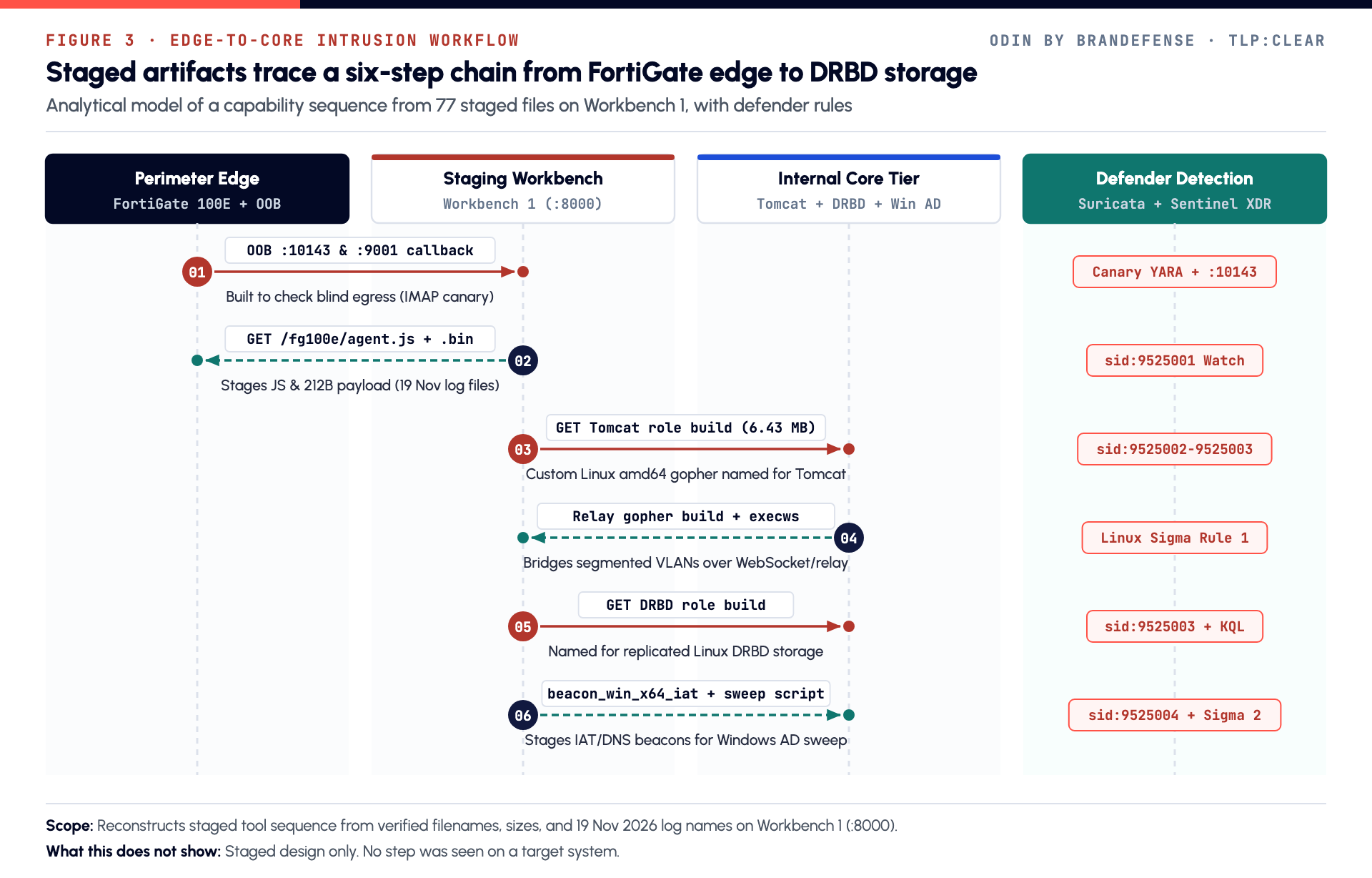
| Step | Staged files | What they are built for | Detection |
|---|---|---|---|
| 1 | IMAP canary, listeners on 10143 and 9001 | Check blind egress from a target | Canary YARA rule |
| 2 | /fg100e/agent.js and second_stage.bin | Stage code on a FortiGate 100E | SID 9525001 |
| 3 | Tomcat-named Linux amd64 gopher (6.43 MB) | Agent for a Tomcat server | SIDs 9525002 and 9525003 |
| 4 | Relay gopher build and execws.py | Bridge segmented networks over WebSocket or relay | Linux Sigma rule 1 |
| 5 | DRBD-named Linux amd64 gopher | Agent for a DRBD storage node | SID 9525003 and KQL |
| 6 | beacon_win_x64_iat.exe and the sweep script | Windows beacons and domain discovery | SID 9525004 and Sigma rule 2 |
4. Workbenches 2 and 3: Sliver and SSRF Callbacks
In short
Two smaller port 8000 servers, active from 16 to 18 November 2026, hold different tools. Workbench 2 in Finland stages a 23.08 MB Sliver implant inside a Python 3.12 crypto environment. Workbench 3 in China runs an SSRF callback listener and fuzzing scripts.
Keeping implants, crypto helpers and callback listeners on separate servers means one takedown does not stop the whole workflow. Nothing in the data shows whether one operator runs all three workbenches.
| Workbench | Country, dates | Files | Main content | Detection |
|---|---|---|---|---|
| Workbench 1 | US, 19 Nov | 77 | /fg100e/ kit, 26 gopher, 22 beacon, 10143 OOB canary | SIDs 9525001 to 9525004, YARA |
| Workbench 2 | FI, 16 to 18 Nov | 29 | 23.08 MB /sliver.bin, /HollowGhost.png, Python 3.12 PyCryptodome | SID 9525005, Linux Sigma rule 1 |
| Workbench 3 | CN, 16 to 18 Nov | 27 | /listener.py SSRF sink, 16.43 MB log, /bb/fuzz.py, /rsyncgrab/loop.sh | SID 9525006, canary YARA rule |
Workbench 2: Sliver implant and a Python 3.12 crypto stack
At the web root sits /sliver.bin (23,081,076 bytes). Its size is consistent with a full Go-compiled Sliver implant with built-in mutual TLS and HTTP(S) transports. Sliver is a public adversary-emulation framework that intrusion operators also use.
The root also holds /HollowGhost.png (146,651 bytes), whose purpose is not established, and an exposed .git pack file (163,894 bytes). A Python virtual environment holds native PyCryptodome libraries.
| Library | Size (bytes) |
|---|---|
_raw_eksblowfish.abi3.so | 214,520 |
_scrypt.abi3.so | 202,872 |
_curve25519.abi3.so | 130,112 |
_raw_aesni.abi3.so | 106,376 |
_chacha20.abi3.so | 93,280 |
This is a standard Python crypto stack. Custom payload encoders and C2 staging proxies often use it.
Workbench 3: SSRF callback listener and rsync polling
Workbench 3 runs on a GPU-equipped Linux cloud instance. It works as a server-side request forgery (SSRF) callback and recon server. In an SSRF test, a target server is tricked into calling an address the attacker controls, and the attacker logs the call.
| File | Size (bytes) | Role |
|---|---|---|
/listener.py | 971 | Python 3.12 http.server listener started from /tmp/listener.py; answers HTTP 200 and logs each request |
ssrf.log | 323,215 | Callback log |
ssrf_srv.log | 173,172 | Server log; tracebacks show external connections reset mid-handshake (ConnectionResetError) |
http8000.log | 16,431,425 | HTTP access log on port 8000 |
/bb/fuzz.py | 1,253 | Iterative parameter fuzzing |
/bb/final.py | 1,500 | Verification step after fuzzing |
/rsyncgrab/loop.sh | 354 | Loop that keeps polling rsync shares on exposed backup or storage services |
The logs hold requests from third-party systems. Their contents are withheld.
5. Modular C2 Fleets: Nemo, Xalgorix, AtlasX and Relays
In short
Ten modular C2 and relay families account for 71 endpoints on 68 hosts. Eight are confirmed controllers. The other 63 are suspected or candidate listeners, and some of them share TLS fingerprints with cloud load balancers.
These fleets keep long-running interactive C2 and recon tasks apart from the open file servers. They listen on ports 5000, 8080, 8443, 2334 and 443.
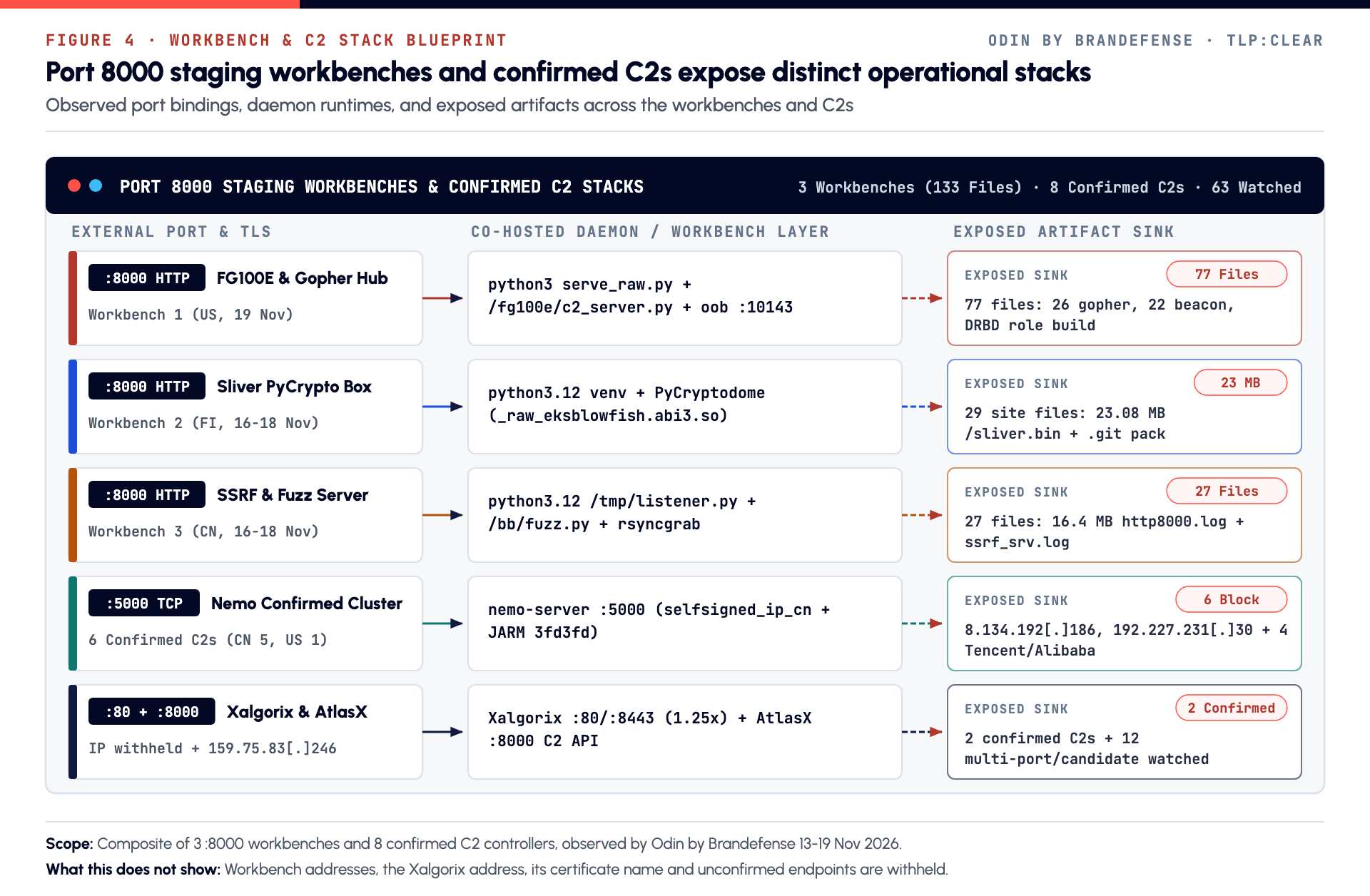
Confirmed controllers
All eight confirmed controllers belong to three modular frameworks on rented cloud hosting.
Nemo. Six recon and C2 task controllers listen on TCP 5000. Three sit on Shenzhen Tencent, two on Hangzhou Alibaba and one on HostPapa in the United States. Five of the six share the JARM value 3fd3fd00000000000043d3fd3fd43d79451d8c63b099acafdbabb24551d0e6. The sixth, 8.134.192[.]186, presents the same selfsigned_ip_cn certificate label.
Xalgorix. One confirmed node listens on port 80 on a Microsoft Corporation network in the Netherlands. Its custom certificate names a pentest-themed subdomain, so we withhold its address and certificate name (see Chapter 6). Nine companion endpoints are watched. They sit on Contabo, Hetzner Online (three on port 49567) and Data Hub Pvt. Ltd. in Nepal (one host on ports 11015 and 11080). Two separate Contabo hosts use port 8443. A candidate shares the Nemo JARM, and a suspected node shares a JARM with PupyC2 (see the watched-pattern table below).
AtlasX. One confirmed controller, 159.75.83[.]246:8000, sits on Shenzhen Tencent. Three candidates are watched: two on port 8000 (Huawei Cloud and Alibaba Cloud) and one on port 9852.
| Endpoint | Family | Country and network | Fingerprint | Seen |
|---|---|---|---|---|
| 8.134.192[.]186:5000 | Nemo | CN, Hangzhou Alibaba Advertising | selfsigned_ip_cn | 18 Nov 2026 |
| 82.156.139[.]85:5000 | Nemo | CN, Shenzhen Tencent | selfsigned_ip_cn, JARM 3fd3fd...51d0e6 | 13 Nov 2026 |
| 49.235.137[.]92:5000 | Nemo | CN, Shenzhen Tencent | selfsigned_ip_cn, JARM 3fd3fd...51d0e6 | 13 Nov 2026 |
| 192.227.231[.]30:5000 | Nemo | US, HostPapa | selfsigned_ip_cn, JARM 3fd3fd...51d0e6 | 13 Nov 2026 |
| 39.104.88[.]50:5000 | Nemo | CN, Hangzhou Alibaba Advertising | selfsigned_ip_cn, JARM 3fd3fd...51d0e6 | 13 Nov 2026 |
| 43.136.55[.]111:5000 | Nemo | CN, Shenzhen Tencent | selfsigned_ip_cn, JARM 3fd3fd...51d0e6 | 13 Nov 2026 |
| Address withheld, port 80 | Xalgorix | NL, Microsoft Corporation | Custom certificate (withheld) | 13 Nov 2026 |
| 159.75.83[.]246:8000 | AtlasX | CN, Shenzhen Tencent | Confirmed port 8000 C2 API | 13 Nov 2026 |
Watched relay and implant clusters
The 63 watched endpoints are leads, not block targets. Four patterns help hunters.
| Pattern | Endpoints | Detail |
|---|---|---|
| Port 8080 edge relays | Oktos 12, GhostFrame 10 | 8 of 12 Oktos nodes and all 10 GhostFrame nodes use TCP 8080. Oktos spans HK 6, CN 3, JP 1, SG 1 and LT 1, with 4 on GNET INC. GhostFrame sits in the US: 5 on BL Networks and 4 on HOSTING INDUSTRY LIMITED |
| StrikeAgent on port 2334 | 7 | All 7 candidates use TCP 2334 (6 in CN, 1 in NL). Two present the certificate CN=StrikeAgent-AtkBrain-Flash with JARM 3fd3fd00000000000043d43d00043dc3b2afa8a5ec09b510a8559aff7899fb |
| CloudSorcererAPT label | 2 | Two candidates on port 443, in Indonesia and Malaysia, share JARM 20d08b20d21d20d20c42d08b20b41d4e146478463a800ecaae72d070cbd53e. The family name is a signature label, not attribution |
| PrismX and PupyC2 | 3 and 2 | PrismX has two suspected listeners on ports 80 and 8888. One PupyC2 candidate on port 9000 shares JARM 2ad2ad000...7b06eb with a suspected Xalgorix node on port 8443. That Contabo node is not the Nemo JARM candidate |
Why the Cobalt Strike matches are not blocked
Fifteen endpoints match an unverified Cobalt Strike signature. None is confirmed. Seven of them sit on Amazon.com (5 in Ireland, 1 in the US, 1 in Japan) and share one JARM value, 2ad2ad16d2ad2ad00042d42d00000061256d32ed7779c14686ad100544dc8d.
Default HTTP and HTTPS profiles and TLS cipher orderings often collide with AWS load balancers, CloudFront and Hetzner reverse proxies. Blocking AWS addresses on a JARM or header match alone would disrupt legitimate SaaS traffic. These 15 stay on a watchlist until a malleable-C2 URI or a process signal confirms them.
6. Who Runs This: Competing Explanations
In short
The staged files fit an intrusion operator, but they also fit an authorized red team. Nothing links the three workbenches to the C2 fleets.
We weighed three explanations for Workbench 1 and its neighbours.
| Hypothesis | For | Against | Verdict |
|---|---|---|---|
| H1: An intrusion operator stages edge and internal tooling | FortiGate kit next to role-named implants; builds named for downstream server roles; public exposure | No target-side logs; no device check-ins seen | Plausible, unproven |
| H2: An authorized red team or penetration test | A build named for Kali Linux, a structured MANIFEST.txt and numbered task folders on Workbench 1; the confirmed Xalgorix node uses a pentest-themed certificate subdomain | Leaving 48 implant binaries and C2 scripts on an open server is poor practice for a tester | Plausible |
| H3: One operator runs all three workbenches and the C2 fleets | All three workbenches use a Python HTTP server on port 8000, the same port as the confirmed AtlasX controller | No shared IP, certificate, redirect target or campaign token links them | Not supported |
Either way, an open directory that serves live implants and C2 scripts is a risk on its own. Anyone can download the builds. Defenders should detect the file names and URIs in this report, whoever owns the server.
Because H2 stays plausible, we withhold the workbench addresses, the role-named build names, the task IDs and the file hashes. For the same reason, the Xalgorix address and its certificate name are withheld.
7. What Defenders Should Do
Within 24 hours
- Block the 7 published controller addresses: six Nemo on port 5000 and one AtlasX on port 8000. Re-check each block after 30 days, since cloud addresses get reassigned.
- Block outbound HTTP to port 8000 and connections to port 10143 from firewall management networks.
- Put suspected listeners on a 7-day watchlist and candidates on a 72-hour watchlist. Candidates on dynamic telecom networks such as CHINANET belong on a 24-hour list.
Within 72 hours
- Verify firmware and file system integrity on internet-facing FortiGate gateways, including any FG-100E units, using vendor PSIRT guidance and an offline method. Cross-check firmware against the CISA Known Exploited Vulnerabilities catalog.
- Add DRBD storage nodes and Apache Tomcat servers to process logging (
auditdor eBPF). Alert on unsigned Go or ELF binaries named*_agent.elforgopher_*. - Alert when a Tomcat
javaprocess startscurlorwget, or connects out to ports 8000 or 10143.
Within 7 to 30 days
- Deploy Suricata SIDs 9525001 to 9525008 on perimeter and DMZ segments.
- Enable the Sentinel KQL hunt and the three Sigma rules. Fill the allowlist with the exact hostnames of your own adversary-emulation and canary hosts.
- Add the Nemo JARM
3fd3fd...51d0e6, the StrikeAgent certificate subject and the shared JARM values to external attack surface hunting. - Close unauthenticated
rsync(TCP 873) exposure, and inspect web and API egress for SSRF callbacks to external port 8000 and 10143 listeners.
8. Detection Rules
The full rules are in the Detection rules tab. Every rule file loads without errors in its engine (Suricata 7.0.12, YARA-X, pySigma, Kusto.Language); the rules were not replayed against live traffic. Test them in your own environment before production use.
| Rule file | What it catches |
|---|---|
odin_fortigate_fg100e_and_gopher_staging.rules | Suricata 7: eight signatures for /fg100e/ pulls, gopher and beacon fetches, open Sliver and SSRF listings, Nemo task dispatch and the StrikeAgent certificate |
sentinel_fortigate_edge_and_multiarch_gopher_hunt.kql | Microsoft Sentinel and Defender XDR: contact with confirmed controllers, staging-port pulls and gopher, beacon, Sliver or /fg100e/ process activity |
sigma_multiarch_gopher_beacon_and_edge_staging.yml | Sigma (3 rules): Linux gopher and Sliver execution, Windows beacon execution, and /fg100e/, canary and SSRF script starts |
odin_fg100e_gopher_beacon_iat_artifacts.yar | YARA (4 rules): /fg100e/ kit manifests, multi-arch gopher build sets, beacon kits, and OOB canary or SSRF workbench files |
How the Suricata signatures work
| SID | Looks for | Why |
|---|---|---|
| 9525001 | Outbound GET whose URI starts with /fg100e/ on ports 8000, 8080 or 80 | Catches a pull of the FortiGate kit stages |
| 9525002 | Outbound GET for gopher_linux, gopher_windows, gopher_macos, gopher_win, gopher_kali or gopher_relay | Catches multi-arch gopher fetches |
| 9525003 | Outbound GET for a URI ending in <name>_agent.elf | Catches role-named Linux agents without naming a target |
| 9525004 | Outbound GET for beacon_dns, beacon_http or beacon_win with x64 or x86 | Catches beacon payload fetches |
| 9525005 | Port 8000 response with Directory listing for / and sliver.bin | Catches an open Sliver staging directory |
| 9525006 | Port 8000 response with Directory listing for / and ssrf_srv.log | Catches an open SSRF callback server |
| 9525007 | Outbound JSON POST to /v1/task/ on port 5000 | Catches Nemo task dispatch |
| 9525008 | TLS certificate subject CN=StrikeAgent-AtkBrain-Flash from port 2334 | Hunt only: the listeners are candidates. Pair with endpoint checks before acting |
How the other rules work
The KQL query has a 7-day lookback. It flags devices that contact the 7 confirmed controller addresses. It also flags curl, wget, Python, Node.js, PowerShell, rundll32 or java processes that reach the staging and C2 ports in this report. A process branch flags files named *_agent.elf, gopher_*, beacon_* or sliver.bin, and command lines that reference /fg100e/, second_stage.bin or the canary and WebSocket scripts. A third condition flags a device that reaches 10 or more remote addresses on two or more of these ports. The allowlist never hides a match on a confirmed controller.
The first Sigma rule flags Linux execution of *_agent.elf, default gopher builds or /sliver.bin. The second flags Windows beacon and gopher executables, and command lines that load beacon DLL or shellcode files. The third flags Python, Node.js or shell processes that start the /fg100e/ scripts, the IMAP canary, execws.py, oob_listener.py, /bb/fuzz.py or rsyncgrab/loop.sh. Each rule excludes only exact hostnames that you register.
| YARA rule | Fires when |
|---|---|
ODIN_FortiGate_FG100E_PostExploit_C2_Kit | /fg100e/ or c2_server.py appears with second_stage.bin, agent.js or c2_stdout.log |
ODIN_Adaptix_MultiArch_Gopher_Build_Set | A manifest or listing names gopher builds for three or more OS and CPU targets |
ODIN_Beacon_DNS_HTTP_IAT_Staging_Manifest | Two beacon build names appear with execws.py or oob_listener.py |
ODIN_OOB_IMAP_Canary_and_SSRF_Fuzz_Workbench | The IMAP canary and its port 10143 output file appear together, or two SSRF workbench file names do |
9. Indicators
The Indicators tab holds 7 published indicators: 7 addresses and 0 hashes. They are the confirmed Nemo and AtlasX controllers listed in Chapter 5.
| Type | Count | Where |
|---|---|---|
| Confirmed controller endpoints to block (IP and port) | 7 | Indicators tab and Chapter 5 |
| Confirmed controller with address withheld (Xalgorix) | 1 | Text only |
| Hashes of selected staged files (SHA-256) | 7 | Withheld, like every other build hash |
| Watched C2 and relay endpoints | 63 | Withheld; described by family, port and fingerprint |
Supporting fingerprints stay in the text: the Nemo JARM 3fd3fd00000000000043d3fd3fd43d79451d8c63b099acafdbabb24551d0e6, the StrikeAgent certificate subject CN=StrikeAgent-AtkBrain-Flash, the URI patterns in Chapter 8, and the file names and sizes in Chapters 3 and 4.
Withheld: the three workbench addresses, the seven selected file hashes and all other build hashes, the role-named build names and task IDs, the Xalgorix address and certificate name, and all suspected or candidate addresses.
MITRE ATT&CK
The staging servers serve tools for transfer into a target network, which maps to T1105 Ingress Tool Transfer. SIDs 9525001 to 9525006 and the YARA rules detect this transfer and its staging directories.
10. Scope and Limits
- Window. The findings cover a two-week observation window ending 18 November 2026, with data to 19 November. Workbench 1 files were captured on 19 November. Workbenches 2 and 3 were seen from 16 to 18 November. Log dates are file names, not proof of activity.
- Staged is not used. The workbenches show what was prepared. We saw no target-side logs, and no step of the modeled chain was observed on a victim.
- Owner not established. An authorized red team is a plausible owner of Workbench 1. Treat its builds as hostile tooling for detection, without assuming hostile intent.
- Confirmed is not attribution. Family names come from signature labels. They do not tie these hosts to any named group or published campaign.
- Leads stay leads. The 63 watched endpoints rest on weaker signals. Do not block them without a second signal.
- No links between populations. Nothing ties the workbenches to the C2 fleets, or the fleets to each other.
- Rule testing. Every published rule file loads without errors in its engine (Suricata 7.0.12, YARA-X, pySigma and Microsoft's Kusto.Language analyzer, checked on 20 November 2026). The rules were not replayed against live traffic, so test and tune them in your own environment before production use.
11. Sources
- CISA. Known Exploited Vulnerabilities Catalog. https://www.cisa.gov/known-exploited-vulnerabilities-catalog (verified 20 November 2026)
- PSIRT advisories for FortiOS and FortiGate. https://www.fortiguard.com/psirt (verified 20 November 2026)
- MITRE ATT&CK. T1105 Ingress Tool Transfer. https://attack.mitre.org/techniques/T1105/ (verified 20 November 2026)
- LINBIT. DRBD 9 User Guide. https://linbit.com/drbd-user-guide/drbd-guide-9_0-en/ (verified 19 November 2026)
- Apache Software Foundation. Apache Tomcat 10.1 Security Considerations. https://tomcat.apache.org/tomcat-10.1-doc/security-howto.html (verified 20 November 2026)
- OISF. Suricata 7.0 User Guide, HTTP keywords. https://docs.suricata.io/en/suricata-7.0.0/rules/http-keywords.html (verified 20 November 2026)
- Salesforce Engineering. Easily Identify Malicious Servers on the Internet with JARM. https://engineering.salesforce.com/easily-identify-malicious-servers-on-the-internet-with-jarm-e095edac525a/ (verified 20 November 2026)
What is…?
Short explanations of the tools and families named in this study.
What is FortiGate?
FortiGate is Fortinet's line of firewall and VPN appliances. Exploited edge devices are a common entry point and a place to hide C2.
More about FortiGateReconnaissance platformWhat is Nemo?
Nemo is an open-source asset collection and reconnaissance platform with a web console.
More about NemoTechniqueWhat is JARM?
JARM is an open TLS server fingerprinting method from Salesforce. It hashes how a server answers a set of crafted TLS handshakes.
More about JARMC2 frameworkWhat is Sliver?
Sliver is an open-source command-and-control (C2) framework from Bishop Fox, written in Go. Red teams use it for adversary emulation, and criminal and state operators use it as a free alternative to Cobalt Strike.
More about SliverC2 frameworkWhat is Cobalt Strike?
Cobalt Strike is commercial adversary simulation software. Its Beacon implant gives an operator remote control of a compromised host. Cracked and leaked copies are widely used by ransomware and espionage operators.
More about Cobalt StrikeFrequently asked questions
What was on the main staging server?
Workbench 1, in the United States, exposed 77 files in an open web directory. They fall into four groups. The /fg100e/ folder holds a 5,198-byte Python controller, a 744-byte Node.js stage, a 212-byte second stage, a startup script and two controller logs. The logs show that the controller wrote output. They do not show which firewalls, if any, checked in. Any FortiGate that did would be a victim, and we publish no device data.
Why do the build names matter?
All 26 gopher builds and 22 beacon builds carry unique SHA-256 hashes. Even the 17 Linux amd64 gopher builds, which are all exactly 6,430,904 bytes, differ. That suggests a key or profile stamped into each build for a specific listener or target.
What did the other two servers hold?
Two smaller port 8000 servers held different tools from 16 to 18 November 2026. In an SSRF test, a target server is tricked into calling an address the attacker controls. Workbench 3 answered those calls and logged them, including a 16.43 MB access log. Those logs hold requests from third-party systems, so their contents are withheld.
Who runs it, and what should be blocked?
We cannot say. The files fit an intrusion operator. They also fit an authorized red team: one build is named for Kali Linux, and the server carries a manifest and numbered task folders. Either way, an open directory full of live implants is a risk, because anyone can download them. We withhold the workbench addresses and file hashes.