


Key takeaways
- One open staging server pairs a seven-file FortiGate 100E kit with 26 gopher and 22 beacon builds.
- Several Linux builds are named for DRBD storage nodes and Tomcat servers, the likely next hops.
- Two smaller servers stage a 23.08 MB Sliver implant and an SSRF callback listener.
- Of 71 modular C2 endpoints, 8 are confirmed; 7 addresses are published for blocking.
- Check firewall integrity offline, log Linux storage and Tomcat hosts, and block confirmed controllers.
In a two-week observation window ending 18 November 2026, with data to 19 November, Odin by Brandefense found three open staging servers on port 8000. The largest holds a small control kit for FortiGate 100E firewalls, next to 48 implant builds for Linux, macOS and Windows. Several builds are named for the servers they would reach next: replicated storage nodes and Tomcat application servers. For defenders, the message is clear. The path runs from a firewall with no endpoint agent to Linux tiers that often have none either.
What was on the main staging server?
Workbench 1, in the United States, exposed 77 files in an open web directory. They fall into four groups.
| Content | Files |
|---|---|
/fg100e/ kit for FortiGate 100E firewalls | 7 |
| Adaptix gopher builds (Go agents) | 26 |
| Windows beacon builds | 22 |
| Out-of-band canary, WebSocket and sweep helpers and logs | 22 |
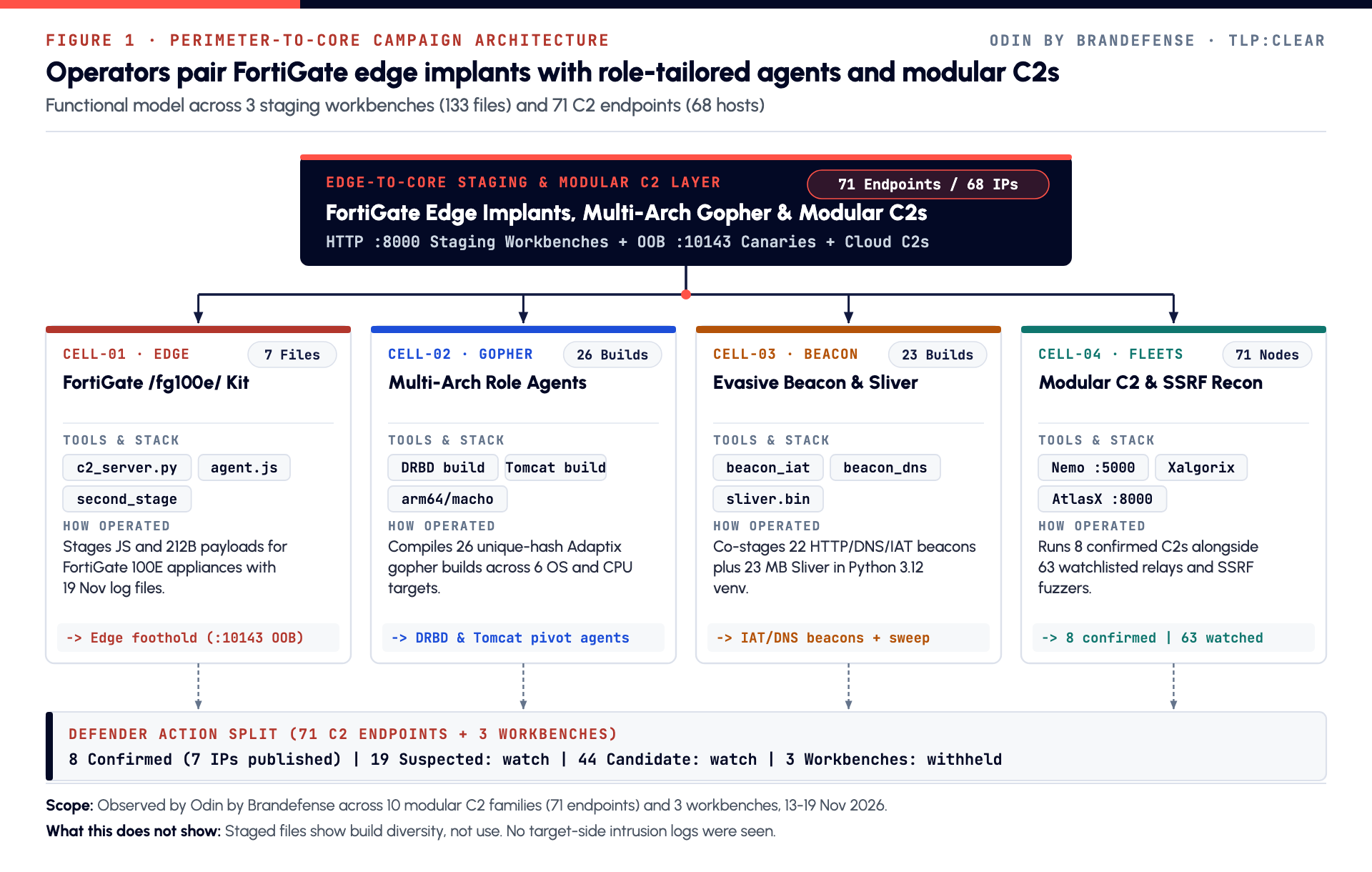
The /fg100e/ folder holds a 5,198-byte Python controller, a 744-byte Node.js stage, a 212-byte second stage, a startup script and two controller logs. The logs show that the controller wrote output. They do not show which firewalls, if any, checked in. Any FortiGate that did would be a victim, and we publish no device data.
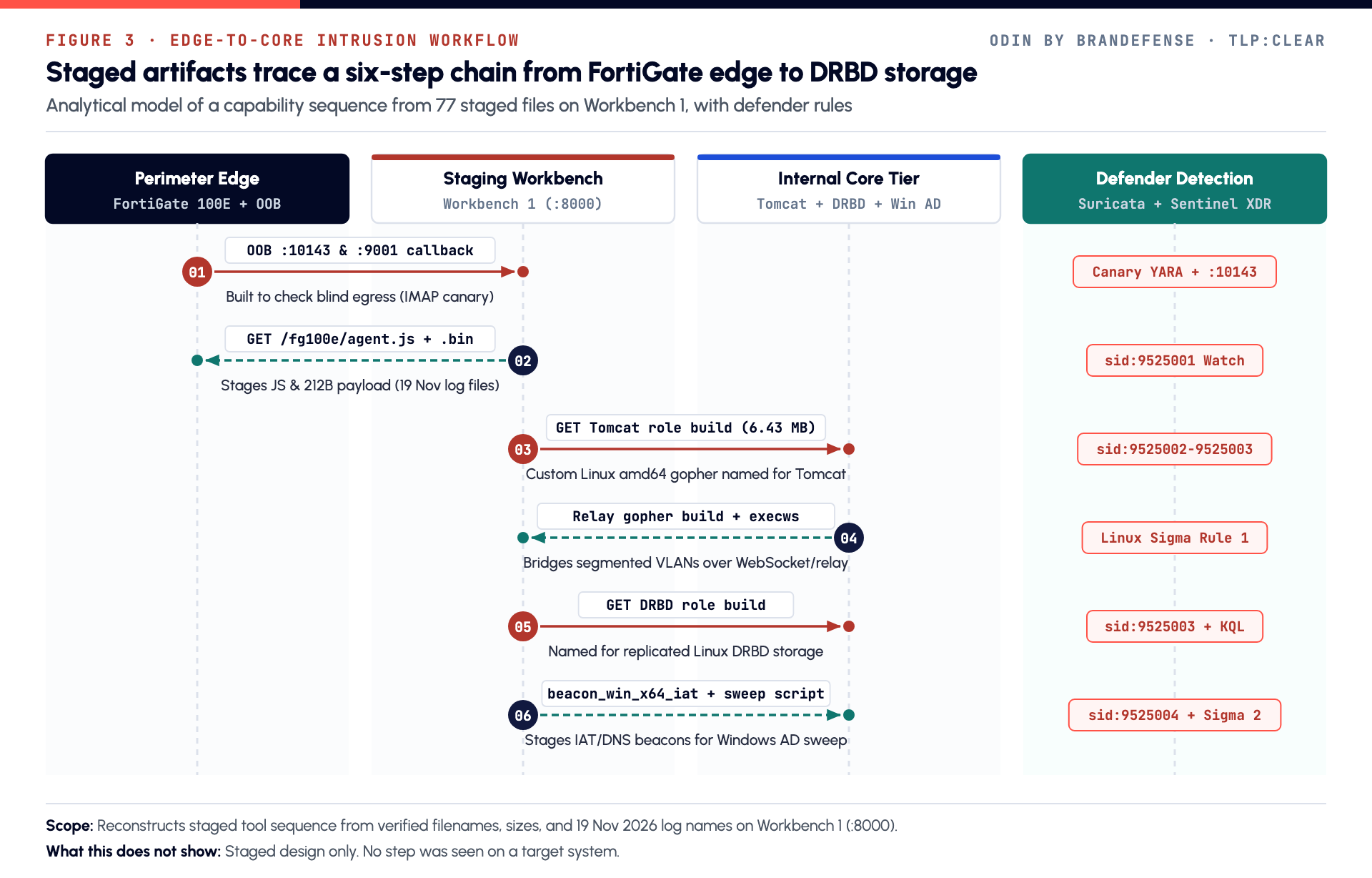
Helper scripts sit beside the kit. One listens for IMAP callbacks on TCP 10143. Such out-of-band listeners let an operator confirm that a target can reach the internet even when the main channel stays silent. Others bridge commands over WebSocket or sweep Windows subnets.
Why do the build names matter?
All 26 gopher builds and 22 beacon builds carry unique SHA-256 hashes. Even the 17 Linux amd64 gopher builds, which are all exactly 6,430,904 bytes, differ. That suggests a key or profile stamped into each build for a specific listener or target.
The names are the bigger clue. Several Linux builds are named for a second DRBD storage node, an Apache Tomcat server, a back-office host and a relay. We withhold the exact names, because they may echo a target's own host naming.
DRBD mirrors block storage across high-availability Linux clusters. It often backs virtualization datastores and core databases, where teams avoid kernel changes and third-party agents. Tomcat servers often sit in a DMZ between reverse proxies and internal databases. Both are valuable, and both are often poorly watched.
The beacons cover HTTP, DNS, service, shellcode and IAT-obfuscated Windows variants. Figure 3 places all of these files on one possible path from the firewall to storage. It is a model built from file names. No step was seen on a target system.
What did the other two servers hold?
Two smaller port 8000 servers held different tools from 16 to 18 November 2026.
| Server | Country | Files | Main content |
|---|---|---|---|
| Workbench 2 | Finland | 29 | A 23.08 MB Sliver implant inside a Python 3.12 crypto environment |
| Workbench 3 | China | 27 | An SSRF callback listener, fuzzing scripts and an rsync polling loop |
In an SSRF test, a target server is tricked into calling an address the attacker controls. Workbench 3 answered those calls and logged them, including a 16.43 MB access log. Those logs hold requests from third-party systems, so their contents are withheld.
Splitting tools across servers means one takedown does not stop the whole workflow. Nothing in the data shows whether one operator runs all three.
Who runs it, and what should be blocked?
We cannot say. The files fit an intrusion operator. They also fit an authorized red team: one build is named for Kali Linux, and the server carries a manifest and numbered task folders. Either way, an open directory full of live implants is a risk, because anyone can download them. We withhold the workbench addresses and file hashes.
Separately, Odin mapped 71 modular C2 and relay endpoints on 68 hosts across ten families. Only 8 are confirmed controllers.
| Family | Confirmed | Port | Hosting |
|---|---|---|---|
| Nemo | 6 | 5000 | Shenzhen Tencent, Hangzhou Alibaba, HostPapa |
| Xalgorix | 1 (address withheld) | 80 | Microsoft Corporation, Netherlands |
| AtlasX | 1 | 8000 | Shenzhen Tencent |
The Xalgorix node uses a pentest-themed certificate, so its address is withheld. The other 63 endpoints are suspected or candidate listeners. Fifteen match an unverified Cobalt Strike signature, and seven of those sit behind Amazon load balancers that share one TLS fingerprint. Blocking them on that match alone would break legitimate traffic. Nothing links the C2 fleets to the three workbenches.
What to do now
- Check FortiGate integrity offline. Verify firmware and file systems on internet-facing FortiGate gateways using vendor guidance, and block outbound port 8000 and 10143 traffic from management networks.
- Watch Linux storage and Tomcat hosts. Add process logging to DRBD nodes and Tomcat servers, and alert on unsigned binaries named
*_agent.elforgopher_*. - Block the 7 confirmed controllers in the full report's Indicators tab, and re-check each block after 30 days.
- Keep leads on watchlists. Route the 63 suspected and candidate endpoints to correlation rules, not to block lists.
- Deploy the rules. The full report's Detection rules tab has Suricata, Sentinel KQL, Sigma and YARA rules for the kit, the builds and the fleets.
The full report covers the file inventory, the fleet fingerprints and the rule logic in detail.
What is…?
Short explanations of the tools and families named in this study.
What is FortiGate?
FortiGate is Fortinet's line of firewall and VPN appliances. Exploited edge devices are a common entry point and a place to hide C2.
More about FortiGateReconnaissance platformWhat is Nemo?
Nemo is an open-source asset collection and reconnaissance platform with a web console.
More about NemoTechniqueWhat is JARM?
JARM is an open TLS server fingerprinting method from Salesforce. It hashes how a server answers a set of crafted TLS handshakes.
More about JARMC2 frameworkWhat is Sliver?
Sliver is an open-source command-and-control (C2) framework from Bishop Fox, written in Go. Red teams use it for adversary emulation, and criminal and state operators use it as a free alternative to Cobalt Strike.
More about SliverC2 frameworkWhat is Cobalt Strike?
Cobalt Strike is commercial adversary simulation software. Its Beacon implant gives an operator remote control of a compromised host. Cracked and leaked copies are widely used by ransomware and espionage operators.
More about Cobalt StrikeFrequently asked questions
What was on the main staging server?
Workbench 1, in the United States, exposed 77 files in an open web directory. They fall into four groups. The /fg100e/ folder holds a 5,198-byte Python controller, a 744-byte Node.js stage, a 212-byte second stage, a startup script and two controller logs. The logs show that the controller wrote output. They do not show which firewalls, if any, checked in. Any FortiGate that did would be a victim, and we publish no device data.
Why do the build names matter?
All 26 gopher builds and 22 beacon builds carry unique SHA-256 hashes. Even the 17 Linux amd64 gopher builds, which are all exactly 6,430,904 bytes, differ. That suggests a key or profile stamped into each build for a specific listener or target.
What did the other two servers hold?
Two smaller port 8000 servers held different tools from 16 to 18 November 2026. In an SSRF test, a target server is tricked into calling an address the attacker controls. Workbench 3 answered those calls and logged them, including a 16.43 MB access log. Those logs hold requests from third-party systems, so their contents are withheld.
Who runs it, and what should be blocked?
We cannot say. The files fit an intrusion operator. They also fit an authorized red team: one build is named for Kali Linux, and the server carries a manifest and numbered task folders. Either way, an open directory full of live implants is a risk, because anyone can download them. We withhold the workbench addresses and file hashes.