


1. Executive Summary
In short
Odin by Brandefense mapped 172 command-and-control (C2) endpoints on 131 hosts across twelve remote access, loader and stealer families. Of these, 35 endpoints on 26 hosts are confirmed. Beside them sits an exposed Russian staging server with 212 files: corporate tax lures, hidden-desktop DLLs and scripts that relaunch Chrome to read session cookies. Block the confirmed controllers, keep PureRAT and ShadowHVNC candidates on watchlists, and alert when scripts relaunch browsers with a remote debugging port.
Remote access trojans (RATs) give an operator control of a Windows workstation. Hidden-desktop tools, known as HVNC (hidden virtual network computing), let the operator use the victim's browser on an invisible second desktop. This report maps where these controllers listen and what one exposed staging server shows about attack preparation.
PureRAT and ShadowHVNC use two different hosting patterns.
PureRAT has 61 endpoints on 38 hosts, and 44 of them sit on sequential ports 56001 to 56003. ShadowHVNC has 8 endpoints, all on port 443, and 5 of them sit on one offshore VPS provider, DEDIK SERVICES LIMITED.
One staging server links IRS tax lures to cookie theft and hidden desktops.
The server holds a 1,392,428-byte Form1120.pdf that is byte-identical to a raw payload file, .pdf.lnk shortcut lures, five hidden-desktop DLL builds and scripts that relaunch Chrome with remote debugging. These are staged files. Nothing shows they were used against a target.
Confirmed loader and RAT controllers sit next to false-positive traps.
The 35 confirmed endpoints belong to Emotet (28), XenoRAT (2), OrcusRAT (2), SerpentStealer (2) and ChaosRAT (1). Three suspected Emotet listeners share a Dutch registrar's FTP hosting, and two Emotet nodes outside the confirmed 35 sit on a dynamic China Unicom network. These five belong on watchlists, not block lists.
Three Decisions for Leaders
- Block confirmed controllers and keep candidates on watchlists. Block the confirmed C2 addresses in this report. Keep uncorroborated PureRAT and ShadowHVNC listeners, FTP collisions and dynamic telecom addresses on time-bound watchlists.
- Lock down browser remote debugging. Alert when PowerShell, Windows Script Host or an unsigned program relaunches Chrome, Edge or Brave with
--remote-debugging-port. Set the browser policy that turns remote debugging off on managed workstations. - Inspect tax-season attachments and high-port TLS egress. Block
.pdf.lnkdouble-extension shortcuts at the mail gateway. Watch outbound connections to ports 56001 to 56003 and 57003.
The Study in Numbers
| Number | What it is |
|---|---|
| 172 | C2 endpoints across twelve families, on 131 hosts |
| 35 | Confirmed C2 endpoints on 26 hosts; the other 137 stay on watchlists |
| 61 | PureRAT endpoints on 38 hosts; 44 of them on ports 56001 to 56003 |
| 8 | ShadowHVNC endpoints, all on port 443; 5 on DEDIK SERVICES LIMITED |
| 212 | Files on one exposed staging server, spanning tax lures, HVNC DLLs and Chrome cookie scripts |
| 1,392,428 | Bytes in the Form1120.pdf file that is byte-identical to Form1120.bin |
| 5 | Listeners held on watchlists despite a match: 3 FTP collisions and 2 dynamic telecom addresses |
How to use this report.
Leaders can read Chapters 1, 6 and 7. SOC and detection engineers should start with Chapters 7 to 9. CTI analysts will find fleet and workbench detail in Chapters 2 to 5.
2. The Ecosystem at a Glance
In short
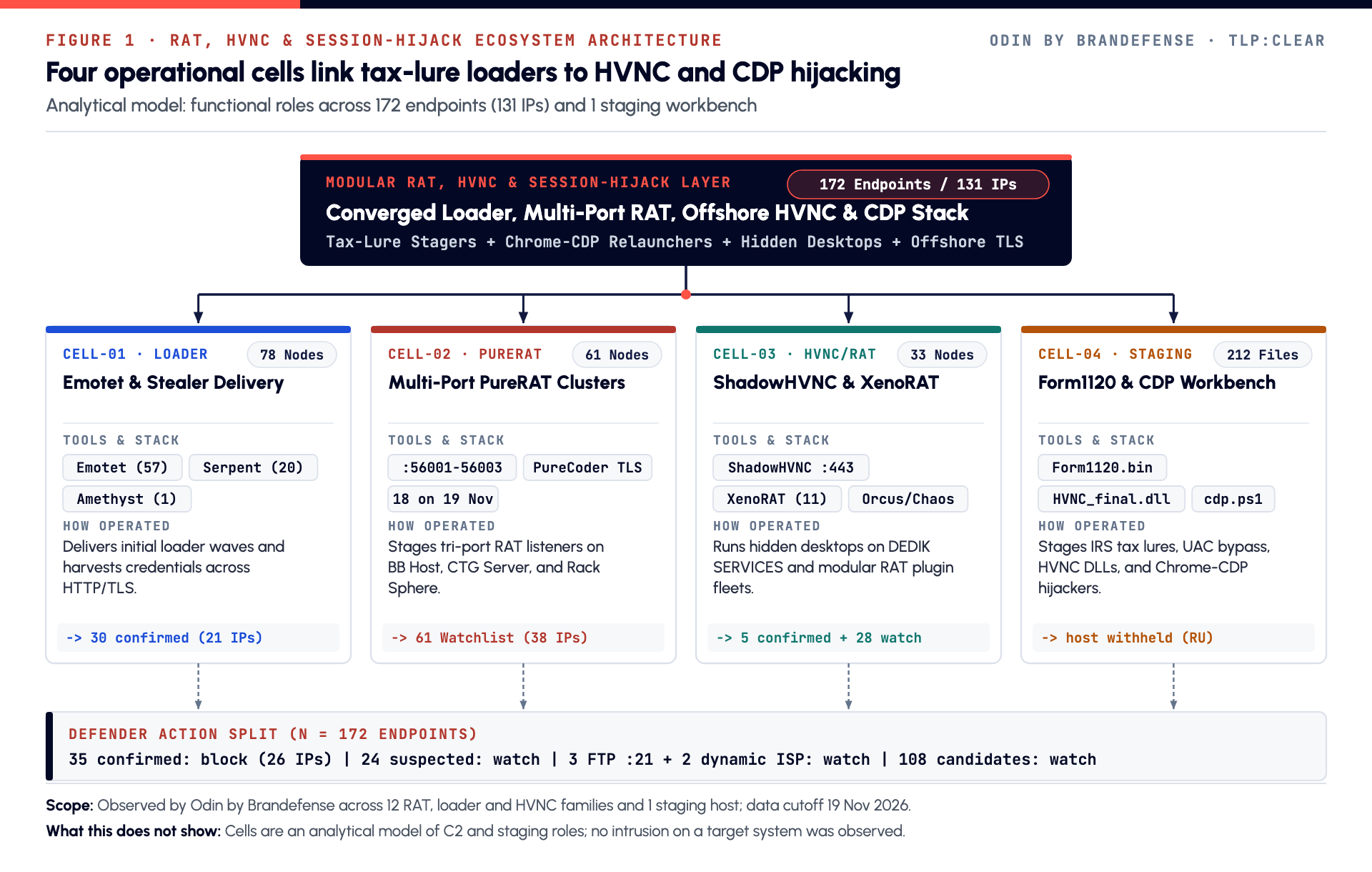
Twelve families split into four roles: loaders and stealers, multi-port RATs, hidden-desktop tools, and a staging workbench. No host carries more than one family, so the four roles are an analytical model, not a single actor.
Four roles, not one group
Modern workstation intrusions rarely rely on one tool. Operators combine upstream loaders and stealers, multi-port RATs, and session-bypass tools such as HVNC and Chrome DevTools Protocol (CDP) cookie scripts.
Figure 1 groups the 172 endpoints and the staging server into four cells. The cells are an analytical model of functional roles. None of the 131 hosts carries two families, so we make no claim that one group runs all twelve.
Counts by family
An endpoint is one IP address and port.
| Family | Role | Endpoints | Hosts | Endpoints per host | Confirmed | Watchlist |
|---|---|---|---|---|---|---|
| PureRAT | Multi-port .NET RAT and HVNC client | 61 | 38 | 1.61 | 0 | 61 candidates |
| Emotet | Modular loader | 57 | 45 | 1.27 | 28 | 24 suspected, 3 FTP collisions, 2 dynamic ISP |
| SerpentStealer | Credential and token stealer | 20 | 14 | 1.43 | 2 | 18 candidates |
| XenoRAT | Plugin-based C# RAT | 11 | 11 | 1.00 | 2 | 9 candidates |
| ShadowHVNC | Hidden-desktop C2 | 8 | 8 | 1.00 | 0 | 8 candidates |
| ChaosRAT | Cross-platform admin trojan | 3 | 3 | 1.00 | 1 | 1 with open directory, 1 candidate |
| OrcusRAT | Modular remote admin trojan | 3 | 3 | 1.00 | 2 | 1 candidate |
| SectopRAT | Hidden-desktop and browser RAT | 3 | 3 | 1.00 | 0 | 3 candidates on 15647 |
| PhantomRAT | TLS remote access trojan | 2 | 2 | 1.00 | 0 | 2 candidates on 443 |
| SparkRAT | Cross-platform Go RAT | 2 | 2 | 1.00 | 0 | 2 candidates on 8000 |
| AmethystStealer | .NET browser stealer | 1 | 1 | 1.00 | 0 | 1 candidate on 443 |
| NDragonRAT | High-port HTTP and TLS RAT | 1 | 1 | 1.00 | 0 | 1 candidate on 8080 |
| Total | 172 | 131 | 35 | 137 |
Of the 131 hosts, 36 bind more than one port: 16 for PureRAT, 12 for Emotet, 6 for SerpentStealer and 2 for other families.
Where the endpoints sit
Seven countries lead.
| Country | Endpoints | Share |
|---|---|---|
| United States | 48 | 27.9% |
| China | 20 | 11.6% |
| Germany | 16 | 9.3% |
| Netherlands | 16 | 9.3% |
| Hong Kong | 11 | 6.4% |
| Brazil | 11 | 6.4% |
| Singapore | 11 | 6.4% |
Hosting differs by role. ShadowHVNC clusters on one offshore provider, PureRAT on regional VPS hosts, and confirmed Emotet controllers on large clouds.
3. PureRAT, ShadowHVNC and XenoRAT Fleets
In short
PureRAT spreads listeners across sequential high ports on regional VPS hosts. ShadowHVNC hides on port 443 with one offshore provider. XenoRAT has two confirmed TLS controllers and a candidate whose certificate imitates a browser name.
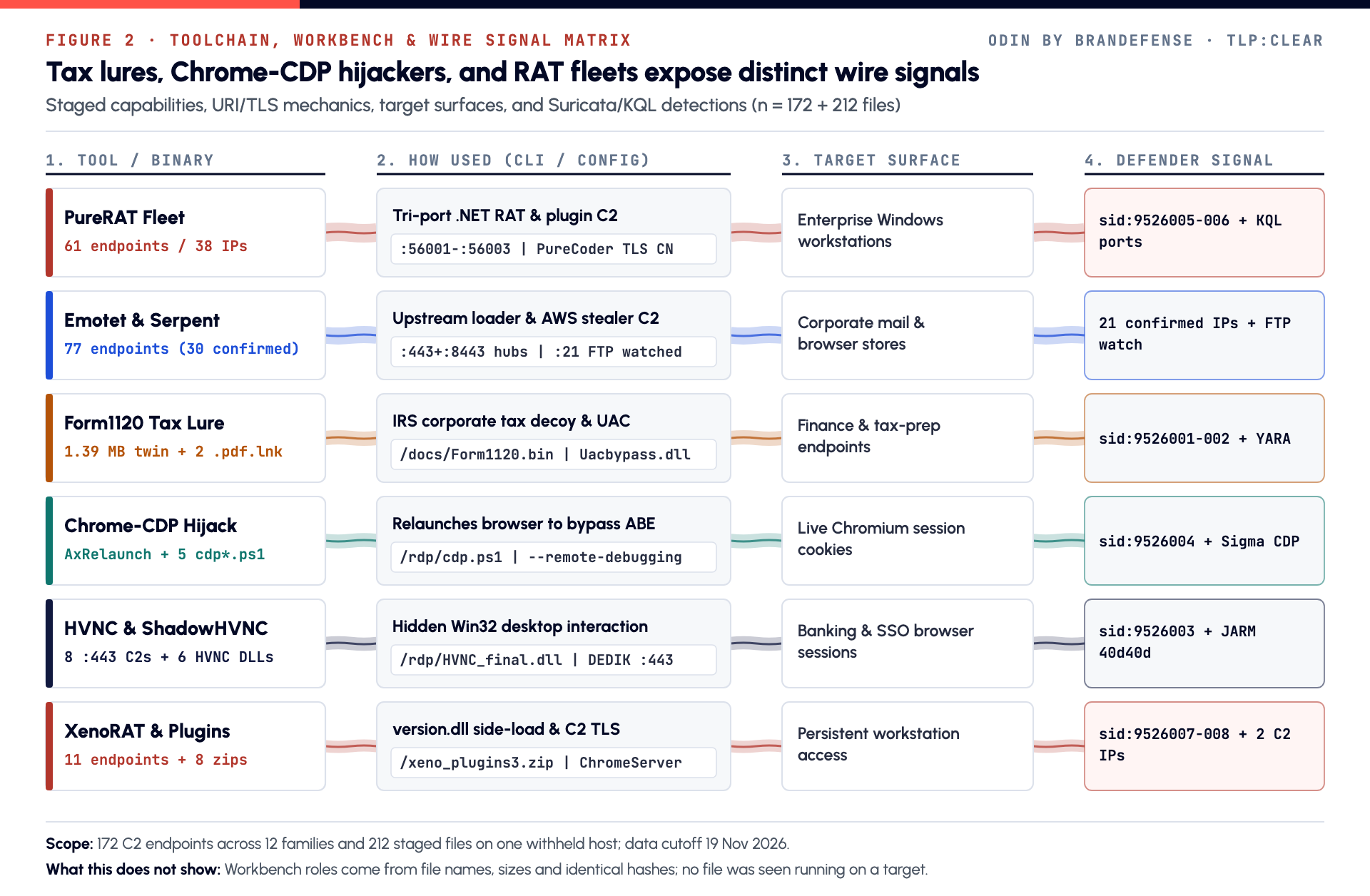
Even when the payload is packed or side-loaded, each family leaves its own transport and TLS signals. Figure 2 maps six capability groups to their wire signals and to the matching rules in Chapter 8.
PureRAT: three ports per host
PureRAT is sold in the PureCoder commercial malware line, next to PureHVNC and PureLogs. It has the highest port-to-host density in this study: 61 endpoints on 38 hosts.
Operators often open sequential high ports instead of one web port. The likely purpose is to separate client check-ins, live desktop streams and plugin traffic.
| Port | PureRAT endpoints |
|---|---|
| 56002 | 17 |
| 56003 | 14 |
| 56001 | 13 |
| 443 | 5 |
| 442, 6767 | 2 each |
| 1337, 4443, 7500, 7777, 55004, 55005, 55009, 57003 | 1 each |
Ports 56001 to 56003 carry 44 of the 61 endpoints (72.1%). Five hosts bind all three ports at once, on BB Host LTDA (Brazil), RACK SPHERE HOSTING S.A. (Netherlands) and Tier.Net Technologies (United States). Another 11 hosts bind two of them. Of the 61 endpoints, 18 on 11 hosts were first seen on 19 November 2026.
Two TLS certificates point to the vendor: a PureCoder-branded API hostname on Contabo and the subject PureRAT Agent on CTG Server.
| Hosting (country) | Ports | TLS subject and JARM prefix | First seen |
|---|---|---|---|
| Contabo Inc. (US) | 57003 | PureCoder API hostname (withheld) · 2ad2ad15d2ad2ad0 | 19 Nov 2026 |
| CTG Server Limited (HK) | 443 | PureRAT Agent · 22b22b07b22b22b2 | 18 Nov 2026 |
| BB Host LTDA (BR) | 56001 to 56003 | Raw TCP, three sockets | 19 Nov 2026 |
| BB Host LTDA (BR) | 56001 to 56003 | Raw TCP, three sockets | 19 Nov 2026 |
| RACK SPHERE HOSTING S.A. (NL) | 56001 to 56003 | Raw TCP, three sockets | 19 Nov 2026 |
| CTG Server Limited (HK) | 56001, 56002 | Dual-port host, paired with a second CTG address | 19 Nov 2026 |
| CTG Server Limited (JP) | 56001, 56002 | Domain withheld · 1dd40d40d00040d0 | 18 Nov 2026 |
| OVH SAS (SG) | 56002, 56003 | Domain withheld · 15d3fd16d29d29d0 | 17 Nov 2026 |
All 61 PureRAT endpoints are candidates. Each rests on a port and TLS pattern without a confirmed C2 protocol match, so their addresses are withheld.
ShadowHVNC: all on port 443
ShadowHVNC binds only TCP port 443. This blends interactive hidden-desktop traffic into normal HTTPS egress.
| Hosting provider | Countries | Endpoints |
|---|---|---|
| DEDIK SERVICES LIMITED | Germany (3), United States (1), Netherlands (1) | 5 |
| The Constant Company, LLC | United States | 2 |
| Heymman Servers Corporation | United States | 1 |
Five of the eight (62.5%) sit on DEDIK SERVICES LIMITED. Two of the nodes present self-signed certificates with the IP address as the common name. Both share JARM 40d40d40d00000000043d43d00043d6aff5ab0f4fc31897186312c9e639319.
JARM is a fingerprint of how a server answers TLS handshakes. A shared JARM groups servers built the same way, but it is not enough to block on. All eight ShadowHVNC endpoints are candidates, and their addresses are withheld.
XenoRAT: two confirmed controllers
XenoRAT has 11 endpoints on 11 hosts. Two dedicated Asian VPS nodes are confirmed TLS controllers: 156.239.225[.]62:443 on CORENET CLOUD (HK) and 111.90.147[.]147:443 on Shinjiru Technology (MY).
The other nine are candidates on ports 443, 4444, 5333, 8080, 8123 and 50607. Two of them, on port 4444 in France and the United States, were first seen on 19 November 2026.
One candidate on a Belgian broadband network listens on port 5333. Its certificate subject is CN=ChromeServer, a name that imitates the browser. It shares JARM 22b22b00022b22b22b22b22b22b22bd3b67dd3674d9af9dd91c1955a35d0e9 with an OrcusRAT candidate on port 8080 that presents CN=Orcus Server. The shared fingerprint is a lead, not proof of a shared operator.
4. The Form1120 Workbench: Tax Lures, Cookie Theft and Hidden Desktops
In short
An open directory on a Russian server, port 8080, held 212 staged files between 16 and 18 November 2026. They combine IRS Form 1120 tax lures, privilege escalation, DLL side-loading, five hidden-desktop builds and Chrome cookie-theft scripts.
Listeners show where controllers sit. An open staging server shows how operators build lures and work around endpoint and browser defenses. The server's address is withheld.
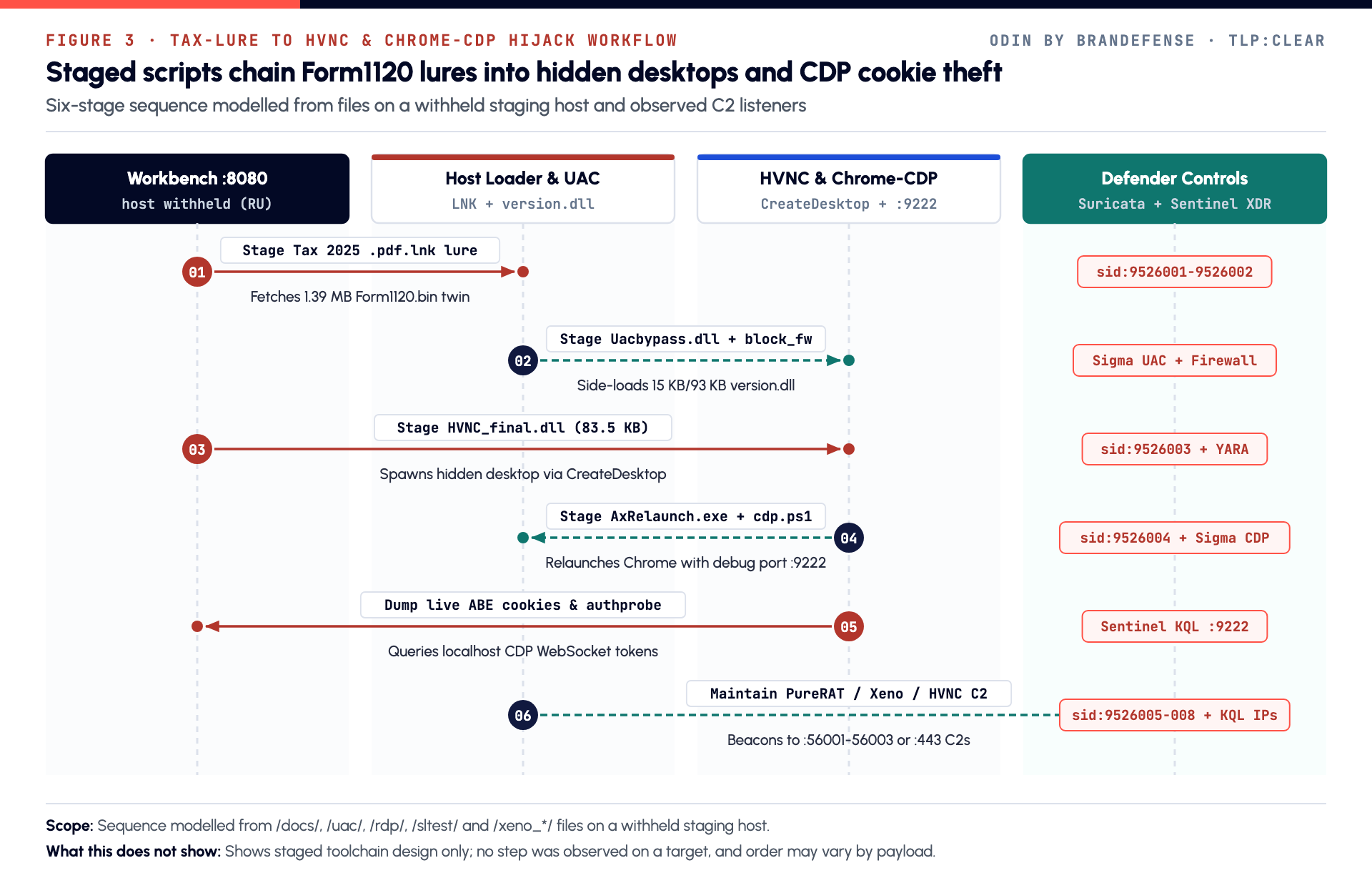
What the server held
Of the 212 files, 90 have SHA-256 values on record. Those 90 include 23 DLLs, 23 PowerShell scripts, 16 raw shellcode .bin files, 13 ZIP archives, 8 Windows executables and 4 VB.NET client sources.
Figure 3 lays out a six-stage sequence modelled from these files. No step was observed on a target system, and the real order may vary by payload.
Stage 1: tax-season delivery
The file names target corporate finance and accounting staff ahead of year-end tax work. IRS Form 1120 is the U.S. Corporation Income Tax Return.
| File | Size (bytes) | What it is |
|---|---|---|
/docs/Form1120.pdf and /docs/Form1120.bin | 1,392,428 | Byte-identical pair; the .pdf is a raw payload, not a tax form |
/rdp/Tax Documents 2025.pdf.lnk | 1,245 | Shortcut with a double extension, posing as a PDF |
/rdp/relaunch2.pdf.lnk | 3,258 | Second .pdf.lnk shortcut |
/rdp/deliver.vbs | 1,543 | Visual Basic script stager |
/rdp/sacloader.b64 | 5,464 | Base64-encoded loader |
The two Form1120 files share one SHA-256 value. So the .pdf file is the same raw payload under a document extension. The likely aim is to slip past URL and proxy filters that trust .pdf names.
Stage 2: elevation, firewall and side-loading
| File | Size (bytes) | What it is |
|---|---|---|
/uac/Uacbypass.dll | 19,968 | User Account Control (UAC) bypass module |
/block_fw.ps1 | 3,331 | Host firewall tampering script |
/hidden_launch.exe | 15,872 | Launcher for hidden processes |
/sltest/mstsc.exe | 1,114,112 | Copy of the Microsoft Remote Desktop client |
/sltest/version.dll | 93,375 | Proxy DLL, byte-identical to /rdp/version_new_fresh.dll |
/sltest/version_orig.dll | 55,192 | Original version.dll kept for forwarding |
/sltest/shell.bin | 53,868 | Shellcode loaded by the proxy |
DLL side-loading (MITRE ATT&CK T1574.002) works by placing a fake version.dll next to a trusted program. When the program starts, Windows loads the fake DLL first. Here the trusted program is a copy of mstsc.exe outside System32.
The same pattern repeats in five sibling directories, four of them named /xeno_*/. Each pairs an 85,100-byte shell.bin with a 15,360-byte version.dll. Four of these version.dll files share one SHA-256 value.
Stage 3: hidden desktops
HVNC takes a different route. It does not move cookies off the host. Instead it calls the Windows CreateDesktop and SetThreadDesktop functions to open an invisible second desktop. There it starts a cloned browser profile and uses the victim's own IP address, device fingerprint and active sign-in sessions.
| File | Size (bytes) | Build |
|---|---|---|
/hvnc_test.dll | 59,904 | First test build |
/rdp/hvnc_new.dll | 60,416 | Second build |
/rdp/HVNC_patched.dll | 75,264 | Patched build |
/rdp/HVNC_mark3.dll | 76,288 | mark3 build |
/rdp/HVNC_final.dll | 83,456 | Final build |
Related files sit next to the five builds: /rdp/hijack_standalone.dll (1,078,272 bytes), /rdp/hvx.dll (10,752), /rdp/uia_test.exe (6,656), /rdp/payload_uia.bin (55,296) and /rdp/desks.ps1 (2,395). The uia names point to Windows UI Automation, which lets code drive a window without a visible user.
The growing file sizes suggest an operator iterating on one module. We infer each file's purpose from its name, size and any identical hashes.
Stages 4 and 5: defeating Chrome App-Bound Encryption
In mid-2024 Google added App-Bound Encryption (ABE) to Chrome on Windows. ABE ties the cookie encryption key to a system service that checks which program is asking. Stealers that read the Cookies database from disk no longer get usable cookies.
The /rdp/ folder shows an operator testing a way around this. The idea is to ask the real, signed browser for its cookies. The scripts relaunch Chrome with a remote debugging port and request cookies over a local WebSocket through the Chrome DevTools Protocol (CDP) call Network.getAllCookies.
| Files | Sizes (bytes) | Purpose by name and size |
|---|---|---|
abtest.ps1, abtest2.ps1, get_abkey.ps1 | 3,071 / 2,433 / 365 | Test ABE key boundaries |
AxRelaunch.cs, AxRelaunch.exe | 1,207 / 4,096 | C# browser relauncher; the .exe is byte-identical to ax.dll |
cdp.ps1, cdp_real.ps1, cdp_real2.ps1, cdp_real3.ps1 | 1,641 / 1,980 / 1,813 / 2,333 | CDP cookie requests |
check_cdp.ps1, dump_cookies.ps1 | 272 / 441 | Check the debug port and save cookies |
authprobe.ps1 to authprobe4.ps1 | 1,615 to 1,919 | Test whether stolen sessions still work |
expiry_dump.exe | 1,065,984 | Cookie expiry dumper |
For defenders, a script or small unsigned program that starts Chrome with --remote-debugging-port is a strong signal. So is PowerShell connecting to local port 9222.
5. Loaders, Confirmed Controllers and Co-Staged RAT Kits
In short
Emotet supplies 28 of the 35 confirmed endpoints, on 19 cloud hosts. The staging server also holds full XWorm, XenoRAT and Remcos kits, so the operator keeps several implant families ready.
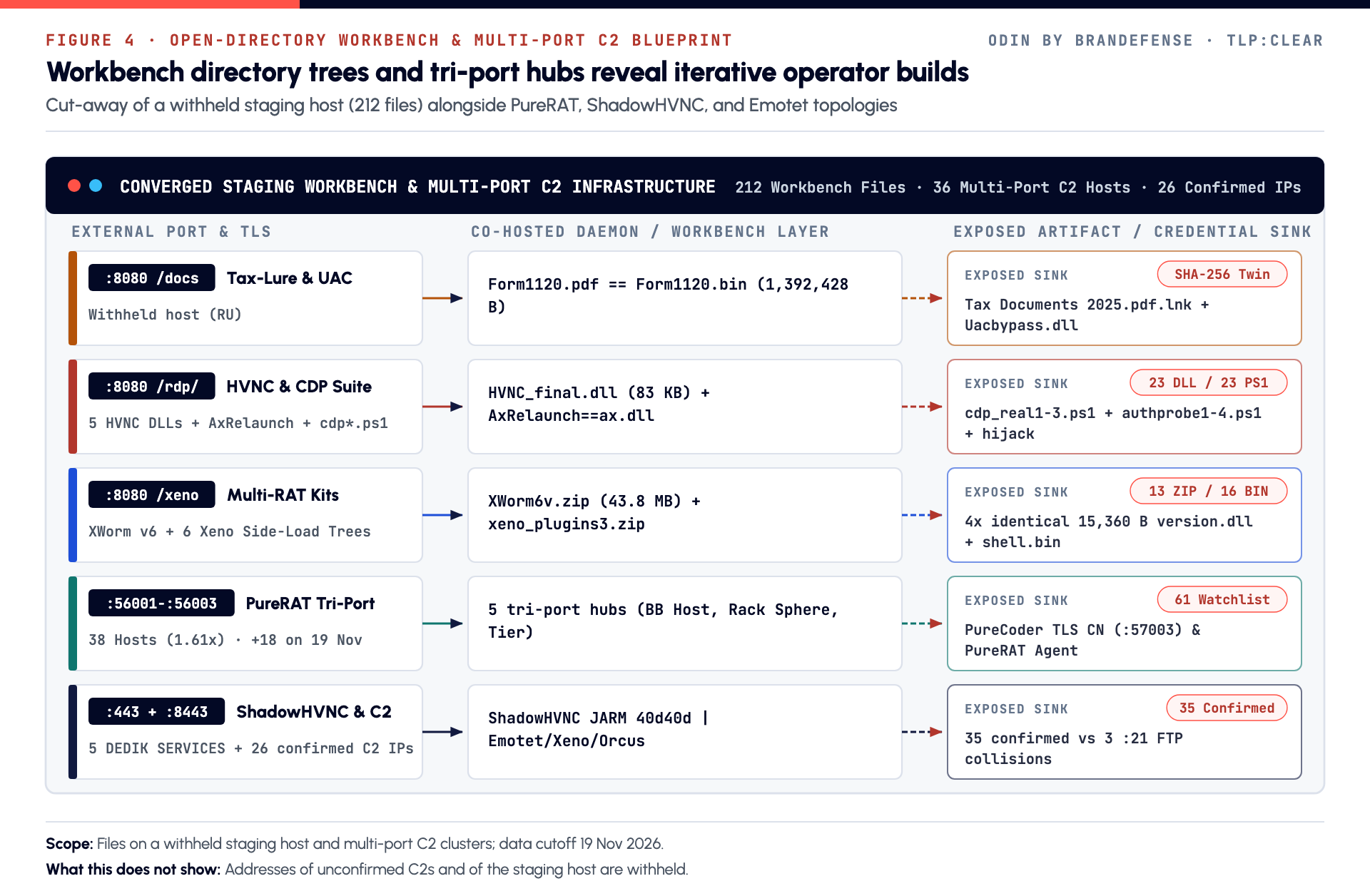
Operators of hidden-desktop and cookie-theft tools often buy access from loader botnets, then add commodity RAT panels for backup. Figure 4 shows the staging server's folders next to the multi-port C2 clusters.
Confirmed Emotet controllers
Emotet has 57 endpoints on 45 hosts. Of these, 28 HTTP and HTTPS endpoints on 19 dedicated cloud addresses are confirmed. Nine hosts carry two confirmed ports each. The three Huawei Cloud hosts share one certificate (domain withheld) and the JARM prefix 2ad2ad16d2ad2ad0. The three Alibaba hosts were confirmed on 18 November 2026.
| Address | Ports | Hosting (country) |
|---|---|---|
| 1.95.216[.]95 | 443, 8443 | Huawei Cloud (CN) |
| 1.95.144[.]27 | 443, 8443 | Huawei Cloud (CN) |
| 1.94.25[.]210 | 443, 8443 | Huawei Cloud (CN) |
| 8.130.115[.]156 | 443 | Hangzhou Alibaba (CN) |
| 8.130.122[.]123 | 443 | Hangzhou Alibaba (CN) |
| 8.130.159[.]214 | 443 | Hangzhou Alibaba (CN) |
| 64.227.189[.]225 | 80, 443 | DigitalOcean (IN) |
| 167.71.229[.]25 | 80, 443 | DigitalOcean (IN) |
| 128.199.131[.]70 | 80, 443 | DigitalOcean (SG) |
| 142.93.158[.]102 | 80, 443 | DigitalOcean (CA) |
| 167.172.183[.]165 | 80, 8010 | DigitalOcean (DE) |
| 185.232.107[.]206 | 80, 8010 | Data Storage Center JSC (RU) |
| 91.206.14[.]212 | 80 | JSC Selectel (RU) |
| 185.137.233[.]37 | 80 | JSC Selectel (RU) |
| 185.137.233[.]198 | 80 | JSC Selectel (RU) |
| 188.246.224[.]196 | 80 | JSC Selectel (RU) |
| 178.57.77[.]87 | 80 | Data Storage Center JSC (RU) |
| 159.203.173[.]129 | 80 | DigitalOcean (US) |
| 138.197.111[.]250 | 80 | DigitalOcean (US) |
Other confirmed controllers
Seven confirmed endpoints belong to other families.
| Family | Endpoint | Hosting (country) | Note |
|---|---|---|---|
| XenoRAT | 156.239.225[.]62:443 | CORENET CLOUD (HK) | TLS controller |
| XenoRAT | 111.90.147[.]147:443 | Shinjiru Technology (MY) | TLS controller |
| OrcusRAT | 165.22.243[.]96:443 | DigitalOcean (SG) | TLS controller |
| OrcusRAT | Address withheld, port 8086 | UK consumer broadband (Virgin Media) | Custom TCP port; see Chapter 6 |
| ChaosRAT | 93.127.160[.]122:80 | 23M GmbH (DE) | HTTP controller |
| SerpentStealer | 13.216.143[.]112:80 | Amazon AWS (US) | Confirmed 18 Nov 2026 |
| SerpentStealer | 23.22.63[.]150:80 | Amazon AWS (US) | HTTP collector |
Two more clusters stay on watchlists. A ChaosRAT candidate on DigitalOcean (US), port 8080, shares its host with an exposed open directory. Three SectopRAT candidates on port 15647 sit on NForce (NL), Flyservers (HU) and Data Campus (NL), and share the JARM prefix 14d14d16.
Three RAT kits on one server
The staging server holds builders, panels and loaders for three RAT families at once. That points to redundancy: if one implant is caught, another is ready.
| Family | Files | Sizes (bytes) |
|---|---|---|
| XWorm | /XWorm6v.zip (version 6), /XWormV5.6_panel.zip, /XWormV3.1_clean.exe | 43,798,746 / 25,644,229 / 7,278,080 |
| XWorm | Four VB client sources (/xw56_desig.vb, /xworm56_client.vb, /xw56_desig2.vb, /client.vb) | 78 to 87 KB each |
| XWorm | /find_xworm_reg.ps1 (registry persistence finder), /xwprobe_host.exe | 1,018 / 113,152 |
| XenoRAT | /xeno_plugins3.zip, /implant_xeno.zip, /xeno_plugins2.zip, /xeno_plugins_renamed.zip | 1,133,184 / 638,010 / 237,927 / 102,164 |
| XenoRAT | Five archives of about 86 KB: /xeno_inj.zip, /xeno_nobypass.zip, /xeno_desig.zip, /xeno_hide.zip, /xeno_mini.zip | About 86 KB each |
| Remcos | /rdp/shell_remcos.bin, /rdp/version_remcos.dll | 660,480 / 27,136 |
| Shellcode | /rdp/shell_rp.bin, /rdp/shell_debug.bin, /rdp/shell_amsi.bin | 10.37 MB / 10.35 MB / 77,420 |
The five XenoRAT archives match the /xeno_*/ side-loading folders described in Chapter 4.
6. What Not to Block
In short
A match is not always a hostile host. Shared FTP hosting, rotating telecom addresses, old cloud addresses and uncorroborated candidates all need corroboration before anyone blocks them.
Of the 172 endpoints, 35 (20.3%) are confirmed. The other 137 belong on watchlists for one of the reasons below.
| Group | Endpoints | Why not block | Suggested action |
|---|---|---|---|
| Suspected Emotet listeners on a Dutch registrar's shared hosting | 3 | They sit beside ordinary FTP on port 21; blocking would hit the registrar's customers | Watchlist about 72 hours; never alert on port 21 alone |
| Emotet nodes on China Unicom Guangdong | 2 | Subscriber addresses move between unrelated customers | Watchlist about 24 hours; addresses withheld |
| ChaosRAT candidate with an open directory | 1 | Open directory; not yet corroborated | Watchlist about 7 days |
| Uncorroborated candidates, including all 61 PureRAT and 8 ShadowHVNC endpoints | 107 | Feed label only; not corroborated | Watchlist about 72 hours |
| Suspected Emotet listeners | 24 | Feed label only; not corroborated | Watch for a second signal |
Eighteen of the SerpentStealer candidates are on Amazon AWS. Their records are older feed entries, and cloud addresses that old have likely moved to other AWS customers. Only the two SerpentStealer collectors confirmed in November 2026 are in the block set.
One confirmed OrcusRAT controller sits on a UK consumer broadband network. We withhold its address. Defenders who track it should block only its custom port 8086 and recheck ownership every 14 to 30 days.
Who runs the staging server
We weighed two explanations for the Russian staging server.
| Hypothesis | For | Against | Verdict |
|---|---|---|---|
| H1: Criminal intrusion staging | Cracked XWorm 5.6 and 6 panels, Remcos shellcode and IRS tax lures sit together | No campaign or victim tie was observed | Most likely |
| H2: Authorized red-team server | Custom C# relauncher and HVNC test builds look like offensive research | Red teams rarely stage cracked commercial RAT panels beside tax lures | Less likely |
The file mix fits financially motivated intrusion staging better than a scoped red-team exercise. Either way, an internal workstation that fetches /docs/Form1120.*, /rdp/HVNC_* or /rdp/cdp*.ps1 should be isolated and examined. Because the owner is not established, the server's address and file hashes are withheld.
7. What Defenders Should Do
Within 24 hours
- Block the 25 confirmed C2 addresses published in this report. Chapter 9 explains which confirmed addresses are published and which are withheld. Review cloud and AWS addresses every 30 days, since providers reassign them.
- Keep the FTP collisions, dynamic telecom addresses and all PureRAT and ShadowHVNC candidates on watchlists, not block lists.
Within 72 hours
- Block
.pdf.lnkdouble-extension shortcuts and tax-themed.vbsand.b64attachments at the mail gateway and with Windows Attack Surface Reduction rules. - Set the Chrome and Edge policy
RemoteDebuggingAllowedto false on managed workstations. This stops user-space scripts from opening a CDP debug socket. - Alert on outbound connections to ports 56001 to 56003 and 57003 from workstation processes.
Within 7 to 30 days
- Deploy the three Sigma rules and four YARA rules for HVNC DLLs,
Uacbypass.dllandmstsc.exerunning outsideSystem32. - Load the eight Suricata signatures for tax-lure fetches, HVNC and CDP file downloads, and RAT certificate subjects.
- Schedule the Sentinel hunt with an exact list of approved Playwright, Puppeteer or Selenium hosts. Never use wildcard exclusions.
8. Detection Rules
The full rules are in the Detection rules tab.
| Rule file | What it catches |
|---|---|
odin_purerat_shadowhvnc_xenorat_cdp.rules | Suricata 7: eight signatures for tax-lure fetches, HVNC and CDP file downloads, XenoRAT plugin archives and RAT certificate subjects |
sentinel_form1120_hvnc_cdp_and_purerat_hunt.kql | Microsoft Sentinel and Defender XDR: contact with confirmed C2 addresses, PureRAT high ports, local CDP sockets and workbench process markers |
sigma_hvnc_dll_uacbypass_and_chrome_cdp_hijack.yml | Sigma (3 rules): browser relaunch with a debug port, HVNC and UAC bypass DLLs or side-loaded mstsc.exe, and tax-lure or firewall-script execution |
odin_hvnc_form1120_xenorat_purerat_artifacts.yar | YARA (4 rules): HVNC DLLs, CDP cookie scripts, Form1120 stagers, and XenoRAT or PureRAT plugin and config markers |
How the Suricata signatures work
| SID | Looks for | Why |
|---|---|---|
| 9526001 | Outbound GET with /docs/Form1120. in the URI | Catches the tax-lure payload pair being fetched |
| 9526002 | Outbound GET with a URI ending in .pdf.lnk | Catches the double-extension shortcut lure (T1204.002) |
| 9526003 | Outbound GET for /rdp/HVNC_ followed by .dll | Catches hidden-desktop DLL downloads |
| 9526004 | Outbound GET for /rdp/cdp followed by .ps1 | Catches CDP cookie-script downloads |
| 9526005 | TLS certificate subject containing purecoder from PureRAT ports or 443 | Catches PureCoder-branded PureRAT listeners |
| 9526006 | TLS certificate subject PureRAT Agent | Catches the default PureRAT agent certificate |
| 9526007 | TLS certificate subject ChromeServer from ports 443, 4444, 5333 or 8080 | Catches the XenoRAT browser-name certificate |
| 9526008 | Outbound GET for /xeno_plugins followed by .zip | Catches XenoRAT plugin archive downloads |
TLS 1.3 encrypts the server certificate. Against TLS 1.3 listeners, SIDs 9526005 to 9526007 will not fire. Pair them with JARM hunting in your attack surface tools or with endpoint socket data from the KQL hunt. Exempt detonation sandboxes from SID 9526002.
How the other rules work
The KQL hunt has a 7-day lookback. It flags devices that contact any of the 25 confirmed C2 addresses, or that connect to PureRAT and related ports (55004, 55005, 55009, 56001 to 56003, 57003, 15647, 4444, 5333, 8086). It also flags PowerShell or AxRelaunch.exe talking to local port 9222.
The hunt then joins process events that name workbench files such as Form1120, HVNC_final or cdp_real, or a script host relaunching a browser with --remote-debugging-port=. An exact approved-host list applies to the port and process branches only. It never hides contact with a confirmed C2 address.
| Sigma rule | Fires when |
|---|---|
| Chromium forced relaunch with remote debugging port | Chrome, Edge or Brave starts with --remote-debugging-port= or --remote-allow-origins=, and the parent is PowerShell, cmd.exe, wscript.exe, AxRelaunch.exe or hidden_launch.exe (T1539) |
HVNC DLL, UAC bypass and version.dll side-loading | A command line names Uacbypass.dll, an HVNC_*.dll build, hijack_standalone.dll or a proxy version.dll, or mstsc.exe starts from any path other than System32 or SysWOW64 (T1574.002, T1548.002) |
Tax-lure .pdf.lnk execution and firewall tampering | A command line names Form1120, the two .pdf.lnk lures, sacloader.b64 or block_fw.ps1 (T1204.002, T1562.004) |
Sigma exclusions name exact hosts only. Replace them with your own QA and lab machines.
| YARA rule | Fires when |
|---|---|
ODIN_HVNC_HiddenDesktop_DLL_Strings | A file under 2 MB holds CreateDesktopA or CreateDesktopW, SetThreadDesktop and PrintWindow, plus one HVNC build name |
ODIN_Chrome_CDP_Cookie_Hijack_PowerShell | A script under 512 KB holds a debug-port or /json/version marker, a cookie call (Network.getAllCookies or Storage.getCookies) and AxRelaunch or dump_cookies |
ODIN_Form1120_TaxLure_Delivery_Stager | A file names Form1120.bin or Form1120.pdf together with a .pdf.lnk lure, sacloader.b64 or Uacbypass.dll |
ODIN_XenoRAT_PureRAT_Plugin_Loader_Config | xeno_plugins with ChromeServer or version_new_fresh.dll; or PureRAT Agent; or purecoder with one of the XenoRAT markers |
9. Indicators
The Indicators tab holds 19 published indicators: 19 confirmed C2 addresses and no file hashes. Six more confirmed Emotet addresses are listed in Chapter 5 and in the KQL rule only, which brings the published confirmed addresses to 25.
| Type | Count | Where |
|---|---|---|
| Confirmed C2 addresses (with port) | 19 | Indicators tab and this report |
| Additional confirmed Emotet addresses | 6 | This report and the KQL rule |
| Withheld confirmed address (UK consumer broadband) | 1 | Not published |
| Watchlist endpoints | 137 | Not published; counts and hosting only |
| Staging-server file hashes | 0 published | Withheld; names and sizes in Chapter 4 |
Supporting fingerprints for hunting: certificate subjects PureRAT Agent, ChromeServer and Orcus Server; the ShadowHVNC JARM 40d40d40d00000000043d43d00043d6aff5ab0f4fc31897186312c9e639319; and the XenoRAT and OrcusRAT JARM 22b22b00022b22b22b22b22b22b22bd3b67dd3674d9af9dd91c1955a35d0e9.
Confirmed endpoints in the Indicators tab
| Endpoint | Family | Hosting (country) | Seen |
|---|---|---|---|
| 156.239.225[.]62:443 | XenoRAT | CORENET CLOUD (HK) | 13 Nov 2026 |
| 111.90.147[.]147:443 | XenoRAT | Shinjiru Technology (MY) | 13 Nov 2026 |
| 165.22.243[.]96:443 | OrcusRAT | DigitalOcean (SG) | 13 Nov 2026 |
| 93.127.160[.]122:80 | ChaosRAT | 23M GmbH (DE) | 13 Nov 2026 |
| 13.216.143[.]112:80 | SerpentStealer | Amazon AWS (US) | 18 Nov 2026 |
| 23.22.63[.]150:80 | SerpentStealer | Amazon AWS (US) | 13 Nov 2026 |
| 8.130.115[.]156:443 | Emotet | Hangzhou Alibaba (CN) | 18 Nov 2026 |
| 8.130.122[.]123:443 | Emotet | Hangzhou Alibaba (CN) | 18 Nov 2026 |
| 8.130.159[.]214:443 | Emotet | Hangzhou Alibaba (CN) | 18 Nov 2026 |
| 1.95.216[.]95:443 | Emotet | Huawei Cloud (CN) | 16 Nov 2026 |
| 1.95.144[.]27:443 | Emotet | Huawei Cloud (CN) | 16 Nov 2026 |
| 1.94.25[.]210:443 | Emotet | Huawei Cloud (CN) | 16 Nov 2026 |
| 91.206.14[.]212:80 | Emotet | JSC Selectel (RU) | 14 Nov 2026 |
| 185.232.107[.]206:80 | Emotet | Data Storage Center JSC (RU) | 13 Nov 2026 |
| 185.137.233[.]37:80 | Emotet | JSC Selectel (RU) | 13 Nov 2026 |
| 64.227.189[.]225:443 | Emotet | DigitalOcean (IN) | 13 Nov 2026 |
| 128.199.131[.]70:443 | Emotet | DigitalOcean (SG) | 13 Nov 2026 |
| 167.172.183[.]165:80 | Emotet | DigitalOcean (DE) | 13 Nov 2026 |
| 142.93.158[.]102:443 | Emotet | DigitalOcean (CA) | 13 Nov 2026 |
Withheld: the UK broadband OrcusRAT address, the staging server's address and its file hashes, the two China Unicom addresses, the three FTP-collision hosts, and every suspected or candidate address. Certificate domains seen only on unconfirmed servers, including the PureCoder API hostname, are withheld too.
MITRE ATT&CK mapping
| Tactic | Technique | How it shows here | Detection |
|---|---|---|---|
| Initial Access / Execution | T1204.002 User Execution: Malicious File | .pdf.lnk tax lures and the Form1120.pdf payload | SIDs 9526001, 9526002; Sigma tax-lure rule; YARA Form1120 rule |
| Privilege Escalation | T1548.002 Bypass User Account Control | Uacbypass.dll | Sigma HVNC and UAC rule |
| Defense Evasion | T1574.002 Hijack Execution Flow: DLL Side-Loading | Proxy version.dll beside mstsc.exe and in /xeno_*/ folders | Sigma HVNC and UAC rule; YARA XenoRAT rule |
| Defense Evasion | T1562.004 Impair Defenses: Disable or Modify System Firewall | block_fw.ps1 | Sigma tax-lure rule |
| Credential Access | T1539 Steal Web Session Cookie | CDP relaunch scripts and Network.getAllCookies | SID 9526004; Sigma CDP rule; YARA CDP rule; KQL port 9222 branch |
10. Scope and Limits
- Window. The findings cover a two-week observation window ending 19 November 2026. Some records are older feed entries, such as the SerpentStealer candidates on AWS; no dates are given for them. We do not use those as a tracking start.
- Infrastructure, not intrusions. This report describes C2 listeners and staged files. We observed no intrusion on a target system and make no claim about victims.
- Staged is not used. The staging server's files show intent and tooling. Their purposes are inferred from file names, sizes and identical hashes. Nothing shows the files were run against a target.
- Candidates are leads. All PureRAT and ShadowHVNC endpoints are candidates. Do not block them without corroboration.
- Family names. A family label names the software a listener matches. It is not attribution to a named group, and the four-cell view in Figure 1 is an analytical model.
- First-seen dates are not build dates. Eighteen PureRAT endpoints were first seen on 19 November 2026. That date is a first observation, not the date the operator set them up.
- Rule testing. Every published rule file loads without errors in its engine (Suricata 7.0.12, YARA-X, pySigma and Microsoft's Kusto.Language analyzer, checked on 20 November 2026). The rules were not replayed against live traffic, so test and tune them in your own environment before production use.
11. Sources
- Chrome DevTools Team. Chrome DevTools Protocol. https://chromedevtools.github.io/devtools-protocol/ (verified 19 November 2026)
- Google Security Blog. Improving the security of Chrome cookies on Windows. https://security.googleblog.com/2024/07/improving-security-of-chrome-cookies-on.html (verified 19 November 2026)
- Microsoft Learn. CreateDesktopA function (winuser.h). https://learn.microsoft.com/en-us/windows/win32/api/winuser/nf-winuser-createdesktopa (verified 19 November 2026)
- MITRE ATT&CK. T1574.002 Hijack Execution Flow: DLL Side-Loading. https://attack.mitre.org/techniques/T1574/002/ (verified 19 November 2026)
- Internal Revenue Service. About Form 1120, U.S. Corporation Income Tax Return. https://www.irs.gov/forms-pubs/about-form-1120 (verified 19 November 2026)
- OISF. Suricata 7.0 User Guide, HTTP keywords. https://docs.suricata.io/en/suricata-7.0.0/rules/http-keywords.html (verified 19 November 2026)
- Salesforce Engineering. Easily identify malicious servers on the internet with JARM. https://engineering.salesforce.com/easily-identify-malicious-servers-on-the-internet-with-jarm-e095edac525a/ (verified 19 November 2026)
What is…?
Short explanations of the tools and families named in this study.
What is PureRAT?
PureRAT, also tracked as PureHVNC, is a commercial modular .NET remote access trojan with hidden-desktop control.
More about PureRATMalware loaderWhat is Emotet?
Emotet is a long-running modular malware loader and botnet spread by malicious email attachments. It was disrupted by law enforcement in 2021 and later resurfaced.
More about EmotetRemote access trojanWhat is XenoRAT?
XenoRAT is an open-source C# remote access trojan with hidden-desktop (HVNC) support.
More about XenoRATRemote access trojanWhat is ShadowHVNC?
ShadowHVNC is a hidden virtual network computing (HVNC) remote access tool that controls a hidden desktop on the victim's machine.
More about ShadowHVNCTechniqueWhat is HVNC?
Hidden VNC (HVNC) creates a second, invisible desktop on the victim's computer so an attacker can use the victim's browser sessions unseen.
More about HVNCRemote access trojanWhat is OrcusRAT?
OrcusRAT is a commercial .NET remote access trojan marketed as a remote administration tool.
More about OrcusRATFrequently asked questions
What did we find?
Remote access trojans (RATs) give an operator control of a Windows workstation. Hidden-desktop tools, known as HVNC, go one step further. They open an invisible second desktop and use the victim's own browser, IP address and active sign-ins.
What was on the staging server?
An open directory on a Russian server, port 8080, held 212 files between 16 and 18 November 2026. Its address is withheld. The files fit together into one toolchain. The server also holds full XWorm, XenoRAT and Remcos kits. These are staged files. Nothing shows they were used against a target.
Why not block everything that matches?
Some matches sit on infrastructure that other people share. Blocking them would break legitimate traffic or punish the wrong customer. Of the 172 endpoints, 35 are confirmed. The other 137 belong on watchlists that expire, until a second signal turns up.
Which signals give these tools away?
Payloads can be packed or renamed, but some signals are hard to hide. Each signal alone can be noisy. Browser test farms, for example, use remote debugging on purpose. Pair signals, and list approved automation hosts by exact name.