


Key takeaways
- Odin mapped 172 C2 endpoints across twelve RAT, loader and stealer families; 35 are confirmed.
- PureRAT spreads across ports 56001 to 56003, while ShadowHVNC hides on port 443.
- One exposed server staged Form 1120 tax lures, hidden-desktop DLLs and Chrome cookie scripts.
- Shared FTP hosting and rotating telecom addresses belong on watchlists, not block lists.
- Turn off browser remote debugging and alert when scripts relaunch Chrome with a debug port.
In a two-week observation window ending 19 November 2026, Odin by Brandefense mapped 172 command-and-control (C2) endpoints. They span twelve remote access, loader and stealer families on 131 hosts. Of these, 35 endpoints on 26 hosts are confirmed. Beside them sits an exposed Russian staging server with 212 files. It shows how operators turn a corporate tax lure into a hidden desktop and stolen browser sessions. For defenders, the weak points are browser remote debugging, double-extension shortcuts and high-port TLS traffic from workstations.
What did we find?
Remote access trojans (RATs) give an operator control of a Windows workstation. Hidden-desktop tools, known as HVNC, go one step further. They open an invisible second desktop and use the victim's own browser, IP address and active sign-ins.
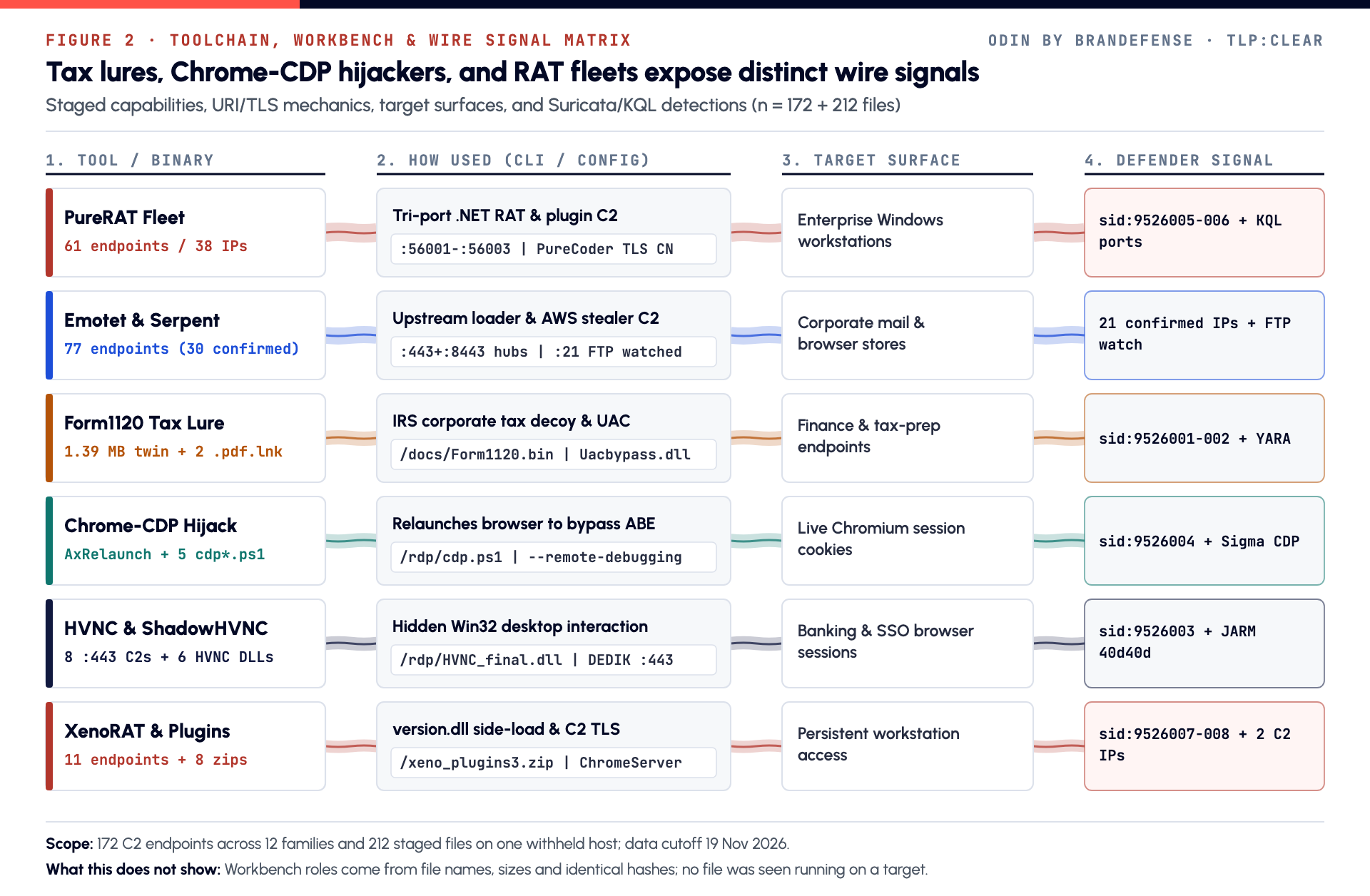
| Family | Endpoints | Confirmed | Pattern |
|---|---|---|---|
| PureRAT | 61 | 0 | 44 on sequential ports 56001 to 56003 |
| Emotet | 57 | 28 | Cloud controllers on ports 80, 443, 8010 and 8443 |
| SerpentStealer | 20 | 2 | Two confirmed collectors on Amazon AWS |
| XenoRAT | 11 | 2 | TLS controllers in Hong Kong and Malaysia |
| ShadowHVNC | 8 | 0 | All on port 443, 5 on one offshore VPS provider |
| OrcusRAT | 3 | 2 | TLS and custom-port controllers |
| ChaosRAT | 3 | 1 | HTTP controller in Germany |
PureRAT and ShadowHVNC use opposite hosting styles. PureRAT opens two or three high ports per host on regional VPS providers. ShadowHVNC binds only port 443, which blends hidden-desktop traffic into normal web traffic. Five of its eight servers sit on DEDIK SERVICES LIMITED.
Five more families (SectopRAT, SparkRAT, PhantomRAT, AmethystStealer and NDragonRAT) have one to three candidate endpoints each.
Every PureRAT and ShadowHVNC endpoint is still a candidate. That makes them good hunting leads, but not block-list entries.
What was on the staging server?
An open directory on a Russian server, port 8080, held 212 files between 16 and 18 November 2026. Its address is withheld. The files fit together into one toolchain.
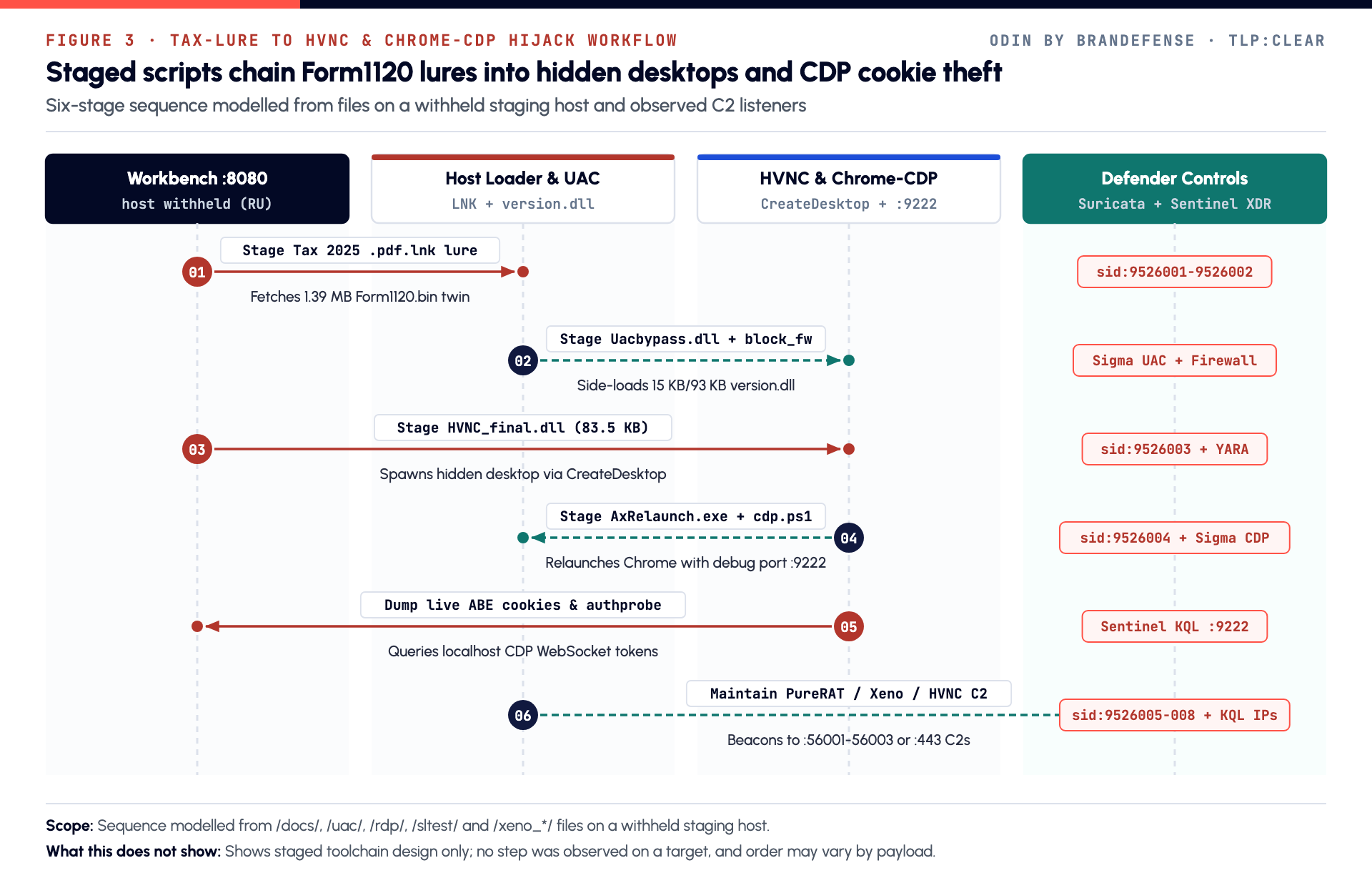
Tax lures. A file named Form1120.pdf is 1,392,428 bytes and byte-identical to a raw payload called Form1120.bin. IRS Form 1120 is the U.S. corporate income tax return. Two shortcut files end in .pdf.lnk to pose as documents.
Privilege and side-loading. A Uacbypass.dll module, a firewall-tampering script and a fake version.dll placed beside a copy of the Remote Desktop client (mstsc.exe) prepare the host.
Cookie theft past Chrome's new defense.
Since mid-2024, Chrome on Windows ties cookie keys to the real browser through App-Bound Encryption. The server's scripts work around this by relaunching Chrome with a remote debugging port. They then ask the browser itself for its cookies over the Chrome DevTools Protocol.
Hidden desktops. Five HVNC DLL builds grow from 59,904 to 83,456 bytes, from hvnc_test.dll to HVNC_final.dll. That looks like an operator iterating on one module.
The server also holds full XWorm, XenoRAT and Remcos kits. These are staged files. Nothing shows they were used against a target.
Why not block everything that matches?
Some matches sit on infrastructure that other people share. Blocking them would break legitimate traffic or punish the wrong customer.
- Three suspected Emotet listeners share a Dutch registrar's hosting with ordinary FTP on port 21.
- Two Emotet nodes outside the confirmed 35 sit on a dynamic China Unicom network, where addresses move between customers.
- Eighteen SerpentStealer candidates on AWS are older feed entries, so the addresses have likely changed hands.
- One confirmed OrcusRAT controller sits on a UK consumer broadband line. We withhold its address.
Of the 172 endpoints, 35 are confirmed. The other 137 belong on watchlists that expire, until a second signal turns up.
Which signals give these tools away?
Payloads can be packed or renamed, but some signals are hard to hide.
- Browser relaunches. A script or small unsigned program that restarts Chrome, Edge or Brave with
--remote-debugging-portis rare in normal office work. So is PowerShell talking to local port 9222. - Side-loading from odd folders. The Remote Desktop client
mstsc.exeshould start fromSystem32. A copy running from a user folder next to its ownversion.dlldeserves a look. - Certificate names. PureRAT listeners can present the subject
PureRAT Agent. One XenoRAT candidate usesChromeServer, a name chosen to look like the browser. - Port patterns. Workstations rarely need outbound TLS to ports 56001 to 56003.
Each signal alone can be noisy. Browser test farms, for example, use remote debugging on purpose. Pair signals, and list approved automation hosts by exact name.
What to do now
- Block the confirmed controllers. The full report's Indicators tab lists 19 confirmed C2 addresses. The full report adds six more Emotet addresses, for 25 in total.
- Turn off browser remote debugging on managed workstations with the Chrome and Edge
RemoteDebuggingAllowedpolicy. Alert when PowerShell or an unsigned program starts a browser with--remote-debugging-port. - Stop double-extension lures. Block
.pdf.lnkshortcuts and tax-themed script attachments at the mail gateway. - Watch high-port TLS egress to ports 56001 to 56003 and 57003 from workstations.
- Deploy the rules. The full report's Detection rules tab has Suricata, Sentinel KQL, Sigma and YARA rules for tax-lure fetches, HVNC DLLs, side-loading and Chrome debug relaunches.
The full report covers the fleets, the staging server's files and the rule logic in detail.
What is…?
Short explanations of the tools and families named in this study.
What is PureRAT?
PureRAT, also tracked as PureHVNC, is a commercial modular .NET remote access trojan with hidden-desktop control.
More about PureRATMalware loaderWhat is Emotet?
Emotet is a long-running modular malware loader and botnet spread by malicious email attachments. It was disrupted by law enforcement in 2021 and later resurfaced.
More about EmotetRemote access trojanWhat is XenoRAT?
XenoRAT is an open-source C# remote access trojan with hidden-desktop (HVNC) support.
More about XenoRATRemote access trojanWhat is ShadowHVNC?
ShadowHVNC is a hidden virtual network computing (HVNC) remote access tool that controls a hidden desktop on the victim's machine.
More about ShadowHVNCTechniqueWhat is HVNC?
Hidden VNC (HVNC) creates a second, invisible desktop on the victim's computer so an attacker can use the victim's browser sessions unseen.
More about HVNCRemote access trojanWhat is OrcusRAT?
OrcusRAT is a commercial .NET remote access trojan marketed as a remote administration tool.
More about OrcusRATFrequently asked questions
What did we find?
Remote access trojans (RATs) give an operator control of a Windows workstation. Hidden-desktop tools, known as HVNC, go one step further. They open an invisible second desktop and use the victim's own browser, IP address and active sign-ins.
What was on the staging server?
An open directory on a Russian server, port 8080, held 212 files between 16 and 18 November 2026. Its address is withheld. The files fit together into one toolchain. The server also holds full XWorm, XenoRAT and Remcos kits. These are staged files. Nothing shows they were used against a target.
Why not block everything that matches?
Some matches sit on infrastructure that other people share. Blocking them would break legitimate traffic or punish the wrong customer. Of the 172 endpoints, 35 are confirmed. The other 137 belong on watchlists that expire, until a second signal turns up.
Which signals give these tools away?
Payloads can be packed or renamed, but some signals are hard to hide. Each signal alone can be noisy. Browser test farms, for example, use remote debugging on purpose. Pair signals, and list approved automation hosts by exact name.