


1. Executive Summary
In short
In a two-week observation window ending 18 November 2026, Odin by Brandefense mapped 89 endpoints on 74 hosts across nine persistent-access and backdoor families. Hak5 Cloud C2 and ReverseSSH make up 66.3% of them. Twelve endpoints are confirmed, but most run dual-use testing tools, so five are published for blocking. Thirteen lookalikes were ordinary mail servers. Block the five published endpoints, enforce 802.1X on wired ports, and hunt default CN=www.wolfssl[.]com, CN=:3232 and CN=Gshell Server certificates.
These tools all keep access to a network that blocks inbound connections. A hardware implant or small agent inside dials out to a cloud server over HTTP, WebSocket or TLS. Relays can hide the real controller address.
Hak5 Cloud C2 and ReverseSSH make up most of the infrastructure.
ReverseSSH has 36 endpoints on 30 hosts and Hak5 Cloud C2 has 23 endpoints on 19 hosts. Together they are 66.3% of the 89 endpoints. Both are sold or published for authorized testing, so a confirmed install is not proof of hostile use.
Go shells and a wolfSSL backdoor keep footholds on Linux and Windows.
GShellC2 has seven endpoints, all in Hong Kong, with one confirmed controller. KeyPlug has five endpoints on ports 10443, 10444, 8443 and 443. Two of them present the default CN=www.wolfssl[.]com library certificate.
Two open directories expose the relay layer behind the controllers.
One host stages a 19.2 MB TokenFlow Linux binary, Node.js proxy scripts and a 153.2 MB HTTP traffic log. Another archives OpenWrt router backups and stunnel TLS tunnel configurations across 23 mirrored sites.
Three Decisions for Leaders
- Block only what is clearly hostile. Block the five published endpoints. Keep standalone Hak5 controllers, plain ReverseSSH listeners, mail-port lookalikes and dynamic ISP addresses on watchlists or in analyst review.
- Close the wired door. Require 802.1X port-based access control on branch closets, meeting rooms and wall jacks, so a plugged-in drop-box cannot join the network. Audit edge Linux hosts for unapproved ReverseSSH,
stunneland Node.js proxy processes. - Inspect unusual TLS egress. Watch outbound traffic on ports 3232, 5000, 8080 to 8088, 8443, 9090, 10443, 10444 and 23590. Look for default library certificates and WebSocket upgrades.
The Study in Numbers
| Number | What it is |
|---|---|
| 89 | Unique endpoints on 74 hosts, across nine families |
| 12 | Confirmed endpoints on 11 IPs (6 Hak5 Cloud C2, 5 ReverseSSH, 1 GShellC2); 5 of them, on 4 hosts, are published for blocking |
| 36 | ReverseSSH endpoints, the largest family; 16 listen on the default port 3232 |
| 23 | Hak5 Cloud C2 endpoints on 19 IPs, controllers for LAN Turtle, Packet Squirrel, WiFi Pineapple and Key Croc implants |
| 5 | KeyPlug endpoints on ports 10443, 10444, 8443 and 443; 2 present the default wolfSSL certificate |
| 13 | Mail-server lookalikes on ports 110 to 995 that match a tool banner but are not hostile |
| 2 | Open-directory relay workbenches, one with a TokenFlow relay stack and one with OpenWrt stunnel backups |
2. How the Persistence Stack Works
In short
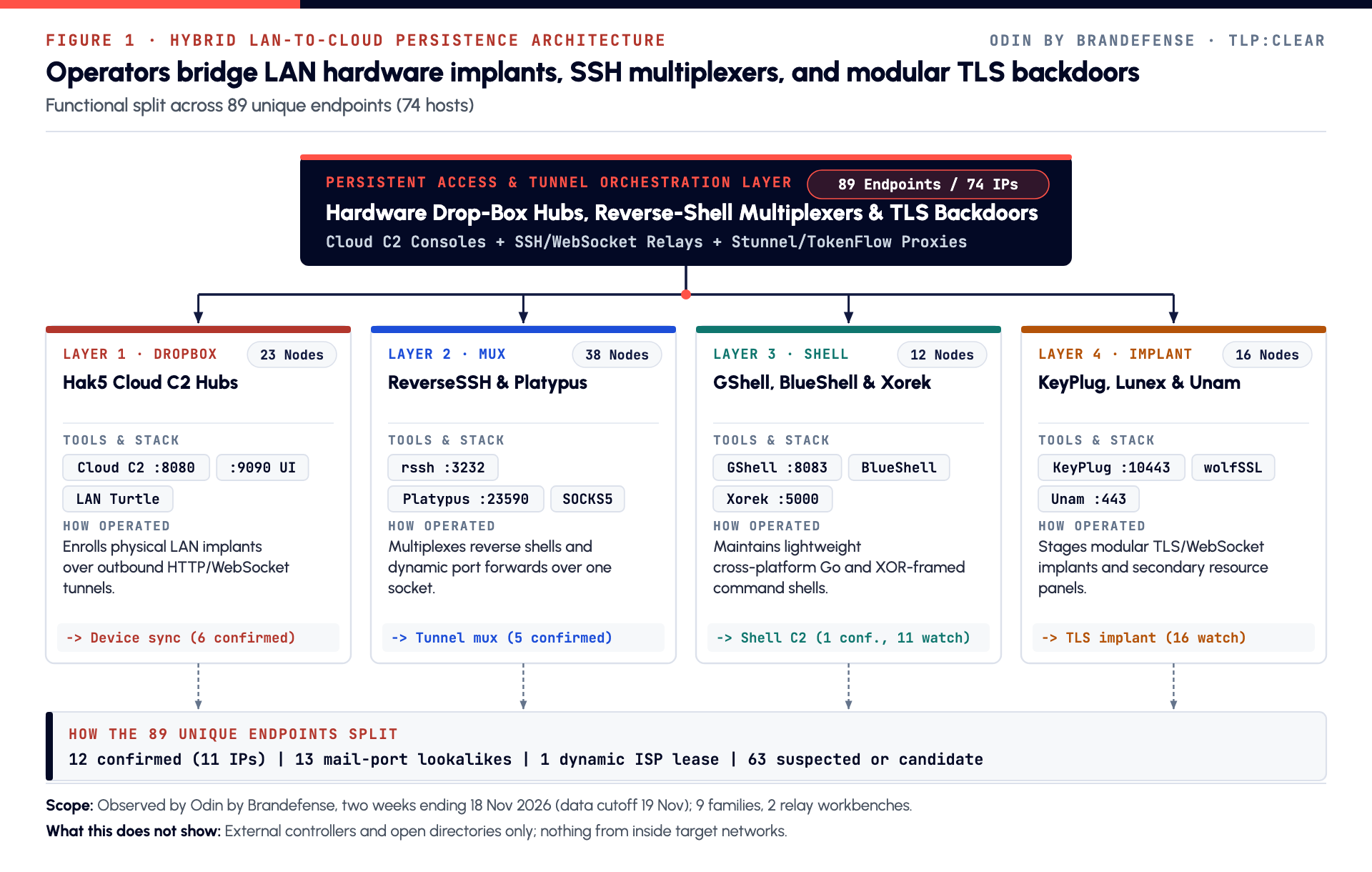
The nine families fall into four layers: hardware drop-box hubs, reverse-shell multiplexers, lightweight shells and modular TLS implants. Relays can sit in front of any of them.
Outbound by design
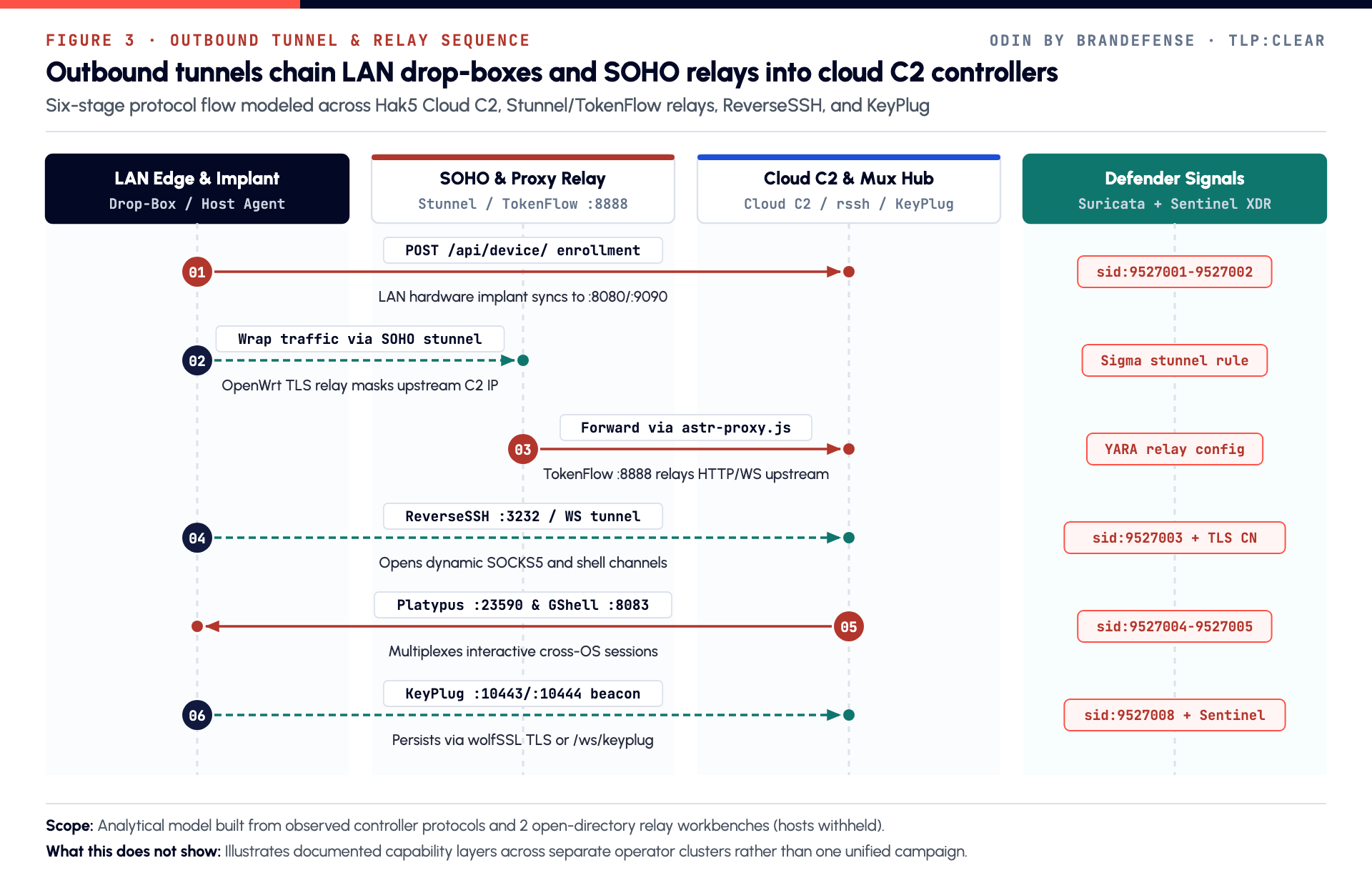
These tools turn the connection around. A physical drop-box (Hak5 Cloud C2) or a small shell agent (ReverseSSH, Platypus, GShellC2, BlueShell, XorekC2 or KeyPlug) starts an outbound session to a cloud server. The session runs over HTTP, SSH inside TLS, or WebSocket. Some operators bounce it through stunnel or a TokenFlow proxy first.
Figure 1 is an analytical model. It groups the families by role. It does not describe one attributed intrusion campaign, and no logs from inside target networks were available.
The nine families
The study covers 89 unique endpoints on 74 hosts. No host runs two families. Twelve hosts run one family on several ports.
| Family | Role | Endpoints (hosts) | Confirmed | Mail lookalikes | Dynamic ISP | Suspected | Candidates |
|---|---|---|---|---|---|---|---|
| ReverseSSH | ReverseSSH multiplexer | 36 (30) | 5 | 8 | 1 | 3 | 19 |
| Hak5 Cloud C2 | Hardware drop-box hub | 23 (19) | 6 | 5 | 0 | 5 | 7 |
| Unam | Cryptominer web panel | 8 (7) | 0 | 0 | 0 | 1 | 7 |
| GShellC2 | Go reverse-shell controller | 7 (5) | 1 | 0 | 0 | 0 | 6 |
| KeyPlug | Modular C++ TLS backdoor | 5 (4) | 0 | 0 | 0 | 0 | 5 |
| Lunex | Secondary TLS listener | 3 (3) | 0 | 0 | 0 | 0 | 3 |
| BlueShell | Go TLS backdoor | 3 (2) | 0 | 0 | 0 | 0 | 3 |
| Platypus | Go reverse-shell multiplexer | 2 (2) | 0 | 0 | 0 | 0 | 2 |
| XorekC2 | Port 5000 XOR shell | 2 (2) | 0 | 0 | 0 | 0 | 2 |
| Total | 89 (74) | 12 | 13 | 1 | 9 | 54 |
Where the endpoints sit
Six countries lead. The country totals need care, because benign mail servers inflate two of them.
| Country | Endpoints | Share | Note |
|---|---|---|---|
| Hong Kong | 18 | 20.2% | Includes all 7 GShellC2 endpoints |
| United States | 17 | 19.1% | |
| Netherlands | 13 | 14.6% | 5 are mail ports on one host |
| Italy | 8 | 9.0% | All 8 are mail-server lookalikes |
| China | 7 | 7.9% | |
| Germany | 6 | 6.7% |
The 12 confirmed endpoints all sit on dedicated cloud and VPS hosting. DigitalOcean has 3, Amazon AWS 2 and Latitude.sh 2 (two ports on one host). netcup, Shenzhen Tencent, Scloud, HK Kwaifong and HK Lightlayer have one each.
3. Drop-Box Hubs and Multiplexers: Hak5 Cloud C2, ReverseSSH, Platypus
In short
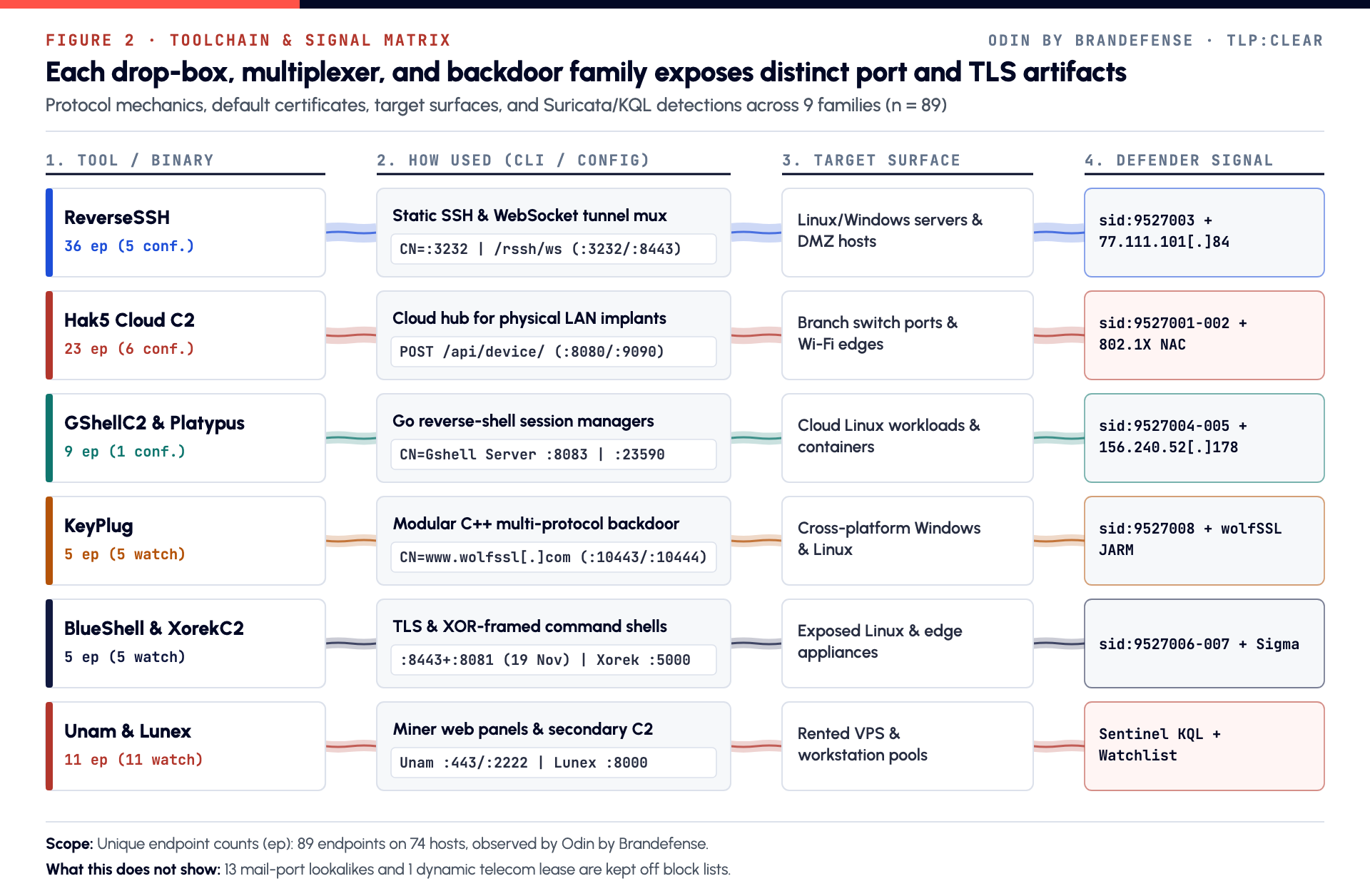
Hardware implants and multiplexed SSH tunnels give an operator the same thing: a durable outbound control channel with built-in SOCKS pivoting. Hak5 Cloud C2, ReverseSSH and Platypus account for 61 of the 89 endpoints (68.5%).
Figure 2 maps each family to its ports, default certificates, target surface and detection.
Hak5 Cloud C2
Hak5 Cloud C2 (c2-community or c2-pro) manages the vendor's implants: LAN Turtle, Packet Squirrel, WiFi Pineapple, Key Croc and Screen Crab. A device plugged into an unattended Ethernet jack beacons out over HTTP or WebSocket. It can then open a reverse SSH shell with no inbound firewall rule.
The fleet holds 23 endpoints on 19 IPs.
| Port | Endpoints |
|---|---|
| 8080 | 5 |
| 80 | 4 |
| 9090 | 2 |
| 443 | 2 |
| 8088 | 1 |
| 8095, 8834, 31010, 3389 | Candidates, one each |
| 110, 143, 465, 993, 995 | 5 mail-port lookalikes on one host |
Six controllers on dedicated cloud hosting are confirmed as Hak5 Cloud C2. Hak5 sells this product to penetration testers, so a standalone controller does not show hostile use. We publish only the one controller with a second, independent offensive signal.
| Endpoint | Hosting | Port | Certificate and JARM | Status |
|---|---|---|---|---|
| 146.190.211[.]163 | DigitalOcean (US) | 8088 | HTTP | Published for blocking. Monograph 12 documents a separate GoPhish phishing server on the same host |
| Address withheld | netcup (DE) | 8080 | Certificate domain withheld | Analyst review |
| Address withheld | Amazon AWS (GB) | 80 | Certificate domain withheld | Analyst review |
| Address withheld | Amazon AWS (US) | 8080 | HTTP | Analyst review |
| Two addresses withheld | DigitalOcean (US) | 9090 | A pair sharing one certificate and one JARM | Analyst review |
Three more Hak5 instances present self-signed CN=pentest certificates. They sit on Amazon AWS in France (443), Microsoft Azure in Ireland (3389) and Amazon AWS in Germany (443). The certificate suggests an authorized red-team engagement, so their addresses are withheld.
ReverseSSH
ReverseSSH (rssh) builds an SSH server into one static binary. The binary dials out over TCP, TLS, HTTP or WebSocket, by default to port 3232. Through that one socket the operator gets a shell, SOCKS5 proxying (-D) and SFTP file transfer.
The fleet holds 36 endpoints on 30 hosts. Sixteen listen on 3232. Eight of those present a self-signed CN=:3232 certificate, and seven share the JARM 3fd3fd20d3fd3fd00043d3fd3fd43d5ecfbe778b06e32b538bd51f24eb7398.
Five ReverseSSH endpoints on dedicated cloud hosting are confirmed. ReverseSSH is an open-source tool used by testers too. We publish the two hosts that wrap SSH in TLS under a self-signed certificate named after their own IP:port, matching Monograph 12. The two plain HTTP listeners stay in analyst review.
| Endpoint | Hosting | Certificate | JARM | Seen |
|---|---|---|---|---|
| 77.111.101[.]84:8082 | Latitude.sh (BR) | Self-signed, IP-literal CN | 3fd3fd0003fd3fd00043d43d00043d3bef2bf79cd6719851e8198c1e8f9a14 | 14 Nov 2026 |
| 77.111.101[.]84:8443 | Latitude.sh (BR) | Self-signed, IP-literal CN | Same as above | 14 Nov 2026 |
| 165.154.199[.]52:443 | Scloud Pte Ltd (SG) | Self-signed, IP-literal CN | Same as above | 13 Nov 2026 |
| Address withheld, port 80 | Shenzhen Tencent (CN) | None (HTTP) | None | 13 Nov 2026 |
| Address withheld, port 80 | HK Kwaifong Group (HK) | None (HTTP) | None | 13 Nov 2026 |
Platypus
Platypus is a Go manager for many reverse-shell sessions at once. It offers REST and WebSocket control and uses port 23590 by default. Two candidates were seen. One listens on 23590 at Evoxt in Japan. The other listens on 443 at ROUTE 95 in the United States, with the certificate CN=platypus-ingress. Both addresses are withheld.
4. Cross-Platform Backdoors: GShellC2, BlueShell, XorekC2 and KeyPlug
In short
Compiled Go and C++ backdoors give operators Linux and Windows footholds next to the drop-box hubs. Default certificates such as CN=Gshell Server and CN=www.wolfssl[.]com are the best hunting pivots.
GShellC2, KeyPlug, BlueShell and XorekC2 account for 17 endpoints on 13 hosts. Figure 3 is a model of how the layers connect, from a LAN implant through relays to a cloud controller, with the defender signal for each step.
GShellC2
All seven GShellC2 endpoints sit in Hong Kong, on five IPs at Antbox Networks (4) and HK Lightlayer (3). Four listen on 8083 and three on 8080.
The confirmed controller is 156.240.52[.]178:8083 on HK Lightlayer, seen on 13 November 2026. It presents CN=Gshell Server with the JARM 3fd3fd20d00000021c43d43d00043d15e5079913504d6ff89229f1f99b095c. A dual-port Antbox candidate on 8080 and 8083 shares that JARM. Two more 8083 listeners were seen on 19 November. Their addresses are withheld.
BlueShell and XorekC2
| Family | Endpoints | What was seen |
|---|---|---|
| BlueShell | 3 on 2 IPs | One host at Bangmod Enterprise (TH) listens on 8081 (from 18 November) and 8443 (from 19 November). A third listener sits on 443 in China |
| XorekC2 | 2 | Twin 5000 listeners at DpkgSoft International (NL), both with self-signed IP-literal certificates |
All five are candidates, and their addresses are withheld.
KeyPlug
KeyPlug is a modular backdoor with Windows and Linux builds. It speaks raw TCP, TLS, HTTP and WebSocket. The fleet holds five candidate endpoints on four IPs.
| Hosting | Port | Certificate | Note |
|---|---|---|---|
| Hangzhou Alibaba (CN) | 10443 | Certificate domain withheld | Same host also listens on 10444, seen 18 and 19 November |
| Hangzhou Alibaba (CN) | 10444 | None recorded | Second port of the host above |
| Hangzhou Alibaba (CN) | 10443 | CN=www.wolfssl[.]com | Default wolfSSL library certificate |
| Baxet Group (ES) | 443 | CN=www.wolfssl[.]com | Default wolfSSL library certificate |
| Nebula Global (HK) | 8443 | Certificate domain withheld | Not corroborated |
wolfSSL is an embedded TLS library. A build that keeps its sample certificate presents the vendor's name as the subject. That default makes a good hunting pivot, but it is not corroborated, so these addresses stay withheld.
Lunex and Unam
Lunex has three candidate listeners, two on 8000 and one on 443. Unam has eight SilentCryptoMiner web panels on seven IPs. One Unam panel on 2222, at Obehosting in the Netherlands with CN=localhost, is suspected. The rest are candidates. None of these addresses is published.
5. Relay Workbenches: TokenFlow Proxies and OpenWrt Stunnel Tunnels
In short
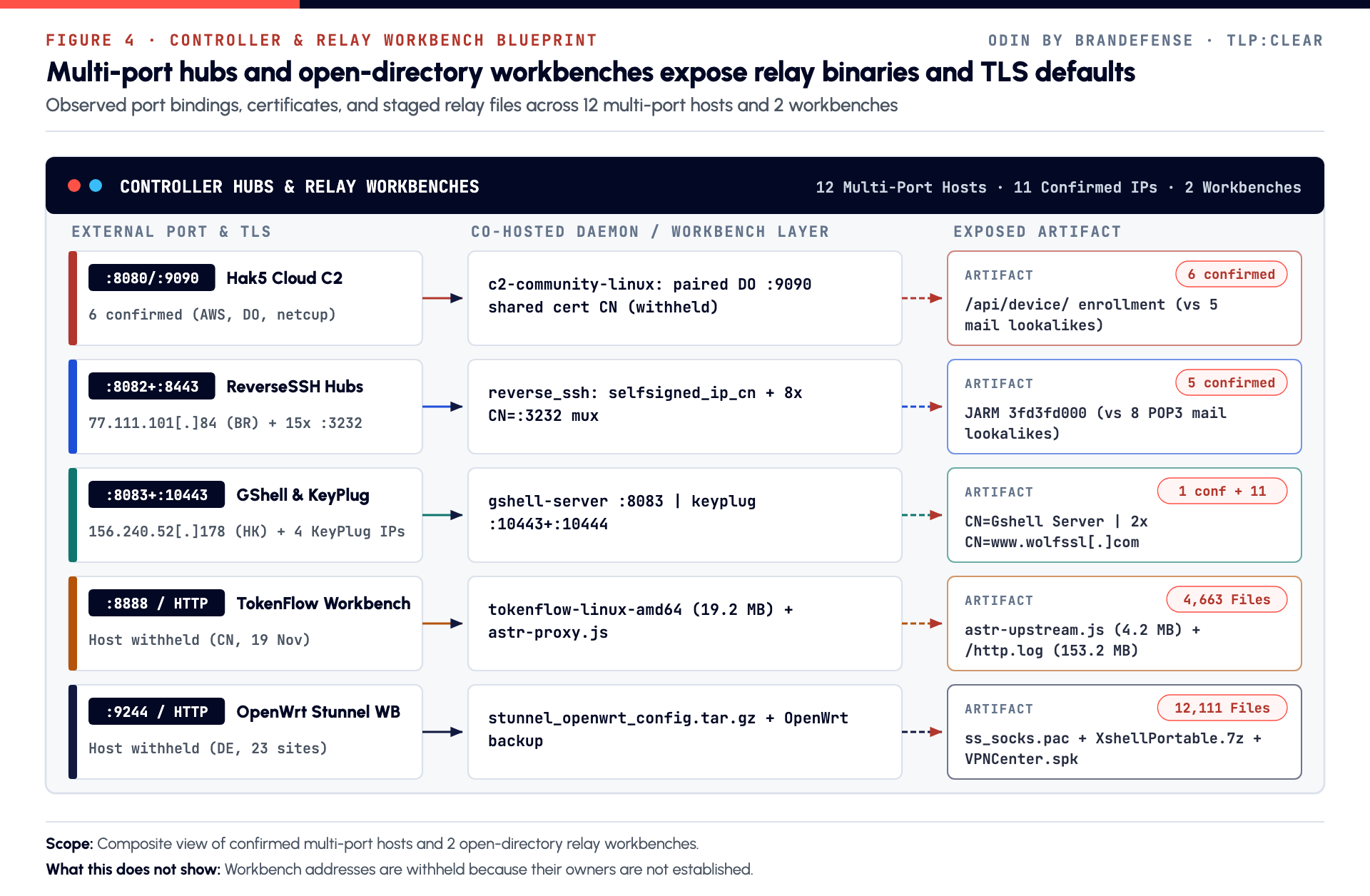
Operators who connect straight to a cloud controller risk losing it to a takedown. Two open directories show the relay layer that hides it: a TokenFlow proxy stack and a set of OpenWrt stunnel backups.
Figure 4 pairs the multi-port controller hosts with the workbench files. The owners of both workbench hosts are not established, so their addresses are withheld.
Workbench 1: TokenFlow and Node.js upstream relay
This host is in China and serves an open directory on port 8888. The directory tree holds 4,663 files. Files on it were listed between 17 and 19 November 2026.
The host is a Linux build machine with Python 3.11.10, Go 1.24.0 (78.4 MB), Node v22.22.2 and Playwright headless Chromium. Next to them sits a traffic-forwarding stack.
| File | Size (bytes) | Role |
|---|---|---|
tokenflow-linux-amd64 | 19,244,069 | Compiled Linux amd64 TokenFlow relay daemon |
tokenflow-linux-amd64-logo | 19,383,325 | Second build of the same daemon |
astr-proxy.js | 4,158,208 | Bundled Node.js edge proxy |
astr-upstream.js | 4,158,208 | Bundled Node.js upstream forwarder |
http.log | 153,166,632 | HTTP and WebSocket traffic log |
body | 81,647 | Captured request body |
The proxy and upstream scripts sit side by side with a large traffic log. That pattern fits a relay that forwards HTTP and WebSocket requests to a hidden upstream server. The log content is not published.
Workbench 2: OpenWrt router and stunnel backups
This host is in Germany and serves an open directory on port 9244. It mirrors 23 sites with 12,111 files in total, and was indexed on 18 November 2026.
| File | Size (bytes) | Role |
|---|---|---|
stunnel_openwrt_config.tar.gz | Not recorded | stunnel TLS wrapper configuration for an OpenWrt router |
backup-OpenWrt-2021-05-09.tar.gz | Not recorded | Full OpenWrt router configuration backup; the file name carries the date 9 May 2021 |
ss_socks.pac | 588,998 | Proxy auto-configuration rules that route traffic through SOCKS |
XshellPortable.7z | 4,644,065 | Portable SSH client |
Wrapping a raw TCP or reverse-shell stream in stunnel on a small-office router adds TLS and a residential IP reputation. The operator gets both without changing the implant binary.
6. Telling Hostile Infrastructure from Lookalikes
In short
Mail servers, a home broadband lease and dual-use testing tools with no second hostile signal stay off block lists.
Before blocking, rule out three explanations: a shared mail server, an authorized test, or a dynamic home connection.
Mail-server lookalikes
Eight ReverseSSH matches sat on four hosts at an Italian hosting provider. Each host pairs POP3 (110) with POP3S (995), and all share one certificate and one JARM.
Five Hak5 Cloud C2 matches sat on one host at a Dutch hosting provider, on mail ports 110, 143, 465, 993 and 995, with one shared certificate. Blocking shared mail servers would cut legitimate email. None of these 13 addresses is published, and mail-port matches should never feed a block list.
Authorized testing
Hak5 Cloud C2 and ReverseSSH both have legitimate testing users. Three Hak5 instances carry CN=pentest certificates. Five standalone Hak5 controllers and two plain-HTTP ReverseSSH listeners are confirmed installs but show no second hostile signal. We send all of these to analyst review and withhold their addresses.
Dynamic home connections
One more ReverseSSH listener on 3232 sits on Korea Telecom broadband. It is counted as the one dynamic ISP lease, not among the 12 confirmed endpoints. Home addresses move between unrelated customers. It belongs on a watchlist that expires after 24 hours, not on a permanent block list.
What each group gets
| Group | Endpoints | Action |
|---|---|---|
| Confirmed, with hostile context or a non-testing tool | 5 (on 4 hosts) | Block |
| Confirmed dual-use tool, no second hostile signal | 7 | Analyst review |
| Mail-server lookalikes | 13 | Do not block |
| Dynamic ISP lease | 1 | 24-hour watchlist |
Suspected, including 3 CN=pentest Hak5 instances | 9 | Watch and look for a second signal |
Candidates, including KeyPlug wolfSSL and ReverseSSH CN=:3232 listeners | 54 | Hold until a wire or process alert corroborates them |
| Total | 89 |
7. What Defenders Should Do
Within 24 hours
- Block the five published endpoints at the perimeter: 146.190.211[.]163:8088, 77.111.101[.]84:8082, 77.111.101[.]84:8443, 165.154.199[.]52:443 and 156.240.52[.]178:8083.
- Keep mail-port matches (110, 143, 465, 993, 995) and dynamic ISP addresses out of automatic block feeds.
- Re-check cloud addresses before renewing a block, since VPS addresses get reassigned.
Within 72 hours
- Enforce 802.1X port-based access control and MAC-move alerts on branch closets, meeting rooms and wall jacks.
- Audit edge routers and Linux appliances for unapproved OpenWrt
stunnelwrappers,TokenFlowbinaries and Node.jsastr-proxy.jsforwarders. - Alert on outbound sessions from servers to 3232, 10443, 10444 and 23590.
Within 7 to 30 days
- Deploy the Suricata signatures and add TLS inspection alerts for
CN=www.wolfssl[.]com,CN=:3232andCN=Gshell Server. - Enable the Sentinel query and the three Linux Sigma rules, with exact hostnames of your sanctioned test devices in the allowlist.
- Add the ReverseSSH JARM values and the GShellC2 JARM in this report to external attack surface hunting.
- Record your own authorized Hak5 and red-team infrastructure, so your SOC can clear its alerts fast.
8. Detection Rules
The full rules are in the Detection rules tab. Every rule file loads without errors in its engine (Suricata 7.0.12, YARA-X, pySigma, Kusto.Language); the rules were not replayed against live traffic.
| Rule file | What it catches |
|---|---|
odin_hak5_reversessh_platypus_keyplug.rules | Suricata 7: eight signatures for Hak5 Cloud C2 enrollment and controller responses, ReverseSSH WebSocket tunnels, Platypus, GShellC2, BlueShell and XorekC2 check-ins, and KeyPlug WebSocket transport |
sentinel_hak5_reversessh_and_keyplug_backdoor_hunt.kql | Microsoft Sentinel and Defender XDR: contact with the four published hosts, and tunnel or backdoor ports joined with tunnel and proxy processes |
sigma_reversessh_keyplug_and_stunnel_persistence.yml | Sigma (3 rules): ReverseSSH and Platypus clients, KeyPlug, BlueShell and XorekC2 daemons, and stunnel or TokenFlow relays on Linux |
odin_hak5_platypus_blueshell_keyplug_artifacts.yar | YARA (4 rules): Hak5 Cloud C2 configs, ReverseSSH and Platypus manifests, GShellC2, BlueShell and XorekC2 configs, and KeyPlug, TokenFlow and stunnel relay files |
How the Suricata signatures work
| SID | Looks for | Why |
|---|---|---|
| 9527001 | Outbound POST to /api/device/ with "device_model" in the body, on ports 80, 443, 8080, 8088 or 9090 | Catches a Hak5 implant enrolling with its controller |
| 9527002 | A 200 response with "cloudc2_edition" followed by "device_count" in the body | Catches a Hak5 Cloud C2 controller answering a device |
| 9527003 | /rssh/ws in the URI with an Upgrade: websocket header | Catches a ReverseSSH tunnel moving onto WebSocket |
| 9527004 | /api/client/ with an X-Platypus-Auth: header, on 23590, 443 or 8080 | Catches Platypus API control |
| 9527005 | POST /gshell/beacon with a user agent that starts with Gshell-Client, on 8083 or 8080 | Catches a GShellC2 check-in |
| 9527006 | /blueshell/poll with an X-BlueShell-Node: header | Catches BlueShell tasking polls |
| 9527007 | POST /xorek/register with "session_xor" in the body, on 5000 or 8443 | Catches XorekC2 session registration |
| 9527008 | /ws/keyplug with a Sec-WebSocket-Key: header, on 443, 8443, 8888, 10443 or 10444 | Catches KeyPlug WebSocket transport |
These signatures need plaintext or decrypted HTTP. ReverseSSH in raw mode on 3232 and KeyPlug in binary mode on 10443 and 10444 skip HTTP framing. For those, pair Suricata with TLS certificate checks and endpoint data. Add explicit pass rules for your own sanctioned Hak5 exercises, because SIDs 9527001 and 9527002 also fire on legitimate use.
How the other rules work
The KQL query looks back 7 days. It flags any device that contacts the four published hosts, with no exclusion. It also flags ssh, rssh, stunnel, node, curl or python3 connecting to the backdoor and tunnel ports listed above. It joins these with processes whose command lines name ReverseSSH, Platypus, GShellC2, BlueShell, KeyPlug, TokenFlow, astr-proxy or stunnel.
The port and process branches skip an exact list of approved test hostnames, which you replace with your own. Drop-boxes run no EDR agent, so catch them with 802.1X alerts and firewall logs.
| Sigma rule | Fires when |
|---|---|
| Unapproved ReverseSSH or Platypus tunnel | A Linux command line contains reverse_ssh, :3232, :23590, platypus-agent or gshell-client, on a host outside the exact approved list |
| KeyPlug, BlueShell or XorekC2 daemon | A command line names keyplug with 10443 or 10444, blueshell with 8443 or 8081, xorek with 5000, or /ws/keyplug |
| Stunnel or TokenFlow relay | stunnel, stunnel4, node or the tokenflow-linux-amd64 binary runs with stunnel_openwrt, astr-proxy.js, astr-upstream.js or tokenflow-linux-amd64 in its arguments |
| YARA rule | Fires when |
|---|---|
ODIN_Hak5_CloudC2_Controller_Config | cloudc2_edition or c2-community-linux appears with both /api/device/ and device_model |
ODIN_ReverseSSH_Platypus_Multiplexer_Manifest | /rssh/ws, reverse_ssh and 3232 appear together, or X-Platypus-Auth, platypus-ingress and 23590 appear together |
ODIN_GShell_BlueShell_Xorek_Backdoor_Config | A matching pair appears: Gshell Server with /gshell/beacon, /blueshell/poll with X-BlueShell-Node, or /xorek/register with session_xor |
ODIN_KeyPlug_TokenFlow_Stunnel_Relay_Config | /ws/keyplug with www.wolfssl[.]com, tokenflow-linux-amd64 with astr-proxy.js, or stunnel_openwrt_config |
All four YARA rules apply only to files under 512 KB.
9. Indicators
The Indicators tab holds 5 published indicators: 5 addresses (IP and port) on 4 hosts, and no hashes.
| Endpoint | Family | Hosting | Key fingerprint | Seen |
|---|---|---|---|---|
| 146.190.211[.]163:8088 | Hak5 Cloud C2 | DigitalOcean (US) | Hak5 console; GoPhish on the same host (Monograph 12) | 13 Nov 2026 |
| 77.111.101[.]84:8082 | ReverseSSH | Latitude.sh (BR) | Self-signed IP-literal certificate, JARM 3fd3fd0003fd...9a14 | 14 Nov 2026 |
| 77.111.101[.]84:8443 | ReverseSSH | Latitude.sh (BR) | Same certificate pattern and JARM | 14 Nov 2026 |
| 165.154.199[.]52:443 | ReverseSSH | Scloud Pte Ltd (SG) | Self-signed IP-literal certificate, JARM 3fd3fd0003fd...9a14 | 13 Nov 2026 |
| 156.240.52[.]178:8083 | GShellC2 | HK Lightlayer (HK) | CN=Gshell Server, JARM 3fd3fd20d000...095c | 13 Nov 2026 |
Certificate subjects (CN=Gshell Server, CN=:3232, CN=platypus-ingress, CN=www.wolfssl[.]com) and JARM values stay in the text of Chapters 3 and 4.
Withheld: the five standalone Hak5 Cloud C2 controllers and the two plain-HTTP ReverseSSH listeners, which are confirmed installs of dual-use tools with no second hostile signal. Also withheld are the three CN=pentest hosts, the 13 mail-server lookalikes, the Korea Telecom lease, all suspected and candidate hosts, both relay workbenches, and every certificate domain.
MITRE ATT&CK tactics
This report maps the families to tactics only, not to technique IDs.
| Tactic | How the families use it | Detection |
|---|---|---|
| Initial Access | Hak5 implants plugged into unattended Ethernet jacks or closets | 802.1X alerts; SID 9527001 |
| Persistence | ReverseSSH, KeyPlug, BlueShell and XorekC2 agents on Linux and Windows hosts | Sigma rules 1 and 2; YARA rules |
| Command and Control | Outbound HTTP, WebSocket and TLS sessions to cloud controllers, through stunnel or TokenFlow relays | SIDs 9527001 to 9527008; KQL; Sigma rule 3 |
10. Scope and Limits
- Window. The findings cover a two-week observation window ending 18 November 2026, with data up to 19 November 2026. Some records carry earlier first-seen dates from public sources. We do not use those as a tracking start.
- Outside view only. We saw controllers, listeners and open directories from the internet. We saw nothing inside any target network, and no intrusion is described here.
- Confirmed is not the same as hostile. A confirmed endpoint runs the software. Hak5 Cloud C2 and ReverseSSH have many legitimate testing users, so 7 confirmed endpoints are withheld for lack of a second hostile signal.
- Candidates are leads. The 54 candidates and 9 suspected endpoints rest on one or a few signals. Do not block them without corroboration.
- The four-layer view is a model. No host runs two families, and nothing in the data links the relay workbenches to a specific controller.
- Family names are signature labels. They describe what the software looks like. They are not attribution to any actor.
- Rule testing. Every published rule file loads without errors in its engine (Suricata 7.0.12, YARA-X, pySigma and Microsoft's Kusto.Language analyzer, checked on 20 November 2026). The rules were not replayed against live traffic, so test and tune them in your own environment before production use.
11. Sources
- Hak5. Cloud C2 documentation. https://docs.hak5.org/cloud-c2/ (verified 19 November 2026)
- NHAS. ReverseSSH repository. https://github.com/NHAS/reverse_ssh (verified 19 November 2026)
- WangYihang. Platypus repository. https://github.com/WangYihang/Platypus (verified 19 November 2026)
- wolfSSL Inc. wolfSSL manual. https://www.wolfssl.com/docs/wolfssl-manual/ (verified 19 November 2026)
- Stunnel project. Documentation. https://www.stunnel.org/docs.html (verified 19 November 2026)
- OISF. Suricata 7.0 user guide, HTTP keywords. https://docs.suricata.io/en/suricata-7.0.0/rules/http-keywords.html (verified 19 November 2026)
- Salesforce Engineering. Easily identify malicious servers on the internet with JARM. https://engineering.salesforce.com/easily-identify-malicious-servers-on-the-internet-with-jarm-e095edac525a/ (verified 19 November 2026)
What is…?
Short explanations of the tools and families named in this study.
What is ReverseSSH?
ReverseSSH is an open-source tool that gives an operator an SSH shell through a connection the target opens outward.
More about ReverseSSHDevice controllerWhat is Hak5 Cloud C2?
Hak5 Cloud C2 is a controller for Hak5 implant devices, such as drop boxes, that call home over the internet.
More about Hak5 Cloud C2BackdoorWhat is KeyPlug?
KeyPlug is a modular backdoor with Windows and Linux builds that public reporting links to APT41.
More about KeyPlugTechniqueWhat is JARM?
JARM is an open TLS server fingerprinting method from Salesforce. It hashes how a server answers a set of crafted TLS handshakes.
More about JARMShell managerWhat is Platypus?
Platypus is an open-source Go tool for managing many reverse-shell sessions at once.
More about PlatypusPhishing frameworkWhat is GoPhish?
GoPhish is an open-source phishing simulation framework. Companies use it for awareness training and attackers use it for real campaigns.
More about GoPhishFrequently asked questions
How do these tools get past a firewall?
They do not come in. They call out. A small device plugged into an office network jack, or a small program on a server, opens a connection to a cloud server over ordinary web or encrypted traffic. The operator then works through that connection. Firewalls that block inbound traffic do not stop it.
What did the lookalikes look like?
Thirteen matches were ordinary mail servers. Eight sat at an Italian hosting provider on POP3 ports 110 and 995. Five sat on one mail host at a Dutch provider. Their banners and certificates happened to match a tool signature. Blocking them would cut legitimate email.
What do the backdoors and relays add?
Beyond the two big families, operators use compiled shells and backdoors. All seven GShellC2 endpoints sit in Hong Kong. BlueShell and XorekC2 add five more candidate listeners in Thailand, China and the Netherlands. KeyPlug, a modular backdoor for Windows and Linux, has five endpoints on ports 10443, 10444, 8443 and 443. Two of them present the unchanged sample certificate of the wolfSSL library, CN=www.wolfssl[.]com.