


Key takeaways
- Odin mapped 89 endpoints on 74 hosts across nine persistent-access and backdoor families.
- Hak5 Cloud C2 and ReverseSSH make up 66.3% of them, and both have legitimate testing users.
- Of 12 confirmed endpoints, 5 show a second hostile signal and are published for blocking.
- Thirteen matches were ordinary mail servers; blocking them would cut legitimate email.
- Enforce 802.1X on wired ports and hunt default wolfSSL, CN=:3232 and CN=Gshell Server certificates.
In a two-week observation window ending 18 November 2026, Odin by Brandefense mapped 89 internet-facing endpoints on 74 hosts. They belong to nine families of tools that keep access to a network from the inside out: hardware drop-box controllers, reverse-SSH tunnels, small Go shells and modular backdoors. Twelve endpoints are confirmed. Only five carry enough hostile context to block, because the two biggest families are also everyday tools for penetration testers. For defenders, the lesson is to block carefully and to close the doors these tools use.
How do these tools get past a firewall?
They do not come in. They call out. A small device plugged into an office network jack, or a small program on a server, opens a connection to a cloud server over ordinary web or encrypted traffic. The operator then works through that connection. Firewalls that block inbound traffic do not stop it.
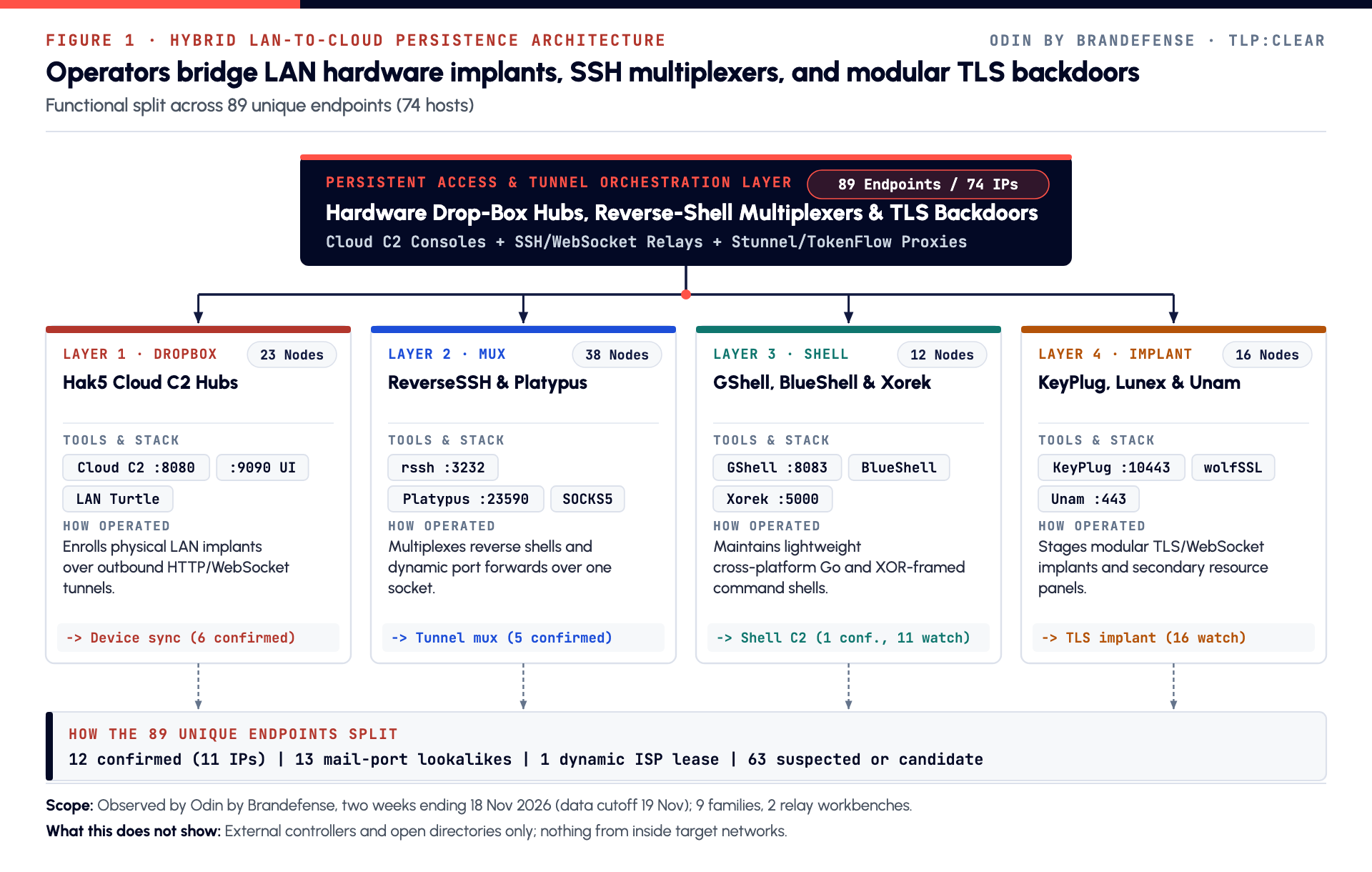
The nine families fall into four layers. This grouping is a model of roles, not one campaign.
| Layer | Families | Endpoints | What it does |
|---|---|---|---|
| Drop-box hubs | Hak5 Cloud C2 | 23 | Manages implants such as the LAN Turtle and WiFi Pineapple |
| Tunnel multiplexers | ReverseSSH, Platypus | 38 | Carries shells, file transfer and proxying over one connection |
| Lightweight shells | GShellC2, BlueShell, XorekC2 | 12 | Gives interactive command shells on Linux and Windows |
| Modular implants | KeyPlug, Lunex, Unam | 16 | Runs TLS backdoors and cryptominer web panels |
ReverseSSH is the largest family, with 36 endpoints, and 16 of them listen on its default port 3232. Hak5 Cloud C2 follows with 23 endpoints. Together they make up 66.3% of the total.
Why block only five of twelve confirmed endpoints? It does not mean the person running it is hostile.
Hak5 sells its implants and Cloud C2 server to security testers. ReverseSSH is an open-source tool that testers use as well. Three Hak5 servers even carry certificates named pentest. A standalone Hak5 controller, or a plain ReverseSSH listener, looks the same whether a red team or a criminal runs it.
So we publish an address only when it shows more than a testing tool:
- 146.190.211[.]163 on DigitalOcean (US) runs Hak5 Cloud C2 on the same host as a GoPhish phishing server, as Monograph 12 documents.
- 77.111.101[.]84 on Latitude.sh (BR) wraps ReverseSSH in TLS on ports 8082 and 8443, behind a self-signed certificate named after its own address.
- 165.154.199[.]52 on Scloud (SG) shows the same pattern and the same TLS fingerprint on port 443.
- 156.240.52[.]178 on HK Lightlayer (HK) runs a GShellC2 controller on port 8083 with the default certificate
CN=Gshell Server.
The other seven confirmed endpoints, five Hak5 controllers and two plain ReverseSSH listeners, go to analyst review. Their addresses are withheld.
What did the lookalikes look like?
Thirteen matches were ordinary mail servers. Eight sat at an Italian hosting provider on POP3 ports 110 and 995. Five sat on one mail host at a Dutch provider. Their banners and certificates happened to match a tool signature. Blocking them would cut legitimate email.
One more ReverseSSH listener sat on Korea Telecom home broadband. It is counted as a dynamic home lease, not among the 12 confirmed endpoints. Home addresses pass between unrelated customers, so it belongs on a watchlist that expires after 24 hours. The remaining 63 endpoints are suspected or candidate leads that need a second signal.
What do the backdoors and relays add?
Beyond the two big families, operators use compiled shells and backdoors. All seven GShellC2 endpoints sit in Hong Kong. BlueShell and XorekC2 add five more candidate listeners in Thailand, China and the Netherlands. KeyPlug, a modular backdoor for Windows and Linux, has five endpoints on ports 10443, 10444, 8443 and 443. Two of them present the unchanged sample certificate of the wolfSSL library, CN=www.wolfssl[.]com. That default is rare on a real service and easy to hunt for.
Two open directories show the relay layer that hides controllers from takedowns. One host in China stages a 19.2 MB TokenFlow relay binary, two Node.js proxy scripts and a 153.2 MB HTTP traffic log. Another in Germany archives OpenWrt router backups and stunnel TLS tunnel settings across 23 mirrored sites. A small-office router running stunnel gives an operator encryption and a residential IP reputation without changing the implant. We withhold both workbench addresses, because their owners are not established.
What to do now
- Block the five published endpoints listed above and in the full report's Indicators tab. Send standalone Hak5 controllers and plain ReverseSSH listeners to analyst review, and keep mail-port matches off block lists.
- Enforce 802.1X port-based access control on branch closets, meeting rooms and wall jacks, so a plugged-in drop-box cannot join the network.
- Hunt default certificates and odd ports:
CN=www.wolfssl[.]com,CN=:3232andCN=Gshell Server, and outbound sessions to 3232, 10443, 10444 and 23590. - Audit edge routers and Linux hosts for unapproved
stunnelwrappers,TokenFlowbinaries and Node.js proxy scripts. - Deploy the rules in the full report's Detection rules tab: Suricata, Sentinel KQL, Sigma and YARA. Add the exact hostnames of your own test devices to the allowlists first.
The full report covers the ports, certificates, fingerprints and rule logic in detail.
What is…?
Short explanations of the tools and families named in this study.
What is ReverseSSH?
ReverseSSH is an open-source tool that gives an operator an SSH shell through a connection the target opens outward.
More about ReverseSSHDevice controllerWhat is Hak5 Cloud C2?
Hak5 Cloud C2 is a controller for Hak5 implant devices, such as drop boxes, that call home over the internet.
More about Hak5 Cloud C2BackdoorWhat is KeyPlug?
KeyPlug is a modular backdoor with Windows and Linux builds that public reporting links to APT41.
More about KeyPlugTechniqueWhat is JARM?
JARM is an open TLS server fingerprinting method from Salesforce. It hashes how a server answers a set of crafted TLS handshakes.
More about JARMShell managerWhat is Platypus?
Platypus is an open-source Go tool for managing many reverse-shell sessions at once.
More about PlatypusPhishing frameworkWhat is GoPhish?
GoPhish is an open-source phishing simulation framework. Companies use it for awareness training and attackers use it for real campaigns.
More about GoPhishFrequently asked questions
How do these tools get past a firewall?
They do not come in. They call out. A small device plugged into an office network jack, or a small program on a server, opens a connection to a cloud server over ordinary web or encrypted traffic. The operator then works through that connection. Firewalls that block inbound traffic do not stop it.
What did the lookalikes look like?
Thirteen matches were ordinary mail servers. Eight sat at an Italian hosting provider on POP3 ports 110 and 995. Five sat on one mail host at a Dutch provider. Their banners and certificates happened to match a tool signature. Blocking them would cut legitimate email.
What do the backdoors and relays add?
Beyond the two big families, operators use compiled shells and backdoors. All seven GShellC2 endpoints sit in Hong Kong. BlueShell and XorekC2 add five more candidate listeners in Thailand, China and the Netherlands. KeyPlug, a modular backdoor for Windows and Linux, has five endpoints on ports 10443, 10444, 8443 and 443. Two of them present the unchanged sample certificate of the wolfSSL library, CN=www.wolfssl[.]com.