


Key takeaways
- A stolen browser cookie can stand in for a password and an MFA prompt.
- One exposed workbench pairs an OpenClaw agent with a logged-in Chromium profile and headless Playwright.
- A second workbench stages wallet-brand recon and SaaS cookie capture.
- Of 193 stealer, clipper, loader and RAT endpoints, 20 are confirmed C2 servers.
- Bind sessions to devices, block confirmed C2, and watch who reads browser cookie stores.
In a two-week observation window ending 18 November 2026, Odin by Brandefense mapped 193 endpoints across 11 stealer, clipper, loader and remote-access families. We also found two exposed workbenches that show how a logged-in browser can be driven by an automation agent. For defenders, the message is simple. A password reset does not end an infostealer incident when the attacker already holds a live session cookie.
Why does a stolen cookie matter so much?
When you log in to a web service, it gives your browser a session cookie. From then on, many services trust that cookie and do not ask for your password or MFA again. Modern infostealers copy the whole Chromium profile folder, cookies included. Whoever holds a fresh cookie can often act as you.
Browser automation makes this easy to scale. Microsoft Playwright, a popular testing tool, can start a headless Chromium browser on top of an existing profile folder. Any script or AI agent driving that browser inherits the sessions inside it. This is a normal, documented feature. It also happens to be exactly what an attacker needs.
The fixes already exist, but few teams have turned them on. Chrome's App-Bound Encryption makes the cookie store harder for other programs to read on Windows. Device Bound Session Credentials tie a session to a key held in the device's hardware, so a copied cookie stops working elsewhere. Continuous access evaluation can revoke a session when it suddenly shows up from a new network or a headless client.
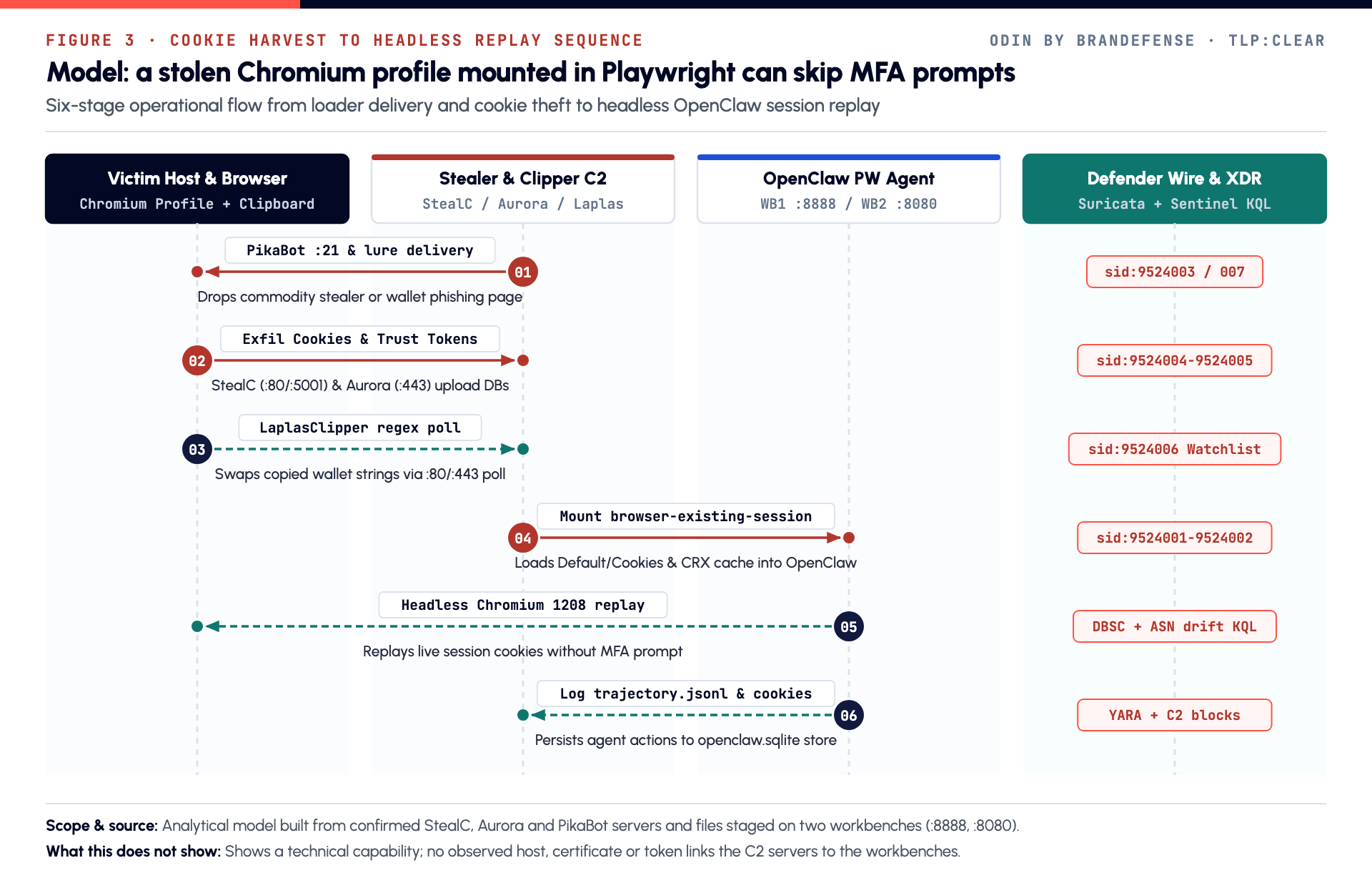
Figure 3 shows the chain as a model. A loader drops a stealer. The stealer uploads the browser's cookie store. A clipper swaps copied wallet addresses. An agent then loads the stolen profile and uses the session. We observed the pieces separately. Nothing we saw links a specific stealer server to a specific workbench, and we saw no replay against a real account.
What did the workbenches hold?
The first workbench is a cloud server in China with an open directory on port 8888. It holds Playwright's headless Chromium build 1208 and an OpenClaw agent folder named browser-existing-session. OpenClaw is an autonomous agent that can drive a browser. That folder is a complete Chromium profile, with a cookie store, Trust Tokens, browsing history and a key database. The agent logs each step it takes.
These files show the mechanism. They do not show where the profile came from. It may be stolen, or it may be the owner's own browser copied for automation. We withhold the server's address and every file hash from it.
The second workbench is a server in France with an open directory on port 8080. It holds 59 target folders and 10,650 files. One folder hunts for abandoned subdomains of a hardware crypto-wallet vendor, where a fake seed-phrase or login page could sit under the vendor's own name. Another runs headless Chrome 149 scripts against a design SaaS platform and saves the resulting cookie jars. Both brands are withheld. A careless security contractor is one possible owner, so we treat the owner as unknown.
Who supplies the stolen data?
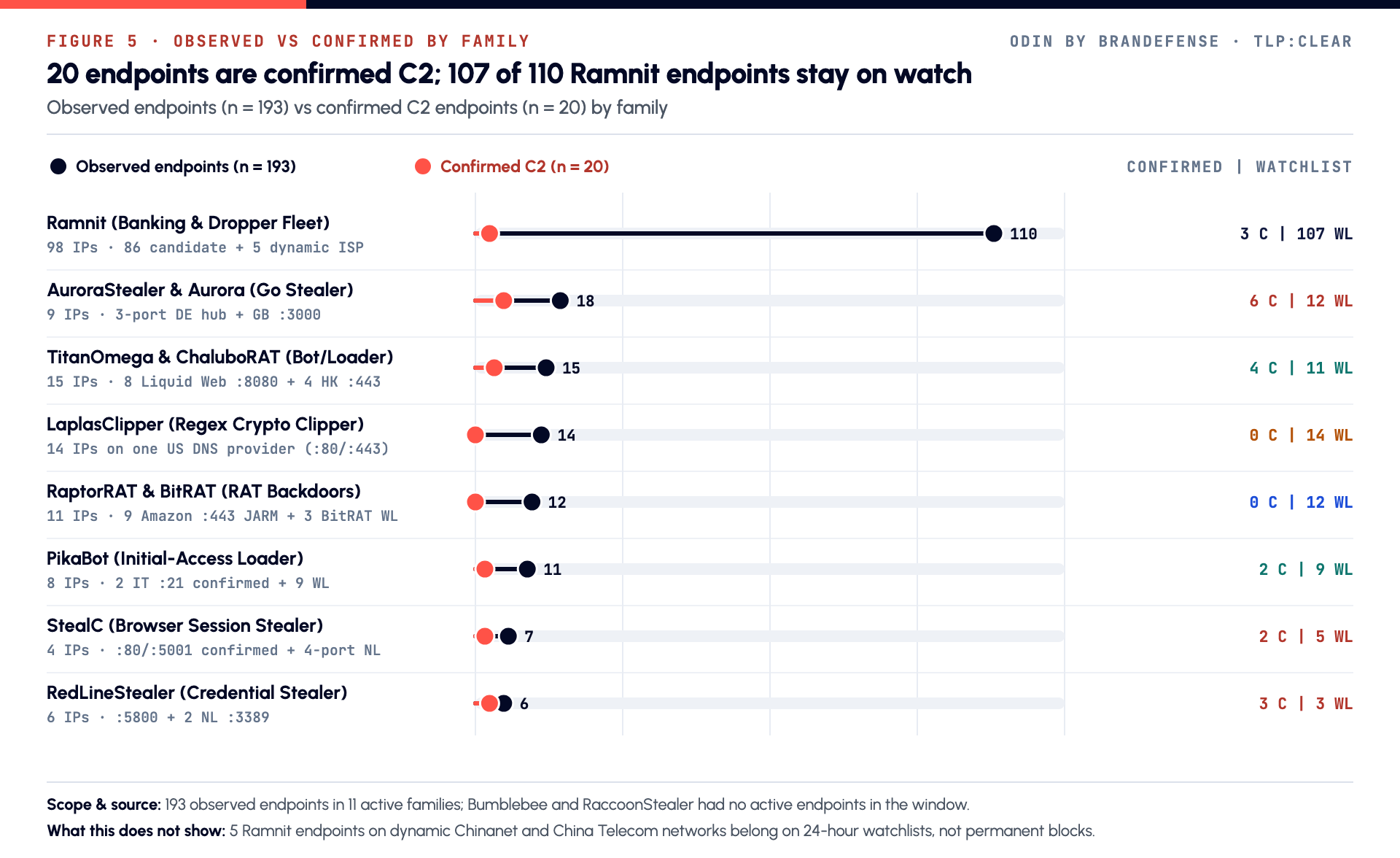
Commodity stealers do the collecting. Aurora and AuroraStealer account for 18 endpoints on 9 hosts. One German server runs three AuroraStealer C2 ports at once. StealC has 7 endpoints and RedLineStealer 6. Two RedLine servers in the Netherlands share the same Windows certificate.
Fourteen suspected LaplasClipper nodes sit with one US provider. A clipper watches the clipboard and replaces any copied wallet address with the attacker's. Because that provider's ranges are shared by many customers, these nodes stay on watchlists.
Loaders and backdoors make up 148 of the 193 endpoints. PikaBot, TitanOmega, Ramnit, ChaluboRAT, RaptorRAT and BitRAT handle delivery and long-term access. Four ChaluboRAT servers in one Hong Kong address block are confirmed.
What should we block, and what should we only watch?
Only 20 of the 193 endpoints are confirmed C2 servers. We publish 15 of them, on 13 addresses, in the full report's Indicators tab. The other five sit on shared web hosting or broadband networks, where an address can belong to someone else. We withhold those.
The rest need care. Ramnit alone accounts for 110 endpoints, and 107 of them stay on watchlists. Five sit on dynamic Chinese telecom ranges that change hands often, so they belong on 24-hour watchlists. Playwright and subdomain tools also run in honest QA and red-team work, so a headless browser on its own is not a threat signal.
What to do now
- Bind sessions to devices. Pilot Device Bound Session Credentials or continuous access evaluation, so a cookie replayed from a new network or a headless client fails.
- Block the 15 published C2 endpoints from the full report's Indicators tab, and review them after 30 days. Keep dynamic and shared-network addresses on short watchlists.
- Guard browser profile stores. Alert when any process other than an installed browser reads Chromium cookie, token or extension storage.
- Remove dangling DNS records that a wallet or login lure could use.
- Deploy the rules in the full report's Detection rules tab: Suricata, Sentinel KQL, Sigma and YARA. Start in alert mode and allowlist your QA runners by exact hostname.
The full report covers the workbench files, the C2 infrastructure and the rule logic in detail.
What is…?
Short explanations of the tools and families named in this study.
What is Ramnit?
Ramnit is a long-running banking trojan and worm. Many of its infrastructure records are old feed entries.
More about RamnitInfostealerWhat is Aurora Stealer?
Aurora Stealer is a Go-based infostealer sold as malware-as-a-service.
More about Aurora StealerAI agentWhat is OpenClaw?
OpenClaw is an open-source autonomous agent gateway that keeps trajectories, auth profiles and session logs on disk.
More about OpenClawTechniqueWhat is JARM?
JARM is an open TLS server fingerprinting method from Salesforce. It hashes how a server answers a set of crafted TLS handshakes.
More about JARMMalware loaderWhat is PikaBot?
PikaBot is a malware loader and backdoor distributed through phishing, used to deliver follow-on payloads.
More about PikaBotInfostealerWhat is RedLine?
RedLine is an infostealer sold as malware-as-a-service. It steals browser credentials, cookies and crypto wallets. Law enforcement disrupted its infrastructure in 2024.
More about RedLineFrequently asked questions
Why does a stolen cookie matter so much?
When you log in to a web service, it gives your browser a session cookie. From then on, many services trust that cookie and do not ask for your password or MFA again. Modern infostealers copy the whole Chromium profile folder, cookies included. Whoever holds a fresh cookie can often act as you.
What did the workbenches hold?
The first workbench is a cloud server in China with an open directory on port 8888. It holds Playwright's headless Chromium build 1208 and an OpenClaw agent folder named browser-existing-session. OpenClaw is an autonomous agent that can drive a browser. That folder is a complete Chromium profile, with a cookie store, Trust Tokens, browsing history and a key database. The agent logs each step it takes.
Who supplies the stolen data?
Commodity stealers do the collecting. Aurora and AuroraStealer account for 18 endpoints on 9 hosts. One German server runs three AuroraStealer C2 ports at once. StealC has 7 endpoints and RedLineStealer 6. Two RedLine servers in the Netherlands share the same Windows certificate.
What should we block, and what should we only watch?
Only 20 of the 193 endpoints are confirmed C2 servers. We publish 15 of them, on 13 addresses, in the Indicators tab. The other five sit on shared web hosting or broadband networks, where an address can belong to someone else. We withhold those.