
Key takeaways
- On 20 November 2026, Abnormal Security reported Microsoft Entra app-only user creation and Exchange full_access_as_app abuse minting five-minute ROPC accounts.
- Checking all 5 published AntiFox/ARTEX IPv4s (4 AntiFox, 1 ARTEX) matched 1 cloud host (Host AF-01 on Google Cloud AS396982), beside 6,343 ARTEX and 3,648 CyberStrikeAI records.
- Zero IPs, certs, or files link Host AF-01 to Workbench B, a Germany VPS on TCP 8899 holding 842 entries (614 sized = 316,723,715 bytes).
- Workbench B stages autosecure-app.tar.gz (298.9 MB), 3 Discord OTP bot trees (129 entries), 36 OAuth probe items, and 16 Playwright folders (432 entries).
- All 5 incident IPs, Workbench B's IP, and all 83 user files (13,968,406 bytes) stay withheld; retire full_access_as_app, require MFA so ROPC cannot complete, and enforce FIDO2.
One of five AntiFox/ARTEX-linked IPv4s disclosed on 20 November 2026 matched candidate Host AF-01, while an unlinked server exposed 842 Autosecure entries on TCP 8899. Across evidence dated 13–27 November 2026, Odin by Brandefense studied both identity tracks side by side.
Monograph 60 covered seven-tool console growth and Storm-0940 or ZQAgent overlaps. By contrast, Monograph 72 examines Microsoft Entra app-only role abuse alongside an 842-entry OTP and OAuth Autosecure workbench (Workbench B).
Zero IPv4s, certs, or files link Host AF-01 to Workbench B. We compare them side by side to contrast enterprise app-role abuse with OTP and OAuth session hijacking. We publish 0 IPv4s, 0 SHA-256 hashes, and 0 user filenames.
How do broad Entra app roles allow five-minute ROPC token minting?
On 20 November 2026, Abnormal Security shared findings from a breach in a U.S. financial-services Microsoft Entra tenant. An operator abused an Entra app holding app-only user-creation rights (User.ReadWrite.All) and the legacy Exchange Online full_access_as_app role. Unless replaced by scoped Exchange RBAC, full_access_as_app opens every mailbox in the tenant without a signed-in user.
App-only tokens often fail when internal business APIs expect user scopes. To bridge that gap without prompting real staff, the operator created short-lived cloud users. Next, the operator signed in via OAuth 2.0 Resource Owner Password Credentials (ROPC, grant_type=password) at /oauth2/v2.0/token. Each temporary user was disabled within roughly five minutes after the token call.
Teams can use cyber threat intelligence to check external console activity against cloud audit spikes. Pairing those checks with dark web monitoring helps analysts catch leaked app secrets and session bundles before attackers reach internal APIs.
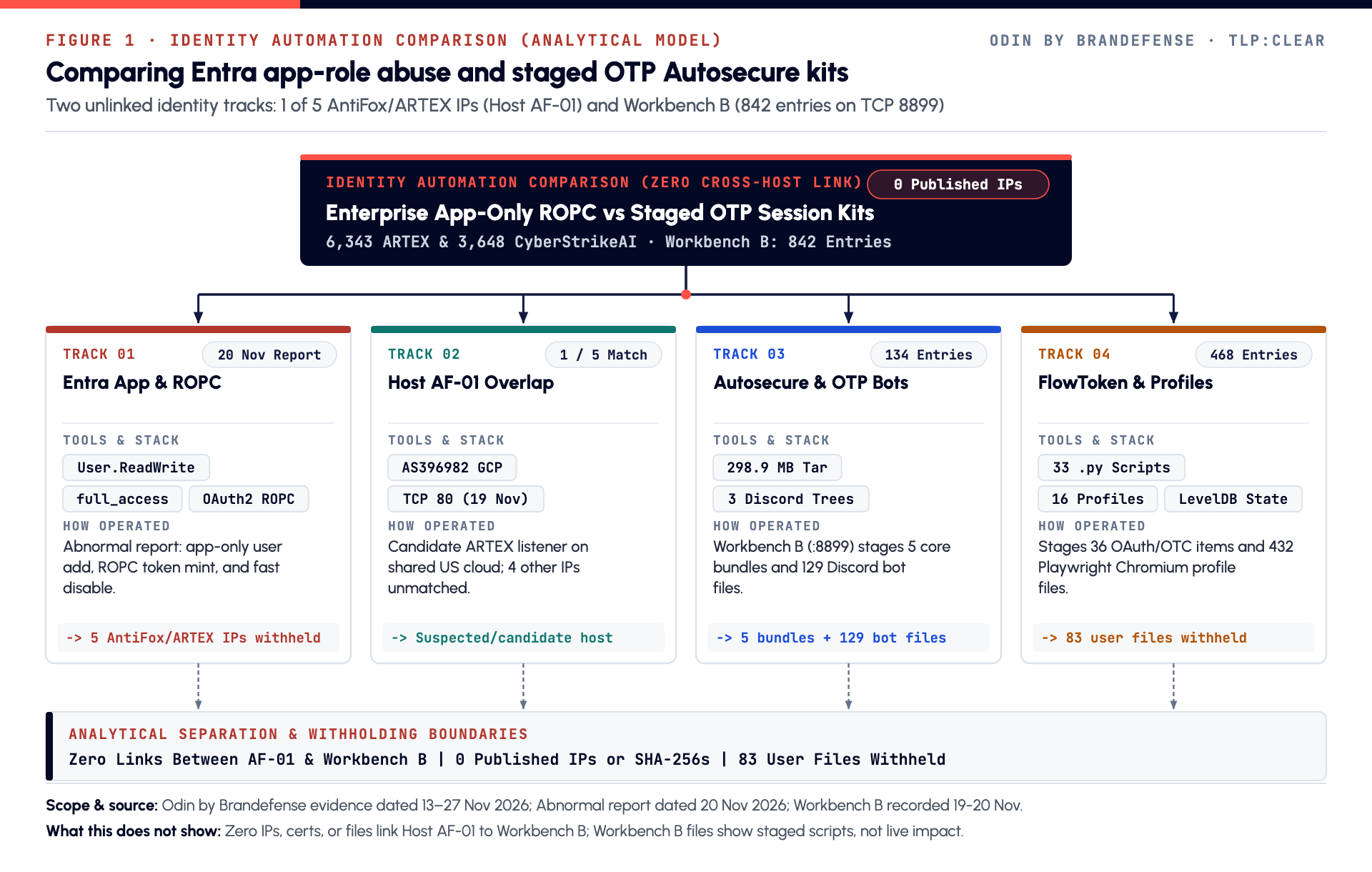
Sign-ins and recovery calls in the 20 November 2026 post came from 5 AntiFox/ARTEX IPv4s (4 labeled AntiFox and 1 ARTEX). Abnormal Security noted that the data does not show either tool ran the Entra calls directly.
Checking all 5 published IPv4s matched 1 host (20.0%): Host AF-01 on Google Cloud (AS396982, United States). Odin by Brandefense flagged Host AF-01 on TCP 80 on 19 November 2026. We then saw an open ARTEX candidate listener on TCP 443 on 25-26 November 2026.
The other 4 IPs (80.0%) showed no web console. Across global internet space, cumulative candidate records reached 6,343 ARTEX on 26-27 November 2026, up +1,800 from 4,543 on 15 November (4 verified controllers). Peer CyberStrikeAI records reached 3,648.
What did Workbench B's 842 entries show about OTP Autosecure kits?
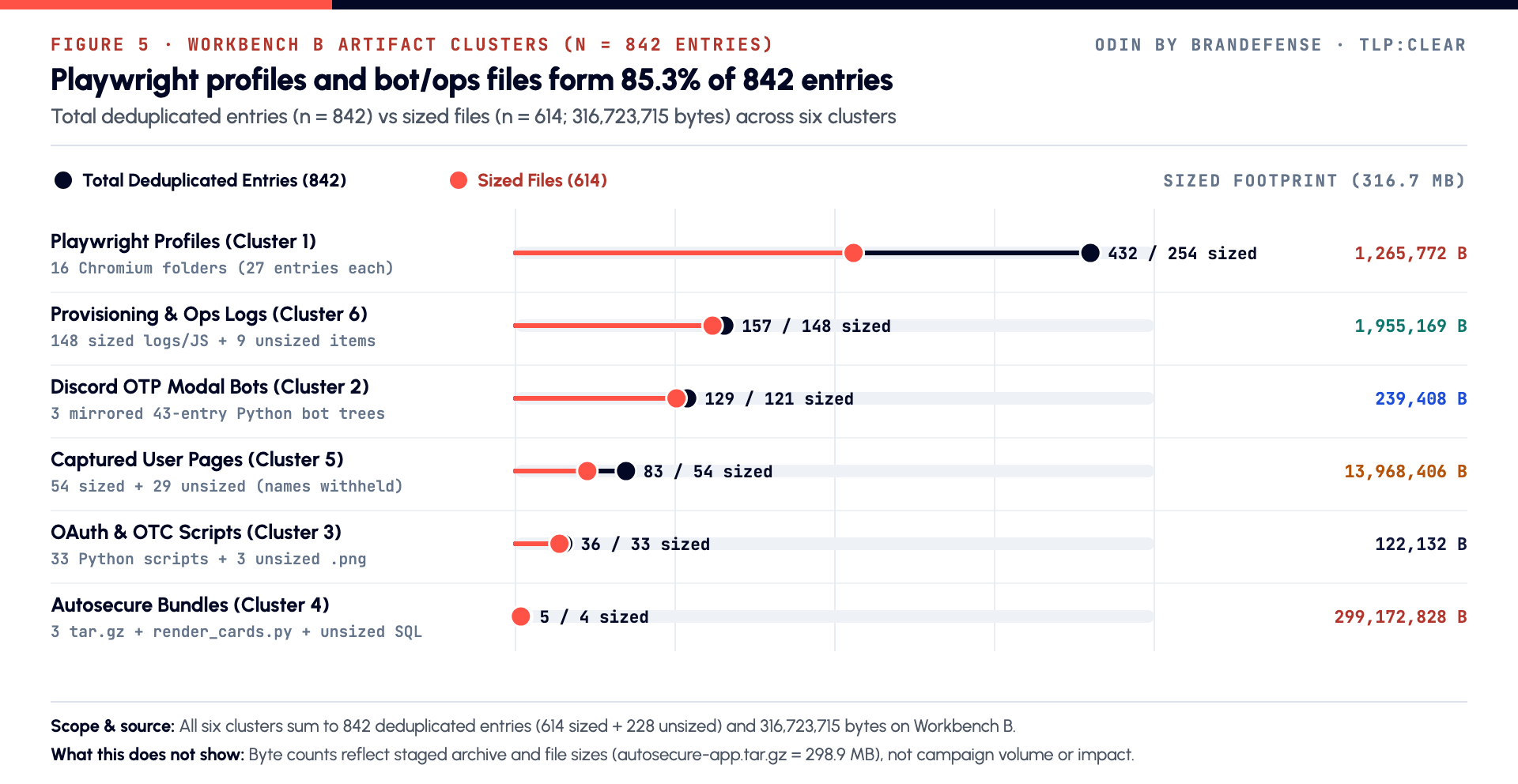
First seen on 13 November 2026 and recorded on 19-20 November 2026, Workbench B ran an open HTTP index on TCP 8899 of a Germany VPS. Its 842 deduplicated entries split into 614 sized files (316,723,715 bytes) and 228 unsized items.
Three workspace zones hold all 842 entries. Sixteen Playwright browser folders hold 432 entries (1,265,772 B). Root archives, scripts, and logs hold 281 entries (315,218,535 B), and three Discord bot trees hold 129 entries (239,408 B).
Six functional clusters divide those same 842 entries cleanly. Playwright folders (432), setup and ops logs (157), and Discord OTP bots (129) make up 718 of the 842 entries (85.3%).
Cluster on Workbench B (TCP 8899) | Entries | Share (%) | Sized | Unsized | Sized bytes | Staged examples (Cluster 5 names withheld) |
|---|---|---|---|---|---|---|
| Playwright Session Profiles | 432 | 51.3% | 254 | 178 | 1,265,772 | 16 playwright_chromiumdev_profile-* folders (27 items each). |
| Setup & Ops Logs | 157 | 18.6% | 148 | 9 | 1,955,169 | admin_check.js (43,943 B), provision.log (26,735 B), smoke.sh (2,617 B). |
| Discord OTP Modal Bots | 129 | 15.3% | 121 | 8 | 239,408 | 3 43-item trees (Minecraft-Simple-Autosecure, template-otp, template_ref): views/otp.py (15,571 B). |
| Captured User Pages (Withheld) | 83 | 9.9% | 54 | 29 | 13,968,406 | Filenames withheld (0 names or handles published). |
| OAuth & OTC Scripts | 36 | 4.3% | 33 | 3 | 122,132 | 27 probe_*.py files, ms_probe.py (2,831 B), 5 test_*/e2e* .py files, and 3 unsized .png items. |
Core Autosecure Bundles | 5 | 0.6% | 4 | 1 | 299,172,828 | autosecure-app.tar.gz (298,924,100 B), autosecure-src.tar.gz (242,567 B), render_cards.py (5,871 B). |
| Total | 842 | 100.0% | 614 | 228 | 316,723,715 | Recorded 19-20 November 2026; host IP withheld. |
Inside the 36-entry OAuth cluster, 33 Python scripts test login[.]live[.]com login and reset steps. Files include probe_flowtoken_cookie.py (6,835 B), probe_signup_otc.py (5,484 B), and probe_otc_altemail.py (2,915 B). Other scripts include probe_full_fingerprint.py (6,779 B) and probe_blocked_account.py (5,880 B).
Those scripts test sFT flow tokens and one-time-code submission. Meanwhile, 16 playwright_chromiumdev_profile-* folders keep Local Storage/leveldb and shared_proto_db state on disk. Staged files on Workbench B show operator prep rather than live victim impact, and all 83 user files (13,968,406 B) stay withheld.
Why do both tracks bypass six-digit OTP assumptions?
Both approaches go well past basic credential stuffing by targeting token grants and login state directly:
- Entra ROPC skips user prompts. App-only user creation paired with
ROPC(grant_type=password) mints user tokens in directPOSTcalls without touching staff phones. - Discord modals relay six-digit codes live. Email and app codes lack domain binding, so a code typed into
views/otp.pyormodal_one.py(12,384 B) can be replayed right away. - Playwright folders save browser state. Storing
LevelDBandShared Dictionary/db(45,056 B) across 16 headless Chromium folders keeps login state alive during recovery edits.
What should identity, cloud, and SOC teams do first?
Defenders can close both cloud app-role and OTP-relay gaps in three direct steps:
- Retire
full_access_as_appand preventROPC. Move Exchange apps to scoped Exchange RBAC and block legacy authentication in Conditional Access. Require MFA for all users, including newly created accounts, on the relevant resources soROPCcannot complete. Restrict workload tokens by IP and cert, and run our 10-minute Sentinel KQL join plus Sigma Rule 1. - Require
FIDO2/WebAuthnpasskeys. Replace SMS, email codes, and six-digit app codes on key portals with domain-boundFIDO2keys or passkeys. Require a freshFIDO2check before any backup-email change. - Gate cloud panels and block
TCP 8899egress. Scan cloud VPCs for openARTEX(cd3ebd16437d6d3963592f7365dd3980) andCyberStrikeAIpanels. Usesid:9572001andsid:9572003to alert when internal clients receive external console banners. Block unauthorizedTCP 8899egress in proxy policy;sid:9572005-9572006 alert on that traffic.sid:9572007alerts on bot-directory fetches on any port.
What is…?
Short explanations of the tools and families named in this study.
What is ARTEX?
ARTEX is an autonomous red-team console that chains AI agents and security tools. Operators fork and rebrand it; its default listener port is 8787.
More about ARTEXAI offensive toolWhat is CyberStrikeAI?
CyberStrikeAI is a public AI-driven offensive security platform. It spreads its operator interface, API and agent listener across several ports on one host and exposes tools through MCP.
More about CyberStrikeAIFrequently asked questions
How do broad Entra app roles allow five-minute ROPC token minting?
On 20 November 2026, Abnormal Security shared findings from a breach in a U.S. financial-services Microsoft Entra tenant. An operator abused an Entra app holding app-only user-creation rights (User.ReadWrite.All) and the legacy Exchange Online full_access_as_app role. Unless replaced by scoped Exchange RBAC, full_access_as_app opens every mailbox in the tenant without a signed-in user.
What did Workbench B's 842 entries show about OTP Autosecure kits?
First seen on 13 November 2026 and recorded on 19-20 November 2026, Workbench B ran an open HTTP index on TCP 8899 of a Germany VPS. Its 842 deduplicated entries split into 614 sized files (316,723,715 bytes) and 228 unsized items.
Why do both tracks bypass six-digit OTP assumptions?
Both approaches go well past basic credential stuffing by targeting token grants and login state directly:
What should identity, cloud, and SOC teams do first?
Defenders can close both cloud app-role and OTP-relay gaps in three direct steps: