
Key takeaways
- Workbench A on a China-hosted VPS (TCP 8000) reported 2,105 files on 26 November 2026 and yielded 1,180 deduplicated entries (816 sized = 51.24 MB).
- Listeners logged TCP and LDAP callbacks within 13 seconds on 16 November (TCP 1099/1389/8888) and hello-test-13890 on 18 November (10990/13890/13891/18888).
- Seeyon OA spraying logged 445 invalid main.do attempts when verifyCode='false', while 519 REST probe lines received HTTP 200 and state 2003 warnings.
- Scripts in wb/ and wb2/ (245 entries) pulled RAR and ZIP backups across 21 subdomains, while poll.log recorded 9,363 refused SSRF polls.
- Enforce OA MFA and server-side CAPTCHA lockouts, delete RAR/ZIP backups from webroots, upgrade Log4j2 (>= 2.17.1), and block direct JVM egress.
An open TCP 8000 directory on a China-hosted server paired seven-port JNDI callback logs with Seeyon OA password-spraying scripts, web-backup harvesters, and minute-interval SSRF pollers. Odin by Brandefense analyzed 1,180 deduplicated entries from this adversary staging server (Workbench A) recorded across 19-26 November 2026.
Stored scripts and logs target higher-education and provincial education portals. Zero IPv4 addresses and zero file SHA-256 digests are therefore published. Workbench A's IPv4 address, all target IPs, portal domains, victim-named archive filenames, and cyber-range names are also withheld.
How Were the 1,180 Entries Organized Across Workbench A?
When last recorded on 26 November 2026 at 04:46 UTC, the live TCP 8000 directory header reported 2,105 files. The reviewed inventory contains 1,180 distinct entries: 816 sized files (51,239,679 bytes, or 51.24 MB) and 364 unsized entries.
Analysts inspected 59 stored files directly in content, while the remaining 1,121 entries were analyzed from paths, byte sizes, and extensions. Web teams rely on external attack surface management to spot forgotten backup archives and exposed OA login forms across secondary subdomains. Detection engineers also pair cyber threat intelligence with firewall telemetry to connect multi-port JNDI callback listeners and portal-spraying kits.
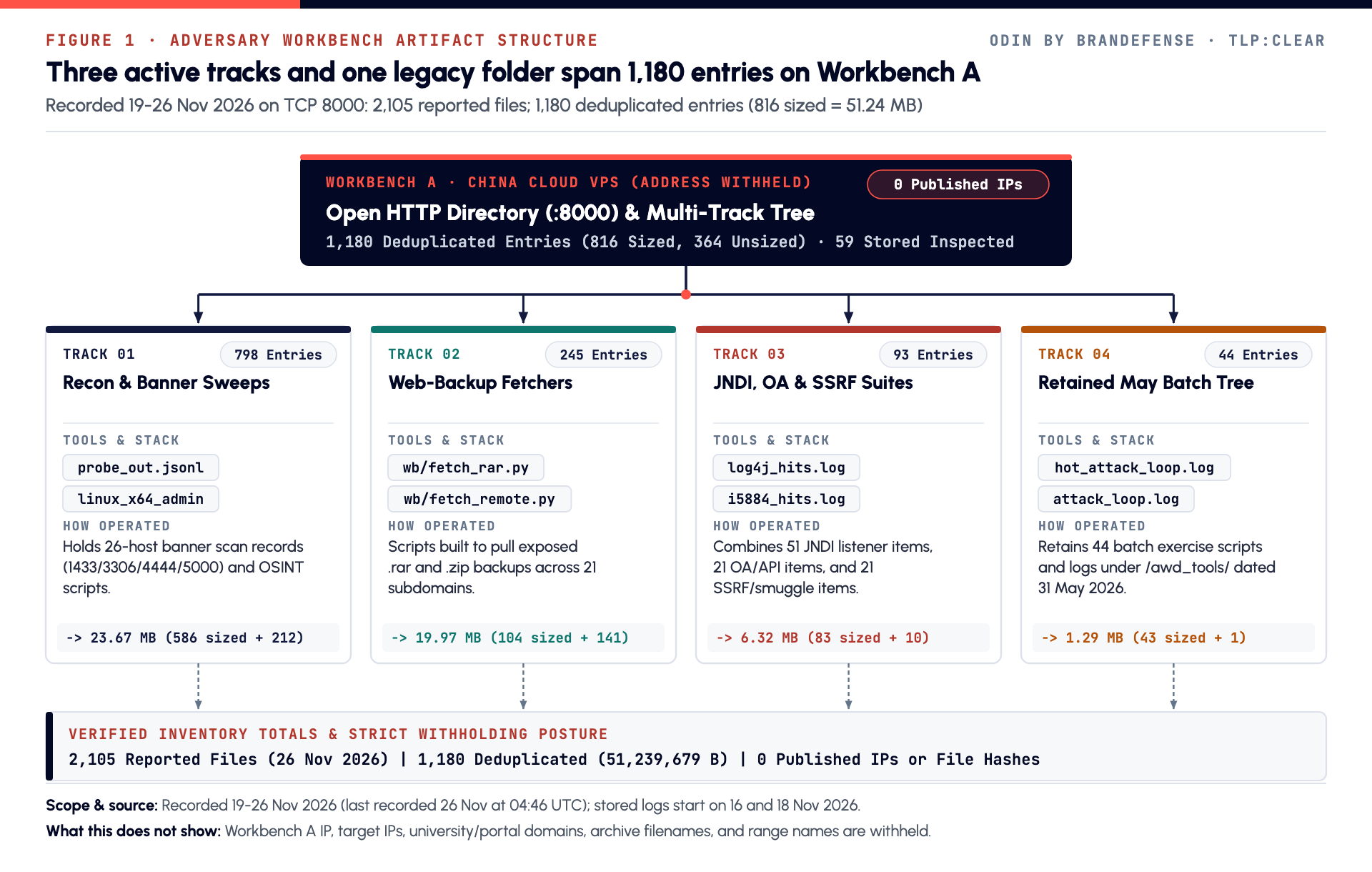
Across directory zones, 588 entries (49.8%) sit in /iNNNN/ issue and root listener trees, 245 (20.8%) sit in wb/ and wb2/, and 184 (15.6%) sit in (root). Another 94 entries (8.0%) sit in /osint/, 44 (3.7%) sit in /awd_tools/, and 25 (2.1%) sit in OA, API, and SSRF folders.
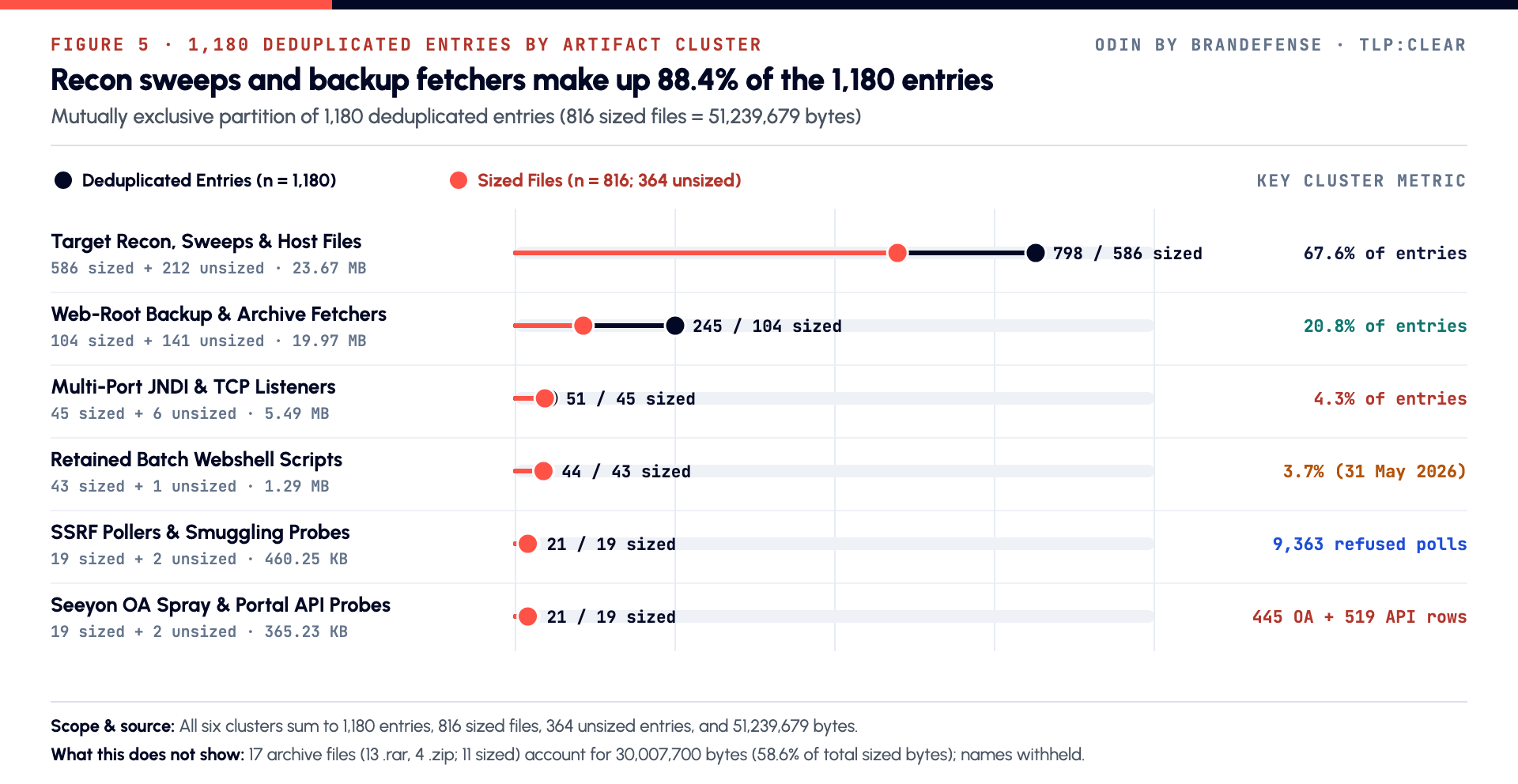
By file kind, text and log captures lead by count (650 entries, 55.1%), followed by 285 scripts (24.2%) and 139 .dbf database files (11.8%). However, just 17 .rar and .zip archives (11 sized files) account for 30,007,700 bytes (58.6% of all sized bytes).
| Artifact cluster in 1,180-entry inventory | Entries | Sized bytes | Verified Workbench A artifacts |
|---|---|---|---|
| Target Recon, Subdomain Sweeps & Host Telemetry | 798 | 23,666,871 | i6530/probe_out.jsonl (26 hosts on 1433/3306/4444/5000), /linux_x64_admin (2.50 MB), /osint/ (94), 139 .dbf items, and withheld snapshots. |
| Automated Web-Root Backup & Archive Harvesters | 245 | 19,968,187 | wb/fetch_rar.py, wb/fetch_remote.py, wb2/fetch2.py, _log.jsonl (57,362 B), and run.log across 21 subdomains (names withheld). |
| Multi-Port JNDI, LDAP & TCP Callback Listeners | 51 | 5,490,096 | log4j_hits.log & oob_out.log (1,363 lines each on 1099/1389/8888), i5884_hits.log (747 lines on 10990–18888), and ldap_responder.py. |
| Legacy Batch Webshell & Persistence Loop Scripts | 44 | 1,289,047 | 44 /awd_tools/ entries dated 31 May 2026, including hot_attack_loop.log (565,011 B) and attack_loop.log (330,090 B). |
| SSRF Pollers, Request-Smuggling & WebVPN Probes | 21 | 460,248 | ssrf782/poll.log (9,363 refused lines), ssrf_test.sh, watchdog.sh, i1616_smuggle*.py, and i8059/probe_smug.py. |
| Seeyon OA Credential Spraying & Portal API Probes | 21 | 365,230 | spray_oa3.jsonl (445 main.do records; 0 valid), spray_oa3.py, puredes.py, and pjxt/probe1.tsv (519 API lines). |
What Did the JNDI Callback Logs, Seeyon OA Spraying, and API Sweeps Show?
Two mid-November listener runs confirm live out-of-band callback reachability from a withheld target network to Workbench A. Started on 16 November 2026 at 15:26:46 UTC (PID 1138045), log4j_hits.log and oob_out.log measure 1,275,815 bytes (1,363 lines) each. Both bound TCP 1099, 1389, and 8888 and logged inbound TCP and LDAP hits within 13 seconds of startup.
On 18 November 2026 at 10:47:13 UTC (PID 1355974), i5884_hits.log (112,102 bytes; 747 lines) shifted to TCP 10990, 13890, 13891, and 18888. It logged inbound connections from the same target network, including the 16-byte verification payload hello-test-13890.
NVD describes CVE-2021-44228 in Log4j2 2.0-beta9 through 2.15.0, excluding 2.12.2, 2.12.3, and 2.3.1. Version 2.15.0 disabled lookup substitution by default; 2.16.0 removed the vulnerable functionality. Here, callback logs confirm outbound network reachability, but they do not establish remote class loading or target shell creation.
Separately, oa_spray/spray_oa3.py (6,259 B) and puredes.py (4,406 B) tested '1234567890' and '111111' when verifyCode='false'. All 445 sampled records against a university's /seeyon/main.do login form in spray_oa3.jsonl (85,057 B) returned 76,241–76,242-byte invalid responses (0 valid logins). File pjxt/probe1.tsv (79,727 B; 519 lines) swept /api/v2/AIReport/reports and /api/v2/article/articles, logging HTTP 200 JSON replies and state 2003 warnings.
How Did the Backup Fetchers, SSRF Pollers, and Retained Scripts Operate?
Three additional sections complete the remaining 1,108 entries on Workbench A:
- Multi-subdomain RAR and ZIP backup harvesting (245 entries). Inside
wb/andwb2/,fetch_rar.py(2,522 B),fetch_remote.py(3,998 B), andfetch2.py(5,064 B) ran automated archive sweeps. Together they pulled exposed.rarand.zipweb-root backups across 21 education portal subdomains (all names withheld). - Minute-cadence SSRF polling, request smuggling, and recon sweeps (819 entries across two clusters). In the 21-entry SSRF cluster,
watchdog.shandssrf_test.shdrove 9,363 minute-interval polls inssrf782/poll.log(403,032 B) from16 November 2026. That loop tested server-side request forgery exposure and logged repeated connection-refused errors beside stagedCL-TEscripts (i1616_smuggle3.py,i1616_smuggle.py,probe_smug.py). In the 798-entry recon cluster,i6530/probe_out.jsonl(240,202 B) checked 26 hosts acrossTCP 1433, 3306, 4444, 5000. - Retained May batch tools (44 entries). Folder
/awd_tools/holdshot_attack_loop.log(565,011 B) andattack_loop.log(330,090 B). All 44 batch scripts and logs date to31 May 2026cyber-range exercises retained on the host.
What Should OA, Java, and Edge Gateway Teams Do First?
Portal, Java, and network defenders can close these exposure paths in priority order:
- Enforce server-side CAPTCHA lockouts and MFA on Seeyon OA and REST APIs. Patch Seeyon OA, enforce unconditional server-side rate limits and MFA on
/seeyon/main.do, and tighten token checks on/api/v2/*routes. - Purge
.rarand.zipbackups from webroots across every subdomain. Delete compressed site backups and.dbffiles from public web directories, and block archive suffixes at reverse proxies. - Upgrade Log4j2, block high-port JVM egress, and normalize proxy headers. Keep Log4j2 on
2.17.1or later and block direct outbound TCP from JVM subnets (1099, 1389, 8888, 10990–18888). Reject dualContent-LengthandTransfer-Encodingheaders at edge proxies, and deploy Suricatasid:9570001–9570007.
What is…?
Short explanations of the tools and families named in this study.
What is JNDI injection?
JNDI injection makes a Java application look up a remote object, usually over LDAP or RMI, and load attacker code. Log4Shell is the best-known example.
More about JNDI injectionVulnerabilityWhat is Log4Shell?
Log4Shell (CVE-2021-44228) is a remote code execution flaw in Apache Log4j 2 triggered by JNDI lookups in logged strings.
More about Log4ShellFrequently asked questions
How Were the 1,180 Entries Organized Across Workbench A?
When last recorded on 26 November 2026 at 04:46 UTC, the live TCP 8000 directory header reported 2,105 files. The reviewed inventory contains 1,180 distinct entries: 816 sized files (51,239,679 bytes, or 51.24 MB) and 364 unsized entries.
What Did the JNDI Callback Logs, Seeyon OA Spraying, and API Sweeps Show?
Two mid-November listener runs confirm live out-of-band callback reachability from a withheld target network to Workbench A. Started on 16 November 2026 at 15:26:46 UTC (PID 1138045), log4j_hits.log and oob_out.log measure 1,275,815 bytes (1,363 lines) each. Both bound TCP 1099, 1389, and 8888 and logged inbound TCP and LDAP hits within 13 seconds of startup.
How Did the Backup Fetchers, SSRF Pollers, and Retained Scripts Operate?
Three additional sections complete the remaining 1,108 entries on Workbench A:
What Should OA, Java, and Edge Gateway Teams Do First?
Portal, Java, and network defenders can close these exposure paths in priority order: