
1. Executive Summary
In short
An open TCP 8000 directory on a China-hosted adversary workbench recorded on 19-26 November 2026 reported 2,105 files and yielded 1,180 deduplicated entries (51.24 MB). Stored logs record seven-port JNDI and TCP callbacks, 445 invalid Seeyon OA login attempts, 21-subdomain backup sweeps, and 9,363 refused SSRF polls. Enforce OA MFA, delete webroot backups, and block JVM internet egress.
Enterprise office-automation portals and education gateways often share edge networks with Java backend services and legacy web roots. Disabled login challenges or forgotten site archives let operators combine credential spraying, naming callbacks, backup harvesting, and proxy polling on one host. This adversary workbench groups active activity into three tracks and shows the older batch-script folder separately.
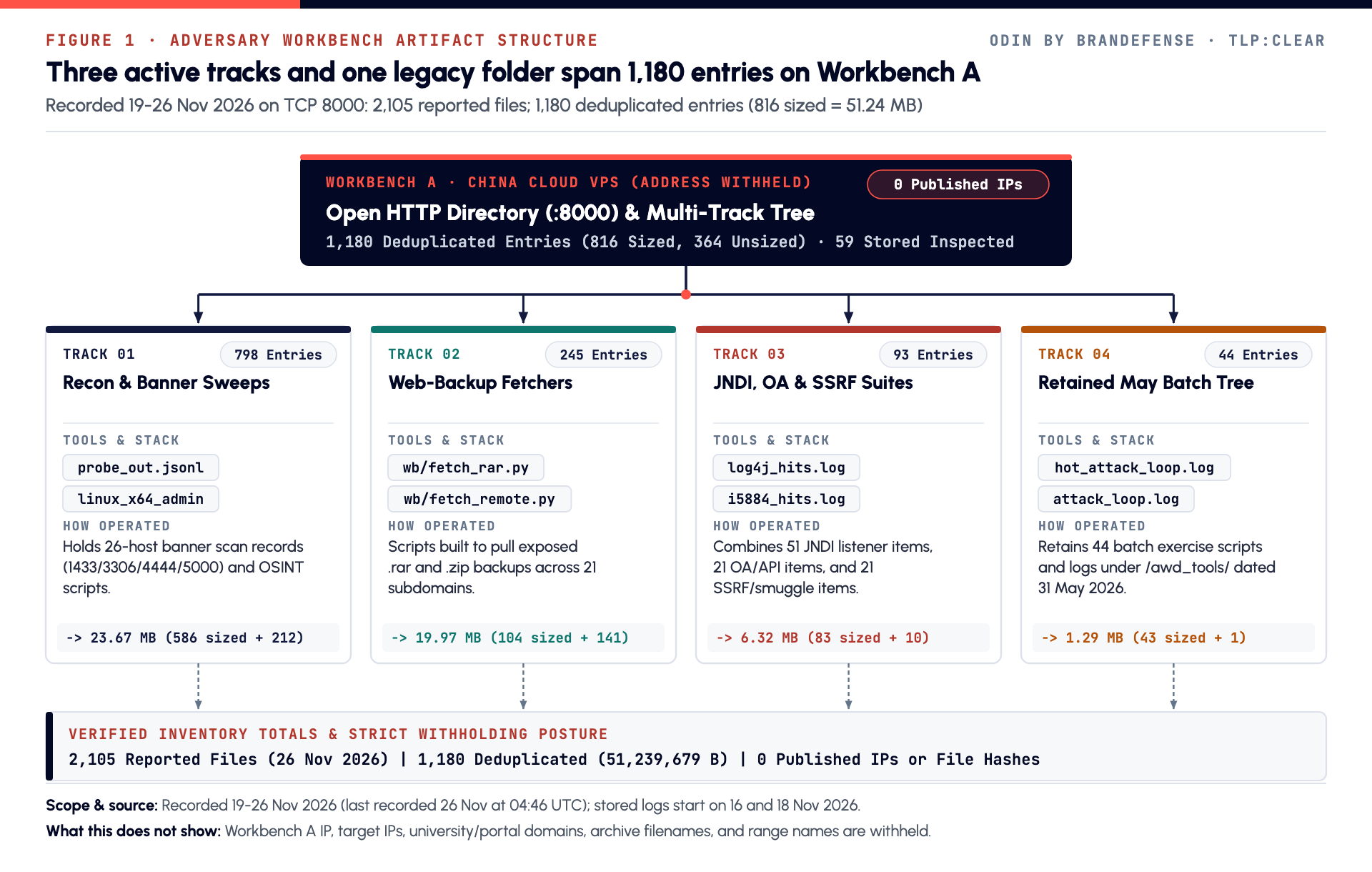
Between 19 and 26 November 2026, Odin by Brandefense analyzed an open HTTP directory on TCP port 8000 of a China-hosted VPS (Workbench A). When last recorded on 26 November 2026 at 04:46 UTC, that directory reported 2,105 files.
The reviewed inventory contains 1,180 distinct entries across 816 sized files totaling 51,239,679 bytes (51.24 megabytes) and 364 unsized entries. Analysts inspected 59 stored files directly in content.
Stored logs and target lists reference higher-education and government portals. Odin by Brandefense therefore publishes zero IPv4 addresses and zero file SHA-256 digests. Workbench A's address, target addresses, portal domains, archive names, and range names are withheld.
Seven listener ports logged live target callbacks on 16 and 18 November 2026.
Logs log4j_hits.log and oob_out.log (1,363 lines each) bound TCP 1099, 1389, and 8888 on 16 November and logged hits within 13 seconds. On 18 November, i5884_hits.log (747 lines) bound TCP 10990, 13890, 13891, and 18888, logging hello-test-13890 (target RCE unverified).
Seeyon OA password spraying failed across 445 records while REST probes returned HTTP 200.
Scripts spray_oa3.py and puredes.py tested '1234567890' and '111111' on /seeyon/main.do when verifyCode='false', logging 0 valid logins. Separately, pjxt/probe1.tsv (519 lines) hit /api/v2/AIReport/reports and /api/v2/article/articles, receiving HTTP 200 and state 2003 warnings.
Automated harvesters swept .rar and .zip backups across 21 portal subdomains.
Folders wb/ and wb2/ (245 entries) pair fetch_rar.py, fetch_remote.py, and fetch2.py to pull exposed webroot archives. Across the full workbench, 17 archive entries account for 30.01 megabytes (58.6% of sized bytes).
Minute-interval SSRF pollers, port sweeps, and 31 May scripts complete Workbench A.
Log ssrf782/poll.log (9,363 lines) polled an endpoint every minute from 16 November and logged repeated connection-refused errors. Scan file i6530/probe_out.jsonl checked 26 hosts on TCP 1433, 3306, 4444, 5000, while /awd_tools/ holds 44 files dated 31 May 2026.
Three Decisions for Enterprise Security Leaders
- Enforce server-side CAPTCHA lockouts and MFA on Seeyon OA and REST APIs. Never rely on client-visible CAPTCHA flags, block weak default passwords, and validate bearer tokens strictly on
/api/v2/*routes. - Delete compressed backup archives from webroots and block archive URLs. Purge
.rar,.zip, and.dbffiles across all portal subdomains and block archive extensions at reverse proxies. - Upgrade Log4j2, block outbound JVM callback ports, and normalize proxy headers. Keep Log4j2 on
2.17.1or later, enforce default-deny JVM egress rules, and reject dualContent-LengthandTransfer-Encodingheaders.
The Study in Numbers
| Number | What it is |
|---|---|
| 2,105 | Files reported by the open TCP 8000 directory on Workbench A when last recorded on 26 November 2026 at 04:46 UTC |
| 1,180 | Distinct reviewed entries across six workspace zones (816 sized files and 364 unsized entries) |
| 816 | Sized files totaling 51,239,679 bytes (51.24 MB), including 17 archive entries (11 sized = 30,007,700 bytes, 58.6% of sized bytes) |
| 59 | Stored files inspected directly in content (1,121 entries analyzed from paths, byte sizes, and extensions) |
| 21 | Provincial education portal subdomains swept by wb/ and wb2/ web-root archive harvesters (245 entries; subdomain names withheld) |
2. Workbench Architecture, Six-Zone Reconciliation, and Callback Ports
Workbench A ran on a China-hosted cloud virtual private server (IPv4 address withheld) exposing an open HTTP directory on TCP 8000. Odin by Brandefense recorded the server across 19-26 November 2026, with the final capture on 26 November 2026 at 04:46 UTC. Platform defenders use external attack surface management to find forgotten subdomain backup archives and exposed OA login pages early.
SOC analysts also apply cyber threat intelligence to connect multi-port JNDI callback infrastructure with portal spraying and proxy probes. Figure 1 maps the three active tracks and the retained May folder on Workbench A.
Reconciling the 2,105 Reported Files and 1,180 Deduplicated Entries
On 26 November 2026 at 04:46 UTC, the TCP 8000 directory listing reported 2,105 files. This report covers 1,180 distinct entries; it does not characterize the remainder of the server’s reported files.
Those 1,180 entries comprise 816 sized files totaling 51,239,679 bytes (51.24 MB) and 364 unsized entries. Analysts inspected 59 stored files in content, while the other 1,121 entries are analyzed from paths, byte sizes, and extensions.
Evidence across the 59 stored files consistently establishes Workbench A as an adversary staging workbench. It combines live external callback logs, university OA password spraying, portal API probing, 21-subdomain backup harvesting, and minute-interval SSRF polling. All server and target IPs, portal domains, victim-named archives, and file hashes are withheld.
| Workspace zone | Top-level dirs | Deduplicated entries | Share (%) | Sized files | Unsized entries | Sized bytes | Operational role |
|---|---|---|---|---|---|---|---|
Issue-Numbered Exploit, JNDI & Probe Trees (/iNNNN/ & Root Listeners) | 1+ | 588 | 49.8% | 469 | 119 | 9,981,449 | Holds JNDI logs (log4j_hits.log, oob_out.log, i5884_hits.log), ldap_responder.py, probe_out.jsonl, and smuggling scripts. |
Web-Archive Harvester Trees (/wb/ & /wb2/) | 2 | 245 | 20.8% | 104 | 141 | 19,968,187 | Holds fetch_rar.py, fetch_remote.py, fetch2.py, JSONL logs, and batch lists across 21 subdomains (names withheld). |
| Root Controller Binaries, Telemetry & Environment Configs | 0 (root) | 184 | 15.6% | 155 | 29 | 19,097,216 | Holds /linux_x64_admin (2.50 MB), RPM shards, log4j_payload_sent.json, spray_11457.log, and withheld snapshots. |
External OSINT & Code-Search Scripts (/osint/) | 1 | 94 | 8.0% | 22 | 72 | 128,088 | Holds 22 sized OSINT and code-search scripts/outputs (128,088 B) and 72 unsized items. |
Legacy Batch-Exploit Harness Folder (/awd_tools/) | 1 | 44 | 3.7% | 43 | 1 | 1,289,047 | Holds 44 entries dated 31 May 2026 (hot_attack_loop.log, attack_loop.log, and batch scripts). |
| OA Password-Spray, Portal API & SSRF Polling Modules | 3 | 25 | 2.1% | 23 | 2 | 775,692 | Holds oa_spray/ (spray_oa3.jsonl), pjxt/ (probe1.tsv), and ssrf782/ (poll.log 403,032 B). |
| Combined deduplicated inventory | 8+ trees + root | 1,180 | 100.0% | 816 | 364 | 51,239,679 | Reported 2,105 files on TCP 8000 (26 Nov 2026); 59 stored files inspected. |
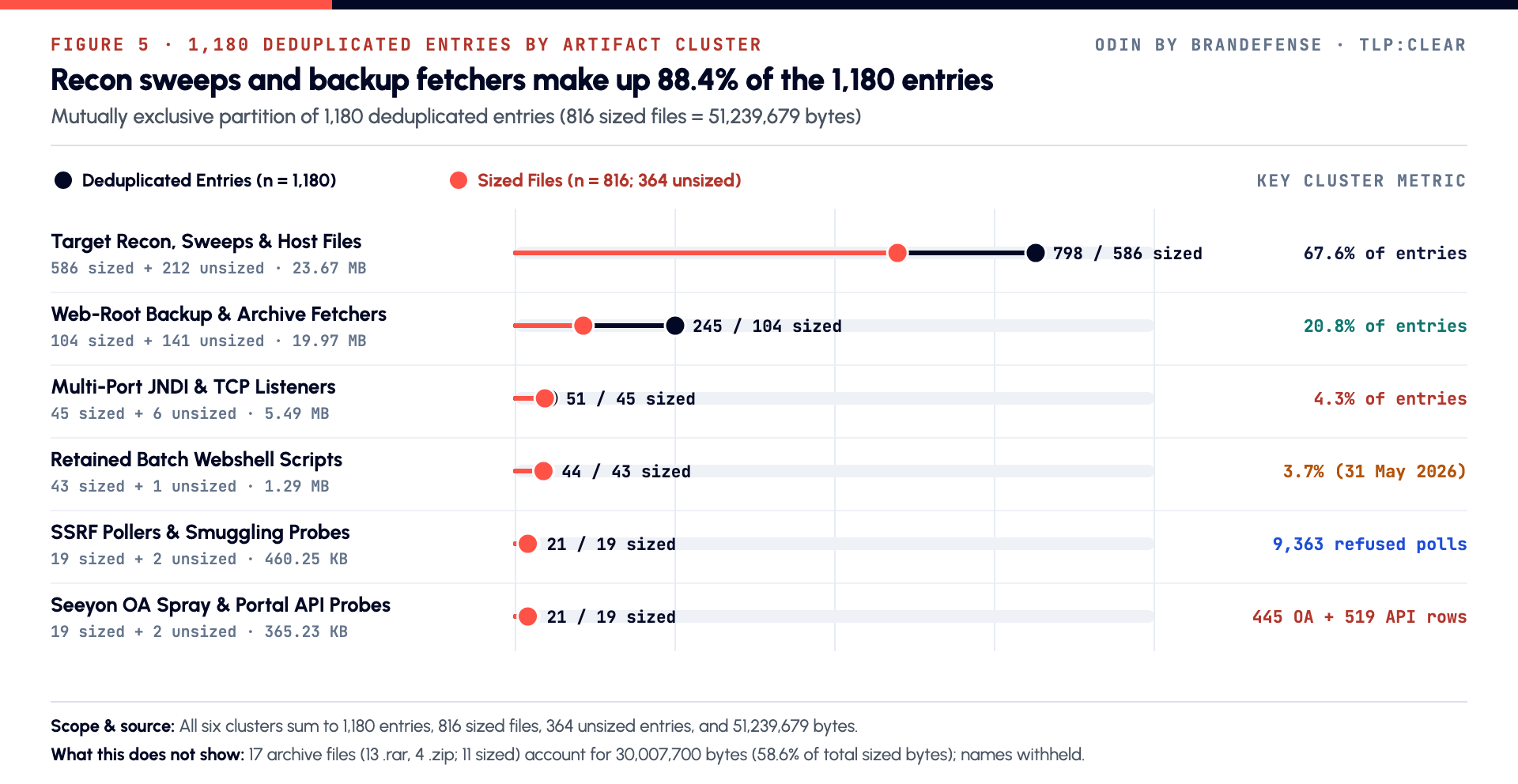
A second breakdown reconciles the same 1,180 entries (816 sized, 364 unsized, 51,239,679 bytes) across seven file types. Text logs and structured captures lead by count (650, 55.1%), whereas 17 archives make up 58.6% of sized bytes (30.01 MB).
Artifact class (kind) | Deduplicated entries | Share (%) | Sized files | Unsized entries | Sized bytes | Verified extensions & contents |
|---|---|---|---|---|---|---|
Logs, captures & structured text (text) | 650 | 55.1% | 537 | 113 | 10,604,554 | 149 .txt, 79 .body, 70 .html, 61 .hdr, 58 .bin, 51 .log, 36 .json, 22 .out, 22 .xml, 18 none, and 84 JSONL/TSV items. |
Python, shell & web scripts (script) | 285 | 24.2% | 232 | 53 | 7,137,591 | 155 .py, 86 .sh, 12 .aspx, 11 .js, 11 .asp, 8 .php, and 2 .jsp files. |
Database table files (data) | 139 | 11.8% | 7 | 132 | 148,362 | 139 .dbf database table items (7 sized = 148,362 B + 132 unsized). |
Error traces, headers & DB shards (other) | 84 | 7.1% | 24 | 60 | 796,183 | 34 .err, 21 extensionless, 12 .hdr, 7 .body, 2 .css, 2 .lock, 3 RPM shards, 1 .ser, and 2 misc items. |
RAR & ZIP archives (archive) | 17 | 1.4% | 11 | 6 | 30,007,700 | 13 .rar and 4 .zip archives (11 sized = 30.01 MB + 6 unsized; victim-subdomain filenames withheld). |
Compiled Linux & utility binaries (exe) | 4 | 0.3% | 4 | 0 | 2,542,932 | 4 sized extensionless Linux binaries including /linux_x64_admin (2,495,372 B). |
Binary image/asset payload (image) | 1 | 0.1% | 1 | 0 | 2,357 | 1 sized .bin asset file (2,357 B). |
| Total | 1,180 | 100.0% | 816 | 364 | 51,239,679 | Exact byte-level parity (51.24 MB). |
Figure 5 partitions all 1,180 entries into six mutually exclusive clusters (798 + 245 + 51 + 44 + 21 + 21 = 1,180). Target recon sweeps (798) and web-root archive fetchers (245) account for 88.4% of all entries.
Seven Callback Ports Alongside Open TCP 8000
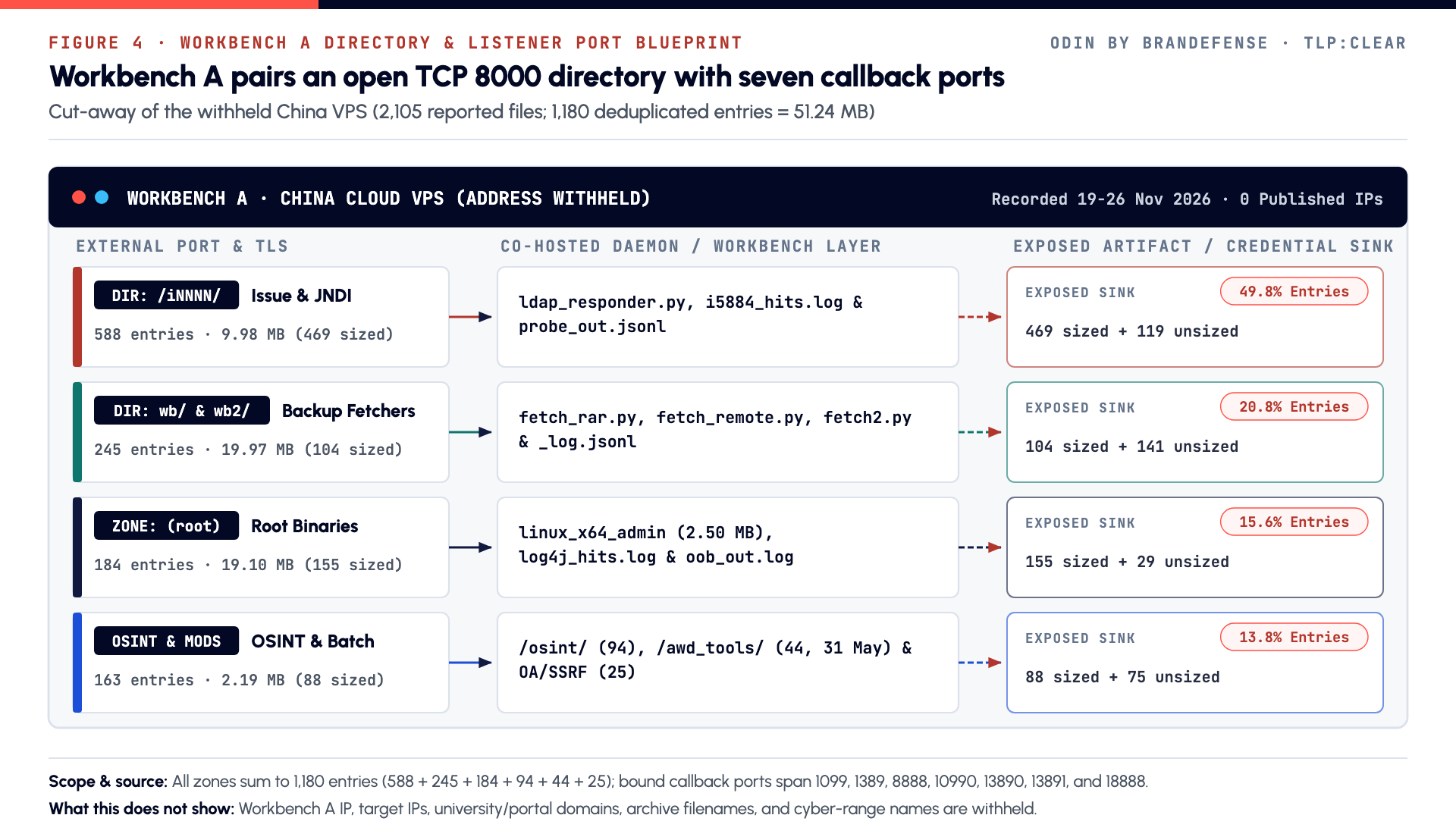
Stored listener logs document seven TCP callback ports alongside the open TCP 8000 HTTP directory on Workbench A:
- Primary callback ports (
TCP 1099, 1389, and 8888). Bound on16 November 2026 at 15:26:46 UTCunderPID 1138045(log4j_hits.logandoob_out.log), logging inbound TCP/LDAP hits within 13 seconds. - Shifted high callback ports (
TCP 10990, 13890, 13891, and 18888). Bound on18 November 2026 at 10:47:13 UTCunderPID 1355974(i5884_hits.log), shifting standard JNDI ports upward and logginghello-test-13890.
3. Seeyon OA Credential Spraying, Portal API Sweeps, and JNDI Callback Logs
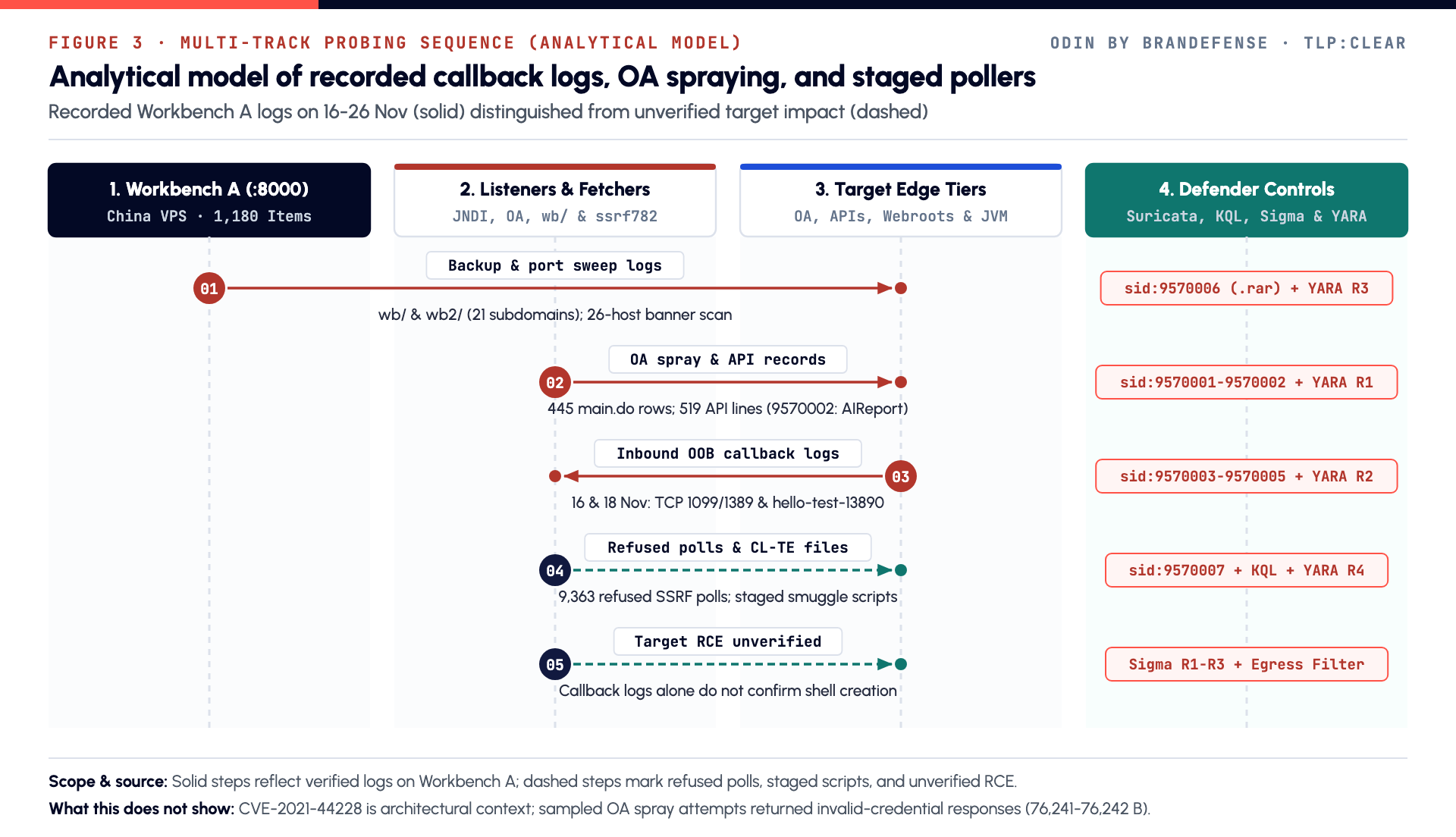
Stored November logs link out-of-band JNDI callback listeners with Seeyon OA password spraying and portal REST enumeration. Figure 3 presents an analytical model distinguishing verified Workbench A log events (solid) from refused SSRF polls, staged smuggling scripts, and unverified target RCE (dashed).
Multi-Port JNDI, LDAP, and Shifted TCP Callback Logs (51 Entries)
Fifty-one entries (45 sized files = 5,490,096 bytes + 6 unsized) capture out-of-band callback listeners ([REF-01], [REF-07]). Root files log4j_hits.log and oob_out.log measure 1,275,815 bytes (1,363 lines) each, beside log4j_payload_sent.json (34,030 B). Both logs started on 16 November 2026 at 15:26:46 UTC (PID 1138045) on TCP 1099, 1389, and 8888. They recorded inbound TCP and LDAP callbacks within 13 seconds from a withheld target IPv4.
Two days later, i5884_hits.log (112,102 bytes; 747 lines) started on 18 November 2026 at 10:47:13 UTC (PID 1355974). It bound TCP 10990, 13890, 13891, and 18888, recording inbound hits including the 16-byte string hello-test-13890. Issue folders add /i8022/ldap_responder.py (6,674 B), /i8022/conn.log (1,381,378 B), /i8022/responder.out (1,380,459 B), and /i1601/lsn.py (2,415 B).
NVD describes CVE-2021-44228 in Apache Log4j2 2.0-beta9 through 2.15.0, excluding 2.12.2, 2.12.3, and 2.3.1 ([REF-01]). Version 2.15.0 disabled lookup substitution by default; 2.16.0 removed the vulnerable functionality ([REF-01], [REF-03]). Here, callback logs confirm outbound network reachability from the target network, while remote class loading and target command execution remain unverified.
Seeyon OA Credential Spraying and Portal REST API Probes (21 Entries)
Twenty-one entries (19 sized files = 365,230 bytes + 2 unsized) target higher-education OA and portal endpoints ([REF-06], [REF-10]). Inside oa_spray/, spray_oa3.py (6,259 B) and puredes.py (4,406 B) sit beside spray_11457.log (17,584 B). Output file spray_oa3.jsonl measures 85,057 bytes across 445 JSONL records.
Those scripts target a regional university's Seeyon OA /seeyon/main.do login endpoint (domain withheld), testing '1234567890' and '111111' when verifyCode='false'. Every sampled attempt returned invalid-credential responses of 76,241 to 76,242 bytes, confirming 0 valid logins in sampled records.
Inside pjxt/, probe1.tsv (79,727 bytes; 519 lines) sits with probe_postall.tsv (51,745 B) and api_paths.txt (17,946 B). Companion files include chunks.tsv (17,029 B), dl.log (15,242 B), and a 32,309-byte withheld URL list. File probe1.tsv sweeps /api/v2/AIReport/reports and /api/v2/article/articles, logging HTTP 200 JSON payloads and state 2003 concurrent-session warnings.
4. Web-Root Backup Harvesters, SSRF Pollers, and Retained Batch Scripts
Workbench A also runs multi-subdomain web-backup harvesters, minute-interval server-side request forgery pollers, HTTP request-smuggling scripts, and multi-port banner scans. Figure 4 shows the directory layout and bound listener ports on the China VPS.
Automated Web-Root Archive Harvesters (245 Entries)
Folders wb/ and wb2/ hold 245 entries (104 sized files = 19,968,187 bytes + 141 unsized; [REF-08]). Harvester scripts include wb/fetch_rar.py (2,522 B), wb/fetch_remote.py (3,998 B), and wb2/fetch2.py (5,064 B). Run outputs sit in wb2/out/_log.jsonl (57,362 B), _log_prev.jsonl (18,420 B), and wb2/run.log (11,696 B). Three withheld JSON batch lists measure 28,196 B, 16,057 B, and 10,142 B.
Together they pull exposed .rar and .zip web-root backups across 21 subdomains of a provincial education portal (all subdomain and archive names withheld). Across the entire 1,180-entry inventory, 17 archive items (13 .rar, 4 .zip; 11 sized) total 30,007,700 bytes (58.6% of sized bytes).
SSRF Pollers, Request Smuggling, Banner Sweeps, and 31 May Scripts (863 Entries)
Twenty-one entries (19 sized = 460,248 B + 2 unsized) form the SSRF and proxy-smuggling cluster ([REF-04], [REF-05]). Wrappers watchdog.sh and ssrf_test.sh (3,236 B) pair with ssrf782/poll.log (403,032 bytes; 9,363 lines) and http.log (9,563 B). Starting 16 November 2026, that loop polled a withheld endpoint every minute and logged repeated connection-refused states.
Sibling scripts i1616_smuggle3.py (12,480 B), i1616_smuggle.py (7,295 B), and i8059/probe_smug.py (6,122 B) stage CL-TE smuggling probes (target bypass unverified). Companion files i350/rawhttp.py (2,697 B) and i8059/webvpn_443.json (6,842 B) complete the cluster.
Meanwhile, 798 recon entries (586 sized = 23,666,871 B + 212 unsized) include i6530/probe_out.jsonl (240,202 B). That file records 26 host records scanned across TCP 1433, 3306, 4444, and 5000. The same cluster holds /linux_x64_admin (2,495,372 B), /osint/ (94 entries = 128,088 B), and 139 .dbf entries (148,362 B). It also holds RPM shards (286,719 B and 266,239 B) and withheld snapshots.
Finally, /awd_tools/ holds 44 entries (43 sized = 1,289,047 B + 1 unsized), led by hot_attack_loop.log (565,011 B) and attack_loop.log (330,090 B). It also holds known_path_attack_loop.log (200,616 B), exploit_persist_seed_batch.py (10,865 B), and exploit_php_webshell_batch.py (10,160 B). All 44 entries date to 31 May 2026 cyber-range batch exercises retained on the server, and Figure 2 maps all 1,180 entries to detections.
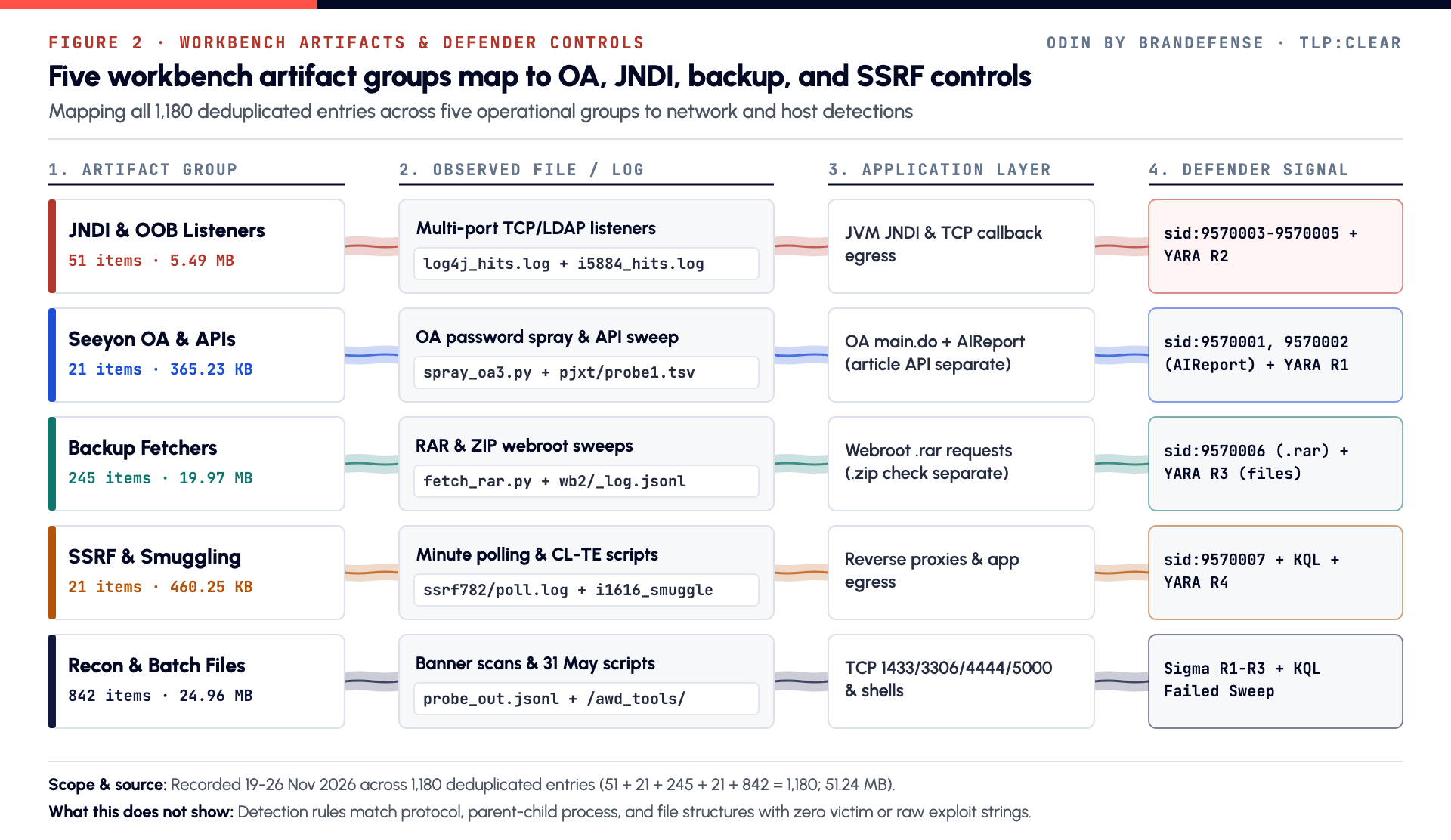
5. Enterprise OA, JVM, Webroot, and Proxy Exposure Analysis
Platform and security teams should verify four defensive controls mapped directly to Workbench A's artifacts:
| Exposure layer | Observed Workbench A evidence | Control to verify | Operational risk |
|---|---|---|---|
| Seeyon OA & REST API auth | spray_oa3.jsonl (445 /seeyon/main.do records when verifyCode='false'; 0 valid) + pjxt/probe1.tsv (519 lines, state 2003). | Verify whether OA portals enforce unconditional server-side CAPTCHA/lockouts and MFA ([REF-06], [REF-10]) and strict API token checks. | Disabled CAPTCHA challenges let scripts spray weak passwords (1234567890, 111111) without lockouts. |
| JVM JNDI & high-port egress | log4j_hits.log (1,363 lines on 1099/1389/8888) + i5884_hits.log (747 lines on 10990/13890/13891/18888, hello-test-13890). | Verify Log4j2 (>= 2.17.1, [REF-01], [REF-03]) and default-deny firewall rules blocking outbound LDAP, RMI, and high TCP ports from JVM subnets. | Unpatched JNDI sinks with open TCP egress permit external naming lookups and callback verification. |
| Public webroot backup hygiene | wb/ and wb2/ (245 entries; fetch_rar.py, fetch_remote.py) across 21 subdomains; 17 archives = 30.01 MB. | Verify whether deployment scripts delete .rar, .zip, .bak, and .dbf files from webroots and block archive extensions at proxies ([REF-07]). | Exposed webroot backups leak full source trees, DES/JWT keys, and database credentials. |
| Edge proxies & SSRF egress | ssrf782/poll.log (9,363 refused polls), i1616_smuggle*.py, probe_smug.py, and probe_out.jsonl (1433/3306/4444/5000). | Verify whether reverse proxies reject dual Content-Length + Transfer-Encoding headers ([REF-05]) and enforce SSRF allowlists ([REF-04]). | Proxy smuggling or SSRF sinks let external callers probe loopback services and internal SQL databases. |
6. Alternative Hypotheses
| Hypothesis | Evidence for | Evidence against | Assessment |
|---|---|---|---|
Callback logs (log4j_hits.log, i5884_hits.log) confirm target RCE | Logs record inbound hits within 13s on 1099/1389/8888 (16 Nov) and hello-test-13890 on 13890 (18 Nov). | Modern JDKs set trustURLCodebase=false, and TCP/LDAP connection logs do not show remote class loading or shell creation. | Confirmed for OOB reachability only; target RCE unverified. Treat logs as callback reachability, not target RCE. |
Seeyon OA spraying (spray_oa3.jsonl) yielded valid logins | spray_oa3.py and puredes.py logged 445 attempts when verifyCode='false', while probe1.tsv got HTTP 200 JSON replies. | All sampled spray_oa3.jsonl rows returned 76,241–76,242-byte invalid-credential responses, and probe1.tsv hit separate /api/v2/* routes. | Refuted for sampled OA records. Zero valid OA logins appear in sampled spray_oa3.jsonl entries. |
Workbench A is a benign student or cyber-range server | Retains 44 /awd_tools/ flag-loop files dated 31 May 2026 alongside /osint/ scripts. | Active November 2026 trees spray a university's /seeyon/main.do, pull archives across 21 education subdomains, and log live callbacks. | Contradicted. Assessed consistently as an adversary staging workbench retaining older 31 May 2026 files. |
ssrf782/poll.log (9,363 lines) retrieved internal data | watchdog.sh and ssrf_test.sh ran minute-interval polling from 16 November 2026 across 9,363 lines. | Inspected poll.log lines record repeated connection-refused errors rather than internal responses. | Refuted for extraction. Line volume reflects automated watchdog retries against a refused endpoint. |
7. What Defenders Should Do
OA administrators, Java teams, and network defenders should apply five controls in priority order:
- Harden Seeyon OA authentication and REST API tokens (
0–48 Hours). Patch Seeyon OA portals, enforce unconditional server-side CAPTCHA lockouts and MFA regardless ofverifyCodeflags, and block weak passwords (1234567890, 111111;[REF-06],[REF-10]). Enforce strict bearer-token expiration on/api/v2/*endpoints returning state 2003 warnings. - Purge compressed backup archives from public webroots (
0–72 Hours). Audit every subdomain document root to delete.rar,.zip,.bak,.sql, and.dbffiles ([REF-07],[REF-08]). Configure reverse proxies to deny requests ending in archive extensions. - Upgrade Log4j2 and block shifted high-port JVM egress (
Days 1–7). Keep Apache Log4j2 on2.17.1or later (CVE-2021-44228in2.0-beta9through2.15.0, excluding2.12.2,2.12.3, and2.3.1;2.16.0removed lookup functionality;[REF-01],[REF-02],[REF-03]). Enforce default-deny outbound TCP firewall rules on JVM subnets so shifted listeners (10990/13890/13891/18888) fail closed ([REF-09]). - Normalize HTTP framing at edge proxies (
Days 7–14). Reject HTTP/1.1 requests carrying bothContent-LengthandTransfer-Encodingheaders across CDN, WAF, and WebVPN gateways, and prefer end-to-end HTTP/2 ([REF-05]). - Enforce SSRF destination allowlists and segment SQL ports (
Days 14–30). Restrict URL-fetching services to explicit destination allowlists while blocking loopback and RFC1918 subnets ([REF-04]). IsolateTCP 1433, 3306, 4444, and 5000 inside authenticated database VLANs.
8. Detection Rules
The full rules are in the Detection rules tab. Because all IPv4 addresses and file SHA-256 digests are withheld, each rule file targets protocol, process, egress, and file-structure signals across OA, JVM, and proxy tiers. Static checks passed in the Odin Suricata linter (0 problems) and offline structural checks across KQL, 3 Sigma rules, and 4 YARA rules. Because live suricata -T, Kusto.Language, pySigma, and YARA binaries were not run locally, test each rule in staging first.
| Rule file | What it catches |
|---|---|
odin_seeyon_oa_jndi_backup_and_ssrf_hunt.rules | Suricata 7.x (7 alert rules, sid:9570001–9570007): inbound /seeyon/main.do verifyCode POSTs, /api/v2/AIReport/reports GETs, hex-escaped |24 7B|jndi: headers, jndi:ldap:// bodies, outbound hello-test-13890 TCP callbacks on 1099/1389/8888/10990/13890/13891/18888, inbound .rar GETs, and dual Transfer-Encoding: chunked + Content-Length: headers. |
sentinel_jndi_oa_and_ssrf_egress_hunt.kql | Microsoft Sentinel KQL (7-day lookback): correlates Linux/Windows JVM or web worker child shells and named workbench CLI arguments in DeviceProcessEvents with public JNDI egress (389/636/1099/1389/8888/10990/13890/13891/18888) and ConnectionFailed sweeps (1433/3306/4444/5000) in DeviceNetworkEvents. |
sigma_jvm_shells_harvesters_and_ssrf_loops.yml | Sigma (3 process_creation rules): Linux /java, /nginx, or /httpd spawning shells or transfer tools (Rule 1), Windows java.exe or tomcat9.exe spawning shells, curl.exe, or whoami.exe (Rule 2), and Linux execution of /linux_x64_admin or named workbench scripts (Rule 3). |
odin_jndi_oa_and_harvester_artifacts.yar | YARA (4 filesize-bounded rules): Seeyon OA /seeyon/main.do DES password-spray scripts (< 128KB), multi-port JNDI/LDAP callback responders (< 256KB), .rar and .zip web-root archive harvester scripts (< 128KB), and raw-socket CL-TE smuggling / SSRF scripts (< 128KB). |
8.1 Suricata 7.x Network Signatures (sid:9570001–9570007)
Six HTTP alert rules and one TCP alert rule (sid:9570005) cover Workbench A's traffic. Rules sid:9570001–9570004 match /seeyon/main.do verifyCode POSTs, /api/v2/AIReport/reports GETs (hunt /api/v2/article/articles separately), hex-escaped |24 7B|jndi: headers, and jndi:ldap:// bodies. Rules sid:9570005–9570007 match outbound hello-test-13890 TCP payloads, inbound .rar GETs (check .zip requests separately), and HTTP headers combining Transfer-Encoding:, chunked, and Content-Length:.
None of these alert signatures block traffic inline. The six HTTP rules require cleartext HTTP visibility or a TLS-terminating proxy; tune sid:9570001 around legitimate OA portals and exclude approved mirrors from sid:9570006.
8.2 Microsoft Sentinel KQL Hunt
This 7-day Sentinel KQL query correlates JVM and web worker shell spawns with workbench CLI markers. It also flags public JNDI egress (389, 636, 1099, 1389, 8888, 10990–18888) and failed ConnectionFailed sweeps to TCP 1433, 3306, 4444, 5000. Replace app-ci-01.corp[.]example and sec-bastion-01.corp[.]example in ApprovedAdminAndBuildHosts before scheduling.
8.3 Portable Sigma Process-Creation Rules
Rule 1 catches Linux /java, /nginx, or /httpd spawning shells or transfer tools outside oa-maint-01.corp[.]example. Rule 2 catches Windows java.exe or tomcat9.exe spawning shells, curl.exe, or whoami.exe outside oa-win-maint-01.corp[.]example. Rule 3 catches /linux_x64_admin or named workbench script execution (ldap_responder.py, spray_oa3.py, puredes.py, fetch_rar.py, ssrf_test.sh, hello-test-13890) outside sec-lab-01.corp[.]example.
8.4 Bounded YARA File-Structure Rules
Four filesize-bounded YARA rules cover these files. Rule 1 matches Seeyon OA DES spray scripts; Rule 2 matches multi-port JNDI callback responders. Rule 3 matches .rar and .zip harvester scripts; Rule 4 matches CL-TE smuggling scripts.
9. Indicators
The Indicators tab holds 0 published indicators (0 IPv4 addresses and 0 file SHA-256 digests) to protect targeted education and government portals. Workbench A's IPv4 address, all target IPv4 addresses, all portal domains, all victim-named archive filenames, and all file hashes are withheld. Defenders can hunt using the 10 report-only behavioral and protocol markers below.
| Marker category | Pattern / protocol artifact | Layer | Defensive hunt & control |
|---|---|---|---|
| Seeyon OA login spray | POST /seeyon/main.do with verifyCode | HTTP / WAF ingress | Enforce server-side CAPTCHA and MFA ([REF-06], [REF-10]); alert via sid:9570001 and YARA Rule 1. |
| Portal REST API sweep | GET /api/v2/AIReport/reports & /api/v2/article/articles | HTTP / API gateway | Enforce strict token validation and rate limits; sid:9570002 alerts on the AIReport route. Hunt /api/v2/article/articles separately. |
| JNDI header lookup | Hex 24 7B + jndi: prefix in HTTP header | HTTP / WAF ingress | Upgrade Log4j2 >= 2.17.1 ([REF-01], [REF-03]) and alert via sid:9570003. |
| JNDI LDAP body URI | jndi:ldap:// scheme in HTTP request body | HTTP / API gateway | Disable JNDI lookups ([REF-02]) and alert via sid:9570004. |
| Shifted TCP callback | hello-test-13890 (16-byte payload) | TCP egress (10990–18888) | Block unapproved app-tier TCP egress and alert via sid:9570005 and YARA Rule 2. |
| Webroot backup probe | GET *.rar archive requests | HTTP / Reverse proxy | Delete archives from webroots and alert on .rar requests via sid:9570006; check .zip requests separately. YARA Rule 3 hunts harvester files. |
CL-TE smuggling | Dual Transfer-Encoding: chunked + Content-Length: | HTTP edge proxy | Reject ambiguous framing ([REF-05]) and alert via sid:9570007 and YARA Rule 4. |
| JVM/OA child shell | java / tomcat9.exe -> sh, bash, cmd.exe, powershell.exe | Linux / Windows EDR | Alert immediately on OA or JVM child shells (Sigma Rules 1–2; KQL; [REF-07]). |
| JVM JNDI public egress | java / tomcat9.exe -> public 389/636/1099/1389/8888/10990/13890/13891/18888 | Firewall / EDR | Enforce default-deny internet egress on JVM and OA VLANs (Sentinel KQL; [REF-09]). |
| Failed SSRF sweep | Repeated ConnectionFailed from web/JVM worker to 1433, 3306, 4444, 5000 | Host / Internal FW | Enforce SSRF allowlists ([REF-04]) and hunt failed backend sweeps with KQL; Sigma Rule 3 flags named workbench scripts. |
10. Scope and Limits
Odin by Brandefense analyzed adversary staging workbench Workbench A on a China-hosted VPS (TCP 8000) recorded across 19-26 November 2026 (last recorded 26 November 2026 at 04:46 UTC). The open directory reported 2,105 files and the reviewed inventory covers 1,180 distinct entries (816 sized files = 51,239,679 bytes + 364 unsized entries; 59 stored files inspected).
Stored listener and polling logs start on 16 November 2026 (log4j_hits.log, oob_out.log, ssrf782/poll.log) and 18 November 2026 (i5884_hits.log). Separately, 44 /awd_tools/ entries date to 31 May 2026. Callback hits confirm outbound reachability without confirming target RCE, sampled spray_oa3.jsonl rows (445) returned 0 valid logins, and poll.log (9,363 lines) logged connection-refused states. All IPs, SHA-256 digests, portal domains, victim-named archives, and range names are withheld.
11. Sources
[REF-01]NIST NVD, *NIST NVD - CVE-2021-44228 (Apache Log4j2 JNDI Lookup Remote Code Execution)* (verified on 27 November 2026).[REF-02]CISA, *CISA Apache Log4j Vulnerability Guidance* (verified on 27 November 2026).[REF-03]Apache Logging Services, *Apache Logging Services - Log4j Security Vulnerabilities Advisory* (verified on 27 November 2026).[REF-04]OWASP, *OWASP Server-Side Request Forgery Prevention Cheat Sheet* (verified on 27 November 2026).[REF-05]PortSwigger Web Security Academy, *PortSwigger Web Security Academy - HTTP Request Smuggling* (verified on 27 November 2026).[REF-06]MITRE ATT&CK, *MITRE ATT&CK - Password Spraying (T1110.003)* (verified on 27 November 2026).[REF-07]MITRE ATT&CK, *MITRE ATT&CK - Exploit Public-Facing Application (T1190)* (verified on 27 November 2026).[REF-08]MITRE ATT&CK, *MITRE ATT&CK - Active Scanning: Vulnerability Scanning (T1595.002)* (verified on 27 November 2026).[REF-09]MITRE ATT&CK, *MITRE ATT&CK - Application Layer Protocol: Web Protocols (T1071.001)* (verified on 27 November 2026).[REF-10]NIST, *NIST SP 800-63B Digital Identity Guidelines - Authentication and Lifecycle Management* (verified on 27 November 2026).
What is…?
Short explanations of the tools and families named in this study.
What is JNDI injection?
JNDI injection makes a Java application look up a remote object, usually over LDAP or RMI, and load attacker code. Log4Shell is the best-known example.
More about JNDI injectionVulnerabilityWhat is Log4Shell?
Log4Shell (CVE-2021-44228) is a remote code execution flaw in Apache Log4j 2 triggered by JNDI lookups in logged strings.
More about Log4ShellFrequently asked questions
How Were the 1,180 Entries Organized Across Workbench A?
When last recorded on 26 November 2026 at 04:46 UTC, the live TCP 8000 directory header reported 2,105 files. The reviewed inventory contains 1,180 distinct entries: 816 sized files (51,239,679 bytes, or 51.24 MB) and 364 unsized entries.
What Did the JNDI Callback Logs, Seeyon OA Spraying, and API Sweeps Show?
Two mid-November listener runs confirm live out-of-band callback reachability from a withheld target network to Workbench A. Started on 16 November 2026 at 15:26:46 UTC (PID 1138045), log4j_hits.log and oob_out.log measure 1,275,815 bytes (1,363 lines) each. Both bound TCP 1099, 1389, and 8888 and logged inbound TCP and LDAP hits within 13 seconds of startup.
How Did the Backup Fetchers, SSRF Pollers, and Retained Scripts Operate?
Three additional sections complete the remaining 1,108 entries on Workbench A:
What Should OA, Java, and Edge Gateway Teams Do First?
Portal, Java, and network defenders can close these exposure paths in priority order: