

- Learn more
- Threat Intelligence 101: What It Is and How It Works
- Product track
- Cyber Threat Intelligence
What Is the Diamond Model of Intrusion Analysis?
The Diamond Model is a way to record and reason about attack activity. Its basic unit is the event: one step an attacker takes, such as one phishing call or one malware callback. The paper’s first axiom puts it in one line. “For every intrusion event there exists an adversary taking a step towards an intended goal by using a capability over infrastructure against a victim to produce a result.”
The model is named after its shape. The four core features sit on the corners of a diamond, and the lines between them show which feature can reveal another. Three analysts, Sergio Caltagirone, Andrew Pendergast and Christopher Betz, set it out in a 61-page paper in 2013. They built it by asking of their own work: “What is the underlying method to our work?”
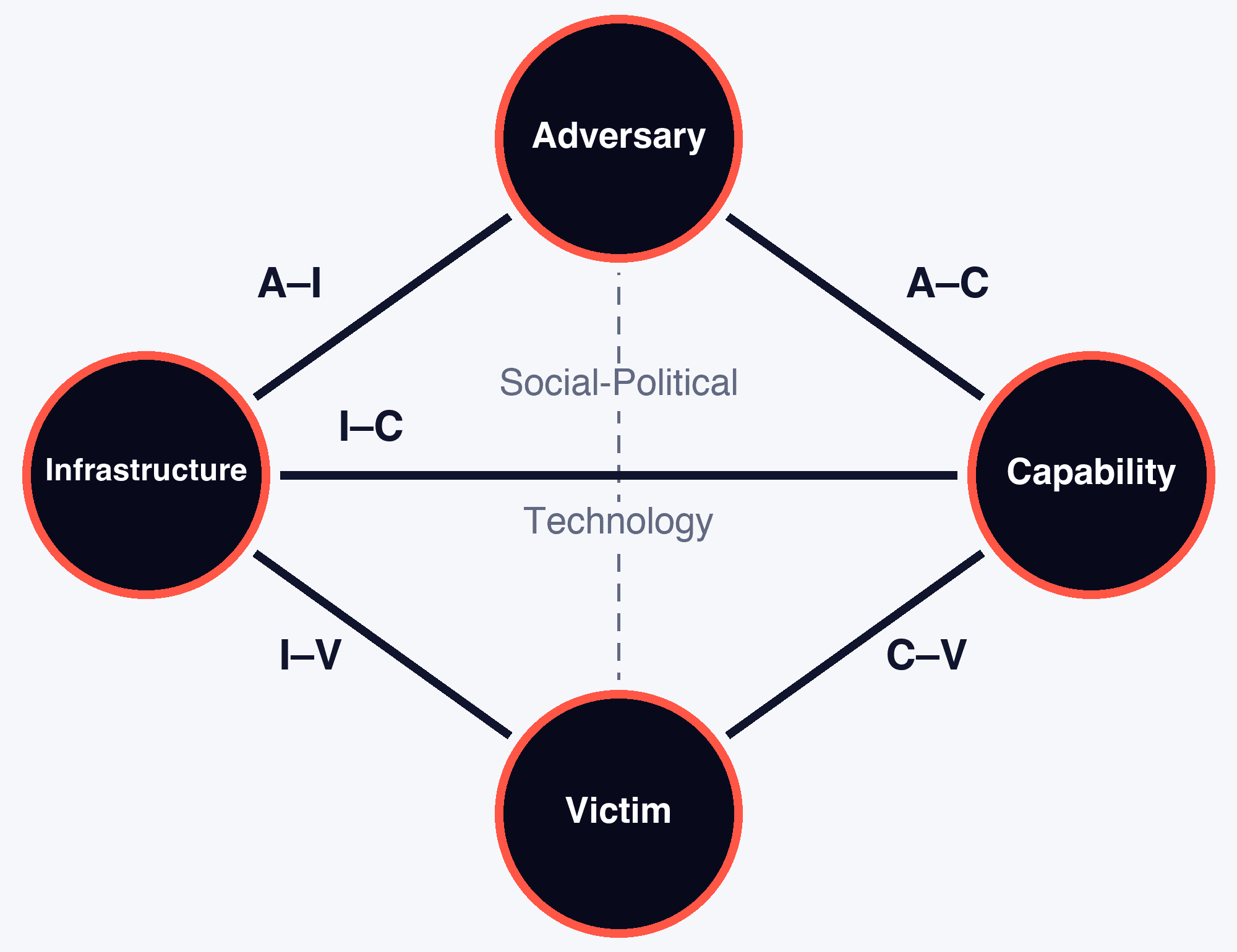
Many short guides stop at the four corners. The paper goes further, with meta-features, seven axioms, activity threads that chain events in order, and activity groups that cluster threads into campaigns. This page covers each part. It then fills a diamond with a real group from our threat group library and turns it into a detection plan.
What Are the Four Corners of the Diamond?
Each corner can be as broad or as detailed as the case needs. The paper also splits each one into parts that matter in daily work.
| Corner | What the paper means | Parts the paper names | Typical examples |
|---|---|---|---|
| Adversary | The actor or organization that uses a capability against the victim. It is usually unknown when an event is first found. | Operator: the person at the keyboard. Customer: whoever benefits, who may be the same party. | A named group, an alias, or “unknown” |
| Capability | The tools and techniques used in the event, from manual password guessing to automated exploits. | Capacity: every weakness one capability can use. Arsenal: all of an adversary’s capabilities. Command and control (C2) counts as part of capability. | Malware, an exploit, a phishing script, a remote access tool |
| Infrastructure | The physical or logical structures used to deliver a capability, control it and take results out. | Type 1: owned or fully controlled by the adversary. Type 2: run by an intermediary, witting or not. Service providers: ISPs, registrars, webmail. | IP addresses, domains, email addresses, hacked hosts |
| Victim | The target whose vulnerabilities and exposures are used. | Persona: the people and organization, with their industry and roles. Assets: the attack surface, such as networks, hosts, email addresses and accounts. | A company, a help desk, a server, a cloud account |
Two details in that table matter later. The paper lists malicious domain names, staging servers and compromised email accounts as Type 2 infrastructure, because this is what the victim sees in place of the real operator. A victim asset can also become infrastructure in the next event, such as a hacked mailbox used to phish a partner. In the paper’s words, “the apparent target of activity may not necessarily be the victim.”
What Are Meta-Features and Confidence Values?
Around the four corners, every event carries meta-features. The paper lists six of them:
- Timestamp: start and end time, so older knowledge can lose weight as the attacker changes.
- Phase: where the event sits in the attack. Any phased model works, such as the cyber kill chain.
- Result: success, failure or unknown, or which of confidentiality, integrity and availability was hit.
- Direction: one of seven values, such as Infrastructure-to-Victim, Victim-to-Infrastructure or Bidirectional. It shows where a sensor or a block can sit.
- Methodology: the class of activity, such as spear-phish email or port scan.
- Resources: what the event needed, such as software, knowledge, a stolen password, money for domains or network access.
Every feature, core or meta, also carries a confidence value. The paper leaves the scale to each team. An empty feature is not a failure. The paper calls it a knowledge gap, a prompt for the next pivot.
The extended diamond adds two links that cross the shape. Social-political joins adversary and victim: the adversary has a need, such as income or espionage, and the victim can meet it. Technology joins capability and infrastructure: the protocols that let them work together, such as DNS and HTTP for malware that looks up a domain and calls home.
What Are the Seven Axioms of the Diamond Model?
The paper states seven axioms. Some guides list different ones, so here they are in the paper’s own order, shortened, with what each one means for a defender.
| # | What the axiom says | What it means for a defender |
|---|---|---|
| 1 | Every intrusion event has an adversary using a capability over infrastructure against a victim to produce a result. | Record each alert as an event with four corners, even if three are still blank. |
| 2 | There is a set of adversaries (insiders, outsiders, individuals, groups and organizations) that seek to compromise systems to meet their needs. | Threats are actors with goals, not just malware. Ask whose need the event serves. |
| 3 | Every system, and so every victim asset, has vulnerabilities and exposures. | Assume something is exposed, and look for it from the outside first. |
| 4 | Every malicious activity has two or more phases that must succeed in order. | One alert is one phase. Look for the steps before and after it. |
| 5 | Every intrusion event needs one or more external resources before it can succeed. | Stolen logins, domains and rented servers are points where the attacker can be slowed. |
| 6 | A relationship always exists between the adversary and its victims, even if distant, fleeting or indirect. | Victimology helps. Ask who else shares your profile and was hit. |
| 7 | Some adversaries have the motivation, resources and capabilities to sustain effects for a long time and resist mitigation. | Some attackers come back after cleanup. Plan for their return, not only their removal. |
Axiom 7 leads to two useful labels. A victim of opportunity is expendable: the attacker would likely not notice losing access. A victim of interest is worth enough that the attacker would spend resources to get back in.
How Does Pivoting Work in the Diamond Model?
Pivoting means taking one data element and using it, with a data source, to find related elements. The paper says the diamond “was originally revealed after exploring pivot scenarios.” Its own example has five pivots:
- A victim finds malware on its network.
- Reverse engineering the malware exposes its command and control domain.
- Resolving the domain exposes the IP address of the malware’s controller.
- Firewall logs show other internal hosts talking to that IP address.
- The registration of the IP address reveals details that may point to the adversary.
In the paper’s formal graph, five edges join the corners: adversary to capability, adversary to infrastructure, infrastructure to capability, infrastructure to victim, and capability to victim. Adversary and victim have no direct edge. What connects them is the social-political meta-feature.
The paper also names “centered” approaches, after the corner where the work starts:
- Victim-centered: most security teams already work this way through their own monitoring. The paper’s example is the Honeynet Project, which sets up hosts that are meant to be attacked.
- Capability-centered: start from a malware sample. The paper cites Kaspersky’s “Red October” work, which went from the malware to “over 1000 different” related files, then to the infrastructure, then sinkholed it to find victims.
- Infrastructure-centered: start from a domain or IP address. In the paper’s SKHack example, analysts went from callback domains through WHOIS records to other domains with the same registrant. That mapped infrastructure the attack had not used yet.
- Adversary-centered: watch the adversary directly. This needs access that few teams have.
- Social-political and technology-centered: predict likely victims from the adversary’s needs, or hunt misuse of a technology such as DNS.
The paper adds a warning: the diamond shows what is possible, not what is certain. Registration details can be false. Even so, a fake persona used the same way every time can still be tracked.
What Does a Diamond Look Like for a Real Group?
Here is one diamond filled in from public sources. Scattered Spider is attributed by MITRE ATT&CK (group G1015) and by the FBI, CISA and partner agencies as a cybercriminal group. It targets large companies and their contracted IT help desks.
The main source is the joint advisory AA23-320A, first published on 16 November 2023. Its update of 29 July 2025 uses FBI data as recent as June 2025.
The event below is the help desk takeover that the advisory describes. It is a model built from the advisory, not one real incident.
| Feature | Filled in from the advisory and MITRE |
|---|---|
| Adversary | Scattered Spider, also tracked as UNC3944, Octo Tempest, Storm-0875 and Muddled Libra, among other names. |
| Capability | Calls to the help desk posing as an employee, to reset a password and move MFA (T1566.004). Repeated MFA prompts, known as MFA fatigue (T1621), and SIM swapping (T1451). The attacker then registers its own MFA token (T1556.006). |
| Infrastructure | Phone calls and SMS. Lookalike domains on patterns such as targetsname-sso[.]com, targetsname-servicedesk[.]com and targetsname-okta[.]com (T1583.001). The advisory says these have not been seen recently but could be reused. |
| Victim persona | Large companies and their contracted IT help desks. MITRE says the group first hit CRM, outsourcing, telecom and technology firms, then widened in 2023 to gaming, hospitality, retail, managed service providers, manufacturing and finance. |
| Victim assets | Single sign-on accounts, the help desk reset process and employee phone numbers. |
| Resources | Employee or contractor logins bought on illicit markets such as Russia Market (T1597.002), and personal details from social media, open sources and database leaks. |
| Social-political | Money. The advisory describes data theft for extortion and several ransomware families, most recently DragonForce. |
| Technology | Single sign-on and identity federation, mobile networks and commercial remote access tools. |
The rest of the attack forms an activity thread, with one diamond per phase. The adversary corner stays the same in each row.
| Phase | What the attacker does, and to which asset | Infrastructure |
|---|---|---|
| Persistence and control | Registers its own MFA tokens and runs remote monitoring and management (RMM) tools such as AnyDesk, TeamViewer and ScreenConnect (T1219.002). Asset: employee endpoints and accounts. | Commercial RMM services, tunnels such as ngrok, and proxy networks. |
| Discovery | Searches SharePoint, password documents, VMware vCenter, backups and VPN guides. Reads Slack, Teams and Exchange for talk about the response. Asset: internal documents and chats. | The victim’s own collaboration tools. |
| Exfiltration | Runs thousands of queries against Snowflake right away and sends data out (T1567.002). Asset: data platforms. | MEGA and Amazon S3. |
| Impact | Encrypts VMware ESXi servers with DragonForce ransomware, per trusted third parties cited in the advisory. Asset: ESXi servers. | Contact with the victim over Tor, Tox, email or encrypted apps. |
Many of these corners are service providers in the paper’s sense. RMM vendors, MEGA and Amazon S3 are legitimate services. So the defence on those corners is to approve and watch their use, not to block a vendor outright.
How Does the Diamond Turn Into a Detection Plan?
Each edge of the diamond, and the resources an event needs, is a question you can ask of your own data. The table follows the pivots in the example above. It names the data that answers each question, and the control the advisory or the UK NCSC recommends where there is one.
| Pivot and question | Where to look | What to do |
|---|---|---|
| Infrastructure to victim. Is anyone registering domains that join our name with “sso”, “servicedesk”, “okta” or “helpdesk”? | New domain registrations and certificate transparency logs for your brand. | Block the domains in email and web filters, and request a takedown. |
| Resources (meta-feature). Are our staff’s logins for sale, or sitting in stealer logs? | Criminal markets and stealer logs that mention your domain. | Reset the exposed accounts and review their recent sign-ins. |
| Capability to victim. Did one account get a password reset and a new MFA device in the same short window? Did a user get a burst of MFA prompts? | Identity provider logs and help desk tickets. | Check how the help desk proves a caller’s identity before a reset, as the UK NCSC advises. Move to phishing-resistant MFA (FIDO or WebAuthn). |
| Capability to infrastructure. Is a remote access tool running that is not on our approved list, including portable versions? | EDR and application control logs. | Allowlist remote access programs. The advisory points to the open LOLRMM project for indicators and Sigma rules. |
| Infrastructure to victim. Is data moving to MEGA or a new S3 bucket, or is Snowflake getting a sudden burst of queries? | Proxy, cloud and data platform logs. | Alert on unusual volume. Keep offline backups and test them. |
| Infrastructure to adversary. Is the attacker using our own chat and call tools to watch our response? | New accounts, chat channels and incident call attendees. | Check new identities and call attendees before you discuss the response. |
The paper’s planning section says to choose actions that cost the defender little and the adversary much. A blocked domain costs this attacker one new registration. A help desk that checks identity, and logins that are reset before they are used, take away the resources the whole thread depends on.
A team can store each event as a simple record. Here is a template for the help desk event above. Values in angle brackets come from your own logs. The low, medium and high scale is our example, since the paper leaves the scale to each team.
event:          help desk password and MFA reset
phase:          delivery (cyber kill chain)
time_start:     <first call in the help desk log>
time_end:       <new MFA device registered>
adversary:      Scattered Spider             confidence: low (process match only)
capability:     vishing, T1566.004           confidence: high
infrastructure: caller number <number>       confidence: medium
                <brand>-sso.<tld> lookalike  confidence: <if seen>
victim_persona: IT help desk; employee with admin rights
victim_asset:   SSO account <user>           confidence: high
result:         success (password reset, MFA moved)
direction:      Infrastructure-to-Victim
methodology:    vishing; MFA reset abuse
resources:      employee personal data (source unknown)
gaps:           owner of the caller number; source of the personal data
How Do Events Become Activity Threads and Activity Groups?
An activity thread is the phase-ordered chain of events for one adversary and one victim. Each arrow between two events carries four labels:
- a confidence value;
- AND if the step is required, or OR if it is one of several routes;
- actual, or only a hypothesis;
- what the earlier event provided to the next one.
Filling gaps inside one thread is vertical correlation. Linking threads across victims is horizontal correlation. In the paper’s example, the attacker uses a network administrator’s mailbox at one company to send the same payload to a research firm.
An activity group clusters events and threads that share features or behavior. The paper gives six steps: define the analytic problem, select features, create the groups, grow them as new events arrive, analyse them, and redefine them when they drift. Groups that share non-technical traits, such as one source of funding and tasking, form an activity group family.
The features depend on the question. Grouping for attribution needs different features than grouping to find shared malware authors. The paper’s sample feature vector combines an infrastructure IP address, a capability hash and an adversary process.
The adversary process is the most durable of these. It is the order of steps an attacker prefers.
The paper’s example is a web search for “network administrator”, then a spear-phish with a trojanized attachment, then a known exploit, then an HTTP POST out. Attackers swap IP addresses and malware often. Their habits change more slowly.
This matters for Scattered Spider. The UK National Crime Agency said on 16 July 2026 that its action against two leading members effectively halted the group, while others may reuse the name. A team that groups activity by process will still catch a copycat: help desk resets, then new MFA devices, then RMM tools. A team that groups only by name will not.
The paper also warns about overfitting. An unrelated event joins a group because two actors share a public tool or hosting, and that wrong event is then used to match more. Groups need review and redefinition over time.
What Changes When Several Criminals Share One Intrusion?
The 2013 model draws one adversary per diamond. Cybercrime today often splits one attack between several sellers and buyers. In May 2025 Cisco Talos proposed an extended Diamond Model with a “Relationship Layer” for these split attacks. It labels the links between diamonds, such as “purchased from”, “handover from” and “leaked from”.
Talos showed why with an intrusion it found in 2023 at a critical infrastructure enterprise. A first wave stole credentials and planted a custom backdoor, which Talos calls LAGTOY, that was then never used. About three weeks later a ransomware group arrived with different tools and logged in with the credentials from the first wave.
Talos concluded that an initial access broker had handed over access. The first reading, one group behind both waves, would have put the backdoor in the ransomware group’s toolset.
Our own research sees the same split in criminal offers. The chapter How Cybercriminals Divide the Work of Cybercrime Report 2026 compares four advertised offers from the report’s catalogues. In one, an infostealer licensee may sell access to a compromised machine, with its logs, to a third buyer who is said to need no subscription. The chapter warns that merging such roles “would turn a product description into unsupported attribution or an unconfirmed incident.”
So draw one diamond per actor and label the link between them, such as “purchased from” for the access seller.
In the report’s Initial Access Offers chapter, we read 120 corporate network access offers in full, posted from 1 January to 27 October 2026. Counting one repeated firewall family once, 48 of 106 named an edge device or remote-access service. These are advertised offers, not verified breaches, but an access seller’s diamond often starts at the perimeter.
How Does It Compare With the Cyber Kill Chain and MITRE ATT&CK?
The three models answer different questions, and teams use them together. The paper calls the Diamond Model and kill chain analysis “highly complementary”. Each event’s phase can come from the kill chain. An activity thread can then be read against the kill chain’s course of action matrix: detect, deny, disrupt, degrade, deceive and destroy.
| Diamond Model | Cyber kill chain | MITRE ATT&CK | |
|---|---|---|---|
| Main question | Who used what, over which infrastructure, against whom? | Which stage is the intrusion in, and where can we break it? | Which exact technique was used, and how do we detect it? |
| Unit | The event, then threads and groups | Seven ordered stages of one intrusion | Tactics, techniques and sub-techniques, plus group and software entries |
| Best for | Pivoting between related facts and clustering campaigns | Planning defences for each stage | Shared IDs for detections and reports |
| Watch out for | Manual work; the adversary corner is often empty | A fixed order that attackers who buy access can skip | Techniques are listed one by one; how events relate is left to you |
| Origin | Caltagirone, Pendergast and Betz, 2013 | Lockheed Martin, 2011 | MITRE |
In practice, ATT&CK IDs fill the capability corner, the kill chain fills the phase, and the diamond keeps the links between them. Our pages on the cyber kill chain and MITRE ATT&CK explain the other two.
How Do You Store Diamond Events in STIX?
The paper does not define a sharing format, but its authors expected the model to form the basis of one. STIX 2.1, the OASIS standard for threat intelligence, has objects that fit each corner. See our page on STIX and TAXII for how the data moves.
| Diamond feature | STIX 2.1 object | Link from the intrusion set |
|---|---|---|
| Adversary | intrusion-set for the activity cluster; threat-actor for the people behind it | attributed-to |
| Capability | attack-pattern, malware, tool | uses |
| Infrastructure | infrastructure, with types such as phishing, command-and-control or exfiltration | uses, compromises, or hosts and owns |
| Victim | identity (an organization or a class, with sectors), location, vulnerability | targets |
| Meta-features | first_seen and last_seen, kill_chain_phases, confidence (0 to 100), primary_motivation | Properties on the objects |
STIX defines an intrusion set as “a grouped set of adversarial behaviors and resources with common properties that is believed to be orchestrated by a single organization.” That is close to the paper’s activity group.
What Are the Limits of the Diamond Model?
- It is manual. The authors wrote that the model “at present is cognitive and highly manual” and would be far more useful with automation.
- The adversary is often unknown. The paper expects this corner to be “empty for most events”, at least when they are found.
- Pivots can mislead. Shared hosting, public tools and fake registration details can join events that are not related.
- One actor per diamond does not fit shared crime. Access brokers and service providers need their own diamonds and labelled links, as Talos proposed.
- Correlation is not causation. The paper says this about linking attacks to political events, and it holds for every pivot.
How Do You Start Using It?
- Take one recent alert and write it as an event: four corners, six meta-features and a confidence for each.
- Mark the empty fields as knowledge gaps, and pick the pivot that fills the most of them.
- Give the event a phase, and look for the events before and after it.
- Compare the thread with a known group’s profile by process, not only by indicators of compromise.
- Turn each edge into a detection or control, as in the table above, and record which pivots paid off.
Brandefense Cyber Threat Intelligence tracks 1,000+ threat actors and 100+ ransomware groups. It sends its findings to SIEM and SOAR tools, and offers them through an API with STIX 2.0 and TAXII 2.1.
Also Called
- Diamond Model
Frequently Asked Questions
Who created the Diamond Model of Intrusion Analysis?
Sergio Caltagirone, Andrew Pendergast and Christopher Betz described it in a 2013 paper, The Diamond Model of Intrusion Analysis. They built it from years of analyst experience. Their aim was a formal method for intrusion analysis, based on measurement, testability and repeatability.
What are the four features of the Diamond Model?
Adversary, capability, infrastructure and victim. Each event also has six meta-features: timestamp, phase, result, direction, methodology and resources. The extended model adds a social-political link between adversary and victim, and a technology link between capability and infrastructure.
Do you need to know the attacker to use the Diamond Model?
No. The paper expects the adversary to be unknown for most events when they are first found. Blank features are knowledge gaps. Pivots from the corners you do know, often infrastructure or capability, fill them in over time.
What is the difference between the Diamond Model and the cyber kill chain?
The kill chain orders an intrusion into seven stages. The Diamond Model describes the relationships inside each step. The paper calls the two highly complementary: the kill chain stage becomes each event's phase, and its course of action matrix turns an activity thread into defensive actions.
What is an activity group in the Diamond Model?
It is a set of events and activity threads grouped because they share features or behavior, weighted by confidence. Analysts often use activity groups to track one adversary over time. STIX 2.1 calls a similar cluster an intrusion set.
Sources
- The Diamond Model of Intrusion Analysis (Caltagirone, Pendergast, Betz, 2013), Sergio Caltagirone, Andrew Pendergast, Christopher Betz (authors' copy; DTIC record ADA586960)1
- Scattered Spider, joint advisory AA23-320A (updated 29 July 2025), CISA, FBI and partner agencies2
- Scattered Spider, Group G1015, MITRE ATT&CK3
- Incidents impacting retailers: recommendations from the NCSC, UK National Cyber Security Centre4
- Defining a new methodology for modeling and tracking compartmentalized threats, Cisco Talos5
- Introducing ToyMaker, an initial access broker working in cahoots with double extortion gangs, Cisco Talos6
- STIX Version 2.1 (OASIS Standard, 10 June 2021), OASIS7
- Cybercrime Report 2026: How Cybercriminals Divide the Work, Brandefense8
