


Key takeaways
- An open staging server held 364 attack files.
- The scripts stage a path from a web shell through SQL Server and Oracle to the domain controller and ESXi.
- A rollback script would disable xp_cmdshell and delete two temporary admins, but leaves a hidden local admin.
- Point-in-time posture scans would miss the rolled-back changes; event history would not.
- Alert on configuration changes and short-lived admin accounts, and isolate hypervisor management networks.
In a two-week observation window ending 18 November 2026, Odin by Brandefense found an open staging server holding 364 attack files. Together the files lay out a path from a perimeter web application, through internal databases, to the domain controller and the VMware hypervisor layer. A rollback script would clean up exactly what a compliance scan checks, and leave a hidden administrator behind. For defenders, the lesson is that a clean configuration today does not mean nothing happened yesterday.
We hold no logs from the targeted network. Every step below is staged capability. Only one captured file, an Oracle error output, records contact with a target system.
What was on the server?
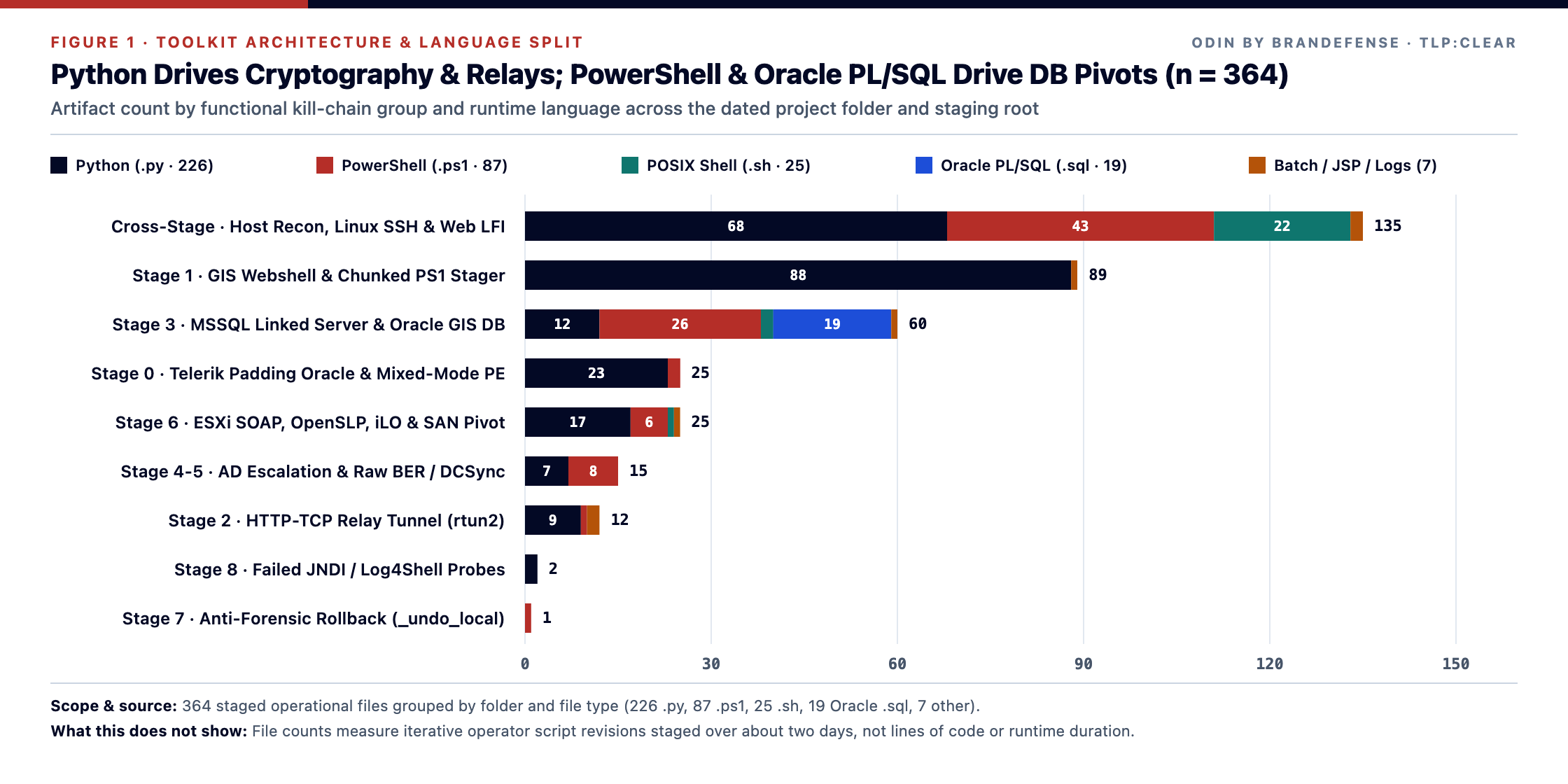
The server held 311 files in a flat working folder, 52 in a curated project folder, and one captured output in a folder named /loot. The project folder has numbered stage subfolders with Chinese names such as "tunnel", "lateral expansion" and "failed attempts".
| Language | Files | Share | Role |
|---|---|---|---|
| Python | 226 | 62.1% | Runs from the staging server: crypto oracles, SOCKS5 relays, SSH automation, raw LDAP checks, DCSync |
| PowerShell | 87 | 23.9% | Runs on Windows targets: SQL Server wrappers, account staging, rollback |
| Shell | 25 | 6.9% | Linux SSH privilege escalation and file collection |
| Oracle PL/SQL | 19 | 5.2% | Java stored procedures on an internal GIS database |
The design keeps the heavy logic outside the target network. On Windows hosts, the scripts use built-in tools such as PowerShell, certutil.exe and cmd.exe. That leaves few new binaries for endpoint tools to flag.
How does the staged path work?
The workflow runs in stages.
- Entry. A web shell on a Windows GIS web server, with a local lab for Progress Telerik padding-oracle testing (CVE-2026-13182, fixed in 2026.2.708). Scripts deliver PowerShell in small Base64 chunks marked
_pushpto avoid firewall resets. - Tunnel. An HTTP-to-TCP relay (
rtun2) gives the operator a SOCKS5 proxy and port forwards to the domain controller's LDAP and SMB ports. - Database pivots. PowerShell wrappers turn on
xp_cmdshellon internal SQL Server hosts and use an RPC-enabled linked server to reach other segments. Oracle scripts compile Java procedures on a GIS database. - Domain identity. Scripts create a temporary domain admin and a temporary local admin. A separate script creates a local admin hidden from the Windows sign-in screen.
- Domain controller. DCSync scripts would request password hashes through the replication protocol. Hand-built LDAP bind packets test credentials against the domain controller.
- Hypervisor and management. Scripts test logins on ESXi, HP iLO, Cisco and Brocade interfaces. They also adapt a public exploit for the ESXi OpenSLP flaw CVE-2021-21974.
At least 96 scripts reference 17 internal addresses across three private subnets. One folder, literally named "failed attempts", holds two Log4Shell probes the operator gave up on. We do not know whether any of these steps worked.
What would the rollback hide?
The rollback script, _undo_local.ps1, would reconnect to the SQL jump hosts, switch xp_cmdshell off and delete both temporary admin accounts. A posture scan run afterwards would see a clean SQL configuration and normal admin groups.
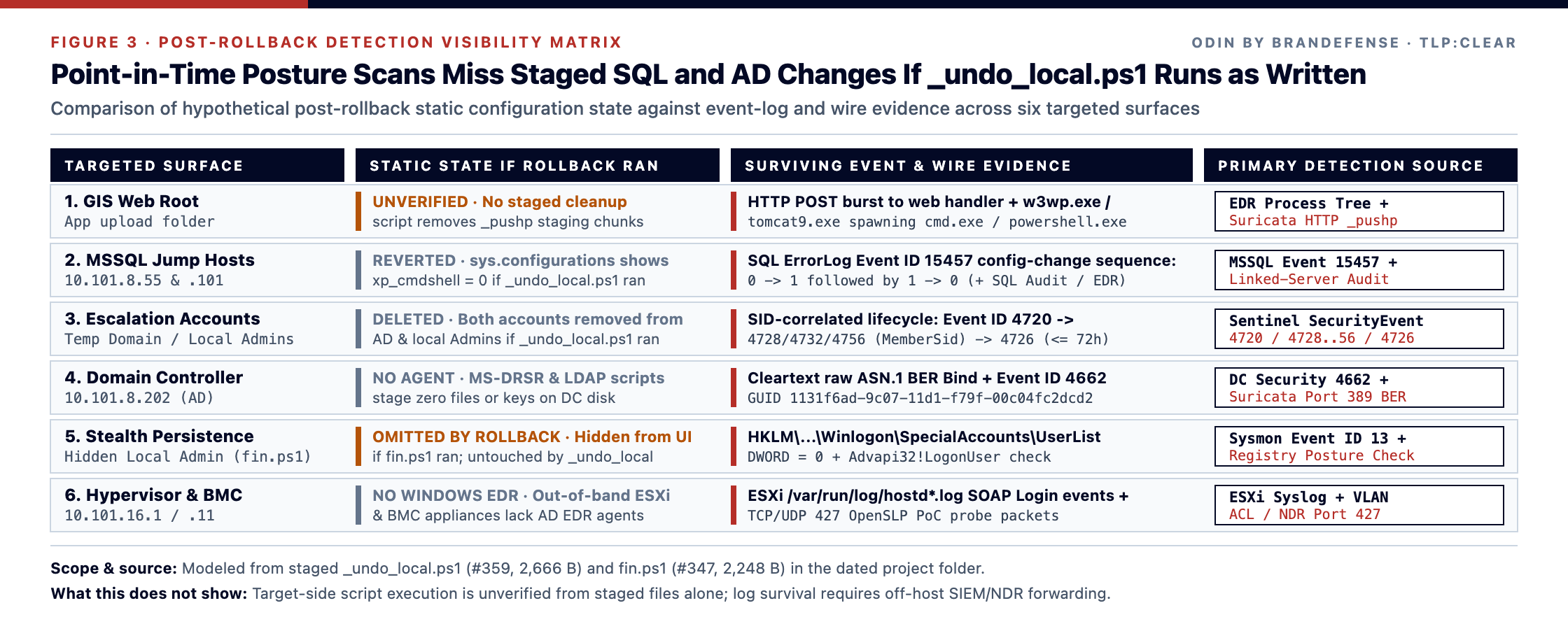
The rollback leaves three things behind:
- the hidden local administrator, which stays out of view on the sign-in screen
- the
_pushpstaging fragments in the web application folder - any trace of DCSync activity on the domain controller, which would write no files to disk and would survive only in event logs and network records
This is why event history matters. SQL Server logs Event ID 15457 each time the xp_cmdshell setting changes. Windows logs account creation, group changes and deletion. A query that joins those events within 72 hours catches an admin account that existed for a few hours and then vanished.
Who is behind it?
The evidence does not say. One file carries a red-team deployment and rollback comment, and the stage folders look like an organised engagement. But the rollback leaves a hidden admin behind, and leaving a toolkit open on the internet breaks normal assessment practice. A research lab or a decoy server are also possible. We therefore do not claim that a real company was breached.
Three other staging toolkits from the same period, 1,458 files in all, follow the same shape. Each keeps a messy working folder plus curated chains, and each relays through the web tier into high-trust data stores such as SQL Server, Oracle, Redis or Hadoop. Nothing links the four to one actor.
What to do now
- Alert on changes, not only on state. Correlate SQL Event 15457 enable-and-disable sequences, and flag admin accounts created, privileged and deleted within 72 hours.
- Hunt for hidden accounts. Check
WinlogonSpecialAccountsUserListon every Windows host, and scan web folders for_pushp,PSBG_DONEandJSPOK|markers. - Watch the domain controller. Enable replication-rights auditing (Event 4662) and alert on cleartext LDAP simple binds.
- Isolate the hypervisor layer. Put ESXi, vCenter, iLO and SAN management on their own network with non-AD credentials, and close port 427 where
slpdis not needed. - Review database trusts. Audit SQL Server linked-server logins with RPC-out enabled, and Oracle Java permissions, like domain trusts.
The full report covers each stage, the file hashes and the logic of every detection rule. The Indicators and Detection rules tabs have the complete lists.
What is…?
Short explanations of the tools and families named in this study.
What is VMware ESXi?
VMware ESXi is a bare-metal hypervisor that runs virtual machines. Ransomware groups target it because one host can hold many servers.
More about VMware ESXiTechniqueWhat is xp_cmdshell?
xp_cmdshell is a SQL Server extended stored procedure that runs operating system commands. Attackers enable it to move from database access to the host.
More about xp_cmdshellTechniqueWhat is DCSync?
DCSync abuses the Active Directory replication protocol to ask a domain controller for password hashes, as if the caller were another domain controller.
More about DCSyncEnterprise softwareWhat is Telerik UI?
Telerik UI for ASP.NET AJAX is a web component library. Older versions have deserialization flaws that allow remote code execution.
More about Telerik UITechniqueWhat is JNDI injection?
JNDI injection makes a Java application look up a remote object, usually over LDAP or RMI, and load attacker code. Log4Shell is the best-known example.
More about JNDI injectionVulnerabilityWhat is Log4Shell?
Log4Shell (CVE-2021-44228) is a remote code execution flaw in Apache Log4j 2 triggered by JNDI lookups in logged strings.
More about Log4ShellFrequently asked questions
What was on the server?
The server held 311 files in a flat working folder, 52 in a curated project folder, and one captured output in a folder named /loot. The project folder has numbered stage subfolders with Chinese names such as "tunnel", "lateral expansion" and "failed attempts".
How does the staged path work?
The workflow runs in stages. At least 96 scripts reference 17 internal addresses across three private subnets. One folder, literally named "failed attempts", holds two Log4Shell probes the operator gave up on. We do not know whether any of these steps worked.
What would the rollback hide?
The rollback script, _undo_local.ps1, would reconnect to the SQL jump hosts, switch xp_cmdshell off and delete both temporary admin accounts. A posture scan run afterwards would see a clean SQL configuration and normal admin groups.
Who is behind it?
The evidence does not say. One file carries a red-team deployment and rollback comment, and the stage folders look like an organised engagement. But the rollback leaves a hidden admin behind, and leaving a toolkit open on the internet breaks normal assessment practice. A research lab or a decoy server are also possible. We therefore do not claim that a real company was breached.