


Key takeaways
- Odin mapped 717 endpoints on 687 hosts across ten infrastructure families.
- Only one HookBot controller, 152.70.24[.]49, is published for blocking.
- P2PInfect nodes are most likely infected victim servers, so we publish no addresses.
- Recon suites make up 93.0% of the endpoints and stay on watchlists, not block lists.
- Close public Redis, require passkeys, and block the one confirmed controller.
In a two-week observation window ending 18 November 2026, Odin by Brandefense mapped 717 internet-facing endpoints on 687 hosts. They belong to ten families: Android banking trojan panels, cloud worms, reverse-proxy phishing kits and attack-surface recon suites. Most of these tools serve defenders as well as attackers. Only one endpoint is a corroborated adversary controller we publish for blocking. For a security team, the hard part is not finding this infrastructure. It is deciding what to block and what to watch.
What did we find?
The 717 endpoints fall into four layers. This grouping is our analytical model. Nothing observed links the people behind one layer to another.
| Layer | Families | Endpoints |
|---|---|---|
| Recon | ARL, ScopeSentry, reNgine | 667 |
| Phishing | EvilGoPhish | 9 |
| Cloud and edge worms | P2PInfect, Moobot | 18 |
| Mobile C2 | HookBot, Octopus, Daam, L3MON | 23 |
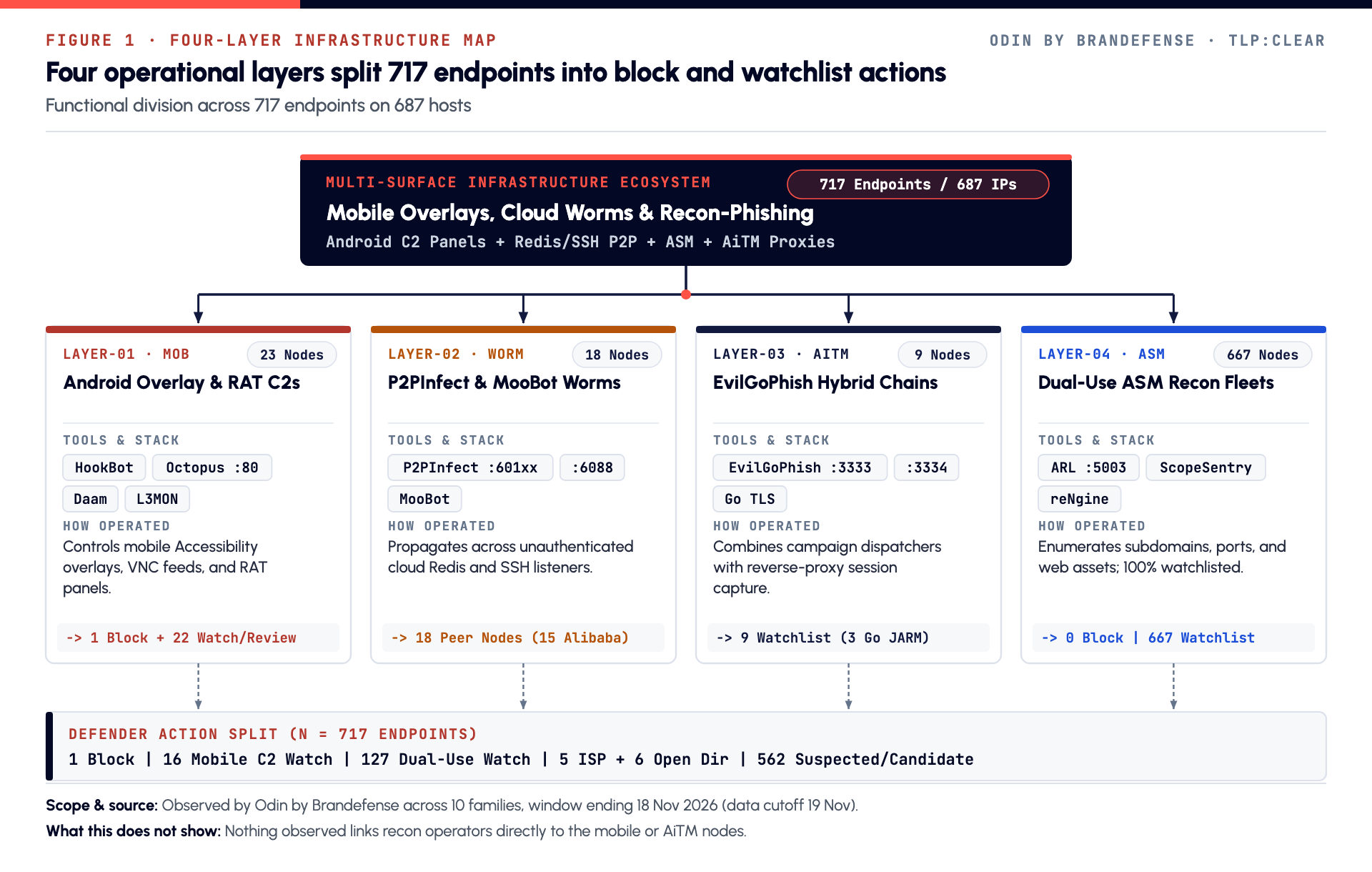
The recon layer is by far the largest, at 93.0% of all endpoints. The mobile layer is small but holds the one controller we publish for blocking.
Which servers should we block?
Block one address: 152.70.24[.]49, a HookBot controller on Oracle Cloud in Germany that we corroborated in the window. HookBot is an Android banking trojan. It draws fake login screens over banking apps, abuses Android Accessibility to tap buttons, and streams the phone's screen to the operator. The full report's Indicators tab lists this address.
Eleven more HookBot addresses come from older feed entries. None has a record inside this window, and cloud addresses get reassigned, so we keep them on watchlists and withhold them. Five of the HookBot records sit behind a stock Traefik certificate, which still makes a good hunting lead.
Five Octopus panels sit on adjacent IBM Cloud addresses in Frankfurt, Germany. Octopus is also the name of an open-source red-team C2 framework, and the cluster fits a test lab. We withhold these addresses and send them to analyst review.
Daam and L3MON, two other Android remote-access tools, show up on five endpoints. Neither is corroborated yet, so they stay on watchlists.
Why not block the worms and phishing kits?
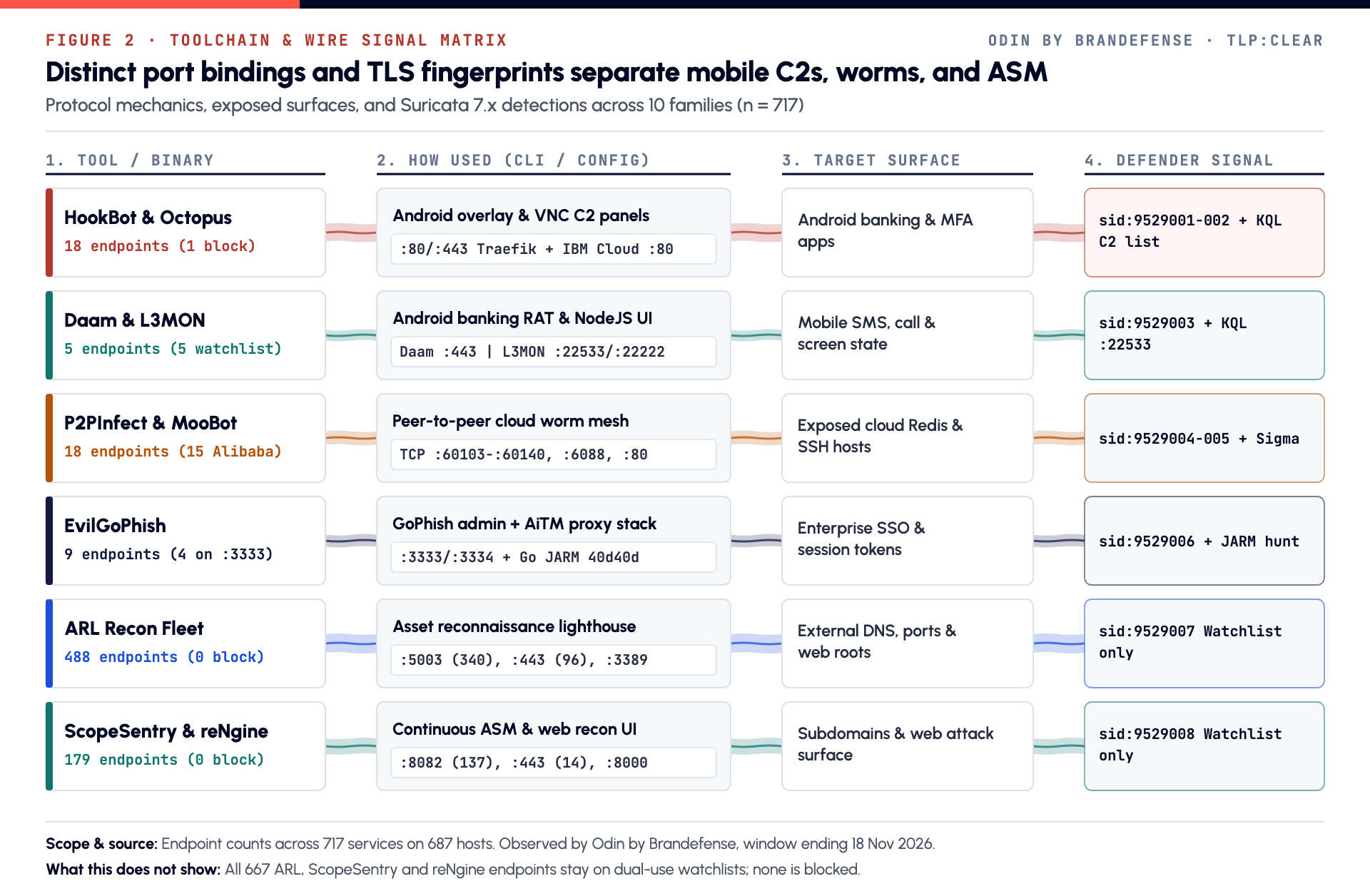
P2PInfect is a self-spreading worm. It finds Redis databases and SSH servers left open on the internet, infects them, and links them into a peer-to-peer mesh on high ports from 60103 to 60140. We found 16 nodes, 15 of them on Alibaba Cloud.
These nodes are most likely someone else's infected servers. Blocking them would hurt their owners, and publishing their addresses would expose those owners. We treat them as victims and describe them only by port and hosting type.
EvilGoPhish pairs a GoPhish email campaign panel with a reverse proxy. The proxy relays a real login page and steals the session cookie and MFA code as the user signs in. We found nine servers, four on the default admin port 3333. Two use certificates for lookalike domains.
Companies also run EvilGoPhish for authorized phishing exercises. A port or TLS fingerprint alone cannot tell the two apart. These servers stay on watchlists until a lure domain confirms hostile use. We do not name the brands the lookalike domains imitate.
What about the recon suites?
ARL (488 endpoints), ScopeSentry (138) and reNgine (41) map subdomains, ports and login portals. Attackers use that map to choose phishing targets. Security teams use the same tools to find their own exposure.
Blocking these hosts would break legitimate scanners and do little to stop an attacker, who can move to a new server. We keep all 667 on watchlists and hunt them by fingerprint instead. Two Chinese servers run ARL and ScopeSentry side by side.
We also found one exposed workbench in Japan with 1,725 files in an open directory. It held AI agent logs, a large agent backup, a Gemini authentication archive and cloud deployment notes. We do not know who owns it, so we withhold its address and file names. It is a reminder that open file servers leak credentials.
What can defenders hunt for?
Addresses change quickly. Fingerprints change slowly, so they make better hunting signals. The full report lists the details, and a few stand out.
| Signal | What it points to |
|---|---|
TRAEFIK DEFAULT CERT on ports 80 or 443 | Five of the HookBot controller records |
| Port 22533 | The default port of the L3MON Android panel |
| Ports 60103 to 60140, or 6088 | P2PInfect peer traffic |
| Port 3333 with a Go TLS fingerprint | A possible EvilGoPhish campaign panel |
CN=rengine.example[.]com | A default reNgine install |
Inside your own network, the most useful signal is a server that starts talking on these ports when it never did before. A Redis server that opens a connection on port 60103 deserves a look. So does a workstation that reaches the confirmed HookBot controller. The Sentinel query in the full report's Detection rules tab joins both checks, and it never lets an allowlisted host hide a contact with a confirmed controller.
What to do now
- Block the confirmed HookBot controller 152.70.24[.]49 on firewalls and mobile VPN gateways, and keep older HookBot entries and the Octopus cluster on watchlists.
- Take Redis off the internet. Turn on protected mode and authentication, and require SSH keys on cloud servers.
- Require phishing-resistant sign-in such as FIDO2 passkeys on workforce SSO, and watch for lookalike certificates of your own domains.
- Harden mobile banking apps with Android restricted settings and runtime integrity checks against Accessibility overlays.
- Watch, do not block, recon suites and phishing kits. The full report's Detection rules tab has Suricata, Sentinel KQL, Sigma and YARA rules to start with.
The full report covers the fingerprints, hosting, indicators and rule logic in detail.
What is…?
Short explanations of the tools and families named in this study.
What is HookBot?
HookBot is an Android banking trojan that uses overlay screens and Accessibility abuse to steal credentials and control the device.
More about HookBotPhishing frameworkWhat is EvilGoPhish?
EvilGoPhish combines a GoPhish campaign panel with an adversary-in-the-middle reverse proxy that captures session cookies.
More about EvilGoPhishWormWhat is P2PInfect?
P2PInfect is a self-spreading peer-to-peer worm that targets exposed Redis and SSH services.
More about P2PInfectReconnaissance platformWhat is ARL?
ARL (Asset Reconnaissance Lighthouse) is an open-source asset discovery platform, popular with Chinese-speaking testers and attackers.
More about ARLReconnaissance platformWhat is ScopeSentry?
ScopeSentry is an open-source asset discovery and scanning platform that maps subdomains, ports and web services.
More about ScopeSentryReconnaissance platformWhat is reNgine?
reNgine is an open-source reconnaissance framework that chains tools such as subfinder, httpx and nuclei in containers.
More about reNgineFrequently asked questions
What did we find?
The 717 endpoints fall into four layers. This grouping is our analytical model. Nothing observed links the people behind one layer to another. The recon layer is by far the largest, at 93.0% of all endpoints. The mobile layer is small but holds the one controller we publish for blocking.
Which servers should we block?
Block one address: 152.70.24[.]49, a HookBot controller on Oracle Cloud in Germany that we corroborated in the window. HookBot is an Android banking trojan. It draws fake login screens over banking apps, abuses Android Accessibility to tap buttons, and streams the phone's screen to the operator. The Indicators tab lists this address.
Why not block the worms and phishing kits?
P2PInfect is a self-spreading worm. It finds Redis databases and SSH servers left open on the internet, infects them, and links them into a peer-to-peer mesh on high ports from 60103 to 60140. We found 16 nodes, 15 of them on Alibaba Cloud.
What about the recon suites?
ARL (488 endpoints), ScopeSentry (138) and reNgine (41) map subdomains, ports and login portals. Attackers use that map to choose phishing targets. Security teams use the same tools to find their own exposure.
What can defenders hunt for?
Addresses change quickly. Fingerprints change slowly, so they make better hunting signals. The full report lists the details, and a few stand out. Inside your own network, the most useful signal is a server that starts talking on these ports when it never did before. A Redis server that opens a connection on port 60103 deserves a look. So does a workstation that reaches the confirmed HookBot controller.