


1. Executive Summary
In short
In a two-week observation window ending 18 November 2026, Odin by Brandefense mapped 717 endpoints on 687 hosts across ten infrastructure families. Android banking panels, cloud worms, reverse-proxy phishing kits and recon suites sit side by side. Recon suites make up 93.0% of the endpoints. Only one HookBot controller, 152.70.24[.]49, is corroborated in the window as adversary infrastructure. Block it, keep everything else on watchlists, and close public Redis access.
This report covers four kinds of internet-facing infrastructure. Android banking trojan panels steal credentials and control phones. Cloud worms spread through exposed Redis and SSH services. Phishing kits proxy login pages to steal session cookies. Recon suites map an organization's external attack surface. The same tools serve attackers and defenders, so the key question for each group is whether to block or to watch.
One HookBot controller is the only address published for blocking.
152.70.24[.]49 on Oracle Cloud in Germany is a HookBot command-and-control (C2) server seen in the window. Eleven more HookBot addresses are older feed entries, kept on watchlists. Five Octopus panels on adjacent IBM Cloud addresses fit a lab and go to review.
P2PInfect peers and EvilGoPhish servers stay on watchlists, not block lists.
Sixteen P2PInfect nodes, 15 on Alibaba Cloud, use high gossip ports from 60103 to 60140. These are most likely infected third-party servers. Nine EvilGoPhish servers pair a GoPhish admin port with a reverse proxy, but authorized phishing tests use the same kit.
Dual-use recon suites dominate the volume and stay on watch.
ARL (488 endpoints), ScopeSentry (138) and reNgine (41) make up 667 endpoints. Security teams run these suites too, so none is blocked. Separately, one exposed workbench in Japan held 1,725 files, including AI agent logs and an authentication archive.
Three Decisions for Leaders
- Block the one confirmed controller and watch everything else. Put 152.70.24[.]49 on perimeter and mobile VPN block lists. Route the older HookBot entries, the Octopus cluster, the 667 recon endpoints and all worm and phishing nodes to time-bound watchlists.
- Require phishing-resistant sign-in and protect mobile apps. FIDO2 passkeys defeat reverse-proxy session theft. Android restricted settings and runtime integrity checks limit the Accessibility abuse that HookBot, Daam and L3MON depend on.
- Close public Redis and audit open file servers. Turn on Redis protected mode and authentication, and keep it off the internet. Remove public directory listings from engineering and automation servers.
The Study in Numbers
| Number | What it is |
|---|---|
| 717 | Endpoints across ten families, on 687 distinct hosts |
| 1 | HookBot controller corroborated in the window and published for blocking |
| 16 | Older HookBot entries (11) and Octopus panels (5) kept on watchlists, addresses withheld |
| 667 | ARL, ScopeSentry and reNgine recon endpoints, all kept on watchlists (93.0%) |
| 16 | P2PInfect peer nodes; 15 sit on Alibaba Cloud |
| 9 | EvilGoPhish phishing servers; 4 use the default admin port 3333 |
| 1,725 | Files on one exposed AI agent workbench in Japan |
| 24 | Hosts that bind several services, including 2 that run both ARL and ScopeSentry |
How to use this report.
Security leaders can read Chapter 1 and Chapter 7. Detection engineers should start with Chapters 7 to 10. CTI analysts will find the infrastructure detail in Chapters 2 to 6.
2. Four Layers of Infrastructure
In short
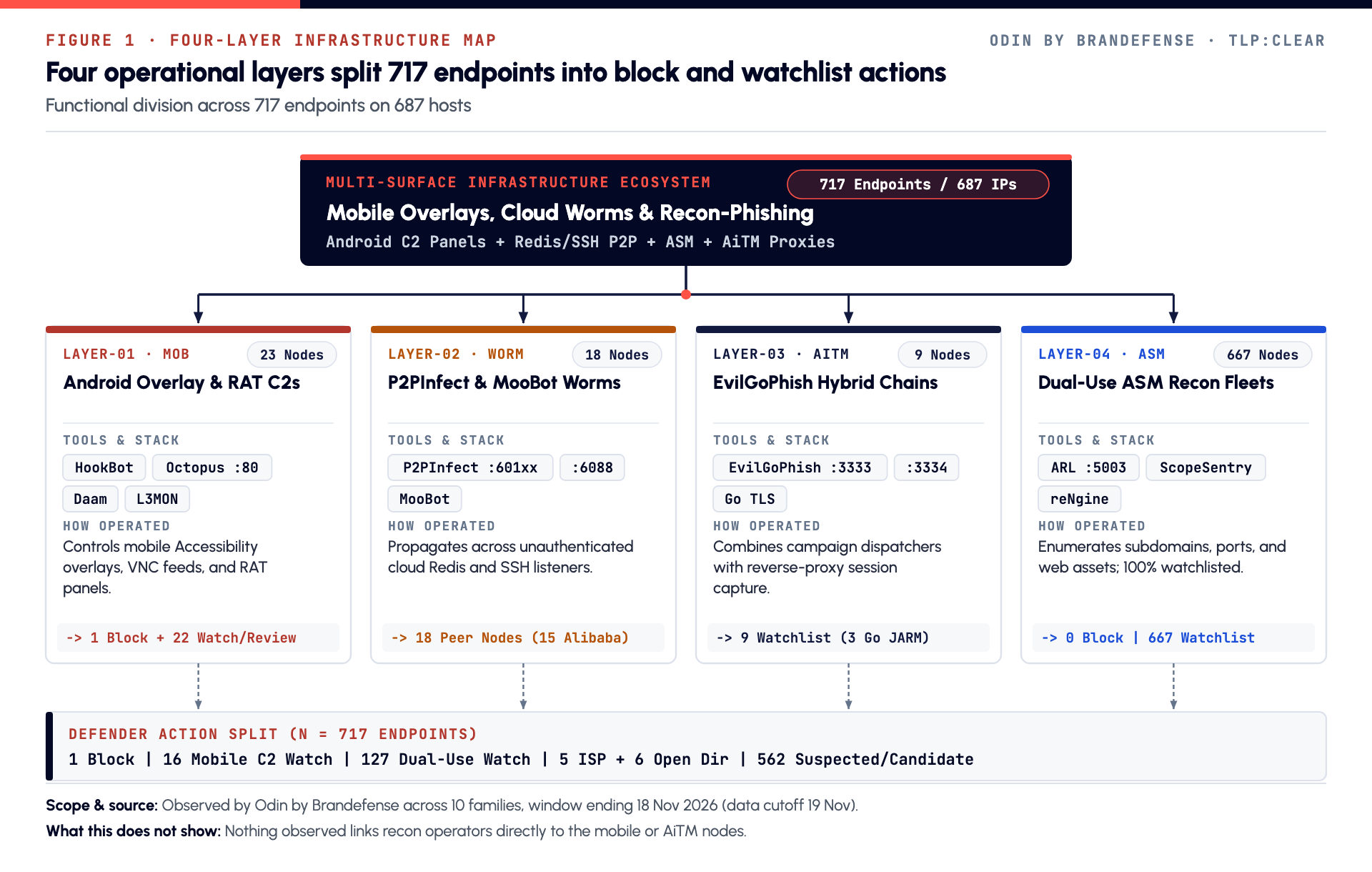
The 717 endpoints fall into four functional layers: recon, phishing, worms and mobile C2. Recon suites are large and noisy; mobile panels and worm meshes are small and compact.
Defenders who ingest raw internet scan feeds face an imbalance. Recon frameworks produce a large volume of banners on ports such as 5003 and 8082. Mobile banking panels and worm meshes run in small, fast-changing clusters. Treating both alike either floods analysts with false positives or blocks benign security tools.
We group the ten families into four layers. This grouping is an analytical model. Nothing observed links the operators of one layer to another.
| Layer | Families | Endpoints |
|---|---|---|
| Recon | ARL, ScopeSentry, reNgine | 667 |
| Initial access phishing | EvilGoPhish | 9 |
| Cloud and edge worms | P2PInfect, Moobot | 18 |
| Mobile C2 | HookBot, Octopus, Daam, L3MON | 23 |
Counts by family
Each endpoint is an IP and port pair. The 717 endpoints sit on 687 hosts, because two servers run two families each.
| Family | Role | Endpoints | Hosts | Block | Watch |
|---|---|---|---|---|---|
| ARL | Dual-use recon | 488 | 474 | 0 | 488 |
| ScopeSentry | Dual-use recon | 138 | 136 | 0 | 138 |
| reNgine | Dual-use recon | 41 | 29 | 0 | 41 |
| P2PInfect | Cloud peer-to-peer worm | 16 | 16 | 0 | 16 |
| HookBot | Android overlay C2 | 13 | 13 | 1 | 12 |
| EvilGoPhish | Reverse-proxy phishing | 9 | 9 | 0 | 9 |
| Octopus | C2 panel | 5 | 5 | 0 | 5 |
| Daam | Android overlay and RAT | 3 | 3 | 0 | 3 |
| L3MON | Android NodeJS RAT | 2 | 2 | 0 | 2 |
| Moobot | Edge botnet worm | 2 | 2 | 0 | 2 |
Where the endpoints run
Six countries lead.
| Country | Endpoints | Share |
|---|---|---|
| China | 332 | 46.3% |
| United States | 164 | 22.9% |
| Hong Kong | 81 | 11.3% |
| Germany | 30 | 4.2% |
| Singapore | 25 | 3.5% |
| Japan | 14 | 2.0% |
The layers use different hosting. ARL runs mostly in China (284), the United States (128) and Hong Kong (52). ScopeSentry shows a similar spread: China 43, Hong Kong 28 and the United States 20. The largest recon hosting networks are Shenzhen Tencent (155 rows), SonderCloud (91) and Hangzhou Alibaba (82).
The HookBot and Octopus panels sit on European and global VPS providers instead. IBM Cloud hosts five in Germany, Contabo two in Germany, Hostinger two, and Oracle one in Germany. P2PInfect keeps 12 of its 16 nodes (75.0%) on Alibaba (US) Technology in Singapore.
3. Android Banking Panels
In short
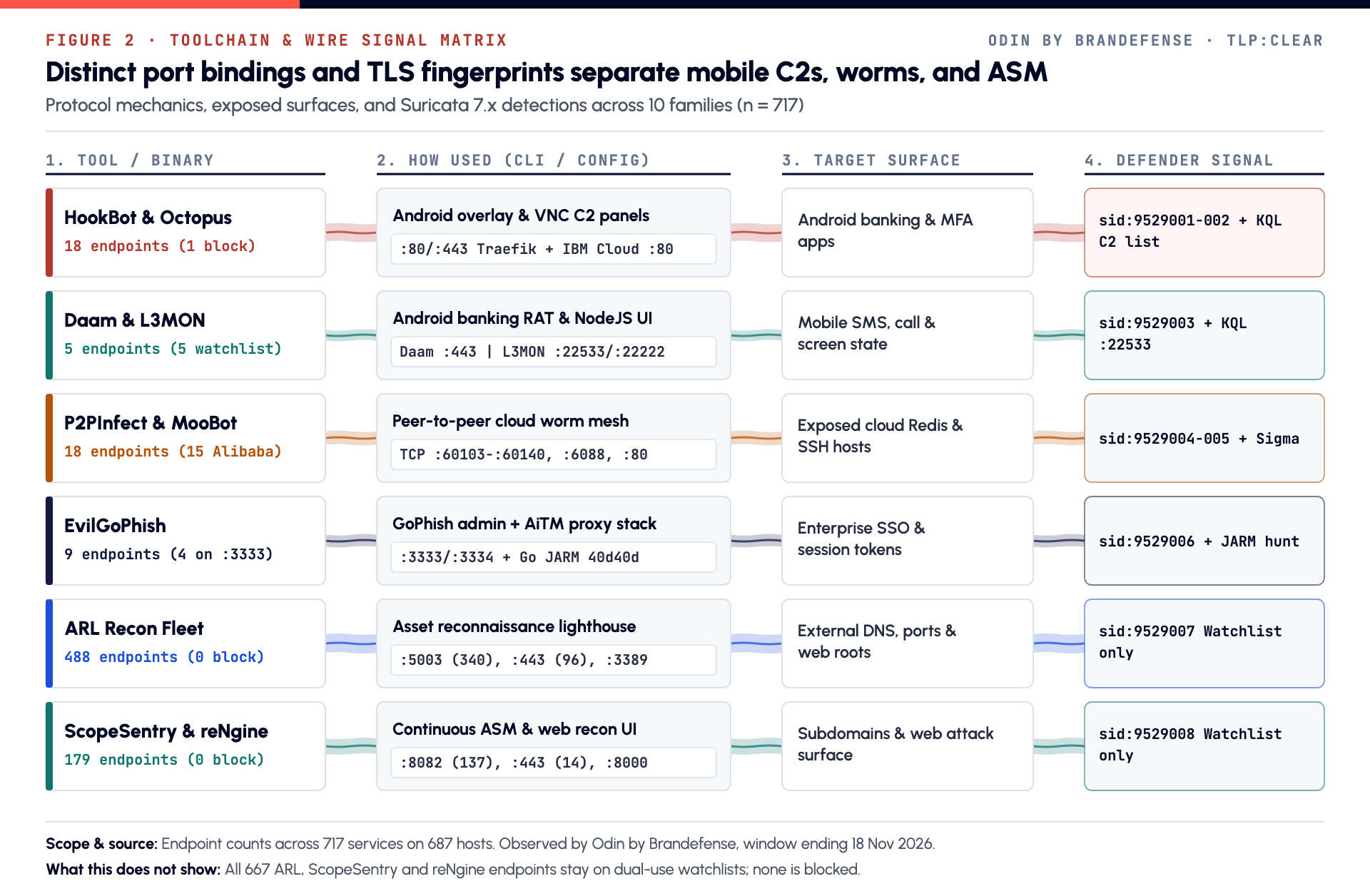
HookBot, Octopus, Daam and L3MON account for 23 endpoints. Only one HookBot controller is corroborated in the window; the other 22 endpoints stay on watchlists.
Modern Android banking trojans combine three tricks. A WebView overlay draws a fake login screen over a banking app. Android AccessibilityService lets the malware read the screen and tap buttons. Real-time VNC screen streaming lets the operator move money directly on the phone.
HookBot
HookBot has 13 endpoints. One controller, 152.70.24[.]49 on port 80, is corroborated in the window. It sits on Oracle Corporation in Germany and presents a certificate for a custom domain, which is withheld.
Eleven more HookBot addresses come from older feed entries. None of them has a record inside this window. Cloud addresses get reassigned, so these entries go to watchlists and their addresses are withheld. The thirteenth endpoint listens on port 2223 and stays a watchlist candidate.
The older entries still carry useful fingerprints. Eight listen on port 80 and four on port 443 across the 12 controller records. Five present the stock TRAEFIK DEFAULT CERT certificate, which points to a containerized deployment behind the Traefik reverse proxy.
| Fingerprint | Records | Hosting |
|---|---|---|
TRAEFIK DEFAULT CERT, JARM prefix 3fd3fd... | 3 | Contabo GmbH (DE, 2), RouterHosting LLC (US) |
TRAEFIK DEFAULT CERT, JARM prefix 26d26d... | 1 | The Constant Company (CL) |
TRAEFIK DEFAULT CERT, JARM prefix 29d29d... | 1 | Amazon.com (ID) |
JARM prefix 0003fd... | 1 | Hostinger (LT) |
Hunt the certificate subject together with the JARM values. Treat a match as a lead, not as proof of a live controller.
Octopus
Five Octopus panels listen on port 80 inside adjacent IBM Cloud subnets in Frankfurt, Germany. Four form a contiguous block and the fifth sits in a nearby subnet. All five were seen on 13 November 2026.
Octopus is also the name of an open-source red-team C2 framework. Five adjacent cloud addresses fit a test lab as well as an attacker. We therefore withhold the addresses and send the cluster to analyst review rather than to block lists.
Daam and L3MON
Daam and L3MON are not corroborated yet, so they stay on watchlists. Their addresses are withheld.
| Family | Endpoints | Ports | Hosting |
|---|---|---|---|
| Daam | 3 | 443 | Saudi Arabia, United States and India; one US node presents CN=Plesk on IONOS |
| L3MON | 2 | 22533, 22222 | Amazon (US) and Iliad Italia (IT) |
L3MON is an open-source NodeJS remote-management panel for Android devices. Its default port 22533 is a useful hunting signal by itself. Both L3MON candidates were seen on 19 November 2026.
4. P2PInfect and Moobot Cloud Worms
In short
P2PInfect builds a peer-to-peer mesh out of exposed Redis and SSH servers. Its 16 nodes are most likely infected third-party machines, so this report treats them as victims and publishes no addresses.
P2PInfect does not rely on one central server. It scans for exposed Redis instances and SSH servers, then turns infected hosts into peers that talk over high ports. Unit 42 describes it as a Rust-based, self-replicating worm. Taking down one node does not stop the mesh.
What the P2PInfect nodes look like
| Feature | Count |
|---|---|
| Nodes in total | 16 |
| On Alibaba Cloud | 15 (93.8%): 12 in Singapore, 2 in China, 1 in Hong Kong |
| Gossip ports 60103 to 60140 | 12 |
| Port 6088 | 2 |
| Port 8281 | 1 |
| Port 9684 | 1 |
Self-signed CN=gateway (shared JARM prefix 3fd3fd...) | 2 |
Self-signed CN=localhost | 3 |
Several nodes were seen on 19 November 2026, on ports 60103, 60136, 60139, 60140 and 6088.
Why no addresses are published
An infected cloud server belongs to someone who is likely unaware of the infection. Blocking it would hurt its owner as much as the worm. Publishing it would expose the owner. We therefore describe the nodes by port, certificate and hosting type only.
Moobot
Two Moobot nodes serve HTTP on port 80. Moobot is a Mirai variant that stages payloads over plain HTTP. One node sits on DA International Group in Bulgaria. Both stay on watchlists with addresses withheld.
5. EvilGoPhish and the Recon Suites
In short
Nine EvilGoPhish servers combine a GoPhish campaign panel with a reverse proxy that captures session cookies. They sit next to 667 recon endpoints that map login portals, subdomains and certificates.
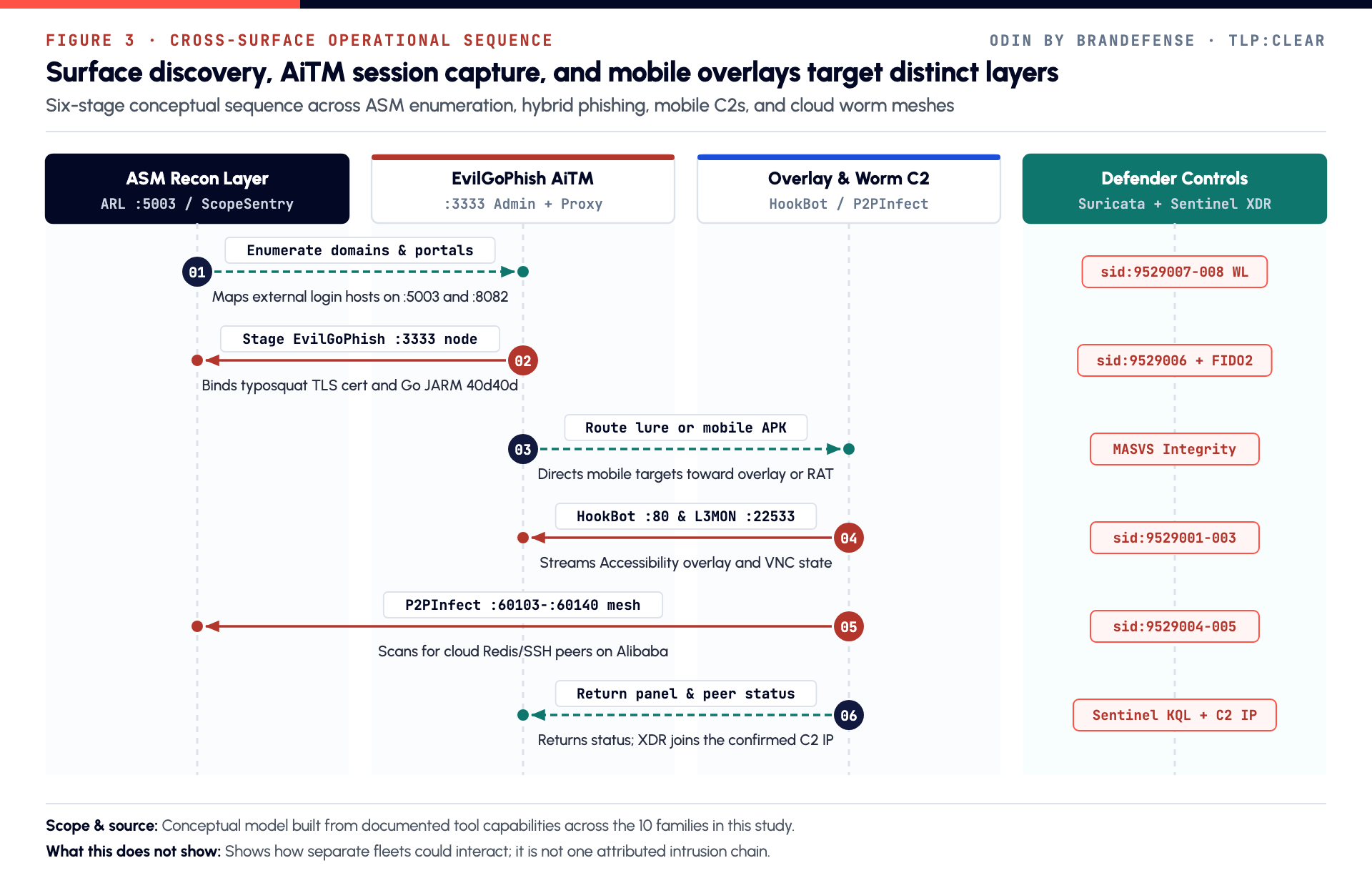
Recon suites and phishing kits serve adjacent stages of an attack. Recon finds the login portals. The phishing kit then copies one of them. Figure 3 shows this sequence as a conceptual model, not as one observed intrusion.
EvilGoPhish
EvilGoPhish joins two tools. GoPhish runs the email campaign through an admin API on port 3333. An Evilginx-style reverse proxy on port 443 relays the real login page. It captures the session cookie and the one-time MFA code as the victim signs in.
| Feature | Detail |
|---|---|
| Servers | 9, one per host |
| Countries | Germany 3, United States 2, Ireland 1, China 1, India 1, Indonesia 1 |
| Ports | 3333 (4 servers), plus 3322, 3334, 33335, 10002 and 443 |
| Shared TLS fingerprint | 3 servers share the Go crypto/tls JARM 40d40d40d00000000043d43d00043d6aff5ab0f4fc31897186312c9e639319 |
| Lookalike certificates | 2 DigitalOcean servers present certificates for lookalike domains (withheld) |
| Activity | 8 were seen on 19 November 2026; two 3333 servers, on IONOS (DE) and Amazon (IE), were first seen that day |
The Go JARM value is common to many Go programs, so it is a hunting lead, not proof by itself. Pair it with port 3333 or a lookalike certificate.
Companies also run EvilGoPhish for authorized phishing exercises. A single port or JARM match cannot tell the two apart. All nine servers stay on watchlists until a lure domain confirms hostile use. Their addresses and the targeted brands are withheld.
ARL, ScopeSentry and reNgine
These three open-source attack-surface management (ASM) frameworks enumerate subdomains, ports and web assets. They make up 93.0% of the endpoints (667 of 717).
| Suite | Endpoints | Hosts | Main ports | Fingerprints |
|---|---|---|---|---|
| ARL | 488 | 474 | 5003 (340, 69.7%), 443 (96, 19.7%) | 123 nodes share JARM 15d3fd16d29d29d00042d43d000000fbc10435df141b3459e26f69e76d5947; 19 suspected hosts also expose RDP on 3389 with self-signed certificates named after internal 10.x addresses |
| ScopeSentry | 138 | 136 | 8082 (119, 86.2%), 18082 (3), 8443 (3) | Hosted in China 43, Hong Kong 28, United States 20 and Japan 11 |
| reNgine | 41 | 29 | 8082 (18), 443 (14), 80 (4), 8000 (2) | 17 present the default CN=rengine.example[.]com; 15 of those share JARM 2ad2ad0002ad2ad0002ad2ad2ad2ada5fc7ec76b7ed0b839211317d3844486 |
reNgine has the most ports per host in this study, at 1.41 endpoints per host. One DigitalOcean stack in Germany runs it on ports 80, 443 and 8000 together.
Two Chinese servers run ARL and ScopeSentry side by side. One, on China Telecom, pairs ARL on 5003 with ScopeSentry on 8082. The other, on CHINANET BACKBONE, pairs ARL on 20000 and 43047 with ScopeSentry on 8082. Their addresses are withheld as dual-use.
6. An Exposed Agent Workbench
In short
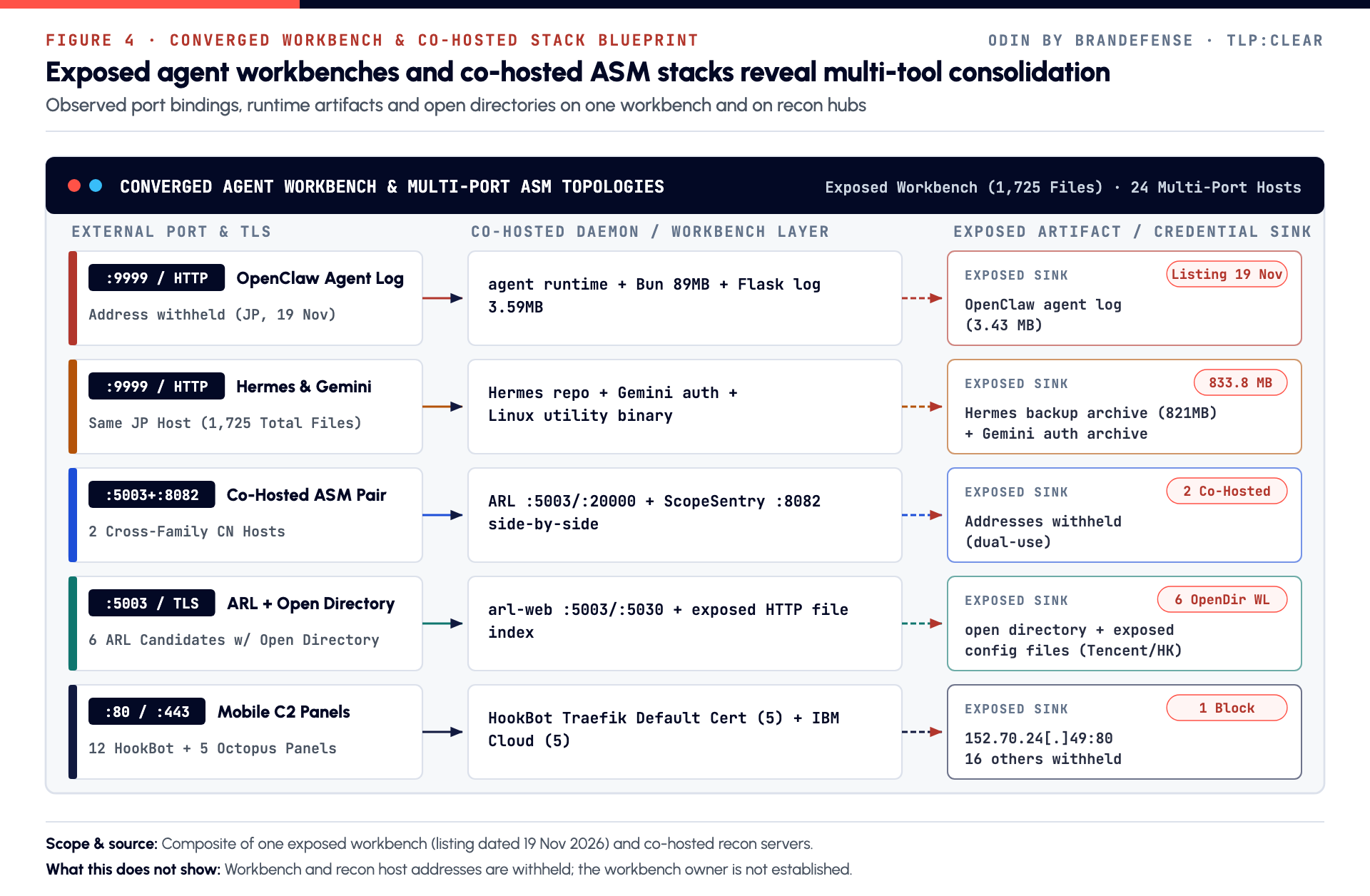
One server in Japan exposed an open directory of 1,725 files. It mixed AI agent logs, an agent backup, a Gemini authentication archive and cloud deployment notes.
Operators sometimes leave a Python file server or a reverse proxy open while they stage tools. The directory tree then shows tool pairings that a banner alone cannot. We do not know who owns this server. It may belong to a developer rather than an attacker, so its address and file paths are withheld.
What the workbench held
The directory listing is dated 19 November 2026. Its main files are listed here.
| Artifact | Size | What it is |
|---|---|---|
| Hermes agent backup archive | 821.1 MB | Complete Hermes agent workspace and state |
| Bun runtime binary | 89.0 MB | Self-contained JavaScript and TypeScript agent runtime |
| Repository archive (name withheld) | 14.7 MB | Packaged code repository in the web root |
| Gemini authentication archive | 12.8 MB | Compressed Gemini API or CLI authentication bundle |
| Linux utility binary (name withheld) | 6.59 MB | Precompiled amd64 tool |
| Flask service log | 3.59 MB | Log of a Python Flask orchestration service |
| OpenClaw agent log, dated 19 November | 3.43 MB | Session log of the OpenClaw autonomous agent |
| OpenClaw agent log, dated 20 November | 292.5 KB | The next day's log, from the server's local UTC+9 clock |
| Headless browser log | 82.1 KB | A Chrome DevTools Protocol daemon, Headless Browser v0.1.9 |
| Cloud deployment notes | 100.4 KB | Notes on deploying Cloudflare Workers, D1, KV and R2 with wrangler to a third-party domain (withheld) |
The workbench also held a Hermes repository index, a backed-up proxy configuration and Cloudflare login logs. Together these show one person running autonomous agents, browser automation and cloud deployment from one machine. Model authentication files sat in an internet-readable folder.
Open directories on recon nodes
Open directories also show up inside the ARL fleet. Six ARL candidate endpoints on five hosts also serve an open HTTP file index. Three of the six also expose configuration or credential files next to the console.
| Hosting (country) | Ports | Notes |
|---|---|---|
| Shenzhen Tencent (CN) | 5003, 5030 | Two ports on one host |
| Shenzhen Tencent (CN) | 5003 | Exposed configuration files |
| LUCIDACLOUD (HK) | 5003 | Exposed configuration files |
| LUCIDACLOUD (HK) | 5003 | Exposed configuration files |
| Tencent Building (KR) | 892 | Open directory |
These hosts stay on watchlists for analyst review. Their addresses are withheld.
7. Block or Watch: Telling Hostile from Dual-Use
In short
Most endpoints here run tools that defenders also use. Blocking them all would break legitimate scanners and still miss rotating worm peers, so only one corroborated controller goes on block lists.
Three innocent explanations apply to large parts of this data:
- Sanctioned security tools. Enterprise EASM and penetration-testing teams run ARL, ScopeSentry and reNgine.
- Authorized phishing exercises. Security-awareness teams deploy EvilGoPhish on cloud servers.
- Victim machines and shared addresses. P2PInfect peers are infected third-party servers. Some recon nodes sit on telecom subscriber networks where addresses rotate.
The table below shows how the 717 endpoints split into actions.
| Group | Endpoints | Suggested action |
|---|---|---|
| HookBot controller corroborated in the window | 1 | Block; review the lease after 30 days |
| Older HookBot feed entries | 11 | Watch; re-check before any block |
| Octopus panels that fit a test lab | 5 | Analyst review |
| Confirmed recon suites: 94 ARL, 23 reNgine, 10 ScopeSentry | 127 | Watch for 7 days; never block automatically |
| Recon nodes on telecom subscriber networks (4 confirmed, 1 suspected) | 5 | Watch for 24 hours |
| ARL candidates with an open directory | 6 | Watch for 7 days; analyst review first |
| Suspected recon nodes: 23 ARL, 2 reNgine | 25 | Watch for 7 days |
| Uncorroborated candidates, including the 16 P2PInfect peers and 9 EvilGoPhish servers | 537 | Watch for 72 hours; act only on corroboration |
The telecom subscriber networks are China Unicom, China Telecom, ChinaTelecom Jiangsu, China Mobile and Telekomunikasi Indonesia. Addresses there change hands, so a long block would hit later, unrelated users.
The action bar at the foot of Figure 1 shows the same split.
8. What Defenders Should Do
Within 24 hours
- Block the confirmed HookBot controller 152.70.24[.]49 on perimeter firewalls and mobile VPN gateways. Review the cloud lease after 30 days, because cloud addresses get reassigned.
- Put the recon, worm and phishing groups on time-bound watchlists, as in Chapter 7. Do not block them automatically.
Within 72 hours
- Take cloud Redis (6379) off the public internet. Turn on protected mode and ACL authentication.
- Require SSH key-only access on cloud servers, so P2PInfect cannot recruit them.
- Require FIDO2 or WebAuthn sign-in on workforce SSO portals. These methods defeat reverse-proxy session theft.
- Watch new TLS certificates for lookalikes of your own domains.
Within 7 to 30 days
- Enforce Android restricted settings and OWASP MASVS runtime integrity checks in mobile banking apps. This limits sideloaded Accessibility overlays and VNC screen capture.
- Deploy the Suricata rules and the Sentinel hunt. Keep the ARL, ScopeSentry and reNgine rules in alert mode, never in drop mode.
- Audit engineering and red-team servers for open HTTP directories that expose agent logs, backups or cloud authentication files.
- Hunt the certificate subjects and JARM values in this report across your external attack surface tooling.
9. Detection Rules
In short
Four rule files cover the mobile panels, cloud worms, EvilGoPhish and recon suites. They hold eight Suricata signatures, one Sentinel query, three Sigma rules and four YARA rules.
The full rules are in the Detection rules tab.
| Rule file | What it catches |
|---|---|
odin_hookbot_p2pinfect_evilgophish_recon.rules | Suricata 7: eight signatures for mobile C2 check-ins, P2PInfect and Moobot fetches, EvilGoPhish campaign calls and recon task APIs |
sentinel_mobile_overlay_p2pinfect_and_evilgophish_hunt.kql | Microsoft Sentinel and Defender XDR: contact with the confirmed HookBot controller, and fleet ports used by Redis, Node, Python or GoPhish processes |
sigma_p2pinfect_redis_ssh_worm_and_evilgophish.yml | Sigma (3 rules): Redis or SSH child processes with worm markers, EvilGoPhish launches, and unapproved recon workers on Linux |
odin_hookbot_l3mon_p2pinfect_evilgophish_artifacts.yar | YARA (4 rules): HookBot or Daam panel configs, L3MON manifests, P2PInfect peer configs and EvilGoPhish configs |
How the Suricata signatures work
All eight signatures inspect outbound HTTP from inside your network.
| SID | Looks for | Ports |
|---|---|---|
| 9529001 | POST to /api/hookbot/ with "accessibility" and "vnc_state" in the body | 80, 443, 2223 |
| 9529002 | POST to /api/octopus/ with "agent_uuid" in the body | 80 |
| 9529003 | POST to /client_login with "device_model" in the body (Daam or L3MON) | 443, 22222, 22533 |
| 9529004 | /p2p/peers request with an X-Peer-Node: header (P2PInfect) | 6088, 8281, 9684, 60103 to 60140 |
| 9529005 | /moobot. fetch with a Wget/ user agent | 80 |
| 9529006 | POST to /api/campaigns/ with an X-EvilGoPhish-Key: header | 443, 3322, 3333, 3334, 10002, 33335 |
| 9529007 | POST to /api/task/ with "task_tag" (ARL), as a policy event | 443, 5003, 5004, 5080, 8443 |
| 9529008 | POST to /api/scan/create with "scan_engine" (ScopeSentry or reNgine), as a policy event | 443, 8000, 8082, 8443, 18082 |
SIDs 9529007 and 9529008 use the policy-violation class. Keep them in alert mode, and add pass rules for your own named EASM scanners. Self-signed 443 and 601xx channels need TLS inspection or endpoint data to be seen.
The Suricata file loads in Suricata 7.0.12. The signatures have not been replayed against captured traffic from each family, so test them in alert mode first.
How the other rules work
The KQL query looks back 7 days and has two parts. The first flags any device that contacts the confirmed HookBot controller address. This branch always alerts, even from an approved host. The second flags fleet ports such as 3333, 6088, 22533 and 60103 when redis-server, python3, node, curl, wget or gophish opens them.
It then joins process events that mention p2pinfect, evilgophish, l3mon or recon workers, or slaveof on Redis. An approved-host list holds exact hostnames for your own scanners and phishing simulators. That list never hides a confirmed controller match.
The first Sigma rule needs a parent of redis-server or sshd and a command line with a worm port, p2pinfect or slaveof. The second flags command lines that name evilgophish, evilginx, gophish_admin or :3333. The third flags ARL, ScopeSentry or reNgine worker launches. Each rule has an exact-hostname exclusion for sanctioned servers.
Each YARA rule is bounded to files under 512 KB and needs at least two independent strings.
| YARA rule | Fires when |
|---|---|
ODIN_HookBot_Daam_Overlay_Panel_Config | A HookBot or Daam marker appears with accessibility_inject or vnc_state |
ODIN_L3MON_NodeJS_Android_Panel_Manifest | An L3MON marker, port 22533 or 22222, and /client_login appear together |
ODIN_P2PInfect_Cloud_Worm_Peer_Config | X-Peer-Node and /p2p/peers appear with a gossip port or redis_peer_sync |
ODIN_EvilGoPhish_Hybrid_AiTM_Config | An EvilGoPhish marker, an admin marker and evilginx_sub appear together |
10. Indicators
The Indicators tab holds 1 published indicator: 1 address and no hashes. It is the HookBot controller 152.70.24[.]49 on port 80, on Oracle Corporation in Germany.
| Type | Count | Where |
|---|---|---|
| Confirmed controller address | 1 | Indicators tab |
| Older HookBot feed entries | 11 | Described in Chapter 3; addresses withheld |
| Octopus panels that fit a test lab | 5 | Described in Chapter 3; addresses withheld |
| Other watchlist endpoints (HookBot candidate, Daam, L3MON, P2PInfect, Moobot, EvilGoPhish, recon suites) | 700 | Described in Chapters 3 to 5; addresses withheld |
| File hashes from the exposed workbench | 5 | Withheld |
Addresses of older HookBot entries, the Octopus cluster, dual-use recon hosts, infected worm peers, phishing servers of unknown purpose and the workbench are withheld. So are the workbench file hashes, lookalike domains and targeted brands.
Supporting fingerprints: TRAEFIK DEFAULT CERT, CN=gateway, CN=rengine.example[.]com, and the JARM values named in Chapters 3 to 5.
11. Scope and Limits
- Service data, not victim logs. This report describes internet-facing services. It does not show what any panel, worm or phishing kit did to a specific victim.
- Older HookBot entries. For 11 of the 12 HookBot controller records, the latest record predates this window, so these addresses are withheld and kept on watchlists.
- Octopus may be a lab. Five adjacent IBM Cloud addresses running a panel named after an open-source red-team C2 can be a test lab. Our data cannot rule that out.
- Layers are a model. The four-layer grouping is analytical. No shared certificate, address or campaign token links the recon, phishing, worm and mobile groups.
- Dual-use tools. ARL, ScopeSentry, reNgine and EvilGoPhish serve both defenders and attackers. Our data cannot tell which use applies to a given host.
- Worm peers are victims. P2PInfect nodes are most likely infected servers. Their owners are not adversaries.
- Workbench owner unknown. The exposed workbench may belong to a developer. Its contents show tooling, not hostile action.
- Rule testing. Every rule file loads without errors in its engine (Suricata 7.0.12, YARA-X, pySigma, Kusto.Language). The rules were not replayed against live traffic.
12. Sources
- Android Developers, AccessibilityService: developer.android.com/guide/topics/ui/accessibility/service (verified on 20 November 2026).
- OWASP Foundation, Mobile Application Security Verification Standard (MASVS): mas.owasp.org/MASVS (verified on 20 November 2026).
- Palo Alto Networks Unit 42, P2PInfect: The Rusty Peer-to-Peer Self-Replicating Worm: unit42.paloaltonetworks.com/peer-to-peer-worm-p2pinfect (verified on 20 November 2026).
- Redis Documentation, Redis security: redis.io/docs/latest/operate/oss_and_stack/management/security (verified on 20 November 2026).
- CISA, Implementing Phishing-Resistant MFA (fact sheet): cisa.gov/sites/default/files/publications/fact-sheet-implementing-phishing-resistant-mfa-508c.pdf (verified on 20 November 2026).
- OISF, Suricata 7.0 User Guide: HTTP keywords: docs.suricata.io/en/suricata-7.0.0/rules/http-keywords.html (verified on 20 November 2026).
- Salesforce Engineering, Easily Identify Malicious Servers on the Internet with JARM: engineering.salesforce.com/easily-identify-malicious-servers-on-the-internet-with-jarm-e095edac525a (verified on 20 November 2026).
What is…?
Short explanations of the tools and families named in this study.
What is HookBot?
HookBot is an Android banking trojan that uses overlay screens and Accessibility abuse to steal credentials and control the device.
More about HookBotPhishing frameworkWhat is EvilGoPhish?
EvilGoPhish combines a GoPhish campaign panel with an adversary-in-the-middle reverse proxy that captures session cookies.
More about EvilGoPhishWormWhat is P2PInfect?
P2PInfect is a self-spreading peer-to-peer worm that targets exposed Redis and SSH services.
More about P2PInfectReconnaissance platformWhat is ARL?
ARL (Asset Reconnaissance Lighthouse) is an open-source asset discovery platform, popular with Chinese-speaking testers and attackers.
More about ARLReconnaissance platformWhat is ScopeSentry?
ScopeSentry is an open-source asset discovery and scanning platform that maps subdomains, ports and web services.
More about ScopeSentryReconnaissance platformWhat is reNgine?
reNgine is an open-source reconnaissance framework that chains tools such as subfinder, httpx and nuclei in containers.
More about reNgineFrequently asked questions
What did we find?
The 717 endpoints fall into four layers. This grouping is our analytical model. Nothing observed links the people behind one layer to another. The recon layer is by far the largest, at 93.0% of all endpoints. The mobile layer is small but holds the one controller we publish for blocking.
Which servers should we block?
Block one address: 152.70.24[.]49, a HookBot controller on Oracle Cloud in Germany that we corroborated in the window. HookBot is an Android banking trojan. It draws fake login screens over banking apps, abuses Android Accessibility to tap buttons, and streams the phone's screen to the operator. The Indicators tab lists this address.
Why not block the worms and phishing kits?
P2PInfect is a self-spreading worm. It finds Redis databases and SSH servers left open on the internet, infects them, and links them into a peer-to-peer mesh on high ports from 60103 to 60140. We found 16 nodes, 15 of them on Alibaba Cloud.
What about the recon suites?
ARL (488 endpoints), ScopeSentry (138) and reNgine (41) map subdomains, ports and login portals. Attackers use that map to choose phishing targets. Security teams use the same tools to find their own exposure.
What can defenders hunt for?
Addresses change quickly. Fingerprints change slowly, so they make better hunting signals. The full report lists the details, and a few stand out. Inside your own network, the most useful signal is a server that starts talking on these ports when it never did before. A Redis server that opens a connection on port 60103 deserves a look. So does a workstation that reaches the confirmed HookBot controller.